Last month we ran the AI citation audit for a four-facility behavioral health operator. The audit looked at every publication the operator’s PR firm had pitched in the past 18 months and cross-referenced it against the publications ChatGPT, Perplexity, Claude, and Google AI Overviews actually cite on behavioral health queries. The number that came back: roughly three-quarters of the PR budget had been targeting publications LLMs do not cite for treatment center prompts. The pitch deck said the program would produce two to four placements per quarter at a $48,000 quarterly fee.
The marketing director sent the deck to me before signing. The question she asked was the right one. “If these placements ran, would they actually move anything in 2026?”
If you have read our piece on why mid-DR backlinks now outperform DR70+ generalist sites for LLM citations, this article is the step-by-step audit to identify your facility’s actual citation targets. The data and the vector-retrieval mechanics are over there. The methodology to run the audit yourself is below.
Which of those publications actually get cited by ChatGPT, Claude, Perplexity, and Google AI Mode when a family searches “best treatment center for dual diagnosis near me.” That data exists. The PR firm didn’t pull it. Most don’t.
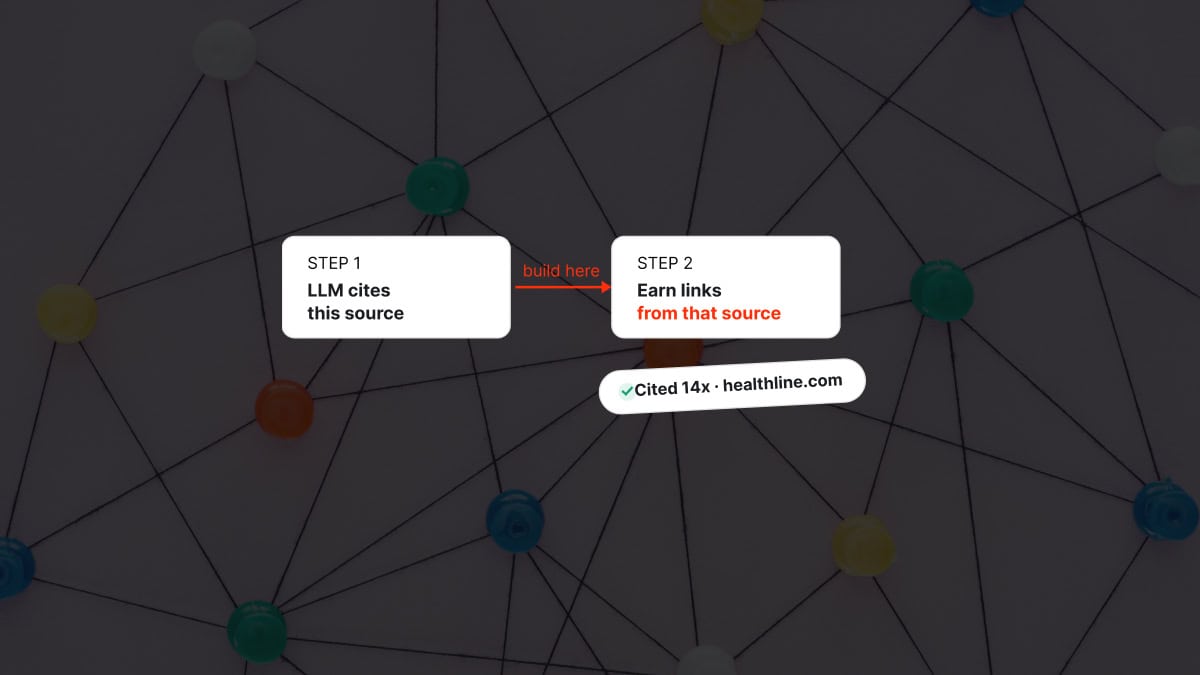
This is the methodology shift the Digital PR program for treatment centers is built around. Before deciding what to pitch, audit what AI assistants are already quoting.
The audit takes a few hours. The output is a target list grounded in actual citation behavior rather than the same Tier-1 publications every PR firm has been chasing since 2018.
This guide walks through the methodology, the data behind it, and what it means for treatment center PR programs operating in the modern AI search environment.
Key Takeaways
- In Profound’s analysis of 27 million AI citations, a brand’s own site made up just 4.3 percent of citations on open-ended category prompts. That means digital PR is the most direct lever for AI search visibility, and the target list matters more than the placement count.
- The citation graph is not what most PR target lists assume. Among ChatGPT’s top 10 cited sources, Wikipedia takes 47.9 percent, Reddit 11.3 percent, and Forbes only 6.8 percent. Reddit takes 46.7 percent of Perplexity’s top 10. Measured against all citations, even Wikipedia is only 7.8 percent of ChatGPT’s total.
- The reverse-engineering audit is a four-step workflow. Define your high-intent prompts, map the citation graph, run a competitive gap analysis, and pitch the specific publications cited. Each step uses tools that exist and data that is public.
- Google’s March 2026 spam update was another round of SpamBrain enforcement against the link schemes that used to work. AI Mode is stricter on health and behavioral health than any other YMYL category. The pitch lists that worked in 2024 are now liability-creating.
- The audit should re-run monthly for the top 10 priority prompts and weekly for the top 5. Citation patterns drift as LLM training data updates and platform policies change.
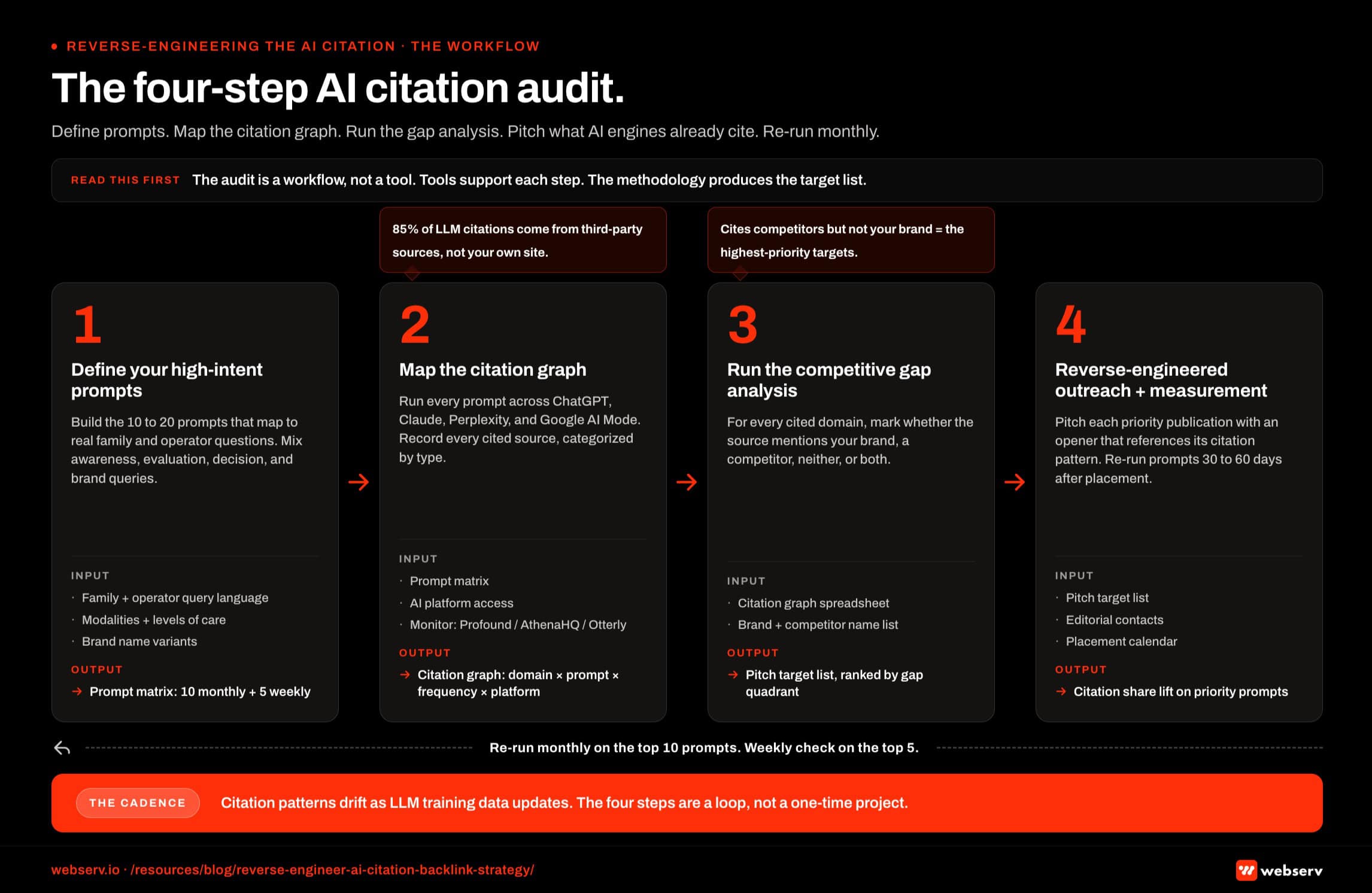 Horizontal four step process map titled ‘The four step AI citation audit.’
Why Traditional PR Target Lists Don’t Map to LLM Citations
Most PR target lists were built between 2018 and 2022. The assumption baked into them was that high-DR earned media on Tier-1 publications would lift domain authority, which would lift Google rankings, which would lift admissions.
That chain worked when Google’s ranking system was the only AI surface that mattered.
The chain has broken in two places in 2026.
The first break is at the AI search layer. When a family searches for behavioral health treatment, the answer increasingly comes from ChatGPT, Claude, Perplexity, or Google AI Mode before any blue-link result loads.
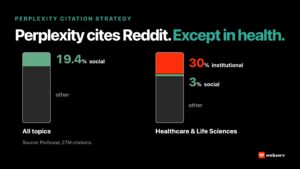
Profound’s analysis of 27 million citations found owned content made up just 4.3 percent of citations on open-ended category prompts, and 27 to 46 percent of citations came from outside the brand even on prompts that named it. Digital PR is therefore the most direct way to influence AI search visibility, and the question becomes which third-party sources the AI engines actually cite.
The answer surprises most PR teams. Profound’s platform-specific citation pattern data shows that within ChatGPT’s top 10 cited sources, Wikipedia takes 47.9 percent, Reddit 11.3 percent, and Forbes 6.8 percent.
Reddit takes 46.7 percent of Perplexity’s top 10. By domain type, .com sites account for 80.41 percent of ChatGPT citations and .org sites 11.29 percent.
Measured against all citations rather than the top 10, the shares shrink fast: Wikipedia is 7.8 percent of ChatGPT’s total, Reddit 6.6 percent of Perplexity’s. The long tail is the rule, not the exception.
The second break is at the Google search layer. Google’s March 2026 spam update was another round of enforcement against the tactics named in its spam policies. Link schemes that used to produce ranking lift now carry penalty risk.
Sponsored link arrangements with obscured attribution, expired-domain redirects, and AI-content private blog networks are all named in those policies.
For healthcare sites, templated location pages and generic content authored without clinical review are the riskiest patterns, with our walkthrough of doorway page risks covering what to look for.
The Forbes contributor placement that used to be the strongest pitch sits in a different position now. It still produces a domain authority signal that Google’s traditional ranking system weights.
It rarely shows up in the AI citation graph for behavioral health queries, and it is one of the most expensive placements to buy.
The PR target list that ignores AI citation data is making a 2024 bet in a 2026 environment.
The Citation Audit, in Four Steps
Define 10-20 High-Intent Prompts
Map the actual questions families and referents ask AI assistants — head terms plus fan-out variants — and freeze them as your monitoring matrix.
Log the Sources LLMs Are Already Citing
Run each prompt through Profound, AthenaHQ, or Otterly and capture the URLs the models are quoting, not just the domains.
Cluster the Citations by Publication and Topic
Tag each cited URL by outlet, topic bucket, and DR tier so you can see where citation share concentrates versus where it fragments.
Turn the Cluster Into a Target List
The outlets and page types getting cited become the pitch list — mid-DR vertical pubs first, followed by the topical adjacencies your competitors are already living in.
The audit is a workflow, not a tool. Tools support each step, but the methodology is what produces the target list. Most teams running it credibly use Profound, AthenaHQ, or Otterly for prompt monitoring, paired with a structured spreadsheet for the analysis layer.
Step 1: Define Your 10 to 20 High-Intent Prompts
The prompts are the foundation. They have to map to the actual questions families and operators ask AI assistants when they’re researching treatment.
For a residential treatment center serving young adults, the prompt list typically includes “best dual-diagnosis treatment center in [state],” “what is the difference between PHP and IOP,” “how do I help my son with opioid addiction,” and the fan-out query variants that branch off each head term.
Most programs build a matrix of 10 priority prompts that get tracked monthly and 5 high-priority prompts that get tracked weekly. The matrix should cover awareness queries, evaluation queries, and decision-stage queries.
Brand-specific prompts (queries that include the facility’s name) belong on the list too. They reveal how AI engines describe the brand to potential patients and family members.
The prompt list is the single most important asset of the audit. Generic prompts produce generic insights. Prompts written in the exact language a family member would use produce actionable data.
Step 2: Map the Citation Graph
Once the prompts are defined, run each one across ChatGPT, Claude, Perplexity, Google AI Mode, and any other AI surface that matters to your buyer funnel. Record every cited source for every prompt. Categorize each citation by source type.
The source categories that matter for behavioral health are institutional research sites (SAMHSA, NIH, NIDA, CMS, ASAM, JCAHO, CARF) and mid-DR vertical publications (Behavioral Health News, Addiction Professional, Treatment Magazine, The Fix, Filter Magazine, Recovery.com).
Plus academic and university sources, niche aggregator platforms (LinkedIn long-form, Reddit communities, Substack newsletters), and the brand’s own owned content.
The output is a citation graph spreadsheet with rows for each unique cited domain, columns for which prompts triggered the citation, frequency of citation, and platform-specific patterns. The most important column is whether the cited domain mentions your brand at all in the source content.
This is where AEO citation share tracking overlaps with the reverse-engineering audit. The measurement tools produce the raw data. The audit applies the source-categorization layer that turns it into a pitch target list.
Step 3: Run the Competitive Gap Analysis
The reverse-engineering value comes from the gap analysis. For every cited domain in the graph, check whether the source content mentions your brand, mentions a direct competitor, mentions neither, or mentions both.
The publications that cite competitors but not your brand are the highest-priority pitch targets. They’re already trusted by the AI engines for your category. They’ve already chosen to write about facilities in your space. They just haven’t included your brand in the conversation.
Publications that mention neither your brand nor competitors are secondary targets. They cover your topic area but haven’t decided which facilities to feature. These tend to be open to fresh expert commentary.
Publications that mention both your brand and competitors are validation targets. The pitch motion here is updates and follow-up coverage rather than first-time placement.
Publications that mention only your brand are protected ground. Don’t lose them. Maintain relationships and offer updates as your program evolves.
Step 4: Reverse-Engineered Outreach and Measurement
The outreach motion looks different from a traditional PR pitch. Instead of pitching a generic “thought leadership piece on behavioral health trends,” the pitch references the specific citation pattern that surfaced the publication.
A pitch to Behavioral Health News might open with: “Your March 2026 article on dual diagnosis was cited by Claude when I asked how does dual diagnosis treatment work. Your March article covered three facilities.
We are a fourth program with a different approach to medication-assisted treatment, and I think your readers would find the contrast useful.”
That opener does three things at once. It validates the publication’s reach (you read what they published). It demonstrates AI-search awareness (you understand which conversations matter). It offers concrete value (a contrast piece that fits the editorial pattern they already publish).
The measurement loop after each placement closes the audit cycle. Re-run the prompt set 30 to 60 days after a placement publishes. Check whether the new citation surface includes your brand.
If it does, the pitch worked at the AI search layer. If it doesn’t, the placement still produced traditional PR value, but the AI citation hypothesis needs to be revisited.
“Most PR target lists are built on what the agency knows how to pitch, not what the AI engines actually cite. The audit flips that. You start from the data instead of from the relationships, and the relationships you build downstream are the ones that move citation share.”
Preston Powell, Chief Executive Officer, Webserv
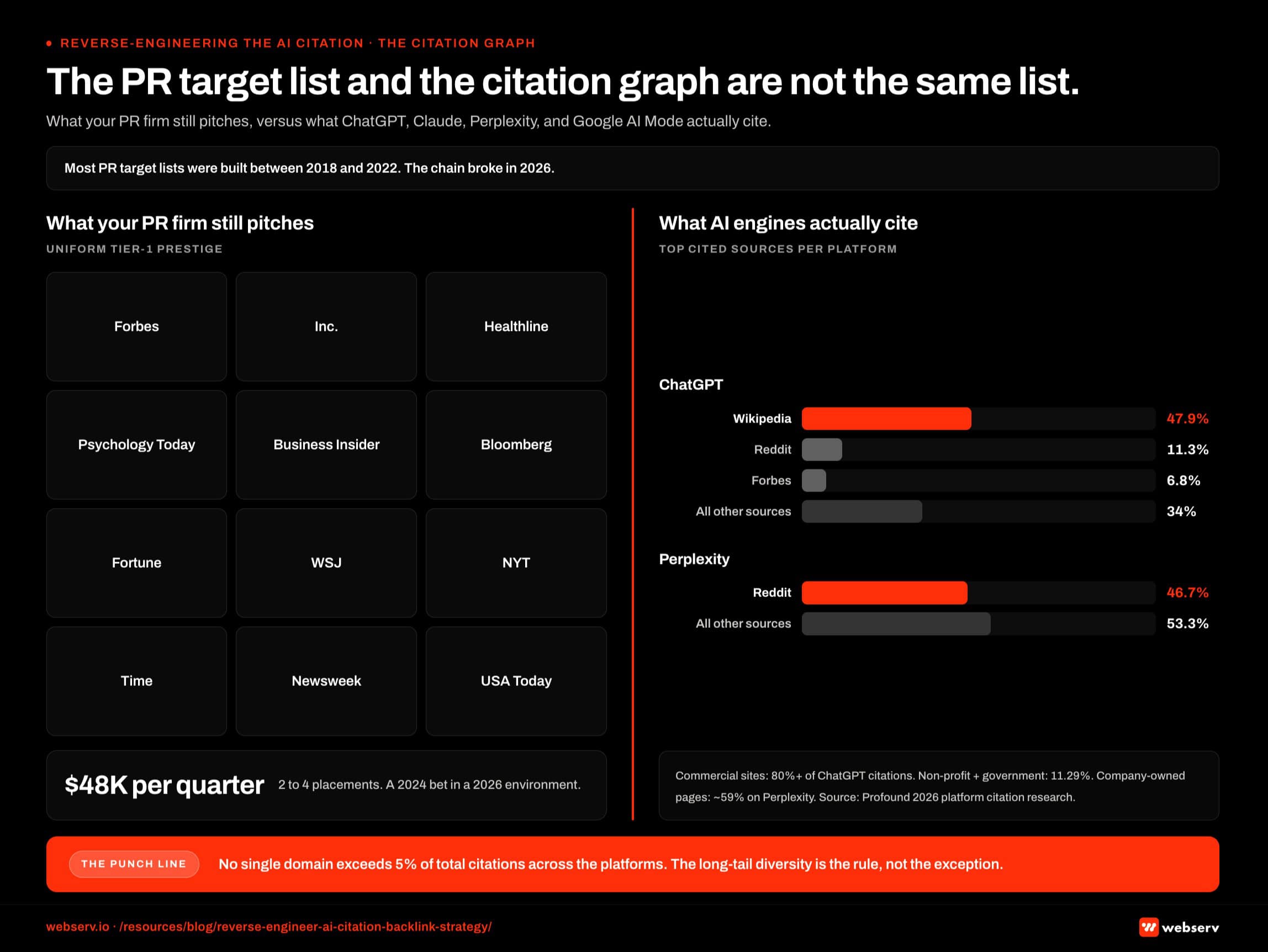 Side by side comparison infographic titled ‘The PR target list and the citation graph are not the same list.’
How to Vet a Mid-DR Site for LLM Citation Value
Once the audit surfaces candidate publications, each one needs vetting before it goes on the pitch list. Not every DR40 site is worth pitching, and the vetting criteria are different from traditional Digital PR vetting.
The three signals that matter:
Topical concentration. What percentage of the publication’s content is in your vertical? Use Ahrefs’ Top Pages report to estimate.
A site that’s 80+ percent in behavioral health is meaningfully more valuable than a DR65 generalist site that’s 5 percent behavioral health, even if the DR65 looks more impressive at first glance.
Author entity strength. Are the authors on the publication recognized clinical or industry entities? Search the author’s name in Google and check for Wikipedia mentions, LinkedIn presence, clinical credentials, and citation count in Google Scholar.
Strong author entities pass topical authority to placements far more efficiently than anonymous staff writers at a generalist outlet.
Structured content density. Pull 5 to 10 recent articles from the publication. Look for tables, clear H2/H3 structure, defined Q&A sections, and compound-prompt-friendly formatting. Publications that publish structured content get pulled into AI Overviews more often. Publications that publish dense long-form prose get cited less, regardless of audience size.
A mid-DR publication that scores well on all three signals is materially more valuable than a DR70+ generalist that scores poorly on two of them. This is the recalibration most PR firms haven’t made yet.
Re-running the Audit (Cadence and What Changes Between Cycles)
The audit isn’t a one-time exercise. LLM citation patterns shift constantly. The training data updates. Platform policies change. New publications enter the citation graph and others fall out.
The right cadence for treatment center programs is a monthly full audit covering 10 priority prompts plus a weekly check on the 5 highest-priority prompts. The full audit produces the pitch target updates. The weekly check catches sudden shifts in citation behavior before they compound.
The shifts that matter most between audit cycles are platform-level changes. When ChatGPT updates its search integration or Perplexity expands its source corpus, citation patterns can move materially in a single week.
Google AI Mode’s expansion into health YMYL queries shifted the citation distribution for behavioral health terms noticeably between mid-2025 and mid-2026. Programs that weren’t auditing missed the shift entirely.
The shifts that don’t matter as much between cycles are individual brand changes. A competitor earning one new placement doesn’t move the citation graph immediately.
The graph adjusts on a quarterly compounding cycle as the new content gets indexed and the cited content gets re-cited in subsequent rankings. Programs that overreact to single-cycle competitor wins burn outreach budget on tactical responses that don’t compound.
When the Citation Audit Should Drive Your PR Budget (and When It Shouldn’t)
The reverse-engineering audit is the right framework for treatment center PR programs where AI search visibility is a primary success metric. That’s most programs in 2026, but not all.
The audit should drive the PR budget when four conditions hold. The program’s measurable goal is AI citation share lift.
The facility has working AEO infrastructure already. The budget is large enough to support sustained outreach against a list of 30 to 60 publications. And the intake operations team can absorb the inquiry volume that follows successful citation lift.
The audit should not be the primary framework when the program is operating on a brand prestige goal that traditional PR still serves. Think a luxury residential brand chasing the New York Times profile for institutional credibility with referring physicians.
The audit also shouldn’t lead when the facility hasn’t built the topical authority foundation that makes AI citation lift possible. Earning a placement in a cited publication doesn’t move the citation graph if the brand’s own content infrastructure can’t carry the entity authority through.
The honest answer for most treatment centers is that the audit-driven framework should be the primary input, with traditional PR placements treated as bonus brand prestige wins where they happen. That’s the inverse of how most PR firms still operate.
Frequently Asked Questions
What tools do I need to run a citation audit?
The audit requires a prompt monitoring tool, a spreadsheet for the analysis layer, and access to the AI assistants you’re tracking.
The prompt monitoring tools that produce usable data for treatment center audits are Profound, AthenaHQ, and Otterly. Profound is the only one with both SOC 2 and HIPAA compliance, which matters for behavioral health programs that need to keep auditable evidence of the prompt set.
Pricing ranges from $99 per month at the entry tier (Otterly) to several thousand per month at the enterprise tier (Profound). Most treatment center programs operate at the mid-tier ($300-$800 monthly) which produces enough data to support a structured monthly audit.
Beyond the prompt monitoring tool, the analysis happens in a spreadsheet that maps cited domains, prompt triggers, frequency, and competitive mention status. The methodology does not require specialized software.
How long does a citation audit take to run?
A first-time audit for a treatment center program typically takes 8 to 16 hours of structured analyst time, depending on the prompt set size and the platform coverage. The bulk of the time is in the categorization and gap analysis steps, not the prompt monitoring itself.
Subsequent monthly cycles run in 2 to 4 hours once the prompt set and source categorization framework are established. The weekly check on top 5 prompts runs in under an hour.
Programs that try to scale the audit beyond 20 prompts typically find diminishing returns. The marginal value of prompt 21 is much lower than the marginal value of prompt 5. Focus the audit on the prompts most likely to produce admission inquiries.
Does this work for treatment centers that haven’t done AEO work yet?
The audit produces useful data for any treatment center, but the actionability depends on whether the AEO foundation is in place.
A facility with no schema, no entity work, no topical authority, and thin content infrastructure can run the audit and get a clean target list, but earning placements in those cited publications will not move citation share until the on-page foundation is built.
The right sequence for most treatment centers is AEO foundation first (6 to 9 months), then citation audit + outreach in parallel as the foundation matures.
Running the audit too early produces target lists that can’t convert to citation share because the brand can’t carry the entity authority through. Some facilities run a lightweight version of the audit during the AEO foundation phase to inform content strategy.
How is this different from traditional digital PR?
Traditional digital PR builds a target list from journalist relationships, publication prestige, and historical placement patterns. The pitch motion focuses on relevance to the publication’s audience and the journalist’s beat.
The reverse-engineering audit builds the target list from AI citation data. The publications that get prioritized are the ones the AI engines have already chosen to trust as sources for your category.
The pitch motion still has to land with the editor, but the selection criteria for which editors to pitch is data-driven rather than relationship-driven.
The two approaches can run in parallel. Programs that combine the citation-audit-driven target list with traditional PR relationship management produce better aggregate results than programs that run either approach in isolation.
How does Google’s March 2026 update affect this methodology?
Google’s March 2026 spam update continued SpamBrain enforcement against link schemes. The methodology described here is unaffected because it doesn’t use link schemes. The audit drives earned media placements in publications that already pass Google’s quality bar, which is the opposite of the patterns SpamBrain targets.
The update did affect adjacent practices. Sponsored link arrangements, expired-domain redirects, and AI-content private blog networks that some PR firms still sell are all named in Google’s spam policies. Treatment centers running those programs alongside legitimate PR carry risk they may not see.
The methodology in this guide is the safer position. Earned placements in AI-cited publications produce both AI citation lift and Google ranking signal without exposure to the spam enforcement that’s tightened across 2026.
What’s the typical timeline from audit to measurable citation lift?
Most treatment center programs see measurable citation share lift within 90 to 180 days of starting the audit-driven outreach.
The fastest lifts come from publications that already cite competitors and have open editorial calendars for related coverage. Slower lifts come from publications that have not covered the category recently and require category-defining pitches before placement.
The compounding effect kicks in around month 9. By that point, the brand has earned placements in multiple cited publications, and the citation graph for the brand’s priority prompts shifts measurably across ChatGPT, Perplexity, and AI Mode.
Programs that abandon the methodology before month 6 usually do so because they were measuring against traditional PR vanity metrics (placement count, headline placements) instead of citation share. The audit-driven approach is geared toward a different outcome and requires patience with the lagging indicator.
From Audit to Pipeline: Running the Cadence Quarterly
The reverse-engineering methodology is one of the most useful tools available for treatment center PR programs in 2026.
It produces target lists grounded in actual citation behavior, prioritizes outreach budget against the publications that AI engines already trust, and connects PR investment to a measurable AI citation share outcome rather than placement count alone.
We run this audit on our own portfolio and build citation-first PR programs for treatment center brands that want to be cited by AI assistants for the queries that drive admissions.
Schedule an intro call to see what the citation graph looks like for your facility’s priority prompts and what a reverse-engineered outreach program could produce. For the deeper Digital PR methodology, see our Digital PR tactics for rehab centers and semantic triple structure for AEO write-ups.
For the wider picture of how Digital PR fits into a full treatment center marketing program, see our ultimate guide to behavioral health marketing.
Trevor Gage is Director of SEO at Webserv, where he leads organic strategy, Digital PR, and AEO programs for behavioral health and addiction treatment centers across the U.S. He writes about treatment-center SEO economics, AI search citation, and the operational realities of marketing high-acuity healthcare.