Single-intent SEO content is 2024 vintage. In 2026, the queries producing meaningful traffic to treatment center content are compound. Two or three intent categories stitched into one query.
“Residential PHP for dual diagnosis with BCBS in Arizona.” “EMDR for veterans with treatment-resistant PTSD.” “What does 30-day residential cost with Aetna out-of-network.”
Google’s AI Mode, AI Overviews, ChatGPT search, Perplexity, and Claude all handle compound prompts differently than they handle single-intent queries.
The retrieval systems parse the prompt into its constituent intents, search across each intent independently, and prefer pages that answer the whole compound. Pages optimized for one intent lose against pages optimized for the compound.
The specific 2026 dynamic: the citation slot on AI answer surfaces for compound prompts sits at positions 2 through 5 of the underlying source list, not position 1.
Position 1 typically goes to a broad category-authority source (SAMHSA, Mayo Clinic, NIMH). Positions 2 through 5 go to specific facility pages that answer the compound prompt more precisely than the category-authority source can. That is where operators actually earn citations that translate to admits.
This piece walks the compound-prompt content model our content SEO team runs. It covers the five compound-prompt shapes that produce most of the compound-query traffic in behavioral health, how to identify the compounds your facility should target, and how to structure content that answers compound prompts on a single page.
It also covers the passage-level rubric that makes the content citation-eligible and the position 2-5 dynamic that determines whether the content actually gets cited.
The piece sits inside Tier 4 of the 5-Tier SEO Priority Framework we run on client engagements and complements our entity SEO explainer that covers the Schema.org layer this content model sits on top of.
Key Takeaways
- Compound prompts are queries that combine two or more intent categories in a single query. Behavioral health has five recurring compound shapes: condition-plus-LOC, modality-plus-population, insurance-plus-facility-type, geography-plus-specialty, and question-plus-scope. Each produces a citation slot that single-intent content cannot fill.
- AI answer surfaces handle compound prompts differently than single-intent queries. They parse the compound into its constituent intents, search across each independently, and prefer sources that answer the whole compound rather than sources strongest on one component. Pages optimized for one intent at a time lose against pages optimized for the compound.
- The citation slot for compound prompts on AI answer surfaces sits at positions 2-5 of the source list, not position 1. Position 1 typically goes to a broad category-authority source (SAMHSA, NIMH, Mayo Clinic). Positions 2-5 go to specific facility pages that answer the compound with operator-specific precision the category source cannot match.
- The content structure that works for compound prompts: single page, primary H1 matches the compound, 3-5 sub-questions (H2s) that each address one intent from the compound, each sub-answer written as a self-contained 40-80 word passage. The passage-level shape is what AI retrieval systems lift when the compound gets asked.
- Four operator failure modes undermine compound-prompt content. Building single-intent pages and hoping for compound queries to hit them. Cramming too many compound intents into one page so no compound gets answered cleanly. Publishing compound-prompt content without the entity-level schema that grounds the citations. Chasing position 1 on single-intent components instead of positions 2-5 on the compound.
DEFINITION
Compound prompt. A query that combines two or more intent categories in a single query string. In behavioral health: LOC-plus-condition, modality-plus-population, insurance-plus-facility-type, geography-plus-specialty, or question-plus-scope. AI answer surfaces (Google AI Mode, AI Overviews, ChatGPT, Perplexity, Claude) parse the compound into its constituent intents, retrieve independently across each, and synthesize an answer that references sources answering the whole compound.
Distinct from long-tail keyword content (one specific low-volume single-intent query) and distinct from broad category content (one high-volume single-intent query). The citation slot for compound prompts sits at positions 2-5 of the source list, not position 1. Position 1 goes to category-authority sources. Treatment centers earn citations at positions 2-5 by producing operator-specific compound answers the category source cannot match.
OPERATOR INSIGHT
Do not target position 1 on the compound. Target positions 2-5.
Position 1 almost always goes to SAMHSA, NIMH, or Mayo Clinic. Category-authority sources have accumulated decades of link equity that individual facility sites cannot match. The traffic that comes from positions 2-5 on compound prompts is higher intent than position 1 traffic on single-intent queries because the family reached the compound by narrowing their research through multiple filters.
What compound prompts are
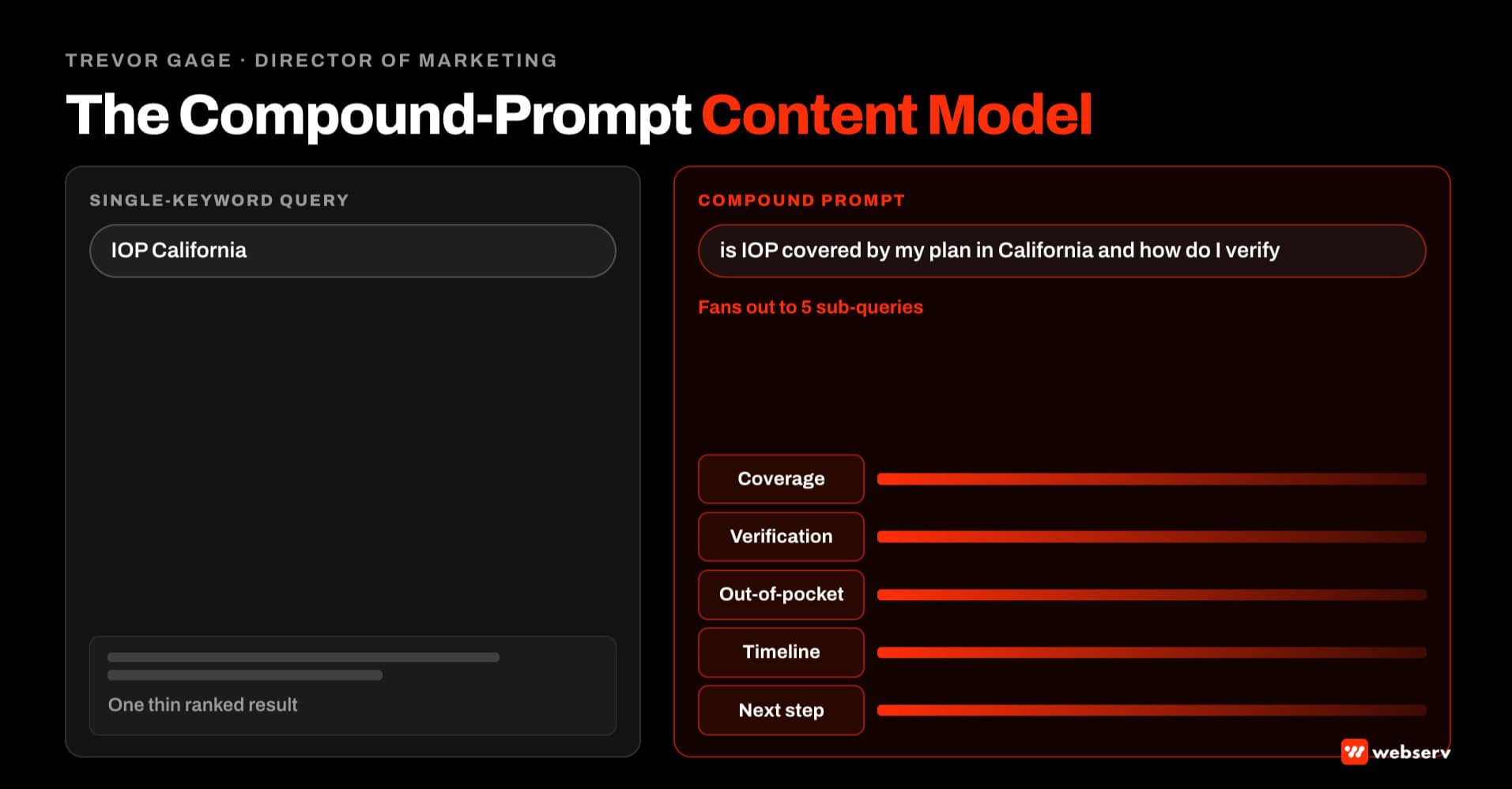
A compound prompt is a query that combines two or more intent categories in a single query string.
Single-intent queries are “residential rehab,” “PHP program,” “dual diagnosis treatment.” Each hits one intent category (LOC, program type, condition). Traditional SEO ranked pages against those single intents individually.
Compound queries are “residential rehab for dual diagnosis with BCBS in Arizona.” Four intents in one string: LOC (residential), condition (dual diagnosis), insurance (BCBS), geography (Arizona). Traditional single-intent optimization does not rank against compound queries because no single-intent page answers all four intents at once.
The compound-query behavior in AI answer surfaces looks different from traditional SERP behavior. Google’s AI Mode parses the compound into its four intents, runs a retrieval pass for each, then synthesizes an answer that references sources answering the compound.
Perplexity, ChatGPT, and Claude follow similar patterns.
The functional result: sources that address the compound directly win the citation. Sources that are stronger on one intent component but silent on others lose.
The five compound-prompt shapes in behavioral health
Behavioral health queries produce five recurring compound shapes.
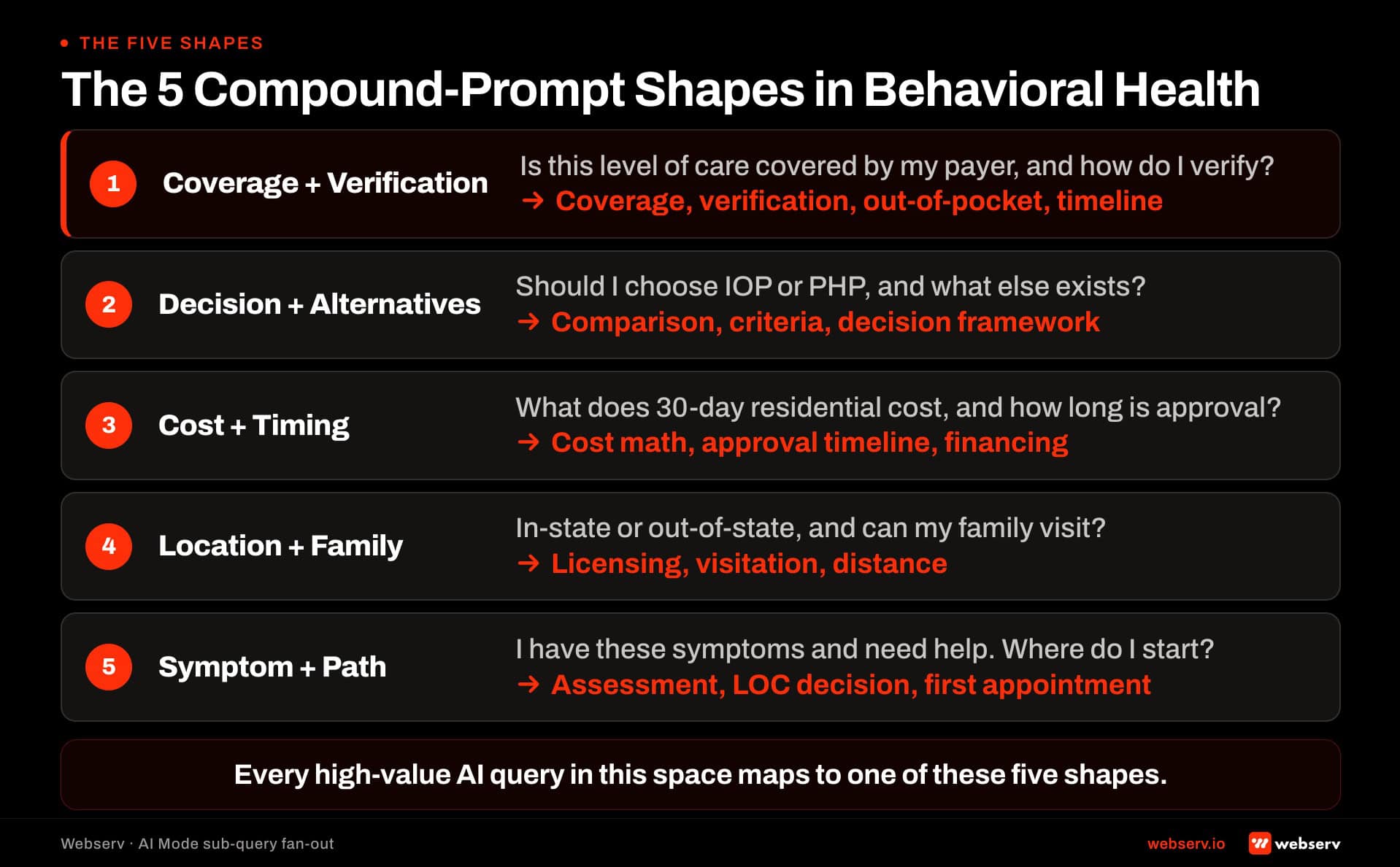
Condition-plus-LOC compound
“Residential PHP for dual diagnosis.” “IOP for opioid use disorder.” “Detox for alcohol use disorder.” The compound combines a treatment condition with a specific level of care. This is the highest-volume compound category in BH because families researching treatment naturally frame their queries around what condition needs treated and what type of treatment fits.
Modality-plus-population compound
“EMDR for veterans with PTSD.” “MAT for pregnant women.” “DBT for adolescents with self-harm behaviors.” The compound combines a specific clinical modality with a specific patient population. Lower volume than condition-plus-LOC but higher commercial intent because the query indicates the family has already narrowed to a specific treatment approach.
Insurance-plus-facility-type compound
“In-network Aetna dual diagnosis residential.” “BCBS out-of-network PHP.” “Cigna coverage for IOP.” The compound combines an insurance carrier or coverage status with a facility type. High commercial intent because insurance-referencing queries are almost always deep in the family’s research process.
Geography-plus-specialty compound
“Trauma-focused rehab in Arizona.” “Adolescent PHP near Denver.” “LGBTQ+ affirming residential in Los Angeles.” The compound combines geographic constraint with a specialty positioning. This shape is where local visibility and specialty positioning intersect, and it typically favors facilities that have invested in both Tier 2 (local presence) and content depth on the specialty.
Question-plus-scope compound
“What does 30-day residential cost with BCBS out-of-network.” “How long is PHP for dual diagnosis.” “What happens in the first 72 hours of detox.” The compound combines a specific question with a specific scope constraint. Lower volume but very high commercial intent because question-plus-scope queries indicate the family is close to a decision moment.
How to identify which compounds your facility should target
Not every compound is worth targeting. The identification process runs across four filters.
Filter 1: Clinical fit. The compound has to align with the facility’s actual clinical offering. A residential SUD facility should target condition-plus-LOC compounds around SUD and residential. It should not target compounds around adolescent PHP or MAT for pregnant women unless those are actual programs.
Filter 2: Payer alignment. For insurance-plus-facility-type compounds, target the payers you actually accept or want to accept. Publishing content on “in-network Aetna dual diagnosis residential” when you are out-of-network with Aetna produces traffic that will not convert.
Filter 3: Geographic scope. For geography-plus-specialty compounds, target the geographies you actually serve. Residential facilities can target broader geographic scope than outpatient (families travel for residential; outpatient is local). Match the scope to the operating footprint.
Filter 4: Query volume threshold. Not every compound has meaningful search volume. Compound queries are inherently lower volume than single-intent queries because the intersection produces smaller audiences. The threshold we use: any compound with 30+ monthly volume across Ahrefs or Semrush and demonstrated intent match qualifies for content investment.
The output of the four filters is a compound-prompt content plan: 15-40 compound prompts the facility should build content around, ranked by combined clinical fit, payer alignment, geographic match, and query volume.
The compound-prompt content surface at a glance
5
Compound shapes: condition+LOC, modality+pop, insurance+facility, geo+spec, question+scope
2-5
Citation slot position on AI answer surfaces — not position 1
15-40
Compound-prompt pages for a single-facility operator, 2-4/mo cadence
90-180 d
Publish-to-citation timeline for compound-prompt content
Sub-query fan-out and answer-first sections
AI Mode fan-out generates 5 to 20 sub-queries per compound prompt depending on query complexity. Each sub-query gets independently answered by the AI system pulling from source pages that have citation-eligible content for that specific sub-query.
The mechanism: each H2 anchors one sub-query, and the section under it answers that sub-query directly in its opening sentences. A compound-prompt-optimized page with 10 H2s covering 10 distinct sub-queries produces 10 independent citation opportunities across the fan-out pattern. Our 40-word answer block piece walks the specific tactical implementation.
Structuring content this way (each H2 anchored to a specific fan-out sub-query, each section opening with a direct answer) gives AI systems a clean passage to cite for each sub-query instead of one general page competing for all of them.
The measurement pattern: audit target compound prompts through AI Mode, identify the sub-query fan-out pattern for each prompt, then verify that facility content has an H2 and a direct answer covering each sub-query. Gaps in coverage indicate specific H2 additions or answer block rewrites that would increase citation eligibility. Visible FAQ sections on primary content pages can answer additional sub-queries, though Google stopped showing FAQ rich results on May 7, 2026; our FAQ schema after the rich result deprecation piece covers FAQ deployment.
The content structure that works for compound prompts
The page structure that produces compound-prompt citations has four load-bearing components.
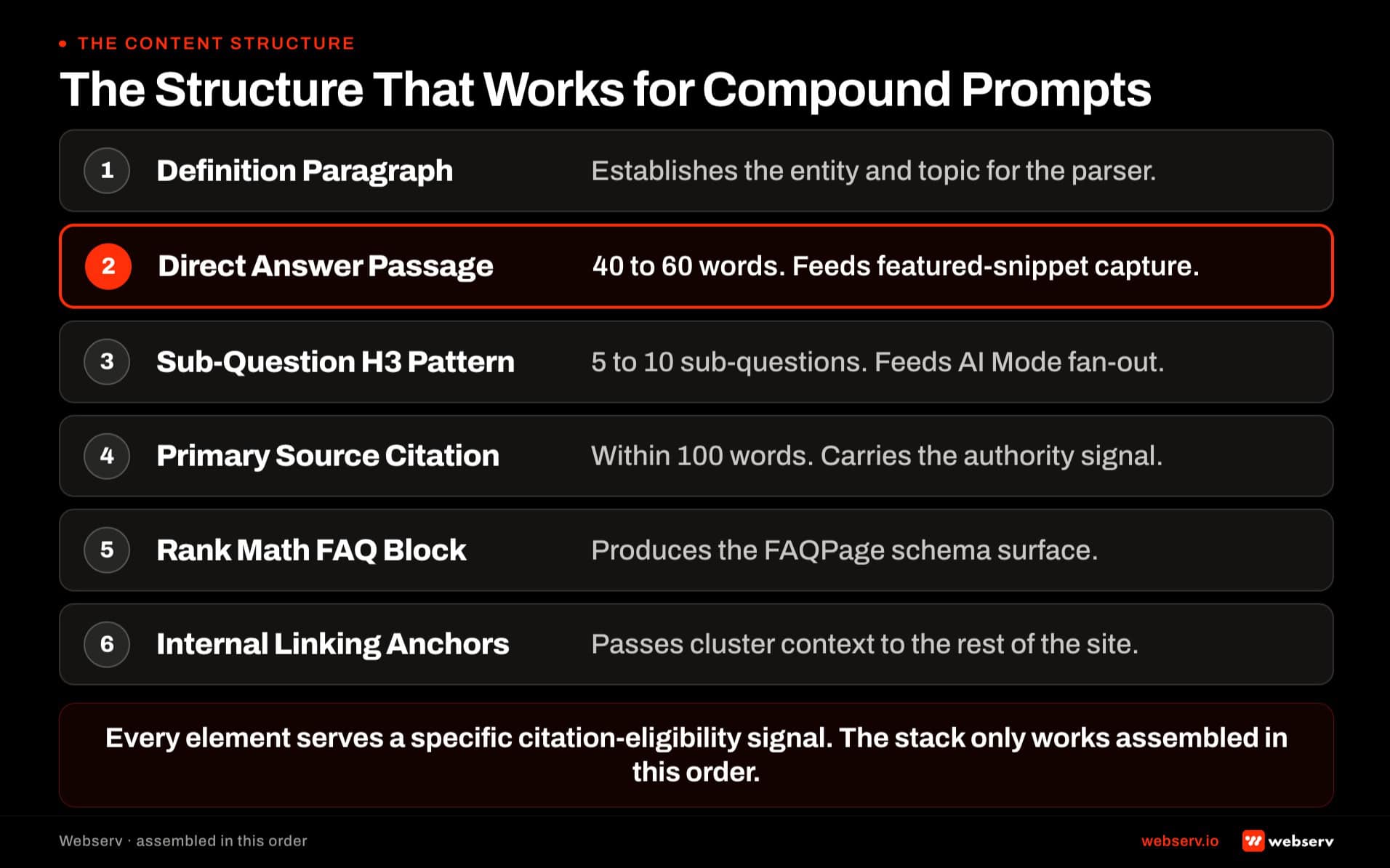
Component 1: H1 matches the compound. The page title and H1 address the full compound directly. Not “Residential Treatment.” Not “Dual Diagnosis Care.” The full compound: “Residential Treatment for Dual Diagnosis in Arizona.” AI retrieval systems parse the H1 as the primary intent signal for the page.
Component 2: Above-the-fold answer. The first 40-80 words of body content directly address the compound. This is the passage AI retrieval systems most often lift when citing the page. The structure that works: state what the facility offers (LOC-plus-condition), where (geography), for whom (population), and one differentiator that separates this offering from category-authority answers.
Component 3: Sub-questions as H2 sections. Three to five sub-questions structured as H2 sections, each addressing one intent component from the compound. For the “residential PHP for dual diagnosis with BCBS in Arizona” example, the sub-questions cover the residential/PHP LOC distinction, dual diagnosis clinical approach, BCBS network status, and Arizona-specific programmatic detail.
Component 4: FAQ block covering the compound decision points. Rank Math FAQ block with 4-6 questions that surface the compound-specific decision points families ask. “What insurance does the facility accept for this program?” “How long is the residential PHP program?” “What clinical modalities does the dual diagnosis track include?”
The passage-level shape across all four components is what AI retrieval systems lift when the compound gets asked.
Open each H2 with a direct answer
AI answer surfaces cite passages, not whole pages, so each H2 section should open with a direct, definitive answer to the query the heading implies. Section length matters too: SE Ranking’s ChatGPT citation study of 216,524 pages found sections of 120 to 180 words averaged 4.6 citations, versus 2.7 for sections under 50 words.
Content structured this way is easier for AI systems to quote than content structured for general readability alone.
What the extraction pattern looks like. Google AI Mode, Perplexity, ChatGPT, and Claude all use similar extraction logic when pulling from long-form content. The heading tells the system what the section is about, and a direct opening sentence gives it a clean passage to quote. Openers built on marketing language, hedging, or throat-clearing give it nothing to quote.
Pair a definitive opening sentence with a fully developed section. A one-line answer with nothing behind it is thin, and a section that buries the answer under preamble is hard to quote even when the underlying content is accurate.
How answer-first sections work with compound prompts. Each H2 in a compound-prompt-optimized piece maps to one sub-query in the AI Mode fan-out pattern. The direct answer that opens each H2 section becomes the citable answer to that specific sub-query. A piece with 8 to 12 H2s produces 8 to 12 distinct sub-query answers, each independently eligible for citation when AI systems query the specific sub-query.
Facilities that write H2s for readability alone (generic headers like “Overview” or “Getting Started”) produce fewer citation opportunities than facilities that write H2s as specific sub-query anchors (“How BCBS OON reimbursement works,” “What VOB confirms versus pre-authorization,” “When to submit pre-authorization”).
The tactical implementation. Our 40-word answer block piece walks the specific tactical implementation across page types (VOB pages, LOC pages, admissions workflow pages, insurance overview pages). The pattern applies to treatment center service pages, blog posts, cluster hubs, and homepage content equally.
Reference implementation for a BH service page: H2 “How dual diagnosis treatment works” followed by a direct opening answer that defines dual diagnosis treatment with specific clinical elements.
Subsequent paragraphs elaborate on the definitional answer. That opening answers the “how dual diagnosis treatment works” sub-query in AI Mode fan-out.
The passage-level rubric for citation eligibility
Not every passage on a compound-prompt page qualifies for citation. The rubric that separates cited passages from ignored passages has four load-bearing criteria.
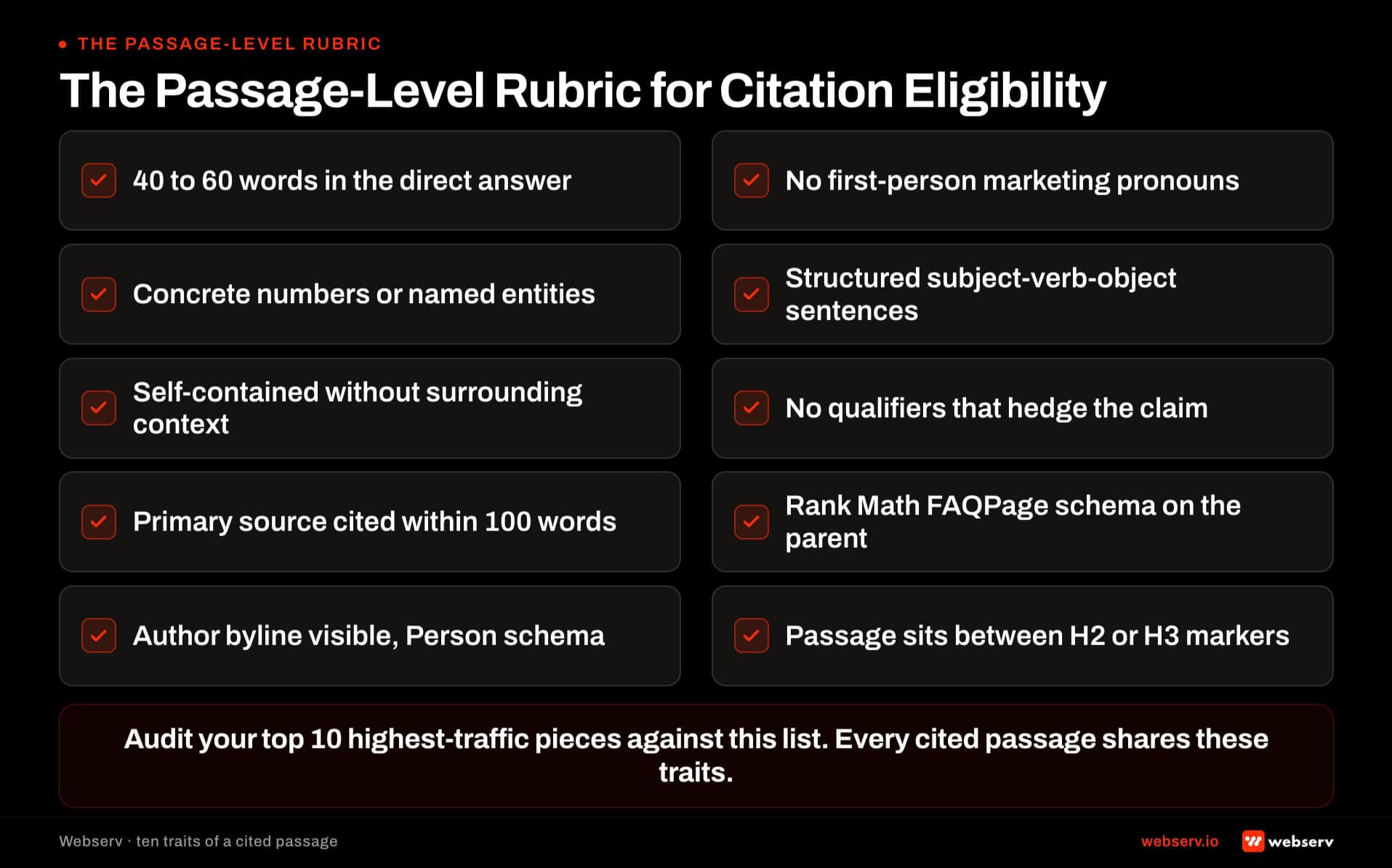
Criterion 1: Self-contained. The passage can be lifted from the page and read as a complete answer without additional context. Passages that reference “as shown above” or “the previous section covered” fail this criterion. Our full AI search stack piece covers the retrieval-friendly passage discipline in depth.
Criterion 2: Declarative. The passage states facts and specifics rather than asking rhetorical questions or building up to a point through argument. AI retrieval systems prefer declarative passages because they compress cleanly into answer summaries. The passage-length target: 40-80 words per cite-eligible passage.
Criterion 3: Specific. The passage carries operator-specific facts that a category-authority source (SAMHSA, NIMH) cannot. Named clinicians. Specific programs. Specific payer lists. Specific geographies. Specificity is what earns positions 2-5 against the position 1 category source.
Criterion 4: Sourced. The passage carries at least one primary source citation to a category-authority when covering clinical claims, at least one internal source when covering facility-specific claims (linking to the specific program page or the clinician bio), and no unsupported claims. Passages carrying unsupported clinical claims fail retrieval preference.
Pages that structure 3-5 passages against all four criteria produce meaningful compound-prompt citation activity within 90-180 days of publish. Pages that miss on any criterion tend not to cite even when the compound gets asked.
Definitive claim structure for compound-prompt eligibility
An answer-first opening only helps if the underlying claim is definitive rather than hedged. A hedged opener gives AI systems nothing definitive to quote, so claim structure matters as much as length.
Definitive claim structure. Subject plus strong verb plus specific number or named entity. “Pre-admission eligibility verification typically resolves in 15 to 45 minutes through real-time eligibility APIs” is a definitive claim structure. “It’s important to note that pre-admission verification can take various amounts of time depending on the payer” is not.
The difference is verifiable specificity in the definitive version versus hedging language in the weak version. Specific, verifiable statements give AI systems a concrete answer to quote.
What separates citation-eligible openers from weak ones. Three specific structural markers. First: the opener answers the H2’s implied question directly rather than restating the topic. Second: the opener contains at least one specific fact (number, named entity, dated range, parenthetical spec). Third: the opener uses active voice with a strong verb rather than passive construction.
Weak opener example: “The topic of verification of benefits is one that many treatment centers consider important.” Citation-eligible opener: “Verification of benefits confirms three specific facts about a patient’s insurance coverage: plan active status, member eligibility, and BH benefit inclusion for the specific level of care.”
Compliance considerations for definitive claims. LegitScript standards apply to definitive claims the same way they apply to ad copy. Guaranteed outcome claims fail LegitScript regardless of definitive structure. Comparative superlatives fail. Specific-outcome numeric claims without documentation fail. The schema layer that supports definitive claim structure is documented in our structured data for AI search beyond Rank Math defaults piece.
The specific pattern that works for BH: definitive claims about process, workflow, timing, and payer patterns are compliant when accurately documented. Definitive claims about treatment outcomes require the specific clinical documentation and disclosure language that LegitScript and clinical documentation standards define.
The position 2-5 dynamic
The citation slot on AI answer surfaces for compound prompts is not position 1. Position 1 almost always goes to a broad category-authority source: SAMHSA’s treatment locator or condition documentation, NIMH’s condition pages, Mayo Clinic’s clinical overviews, or an equivalent authoritative reference.
Position 1 is not the target for treatment center content. Category-authority sources have accumulated decades of link equity and topical authority that individual facility sites cannot match, and AI systems weight them as canonical for broad category queries.
Positions 2 through 5 are where treatment center pages actually get cited. The position 2-5 slot goes to sources that answer the compound with operator-specific precision the category source cannot match.
When a family asks about residential PHP for dual diagnosis with BCBS in Arizona, SAMHSA cannot answer with a specific facility’s BCBS in-network status or the specific dual diagnosis program details. A well-structured facility page can.
The implication for the content model: do not target position 1 on the compound. Target positions 2-5 by producing operator-specific compound answers.
The traffic that comes from positions 2-5 on compound prompts is higher intent than position 1 traffic on single-intent queries because the family reached the compound by narrowing their research through multiple filters.
DO
- Match the H1 to the full compound (all intents named), not one component of it — AI retrieval parses H1 as the primary intent signal.
- Write the first 40-80 words as a self-contained answer to the compound — this is the passage AI retrieval most often lifts.
- Structure 3-5 H2 sub-questions, each addressing one intent from the compound, each answer as a 40-80 word cite-eligible passage.
- Filter compound candidates against clinical fit, payer alignment, geographic scope, and 30+ monthly volume — publishing off-fit compounds produces traffic you cannot convert.
- Build 15-40 compound-prompt pages at 2-4/month cadence over 12-18 months — faster than 4/mo produces quality drift.
DON’T
- Build single-intent pages and hope compound queries hit them — no single-intent page answers the whole compound, no citation earned.
- Cram too many compound intents into one page (residential + PHP + IOP + all conditions + all insurance + 3 states) — no compound gets answered cleanly.
- Publish compound content without Organization + Person + MedicalCondition schema underneath — passages get retrieved but not attributed to your entity.
- Chase position 1 on single-intent components — that slot goes to category authorities. Compete for positions 2-5 on the compound.
- Ship compound content while Tier 1 technical or Tier 3 service page conversion is broken — the citations land on a broken foundation.
The four common failure modes
Failure mode 1: Building single-intent pages and hoping for compound queries. A facility publishes 40 blog posts each targeting one single-intent keyword. Compound queries do not hit those pages because no single page addresses the whole compound. The facility sees traffic on the single-intent queries and nothing on the compounds where citations actually happen.
Failure mode 2: Cramming too many compound intents into one page. A facility publishes one page trying to cover “residential PHP IOP for dual diagnosis, PTSD, and SUD with all major insurance across Arizona, California, and Nevada.” The page addresses so many intents that no compound gets answered cleanly. AI systems parse the page as unfocused and pass on it for citation.
Failure mode 3: Publishing compound content without entity-level schema. A facility builds well-structured compound-prompt pages but does not ground them in Organization schema, Person schema for the clinicians referenced, MedicalCondition schema for conditions, or the sameAs values that resolve the entities against external authorities. The passages get retrieved but the entity attribution fails and citation goes to a competitor with cleaner schema.
Failure mode 4: Chasing position 1 on single-intent components. A facility invests heavily in ranking position 1 for “residential rehab” and “PHP program” as single-intent queries. The single-intent rankings hold. Compound-query citations do not appear because the pages are optimized for single intent, not compound intent.
How the model fits with the AI-readability stack
The compound-prompt content model sits inside Tier 4 of the 5-Tier SEO Priority Framework. It cannot produce citations without the tiers below it working.
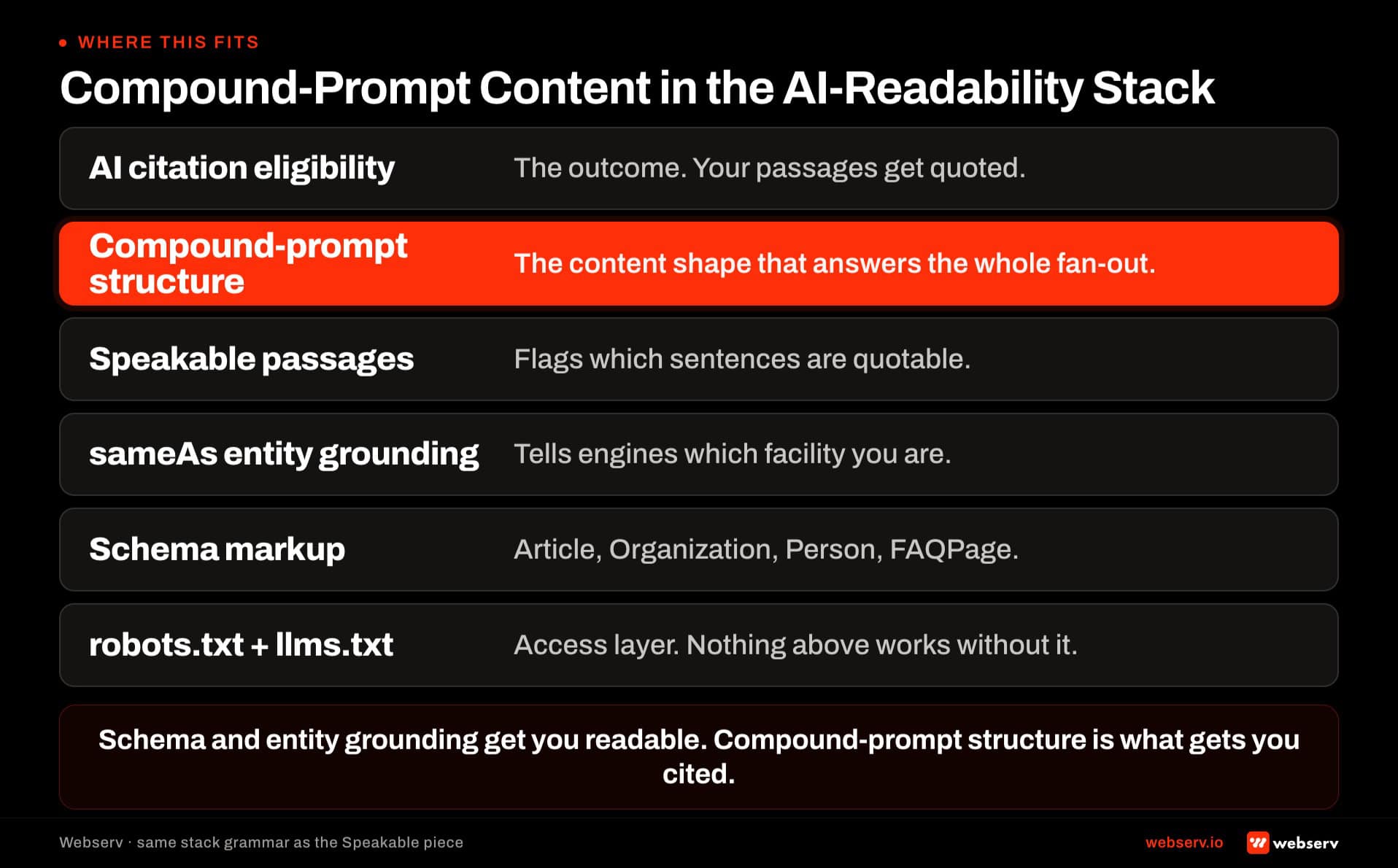
Tier 1 (technical foundation) has to be clear because AI retrieval systems cannot cite pages they cannot render.
Tier 2 (local presence) has to be clear because geography-plus-specialty compounds fail without local visibility signal. Tier 3 (conversion pathways) has to be clear because compound-query traffic that reaches a broken service page produces no admits — our service page rubric covers the Tier 3 execution.
The compound-prompt content model also compounds with the other four AI-readability surfaces (Schema.org, llms.txt, entitymap.json, AI Information page). The same entity model that grounds the AI Information page grounds the entity references in the compound-prompt content. Our full AI search stack piece walks the multi-surface interaction.
The same schema that surfaces on individual service pages surfaces on the compound-prompt hub content that references those services.
Facilities that deploy the compound-prompt content model without the underlying stack produce compound-friendly content that cannot get cited because the surrounding entity resolution is not defensible.
Facilities that deploy the stack without the compound-prompt content model produce a defensible entity graph that does not get pulled into answer surfaces at the compound queries where citations actually matter.
Frequently Asked Questions
How many compound-prompt pages should we publish for a treatment center?
Between 15 and 40 compound-prompt pages for most single-facility operators. The specific target depends on the clinical program mix. A facility offering residential, PHP, IOP, and outpatient across SUD, dual diagnosis, and trauma-focused care produces meaningfully more compound combinations than a facility offering only residential SUD.
The build cadence: 2 to 4 compound-prompt pages per month over 12 to 18 months. Faster than 4 per month tends to produce quality drift because each compound page requires operator-specific detail that a copywriter cannot fabricate. Slower than 2 per month leaves the field open for competitors targeting the same compounds.
Portfolio operators build compound-prompt pages per facility rather than sharing them. A portfolio operator needs compound-prompt pages for each facility because each one has its own geography, payer relationships, and clinical positioning.
How is compound-prompt content different from long-tail keyword content?
Long-tail keyword content targets specific low-volume single-intent queries. “Residential rehab in Scottsdale” is a long-tail keyword. The intent is single: residential rehab in one geography.
Compound-prompt content targets queries combining multiple intent categories. “Residential rehab in Scottsdale for dual diagnosis with BCBS” is a compound prompt. The intent is compound: residential, geography, condition, insurance.
The technical distinction: long-tail content optimizes for one query. Compound-prompt content optimizes for a family of related queries that share the same compound structure. A well-structured compound-prompt page typically ranks and gets cited across 15-40 related compound variations rather than one specific query.
Should we build a separate compound-prompt page for every payer we work with?
No. Payer-specific compound pages should cover payer categories rather than individual payers. A page covering “in-network coverage for residential dual diagnosis” that lists Aetna, BCBS, Cigna, and UHC with facility-specific network status is stronger than four separate pages each covering one payer.
The exception is when a specific payer represents a meaningful share of the facility’s admits and the payer relationship carries specific programmatic content (payer-specific pre-authorization workflow, payer-specific step therapy requirements, payer-specific network positioning). In that case a dedicated payer page is defensible.
The general operating rule: consolidate payers into categorical pages unless a specific payer justifies its own dedicated content.
How long does it take to see compound-prompt citations?
Typically 90 to 180 days from publish. The specific timing depends on the underlying entity graph maturity. Facilities with mature Schema.org deployment, clean sameAs values, and established topical authority see citations start appearing within 60-90 days. Facilities without the entity foundation see 180-day timelines. Our entity SEO explainer covers the underlying schema layer.
The citations do not appear all at once. The pattern that emerges: a compound-prompt page that gets cited at all tends to accumulate citations across multiple compound variations over 6 to 12 months as AI systems re-crawl and re-evaluate the source.
Facilities that abandon compound-prompt content before the 6-month mark typically do so before the citation lift has actually materialized.
What tools identify which compounds our facility should target?
Ahrefs Keywords Explorer with compound query filtering (search phrase contains multiple intent categories) produces the volume data. Google Search Console’s queries report filtered by impression volume against the facility’s current topical footprint identifies compounds the facility already impresses on without ranking.
The specific technique that works: pull the trailing 90-day GSC query report, filter for queries containing more than 4 words with volume above 30, review manually for compound structure, and add to the compound-prompt content plan. This produces the compounds where the facility already has some retrieval signal but is not yet the cited source.
Perplexity and ChatGPT search results for facility-relevant compound queries reveal which compounds AI systems already cite the facility on and which compounds are held by competitors. The gap between the two is the priority compound-prompt content roadmap.
Do compound-prompt pages replace our existing service and program pages?
No. Compound-prompt pages complement service and program pages, they do not replace them.
Service and program pages address the single-intent commercial queries and the branded queries. They carry the primary conversion CTAs, the phone-first hierarchy, the insurance visibility, and the service-page rubric standards. They convert admits. Compound-prompt pages address the compound queries that surface in AI answer surfaces. They carry the entity-grounded topical authority that positions the facility as a credible source across compound variations. They earn citations.
The two page types work together. Compound-prompt pages reference and link to the specific service and program pages. Service and program pages link back to relevant compound-prompt content that provides broader context. Our service page rubric covers the service-page-specific discipline separately.
Trevor Gage is the Director of Marketing at Webserv, a digital marketing agency for treatment centers.