Meta’s advertising standards say the products and services promoted in an ad must match those promoted on the landing page, and Meta’s ad review covers the landing page as well as the ad. Google’s misrepresentation policy lists inconsistencies between the ad and the landing page as misleading ad design.
Both platforms treat the ad and the page as one unit. Campaign workflows don’t always. The creative team writes the ad, the web team owns the page, and the two drift apart until the ad promises something the page doesn’t deliver.
The cost shows up in two places. Families who click and don’t find what the ad promised leave. And in behavioral health, a mismatch can also be a compliance problem.
This piece covers what alignment means, the four places ads and pages drift apart, the platform settings that can break alignment without anyone noticing, and a review process that keeps the two connected. It’s how our ad creative team for treatment centers plans campaigns, and it builds on the ultimate guide to ad creative strategy.
Key Takeaways
- Meta requires the products and services in an ad to match the landing page, and reviews landing pages as part of ad review. Google’s policy treats ad-to-page inconsistencies as misleading.
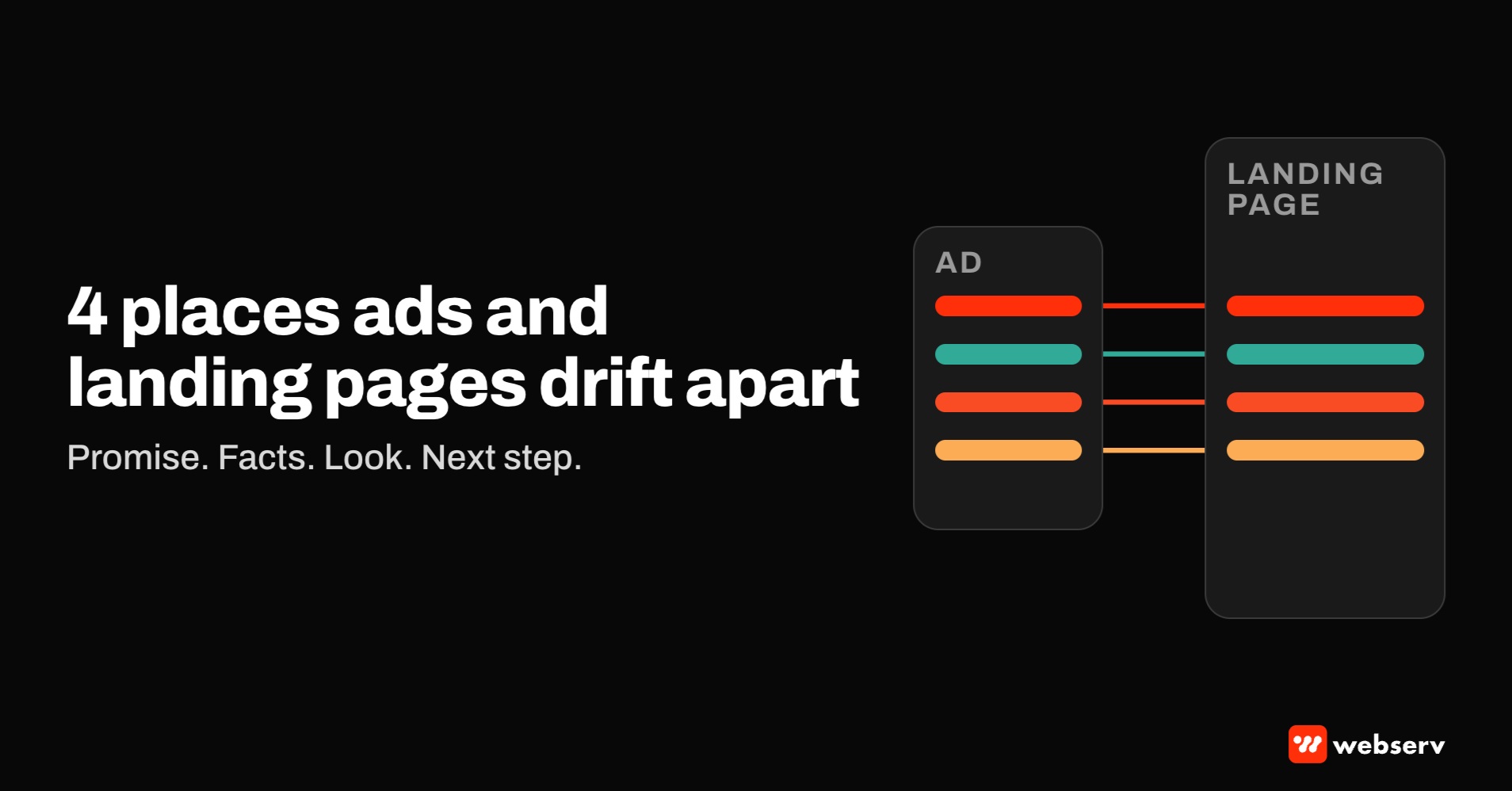
- Alignment has four parts: the promise, the facts, the look, and the next step. Each should carry from ad to page without the visitor having to search.
- Google says the exact search phrase doesn’t need to appear on the page, but the page should follow through on the ad’s offer.
- Google turns on Final URL expansion by default in Performance Max and when advertisers opt into AI Max, which can send clicks to pages you didn’t choose. Meta’s Advantage+ creative can adjust ad text and media.
- Review the ad and the page together, against the same approved claims, before launch and after any change to either.
- Compare link clicks with landing page views on Meta to see how many people leave before the page loads.
What alignment means
Google’s landing page experience measures how relevant and useful the page will be to people who click the ad. Its improvement tips say to keep messaging consistent from ad to landing page and to make sure the page follows through on the ad’s offer.
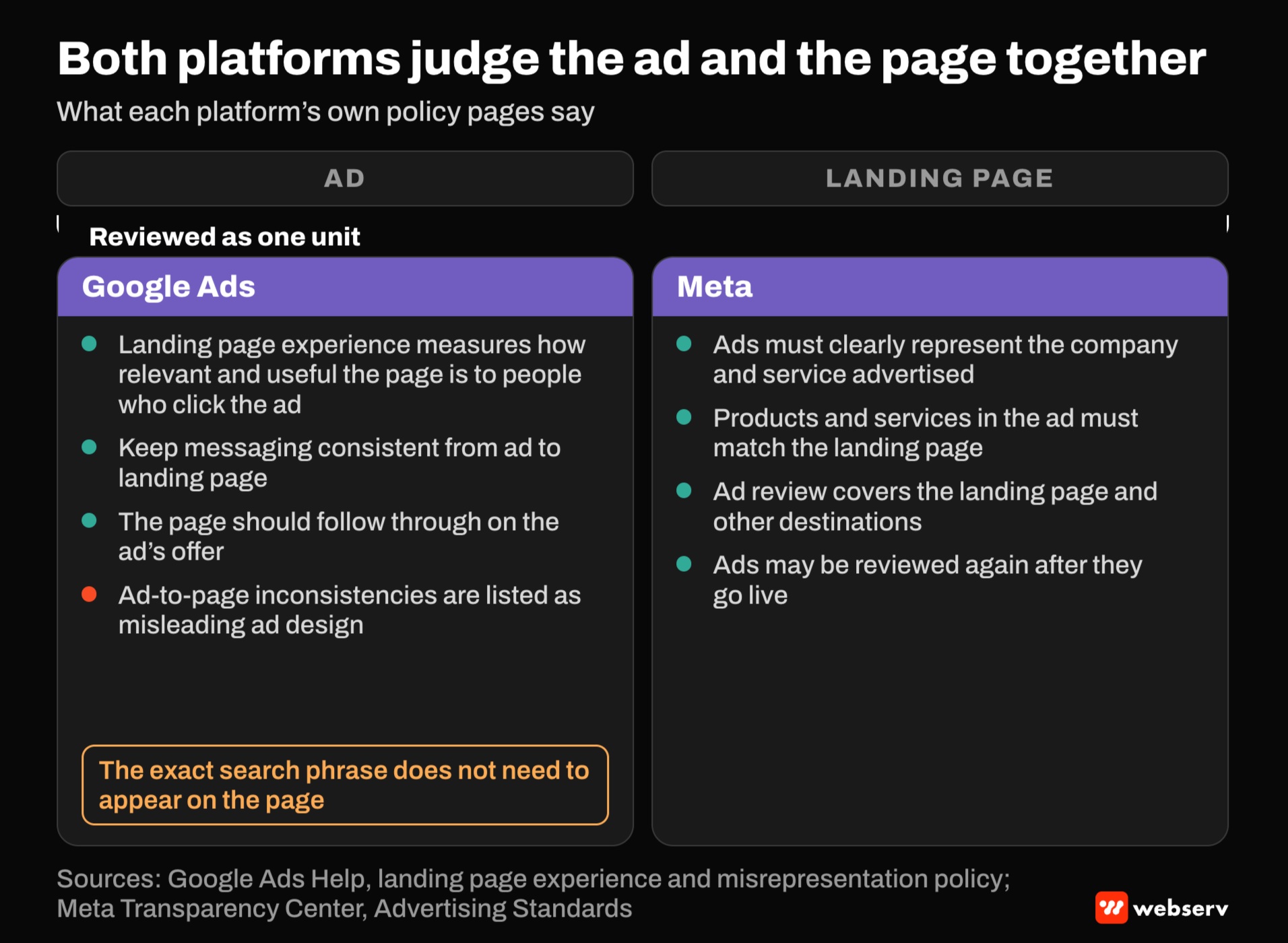
The same page notes the word-for-word search phrase doesn’t need to appear on the page.
DEFINITION
Ad-to-page alignment. The ad and the landing page make the same promise, state the same facts, look like they belong together, and lead to the same next step. A visitor who clicks should recognize the page within seconds and find what the ad said would be there.
Meta’s advertising standards say ads must clearly represent the company and service advertised, that products and services in the ad must match the landing page, and that ad review covers the landing page and other destinations. Ads may be reviewed again after they go live.
The four places ads and pages drift apart
Here’s the short version; each one is explained below.
| Drift point | What the ad says | What the page should do |
|---|---|---|
| The promise | “Same-day admission available” or “Free insurance verification” | Open with admission timing or the verification offer, not a general contact form |
| The facts | A level of care, location, or payer, such as “IOP in Scottsdale” | Confirm the same level of care, location, and payer |
| The look | A clinician in the facility’s group room | Use the same facility, people, and colors, with real photos |
| The next step | “Call our admissions team” or “Take a short assessment” | Make that same action the page’s main button |
1. The promise. The ad says “Same-day admission available.” The page doesn’t mention admission timing. Or the ad offers “Free insurance verification” and the page leads with a general contact form. The visitor has to hunt for the thing they clicked for.
Google’s misrepresentation policy says promising services or offers in the ad that are unavailable or not easily found on the destination isn’t allowed.
2. The facts. The ad names a level of care, a location, or a payer. The page has to confirm the same thing.
An ad for “IOP in Scottsdale” that lands on a page for the facility’s residential program in another city fails this test, and LegitScript’s advertising standard requires ads to accurately reflect the services available at each location.
3. The look. A video ad shows a clinician in a bright group room; the page opens with stock photography of a beach. The visitor wonders if they clicked the wrong thing. Use the same facility, people, and colors on both, and use real photos, which LegitScript also requires.
4. The next step. The ad says “Call our admissions team.” The page’s main button is a long form. Or the ad says “Take a short assessment,” and there isn’t one. Match the action the ad promised.
COMMON MISTAKE
One landing page for every ad. A treatment center runs ads for detox, residential, family programming, and specific insurers, and sends all of them to the same general page. Every ad promises something different; the page answers none of them directly.
Group ads by promise and give each group a page that opens with that promise. Our landing page templates cover six layouts and how to map campaigns to them.
Platform settings that can break alignment
Some platform features change the ad or the destination automatically. They’re not bad, but they can undo alignment without anyone noticing.
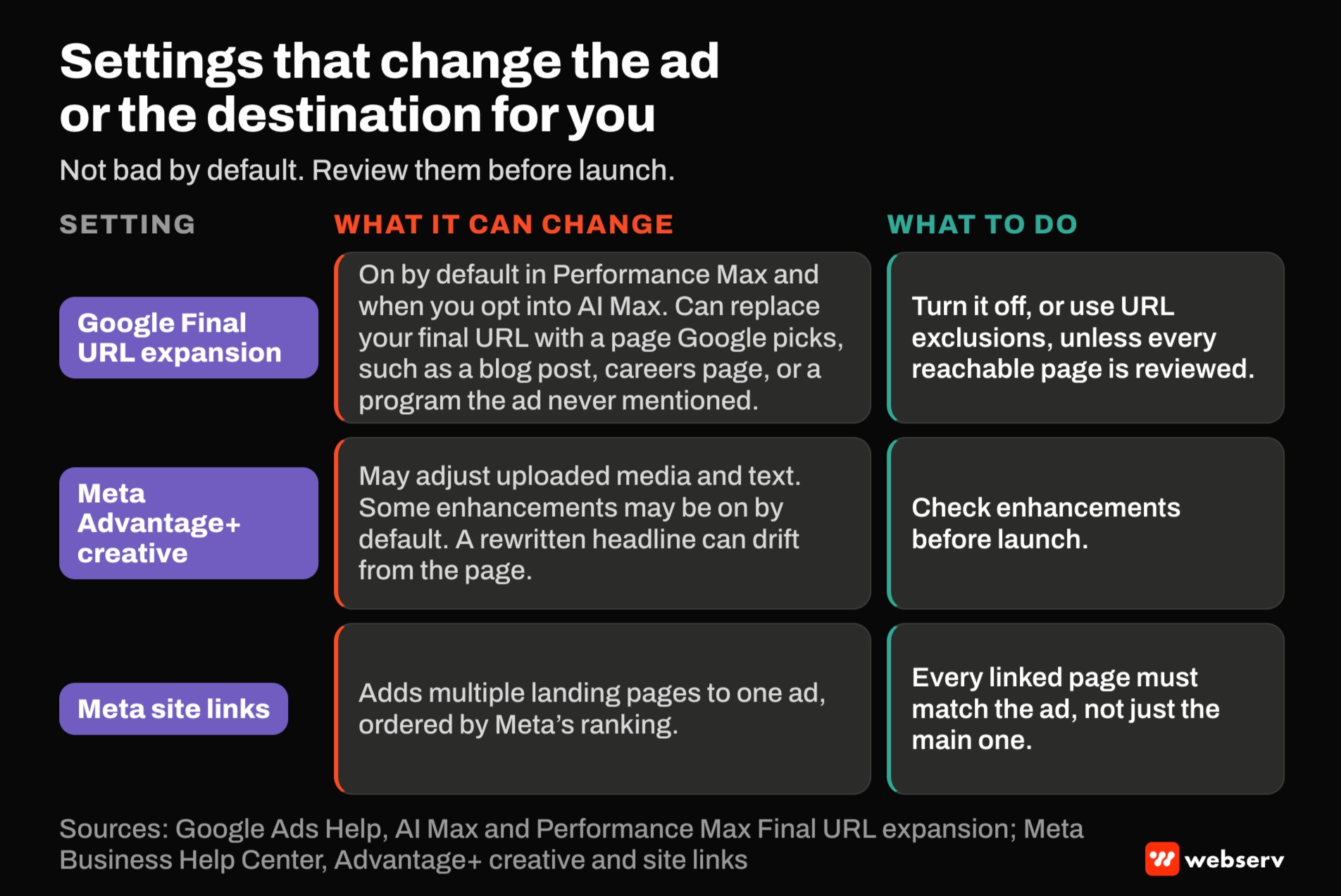
Google Final URL expansion. Google’s AI Max documentation says Final URL expansion is enabled by default when an advertiser opts into AI Max, and may replace the final URL with a page Google considers more relevant. For Performance Max, Google says it’s on by default and can sometimes lead ads to unintended pages.
For a treatment center, an unintended page might be a blog post, a careers page, or a program the ad didn’t mention. Turn it off, or use URL exclusions, unless you’ve reviewed every page it could reach.
Meta Advantage+ creative. Meta’s Advantage+ creative page says uploaded media and text may be adjusted while keeping the core message, and that some enhancements may be on by default. A rewritten headline can drift from what the page says. Check enhancements before launch.
Meta site links. Meta’s site links feature adds multiple landing pages to an ad, ordered by Meta’s ranking. Every linked page needs to match the ad, not just the main one.
Our guide to AI-generated ad creative guardrails covers generated creative more broadly. For the production workflow, see our guide to AI-assisted ad creative production.
A review process that keeps them connected
Alignment tends to break when the ad and the page are reviewed separately, by different people, at different times.
Start from approved claims
One list of what the facility can say: levels of care, locations, insurers, admission timing, credentials. Both the ad and the page draw from it.
Brief the ad and page together
For each ad group, write down the promise, the facts, the visual, and the next step. The page brief and the ad brief should be the same document.
Review side by side
Compliance and creative review the ad and its landing page in one pass, checking the four alignment points.
Check platform settings
Confirm Final URL expansion, Advantage+ enhancements, and site links match what was reviewed.
Click the live ad
After launch, open the live ad on mobile and follow it to the page. Confirm what a visitor actually sees.
Re-review after any change
A page edit, a new program, or a contract change can break an ad that was aligned last week.
How to measure alignment
There’s no single alignment score, but a few signals show when ads and pages are out of step:
- Link clicks versus landing page views on Meta, by ad.
- Landing page experience ratings in Google Ads keyword diagnostics.
- Conversion rate by ad and page pair, not just by page, so a weak pairing isn’t hidden in a page average.
- Call recordings and admissions notes, which reveal when families call asking about something the ad promised and the page didn’t explain.
OPERATOR INSIGHT
On Meta, compare link clicks with landing page views, which count clicks where the destination page loaded. A wide gap means people are leaving before they see the page, which no amount of message match will fix.
Meta recommends landing page view optimization over link click optimization. Google’s tips list improving loading speed for the same reason. Our landing page design guide covers the page-side fixes.
Where this fits
Alignment ties creative and landing pages into one campaign. For the creative side, see our video ad creative guide, static ad creative templates, and our hook testing framework for Meta ads. For the page side, the complete guide to landing pages and our guide to creative strategy for treatment center marketing. For program-level pages, see our guide to modality-specific landing pages. For what those pages should say about coverage, see our guide to insurance pages AI systems can cite.
For how paid media fits the rest of your marketing, see the complete guide to behavioral health marketing. If you want a second look at how your ads and pages line up, book an intro meeting.
Frequently Asked Questions
Why does ad and landing page alignment matter for treatment centers?
Both Google and Meta treat the ad and the page as one unit. Meta requires the services in an ad to match the landing page and reviews the page during ad review; Google’s policy treats ad-to-page inconsistencies as misleading.
Families who don’t find what the ad promised leave.
In behavioral health, a mismatch about services, locations, or insurance can also be a compliance problem.
Does the landing page need to repeat the exact ad headline?
Not word for word. Google says the exact search phrase doesn’t need to appear on the page.
The page should make the same promise and follow through on the ad’s offer, using the same facts and next step.
Open the page with the promise the ad made, so visitors recognize it immediately.
Can Google send our ads to pages we didn’t choose?
Yes. Final URL expansion is on by default in Performance Max and when you opt into AI Max, and Google may replace the final URL with a page it considers more relevant.
For treatment centers, that can mean ads landing on pages that weren’t reviewed with the ad.
Turn the setting off or use URL exclusions unless every eligible page has been reviewed.
How often should ads and landing pages be reviewed together?
Before launch, and whenever either one changes. A page edit, a new program, a closed location, or a payer contract change can break an ad that was aligned.
Review the ad and page side by side against the same approved claims.
Click the live ad on mobile after each change to confirm what visitors see.
What should we do if Meta shows many link clicks but few landing page views?
That gap means people clicked but left before the page loaded. Message match can’t help visitors who never see the page.
Check page load speed, especially on mobile, and consider landing page view optimization, which Meta recommends over link click optimization.
Recheck the gap after changes.
Keaton Nalle is the Director of Paid Admissions at Webserv, a digital marketing agency for treatment centers.