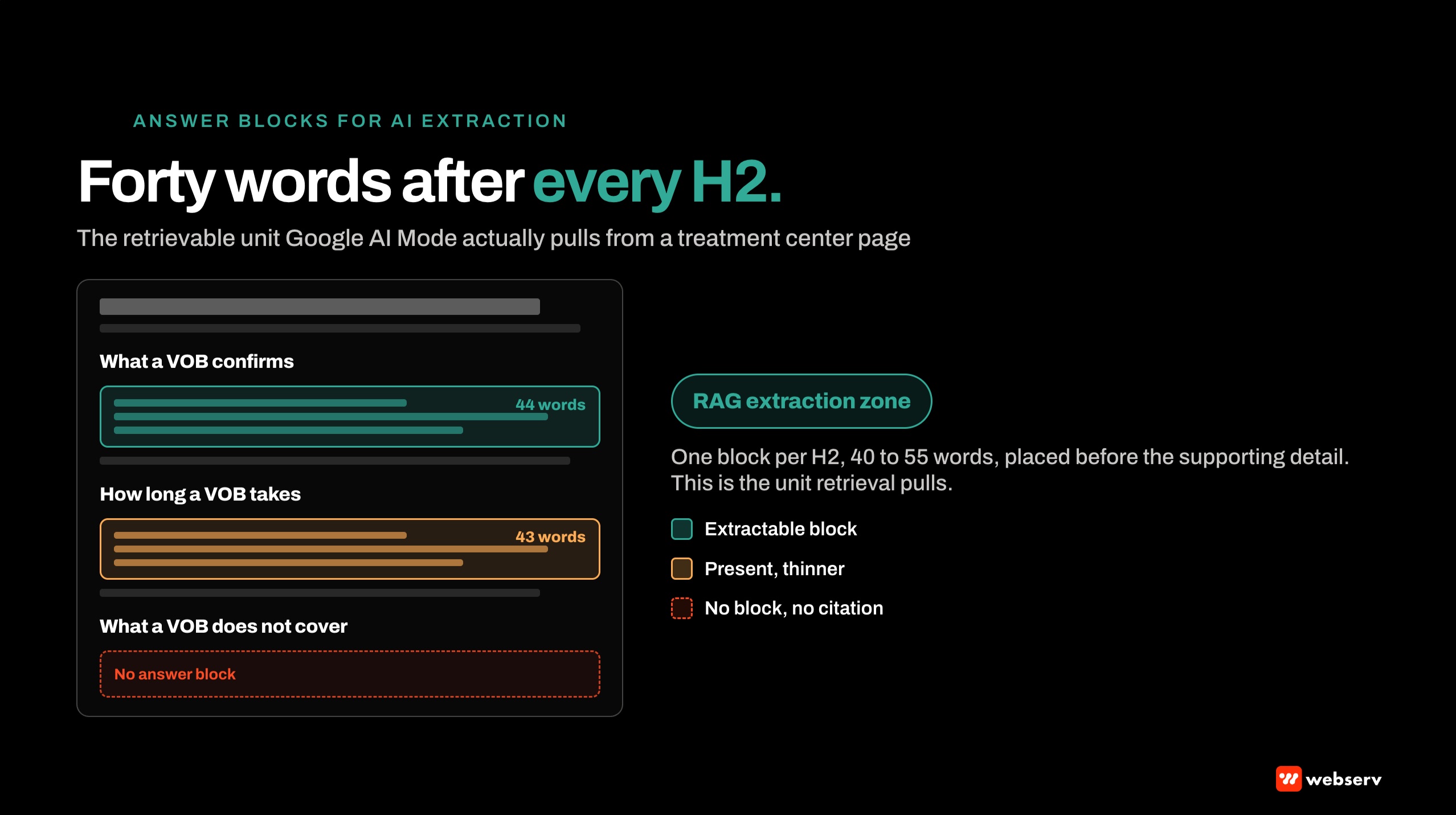
Google AI Mode extraction pulls the first clean answer after each H2 heading. That specific extraction unit is what determines whether a treatment center page gets cited in AI Overviews, Perplexity answers, ChatGPT responses, and Bing Copilot results. This is the tactical piece for our AEO capability.
The unit is short: 40 to 55 words of definitive answer text directly addressing the query the H2 implies. Nothing before it, nothing longer, nothing weaker.
The AEO capability at Webserv has audited answer block placement across 270+ posts in the corpus. The pattern we recommend: open every H2 with a 40-55 word definitive answer, then complete the section. SE Ranking’s study of 216,524 pages found sections of 120-180 words between headings averaged 4.6 ChatGPT citations, versus 2.7 for sections under 50 words.
Treatment center marketing directors ask a specific question about AI Overview optimization: what specifically do we do differently at the content structure level to increase AI citation share? The answer is the 40-word answer block after every H2. This piece walks the specific technique.
The framework this technique sits inside is our compound prompt content model. The broader AI-search picture is in our Full AI Search Stack for treatment centers. Related tactical work: our structured data beyond Rank Math defaults covers the schema layer this technique pairs with. For the surrounding practice see our ultimate guide to behavioral health marketing.
Key Takeaways
- Google AI Mode extraction pulls the first clean answer after each H2 heading. The unit is short: 40 to 55 words of definitive answer text directly addressing the query the H2 implies. Nothing before it, nothing longer, nothing weaker.
- An answer-first opening makes each section easy to extract, but the evidence favors full sections: SE Ranking found 120-180 word sections outperform sections under 50 words for ChatGPT citations. The pattern applies to service pages, blog posts, cluster hubs, and homepage content equally.
- Definitive claim structure: subject plus strong verb plus specific fact (number, dollar amount, named entity, dated range, parenthetical specific). AI systems skip weak openers — hedging, qualifier chains, marketing throat-clearing, topic restatement, vague generalities — and jump to the next clean answer block.
- Every H2 gets its own 40-55 word answer block. Pages with 8 to 12 H2s produce 8 to 12 independent citation opportunities across the AI Mode fan-out pattern.
- Measure the effect on your own target prompts rather than expecting a fixed lift. Baseline citation share tracked pre-implementation via Brand Radar, Otterly, or similar tools, then re-measured after the pages have been recrawled.
DEFINITION
The 40-word answer block. The 40 to 55 word first-paragraph unit under every H2 that AI answer surfaces (Google AI Overviews, Perplexity, ChatGPT, Claude, Bing Copilot) extract as the citation-eligible answer to the sub-query the H2 anchors. Definitive claim structure required: subject plus strong verb plus specific fact. Applies to service pages, blog posts, cluster hubs, and homepage content equally.
Distinct from the H2 itself (which functions as the topical anchor AI systems parse for sub-query mapping), distinct from FAQ block answers (supplementary Q&A extraction units on top of primary-content H2 blocks), and distinct from body-paragraph elaboration (the 2 to 3 paragraphs after the 40-word block that provide depth AI systems reward for citation authority).
OPERATOR INSIGHT
Extraction skips weak openers. Marketing throat-clearing, hedging language, and qualifier chains all get filtered out — extraction jumps to the next clean answer block.
The result: pages with strong H2 anchors plus clean 40-word answer blocks produce citation-eligible content across the sub-query fan-out. Pages with weak openers produce fewer citation opportunities even when the underlying content is accurate. Content structure is the lever, not content volume.
What Google AI Mode extraction actually pulls
Google AI Mode parses long-form content in two passes. First pass identifies the H2 headings as topical anchors that map to specific sub-queries in the AI Mode fan-out pattern. Second pass extracts the first clean answer block under each H2 as the citation-eligible answer unit.
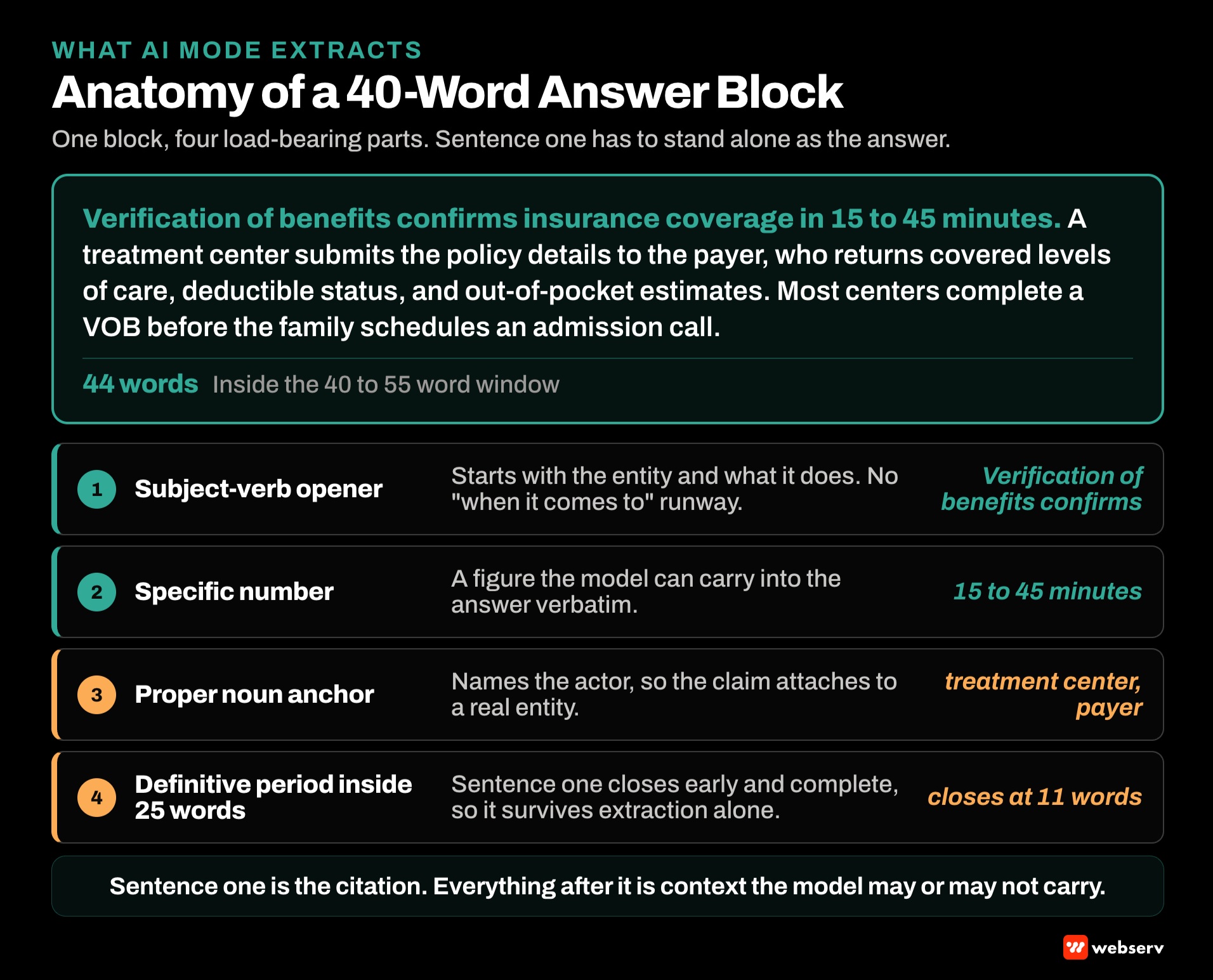
The mechanism: AI Mode breaks a compound prompt into multiple sub-queries. Each sub-query gets answered by pulling from source pages that have citation-eligible content for that specific sub-query.
Extraction skips weak openers. Marketing throat-clearing (“It’s important to note that…”), hedging language (“This is a topic that many families consider…”), and qualifier chains (“It should be noted that in some cases, depending on various factors…”) all get filtered out. Extraction jumps to the next clean answer block.
The result: pages with strong H2 anchors plus clean 40-word answer blocks produce citation-eligible content across the sub-query fan-out. Pages with weak openers produce fewer citation opportunities even when the underlying content is accurate.
Our compound prompt content model piece walks the specific mechanism in depth. The 40-word block is the specific tactical implementation of that model.
The 40-55 word target: why the length matters
The 40-55 word window is not arbitrary. It matches the specific citation display format that AI answer surfaces use.
The 40-55 word opening is an editorial target, not a platform specification: it is long enough to answer the question completely and short enough to quote whole. The rest of the section carries the depth.
Content structured to fit the window gets extracted cleanly. Content that runs over gets truncated mid-answer, which typically produces citation snippets that read as incomplete. Content that runs under provides insufficient answer depth for citation authority.
Facilities that write for the specific extraction window produce meaningfully higher citation rates than facilities that write for general reader engagement without extraction-unit awareness.
The 40-word target also aligns with how families read treatment center content in the AI answer context. Families scanning AI Overview results scan the citation snippet before clicking through.
An opening that answers the question in one complete, quotable unit gives both readers and AI systems a clean answer before the detail.
The answer block program at a glance
40-55
Words in the opening answer we recommend under each H2
Answer first
Lead each H2 with the direct answer, then build the full section
Fan-out
Sub-queries a compound prompt can fan out into, varying by query
120-180
Words per section that earned the most ChatGPT citations (SE Ranking)
Where the answer block goes on treatment center pages
The 40-word answer block applies to every content type on a treatment center site. The specific placement patterns vary by page type.
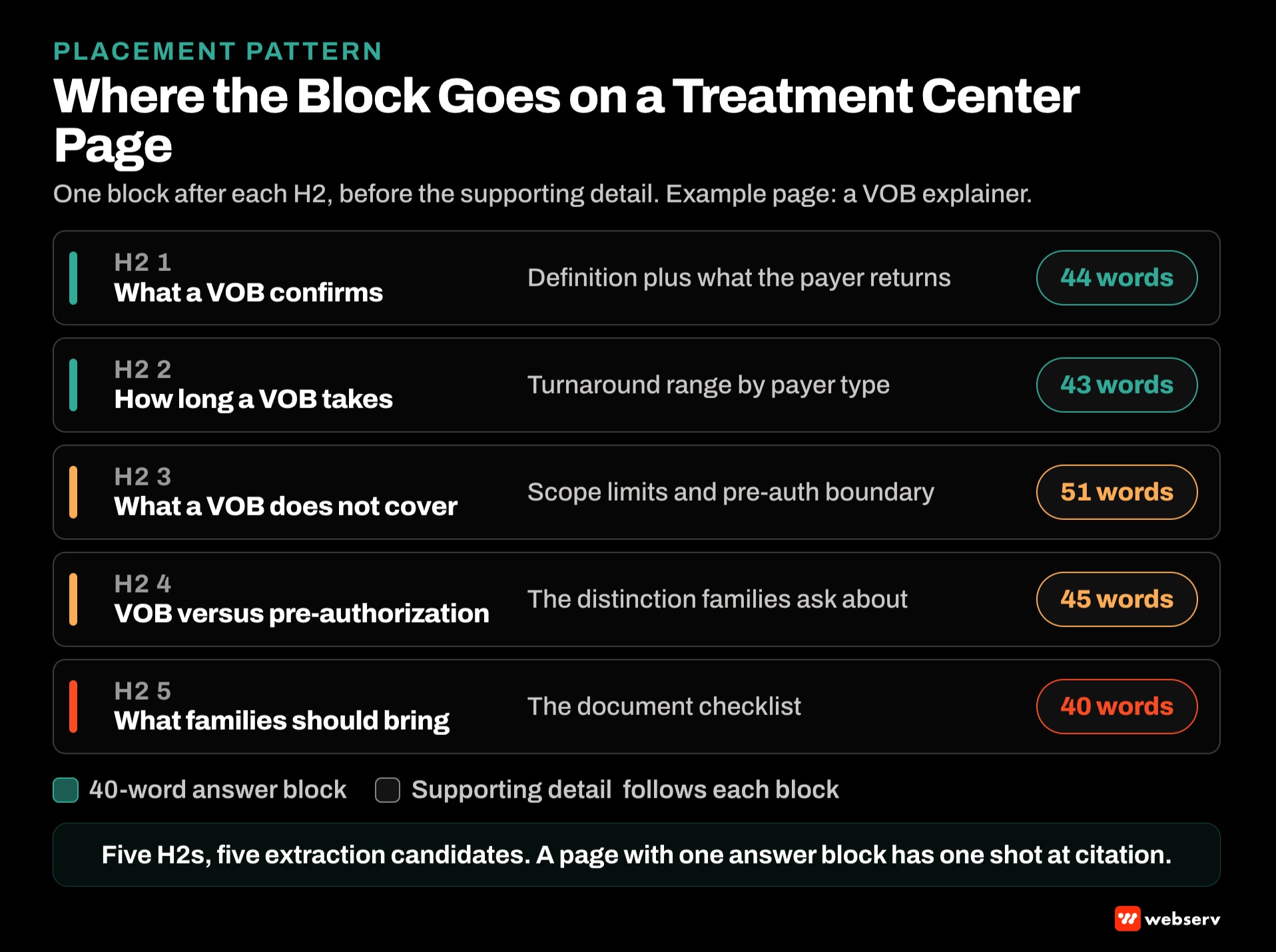
VOB and eligibility pages
H2 “How verification of benefits works” followed by 45-word answer block: “Verification of benefits confirms three specific facts about a patient’s insurance coverage at the moment of the lookup. The plan is active, the patient is a covered member, and the plan includes behavioral health benefits at the specific level of care the facility offers.”
Answer block satisfies the specific sub-query. Subsequent paragraphs elaborate.
Level of care pages
H2 “What residential treatment includes” followed by 47-word answer block: “Residential treatment provides 24-hour clinical care in a live-in facility with structured programming, therapeutic groups, individual therapy, medication management when clinically appropriate, and family involvement. Length of stay depends on clinical need and payer approval.”
The answer establishes the definitional answer for residential treatment. AI Overviews cite the block when families search “what is residential treatment” or similar phrasings.
Admissions workflow pages
H2 “How the admissions process works” followed by 50-word answer block: “The admissions process runs through five specific steps: initial inquiry call, verification of benefits, clinical assessment, insurance pre-authorization, and admission scheduling. Acute-need admits can move within a day, while non-emergency admits with pre-authorization requirements take longer.”
Insurance coverage pages
H2 “Which insurance carriers we accept” followed by 43-word answer block: “The facility accepts in-network coverage from Blue Cross Blue Shield, Aetna, Cigna, and UnitedHealthcare across most plan types. Out-of-network coverage works with additional payers including Anthem, Humana, and specific regional carriers based on patient plan design and out-of-network benefits.”
Program-specific pages
H2 “How dual diagnosis treatment works” followed by 48-word answer block covering the specific integrated treatment approach for co-occurring SUD and mental health conditions.
Every H2 gets its own 40-55 word answer block. Pages with 8 to 12 H2s produce 8 to 12 independent citation opportunities across the AI Mode fan-out pattern.
Definitive-claim structure
The 40-word answer block only produces citation eligibility if the claim structure is definitive. AI systems filter out weak openers regardless of length.
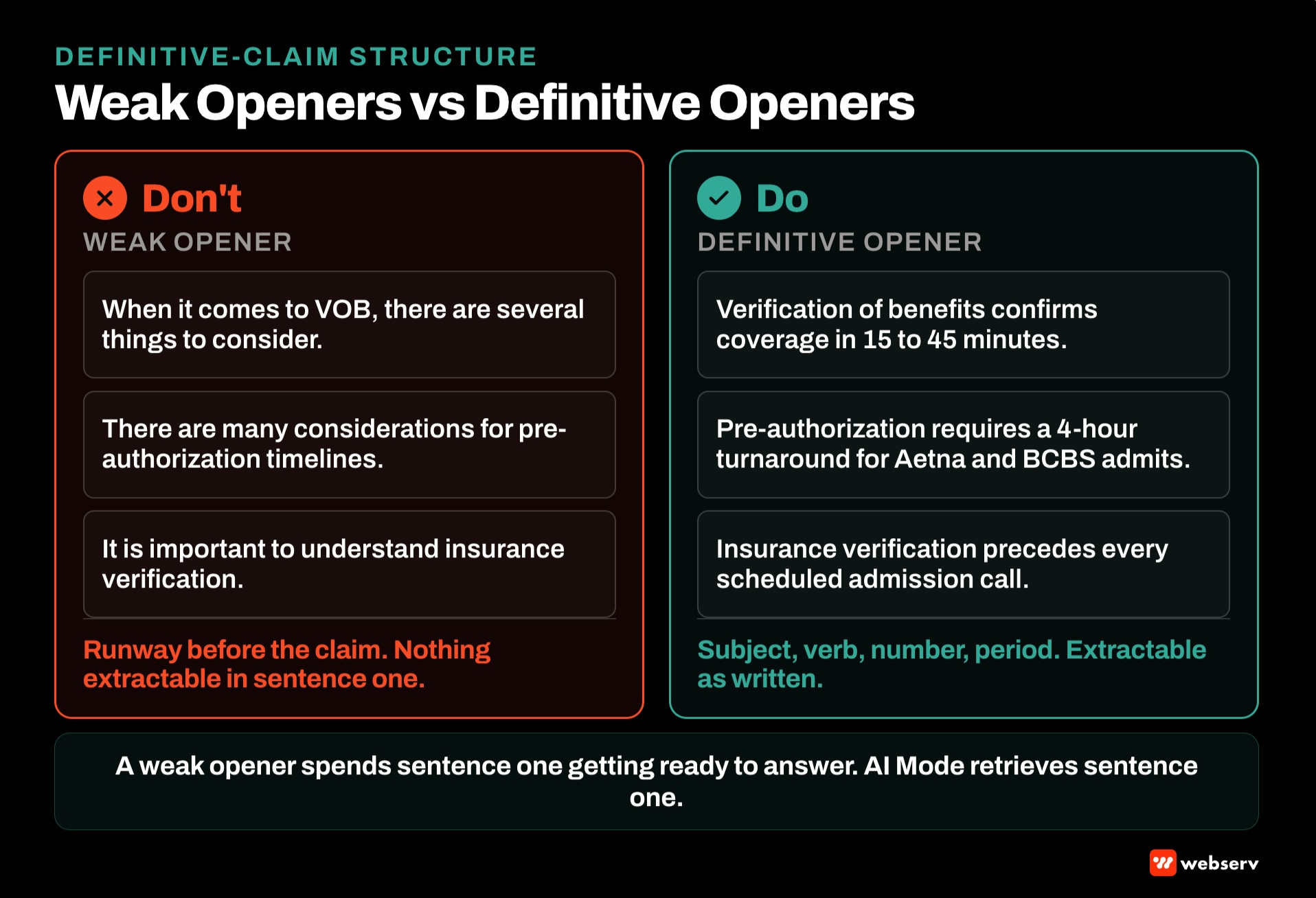
Definitive claim structure: subject plus strong verb plus specific fact. “Real-time eligibility APIs return most pre-admission verification answers the same day” fits the structure.
The subject (pre-admission eligibility verification) is specific. The verb (resolves) is active and strong. The specific fact (same-day answers through real-time eligibility APIs) is verifiable.
Weak claim structure fails: “There are various factors that can affect how long verification of benefits takes, and different payers may have different processes.” No specific subject anchor. Passive construction. No verifiable facts. AI extraction skips this opener in favor of the next clean answer block.
Three specific structural markers separate citation-eligible openers from weak ones.
Marker 1: Direct answer to the H2’s implied question. The opener answers the question the H2 implies rather than restating the topic. “Residential treatment provides 24-hour clinical care…” answers the “what residential treatment includes” question. “Residential treatment is a topic that many families ask about…” restates the topic without answering.
Marker 2: Verifiable specificity. At least one number, dollar amount, named entity, dated range, or parenthetical specific fact in the opener. Facts produce the extraction signal that AI systems reward.
Marker 3: Active voice with strong verb. Active construction with a specific verb. Passive construction (“is done through,” “can be considered as”) produces weaker extraction signal than active construction (“resolves,” “confirms,” “provides”).
DO
- Open every H2 with a 40 to 55 word definitive answer, then complete the section to roughly 120 to 180 words.
- Structure each block as subject + strong active verb + specific fact (number, dollar amount, named payer, dated range, parenthetical spec).
- Write H2s as specific sub-query anchors, not generic navigation labels (“How BCBS OON reimbursement works,” not “Overview”).
- Baseline AI citation share via Brand Radar / Otterly / similar before implementation; re-measure after recrawl to isolate lift.
- Prioritize rollout: cluster hubs and ultimate guides first, then service pages, then supporting content.
DON’T
- Open with hedging or qualifier chains (“It’s important to note…”, “In some cases, depending on…”) — extraction skips them entirely.
- Lead with marketing throat-clearing (“At our facility, we understand…”) — no citation signal, delays the actual answer.
- Restate the topic instead of answering it — “The topic of X is one many families ask about…” produces no extraction eligibility.
- Ship blocks that run under 40 words (insufficient answer depth) or over 55 (get truncated mid-answer, snippets read as incomplete).
- Write H2s as generic navigation labels — every generic H2 is a wasted sub-query citation opportunity in the fan-out.
What NOT to do
Five specific patterns produce weak openers that AI extraction filters out.
Failure 1: Qualifier chains. “It should be noted that in some cases, depending on various factors, the process may take different amounts of time…” Long qualifier chains delay the actual answer and typically get skipped entirely.
Fix: strip qualifiers, deliver the definitive answer with specific facts, then elaborate on edge cases in subsequent paragraphs.
Failure 2: Hedging language. “It’s important to consider that verification of benefits can be a complex process…” Hedging language signals uncertainty that AI systems associate with lower citation authority.
Fix: state the definitive answer confidently with verifiable specificity.
Failure 3: Marketing throat-clearing. “At our facility, we understand that finding the right treatment center is one of the most important decisions a family can make…” Marketing language delays the answer and does not produce citation eligibility.
Fix: skip the marketing preamble, deliver the answer to the H2’s implied question.
Failure 4: Topic restatement. “The topic of verification of benefits is one that many families ask about when considering treatment…” Restating the topic without answering produces no citation signal.
Fix: answer the implied question in the first sentence rather than acknowledging the question.
Failure 5: Vague generalities. “Various treatment approaches exist, and different facilities offer different types of care…” Vague generalities without specific facts produce no citation eligibility.
Fix: replace generalities with specific numbers, named entities, or verifiable facts.
Testing framework
The specific measurement framework for validating answer-block optimization.
Baseline measurement. Track AI citation share for target queries before implementing the answer block optimization. Brand Radar, Otterly, or similar AI citation trackers query the specific AI answer surfaces (Google AI Overviews, ChatGPT, Perplexity, Claude, Bing Copilot) with target prompts and record citation share.
Baseline measurement window: 30 days of citation share tracking before implementation.
Implementation. Deploy 40-word answer blocks under every H2 across primary content pages. Prioritize cluster hubs and ultimate guides first, then service pages, then supporting content.
Implementation means auditing each major page’s structure, rewriting the opener under each H2 with definitive claim structure, and quality-checking for compliance issues.
Post-implementation measurement. Track AI citation share for the same target queries for 60 to 90 days after implementation. Compare to baseline.
Measure the effect on your own target prompts rather than expecting a fixed lift. Any lift shows up only after AI systems recrawl the optimized content.
Secondary measurement: click-through rate from AI answer surfaces. AI Overviews display citation source URLs alongside the extracted answer. Facilities with well-structured answer blocks produce meaningfully higher CTR from citations because the citation snippet reads as complete and authoritative.
Track CTR from AI answer surface referrers in the marketing analytics setup. GA4 with server-side tagging captures the referrer data cleanly.
Tertiary measurement: cost-per-admit shift. The specific downstream signal: AI Overview citations produce inbound traffic that converts to admits at facility-specific rates. Facilities that scale AI citation share typically see measurable cost-per-admit improvement as the AI-driven traffic supplements paid and organic traffic without additional acquisition cost.
Cost-per-admit measurement window: long enough to allow cohort-level attribution.
Frequently Asked Questions
How is the 40-word answer block different from a featured snippet or PAA answer?
Featured snippets and PAA answers are Google’s classic search-result units that predate AI Mode. Both display a short answer pulled from a source page inside the search results page itself. AI extraction pulls the same shape of unit but does so across multiple AI answer surfaces (Google AI Overviews, Perplexity, ChatGPT, Claude, Bing Copilot) as part of compound-prompt fan-out.
The 40-word answer block satisfies both patterns. A page structured with 40-55 word definitive answer blocks under every H2 wins featured snippets, PAA boxes, and AI answer surface citations simultaneously. The extraction logic converged across surfaces on roughly the same answer-unit shape.
The practical implication: optimizing for the 40-word block is optimizing for the whole answer-extraction stack, not just AI Mode.
Do we rewrite existing pages or only new content?
Both, but prioritize by impact. Existing high-traffic pages that currently rank organically but rarely get cited in AI answer surfaces typically produce the highest lift when rewritten because they already have Google’s trust; adding the extraction unit turns organic traffic into AI citation share.
New content should ship with 40-55 word answer blocks under every H2 as the default structure. That prevents a second rewrite pass on freshly published pages later.
The specific rollout sequence that works: audit top-20 organic pages first, rewrite openers under each H2, then roll out the new-content default alongside. Cluster hubs and ultimate guides get priority in the audit because their citation lift compounds across cluster siblings.
What if we already have 40-55 word paragraphs but they’re not being cited?
Length alone is not enough. AI systems filter out weak openers regardless of word count. If the 40-55 word paragraph starts with hedging (“It’s important to note that…”), qualifier chains (“In various cases, depending on multiple factors…”), marketing preamble (“At our facility, we…”), or topic restatement (“The topic of X is one that many families ask about…”), extraction skips the paragraph and jumps to the next clean answer.
The specific fix: rewrite the first sentence to open with subject + strong active verb + specific fact. Keep the length the same. The structural change is what unlocks extraction, not additional words.
Verify by pulling the page URL up in Perplexity or ChatGPT with the target query. If the AI cites the page but the snippet starts mid-paragraph rather than at the opener, the opener is being skipped.
How does the 40-word block interact with FAQ block Q&A?
Both are extraction units, addressing different sub-queries. The 40-word answer block under each H2 satisfies the sub-query the H2 implies. FAQ block Q&A satisfies additional sub-queries the page targets that don’t warrant their own H2. Our FAQ schema after the rich result deprecation piece walks the FAQ block side in depth.
The pattern that works: primary content structured with 40-word answer blocks under every H2, plus a FAQ block at the end of the page with additional Q&A extraction units. Both layers contribute to citation eligibility. A page with 10 H2s and a 7-question FAQ block presents 17 independent citation opportunities across the fan-out.
The FAQ answers themselves should use the same 40-55 word first-paragraph pattern with definitive claim structure, then 2 to 3 elaboration paragraphs. Same structural rule, applied inside the FAQ Q&A instead of under an H2.
Does the 40-word block work on landing pages and service pages, or only long-form content?
Works on both, with structural adjustments. Landing pages typically carry fewer H2s (3 to 5) because they optimize for a single conversion action, so the extraction footprint is smaller. Service pages typically carry 5 to 8 H2s covering the service scope, admissions workflow, insurance coverage, and clinical differentiation.
The specific implementation for landing pages: 40-word answer blocks under the 3 to 5 H2s addressing the specific sub-queries the paid campaign targets. Definitive claims about the specific offer, the specific eligibility criteria, and the specific admissions timeline.
For service pages: 40-word answer blocks under every H2 covering the standard service page sub-queries (what the service is, who it’s for, what admission looks like, insurance patterns, clinical approach). Track whether pages that follow the structure gain citations on your target prompts.
How does this compound with the March 2026 core update changes to FAQ schema?
The March 2026 update elevated fact density and reduced FAQ rich-result eligibility on thin pages. The 40-word answer block sits directly in that shift: extraction units with 3+ verifiable facts per 100 words map to the fact-density signal Google elevated, and primary content pages with H2 + 40-word block structure produce the substantive underlying content that FAQ blocks now require to retain eligibility.
Both patterns are the same underlying principle: AI systems and Google’s ranking both reward definitive answers with specific facts, extracted from primary content that carries authority. Our FAQ schema after the rich result deprecation piece covers the FAQ block side; our compound prompt content model covers the compound-query framework the 40-word block feeds into.
The specific pattern that works: primary content pages structured with 40-word answer blocks under every H2 (this piece), FAQ blocks with 40-word answer patterns on primary content only (FAQ schema piece), and compound-prompt-shaped H2 architecture (compound prompt piece). Three tactical layers on the same underlying model.
What’s the fastest way to test whether an H2’s answer block is citation-eligible?
Three quick tests. First: query Perplexity or ChatGPT with a natural-language version of the H2’s implied question. If the page URL cites and the snippet pulls from the first paragraph under the H2, the block is working. If the snippet pulls from mid-paragraph or a different H2, the opener is being skipped.
Second: read the opener aloud without the H2. If the first sentence delivers a definitive answer that stands alone, extraction eligibility is likely. If the first sentence requires the H2 for context (“This is an important consideration…”), extraction typically skips it.
Third: count verifiable facts in the opener. Zero facts typically means no citation eligibility regardless of writing quality. One fact is borderline. Two or more facts typically clears the extraction threshold.
Trevor Gage is the Director of Marketing at Webserv, a digital marketing agency for treatment centers.