Google said in May 2026 that the average AI Mode search is triple the length of a traditional Search query. People type into AI Mode the way they’d ask a person, and Ahrefs found AI Overviews appear on 57.9% of question queries, compared with 15.5% of non-question queries.
That makes FAQ sections look like an obvious lever: write more questions, phrase them the way people prompt, and get cited. The data is more mixed than that.
Google’s own AI optimization guide says you don’t need to write in a specific way for generative AI search. SE Ranking’s study of ChatGPT citations found pages with question-style headings averaged fewer citations, not more. Its AI Mode study found a small edge for pages with FAQ sections.
This piece covers what the research says about questions and AI search, what Google says, why FAQ sections still matter for treatment centers, and how to write them so they help families and hold up in AI answers. It’s part of the work inside our AEO program for treatment centers.
Key Takeaways
- AI Overviews appear far more often on question queries and longer queries. Ahrefs found 57.9% of question queries triggered one; Pew found 60% of searches beginning with question words produced an AI summary.
- Google says AI Mode searches average triple the length of traditional queries, and that AI Mode breaks questions into subtopics through query fan-out.
- Google also says there’s no need to write specifically for generative AI, and warns that creating separate content for every variation of a search, including fan-out queries, can violate its scaled content abuse policy.
- SE Ranking’s data cuts both ways: FAQ sections had a slight edge in AI Mode citations, while question-style headings and FAQ sections averaged fewer ChatGPT citations.
- FAQ rich results ended on May 7, 2026. Visible FAQ sections still serve readers; FAQ markup isn’t a citation lever.
- Write FAQs from the questions families actually ask admissions, answer each one directly, and keep them on the page where the topic lives.
What the research says about questions
Studies agree that questions and longer queries are where AI answers show up.
Where AI answers show up
57.9%
Of question queries triggered an AI Overview (Ahrefs, 146M results, Nov 2025)
15.5%
Of non-question queries triggered one (Ahrefs)
3x
Average AI Mode search length vs. a traditional query (Google, May 2026)
Ahrefs. Ahrefs’ analysis of 146 million search results, published November 2025, found AI Overviews on 57.9% of question queries versus 15.5% of non-question queries. Single-word queries triggered one 9.5% of the time; queries of seven or more words, 46.4%. Medical YMYL queries triggered them 44.1% of the time.
Ahrefs also grouped queries using categories it attributes to Google’s own classifiers. “Reason” queries, the ones asking why, had the highest rate at 59.8%, followed by yes-or-no questions at 57.4% and definitions at 47.3%.
Pew Research Center. Pew’s July 2025 browsing study found 60% of searches that began with question words such as who, what, or why produced an AI summary, compared with 8% of one- or two-word searches.
Google. Google’s May 2025 AI Mode update says AI Mode uses query fan-out, breaking a question into subtopics and searching for each. Its May 2026 AI Mode report says the average AI Mode search is triple the length of a traditional query.
DEFINITION
Query fan-out. Google’s technique of breaking a single AI Mode question into several related searches, running them, and combining the results into one answer. A page can be cited because it answers one of those sub-questions well, even if it doesn’t match the original question’s wording.
What Google says about writing for AI
Google has been direct about this. Its AI optimization guide, added in May 2026, says you don’t need to write in a specific way just for generative AI search, and that AI systems understand synonyms and general meanings.
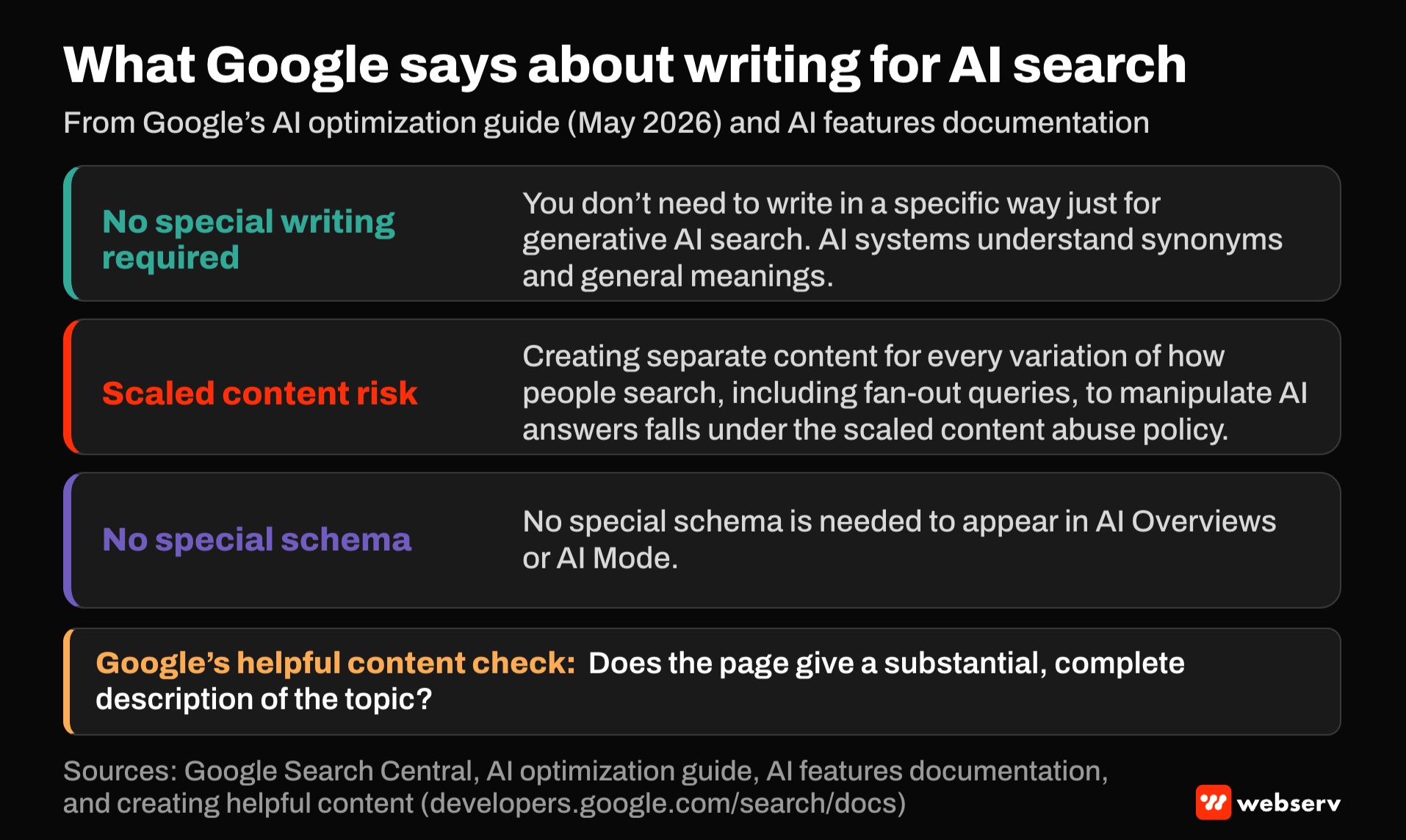
The same guide warns that creating separate content for every variation of how people might search, including fan-out queries, to manipulate AI answers falls under its scaled content abuse policy. Its AI features documentation adds that there’s no special schema needed to appear in AI Overviews or AI Mode.
Google’s helpful content guidance asks whether content provides a substantial, complete description of the topic, and warns against pages that promise to answer a question that has no answer.
COMMON MISTAKE
One page per question. A team takes a list of questions families ask, such as “Does insurance cover detox?”, “How long is detox?”, and “Is detox painful?”, and builds a separate page for each, each one a few paragraphs long.
Google names this pattern as a scaled content risk. Put related questions on the page that covers the topic, such as the detox program page, where the answers support each other and the reader has a next step. Our compound-prompt content model covers how to group them.
What the citation data shows about FAQs
SE Ranking published two large studies of what correlates with AI citations, and their results on FAQs and questions point in different directions.
AI Mode. SE Ranking’s AI Mode study of 2.3 million pages found pages with FAQ sections averaged 4.9 citations, versus 4.4 without. Question-style titles made almost no difference, and FAQ schema showed no meaningful impact.
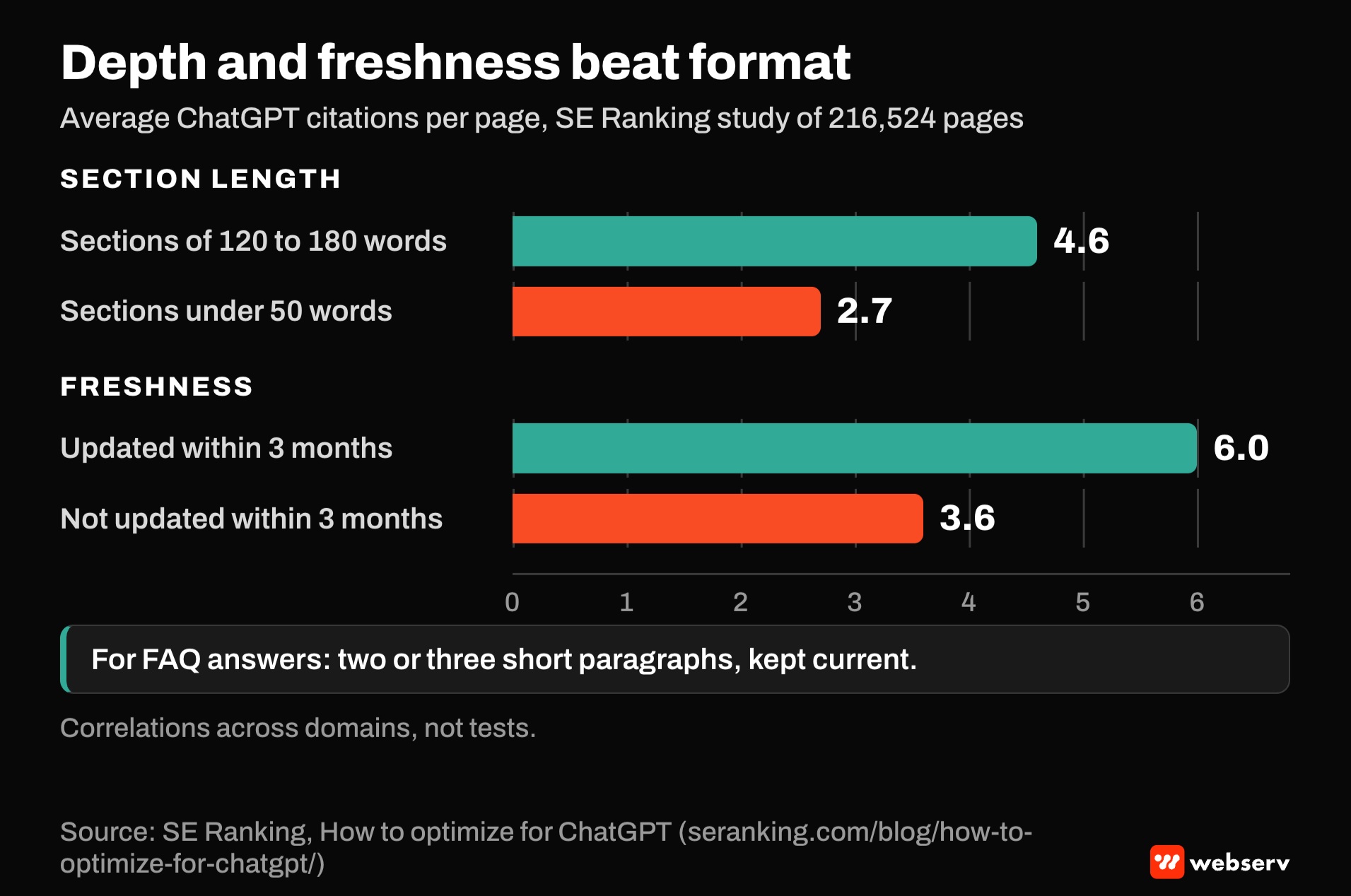
ChatGPT. SE Ranking’s ChatGPT study of 216,524 pages found pages with FAQ sections averaged 3.8 citations versus 4.1 without, and pages with question-style titles and H1s averaged 3.4 versus 4.3. Sections of 120 to 180 words averaged 4.6 citations, versus 2.7 for sections under 50 words. Pages updated within three months averaged 6.0 versus 3.6.
| Factor (average citations, with vs. without) | AI Mode (SE Ranking) | ChatGPT (SE Ranking) |
|---|---|---|
| FAQ section | 4.9 vs 4.4 | 3.8 vs 4.1 |
| Question-style titles | Negligible (4.6 vs 4.5) | 3.4 vs 4.3 |
| FAQ schema | No meaningful impact | 3.6 vs 4.2 |
These are correlations across domains, not tests. Read together, they suggest FAQ sections help when they add real answers, question phrasing alone does little, and depth and freshness matter more than format.
FAQ markup. Google stopped showing FAQ rich results on May 7, 2026, and removed the documentation in June. Our guide to FAQ schema after Google dropped FAQ rich results covers what that means: keep visible FAQ sections that answer real questions, and don’t treat the markup as a citation lever.
Why FAQ sections still matter for treatment centers
The case for FAQ sections on treatment center pages was never mainly about search features. Families have specific, practical questions, and a program page that answers them is more useful than one that doesn’t.
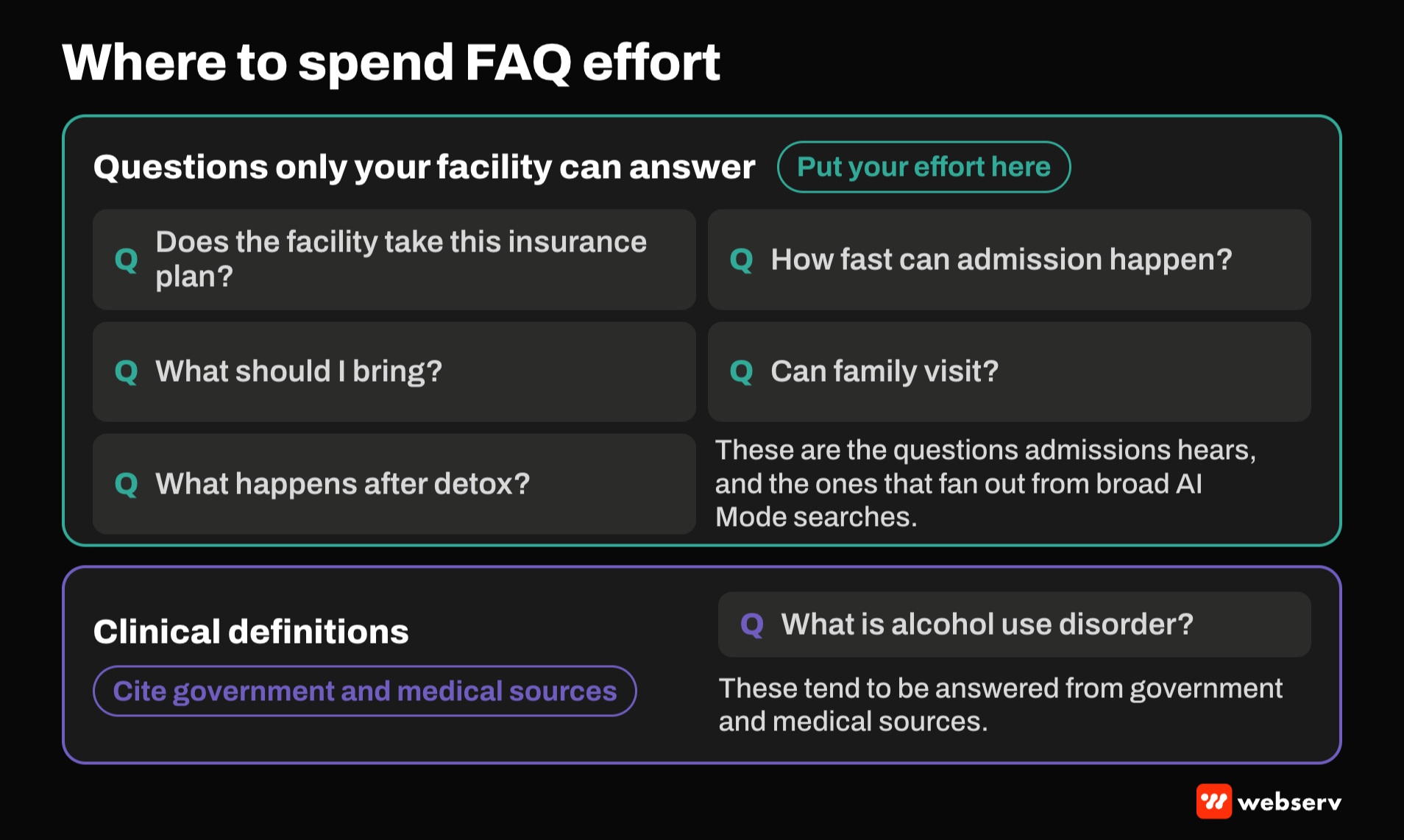
The questions that matter are the ones admissions hears: whether the facility takes a particular insurance, how fast admission can happen, what to bring, whether family can visit, what happens after detox.
Those are also the questions that fan out from a broad AI Mode search like “what should I know before sending my son to residential treatment in Arizona.”
Clinical definitions are a different matter. Questions like “What is alcohol use disorder?” tend to be answered from government and medical sources. Cite those sources; put your effort into the questions only your facility can answer.
How to write FAQ sections that hold up
Source questions from admissions, not keyword tools. Ask the admissions team for the questions families ask on calls, in their words. Add questions from intake forms, reviews, and email.
Answer first, then explain. Start each answer with a direct sentence that stands on its own. Our guide to the 40-word answer block covers the format.
Give enough depth. SE Ranking found mid-length sections outperformed very short ones in ChatGPT citations. A one-line answer rarely covers a real family question; two or three short paragraphs often do.
Be specific to the facility. “Yes, we admit seven days a week, including weekends” is more useful than “Admission times vary.” Specific, verifiable facts are what an AI answer can repeat.
Keep answers current. Insurance, programs, and policies change. SE Ranking found recently updated pages averaged more ChatGPT citations, and outdated answers mislead families.
Place FAQs where the topic lives. Detox questions on the detox page, insurance questions on the insurance page. A single site-wide FAQ page can work as an index, but the answers belong in context.
OPERATOR INSIGHT
Treat the FAQ section as the admissions team’s most common answers, published. When a family calls already knowing the answer to the first five questions, the call moves faster and the website did its job.
Review the FAQs with admissions each quarter. New questions show up when payer rules, programs, or local conditions change.
How to measure it
There’s no single report for FAQ performance in AI answers. Track the outcomes instead. For a related measurement question, see our guide on why blog traffic drops while rankings hold.
- Search Console. AI Mode and AI Overview traffic counts in the Performance report. Google’s dedicated generative AI performance report, rolled out to all sites by August 31, 2026, shows AI Overview and AI Mode impressions by page. Watch the pages with new or updated FAQ sections. Our guide to Search Console’s AI performance reporting covers the reports.
- Citation tracking. Run a fixed set of family questions through AI Mode, ChatGPT, and other assistants and record citations. Our guide to measuring AEO compares methods.
- Admissions feedback. Ask admissions whether callers arrive better informed.
Where this fits
FAQ sections are one part of a page built to answer questions well. For the broader build, see our guide to getting cited in Google AI Overviews and ChatGPT, the Full AI Search Stack, and the 12 SEO failure patterns diagnostic.
For how AI search fits the rest of your marketing, see the complete guide to behavioral health marketing. If you want a second look at your FAQ sections, book an intro meeting.
Frequently Asked Questions
Do FAQ sections help treatment centers get cited by AI?
They can, when they add real answers. SE Ranking found pages with FAQ sections averaged slightly more AI Mode citations, 4.9 versus 4.4.
Its ChatGPT data pointed the other way, with FAQ pages averaging slightly fewer citations, so the format alone isn’t the reason.
Write FAQs that answer specific family questions with facility facts, and keep them current.
Should FAQ questions be phrased like AI prompts?
Not necessarily. Google says you don’t need to write in a specific way for generative AI search, and AI systems understand synonyms and meaning.
SE Ranking found question-style headings made little difference in AI Mode and averaged fewer citations in ChatGPT.
Phrase questions the way families ask them on admissions calls, and answer them directly.
Should we create a page for every question families ask?
No. Google warns that creating separate content for every search variation, including fan-out queries, to manipulate AI answers can violate its scaled content abuse policy.
Group related questions on the page that covers the topic, such as the detox or insurance page.
That keeps answers in context and gives readers a clear next step.
Is FAQ schema still worth adding?
Google stopped showing FAQ rich results on May 7, 2026, and says no special schema is needed for AI features. SE Ranking found FAQ schema had no meaningful effect on AI Mode citations.
Keep visible FAQ sections that answer real questions.
The markup itself isn’t a citation lever.
Which questions should a treatment center FAQ answer?
The practical ones families ask admissions: insurance, admission timing, what to bring, visiting, program schedules, and what happens after each level of care.
Clinical definitions tend to be answered from government and medical sources, so cite those rather than competing with them.
Review the list with admissions each quarter.
Trevor Gage is the Director of Marketing at Webserv, a digital marketing agency for treatment centers.