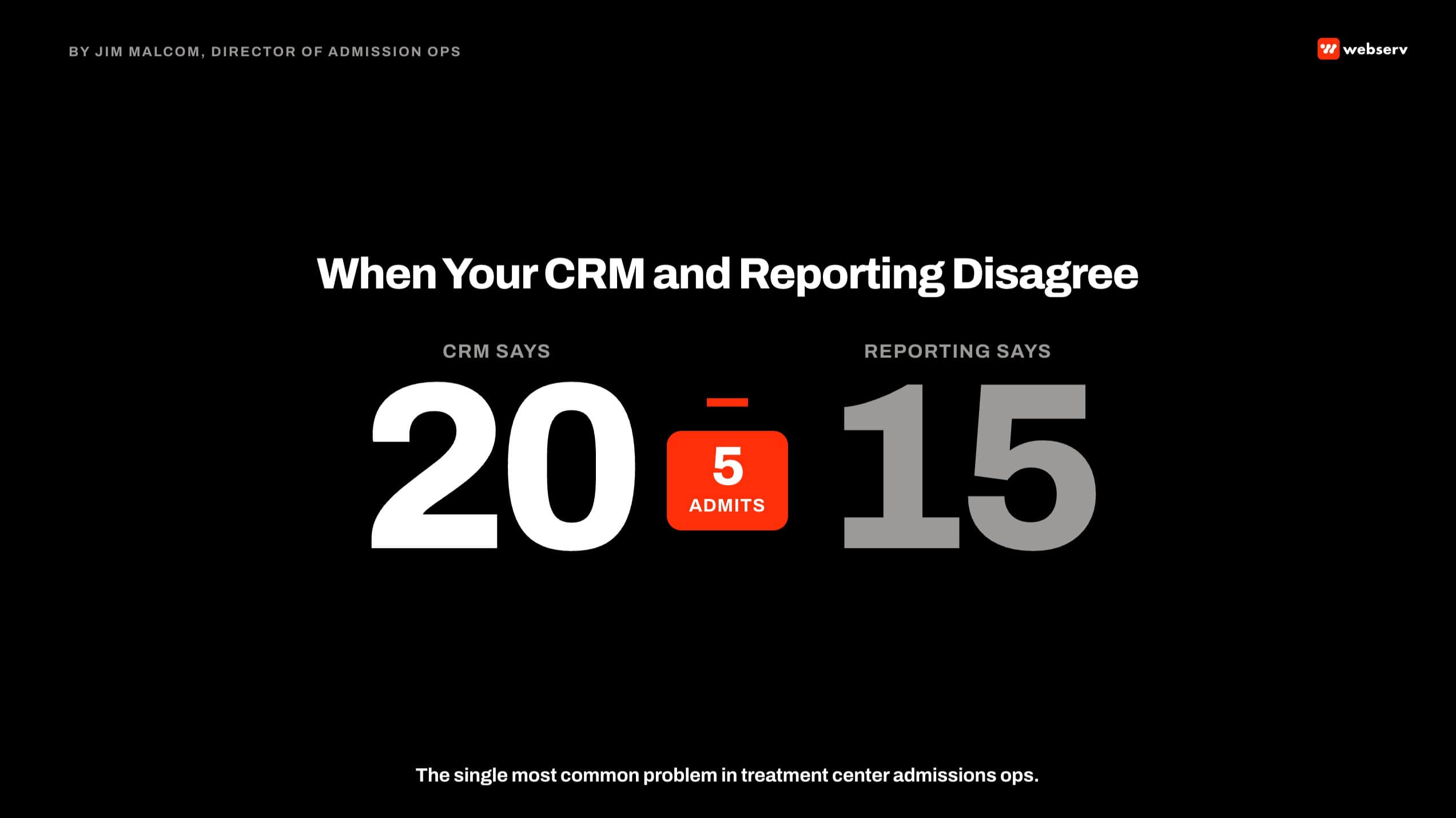
I was on a client call earlier this year running two reports side by side. The CRM said 20 admits for the month. The ad platform reporting said 15.
Somebody had to answer where the five missing admits went, or where the five extra CRM records came from, or where the data broke between the two systems.
This is the reconciliation gap. It is the single most common problem I find inside treatment center admissions operations engagements we run at Webserv, because it invalidates half of every reporting decision downstream.
If the CRM number and the reporting number do not match within a small tolerance, you cannot trust cost per admit, cannot trust attribution, cannot make defensible budget decisions.
This article is the middle piece of a three-part attribution arc for treatment center operators. The first piece established the KPI spine your CRM needs to track.
This piece is the reconciliation discipline that makes those metrics trustworthy. The third piece deals with the specific signal-quality problem of payer tiering. All three build on each other.
Key Takeaways
- A healthy admissions operation shows the same admit count in the CRM and in the billing system within a 5 percent tolerance for any given period. Gaps larger than that mean the reporting is structurally broken and every downstream decision is being made on bad data.
- The reconciliation gap comes from three primary causes: CRM record hygiene, source-attribution decay, and integration drift between systems. Each cause has a specific fix, and each fix is boring.
- The weekly failsafe audit is the standard. Someone in your organization owns it. They run it every week. They report the gap to leadership. When the gap moves out of tolerance, they diagnose the cause before anything else on the marketing dashboard gets acted on.
- Reconciliation is upstream of every other marketing decision. Cost per admit calculations, campaign performance rankings, coordinator scorecards, and paid-media bidding algorithms all inherit whatever accuracy the reconciliation produces. Bad reconciliation compounds through all of them.
- The fastest path to a working reconciliation is a named owner, a documented workflow, and a weekly cadence. The technology is secondary. Every CRM I have deployed can produce clean reconciliation reports if someone in the organization is accountable for running them.
The Live-Call Moment
The pattern always looks the same. Somebody pulls the CRM report on the shared screen. Somebody pulls the marketing platform report next to it. The numbers do not match.
The first reaction is usually to assume one system is right and the other is wrong. That is almost never the case. Both systems are showing what they were told.
What is broken is the process that keeps them in sync, or the source-attribution field that connects them, or the human step where a coordinator was supposed to update the record and did not.
The 20-versus-15 gap I described in the intro was a real number from a real client. When we traced it back, three of the missing admits were in the CRM but had never been pushed as offline conversions back to the ad platform.
The automated sync had silently failed two weeks earlier.
Two of the missing admits were logged in the ad platform’s conversion pipeline but did not exist in the CRM because a coordinator had entered them as free-form notes rather than in the correct admit-status field.
All five gaps had operational fixes. But finding them required a live human sitting with both reports open, running the reconciliation until every discrepancy had a documented cause. That process is the discipline. Not the software.
Data quality discipline in behavioral health treatment data is a broader federal-level concern too. SAMHSA’s National Survey on Drug Use and Health documentation establishes the measurement rigor expected across the industry for treatment data reporting.
Cause 1: CRM Record Hygiene
DEFINITION
Data Hygiene
The discipline of keeping CRM records complete, accurate, and current across the full lifecycle of an admissions prospect. Data hygiene fails when coordinators skip fields, enter data in free-form when structured fields exist, or fail to update records after admits fall through or complete. Half of any CRM’s effectiveness is coordinator buy-in and consistent hygiene. Without it, the CRM is a graveyard of half-filled records.
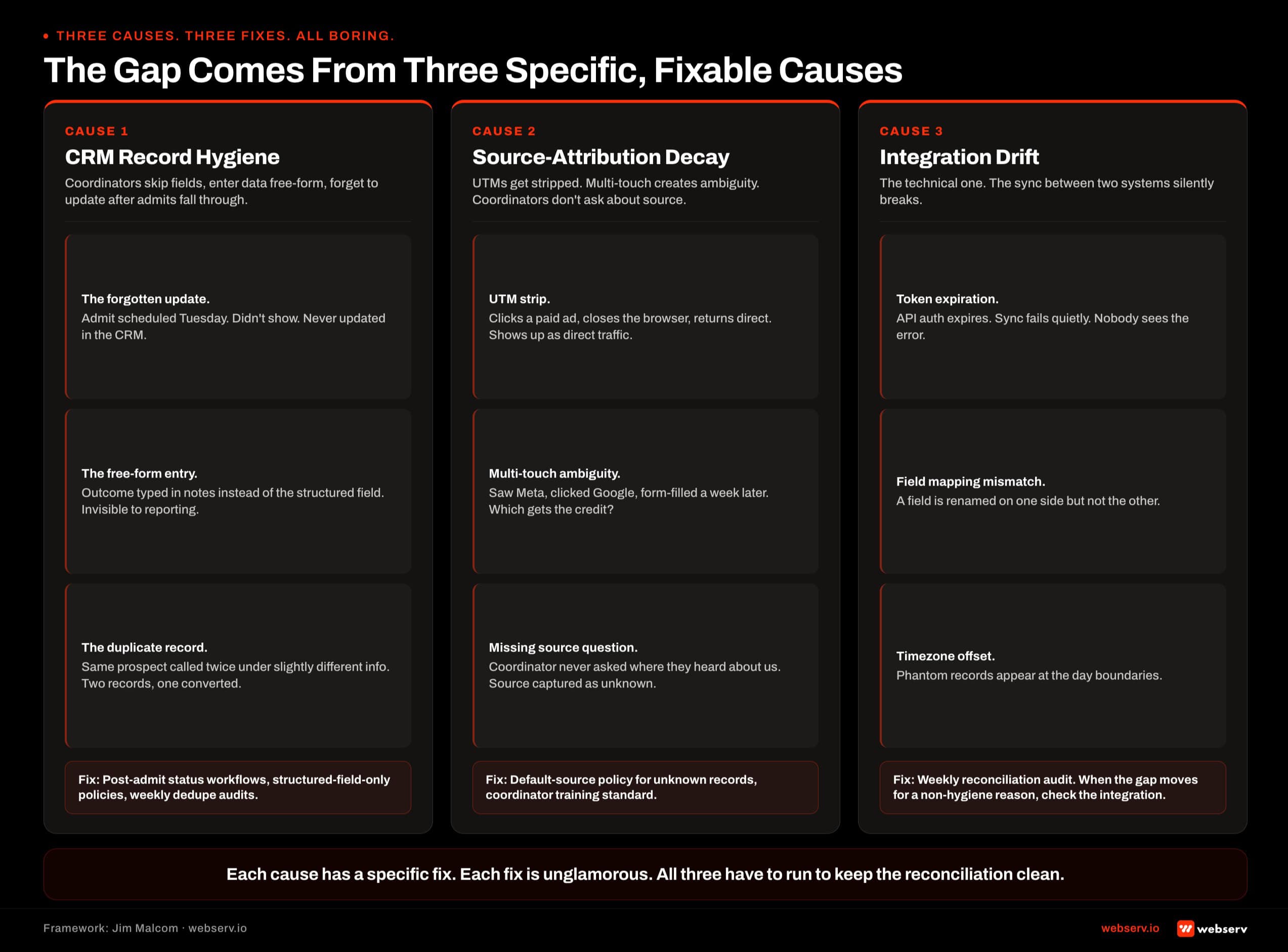 The three causes of the reconciliation gap between a treatment center’s CRM and its reporting systems: CRM record hygiene failures, source-attribution decay, and integration drift, each with common patterns and specific fixes.
The most common cause of the reconciliation gap is data hygiene. The specific patterns I see:
The forgotten update. A coordinator scheduled an admit for Tuesday. The admit did not show. The coordinator was on to the next call and never went back to update the CRM record. The CRM still reflects the admit as scheduled. The billing system reflects reality.
The free-form entry. A coordinator logged the admit outcome in the notes field (“admitted 3/15”) instead of in the structured admit-status field. The CRM’s admit count query does not read the notes field. The admit is invisible to reporting.
The duplicate record. The same prospect called in twice under slightly different contact info and was created as two separate CRM records. When one converted to an admit, the other stayed as an open lead. The CRM double-counts because deduplication was skipped.
The fixes for all three are boring. Post-admit status update workflows, structured-field-only entry policies, and weekly deduplication audits. Every treatment center CRM needs all three configured before the reconciliation can be trusted.
Cause 2: Source-Attribution Decay
SOURCE-ATTRIBUTION DECAY IS INVISIBLE UNTIL YOU AUDIT FOR IT
The reconciliation gap does not always show up in the top-level admit count. Sometimes the counts match but the attribution is silently wrong. Two admits attributed to organic that actually came from paid search will not create a total-admit gap, but they will make the paid search campaign look worse than it is and the organic performance look better than it is. Every reconciliation should include a source-attribution audit alongside the admit count audit.
The second cause is subtler and harder to detect. An admit was logged in billing without a source captured in the CRM. The admit exists. The revenue exists. The attribution to a specific marketing channel or campaign does not.
Source attribution can decay at several points in the funnel. UTMs get stripped when a prospect clicks an ad, lands on a page, closes the browser, and returns to the site by direct search.
The second visit shows up as direct traffic with no source. If the coordinator does not ask the prospect where they heard about the facility during the call, the CRM record gets created without a source.
Multi-touch attribution creates its own version of the problem. A prospect saw the Meta ad, clicked the Google ad two days later, then completed a form fill on the site a week after that.
Depending on how the CRM is configured, the admit might attribute to Meta, Google, or the form fill. All three are technically correct. Only one becomes the reported source.
The fix is a default-source policy for records without a captured source, combined with a coordinator training standard that requires the source question during intake. The default policy is not glamorous, but it is legible. “If source is unknown, tag as direct-unattributed and flag for review” is a rule the CRM can enforce and reporting can filter around.
Cause 3: Integration Drift
The third cause is the technical one. The integration between two systems silently breaks. The API returns errors that nobody sees. A field-mapping gets renamed on one side but not the other. A timezone offset creates phantom records at day boundaries.
Coordinators keep entering data, reports keep running, dashboards keep updating, but the sync between two systems has stopped working.
Integration drift is what caused three of the five gaps in the 20-versus-15 example. The CRM-to-ad-platform offline-conversion sync had silently failed because of a token expiration that neither system flagged loudly.
Two weeks of admits accumulated in the CRM without being pushed as offline conversions. The Google Ads algorithm continued optimizing without seeing the most recent admits, which meant the bidding decisions for those two weeks were made on stale signal.
The pattern for detecting integration drift is simple: run the reconciliation weekly, and when the gap moves out of tolerance for a reason that cannot be traced to CRM record hygiene or source attribution, check the integration health. Ninety percent of the time, the integration is what broke.
The Google Ads API documentation on uploading click conversions is worth understanding as background context here. The mechanism by which admits flow from the CRM back to the ad platform is the specific integration path most likely to fail without alerting anyone.
The Weekly Failsafe Audit
The reconciliation discipline is a weekly audit run by a named owner in the operator’s organization. The workflow:
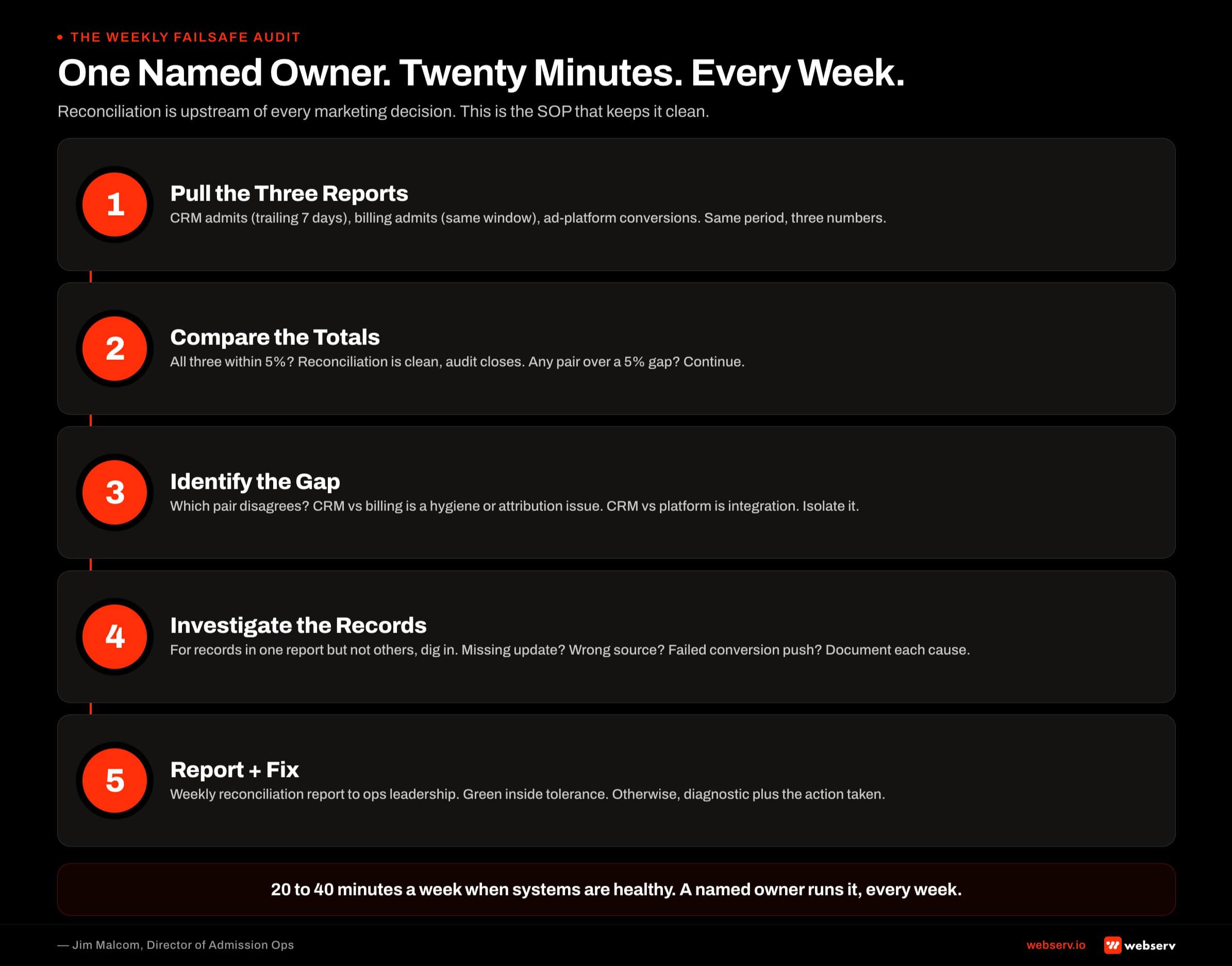 The five sequential steps of the weekly failsafe reconciliation audit for treatment center admissions: pull the three reports, compare the totals, identify the gap, investigate the records, and report and fix.
- Pull the Three Reports. CRM admit report for the trailing 7 days. Billing admit report for the same 7 days. Marketing platform conversion report (Google Ads, Meta Ads, etc.) for the same 7 days. Three numbers, same period.
- Compare the Totals. If all three match within 5 percent of each other, the reconciliation is clean and the audit is done. If any pair shows a gap larger than 5 percent, move to Step 3.
- Identify the Gap. Which pair of reports disagrees? CRM vs billing indicates a data-hygiene or source-attribution issue. CRM vs marketing platform indicates an integration issue. Isolating the pair narrows the cause.
- Investigate the Records. For the specific records that appear in one report but not the others, dig into what happened. Was the record created but never updated? Was the source captured incorrectly? Did the offline conversion push fail? Document the cause of each discrepancy.
- Report and Fix. Send a weekly reconciliation report to operations leadership showing the gap, the cause, and the fix. If the gap is inside tolerance, the report is a one-line green flag. If the gap is outside tolerance, the report includes the diagnostic and the action taken.
The audit takes 20 to 40 minutes per week when the underlying systems are healthy. It takes longer during the first month when the process is being calibrated and every discrepancy is being investigated. Once the process is running, most weeks are green.
The named-owner requirement is load-bearing. If reconciliation is a shared responsibility between the CRM admin, the operations manager, and the marketing lead, it stops happening. If it belongs to one person with the tools, the access, and the accountability, it happens weekly.
What Gets Better Once the Numbers Match
RECONCILIATION IS UPSTREAM OF EVERY MARKETING DECISION YOUR OPERATION MAKES
Cost per admit calculations, campaign performance rankings, coordinator scorecards, and paid-media bidding algorithms all inherit whatever accuracy the reconciliation produces. When the reconciliation is clean, the downstream decisions become defensible. When the reconciliation is broken, everything downstream is opinion instead of fact. This is the single biggest compounding upgrade an admissions operation can make.
The changes downstream of clean reconciliation are not subtle.
Cost per admit becomes an accurate, trustable number. Your $12,000 cost per admit yesterday was fiction if the admit count was wrong. Once reconciled, the number is real, and every follow-on decision (add budget, cut budget, expand to a new market, drop a campaign) becomes defensible.
Campaign-level rankings become correct. When source attribution is clean, the campaigns that are actually producing admits get credit, and the campaigns that are not stop consuming budget by accident.
Most treatment centers I audit have at least one campaign that looks like it is performing well but is actually running on miscredited attribution from a stronger campaign.
Coordinator performance conversations become fair. When every admit is logged accurately and attributed to a specific coordinator, the team-level closing rate breakdown becomes defensible. The top performers get credit. The underperformers get coached. When the data is broken, both conversations get dismissed as “the numbers are wrong anyway.”
Bidding algorithms train on real signal. This is the most important downstream effect. Google Ads Smart Bidding, Meta’s automated bidding, and every other machine-learning-driven optimization system depend on the conversion data you push back to them. Our companion piece on how your admissions team is training the algorithm walks the mechanism in depth.
If the reconciliation is broken, you are training the algorithm on incomplete or wrong data. The algorithm’s optimization is only as good as the signal it receives. That signal training is what the third piece of this attribution arc goes deeper on.
When to Call in Outside Help
<5%
acceptable reconciliation gap for a healthy operation
10-15%
typical gap I find when a new client hasn’t been running a weekly audit
20%+
gaps we see when integration drift has been silent for months
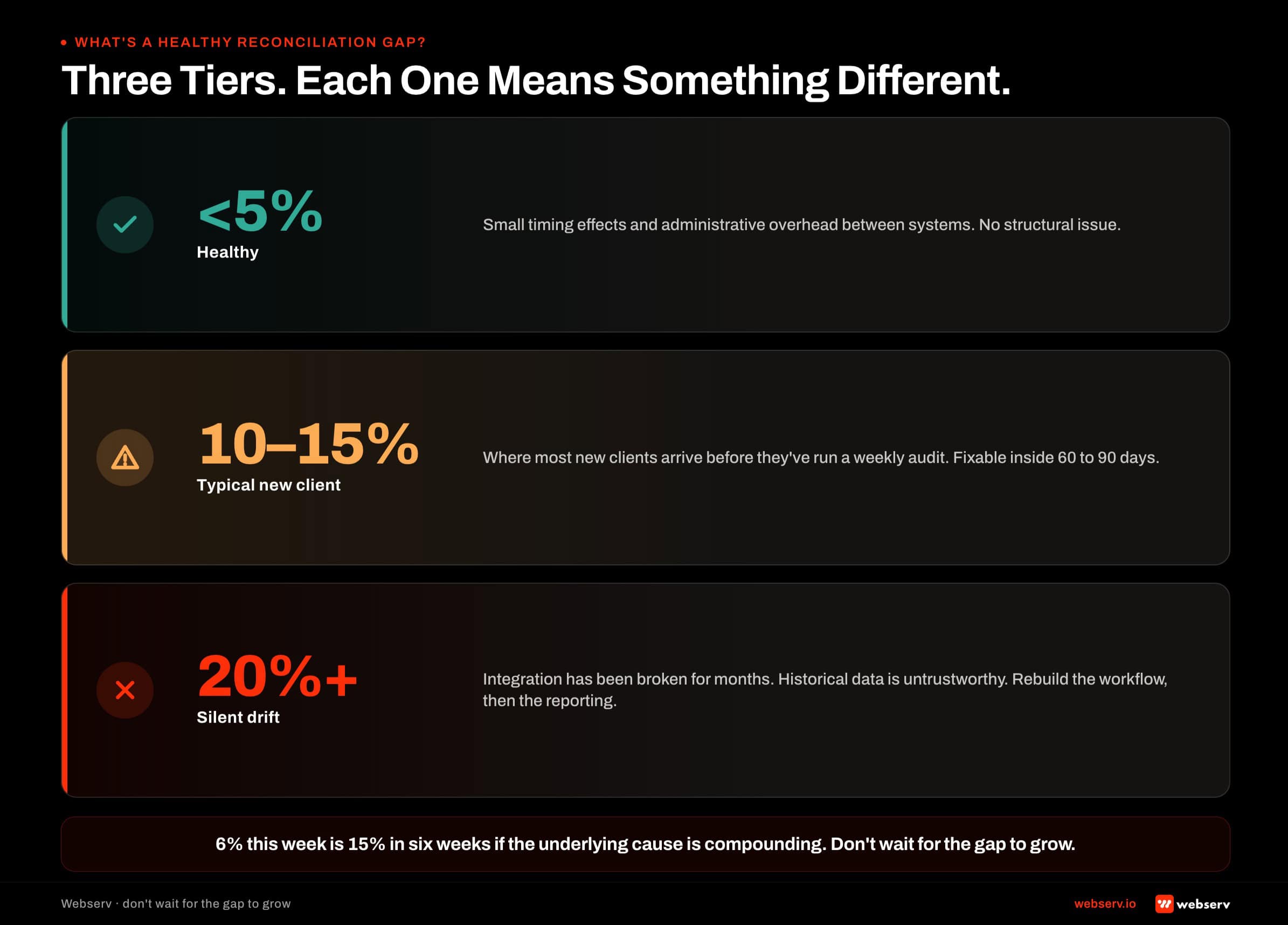 Three tiers of the reconciliation gap between a treatment center’s CRM and reporting: under 5% is healthy, 10-15% is typical for new clients who haven’t been running a weekly audit, and 20% or more indicates silent integration drift.
Most treatment centers can fix reconciliation gaps in-house once someone owns the workflow. The exception is when the underlying systems are so misconfigured that the reconciliation workflow itself cannot run cleanly. Common patterns where outside help accelerates the fix:
- The CRM lacks the fields required for structured admit-status tracking, and the coordinator team is entering data in free-form notes.
- The integration between CRM and ad platform has been broken for months and nobody knows the exact date it started.
- Source-attribution has never been captured cleanly and the historical data has no clear default-source policy.
- The billing system and the CRM live in different data models and the field-mapping was never documented.
In these cases, an outside partner with an admissions-ops audit playbook can catch the structural problem faster than internal teams typically can.
The rebuild of the reconciliation workflow is usually 30 to 60 days of work, and it pays back inside the first quarter once the downstream marketing decisions become defensible. Book an intro meeting if you want to walk your current reconciliation state with our team live.
Frequently Asked Questions
What tolerance should we set for the reconciliation gap?
5 percent is the standard I hold every treatment center admissions operation to. On a facility running 40 admits a month, that is a 2-admit tolerance. Within that range, small timing effects and administrative overhead between systems account for the gap without any structural issue.
Gaps larger than 5 percent should trigger the investigation workflow immediately. Do not wait for the gap to grow. A 6 percent gap this week is a 15 percent gap in six weeks if the underlying cause is compounding.
Some larger operations set tighter tolerances (2 or 3 percent) once the workflow is mature and consistently producing green weeks. That is a reasonable optimization. Starting with 5 percent as the target is the right entry point.
Who should own the reconciliation workflow?
The role depends on facility size. For smaller centers (under 30 admits a month), the operations manager or admissions leader typically owns it. For mid-size centers, a dedicated CRM administrator or analytics lead. For enterprise-scale operations, a dedicated reporting function that consolidates data across facilities.
The requirements are the same regardless of role: authorized access to all three systems (CRM, billing, marketing platform), technical fluency with each system’s reporting layer, and direct accountability to operations leadership. If any of the three requirements is missing, the workflow will not produce weekly reports.
The owner does not need to be a data scientist. They need to be someone who can pull three reports, compare them, and dig into discrepancies methodically. The tools are secondary to the discipline.
How does this relate to the “admissions team is training Google’s algorithm” idea?
The two concepts are directly connected. Google Ads Smart Bidding, Meta’s automated bidding, and every other machine-learning-driven ad platform depends on the conversion data you push back to them. If your CRM and your ad platform disagree on how many admits happened, the platform is optimizing on wrong data.
Every unrecorded admit is a training signal the algorithm never received. Every miscredited admit is a wrong signal the algorithm did receive. Both problems compound over time and eventually produce campaigns that are optimizing toward the wrong prospects.
The reconciliation is what keeps the training signal clean. It is not a nice-to-have for marketing reporting. It is a load-bearing input for how well your paid media performs in the next 60 to 90 days.
What is the fastest way to start fixing a broken reconciliation?
Start with the weekly audit itself. Even if the underlying systems have known issues, run the three-report comparison manually for one week. Do it yourself if there is no named owner yet. Write down the discrepancies. That first audit is diagnostic before it is corrective.
The first audit almost always reveals which of the three causes (record hygiene, source attribution, or integration drift) is producing the biggest gaps. Focus the first month of fixes on the biggest cause. Do not try to solve all three in parallel.
Once the workflow is running and someone owns it, the structural fixes get cheaper because you have documentation of exactly what breaks and how often. Most operators who start with a broken reconciliation are inside a 5-percent tolerance within 90 days of the workflow going live.
Jim Malcom is the Director of Admission Ops at Webserv, a digital marketing agency for treatment centers.