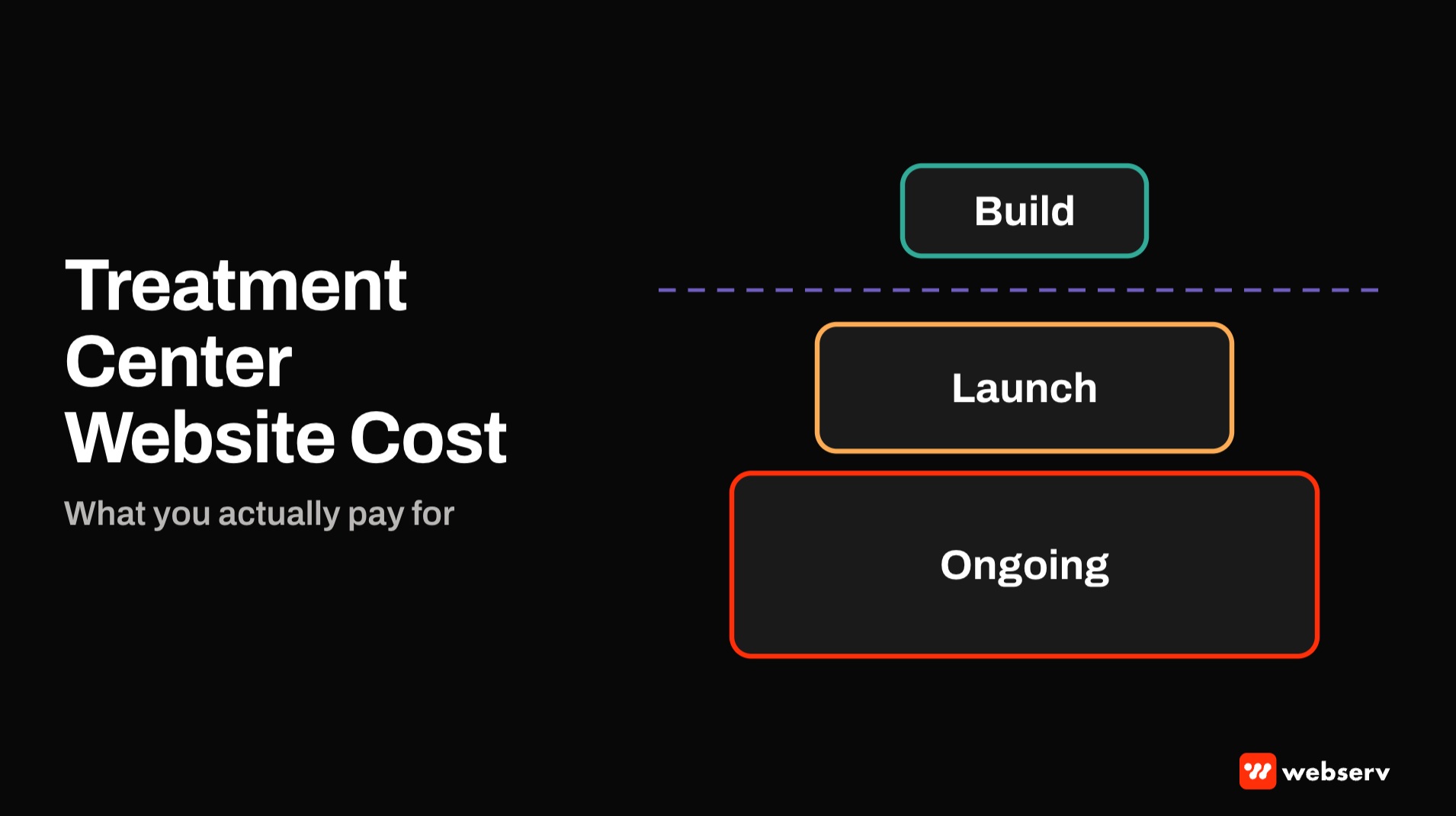
Two treatment center website quotes can land several times apart and both be honest. One covers a template, your logo, and whatever copy you send over. The other covers the work that decides whether the site produces calls: structure, content, tracking, compliance, and a migration that doesn’t lose your search rankings.
The price on the quote matters less than what’s in it. This guide breaks down what drives the cost of a treatment center website, which ongoing costs come after launch, and which compliance work cheap quotes tend to leave out. It’s part of how we approach website design for treatment centers.
Key Takeaways
- The biggest cost drivers are the number of page templates, who writes the content, integrations like call tracking and forms, and how carefully the old site is migrated.
- Ongoing costs continue after launch: hosting, HIPAA-eligible forms, call tracking, LegitScript certification, plugins, and maintenance.
- Compliance work belongs in the scope: HIPAA-safe forms and tracking, accessibility, and state-specific disclosures. Leaving it out doesn’t make it free.
- Ask every vendor what’s included, what’s billed separately, and who maintains the site after launch.
- A refresh of a sound existing site usually costs less and moves faster than a full rebuild.
What drives the cost of a build
Templates matter more than page count. Most quotes are built around templates: the homepage, a program page, a location page, an insurance page, a blog post, and a few others.
Once a template exists, adding pages that use it costs far less than designing a new one. A site with 40 pages and eight templates can cost less than a site with 15 pages and 15 unique designs.
Content. Writing or rewriting program, insurance, and clinical content is often the largest hidden cost. Clinical content needs review by someone qualified, and it needs to match what your admissions team actually says.
Photography. Real photos of your facility and staff cost more than stock images, and they matter more. Our guide to rehab website design as a clinical trust signal explains why.
Integrations. Call tracking, HIPAA-eligible forms, insurance verification forms, live chat, your CRM, and analytics all take setup and testing.
Migration. Moving an existing site means mapping every old URL to a new one, carrying over metadata and schema, and redirecting what changes. Skipping this step is how sites lose rankings after a redesign. Our guide to rebuilding or optimizing your website covers the risk.
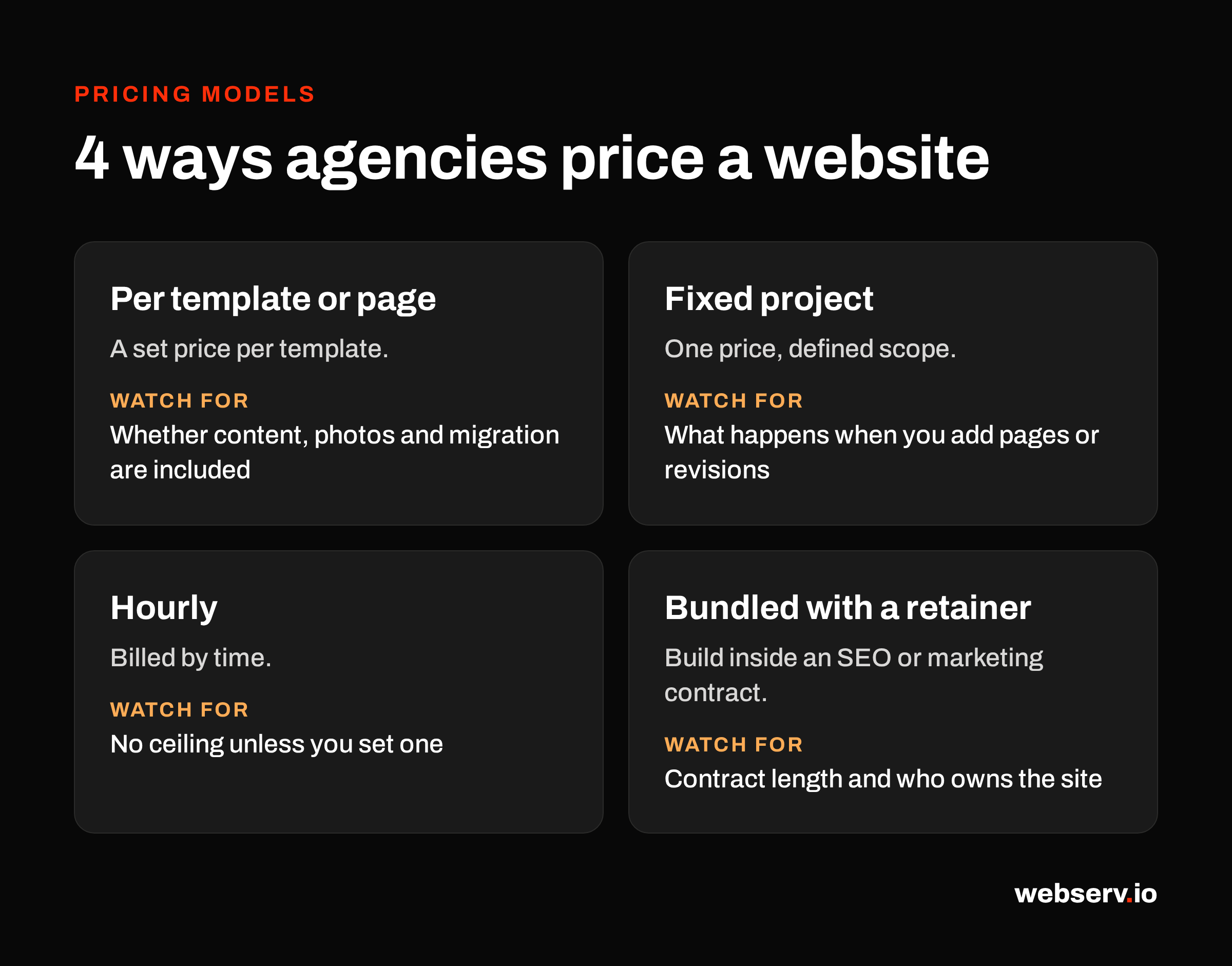
Pricing models you’ll see
Vendors price websites in a few common ways. None is better by default; what matters is what each includes.
| Model | How it works | Watch for |
|---|---|---|
| Per template or per page | A set price for each template or page | Whether content, photos, and migration are included |
| Fixed project | One price for a defined scope | What happens when you add pages or revisions |
| Hourly | Billed by time spent | No ceiling unless you set one |
| Bundled with a retainer | The build is part of an ongoing SEO or marketing engagement | Contract length, and who owns the site if you leave |
At Webserv, we usually build or rebuild sites alongside an SEO engagement, so structure, content, and search planning happen together. Our SEO retainers include website care: plugin updates, security fixes, and checks that forms and call tracking keep working.
COMMON MISTAKE
Comparing quotes by the total alone. A low quote that excludes content, migration, and tracking setup isn’t cheaper. It moves those costs to you, often after launch, when fixing them is harder.
Ongoing costs after launch
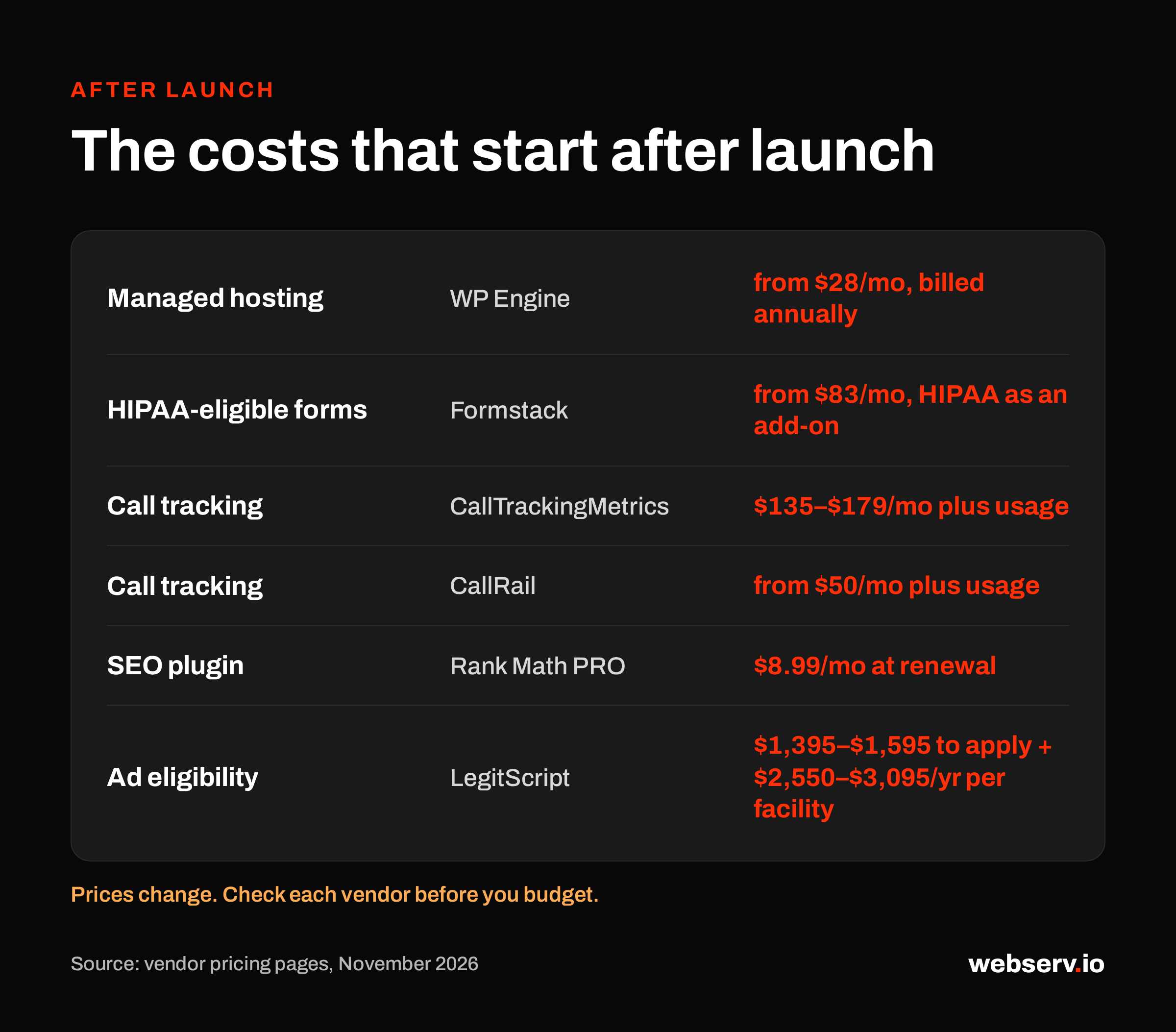
A website keeps costing money after it goes live. These are published prices from common vendors, checked in November 2026. They change often, so confirm before you budget.
| Cost | Example | Published price (November 2026) |
|---|---|---|
| Managed WordPress hosting | WP Engine | Essential plan from $28 per month, billed annually |
| HIPAA-eligible forms | Jotform | HIPAA features on Gold and Enterprise plans only |
| HIPAA-eligible forms | Formstack | Forms plan from $83 per month billed annually, HIPAA as an add-on |
| Call tracking | CallTrackingMetrics | Marketing Pro, which includes HIPAA features, from $135 to $179 per month depending on term, plus usage |
| Call tracking | CallRail | Plans from $50 per month plus usage; healthcare plans and a BAA through sales |
| SEO plugin | Rank Math PRO | $8.99 per month at renewal, billed annually |
| Ad eligibility | LegitScript certification | Application fee of $1,395 to $1,595 per facility, plus an annual fee of $2,550 to $3,095 per facility |
Sources: each vendor’s own pricing page, checked November 10, 2026.
Know what your vendors will and won’t sign. WP Engine says it doesn’t sign business associate agreements and that its hosting shouldn’t store patient health records. Gravity Forms says it won’t sign a BAA because it doesn’t store form data for you.
That’s workable as long as protected health information never sits on the site or flows through those tools. Route sensitive forms through a vendor that signs a BAA.
Maintenance is the other ongoing cost: plugin and core updates, security monitoring, backups, and making sure forms and phone numbers still work. Ask whether it’s included or billed separately.
Compliance work that cheap quotes leave out
These requirements don’t go away because a quote didn’t mention them.
HIPAA-safe forms and tracking. HHS’s guidance on online tracking technologies still applies to authenticated pages and to vendors that receive protected health information, even though a 2024 court decision vacated one part of it. Our guide to HIPAA-compliant contact forms covers the setup.
Accessibility. If your program receives federal financial assistance, such as Medicaid or Medicare payments, HHS’s Section 504 rule requires your website to meet WCAG 2.1 Level AA by May 11, 2027 if you have 15 or more employees, or by May 10, 2028 if you have fewer.
HHS extended both deadlines by a year in May 2026.
State and federal notices. Some requirements are content, not code: a good faith estimate notice for self-pay patients, language assistance notices for federally funded programs, and state disclosures such as California’s licensing status notice. Our website compliance checklist and our piece on the good faith estimate notice cover them.
OPERATOR INSIGHT
Ask each vendor to show where compliance appears in the scope, line by line. If it isn’t listed, assume it isn’t included.
Timelines and refresh vs. rebuild
In our experience, refreshing a sound existing site takes about six to eight weeks. A full rebuild typically takes longer, up to 12 to 16 weeks when revisions and content approvals stretch out.
A refresh makes sense when the platform is healthy and the structure mostly works, but the design, content, or conversion paths need work. A rebuild makes sense when the platform fights you, the structure is wrong, or the site can’t meet compliance requirements without starting over.
Our guide to website development for treatment centers covers platform choices.
Questions to ask before you sign
Put these questions to every vendor in writing, and compare the answers side by side.
QUESTIONS TO ASK EVERY VENDOR
- What’s included? Templates, page count, content writing, photography, migration, redirects, tracking setup, and compliance items.
- What’s billed separately? Revisions beyond a set number, new pages, plugins, and third-party tools.
- Who owns the site and hosting account? You should own both, with admin access.
- Who maintains it after launch, and is that included or extra?
- How will you protect our search rankings during migration?
- Which tools will touch patient information, and will each one sign a BAA?
Where this fits
For the structure behind a strong site, see our guide to rehab website design as a clinical trust signal. For the cost of search work after launch, see our breakdown of rehab SEO cost. For real examples, see our gallery of treatment center website examples.
For how your website fits the rest of your marketing, see the complete guide to behavioral health marketing. If you want a second look at a website quote you’ve received, book an intro meeting.
Frequently Asked Questions
How much does a treatment center website cost?
It depends on templates, content, photography, integrations, and migration more than on page count alone.
Quotes vary widely because they include different work. Compare what each covers before comparing totals.
Budget for ongoing costs too, such as hosting, HIPAA-eligible forms, call tracking, and maintenance.
Does a treatment center website need HIPAA-compliant hosting?
Not if protected health information never sits on the website. Many managed WordPress hosts, including WP Engine, don’t sign business associate agreements.
Route forms that collect health information through a vendor that signs a BAA.
Check every tool that touches patient information, including the host.
Do treatment center websites have to meet accessibility standards?
If your program receives federal financial assistance, HHS’s Section 504 rule requires WCAG 2.1 Level AA.
The deadline is May 11, 2027 for recipients with 15 or more employees and May 10, 2028 for smaller ones.
Accessibility is also good practice for every visitor, whether or not the rule applies.
Should we refresh or rebuild our website?
Refresh when the platform is healthy and the structure mostly works. In our experience, that takes about six to eight weeks.
Rebuild when the platform or structure holds you back, which usually takes longer.
Either way, plan the migration carefully to protect rankings.
What ongoing costs come after a website launch?
Expect hosting, HIPAA-eligible forms, call tracking, plugins, LegitScript certification if you advertise, and maintenance.
Several of these are monthly or annual subscriptions with prices that change.
Ask your vendor which ones are included and which you’ll pay directly.
Trevor Gage is the Director of Marketing at Webserv, a digital marketing agency for treatment centers.