Most treatment center operators we work with have heard the same complaint from their paid media team for the last 18 months: lead quality is down, costs are up, and the campaigns that used to convert do not anymore.
The conversation usually pivots to keywords, agency performance, or the platform itself.
The actual fix is almost always somewhere else. It lives in the part of the operation that nobody on the marketing side touches: how fast, and how, the admissions team scores calls.
A scored call is not just a record-keeping action. It is a training example for Google’s bidding algorithm. Every “lead” tag, every “Medicaid” tag, every “spam” tag is a signal Google uses to decide who to show the next ad to.
The discipline of when and how those tags get applied is a census lever that most facility owners do not realize they are pulling on every day.
Webserv’s paid media program for treatment centers treats call scoring as a first-class part of the campaign architecture, not an admissions-team back-office task.
This piece walks through why the timing and discipline of scoring matters more than most facility operators realize, and the minimum viable scoring SOP that produces material campaign improvement without overloading the admissions team. Scoring is one stage of the broader admissions process that converts leads.
Key Takeaways
- Smart Bidding learns from the conversion data the facility feeds back. Every scored call is a training example for Google’s algorithm. Tagging a Medicaid or spam call as a lead conversion teaches Google to find more of them, which is the opposite of what the facility wants.
- Scoring “the next morning” creates a 20 to 24 hour gap between the click and the signal. The campaign spends today’s budget without yesterday’s lessons. Cross-client observation: facilities scoring same-day outperform next-morning scorers on cost-per-viable-call and cost-per-admit.
- The minimum viable scoring SOP is a 2 to 6 hour delay window for disqualifiers (Medicaid, spam, dead-air) with the lead-conversion trigger delayed to match. Bad calls never reach Google as positive signals. Good VOBs still fire fast enough to keep campaign learning current.
- Pulling a VOB on a caller with insurance but no treatment intent, just to send Google a positive signal, is a bad idea. Google serves ads partly on intent. Rewarding insured-but-not-treatment-seeking calls teaches the system to find insured people, not people who need treatment.
- If VOB cost per call is fine but cost-per-viable-call is high, the facility almost certainly has a data quality problem, not a campaign problem. Same-day scoring discipline is the most load-bearing fix in behavioral health paid media right now.
How Smart Bidding Actually Learns From Call Scoring
Google’s Smart Bidding (a one-line gloss: the automated bidding system that decides what to pay for each ad auction) optimizes against the conversion signal the advertiser sends back.
Every time a call is marked as a lead conversion in the facility’s CRM or admissions system, that signal flows back to Google as an offline conversion import.
Google Ads documentation on offline conversion imports explains the mechanic at the platform level. The piece worth understanding for behavioral health is what the signal teaches the algorithm to do next.
When a call gets tagged as a conversion, Google looks at every available signal about that caller and learns: this is what a good lead looks like. Search history. Device. Time of day. Geography. Audience segment.
The next 100 ads Google serves are weighted toward people who look like the most recent conversions, which is documented in Google’s Smart Bidding guidance.
The mechanism is simple. The implications are not.
If the most recent conversions are Medicaid callers (because the admissions team has not yet scored them out as disqualifiers), Google learns that Medicaid-pattern callers are what the facility wants. The next batch of ads goes to people who look like Medicaid policy holders.
The lead quality problem the operator was already worried about gets worse, not because the campaign is broken, but because the campaign is doing exactly what the facility is teaching it to do.
Same pattern with spam and dead-air. Same pattern with insured callers who are not treatment-seekers. The campaign is a mirror of the conversion data the facility sends back.
The Latency Problem: Why “Score in the Morning” Costs Money
Most facility admissions teams score calls once per day, usually in the morning for the prior day’s calls. This is a workload-driven decision: one person, end of day or start of next, sitting down with the call log and tagging by VOB status.
The latency cost of this rhythm is hidden but real. The gap between when a call comes in and when Google learns whether it was a good lead is 20 to 24 hours on next-morning scoring. The campaign spends today’s budget without yesterday’s lessons.
What happens during that 20 to 24 hour window matters. The facility’s Smart Bidding campaigns are placing thousands of dollars of impressions and clicks based on a conversion signal that has not yet been updated.
If yesterday’s calls included a wave of Medicaid policies that the admissions team will score out as disqualifiers tomorrow morning, today’s campaign is still optimizing as if those calls were the target. Today’s spend is teaching Google to find more of yesterday’s bad leads.
Across our client base, facilities that score same-day (or within a few hours) consistently outperform facilities on next-morning scoring on cost-per-viable-call and cost-per-admit.
The campaigns are the same. The keywords are the same. The agency is the same. The variable that moves the metrics is the speed and discipline of the call scoring loop.
The 2 to 6 Hour SOP
Same-day scoring sounds like a workload increase. Done right, it usually is not.
The fix is to split the scoring action into two parts. Disqualifier tagging (Medicaid, spam, dead-air, wrong-LOC referral) happens fast, within 2 to 6 hours of the call. Full lead scoring (viable, VOB pulled, qualified) continues to happen at end-of-day or next-morning batch cadence.
The lead-conversion action in Google Ads is configured to wait N hours before firing. If the call is tagged as a disqualifier inside the window, the conversion is suppressed and Google never sees it as a positive signal.
If the call has not been tagged a disqualifier when the window expires, the conversion fires normally.
The mechanism is not complex. The hard part is getting the disqualifier-tagging discipline in place on the admissions team side.
The SOP that works for most facilities:
Anyone on the admissions team can tag a disqualifier in real time. Medicaid, dead-air, obvious spam, callers asking for a service the facility does not offer (physical therapy at an SUD center, e.g.) get tagged immediately by whoever picks up the call or whoever reviews the call recording.
The standard is “if it’s not a viable lead in any sense, tag it now.”
Full scoring stays on the existing cadence. The admissions lead or designated scorer continues to do the full pass once per day at a fixed time.
VOB tier changes, viable-vs-not assessments, and lead-quality scoring all happen here. The disqualifier suppression handles the worst signals; the full pass refines the rest.
VOB-pulled and viable-tier conversions can fire in real time. The high-quality signal does not need to wait. As soon as a VOB is pulled and the lead is confirmed viable, the conversion fires to Google. The campaign learning stays current on the good leads.
The result: bad calls never reach Google as positive signals, good calls reach Google fast enough to keep the campaign learning aligned with what the facility actually wants. The admissions team workload increase is minimal: a few extra tag clicks during the day, with the full scoring pass unchanged.
Most treatment center operators losing ground on cost per admit are looking in the wrong place. They are auditing the agency, the keywords, the bidding strategy. The fix is three feet to their left, at the admissions team’s desk. The discipline of when and how the admissions team scores calls is the single biggest paid media lever most facilities are not pulling on.
Preston Powell, CEO of Webserv
The Ethics Question: Should You Pull a VOB to Train Google?
COSTLIEST BAD SIGNAL
Pulling a VOB on a caller with insurance but no clinical intent teaches Smart Bidding to find more insured non-treatment-seekers. The audience drifts toward calls that cost you money to acquire and never convert. Score the call for what it is, not for the algorithm.
The owner question that comes up on every coaching call about call scoring eventually: should we pull a VOB on a caller with good insurance but no clear treatment intent, just to send Google a positive signal?
Our answer is no. The reasoning has two parts.
First, Google’s ad serving partly runs on intent signals. Search history, prior queries, audience behavior, recent context.
Rewarding calls from people who showed insurance but no treatment intent teaches the system to find more insured-but-not-treatment-seeking people. The campaign drifts toward an audience that costs the facility money to acquire and does not convert to admissions.
Second, there is a clinical and operational line worth holding. If the caller is plausibly inside the facility’s level-of-care spectrum, pulling a VOB to assess viability makes sense.
A mental-health-only caller at a primarily SUD facility is a maybe: there may be a co-occurring assessment worth running, or a referral worth making. A physical therapy caller is a never. The line is plausible level-of-care fit, not insurance fit.
The cleaner discipline: pull VOBs on calls where there is a real clinical path. Refer the calls where there is not. Do not pull VOBs purely to feed Google a signal.
Workload Reality: One Person Scoring at 5 PM
The most common admissions team configuration we see is one person doing the full call scoring pass at end of day, usually somewhere between 4 and 6 PM. This is not a failure mode. It is the realistic workload most facility admissions teams can sustain.
The 2-to-6-hour SOP described above is designed to fit on top of that reality, not to replace it. The disqualifier-tag-anyone rule does not add a daily task. It adds a per-call action that anyone on the admissions team can do in 5 seconds.
The conversion delay window handles the technical mechanic on the Google side without changing what the admissions team does.
What does not work is asking the existing scorer to do the full scoring pass three times a day. The workload is real. The fix is to make the system absorb the variability rather than asking the team to absorb it.
The deeper paid media architecture for behavioral health covers the Smart Bidding configuration, audience signals, and campaign structure that pair with the scoring discipline. The call scoring SOP is the input that makes that architecture actually work in practice.
Frequently Asked Questions
How fast should we score admissions calls for Google Ads to learn properly?
Same-day for disqualifiers (Medicaid, spam, dead-air, wrong level-of-care referrals). Full scoring can stay on existing end-of-day or next-morning batch cadence as long as the disqualifier tags are catching the bad signals inside a 2 to 6 hour window.
The conversion event in Google Ads is configured to wait that 2 to 6 hour window before firing. If a call is tagged as a disqualifier inside the window, the conversion is suppressed and Google never sees it. If the call has not been disqualified when the window expires, the conversion fires.
VOB-pulled and viable-tier conversions can fire faster. As soon as a VOB is pulled and the lead is confirmed viable, the conversion fires to Google immediately so the campaign learning stays current on the good leads.
Should we send Medicaid calls to Google as conversions?
No, unless the facility accepts Medicaid and Medicaid callers are actually viable leads. For most behavioral health operators running paid media on commercial-insurance-focused campaigns, Medicaid calls are disqualifiers and should never be tagged as lead conversions in Google Ads.
The framing matters: this is signal hygiene, not patient screening. Calls the facility cannot serve should be routed to appropriate resources (state Medicaid treatment locators, SAMHSA helpline, in-network providers). The disqualifier tag is about teaching Google’s algorithm what the facility’s viable lead profile looks like, not about who deserves help.
Operators sending Medicaid calls to Google as conversions teach Smart Bidding to find more Medicaid-pattern callers. The cost-per-admit climbs as the audience shifts toward people the facility cannot enroll. The fix is same-day disqualifier tagging.
Why are my rehab leads low quality?
The most common cause is the call scoring loop, not the campaign. Smart Bidding optimizes against the conversion signal the facility sends back. If the facility is sending Medicaid calls, spam, and dead-air as positive conversions (because the admissions team has not yet scored them), the campaign learns to find more of them.
The second most common cause is delayed scoring. Next-morning scoring creates a 20 to 24 hour gap between the click and the signal, which means the campaign spends today’s budget optimizing on yesterday’s incorrect data. The fix is the 2 to 6 hour disqualifier-tagging window described above.
If VOB cost per call is in range but cost-per-viable-call is high, the data quality problem is almost certainly the cause. Audit the scoring loop before auditing the agency or the keywords.
What is offline conversion tracking and why does it matter for behavioral health paid media?
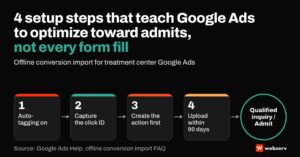
Offline conversion tracking is the mechanism that imports conversion events from outside the website (form-fill, phone call, CRM-confirmed admit) back into Google Ads as training data for Smart Bidding. The conversion fires not when the click happens, but when the facility confirms the lead is real.
For behavioral health, offline conversion tracking is the difference between Smart Bidding optimizing on form-fills (which include spam and unqualified inquiries) and optimizing on actual admits (which are the metric the facility cares about). Operators running paid media without offline conversion tracking are optimizing on a proxy that does not reflect the bank account.
The setup involves CRM integration (HubSpot, Salesforce, custom CRMs), Google Ads click ID capture on form submissions, and the import API or scheduled upload to push admit-confirmed conversions back to Google. The work is one-time setup with ongoing maintenance.
Do we need a different agency or platform to fix lead quality?
Usually not. The agency and platform questions get asked because the lead quality conversation feels like a campaign problem. In most cases we audit, the campaign architecture is fine. The data quality coming out of the admissions team is the constraint.
Before changing agencies or platforms, audit the call scoring loop. How fast are calls being scored? Who is tagging disqualifiers? Is the conversion event firing on form-fill or on admit-confirmed lead? Is Smart Bidding optimizing against the right signal? Most facilities can answer those questions in 30 minutes of CRM and Google Ads review.
If the scoring loop is tight and lead quality is still high, then agency and platform questions become legitimate. If the scoring loop is loose, changing agencies will not fix the underlying problem because the new agency will inherit the same broken data signal.
Make Same-Day Scoring the Highest-Impact Move on Your Marketing Calendar This Month
The call scoring loop is the input that determines whether Smart Bidding optimizes toward the leads the facility actually wants, or toward the leads the facility cannot serve. Most multi-facility operators we work with see cost-per-viable-call shift inside two weeks of disciplined same-day disqualifier tagging, and cost-per-admit shift inside six weeks.
The work is not technical. The Google Ads configuration is a one-time setup. The hard part is the admissions team discipline to tag disqualifiers in real time, and the operator discipline to refuse the VOB-pulling shortcut that feeds Google bad signals.
We help treatment center operators stand up the offline conversion infrastructure, configure the conversion delay window, train the admissions team on the disqualifier-tagging SOP, and measure the campaign-level impact across the first 90 days. The work pairs with the broader paid media architecture that runs on top of clean conversion data.
Book an intro meeting to walk through your current call scoring loop, where the latency and discipline gaps are likely costing you admits, and what a 2-to-6-hour SOP would produce for your facility.
For the broader picture of how paid media fits inside a full treatment center marketing program, see our ultimate guide to behavioral health marketing and our deeper read on why PMax for behavioral health depends on clean conversion data to deliver any return at all.
Mitch Marowitz is the Director of Paid Media at Webserv, where he leads the team building paid media programs for behavioral health and addiction treatment centers across the U.S. He writes about the operational discipline that turns Smart Bidding into census, the conversion infrastructure that makes behavioral health paid media actually work, and the data quality decisions that separate the facilities outperforming on cost-per-admit from the facilities still chasing keyword changes.