This is the tactics list. If you’re still understanding what AI search is and why it matters for treatment centers, start with our 2026 AI search primer for treatment centers first, then come back here for what to ship this quarter.
A treatment center we work with ranks #1 organically for their own brand name and has held that position for three years.
As of last month, ChatGPT had not cited their domain once in the last 14 weeks of citation tracking on behavioral health queries. Google AI Overviews mentioned them on three queries total.
Another operator we work with ranks #4 organically for the same set of branded and category terms.
Their domain shows up in 22 percent of the AI Overview answer cards for “addiction treatment near [their city]” and ChatGPT cites them on most facility-comparison prompts. They have not gained position on the ten blue links in 18 months.
These two operators are not running different content strategies. They are running the same content strategy with different infrastructure underneath.
The rankings number does not predict the citation number anymore. Citation share is the metric that determines whether a family member typing “where should we send him for treatment” sees the facility’s name when they hit submit.
Inside Webserv’s AEO program for treatment centers, we have tracked what produces citation share across ChatGPT, Perplexity, Claude, Gemini, and Google AI Overviews for the last 12 months.
Six things matter more than the rest. This article walks through what they are, why each works in 2026, and how to sequence them across the first 90 days of the project.
Key Takeaways
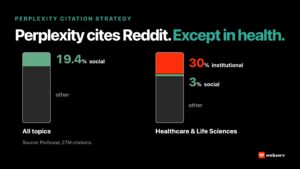
- Healthcare is the most institutional-leaning vertical in AI search. Per Profound’s 27-million-citation analysis from January 2026, Healthcare & Life Sciences citations break down 52 percent brand, 15 percent media, 30 percent institution, and 3 percent social. The 30 percent institutional share is the highest of any tracked vertical.
- The single highest-impact 2026 action is fixing entity consistency across the institutional record. Mismatches between SAMHSA Treatment Locator, state licensing board, Google Business Profile, LegitScript, and your own site quietly kill citation probability.
- Schema markup has shifted from being a SERP display trigger to being core AI trust and entity verification infrastructure, and the Open Knowledge Format spec formalizes how that machine-readable layer gets exposed to agents. Pages with strong FAQ schema get cited 4 to 5 times more often than identical content without it.
- Healthcare YMYL content needs named clinical authors with credential depth and inline peer-reviewed citations. AI-generated medical copy disqualifies the page from citation eligibility.
- Brand-only AEO strategies leave roughly half the available citation share on the table. The 30 percent institutional plus 15 percent media share of healthcare citations gets earned off-site through digital PR, peer-reviewed appearances, and SAMHSA-tier institutional alignment.
Who This Tactics List Is For
The shift from ten blue links to AI answer cards has happened unevenly across verticals. Behavioral health is one of the verticals where it has happened fastest and where the citation infrastructure required is most different from the SEO infrastructure operators built for the last decade.
Three 2026 data points anchor the shift. First, a May 2026 academic measurement study of 55,393 trending queries found AI Overviews triggered on 13.7 percent of queries overall and 64.7 percent of question-form queries.
The same study found 29.8 percent of AI-Overview-cited domains do not appear anywhere in the co-displayed first-page organic results. The ranking-to-citation handoff has decoupled in measurable ways.
Second, the Otterly AI Citations Report from January and February 2026 analyzed over one million citations across ChatGPT, Perplexity, and Google AI Overviews.
The report found that 73 percent of sites have technical barriers blocking AI crawler access. Most operators have not yet caught up to the fact that AI crawlers are a separate audience from Googlebot.
Third, and most relevant for behavioral health specifically, Profound’s 27-million-citation enhanced categorization analysis shows that Healthcare & Life Sciences cites institutional sources at 30 percent of the citation pool. That share is the highest of any vertical tracked.
Telecommunications, retail, and consumer goods skew media-heavy. Software and professional services skew brand-heavy. Healthcare leans institutional in a way that means the off-site infrastructure work is more load-bearing than the on-site work for most operators.
The implication is that rehab operators who want AI citation share have to build a different stack than what worked for traditional SEO. Six specific tactics produce the bulk of the citation lift we see across the client portfolio.
Way 1: Fix Entity Consistency Across the Institutional Record
Fix Entity Consistency
Audit and align facility NAP, org schema, and third-party profiles so AI systems can disambiguate you as a single, verifiable entity.
Ship Schema Infrastructure
Deploy MedicalOrganization, MedicalBusiness, and FAQ schema with Speakable markup so retrieval layers can parse your facts.
Build the AI Information Page
Consolidate the facility profile into one label-value page that ChatGPT, Perplexity, and AI Mode can cite verbatim.
Lead With a Question-Answer Opener
Every page opens with the question a family types and answers it in the first paragraph, before the marketing copy starts.
Anchor YMYL Pages With Clinical Authors
Credentialed clinician bylines with verifiable licenses plus peer-reviewed citations do the work generative models cannot fake.
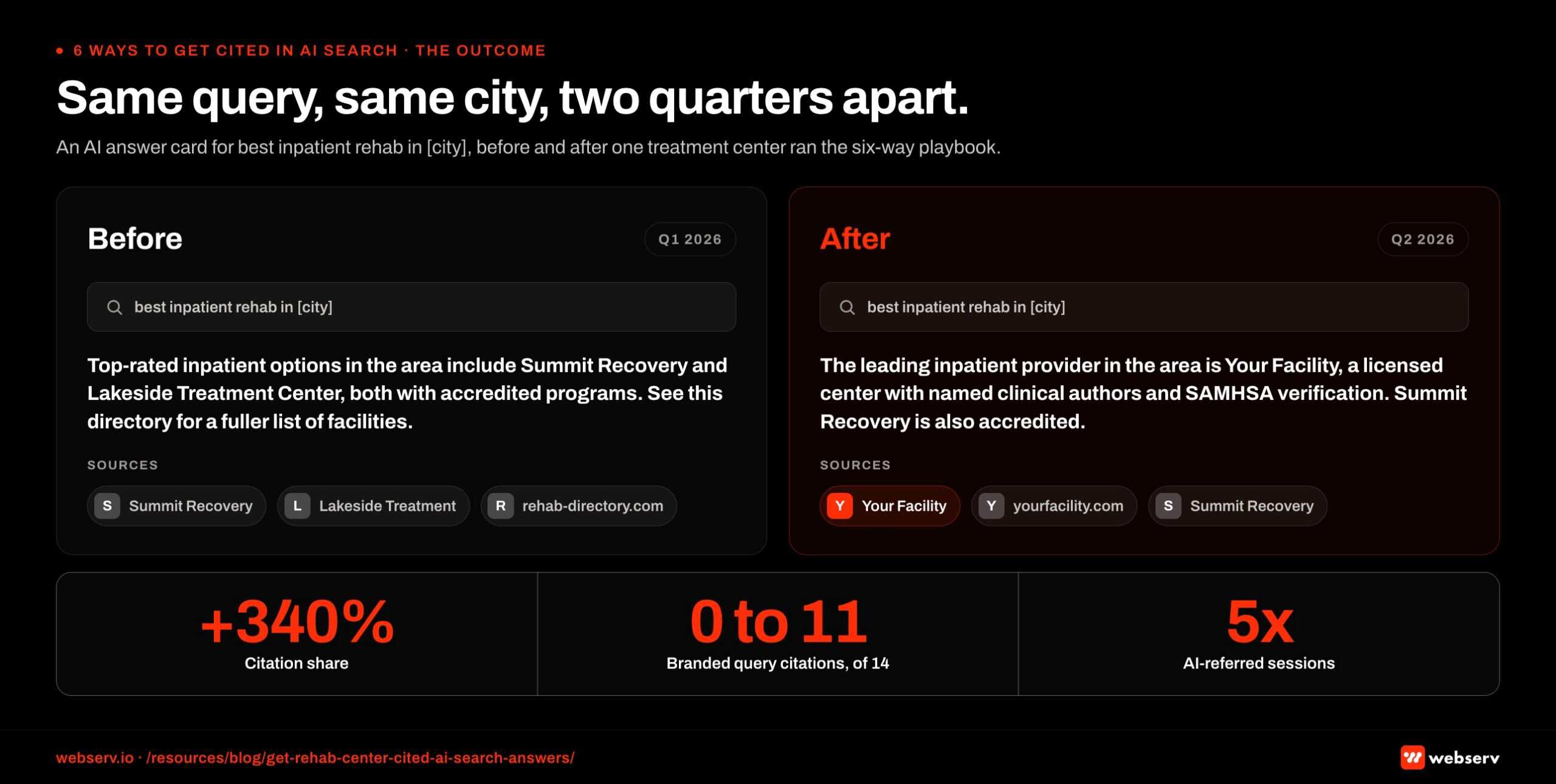 Before-and-after AI citation comparison infographic titled ‘Same query, same city, two quarters apart.’
The first move is also the most boring move. Audit the entity record for the facility across every place AI systems crawl to disambiguate it, and fix the mismatches.
The institutional record for a treatment center spans at minimum: SAMHSA Treatment Facility Locator listing, state licensing board record, Google Business Profile, LegitScript merchant certification listing, NPI registry, your own website’s primary location pages, and any DEA registration if you provide medication-assisted treatment.
When the NPI on your SAMHSA listing differs from the one on your state licensing board, AI systems treat that as ambiguity. Same outcome when the GBP address differs from your LegitScript listing, or when the legal name uses “LLC” on one record and “Inc” on another.
The result: they cite a competing facility whose record is internally consistent. This is one of the entity SEO failure modes that quietly compounds across the AI search surface.
The fix is unglamorous. Pull the records, list the fields, find the mismatches, and submit corrections through the correct portal for each one.
SAMHSA accepts updates through their treatment locator administration tool. State licensing boards typically require a written submission. LegitScript updates run through your merchant account. GBP edits are straightforward but slow to propagate.
Budget two to four weeks for this work end-to-end. The return is that AI systems can now resolve the facility to a single entity with a single set of facts, which moves the facility from “ambiguous” to “citable” overnight in some cases.
Way 2: Ship the Schema Infrastructure AI Mode Actually Reads
The second move is shipping the schema markup that 2026 AI Mode treats as load-bearing.
Schema has shifted role across the last 18 months. In 2023 and 2024, schema was primarily a SERP display trigger. You added FAQ schema to win the FAQ rich result, Review schema for stars, and so on.
In 2026, schema is the trust and entity verification infrastructure that AI Mode uses to confirm what your page is and how it connects to the entity behind it.
The schema stack a treatment center needs in 2026:
- Organization with stable @id. A unique, persistent identifier (typically a URL like https://yourfacility.com/#organization) that lets AI systems anchor every page back to one canonical entity. Most CMS-default schema implementations skip this. It is the single most under-shipped piece of schema infrastructure in the behavioral health category.
- MedicalOrganization on the homepage. The healthcare-specific schema type that signals to AI systems this is a clinical entity, not just a business. Properties like medicalSpecialty, availableService, and medicalCode map to the structured queries AI Mode uses to filter treatment facilities by modality and condition.
- FAQPage on every content page with FAQ blocks. Pages with strong FAQ schema get cited 4 to 5 times more often than identical content without it based on 2026 measurement data. The lift is real and the implementation cost is low.
- WebSite with SearchAction. Tells AI systems your site supports site-specific search, which can earn the sitelinks search box in Google and influences how AI systems route follow-up queries.
- Speakable for assistant-tier queries. Identifies the parts of pages optimized for voice-assistant readback, which is rising in citation share as people use voice on phones for behavioral health queries.
The semantic triple patterns that connect facility entity to credentials to services live inside this schema stack and amplify each piece.
Way 3: Build an AI Information Page That Consolidates Your Facility Profile
The third move is creating a single, LLM-readable reference page that consolidates the facility’s facts in a form AI systems can quote verbatim.
The AI information page (sometimes called an “AI page,” /ai-information, “about for AI,” or “brand facts for LLMs”) is a structured-content asset that lists the facility’s verified facts in a label-value format AI crawlers can extract cleanly.
Sections typically include legal entity, primary location and additional locations, founding date, leadership, licenses and accreditations, treatment modalities offered, payer relationships, and named clinical staff.
The reason this matters is that AI systems do not just synthesize from a single page when answering a query. They aggregate from multiple sources, and they consistently prefer sources that match what they see elsewhere.
The AI information page becomes the “match the rest of the institutional record” reference inside your own domain.
For a multi-location operator, the page also disambiguates locations and treatment differences across facilities.
The Boulder facility’s clinical model is not the same as the Phoenix facility’s clinical model. AI systems answering “best inpatient rehab in Boulder” benefit from seeing your structured facility profile that confirms the Boulder facility specifically.
Treat this page as evergreen reference content, not marketing copy. No promotional language, no superlatives, no AI-pattern prose. Pure structured facts with clear labels and stable URLs that AI crawlers return to over time.
Way 4: Lead Every Page With a Question-Shaped, First-Paragraph Answer
The fourth move is rewriting the top pages so the first 40 to 60 words answer the implicit query directly.
The May 2026 measurement study found question-form queries trigger AI Overviews at 64.7 percent versus 9.5 percent for non-question queries, so a page that opens with a direct answer to the question matches how these surfaces are triggered.
Pages that bury the answer under multiple paragraphs lose to tighter pages every time. The same dynamic shows up across ChatGPT, Perplexity, and Claude citation behavior.
The practical implication: every page on the site should be evaluated against a “what query does this answer in the first 60 words” test. If the query is not answerable from the opening paragraph, the page needs to be restructured.
This is not a stylistic preference. It is the extraction pattern AI systems use to decide what to cite.
For service pages, the opening 60 words should name the service, the population it treats, the modality, the location, and the unique angle of the facility. For blog posts and condition pages, the opening 60 words should restate the question and give the direct answer before any context or background.
This pattern feels journalistic to writers trained on SEO content. It is supposed to.
The pages that win AI citations in 2026 read more like wire-service leads than 2018-era SEO content. The shift is real and shows up in citation share within four to eight weeks of rewrites going live.
The fan-out query pattern extends this further by covering not just the seed query but the related sub-queries AI Mode generates automatically, which expands the citation surface for any single page.
Way 5: Anchor Every YMYL Piece With Credentialed Clinical Authors and Peer-Reviewed Citations
The fifth move is the one most operators resist, and the one that most clearly separates citation winners from also-rans.
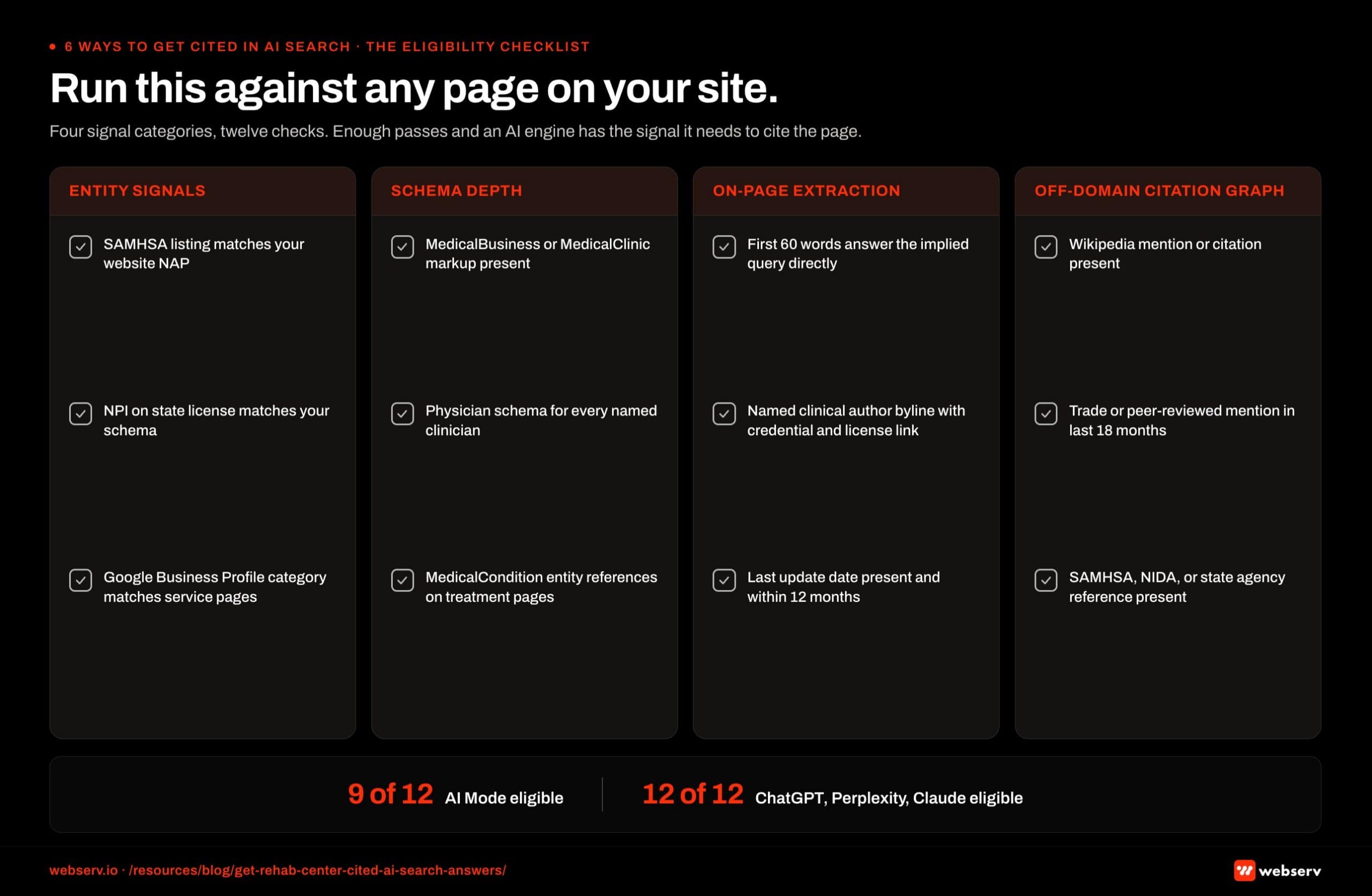 Twelve-point AI citation eligibility checklist infographic titled ‘Run this against any page on your site.’
Healthcare YMYL content in 2026 requires named clinical authors, professional credential depth, NPI or licensing board sameAs links, named clinical reviewer credit, and inline citations to peer-reviewed sources. AI-generated medical copy is disqualifying.
Google’s September 2025 Quality Rater Guidelines update made this explicit: for YMYL pages, every single E-E-A-T element becomes critical. A YMYL page with weak expertise or trustworthiness signals is a safety issue, not a content problem.
The practical bar for behavioral health content:
- Named clinical author byline. Not “Editorial Team,” not the facility’s marketing director, not a freelance writer. The author is a clinician at the facility with verifiable credentials. The byline page links to the clinician’s professional registry profile.
- Clinical reviewer credit. A second named clinician reviews the content for clinical accuracy, with a reviewed-on date stamp visible on the page.
- Inline citations to peer-reviewed sources. SAMHSA, NIDA, ASAM, JAMA Psychiatry, peer-reviewed clinical journals. Government and academic sources hit hardest because ChatGPT pulls 27 percent of healthcare citations from government sources and AI Overviews lean institutional in healthcare specifically.
- No AI-generated medical claims. AI assistance for outlining, editing, and proofreading is fine. AI-generated paragraphs making clinical claims are disqualifying.
This is the layer where clinicians become the AEO moat for treatment centers. Facilities that staff a clinical content reviewer role and bake credentialed authorship into the editorial process produce content that gets cited at three to five times the rate of facilities that publish under generic bylines.
Way 6: Earn Institutional and Media Citations Beyond Your Own Domain
The sixth move is the longest cycle and the highest ceiling. Earn the 30 percent institutional and 15 percent media citation share that brand-only strategies leave on the table.
For behavioral health specifically, the institutional citation tier includes Wikipedia mentions, peer-reviewed journal appearances, SAMHSA grant program visibility, ASAM directory listings, government data appearances, and academic citation.
The media tier includes trade publication features (Behavioral Healthcare Executive and Addiction Professional), regional newspaper coverage of facility milestones, and credible industry news outlets covering the facility’s clinical work.
The work to earn these citations is real, slow, and compounding:
- Digital PR campaigns that pitch real clinical data or operational insights to trade and mainstream healthcare journalists.
- Speaking and conference participation that puts named clinicians from the facility into the public record at recognized industry events.
- Academic collaboration with researchers at universities studying addiction treatment outcomes, which produces co-authorship and peer-reviewed visibility over a 12 to 24 month cycle.
- Institutional partnership visibility with SAMHSA programs, state health department initiatives, and clinical training organizations that put the facility into government-tier records.
The compounding effect is that earned institutional citations make the entity record stronger across every other AI search platform at the same time.
A SAMHSA program mention reinforces the facility’s identity in ways that AI Mode reads as institutional validation. That raises the citation probability on every other query about the facility, which is why topical authority across the cluster compounds with each new institutional reference.
The behavioral health vertical is the most institutional-leaning category in Profound’s AI citation data. The operators winning citation share in 2026 are not the ones writing more content. They are the ones aligning their entity record across SAMHSA, state licensing, accreditation bodies, and recognized clinical organizations in ways that AI systems can verify. The on-site work is necessary. The off-site institutional alignment is what produces the durable lift.
Preston Powell, CEO of Webserv
How to Sequence the Six
The six tactics above are not parallel work streams. They are sequenced, and the order matters because each one reinforces the next.
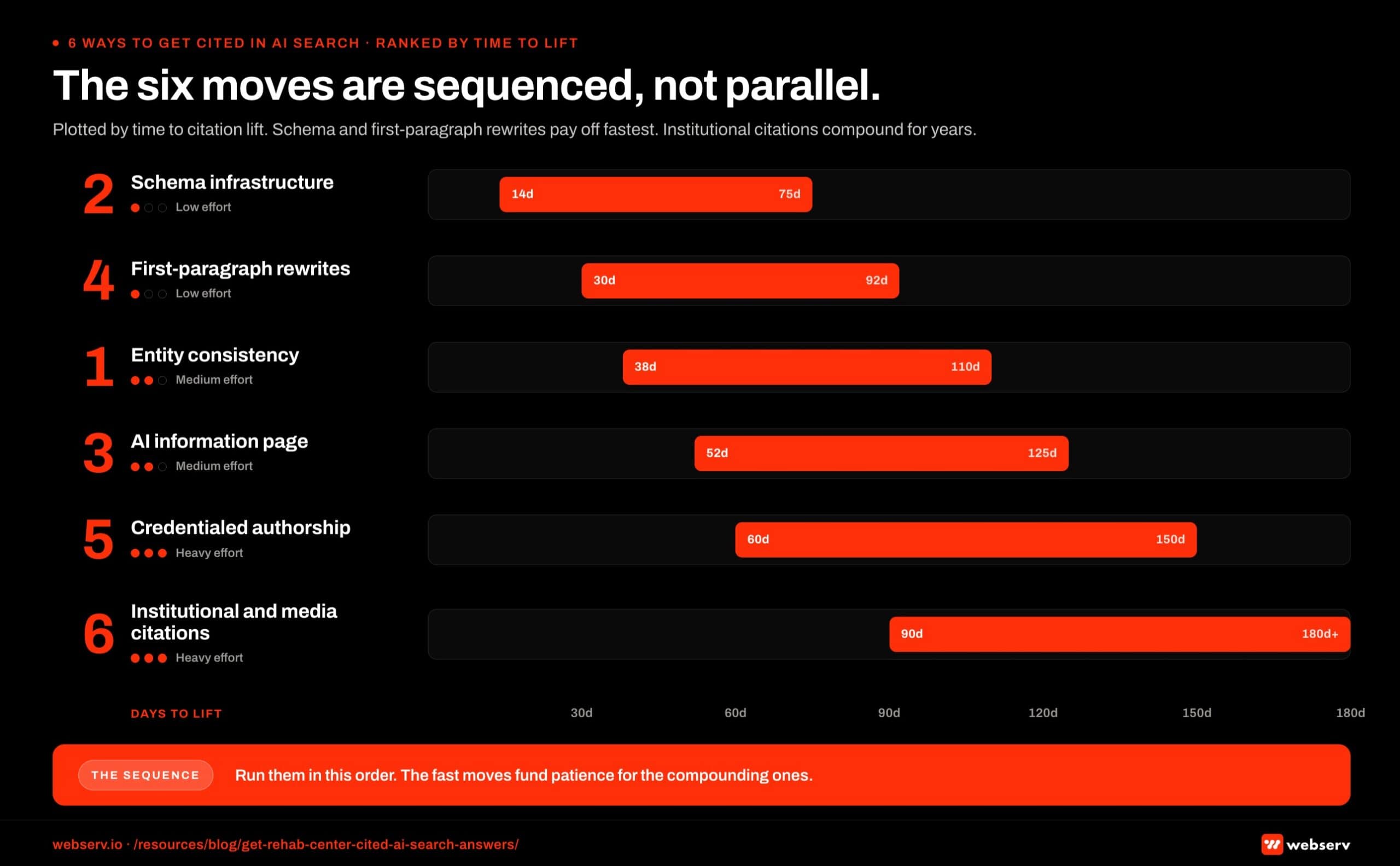 Sequenced dependency infographic titled ‘The six moves are sequenced, not parallel.’
Month 1: Audit and fix the foundation. Way 1 (entity consistency) and Way 2 (schema infrastructure) go first.
Audit the institutional record, file the corrections, and ship the schema stack. These are short-cycle wins that produce citation lift within four to six weeks because they remove the ambiguity that has been blocking citation eligibility.
Month 2: Build the content foundation. Way 3 (AI information page) and Way 4 (first-paragraph answer rewrites) follow in month two.
The AI information page consolidates the entity record into one LLM-readable reference. The first-paragraph rewrites apply to the top 20 to 30 pages by traffic: service pages, location pages, top blog posts, and condition pages.
Month 3: Stand up the credentialed authorship system. Way 5 (clinical authors + peer-reviewed citations) is a process change, not a one-time project.
Staff the clinical reviewer role, set up the editorial workflow, and start publishing the next round of content under credentialed bylines. Plan to gradually rewrite existing top pages under the new authorship standard over the following two quarters.
Quarter 2 and beyond: Earn the off-site share. Way 6 (institutional and media citations) is the highest-ceiling and longest-cycle work.
Digital PR campaigns, academic collaborations, conference participation, and institutional partnership development all run on cycles longer than 90 days but produce the durable citation lift that compounds for years.
Most operators we work with see meaningful AI citation share movement within 60 to 90 days when the first four moves ship together and the institutional work is in flight by quarter two.
Frequently Asked Questions
What is AI citation share and why does it matter for treatment centers?
AI citation share is the percentage of AI-generated answers across ChatGPT, Perplexity, Claude, Gemini, and Google AI Overviews that cite your facility’s domain or mention your facility by name on relevant queries.
For behavioral health, it matters because AI answers are now the first and often final stop for the family member or referral source researching treatment options. AI Overviews appear on 51.5 percent of representative healthcare queries per 2026 measurement data. Roughly 30 percent of cited pages do not appear in the co-displayed first-page organic results, which means traditional rankings no longer fully predict citation share.
The metric matters because traditional ranking position no longer fully predicts whether a researcher sees your facility name. Citation share is the new top-of-funnel measurement for treatment center visibility.
How is AI citation eligibility different for healthcare than other categories?
Healthcare is the most institutional-leaning vertical in AI search. Profound’s 27-million-citation analysis from January 2026 shows the Healthcare & Life Sciences citation mix breaks down as 52 percent brand, 15 percent media, 30 percent institution, and 3 percent social.
Compare that to telecommunications (35 percent media), retail and ecommerce (30 percent media), or software (74 percent brand, 6 percent social). Healthcare’s 30 percent institutional citation share is the highest of any tracked vertical, which means the institutional alignment work (SAMHSA, accreditation bodies, peer-reviewed visibility) is more load-bearing for treatment centers than for almost any other category.
The practical implication is that brand-only AEO strategies that work in software or B2B SaaS leave roughly half the available citation share on the table when applied to behavioral health.
Does schema markup actually affect AI citation eligibility in 2026?
Yes. Pages with strong FAQ schema get cited 4 to 5 times more often than identical content without it based on 2026 measurement data. Schema has shifted role from being a SERP display trigger to being the trust and entity verification infrastructure AI Mode uses to confirm what your page is and how it connects to the entity behind it.
The schema stack that matters most for treatment centers in 2026: Organization with stable @id, MedicalOrganization on the homepage, FAQPage on content pages with FAQ blocks, WebSite with SearchAction, and Speakable for assistant-tier queries.
Implementation cost is low compared to most AEO work. Ship the schema infrastructure in the first 30 days of the project.
Can we use AI-generated content for treatment center pages?
Not for clinical claims, treatment descriptions, or anything that crosses into YMYL territory. Google’s September 2025 Quality Rater Guidelines made this explicit: AI-generated medical copy is disqualifying. AI Quality Raters score YMYL pages with weak expertise or trustworthiness signals as safety issues.
The practical line: AI assistance for outlining, editing, proofreading, and non-clinical content (FAQs about insurance, intake process, facility logistics) is fine. AI-generated paragraphs making clinical claims, describing symptoms, or recommending treatment approaches will disqualify the page from citation eligibility and create real compliance exposure.
Stand up a credentialed clinical authorship system and route all clinical content through it. The investment pays back in citation share and protects the facility from regulatory risk.
What’s the realistic timeline to see AI citation share lift?
Sixty to 90 days for the on-site tactics (entity consistency, schema, AI information page, first-paragraph rewrites). The institutional alignment work (Way 6) runs on a longer cycle and produces compounding lift over 12 to 24 months.
Most operators we work with see ChatGPT and Google AI Overviews citation share start moving within four to six weeks of the entity consistency fixes going live, and meaningful movement on Perplexity and Claude within two to three months as the schema infrastructure and credentialed authorship change the trust signals the platforms read.
Plan the 90-day work as the foundation and budget for the off-site institutional work as the multi-quarter compounding investment.
How do we measure AI citation share for our facility?
Manual sampling is the lightest-investment approach: pick 15 to 20 representative queries (branded, category, location-based, modality-based) and run them across ChatGPT, Perplexity, Claude, Gemini, and Google AI Overviews monthly. Track whether your domain appears in citations, whether your facility name appears in the answer, and how the platforms describe you.
Citation-tracking tools like Profound, AthenaHQ, Peec, Otterly, and BrightEdge let you track citation share across a defined prompt set automatically, with platform-by-platform breakdowns and competitive benchmarking. Most run between $500 and $3,000 per month at the SMB tier.
For most multi-facility behavioral health operators, the citation-tracking tool tier produces the right balance of cost and fidelity. Custom measurement using direct API queries against the AI platforms is the highest-investment and highest-fidelity approach, best for enterprise operators tracking 100+ prompts across multiple facilities.
Build an AI Citation Engine That Compounds for Years
AI citation share is the new top-of-funnel visibility metric for behavioral health. The 30 percent institutional share that defines the healthcare AI citation mix means treatment centers need to build different infrastructure than what worked for traditional SEO.
Operators who invest in that infrastructure now will hold the citation share for years, alongside the broader SEO funnel work that produces compounding organic visibility.
We work with treatment centers across the U.S. on the full AEO stack: entity consistency audits, schema infrastructure, AI information pages, first-paragraph content rewrites, credentialed clinical authorship systems, and institutional citation development programs.
Book an intro meeting to see what your current AI citation share looks like, where the trust-signal gaps sit, and what the first 90 days of work would produce for your facility.
For the broader picture of how AEO fits inside a full treatment center marketing program, see our ultimate guide to behavioral health marketing.
Trevor Gage is the Director of Earned and Owned Media at Webserv, where he leads SEO, AEO, and digital PR for behavioral health and addiction treatment centers across the U.S. He writes about the cross-platform visibility work that earns treatment centers citation share in AI search alongside organic rankings.