Topical authority has been the most misunderstood concept in healthcare SEO for the last three years. Most treatment center operators read about it through the lens of 2020 SEO content. Publish a lot of articles about a topic, link them together, watch the rankings come. That model is what most SEO programs for treatment centers are still running, even though Google retired it in stages between 2022 and 2026.
That model was already weakening when the Helpful Content System launched in August 2022. The August 2024 core update killed it for YMYL verticals. The March 2025 and December 2025 core updates closed the loopholes that had been left open.
What replaced page-count topical authority is harder to game and easier to fail at. Google now evaluates treatment center websites at the domain level for topical identity.
A site that covers ten unrelated topics shallowly is treated differently from one that covers two topics deeply. Even when individual pages are adequate, a fractured topical identity can suppress an entire domain’s perceived authority.
Visible author credentials are now the norm on top-ranking YMYL pages, which is exactly what Google’s rater guidelines ask raters to look for.
This article is the operator-facing version of what we run with treatment center clients. The definition, the seven-step build playbook, the most expensive mistakes we audit and see repeated, what changes when AI search enters the picture, and what we believe about how this vertical actually wins.
Most treatment centers don’t have a content problem. They have an architecture problem dressed up as one. Publishing more pages won’t fix it. Publishing fewer of the right ones will.
Trevor Gage, Director of Earned & Owned Media, Webserv
Key Takeaways
- Topical authority is a sitewide credibility signal, not a per-page property. Google reads it from where your trust signals live, what proportion of your indexed pages serve buyer intent, and whether your architecture concentrates or dilutes earned authority.
- Page-count topical authority died in stages between August 2022 (Helpful Content System) and December 2025 (core update). The site that answers 50 questions about substance use disorder beats the site that answers one question each about 50 unrelated health topics — every time.
- Top-ranking YMYL pages show author credentials. Treatment centers with clinical authorship buried on the /about/ page (or absent entirely) are at a structural disadvantage. The credentials need to live on the level-of-care pages where families decide to call.
- The seven-step build playbook: audit indexed-page composition before publishing, concentrate rather than multiply, move trust signals to conversion pages, build around the singular specialization, schema where Google needs to see expertise, internal linking from authority to conversion, and measure by indexed-page composition and AI citation share.
- AI search raises the penalty for fractured topical identity, not lowers it. The center that exclusively treats one population gets cited; the generic center that mentions the population on page three of the nav gets summarized and not cited. Same architecture works for Google, ChatGPT, Perplexity, and Claude.
The piece below works in four moves: a working definition that aligns with how Google reads topical authority in 2026, two recent audits that show how the signal breaks at different layers, the seven-step playbook we run with treatment center clients, and the platform-specific picture once AI search enters the equation.
What topical authority actually is
Topical authority is a sitewide credibility signal, not a per-page property. Google reads it from three things: where your trust signals live, what proportion of your indexed pages serve buyer intent, and whether your architecture concentrates or dilutes the authority you have already earned.
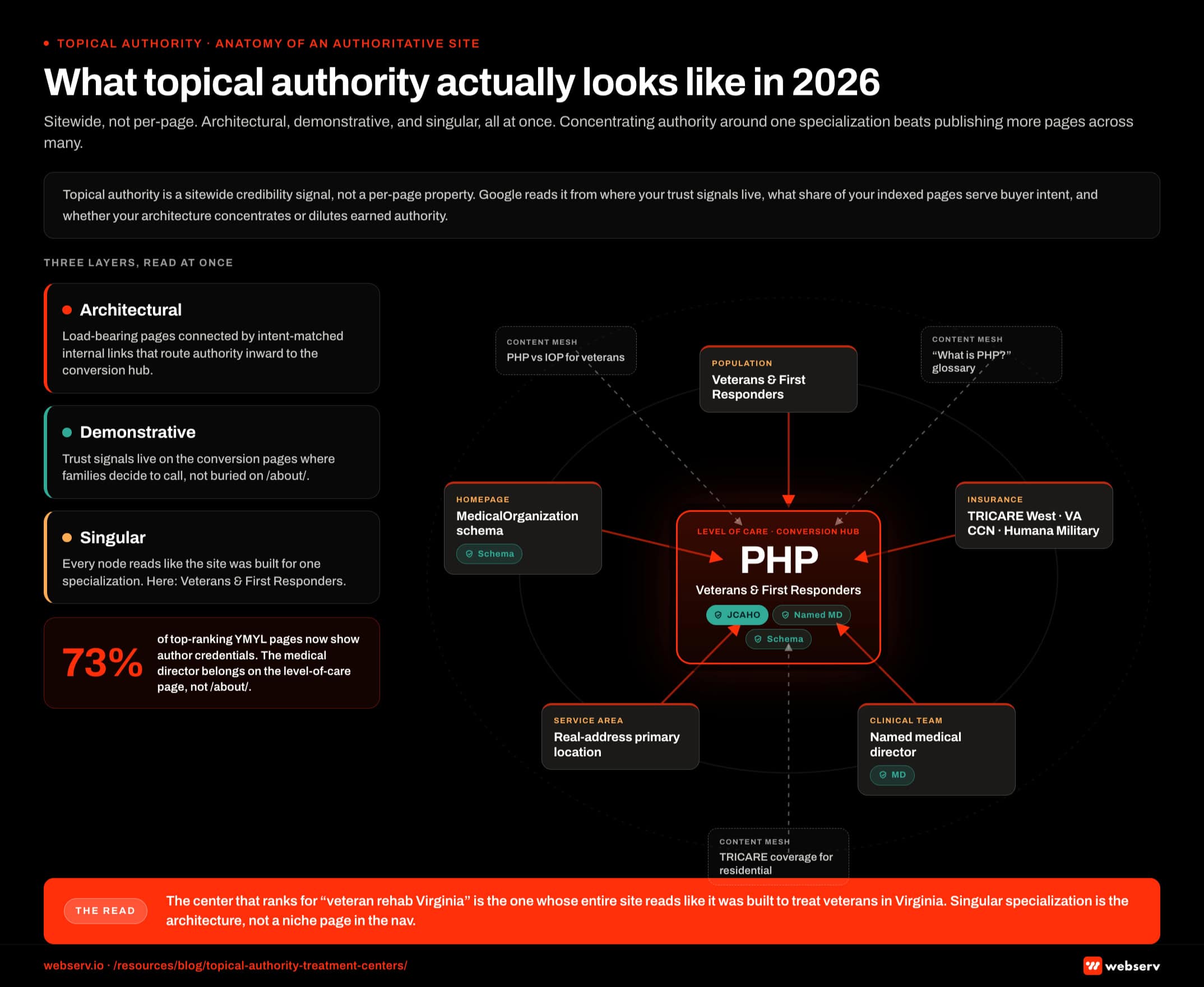 Infographic titled ‘What topical authority actually looks like for a treatment center in 2026’.
Most SEO content writes about topical authority as if it were a page-count problem. Publish 200 articles on a topic and you are an authority on it. That model died with the August 2024 core update and the Helpful Content System refinements that followed. The March 2025 core update continued that direction. Our drug rehab SEO pillar guide shows where topical authority fits in the full program.
The December 2025 core update, which rolled out December 11 to 29, kept rewarding sites with clear expertise and focus.
What replaced page-count authority is harder to game. Google now reads topical authority through the composition of your indexed page set. One treatment center site that answers 50 questions about substance use disorder will outperform one that answers one question each about 50 unrelated health topics.
For a treatment center website specifically, topical authority means three things at the same time:
Architectural. Your service pages, level-of-care pages, and population-specific pages are the load-bearing pages of the site. They must be indexed, technically clean, and connected to each other by internal links that flow from authority-bearing content. The same technical foundation we walk through in the technical SEO guide for treatment center websites is the prerequisite for any topical authority work compounding.
If those pages are not indexed, no amount of domain authority will help. The hub-and-spoke content model, where a central topic hub links to detailed subtopic spokes that link back, is the architecture Google currently rewards.
Demonstrative. Your clinical credentials, accreditations, payer contracts, named medical leadership, and population specialization need to live on the pages where families decide whether to call. Not on /about/. Not in the footer. On the conversion pages, above the fold.
Top-ranking YMYL pages show author credentials. Treatment centers without visible clinical authorship are at a structural disadvantage in 2026.
Singular. The center that ranks for “veteran rehab Virginia” is the one whose entire site reads like it was built to treat veterans in Virginia.
The center that tries to rank for veterans, adolescents, executives, dual diagnosis, eating disorders, and trauma at the same time will rank for none of them. Fractured topical identity holds back even strong domains.
What Google actually rewards in 2026
A working definition. Topical authority is what Google reads when it asks: when a user searches for help inside this category, is this site the source the answer should come from? The helpful, reliable, people-first content guidance is the doc that codifies how Google answers that question.
The signals it weighs:
Coverage of the buyer’s question. Not coverage of the keyword. The query “alcohol rehab in Texas” is a buyer asking which residential program treats their family member. The page that answers it specifically and authoritatively, with the right credentials surfaced and the right clinical proof, outranks the page that ranks well for the keyword but answers a different question. The Helpful Content System penalty has shifted from punishing thin content to punishing content that ranks for queries it does not actually serve.
Distribution of authority signals. Schema, authorship, medical review, and accreditation badges need to live on the pages that Google needs to evaluate.
A medical reviewer credential block on a blog post about benzodiazepine identification does not help Google understand whether your residential program is qualified. It needs to be on the residential program page. The schema implementation matters as much as the content of the page.
Internal architecture. Topical authority compounds through internal links from authority-bearing content to conversion-intent pages. If your highest-authority page is a blog post and the blog post does not link to your level-of-care pages, the authority is stuck. The hub-and-spoke model exists because Google’s ranking systems read it as evidence of intentional topical depth.
Indexed page composition. Pages Google chooses to index are the pages Google has decided are worth indexing. If a site has 700 pages eligible for indexing and Google indexes 35, the 665 that were dropped are sending a signal to the index that decides which 35 stay. Templated location pages, thin blog posts, and orphaned author pages dilute the indexed set in ways that pull commercial pages down with them.
Technical excellence stopped being optional. Sites with high indexed-page counts but poor crawl efficiency lost rankings on commercial terms even when the commercial pages themselves were strong. The patterns I covered in the technical SEO fix list are the prerequisite cleanup before topical authority work compounds.
Citation in AI answers. The newer signal, and the one most operators underestimate. Profound’s research found that beyond a few staples, AI engines show little loyalty to any single domain; after the top two or three, citations fragment across a long tail of sites.
The sites cited in AI answers are the ones whose distinctive expertise is recognizable to an LLM doing retrieval. Generic content gets summarized and not cited. Specific clinical leadership, named protocols, and population specialization get cited.
What this looks like in practice
Two recent audits at our agency illustrate how topical authority breaks at different layers.
The first was a California adolescent behavioral health center with Joint Commission accreditation, links from Forbes, Healthline, Smithsonian, Women’s Health, and Wikipedia, a real medical reviewer with PhD and LMFT credentials, and a clean parent-child URL structure.
Every individual service page looked textbook. Schema was in place. Author bylines were real.
The site went from 722 indexed pages in August 2025 to 35 in May 2026. A 95% loss in nine months. Every residential, PHP, and IOP page sat at zero organic traffic. Four URLs carried 83% of the traffic the site still had.
The pattern that broke it is one we see across treatment center websites running an outdated playbook. The good schema and the credentialed authorship lived in the blog. The crawl budget got eaten by 52 templated city pages, 40+ of them in cities the operator did not have an office in. By the time the Helpful Content System took a position on the pattern, the level-of-care pages had been deindexed.
The second center serves veterans and first responders exclusively. It is one of the few accredited residential programs built specifically for that population. Domain Rating 57. Over 900 referring domains including va.gov, the American Legion, Forbes, Police Magazine, and Military Families Magazine. Referring domains grew 117% in 24 months.
Organic traffic in the same window: flat. The homepage and one personal blog post carry 70% of all traffic. The mission page named after the population the program exclusively treats gets 11 visits a month.
These are not poorly run treatment centers. Both have clinical leadership that deserves to rank. Both have the authority signals Google rewards. Neither has built topical authority the way it actually works in 2026. The first failed at architecture. The second failed at signaling. Both patterns are common enough that the playbook below addresses them directly.
How treatment centers actually build topical authority
This is the playbook we run for treatment center clients. Seven steps, in order. Skipping ahead is the fastest way to repeat the patterns above.
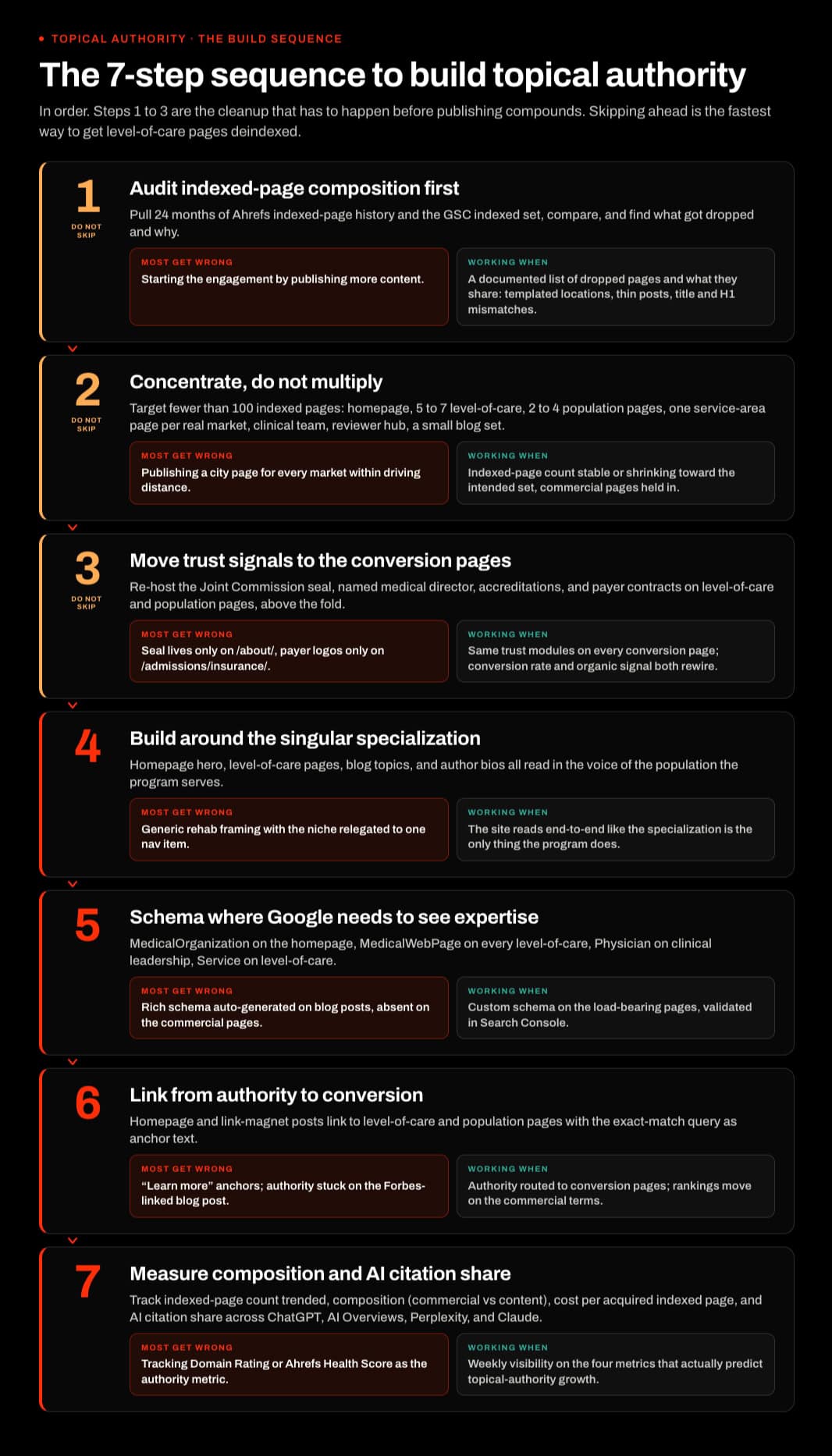 Infographic titled ‘The 7-step sequence to build topical authority for a treatment center’.
Step 1. Audit indexed-page composition before publishing anything new
Most agencies start a topical authority engagement by publishing more content. That is the wrong first move. The first move is figuring out what Google is currently indexing and why.
Pull the Ahrefs indexed pages history for the last 24 months. Pull the Google Search Console indexed page set. Compare. If the indexed set has shrunk, the question is which pages got dropped and what they had in common. Templated locations? Thin blog posts? Pages with title and H1 mismatches? Orphaned employee pages?
The Helpful Content System reacts to patterns. Once it has decided a pattern on your site is unhelpful, it widens the lens. The level-of-care pages can get caught in a deindex wave triggered by templated city pages those level-of-care pages had nothing to do with. The cleanup has to happen first.
Step 2. Concentrate, do not multiply
Treatment center websites do not need more pages. They need their existing pages to earn the right to be indexed.
For most operators, the right architecture is fewer than 100 indexed pages. The homepage. Five to seven level-of-care pages. Two to four population-specific pages. One service-area page per market where the facility actually accepts patients. A clinical team page. A medical reviewer credentials hub. A small set of high-quality blog posts that earn citations and link back to the commercial pages they support.
That is it. The instinct to publish a city page for every market within driving distance is the instinct that gets adolescent treatment centers deindexed. It connects directly to the patterns in our local SEO playbook — real-address Primary Location Pages, no exceptions.
Step 3. Move trust signals to the conversion pages
The trust signals exist on most treatment center sites. They are just in the wrong place.
The Joint Commission seal lives on /about/. It belongs above the fold on every level-of-care page. The named medical director with the PhD credentials lives on the team page. The bio block belongs on the page where families are deciding whether to admit.
The TRICARE West, Humana Military, and VA CCN credentials live on /admissions/insurance/. They belong on the veteran population page that families read first when they search for that population.
Same trust modules. Same content. Different location. The change rewires the page’s signal to Google and rewires the page’s conversion rate for the family reading it.
Step 4. Build around the singular specialization
The center that exclusively treats veterans and first responders should have a site that reads like that is the only thing it does. The center built for adolescent behavioral health should have a site that reads like adolescents are the only patients it sees.
That means the homepage hero is about the specialization, not about treatment in general. The level-of-care pages read in the voice of the population the program serves. The blog topics cluster around the questions that population asks. The author bios surface the team’s specific experience with that population.
Most treatment center sites read like generic rehab sites with a niche page somewhere in the navigation. The right read is the inverse. Generic rehab is the secondary frame. The specialization is the headline. The keyword mapping for this work is what we cover in the keyword strategy guide for rehab and mental health.
Step 5. Schema where Google needs to see expertise
Schema markup is the structured signal Google uses to validate what your pages claim. For a treatment center, the schema that matters is:
MedicalOrganization on the homepage with the full name, license numbers, accreditations, and parent organization properties filled in. MedicalWebPage on every level-of-care page with the specialty, condition treated, and primary audience properties filled in.
Physician schema on the medical director and clinical leadership pages with the credentials, license, and specialties populated. Service schema on the level-of-care pages with the description, area served, and provider properties filled in.
Most treatment center sites have schema. Most have it in the wrong places. The schema is rich on blog posts (because the blog plugin generates it automatically) and absent on the commercial pages where Google needs the validation. The fix is custom schema implementation on the load-bearing pages.
Step 6. Internal linking flows from authority to conversion
If your highest-authority page is your homepage, the homepage needs to link directly to your level-of-care pages with descriptive anchor text that matches the search intent of those pages. Not “Learn More.” Not “Click here.” The exact match query the page is built to rank for.
If your second-highest-authority page is a blog post that picked up the Forbes link, that blog post needs to link to the level-of-care pages and the population pages that the blog post is contextually adjacent to. The authority that came in through the Forbes link is currently stuck on the blog post. Internal links route it to the pages that need it.
If your authority-bearing pages do not link to your commercial pages with intent-matched anchor text, the topical authority you have earned does not reach the pages that have to convert.
Step 7. Measure topical authority by indexed-page composition and AI citation share
Page count is not the metric. Domain Rating is not the metric. Ahrefs Health Score is not the metric.
The metrics that predict whether topical authority is being built or eroded are:
Indexed page count, trended. Stable or growing is healthy. Falling is a signal that pages are getting dropped from the index and the rest of the site is at risk.
Indexed page composition. What percentage of your indexed set is commercial intent (level-of-care, service area, population pages) versus content marketing? If commercial pages are getting dropped while blog posts stay indexed, the topical authority is decaying from the load-bearing side.
Cost per acquired indexed page. If you publish 20 articles a month and the indexed set stays flat, the publishing program is feeding a content treadmill rather than building topical authority.
AI search citation share. OtterlyAI, Profound, AI Rank Lab, or Ahrefs Brand Radar pull citation share for your brand across ChatGPT, Google AI Overviews, Perplexity, and Claude. Semrush’s tracking shows citation share can shift within weeks rather than months.
ChatGPT cited Reddit in close to 60% of responses in early August 2025 and about 10% by mid-September, in Semrush’s data. Treatment centers need to be tracking citation share weekly, not quarterly.
How SoCal Sunrise generated 85 admissions and 2,297% ROI from SEO in 6 months
A ground-up SEO rebuild using the Pathfinder Parents Methodology turned an invisible online presence into a top-ranking admissions engine.
Read the case study →85 admits and 3,152 leads attributed to organic
The most expensive mistakes treatment centers make
Five patterns we audit and see repeated:
1. The location scale strategy. Publishing a templated city page for every market within driving distance, including markets where the operator does not have a physical office. The Helpful Content System treats this pattern as a signal that the site is not built for the user. Once it widens the lens, the level-of-care pages get caught in the deindex wave. This pattern was the proximate cause of the 95% indexed-page loss in our first audit.
2. EEAT only in the blog. Author bylines, medical reviewer credentials, and citation depth living exclusively on blog content. The schema and the authorship signal Google needs are absent from the commercial pages that have to rank. The center looks like a content publisher, not a treatment provider. With top-ranking YMYL pages routinely showing author credentials, the gap on a treatment center page without visible authorship is structural.
3. Trust signals buried on /about/. Joint Commission seal, accreditations, payer contracts, and named clinical leadership living on the about page. Families do not start at /about/. They land on the level-of-care page or the population page. If the trust signals are not there, the page is interchangeable with forty other treatment centers.
4. Generic positioning on a niche brand. A program built for one population trying to rank for everything. The site reads as generic rehab with a niche page somewhere in the navigation. The Forbes link, the va.gov link, the American Legion link came in because the program is the authority on that niche. The site fails to claim it. That kind of fractured topical identity holds back domain-level rankings.
5. Confusing domain authority with topical authority. Domain Rating measures earned link equity. Topical authority measures whether your site has been built to convert that link equity into rankings on commercial terms. A treatment center can have all the backlinks in the world and not rank for the queries families search when they need help. DR 57 with flat organic traffic is one of the most common diagnoses in our audit deck.
What changes when AI search enters the picture
The two audits in the section above were both written for a SERP world. The next set of audits will be written for a SERP plus AI Overviews plus ChatGPT plus Perplexity plus Claude plus Gemini world. The full playbook for the AI side lives in our guide to getting cited in Google AI Overviews and ChatGPT.
 Infographic titled ‘What changes when AI search enters the topical authority picture’.
Topical authority shifts inside an LLM. Google’s ranking system reads a long list of signals and weighs them probabilistically. An LLM doing retrieval reads a shorter list and looks for the source that is distinctively the right one. Generic content gets summarized and not cited. Distinctive expertise gets cited and quoted.
Recent citation analysis shows that pages with strong EEAT signals at ranking positions #6 to #10 get cited 2.3 times more frequently in AI answers than #1-ranked pages with weak authority signals. Position is no longer the gating criterion. Authority depth is.
For a treatment center, this means the topical authority strategy that works for AI Overviews and ChatGPT is the same strategy that works for the Helpful Content era of Google. Singular specialization. Trust signals on the load-bearing pages. Clinical leadership that is real and surfaced. Architecture that concentrates authority instead of dispersing it.
The penalty for the location scale strategy and the blog-only EEAT pattern is higher in the AI era, not lower. An LLM citing one source on “veteran rehab Virginia” will cite the program that exclusively treats that population, not the generic treatment center that mentions veterans on page three of the navigation.
The platform-specific picture matters too. ChatGPT favors Wikipedia-style authority and cites Wikipedia in 26% to 48% of its top citations. Perplexity prioritizes Reddit discussions in 46.7% of its top citations. Google AI Overviews balances professional and social content.
Treatment centers cannot ignore Reddit if they want to be cited by Perplexity, and they cannot ignore named clinical expertise if they want to be cited by ChatGPT. Both need attention. Both are part of topical authority in 2026.
The opportunity is also higher. The center that builds topical authority correctly now has a multi-platform compounding asset. Google rankings. AI Overviews citations. ChatGPT recommendations. Perplexity sources. One body of work, five distribution channels.
This is one piece of a larger technical foundation; see behavioral health marketing guide and why your rehab site isn’t ranking for the rest.
Frequently asked questions about topical authority for treatment centers
How long does it take to build topical authority?
Most treatment centers see the first meaningful topical authority signal at 4 to 6 months when the publishing discipline is correct (named clinical authorship, evidence-backed content, full topical clusters with internal linking). Measurable ranking and citation lift typically follows at 6 to 9 months. The 12-month mark is where compounding starts, and it does not stop compounding once it does.
Topical authority is not a content volume game. A center publishing four well-built cluster pieces per month consistently outperforms a center publishing twelve thin articles per month. The variable that moves authority is depth and structure, not raw post count. The center publishing four pieces also burns less editorial capacity, which means the program is sustainable past month six instead of collapsing at month three.
Programs that switch SEO partners every 6 to 9 months lose the authority compounding entirely. Each transition resets the publishing rhythm and breaks the cluster mesh. The 12 to 24 month horizon is what produces real authority. Operators evaluating partners should weight tenure and consistency higher than novelty.
Should we publish more frequently or focus on depth per topic?
Depth per topic produces more topical authority lift than publishing frequency, especially under the 2025-2026 Helpful Content updates. A treatment center that publishes one comprehensive 3,500-word UG with named clinical authorship and full topical coverage outperforms a center publishing eight 500-word thin posts on adjacent topics. The first builds authority. The second produces noise.
The right rhythm for most treatment centers is one comprehensive pillar piece per quarter plus two to four supporting Micros per month inside the same cluster. The pillar earns the topical authority signal. The Micros build the internal linking mesh that distributes it. Together they form a cluster that ranks the whole topic, not just the pillar URL.
Treatment centers publishing thin content at high frequency get penalized faster in 2026 than they did in 2024. The Helpful Content System now actively demotes shallow YMYL content rather than just refusing to reward it. The cost of publishing for volume’s sake is higher than the cost of publishing less.
Can a new treatment center build topical authority faster than an established one?
New treatment centers can build topical authority on a similar 6 to 12 month horizon as established ones when the foundational work is done correctly. The advantage they have is no legacy content baggage. The disadvantage is no existing domain authority. Net, the timeline is comparable, but the path is cleaner because there is less to undo.
Established centers with thin or stale content carry a structural disadvantage. The Helpful Content System reads outdated or low-quality pages as a site-wide signal, dragging the whole domain down even when the new content is strong. The first 90 days of an authority program for an established center usually involves removing or rewriting historical content before the new content can compound.
The window matters either way. The category is concentrating fast in 2026. Treatment centers that start building topical authority now have a meaningful window before the rest of the category catches up. Twelve months from now, the same starting position will cost more in time and budget to build from.
Is topical authority the same thing as E-E-A-T?
They are related but distinct. E-E-A-T (Experience, Expertise, Authoritativeness, Trustworthiness) is the page-level quality framework Google uses to evaluate individual pieces of content. Topical authority is the site-level framework Google uses to evaluate whether a domain is the right answer for a topic broadly. E-E-A-T feeds topical authority, but topical authority requires more than just strong E-E-A-T on individual pages.
A treatment center can have strong E-E-A-T on each page (named clinicians, evidence citations, accurate medical content) and still not have topical authority if the cluster mesh is missing, the publishing cadence is irregular, or the internal linking is broken. Topical authority requires the architecture, not just the page quality.
For YMYL content, both matter. E-E-A-T is the gate that lets a page rank at all. Topical authority is what lets the page rank against the publishers with more raw authority signal. Treatment centers that invest in only one of the two underperform centers that invest in both as a system.
How do we measure topical authority growth?
Track four metrics over time: organic ranking share across your priority cluster keywords, AI citation share across ChatGPT and Google AI Overviews on those same keywords, organic traffic to the cluster pages, and admissions attributed to organic search from that cluster. The first two are leading indicators. The last two are trailing.
The metric most operators track is generic organic traffic, which is not the same as topical authority. A site can grow traffic from a few high-ranking pages without growing the underlying authority of the topic. The cluster-level view shows whether the program is actually building authority across the topic or just farming a handful of high-volume queries.
Authority signals also compound non-linearly. A cluster at 12 months produces meaningfully more organic admits per month than the same cluster at 6 months at the same content volume, because the internal mesh has densified and the AI citation share has built. Operators evaluating authority programs should weight the 12-month and 24-month numbers, not the 90-day report.
What the centers that win actually do
Most treatment center websites read like every other treatment center website. The clinical credentials are real. The location footprint is real. The story is missing.
Topical authority in 2026 is built by the centers that show their work. Real clinicians on the page. Specific populations treated. Distinctive protocols described in the team’s own voice. Indexed pages that carry their weight. Architecture that concentrates the authority the operator has earned.
The centers we audit who are losing rankings are usually doing more of what worked in 2020 and less of what works now. The ones gaining ground are doing the opposite. Less content, more depth. Fewer pages, more weight per page. Less keyword chasing, more singular positioning.
The center that wins the topical authority game in this vertical is the center that is willing to be the answer to one question really well. Not the answer to twenty questions in a way nobody trusts.
If you want to talk through whether your site is building topical authority or eroding it, book a discovery call. We will run the indexed-page composition audit and tell you what we see. No assumptions about what we find.
The perspective in this article comes from 9 years working exclusively inside behavioral health.
We are a team built by people in recovery who understand that behind every admission is someone asking for help. If that resonates, get to know us.
Trevor Gage is the Director of Earned & Owned Media at Webserv. Webserv works with behavioral health and addiction treatment centers on SEO, paid media, and full-funnel admissions strategy.