Most treatment center operators I talk to have tried some version of PR at some point and been disappointed. The playbook was borrowed from a general B2B agency, the pitches read as marketing announcements, and the placements landed in low-authority outlets that produced no measurable lift.
When I ask what specifically went wrong, the answer is usually the same. Nobody translated the treatment center’s actual story into something a journalist would want to write.
Journalism pitching for behavioral health is different from journalism pitching for a SaaS company or a consumer product. The publications that cover this space have specific standards, specific angles that land, and specific compliance realities (42 CFR Part 2 chief among them) that shape what you can put in front of a journalist. That understanding is the foundation of our Digital PR program for treatment centers at Webserv.
Earning coverage requires understanding what makes a treatment center pitchable and what makes it a wasted send.
This guide walks the Digital PR approach we take for treatment center operators. It covers who actually reports on this space, which angles get picked up, the five-step pitch workflow that produces coverage, the compliance boundaries that constrain what you can pitch, and the realistic timelines and results to expect from a sustained program.
Why Journalism Coverage Matters More for Treatment Centers Than for Most Categories
Key Takeaways
- Behavioral health journalism is covered by three broad tiers of publications: healthcare trade press (Behavioral Health Business, Addiction Center trade coverage), general healthcare journalism (STAT News, KFF Health News, MedPage Today), and consumer publications (national magazines, regional press). Each tier has different pitch mechanics and different audience effects.
- The angles that get coverage are proprietary data, named clinical points of view, operator perspective on policy shifts, and human-interest stories handled with proper 42 CFR Part 2 authorization. The angles that never get coverage are “we opened a new facility,” “our founder has a story to share,” and rewrites of your website copy.
- The realistic timeline from pitch to placement is 60 to 120 days for a feature, less for a reactive comment on breaking news. A sustained program produces 2 to 6 pieces per quarter after the first six months, with compounding effects as journalist relationships mature.
- 42 CFR Part 2 reshapes what treatment centers can pitch. Aggregate outcomes, de-identified case types, clinical points of view, and named-executive positions are all pitchable. Individual patient stories, treatment outcomes tied to identifiable people, and any content that could reveal a patient’s status without written authorization are not.
- Success in healthcare journalism pitching compounds. The first six months usually produce a handful of placements. Months 6 through 18 produce the referral relationships (journalist to journalist, editor to writer) that make the next 24 months materially easier.
- Treatment centers pitchable at scale share five traits: named clinicians willing to be quoted, data they are willing to publish, points of view on industry issues, availability inside 4 to 24 hours when a story breaks, and 42 CFR Part 2 compliance clarity built into the media protocol from day one.
Treatment center content is Your Money Your Life (YMYL) content at the highest tier. Google’s ranking systems weight YMYL content against author expertise, publisher authority, and third-party validation more heavily than they weight almost any other category.
Named journalism coverage in credible publications is one of the few reliable third-party validation signals that treatment centers can build.
Google’s E-E-A-T framework treats named journalist coverage as a strong external signal for expertise and authoritativeness, per its Creating Helpful, Reliable, People-First Content guidance. Pages that reference or are referenced by credible publications tend to rank better on health-related queries, all else equal.
Beyond the search-ranking effect, journalism coverage functions as a trust signal for prospects.
When an operator’s family member searches for treatment options and finds the facility referenced in Behavioral Health Business or STAT News or a regional health beat, the credibility signal is real in a way that a paid ad or a website testimonial cannot replicate.
When other clinicians read the same coverage, referrals sometimes follow.
The third effect is on AI search citation. AI assistants like ChatGPT, Claude, and Perplexity increasingly cite named journalism sources when answering treatment-related queries.
A treatment center referenced in credible publications shows up in AI Overviews, AI Mode, and conversational AI answers as an authoritative option. Facilities without journalism coverage do not.
Who Actually Covers Behavioral Health
DEFINITION
The Beat Journalist
A reporter or editor whose assigned coverage area (their beat) consistently includes a specific topic. In behavioral health, beat journalists cover addiction treatment, mental health policy, substance use disorder trends, or healthcare business. Understanding which journalists have which beats is the foundation of any pitching program. Pitching a food critic on your treatment center story wastes the food critic’s time and yours.
The publications that produce real coverage for treatment centers fall into three tiers. Each has different pitch mechanics.
Trade press. Publications specifically covering behavioral health as an industry. Behavioral Health Business, Addiction Center’s editorial coverage, Addiction Recovery Business, Addiction Professional, Treatment Magazine.
These publications are read primarily by operators, clinicians, and investors in the space. Coverage here builds industry credibility and referral relationships but reaches a limited consumer audience. Pitch mechanics: shorter timeline, more receptive to operator perspectives and data, less concerned with human-interest angles.
General healthcare journalism. Publications that cover healthcare as a beat and treat behavioral health as a subset. STAT News, KFF Health News (formerly Kaiser Health News), MedPage Today, Modern Healthcare, Fierce Healthcare, Healthcare Dive.
These reach a broader clinical and healthcare-industry audience. Coverage carries substantial E-E-A-T weight and often gets picked up by other publications. Pitch mechanics: longer timeline, higher standards for data and clinical credibility, receptive to policy angles.
Consumer and general-interest publications. The big-reach outlets. The New York Times, The Atlantic, Wired, Time, national and regional magazines, city magazines with health beats.
Coverage here reaches families and prospective patients directly. Pitch mechanics: hardest to land, highest standards for story quality, longest timeline. Usually requires a genuine human-interest angle or a major policy story to warrant coverage.
There is also a fourth category worth mentioning: local and regional press. City newspapers, regional health beats, local business journals. These are often overlooked but produce disproportionate results for treatment centers with strong regional presence.
Local business journals will cover treatment centers as employers, as community members, and as regional economic entities in ways national outlets rarely will.
The Angles That Actually Get Coverage
DEFINITION
Newsworthiness
Whether a story satisfies the journalist’s threshold for coverage. Newsworthiness is determined by four factors: relevance to the beat, timeliness to a current news cycle, novelty (does it teach the reader something they did not already know), and specificity (does it name people, cite numbers, and provide verifiable claims). Pitches missing any of the four factors get rejected regardless of how important the topic feels to the operator.
Four angle types consistently produce coverage in behavioral health journalism. The rest do not.
Proprietary data. Numbers that no other operator has published. Cost per admit trends across a specific state Medicaid market. Payer mix shifts observed across a facility portfolio. Length of stay data by level of care.
Journalists cover data because data gives their stories the specificity newsroom editors require.
Named clinical points of view. A specific clinician taking a specific public stance on a specific topic. The medical director arguing that MAT should be integrated with residential more aggressively.
The clinical director explaining why 90-day residential produces better outcomes than 30-day. Named clinicians with real credentials add expertise weight to the coverage.
Operator perspective on policy. The industry-shaping issues where a treatment center operator has firsthand experience. The Medicaid reimbursement compression forcing pivot to commercial insurance. The impact of EKRA on marketing practices. LegitScript certification realities. The 42 CFR Part 2 2024 Final Rule changes.
Operator perspective on policy is highly pitchable because journalists writing policy stories need operator voices to make the story land for readers.
Human-interest stories with proper authorization. Family stories, patient outcomes, recovery journeys, handled with careful 42 CFR Part 2 compliance. These require the patient’s explicit written authorization, careful de-identification where authorization is limited, and coordination with the facility’s compliance officer. They are the highest-reach angle but the most legally fraught.
WHAT NEVER GETS COVERED
The pitches that produce no coverage are self-promotional announcements (“we opened a new facility”), rewrites of your marketing copy dressed as press releases, “the founder has an inspiring story” without a specific news hook, and any pitch that reads as if the treatment center is selling itself. Journalists ignore self-promotional content because their editors reject it. If your pitch could double as a marketing asset, it is not a journalism pitch.
The Five-Step Pitch Workflow
- Beat Research. Build a list of 20-40 journalists actually covering behavioral health, addiction treatment, mental health policy, or healthcare business. Read the last 10 pieces each of them has written. Segment by beat depth (specialist vs. generalist) and by publication tier (trade / healthcare / consumer). This list is your working universe. Refresh it quarterly.
- Angle Development. For each pitch, define the story before you define the recipient. What is the specific claim, backed by what specific data or expertise? Why is this timely now? What can the journalist include that they cannot get elsewhere? If you cannot articulate all three in one paragraph, you do not have a pitch yet.
- Warm-Up. Before pitching a journalist you have never contacted, engage with their work publicly. Comment on their articles on LinkedIn. Reply thoughtfully on X. Share their pieces in your network with substantive commentary. Warm-up is not required but materially improves response rates. Journalists open pitches from names they recognize.
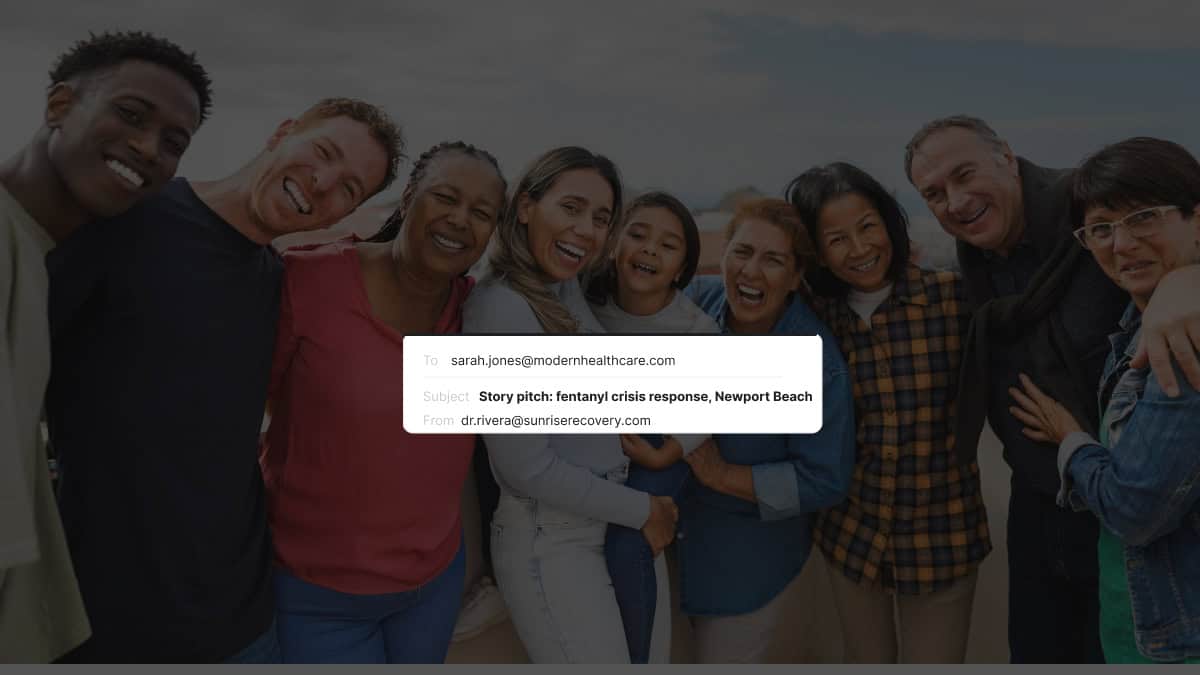
- The Pitch. Short, specific, and offering something the journalist cannot get elsewhere. Subject line names the story angle in under 10 words. Opening paragraph delivers the news. Body provides the supporting detail (data, quotable named source, timing hook). Close offers immediate availability for a call. Keep the whole pitch under 300 words.
- Follow-Up. One follow-up email, 5 to 7 business days after the original pitch, adding new information (a fresh data point, a new development, a clarifying angle). Never send multiple follow-ups. Never pitch the same story to competing publications simultaneously. Respect the journalist’s time and their pipeline.
The workflow above is the operating rhythm for a sustained pitching program. The first month or two of a program often produces zero placements while the beat research, warm-up, and angle iteration mature. Program success is measured in the trailing 90 days of coverage, not the first 30.
What Makes a Treatment Center Pitchable
4-24 hrs
typical journalist response window when a story is breaking
2-6
placements per quarter from a sustained program after month 6
10-15%
response rate on well-targeted cold pitches to beat journalists
Treatment centers vary widely in how ready they are for journalism coverage. Five traits separate the operators who land coverage consistently from the ones who do not.
Named clinicians willing to be quoted. The medical director, clinical director, or senior clinician who can be named in a story and can speak on the record. Treatment centers without named clinicians who will engage with journalism are severely limited in what they can pitch.
Data willingness. Are you willing to share numbers? Cost per admit, viable VOB rates, length of stay data, outcomes tracking, payer mix.
The operators who share substantive data get covered more than the operators who protect it. The data does not have to be exhaustive; it has to be specific and honest.
Point of view. Do you have opinions on the industry-shaping issues? Medicaid pivot economics, EKRA compliance realities, LegitScript, 42 CFR Part 2, staffing shortages, telehealth’s role. Operators with real points of view get quoted. Operators without them do not.
Availability. Can you get the CMO on the phone inside four hours when a story is breaking? Journalists working on deadline cannot wait. The treatment center that responds inside four hours gets included; the one that responds in 48 hours does not.
42 CFR Part 2 compliance clarity. A media protocol that pre-defines what can and cannot be discussed, with sign-off from the compliance officer, is the difference between confident pitching and legal exposure. Building this protocol before pitching begins is a prerequisite, not an afterthought.
The 42 CFR Part 2 Trap
42 CFR PART 2 RESHAPES WHAT TREATMENT CENTERS CAN AND CANNOT PITCH
The federal regulation protecting substance use disorder patient records means any content that could reveal a specific patient’s status, even indirectly, requires explicit written authorization. This is not the same standard as HIPAA. The rules are stricter. A media protocol that pre-defines the compliance boundary is required before any pitching begins.
The 2024 Final Rule updated 42 CFR Part 2 materially through the Federal Register. The updated framework still requires written authorization for any disclosure that could identify a patient as having received substance use disorder treatment, but includes some administrative changes worth understanding.
What treatment centers can pitch without 42 CFR Part 2 exposure:
- Aggregate outcomes data (percentages, ranges, statistical patterns without individual identification)
- De-identified case types (“we treat patients presenting with X” without naming specific patients)
- Named clinical points of view (the medical director’s opinion on treatment approaches)
- Operator perspective on policy and industry issues
- Named-executive quotes on business, operations, and industry topics
- General clinical practice descriptions
What treatment centers cannot pitch without written patient authorization:
- Specific patient stories, even with names removed if the details could reveal identity
- Family member interviews about a patient’s treatment
- Testimonials referencing a specific person’s treatment experience
- Photos or videos of patients or families in treatment settings
- Any content that could confirm a specific person received substance use disorder treatment at the facility
The line between these categories is not always obvious. When in doubt, route the content past your compliance officer before it goes to a journalist. The cost of getting it wrong is materially higher than the cost of a compliance review.
The Reality of Coverage Timelines
THE REALISTIC RHYTHM IS 60 TO 120 DAYS FROM PITCH TO PLACEMENT FOR A FEATURE STORY
Reactive comments on breaking news land faster (24 to 72 hours). Full feature articles take longer as editors approve angles, journalists develop sources, and fact-checking runs. Operators expecting placements in two weeks are usually disappointed. Operators expecting placements in six months are usually rewarded.
The timeline expectations that produce good outcomes:
Days 0 to 30. Beat research, journalist warm-up, initial pitches begin going out. No placements yet in most cases. This month is program construction.
Days 30 to 90. First placements begin landing. Usually 1 to 3 in this window if the program is well-targeted. Reactive comments on breaking news are more likely than feature stories in this phase.
Days 90 to 180. Feature stories from earlier pitches begin publishing. Journalist relationships from months 1 to 3 mature into repeat coverage. Referrals begin from covered journalists to their colleagues.
Days 180 to 365. The compounding phase. Well-run programs produce 2 to 6 placements per quarter. Journalists you have never pitched begin reaching out because your name has surfaced in enough coverage that they know you as a source.
Operators who expect the timeline to compress usually get poorly-targeted mass-email PR agencies that promise “guaranteed placements” and deliver low-authority link-farm coverage that hurts more than it helps.
What Success Actually Looks Like
REALISTIC EXPECTATIONS FOR A TREATMENT CENTER PR PROGRAM
- 2-6 pieces per quarter after month 6 of a sustained program
- Compounding coverage over 12-24 months as journalist relationships mature
- Reactive comments on breaking news land inside 72 hours when responsive
- Named clinicians and executives regularly quoted, building industry authority
- Coverage compounds SEO, AI citation eligibility, and referral pathways together
UNREALISTIC EXPECTATIONS THAT LEAD TO DISAPPOINTMENT
- 10+ placements in the first month of engagement
- One-time press blitz that produces sustained results
- Every pitch produces a placement
- Anonymous or unnamed sources acceptable to the operator
- Coverage is measured only on immediate lead volume
Well-run treatment center PR programs produce coverage that compounds across three effects. Direct traffic and referrals from the coverage itself. SEO lift as high-authority publications link to the treatment center’s site. AI search citation as behavioral-health-related queries pull from journalism coverage the assistants have indexed.
The compound effect is what makes journalism pitching worth the investment despite the slower timeline compared to paid media or organic SEO. A single strong feature in KFF Health News or STAT News can produce more sustained authority for a treatment center than a full quarter of paid media at typical scale, though the paid media is more predictable in the short term. Our companion piece on the specific Digital PR tactics that build authority for rehab centers without buying links covers the earned-media mechanics that stack on top of the pitch workflow described here.
When to Start (and When to Wait)
Not every treatment center is ready for journalism pitching. Signs a program will succeed:
- Named clinicians willing to be quoted, with real credentials.
- Data the operator is willing to share (aggregated appropriately).
- A media-trained CMO or executive who can speak to a journalist without saying anything that requires legal review.
- Compliance officer engaged in a written media protocol.
- Marketing budget dedicated to the program for a minimum 12-month runway.
Signs to wait:
- No named clinicians willing to engage publicly.
- No data willingness beyond what is already on the marketing website.
- Executive team uncomfortable being quoted or on record.
- Compliance function not resourced to review media content in reasonable timeframes.
- Budget available for 3 to 6 months only. PR programs cost less than paid media but require sustained investment across a longer horizon to produce results.
The treatment centers that see the biggest coverage lift are the ones that treat journalism pitching as a 24-month investment in industry authority, not a 90-day tactic. Book an intro meeting if you want to walk your PR readiness with our team live.
Frequently Asked Questions
How much should we budget for a healthcare journalism pitching program?
A sustained in-house program runs $60,000 to $120,000 per year in dedicated staffing (a PR lead or manager) plus $5,000 to $15,000 per year in media database subscriptions and tooling. Outsourced programs run $6,000 to $18,000 per month depending on scope, with a typical minimum 12-month engagement.
The larger cost is executive time. A treatment center CMO or clinical director engaged with a PR program will spend 4 to 8 hours per month on interviews, review, and journalist availability. That time is not free even when it does not show up as a line item.
The programs that pay back are the ones that treat PR as investment in sustained industry authority, not a one-quarter tactical push. Compounding effects across 12 to 24 months produce the returns that justify the investment.
How do we measure PR results if the metrics are not admits?
Measure across four dimensions. First, placement volume and publication tier. Track total placements, publication authority (DA scores or equivalent), and the mix across trade, healthcare, and consumer tiers.
Second, backlink and SEO effects. High-authority publication links compound the site’s organic ranking on treatment-related queries over time. Track referring domain growth and organic ranking movements on core keywords.
Third, referral traffic and citation lift. Direct traffic from coverage articles plus AI search citations that begin appearing after a piece publishes. Set up analytics segments for both.
Fourth, brand-search lift. Coverage produces branded search volume from readers who read the piece and then Google the facility. This shows up in Google Search Console as branded impression growth over 30 to 90 days after each major placement.
None of these are the admit number, but all four upstream the admit number in ways that show up 6 to 18 months later.
Can we hire a general PR agency or do we need a healthcare-specialist agency?
Healthcare-specialist agencies typically produce better results in behavioral health specifically. The reason is beat knowledge. A generalist agency has to learn which journalists cover behavioral health, what angles land in Behavioral Health Business versus STAT News, and how 42 CFR Part 2 shapes what can be pitched. A specialist agency arrives already knowing.
The compliance dimension matters more than most operators expect. General PR agencies unfamiliar with 42 CFR Part 2 have been known to draft pitches that would create compliance exposure if sent as written. A specialist agency has this baked into their standard protocol.
The cost difference is usually modest. Generalist agencies are sometimes cheaper monthly but require more executive time from the treatment center to keep pitches compliant and on-message. The delta narrows when total effort is measured.
How do we handle a journalist asking about topics we do not want to discuss?
Have a media protocol in place before the first journalist call. The protocol defines which topics are on-record, which are on-background, and which are off-limits, with named alternatives to redirect toward.
Common off-limits topics for treatment centers: specific patient stories without written authorization, ongoing regulatory investigations, unresolved employment matters, or specific competitor comparisons. Common redirect topics: the operator’s clinical philosophy, industry-level policy views, aggregate outcomes data, or general operational realities.
A treatment center CMO who can gracefully redirect a journalist away from an off-limits topic while providing genuine value on an on-limits topic is worth more to the PR program than any single placement. Media training pays back the investment within the first two interviews if the training is real.
Trevor Gage is the Director of Marketing at Webserv, a digital marketing agency for treatment centers.