An admissions coordinator runs a verification of benefits on a new patient inquiry. The plan is active, the level of care is covered, and the deductible is met.
She marks the VOB “viable,” the admissions team schedules the admit, and 90 days later the operator opens the collections report and sees the payer paid $675 per day for what was quoted as a $900 per day program.
The math on the admit does not work. Nobody on the admissions team did anything wrong. The system they were using answered the wrong question.
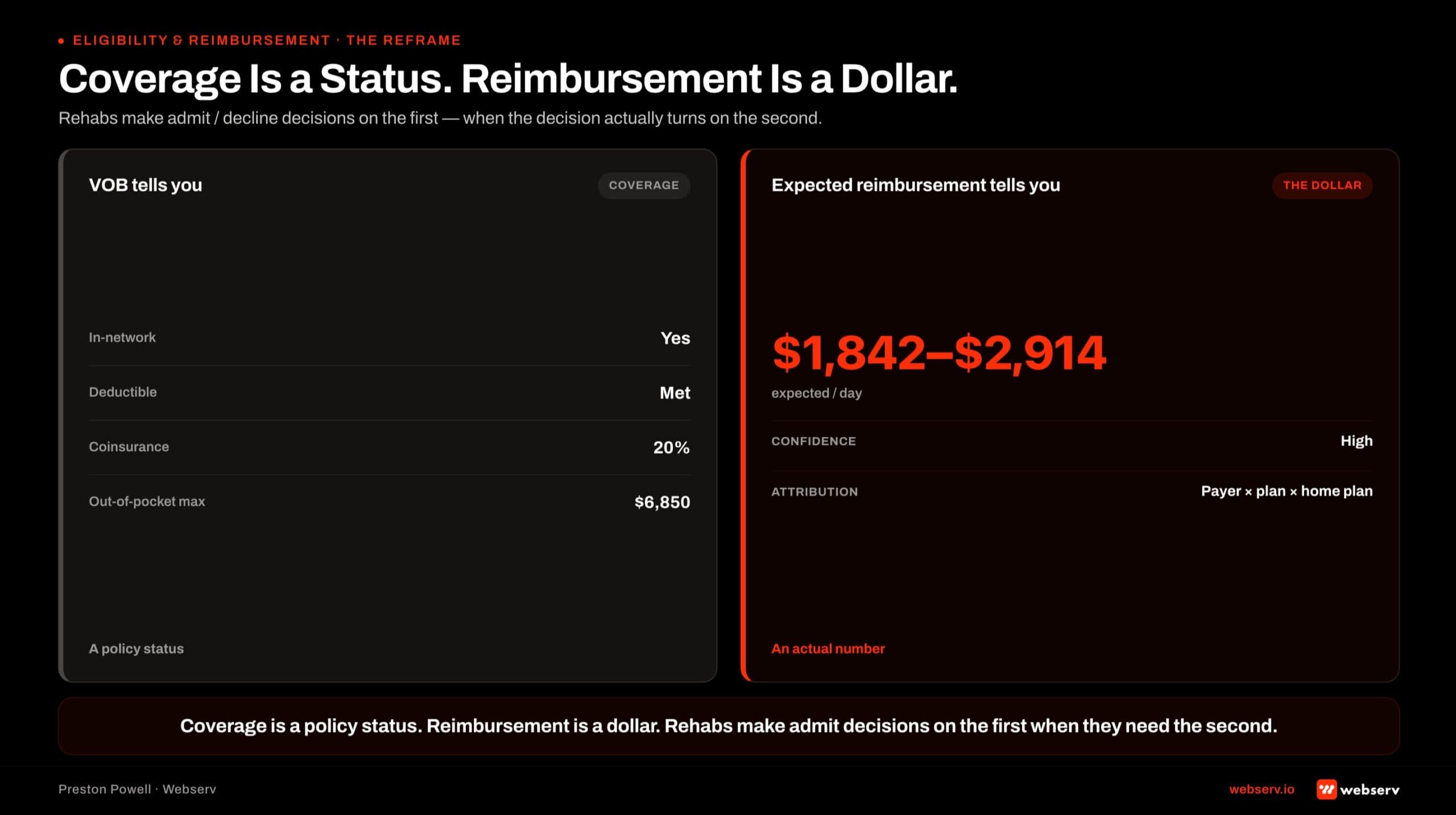
That gap is the single most expensive piece of missing information in behavioral health admissions. The VOB tells you the patient is covered. It does not tell you what the payer will pay.
Those are two different questions, and treating them as one is where treatment centers routinely lose 20 to 40% of expected reimbursement per admit without ever seeing the leak in real time.
I’ve been working in and around treatment center admissions for over a decade, and every operator I’ve spoken with in the last two years has run some version of this exact conversation.
The category we built PayerLenz inside of is not “better VOB.” It is a fundamentally different question the industry has been trying to answer with the wrong tool.
This piece is the definitional reframe, aimed at any operator running a treatment center admissions team who is quietly aware that the numbers on the collections report do not match the numbers on the VOB report and has not yet named why.
Key Takeaways
- A verification of benefits confirms that a patient’s coverage is active and the level of care is in-benefit. It does not confirm what the payer will actually pay for the admission. Those are two different questions with two different data sources.
- “BCBS” is not a single payer. It’s a federation of ~34 independent licensees that fragment further into 138+ home plan entities. Same California, same residential level of care, same OON status: the same “BCBS” eligibility response covers plans that pay anywhere from $662 to $3,778 per day depending on the specific home plan resolved from the alpha prefix.
- VOB tools built on payer eligibility APIs cannot see the rate data because payer eligibility APIs do not return realized-payment information. They return benefit design, which is what the payer says they will cover, not what they have paid on similar claims.
- Expected reimbursement data lives inside adjudicated claims. That is the payment record after the claim has been processed and paid. Rate benchmarks built from adjudicated claims answer the operator’s actual question in a way benefit design data structurally cannot.
- The single operating decision this reframe changes is moving from “can we admit this patient” to “should we admit this patient at this rate,” and that shift affects census planning, payer mix strategy, and OON program viability all at once.
What a verification of benefits actually tells you
A VOB confirms a specific set of facts about a patient’s insurance coverage at a specific moment in time. The plan is active. The benefit design includes the level of care being sought.
The deductible position is X. The out-of-pocket max is Y. Any authorization requirements attached to the level of care are documented. If the payer has carve-out arrangements for behavioral health, those are surfaced.
DEFINITION
VOB vs Expected Reimbursement. A verification of benefits answers “is this patient covered” from payer eligibility API data. Expected reimbursement answers “what will the payer actually pay” from adjudicated claims data. Two different questions, two different data sources, two different product categories. Every VOB tool on the market operates on the front half. Rate intelligence is the back half.
Every one of those data points is real, useful, and necessary. A treatment center running admissions without a VOB process is operating blind on coverage, and that is how facilities end up admitting patients whose benefits terminated three weeks earlier or whose plan does not cover residential care.
The VOB is not the problem. The problem is that the industry has been treating the VOB as if it were the whole answer to “can we admit this patient profitably” when it only answers part of the question.
Coverage confirmation is the front half of the answer. Rate expectation is the back half. Every VOB tool on the market today, VerifyTX included, lives inside the front half.
What a verification of benefits structurally cannot tell you
The reason the VOB stops at coverage confirmation is architectural. Every commercial VOB tool built for behavioral health, and effectively every VOB tool built for any healthcare vertical, is built on payer eligibility APIs.
Payer eligibility APIs are the electronic connection between a provider and a payer that returns benefit design data. That data set includes plan status, deductible position, out-of-pocket, benefit inclusions, prior authorization requirements, and level of care coverage.
What the data set does not include is what the payer has actually paid on adjudicated claims from similar patients at similar facilities for similar levels of care.
The payer does not return that information through the eligibility API. It is a different data set that lives inside the payer’s claims-processing system, and it becomes visible to the provider only after the claim has been submitted, adjudicated, and paid.
By the time an operator can see the realized-payment number, the patient has been in treatment for 30 to 90 days and the operator has already committed the operational cost of the admit.
The VOB tool market has invested heavily in making the eligibility API side of the equation faster, cleaner, and more BH-specific. VerifyTX supports 1,700 payers with sub-30-second response times.
Availity runs one of the largest health information networks in the country. pVerify has strong API depth across specialty verticals. All three of those investments matter, and all three of them are optimizing a data source that stops at coverage confirmation.
Coverage is not a rate: the $662 to $3,778 problem
The number that anchors this whole reframe is the rate variance range on what looks like the same payer to a VOB tool.
Across our adjudicated claims pool, four different Blue Cross Blue Shield home plans in California, all showing as “BCBS coverage confirmed” on any eligibility tool, pay dramatically different rates for the same residential level of care.
Anthem Blue Cross and Blue Shield of Indiana pays $3,778 per day. Anthem Blue Cross and Blue Shield of Ohio pays $3,090. Anthem Blue Cross of California pays $2,297. Blue Shield of California pays $662.
$3,778
Anthem BCBS of Indiana
$3,090
Anthem BCBS of Ohio
$2,297
Anthem Blue Cross of CA
$662
Blue Shield of CA
Same state, same LOC, same out-of-network status, same “BCBS” eligibility label. All four are high-confidence cells in our pool, each backed by 129 to 635 claims from 3+ distinct facilities, current through Q2 2026. A 5.7x spread within one label.
That is not a range across payers. That is a range within what an eligibility tool would return as a single payer entity, driven by alpha prefix, home plan, and the specific negotiated rate schedule that adjudicates the claim.
If an operator only sees the coverage confirmation, they see none of that variance. The VOB comes back “viable” and the admission goes forward.
If the admit adjudicates to the low end of that variance range, the operator’s cost per admit math on that specific patient is broken and there is no signal in the admissions workflow that the break is coming.
The variance is not random noise. It is a structural feature of how modern healthcare payer networks work.
Behavioral health carve-out arrangements, subcontracted network administrators, plan-level rate negotiations, and state-specific regulatory variations all combine to produce a rate schedule that is very different for two members of the same payer group depending on their specific plan structure. That variance is what determines whether the admit is profitable.
Why VerifyTX and similar tools cannot close the gap
This is not a criticism of VerifyTX or any other VOB tool. It is a description of what those tools can and cannot see given their data source. A VOB tool built on payer eligibility APIs is architecturally locked to the front half of the answer.
To answer the rate question, a data source has to have access to adjudicated claims. Not a specific patient’s claim, which is protected health information the provider already has, but a population of adjudicated claims across many providers.
That population needs to be cleaned, normalized, and organized by payer group, alpha prefix, home plan, and level of care. That is the data set that produces a defensible expected reimbursement estimate for a new admit.
VerifyTX, pVerify, Availity, Waystar, and every other tool in the VOB automation category is not built on that data source. They cannot see it structurally without becoming a different kind of tool. That is not a product roadmap problem. It is a data architecture problem.
OPERATOR INSIGHT
The reframe in one sentence: eligibility tells you whether you can bill. Rate intelligence tells you whether you should admit. Coverage confirmation is the front half of the answer. Every VOB tool on the market lives inside the front half.
BCBS is not one payer
The specific complication that most operators underestimate is BCBS. When a VOB tool returns “BCBS coverage confirmed” and marks the plan active, the coordinator on the admissions team reads that as a single answer.
It is not. BCBS is a federation of roughly 34 independent licensee companies operating across states and territories, and inside those licensees the structure fragments further. Our prefix-to-home-plan mapping table carries 21,800 entries and resolves to 138 distinct home plan entities that appear in our data.
The alpha prefix on the member card is the first three characters that identify which specific BCBS plan will process the claim. The home plan is the specific BCBS entity that holds the member’s coverage contract.
Resolution to alpha prefix plus home plan is what determines the rate schedule the claim will adjudicate against. Without that resolution, the VOB tool is returning a coverage confirmation without visibility into which specific rate schedule applies.
This is where the same-payer $662 to $3,778 variance concentrates. Different BCBS home plans within the same “BCBS” eligibility label pay dramatically different rates for the same level of care.
An operator who admits a patient with a BCBS plan without resolving to alpha prefix and home plan is committing operational cost against a rate schedule they cannot see.
Where expected reimbursement data actually comes from
The category of tool that answers the rate question is a different kind of instrument than a VOB tool. Its data source is adjudicated behavioral health claims, contributed by a network of treatment centers.
The data is cleaned and normalized to the alpha prefix and home plan level, and organized so that a new eligibility check can return more than a “covered” status.
It can return “covered and here is what the payer paid on 47 similar claims in the last 12 months at this level of care for this alpha prefix, with a trust score attached to the estimate.”
That instrument does not replace VOB tools. It runs alongside them, or in some cases returns both data sets in the same call.
Operators still need the coverage confirmation. What changes is that they now have the rate expectation too, and the admissions decision framework upstream of the admit changes shape.
The trust score matters here. A rate estimate based on 5 claims is directionally useful. A rate estimate based on 500 claims is operationally defensible.
The confidence layer is what makes the rate data actually usable versus a rough average with no way to interpret how much to trust it.
On high-confidence cells, PayerLenz estimates land within 10% of what the payer actually pays about nine times out of ten, backed by adjudicated claims across more than a million datapoints in the pool. That is the accuracy number an operator can plan against.
How the accuracy holds up against paid claims
The 10% accuracy number is not a marketing claim. It is the observed accuracy against adjudicated claims where paid-versus-expected can be defensibly compared, measured against the rate cell where the confidence formula returned a high-confidence estimate.
The second-order proof of the accuracy is what happens when the same estimate gets applied backward to already-paid claims. In one comparison case across roughly 23,000 claims where paid-versus-expected was defensibly comparable, PayerLenz identified $1.36 million in underpayments the treatment centers involved had not previously known to chase.
That number is the subset where paid-versus-expected was defensibly comparable, not the entire pool. Reimbursement recovery is a payer-relationship discipline, not a mechanical claim resubmission, and the $1.36 million represents estimates rather than guarantees on recovery.
But the number matters strategically because it changes the ROI framing on rate intelligence. The primary axis of value is admit-time decision support. The second axis is the underpayment identification that happens after the paid claim comes back and can be measured against the expected rate.
The operator question this reframe changes
Before rate expectation is in the admissions workflow, the primary operator question is “can we admit this patient.” Coverage is confirmed, the level of care is in-benefit, the payer is in the network or the OON program is viable in principle. The decision is binary.
After rate expectation is in the admissions workflow, the primary operator question shifts to “should we admit this patient at this rate.” Coverage is still confirmed.
But the operator can now see the expected reimbursement attached to that specific coverage, with a trust score, and can compare that expected reimbursement against the operational cost of the admit. If the expected rate is below the operational cost, the admissions decision changes.
The second-order effect is on census planning. Operators who can see rate expectation across their pipeline can forecast collections at the individual admit level instead of the aggregate payer-mix level.
That produces a materially different census plan and a materially different conversation with ownership about which admits to prioritize when capacity is constrained.
The third-order effect is on payer mix strategy. Operators who can see rate variance within their payer mix start making different network decisions.
Which BCBS plans are worth targeting on the OON side. Which are structurally unprofitable given the operator’s cost structure. Which negotiated in-network contracts are underperforming the OON alternative at the alpha prefix level.
None of these decisions are possible with coverage-only data. All of them are unlocked by rate expectation.
What this changes about the admissions ops discipline
The broader implication for admissions ops as a discipline is that the eligibility layer expands from single-question (is the patient covered) to two-question (is the patient covered, and at what expected rate). That expansion propagates through the KPI spine.
The VOB-to-admit reimbursement gap becomes measurable in a way it structurally could not be before. The marketing and admissions QBR starts reporting on rate-adjusted admissions volume alongside raw admissions volume.
The out-of-network reimbursement math at the program level gets built on real data instead of assumptions. And the referral partner conversation shifts from “how many admits did you send us” to “how many admits did you send us and what did they pay.”
None of that is possible with a VOB tool alone. All of it is possible when the eligibility layer includes rate expectation.
Frequently Asked Questions
This connects to the broader revenue cycle picture covered in behavioral health marketing guide and revenue cycle management guide. It’s also worth pairing with billing mistakes that reduce admissions and reducing claim denials.
What’s the difference between a VOB and expected reimbursement?
A VOB confirms coverage. It answers the question “is this patient’s insurance active and does the plan cover the level of care being sought.” Expected reimbursement answers a different question: “given the coverage, what will the payer actually pay for the admission based on similar adjudicated claims.”
The two data sources are architecturally different. A VOB is built on payer eligibility API data. Expected reimbursement is built on adjudicated claims data. A treatment center running admissions without both is missing the rate expectation half of the admissions decision.
The practical difference shows up in collections. Two facilities running identical VOB processes on identical patient pipelines can produce substantially different collections numbers 90 days later because one facility saw rate expectation upstream and made different admissions decisions.
Can’t a VOB tool just add rate data to what it already returns?
Not without changing the underlying data source the tool is built on. Every commercial VOB tool is built on payer eligibility APIs, which return benefit design data (what the payer says they will cover) but do not return realized-payment data (what the payer has actually paid on similar claims).
To return rate data, a tool has to have access to adjudicated claims across a network of providers. That is a different data infrastructure than an eligibility API integration. VOB tools can be excellent at what they do inside the eligibility API side of the equation without ever being able to answer the rate question.
The category we built PayerLenz inside of is not “improved VOB.” It is a data source that runs alongside VOB and answers the question VOB cannot answer.
Why does the same payer pay different rates for the same level of care?
The rate variance within a single payer group is driven by three factors. Alpha prefix resolution, which identifies the specific plan within the payer group that processes the claim.
Home plan structure, which determines which specific rate schedule adjudicates the claim. Behavioral health carve-out arrangements, where the payer has subcontracted BH claims to a third-party network administrator with its own rate schedule.
For BCBS specifically, roughly 34 independent licensee companies operate across states and territories, and those licensees fragment into 138 distinct home plan entities in our data pool.
A patient carrying a BCBS card can have any one of those home plans as their actual coverage entity, and the rate at which their claim adjudicates can vary by a factor of 5x or more within a single state.
Operators who see only “BCBS coverage confirmed” on the VOB are committing operational cost against a rate schedule they cannot see. Alpha prefix and home plan resolution is what closes that visibility gap.
Do we still need a VOB tool if we have expected reimbursement data?
Yes. Coverage confirmation is still necessary for the admissions workflow. Rate expectation without coverage confirmation is not a complete answer either. The two data sources complement each other: coverage confirmation tells the admissions team the patient can be admitted, and rate expectation tells the operator whether the admit will be profitable at the expected rate.
Some tools return both data sets in the same call, which reduces the tool count in the admissions ops stack. Others run alongside a separate VOB tool. Either configuration works as long as both data sources are in the workflow before the admit decision is made.
How accurate is the expected reimbursement estimate?
On high-confidence rate cells, the estimate lands within 10% of what the payer actually pays about nine times out of ten. That accuracy is measured against adjudicated claims where paid-versus-expected can be defensibly compared, on cells where the confidence formula returned a high-confidence score.
The confidence layer matters. Cells with thin data return a lower confidence score and should be treated as directional context rather than planning-grade data. Cells with high confidence return an estimate operators can plan against.
The applied-backward proof of the accuracy is that in one comparison case across roughly 23,000 claims, the same estimate methodology identified $1.36 million in underpayments the treatment centers involved had not previously known to chase. That number is the subset where paid-versus-expected was defensibly comparable, not the entire pool.
How much can rate expectation data actually change our collections?
The variance is substantial enough that it usually shows up as a distinct P&L line item within one quarter of adoption.
A facility running 100 admits per quarter that shifts admissions decisions on the 20 to 30 admits per quarter that were structurally unprofitable at the actual adjudicated rate produces a material change in collected revenue per admit without any change in marketing spend or admissions team headcount.
There is a second recovery axis too. Applied backward against already-paid claims, the same rate benchmark surfaces underpayments the billing team can pursue. In one comparison case across roughly 23,000 claims, this identified $1.36 million in underpayments across a subset where paid-versus-expected was defensibly comparable.
The VOB-to-admit reimbursement gap piece walks the specific math on measuring the gap and closing it. What matters for the reframe in this piece is that the gap exists as a structural feature of the current admissions ops stack, and closing it requires expanding the eligibility layer beyond coverage into rate expectation.
Preston Powell is CEO of Webserv, a behavioral health marketing agency and admissions ops platform working with residential, outpatient, and telehealth treatment providers across the United States. He founded Webserv in 2015 and leads the PayerLenz reimbursement intelligence product alongside Kyle McHenry.