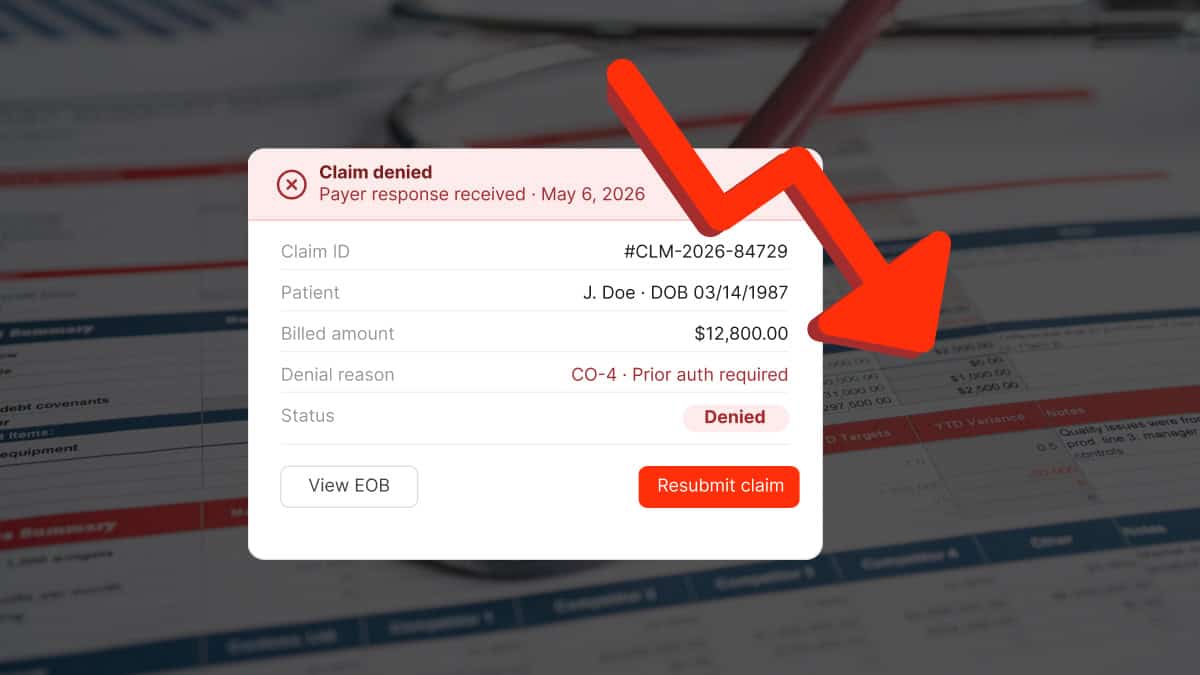
A claim denial comes back. The reason cited is missing authorization. The auth was obtained on day one of admission. The auth number is on the claim. The insurance company knows the auth exists.
Most centers cannot solve denial recovery in-house. Picking the right RCM partner, one that actually publishes claim closure and denial recovery benchmarks, is the single biggest lever on this metric.
The denial is a delay tactic. The clock starts over.
Most behavioral health billing operations treat that letter as new information to react to. They pull medical records, build an appeal, and wait 60 days. Sometimes 90.
The right move is to push back the same day, quote the original determination, and force the payer to articulate exactly what they need. Half the time, the denial reverses once the payer realizes the claim is going to be worked, not absorbed.
That distinction is the difference between a 70% close rate and a 90% close rate at the same treatment center, with the same payer mix, in the same quarter. The denials don’t change. The response to denials does.
Denial rate is a vanity metric. Denial recovery rate is the one that matters.
Kyle McHenry, Founder, Revenue Logic
This guide covers six concrete moves that reduce the denial drag on a treatment center’s claim portfolio. None of them require new software. All of them require a billing partner that is willing to argue with insurance companies on your behalf.
Key Takeaways
- Insurance denials in behavioral health follow patterns, not random events. Each payer has a denial pattern that usually traces to a quiet rule change the payer did not announce. Billing partners that monitor pattern shifts catch rule changes in the first week. Reactive partners catch them six weeks later, after the revenue drop is measurable.
- The most expensive instinct in claims management is sending medical records the moment a payer asks for them. The right first move is to quote the original authorization determination and force the payer to articulate exactly which clinical record they need and why. A meaningful percentage of denials reverse at this stage without any records leaving the building.
- Offshore utilization review is the single fastest path to a higher denial rate. Domestic UR specialists with established payer relationships get longer authorizations and more compliant clinical conversations. The cost savings of offshore UR are visible in the billing fee. The downstream cost lives in lost reimbursement that does not get attributed back to UR.
- The metric that matters is denial recovery rate, not denial rate. A 95% denial rate paired with an 85% recovery rate is a stronger operation than a 70% denial rate paired with a 30% recovery rate. Most billing partners can produce the denial rate but few can produce the recovery rate by payer, which is the report that actually drives operational improvement.
Denials are patterns, not random events
Insurance companies do not generate denials at random. Each payer has a denial pattern. Most patterns track to a quiet rule change that the payer did not announce. The Mental Health Parity Act sets the legal frame for parity in behavioral health denials, but enforcement gaps mean payers still apply quiet rules that affect BH claims more aggressively than physical health.
UnitedHealthcare updated its accepted code set last year. There was no email. No payer bulletin. The denials started arriving roughly two weeks later, all citing “incorrect coding.”
Billing partners that monitor pattern shifts caught it in the first week. Billing partners that worked claims one at a time caught it six weeks in, after a measurable revenue drop.
That gap is one of the most expensive operational differences in the industry. Pattern detection on the payer side closes weeks of lost revenue every time a payer changes a rule.
The first question to ask any billing partner: how do they detect denial pattern shifts, and how fast do they identify when a payer has changed a rule?
If the answer is “we work each claim individually,” the operation is reactive. The pattern catches them, not the other way around.
1. Push back before sending medical records
The most expensive instinct in claims management is sending medical records the moment a payer asks for them.
A claim denial cites missing authorization, ineligible provider type, or coding issues. Sometimes more than one in the same letter. Most of those flags are not real.
The payer is testing whether the claim will be worked or absorbed. If you ship the records, the payer now has a much larger surface area to deny on. They will find something on the records that the claim itself was not asking about.
The right first move is to quote the original auth determination, the date of authorization, the auth number, and the payer’s own confirmation language. Force the payer to articulate which specific clinical record they need and why.
A meaningful percentage of denials reverse at this stage. The records never leave the building. The claim pays.
Train the team to ask: what did the payer actually ask for, and what is the smallest acceptable response?
2. Match every authorization to its clinical record, quarterly
The audit pattern that takes down treatment centers does not start with audits. It starts with authorizations that the chart cannot support.
A previous billing company got the auth. The clinical record does not justify it. When the insurance company eventually requests medical records on a claim from that admission, the discrepancy becomes the treatment center’s problem.
Catching this before the payer does requires a quarterly chart-to-auth audit. Pull a sample of recent authorizations. Read the clinical notes that supported each one. Ask whether a UR specialist could have built that auth from those notes.
If the answer is no on more than 5% of the sample, the chart-auth alignment work has to happen before any new appeals get filed. Otherwise the appeal is exposing a deeper problem.
This audit also surfaces the structural issue most operators do not see: the previous billing company was not lying about the auth. The clinical documentation was thin enough that someone had to interpret it generously to land the auth. The interpretation is the audit risk.
3. Track payer-specific code-set changes
Coding denials are concentrated in a handful of payers each year. The payers do not announce code-set changes. The denials are the announcement.
A billing partner that works in this vertical at scale should be able to tell you, this week, which payers have changed accepted codes in the last 60 days, what the new accepted set is, and whether the change is documented anywhere outside the denial pattern itself.
For a single-location IOP center, the operational answer is: subscribe to a billing partner who maintains this database, and review the denial pattern report monthly.
For a multi-location organization with internal billing, build the database yourself. Tag every denial with payer, denial reason code, claim type, and date. Run the report quarterly and look for clusters.
The clusters are the rule changes. The rule changes are recoverable revenue.
4. Stop sending claims to payers that do not require submission
A pattern we see often: a treatment center is submitting five and six-figure claims to payers that do not need or expect those claims at all. The claims sit. The payer does not pay because the claim is not actionable on their end. A serious verification of benefits process catches these routing problems before admission, but most checkbox-version VOBs miss them entirely.
This is a specific behavioral health pattern that does not exist in most other healthcare verticals. Some out-of-network payers expect a balance bill or a member submission, not a provider claim. Some self-funded plans route through a TPA that the provider has never been credentialed with.
Submitting claims into those workflows generates denial volume that is not actually a denial pattern. It’s a routing error.
The remedy is a payer-by-payer routing audit on the existing claim portfolio. For every payer with significant outstanding receivables, confirm that claims are being submitted into the workflow that payer expects.
Some of those claims need to come back as member submissions. Some need to be re-routed to the right TPA.
A serious billing partner runs this audit during onboarding. If your current partner has not, the cleanup is usually six figures of recoverable revenue at a mid-sized program.
5. Do not outsource utilization review
The single fastest path to a higher denial rate is moving UR offshore.
A care manager at the insurance company has wide latitude on what to approve. They approve more for callers they recognize and trust, and less for callers they do not know who carry a language barrier into a clinical conversation.
When a domestic UR specialist who has worked the same payer for five years calls about a patient, the care manager is looking at a familiar voice on a clean program. The clinical conversation is a clinical conversation.
When an offshore UR contractor reads a script for the same patient, the care manager is reading the audit risk profile in real time. Authorizations come back shorter. Lengths of stay compress. Mental health parity rules are supposed to prevent shorter authorizations for BH versus physical health, but in practice the parity gap is what UR teams are negotiating against on every call.
Compressed lengths of stay produce more denial-adjacent failures: missed continuity of care, level-of-care transitions that don’t get authorized, and final claims that arrive without the supporting auths.
The cost savings of offshore UR are visible in the billing fee. The downstream cost lives in lost reimbursement that does not get attributed to UR. Most operators never connect the two.
The numbers agencies quote you mean very different things depending on payer mix.
Before you benchmark your performance or compare quotes from other agencies, read this. Real data from real OON treatment center campaigns with no cherry-picked numbers.
Read the report → Free and ungated6. Measure denial recovery rate, not denial rate
UPSTREAM SIGNAL, DOWNSTREAM DENIALS
Denials fought after the fact are the most expensive place to win a rate argument. Knowing before admission what the payer typically pays for that level of care collapses a whole class of “underpayment” appeals. PayerLenz attaches expected out-of-network reimbursement figures to real-time eligibility checks, so admissions and billing are working from the same expected number rather than discovering it in an EOB three weeks later.
The metric most treatment center owners ask their billing partner about is denial rate. The metric that actually matters is denial recovery rate.
A 95% denial rate paired with an 85% recovery rate is a stronger operation than a 70% denial rate paired with a 30% recovery rate.
The first program is winning the appeal fight. The second program is letting denials sit.
Most billing partners can produce the denial rate. Few can produce the recovery rate by payer. Even fewer can produce it by denial reason code, which is the report that actually drives operational improvement. Compare against the RCM partners that publish recovery-rate benchmarks when evaluating.
Demand a monthly report that shows denial volume by payer, recovery rate by payer, and average days from denial to recovery. If your billing partner cannot produce that report inside 30 days, they are not measuring the work.
What this looks like at the program level
Apply these six tactics over a single quarter and the close rate moves. We have seen 60% to 90% closure inside 90 days at programs where the workflows were not changed and the staff was not added.
The denials did not change. The response to denials changed.
That is the part of revenue cycle management that gets undersold to operators because it is hard to package as a feature. There is no software demo. There is no AI workflow. The VOB workflow that captures the right alpha-prefix data, the chart-to-auth audit, the payer pattern database, the in-house UR team. These are the operational disciplines that produce the close rate.
There is a billing operation that is willing to argue with insurance companies for hours every day, with a database of payer behavior that goes back years.
Treatment centers that pay for that operation get paid faster, more often, and at higher rates. Treatment centers that pay for the cheaper version pay it back in the recovery rate.
Ask your billing partner three questions this week.
First, what is the program’s denial recovery rate by payer over the last 90 days?
Second, which payers have changed code sets or rule patterns in the last 60 days?
Third, when was the last chart-to-auth audit performed, and what was the alignment rate?
If those questions cannot be answered, or if the answers cost you a quarter, your treatment center is paying for claim submission and absorbing the rest as background loss.
That gap is closeable in 90 days. The first step is asking the questions.
Frequently asked questions about reducing behavioral health claim denials
This connects to the broader revenue cycle picture covered in behavioral health marketing guide and billing mistakes that reduce admissions. It’s also worth pairing with prior authorization for addiction treatment.
What is a realistic denial rate target for a treatment center?
Best-in-class behavioral health programs run denial rates under 8 percent of submitted claims. The strongest programs we audit consistently hit 4 to 6 percent. Programs above 12 percent have either a process problem (UR, coding, submission timing) or a payer mix problem that systematically generates denials.
The target depends on payer mix. Out-of-network heavy programs run higher denial rates structurally because OON claims face more scrutiny. In-network heavy programs should be at the lower end of the range. A mixed program running 8 to 10 percent is usually performing well.
Denial rate alone is incomplete without denial overturn rate. A program at 12 percent denial rate that overturns 75 percent on appeal is in better shape than a program at 6 percent denial rate that overturns 20 percent on appeal. The first program is recovering revenue the second program is writing off.
How long does it take to see a meaningful denial rate reduction?
Most treatment centers see measurable denial rate improvement within 60 to 90 days of implementing the right process changes. The first wave of improvement comes from fixing the most expensive single denial pattern in your account (usually authorization mismatches or clinical documentation gaps). The compounding improvement over the next 6 months comes from systematizing the discipline.
Specific tactics produce specific timelines. Authorization-to-record alignment fixes show within 30 days. UR quality improvements show within 60 days. Coding accuracy changes show within 90 days. The full denial rate transformation typically completes inside 6 months when the program commits to it.
The mistake operators make is to expect denial rate to drop continuously after the changes. The pattern is step-function: meaningful drop in months 1 to 3, plateau in months 4 to 6, second meaningful drop in months 7 to 9 as the new discipline becomes the default. Linear improvement is rare in this work.
Who on staff should own denial reduction work?
The owner is usually the revenue cycle manager or director, with daily execution by the billing team. For most treatment centers, the right ownership pattern is a single named person accountable for the denial rate KPI, with cross-functional support from clinical (for documentation), UR (for authorization quality), and admissions (for VOB accuracy).
The pattern that fails is treating denial reduction as a billing-only problem. Most denials originate upstream of billing. UR submitted incomplete clinical justification. Admissions misclassified a payer at intake. Clinical documentation lacked the elements the payer required. Billing inherits the consequences without controlling the causes.
The fix is structural ownership across the upstream functions plus billing-side execution. A monthly denial review meeting with billing, UR, clinical, and admissions leadership produces better outcomes than any single department working alone.
Are some denial codes worth fighting and others worth writing off?
Yes, with discipline. Denials worth fighting are those with a defensible clinical or contractual basis (missing authorization that was actually obtained, coding errors that can be corrected, medical necessity disputes where clinical documentation supports the case). These typically overturn at 60 to 80 percent on appeal.
Denials not worth fighting are those where the underlying claim was genuinely deficient (missing required documentation, services rendered outside authorization period, non-covered services). Appealing these wastes UR and billing time that could be spent on higher-overturn-rate denials.
The decision should be made by overturn rate per denial reason code, not by claim dollar amount. We track overturn rate by reason code monthly and allocate appeal effort proportionally. A program that appeals every denial uniformly produces worse results than a program that appeals selectively against the codes that consistently overturn.
Does denial rate correlate with marketing spend efficiency?
Directly and dramatically. Marketing spend produces admits. Denials determine what percentage of admit revenue is actually collected. A 15 percent reduction in denial rate at a typical treatment center is equivalent to a 15 percent increase in marketing budget at the same cost-per-admit, because the same admits produce more collected revenue.
The math compounds. A facility spending $80,000 monthly on marketing with a $4,000 cost-per-admit produces 20 admits. If average admit revenue is $50,000 and denial rate is 15 percent, monthly collected revenue is roughly $850,000. Reducing denial rate to 5 percent produces $950,000 monthly on the same marketing spend, a $1.2M annualized lift.
We build attribution reporting that traces marketing spend through admits through denied claims through collected revenue. When that line of sight is clean, marketing budget decisions account for what is actually collectible, not just what produces volume.
The perspective in this article comes from 9 years working exclusively inside behavioral health.
We are a team built by people in recovery who understand that behind every admission is someone asking for help. If that resonates, get to know us.
Kyle McHenry is the founder of Revenue Logic, a behavioral health revenue cycle management firm. He has spent 15 years working with treatment center operators on verification, utilization review, and claims management.