In March 2026, Perplexity described the problem it was trying to fix in health search in one line: most health answers online, it said, are grounded in SEO-optimized content written to rank.
Two months later it announced premium health sources that pull from journals like NEJM and BMJ, and said more than one in ten Perplexity queries are health-related.
For treatment centers, that’s the most important thing to know about Perplexity. It’s the AI platform most willing to cite community content like Reddit in general, and at the same time it’s moving its health answers toward clinical and institutional sources.
This piece covers how Perplexity finds and cites sources, what the citation research shows about its preferences, how those preferences shift for health topics, and the content patterns that give a treatment center a realistic chance of being cited. It’s part of the work we do inside our AEO program for treatment centers.
For the full AI search build, start with our Full AI Search Stack. This piece focuses on one platform.
Key Takeaways
- Perplexity searches the web in real time and attaches numbered citations to its answers. Its crawler, PerplexityBot, has to be allowed for a site to appear in results.
- Perplexity ended its ad experiment in early 2026, so organic citation is the only way into its answers.
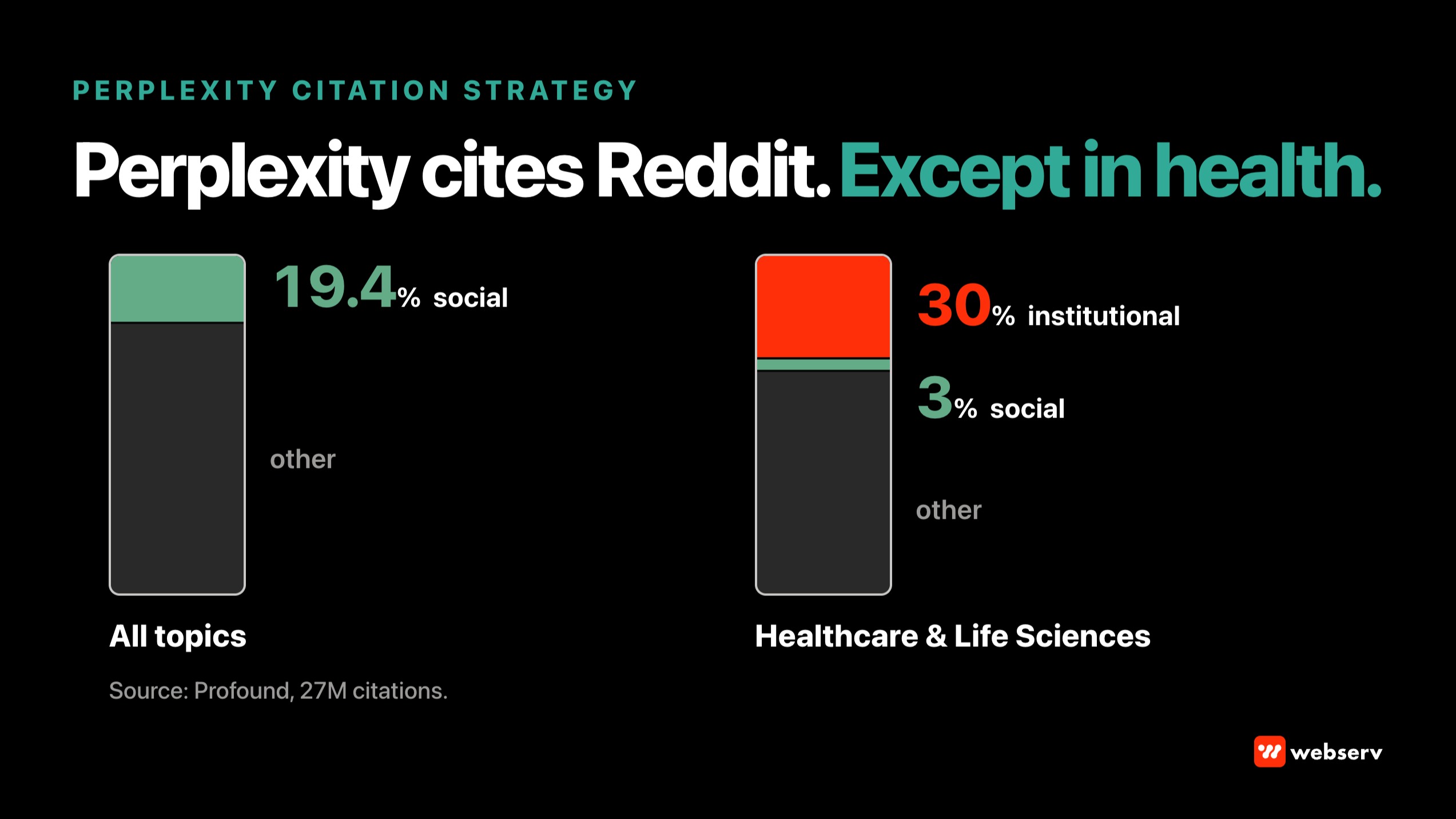
- Across all topics, Perplexity cites social platforms far more than other assistants: Profound found social sources made up 19.4% of Perplexity’s citations versus 5.3% for ChatGPT.
- Healthcare runs the other way. In the same Profound data, Healthcare & Life Sciences citations were 30% institutional and only 3% social, and Perplexity’s new health features lean on medical journals and clinical guidelines.
- Perplexity labels some sources as Government, Academic, or Trusted based on site-wide practices like named authors and correction policies. Those are practices a treatment center can adopt.
- Ahrefs found 28.6% of Perplexity’s cited URLs rank in Google’s top 10, far more than other assistants, so traditional search visibility still matters here.
How Perplexity finds and cites sources
Perplexity’s help center explains how the product works: it searches the internet in real time, gathers information from authoritative sources such as articles, websites, and journals, summarizes it, and attaches numbered citations linking to the original sources.
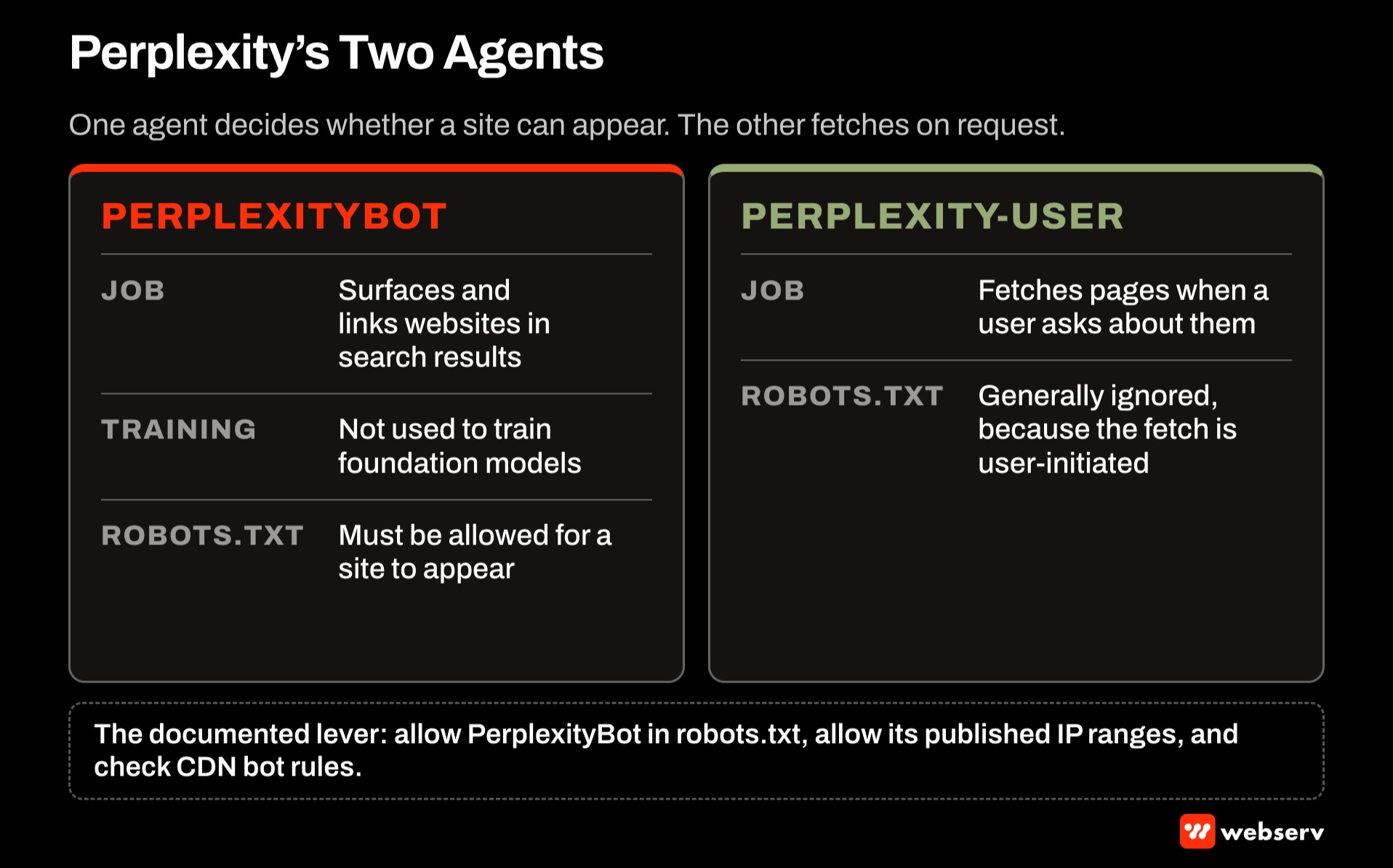
Its crawler documentation describes two agents. PerplexityBot surfaces and links websites in search results and isn’t used to train foundation models. Perplexity-User fetches pages when a user asks about them and, because the fetch is user-initiated, generally ignores robots.txt.
For site owners, the documented lever is access: allow PerplexityBot in robots.txt and allow its published IP ranges. Perplexity doesn’t publish ranking guidance beyond that, so the rest of this piece relies on its product announcements and outside research.
DEFINITION
Perplexity citation. A numbered source link Perplexity attaches to a statement in its answer, pointing to the page it drew that statement from. Unlike a search ranking, a citation is tied to a specific claim, so the cited page has to contain a clear, quotable answer to part of the question.
That claim-level structure is why content patterns matter as much as authority. A strong domain with no clear answer on the page gives Perplexity nothing to cite.
Ads are gone, so citations are the only placement
Perplexity began experimenting with ads in November 2024, as sponsored follow-up questions and paid media beside answers. In February 2026, Search Engine Land reported that Perplexity had phased ads out and had no plans to bring them back, with executives saying ads eroded trust.
For treatment centers, that settles the channel question. There’s no paid route into a Perplexity answer, so visibility depends entirely on being a source Perplexity chooses to cite.
What the citation research shows about Perplexity’s preferences
Outside studies give a consistent picture of how Perplexity differs from other assistants.
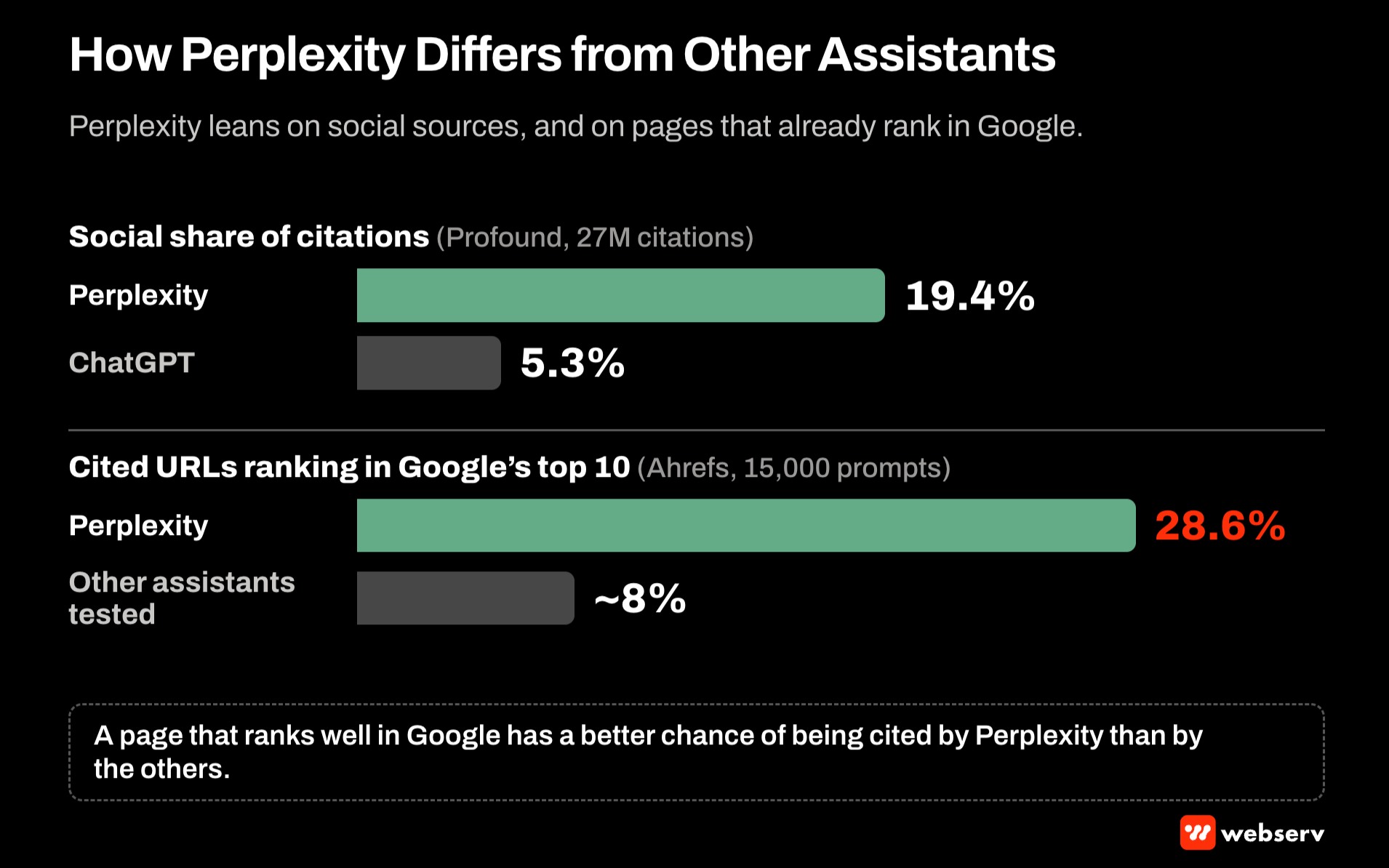
It cites community content more than any other major assistant. Profound’s analysis of 27 million citations found social platforms made up 19.4% of Perplexity’s citations, compared with 5.3% for ChatGPT. In an earlier Profound study of 680 million citations, Reddit was Perplexity’s most-cited domain, followed by YouTube.
It overlaps more with Google than other assistants do. Ahrefs’ AI search overlap study of 15,000 prompts found 28.6% of Perplexity’s cited URLs ranked in Google’s top 10, compared with roughly 8% for the other assistants it tested. A page that ranks well in Google has a better chance of being cited by Perplexity than by the others.
It relies on its own index. Ahrefs also describes Perplexity as building its own index through PerplexityBot rather than relying directly on Google or Bing, which is why crawler access matters.
How health changes the picture
The general pattern of heavy Reddit and social citation doesn’t carry over cleanly to behavioral health.
In the same Profound data, the Healthcare & Life Sciences vertical cited institutional sources 30% of the time and social sources only 3% of the time, one of the most institution-heavy mixes of any industry.
Where Perplexity’s citations come from (Profound, 27M citations)
19.4%
Social share of Perplexity citations, all topics
30%
Institutional share in Healthcare & Life Sciences
3%
Social share in Healthcare & Life Sciences
An older BrightEdge analysis reported by Search Engine Land found healthcare had the highest overlap between Perplexity citations and Google’s top results of any industry it studied, with sources like Mayo Clinic and NIH cited on both.
Perplexity’s own product direction points the same way. Perplexity Health, announced in March 2026, draws on clinical guidelines and peer-reviewed literature. Its premium health sources, announced in May 2026, bring in NEJM, BMJ Journals, and BMJ Best Practice.
The implication for treatment centers: clinical questions about conditions and treatments will increasingly be answered from medical literature and government sources.
The questions a facility can realistically win are the ones those sources don’t answer, such as what a specific program involves, how admissions works, what insurance covers at a specific facility, and what to expect in a given level of care.
COMMON MISTAKE
Competing with NIH on clinical definitions. A treatment center blog post titled “What Is Alcohol Use Disorder?” is up against government sources like NIAAA’s guide to understanding alcohol use disorder, plus the journals Perplexity is actively prioritizing for health. It’s rarely the best use of a content budget.
Cite those clinical sources instead, and put your effort into content only your facility can publish: your program structure, your admissions process, your clinical team, and your answers to the practical questions families ask.
The trust signals Perplexity labels
Perplexity’s help center describes source labels: some cited domains carry a Government, Academic, or Trusted label. Labels assess the whole site rather than individual pages.

The criteria include whether the site corrects its mistakes, identifies who wrote each piece, and separates news from advertising and opinion. Perplexity says partnerships and payments don’t affect labels, and that having no label isn’t a negative judgment.
A treatment center isn’t a news publisher, and there’s no guarantee any facility site gets a label. But the criteria describe practices worth adopting anyway, because they’re the same signals that make health content trustworthy to readers and to other AI systems:
- Named authors and reviewers on every clinical page, with credentials. Our guide to author bios and E-E-A-T covers what they need.
- A visible corrections and review policy, with dates showing when clinical content was last reviewed.
- Clear separation between educational content and promotional content, so an explainer doesn’t read like an ad.
- Sourced claims, with statistics linked to government, clinical, or peer-reviewed sources.
Content patterns that earn Perplexity citations in behavioral health
Because Perplexity cites at the claim level, the goal is pages that contain clear, quotable, specific answers to the parts of a family’s question that clinical sources don’t cover.
Answer the practical question directly. Pages that open each section with a direct answer give Perplexity a clean statement to cite. Our answer-first placement piece covers the pattern.
Publish facility-specific facts in text. Levels of care, schedules, accepted insurance, location, accreditation, and admissions steps are the details families ask about and journals don’t publish. Keep them consistent with your listing on SAMHSA’s FindTreatment.gov. Put them on the page in plain text, not only in images or widgets.
Cite the clinical sources yourself. A program page that links to SAMHSA or NIDA for clinical context, and then explains how the facility applies it, gives Perplexity both the authority it wants and the specific answer it needs.
Contribute original, sourced information. Perplexity cites pages that add something. Original data, carefully sourced guides, and clinician commentary give it a reason to cite you. Our guide to producing original behavioral health research covers how to do that without inventing numbers.
Earn presence in the sources Perplexity already trusts. Health journalism, professional associations, and institutional sites carry weight in healthcare citations. Our guide to landing expert commentary in health journalism covers the reactive side.
Treat community content carefully. Perplexity’s general appetite for Reddit is real, but healthcare citations lean far less social, and recovery communities have strict rules about professional participation. Our Reddit strategy guide covers where participation is appropriate.
OPERATOR INSIGHT
The strongest position in Perplexity’s health answers isn’t trying to beat the institutional sources. It’s building on them: citing the clinical authority, then answering the operational question the authority doesn’t touch.
That combination is hard to copy, because it depends on real program detail and real clinical staff. It’s also the content families find most useful when they’re deciding whether to call.
Access and the crawler debate
Perplexity’s crawler behavior has been contested. In August 2025, Cloudflare reported that Perplexity was accessing sites that had blocked it, using undeclared user agents. Perplexity disputed the findings, arguing that user-initiated fetches aren’t crawling and that Cloudflare had misattributed traffic from a third-party browser service.
Whatever you make of that dispute, the practical decision for a treatment center is simpler. If you want to be cited, allow PerplexityBot and its published IP ranges, and check that your CDN’s bot rules aren’t blocking it. If you want to limit access, know that user-initiated fetches may not follow robots.txt.
Our robots.txt guide for AI bots covers how to make that decision bot by bot.
How to track Perplexity citations
Measure Perplexity separately from other assistants, because its sources differ.
- Build a prompt set from the questions families ask: level of care by city, insurance by program, what to expect in treatment, and comparison questions naming nearby facilities.
- Record the citations, not just whether your facility is mentioned. Perplexity’s numbered sources show exactly which pages it drew from.
- Note which sources win for the prompts you don’t appear in. Institutional sources suggest you should cite and complement them; directories and lists suggest you should correct your listing or earn a place on them.
- Repeat monthly. Single tests swing too much to act on.
Our AEO measurement guide covers citation share tracking across Perplexity, ChatGPT, Claude, and Google.
What this means for your AI search plan
Perplexity rewards the same foundations as other AI platforms: crawler access, strong Google visibility, clear answers, and credible sourcing. What sets it apart for behavioral health is how firmly it’s steering clinical questions toward medical literature and institutions.
Plan around that. Cite the clinical authorities, publish the program and admissions detail they can’t, adopt the trust practices Perplexity describes, and measure what it actually cites. Our 12 SEO failure patterns and 5-tier priority framework help place this work in your wider SEO sequence, and our behavioral health marketing guide covers the rest of the program.
If you want to see what Perplexity cites for your facility’s key questions today, book an intro meeting and we’ll run the test with you.
Frequently Asked Questions
Can a treatment center advertise on Perplexity?
Not currently. Perplexity experimented with sponsored follow-up questions and paid media starting in November 2024, but Search Engine Land reported in February 2026 that it had phased ads out with no plans to bring them back.
That leaves organic citation as the only way into a Perplexity answer.
If ads return, check their health and addiction policies carefully before planning spend. Until then, budget for content and access work instead.
Does Reddit matter for Perplexity citations in behavioral health?
Less than general data suggests. Across all topics, Perplexity cites social platforms, especially Reddit, more than other assistants. In healthcare, Profound’s data shows citations lean heavily institutional and only about 3% social.
Community presence can still help for some practical and experience-based questions, but recovery communities restrict professional participation, and privacy rules apply to anything staff post.
Put institutional presence and on-site content first, and treat community participation as a careful, rules-first addition.
Do we need to rank in Google to be cited by Perplexity?
It helps more than with other assistants. Ahrefs found 28.6% of the URLs Perplexity cited ranked in Google’s top 10, compared with about 8% for the other assistants it studied.
Perplexity uses its own index, so Google ranking isn’t required, but pages that rank well tend to be the kind of clear, authoritative pages Perplexity also cites.
In practice, strong traditional SEO and Perplexity visibility reinforce each other, especially in healthcare.
How do we get a “Trusted” label on Perplexity?
Perplexity doesn’t offer an application process for labels, and it says partnerships and payments don’t affect them. Its help center describes criteria like correcting mistakes, identifying authors, and separating news from advertising and opinion, and says site owners can contact support about labels.
Most treatment center sites won’t carry a label, and Perplexity says having none isn’t a negative judgment.
Adopt the underlying practices anyway: named, credentialed authors, visible review dates and corrections, and clear separation of education from promotion. They build trust with readers regardless of labels.
Should we block Perplexity after the Cloudflare report?
It’s a business decision. Blocking PerplexityBot removes your site from Perplexity’s search results, and Perplexity says its user-initiated fetcher generally doesn’t follow robots.txt anyway.
If citation matters to your admissions strategy, allowing PerplexityBot and its published IP ranges is the only documented way to be eligible.
If you decide to limit access, apply the decision at both robots.txt and your CDN, and revisit it as the platforms’ practices change.
Trevor Gage is the Director of Marketing at Webserv, a digital marketing agency for treatment centers.