Original research is one of the three validated Generative Engine Optimization tactics that produce measurable AI citation lift for behavioral health treatment centers. It sits at the top of the discipline our AEO capability works in. The other two tactics are clean technical SEO plus fact density, and topical authority clusters with clear entity hierarchy.
Of the three, original research produces the highest per-piece citation ceiling because AI systems weight original data sources meaningfully higher than commentary on other people’s data.
When a facility publishes original research on payer reimbursement patterns, admissions workflow measurements, or clinical outcome data, that research becomes a citation source that other pieces reference. The citation loop compounds over time.
The AEO capability at Webserv publishes quarterly original research through the State of BH Marketing quarterly report series to establish exactly this citation loop for the agency itself. The same methodology transfers to treatment center facilities that want to build the citation authority original research produces.
This piece walks the specific methodology for producing original research that gets cited by AI answer surfaces. What counts as original research in behavioral health versus what does not.
Plus the four data source types treatment centers can access without paying for market research, and the publication format that maximizes citation likelihood. Broader context is in our ultimate guide to behavioral health marketing and our Full AI Search Stack for treatment centers.
It also covers the methodology transparency signal that AI systems specifically reward, the distribution strategy across press release plus LinkedIn plus Reddit plus contributed pieces, the cadence framework for how often to publish, and the common failure modes that produce research nobody cites. Related tactical pieces: our 40-word answer block piece, our compound prompt content model, our structured data for AI search beyond Rank Math defaults, and our FAQ schema after March 2026 piece.
Key Takeaways
- Original research is one of the three validated GEO tactics for 2026 (alongside clean technical SEO plus fact density and topical authority clusters). Original data sources produce the highest per-piece AI citation ceiling because AI systems weight primary sources meaningfully higher than commentary on other people’s data.
- What counts as original research in behavioral health: primary data collected and analyzed by the facility or its partners, with published methodology. What does not count: generic industry commentary, aggregation of other people’s published research, opinion pieces, and thought leadership without underlying data.
- Four data source types treatment centers can access without paying for market research: SAMHSA National Survey on Drug Use and Health plus FindTreatment.gov API (public), proprietary data from partners like PayerLenz (facility-specific reimbursement patterns), client-audit data (workflow and outcome measurements from the facility’s own operations), and partner-data arrangements (data-sharing agreements with clinical software vendors or research institutions).
- Publication format that maximizes AI citation: methodology transparency section, data appendix, trend charts with source citations, executive summary suitable for extraction, and downloadable full report for depth. Missing any of these elements typically reduces AI citation eligibility.
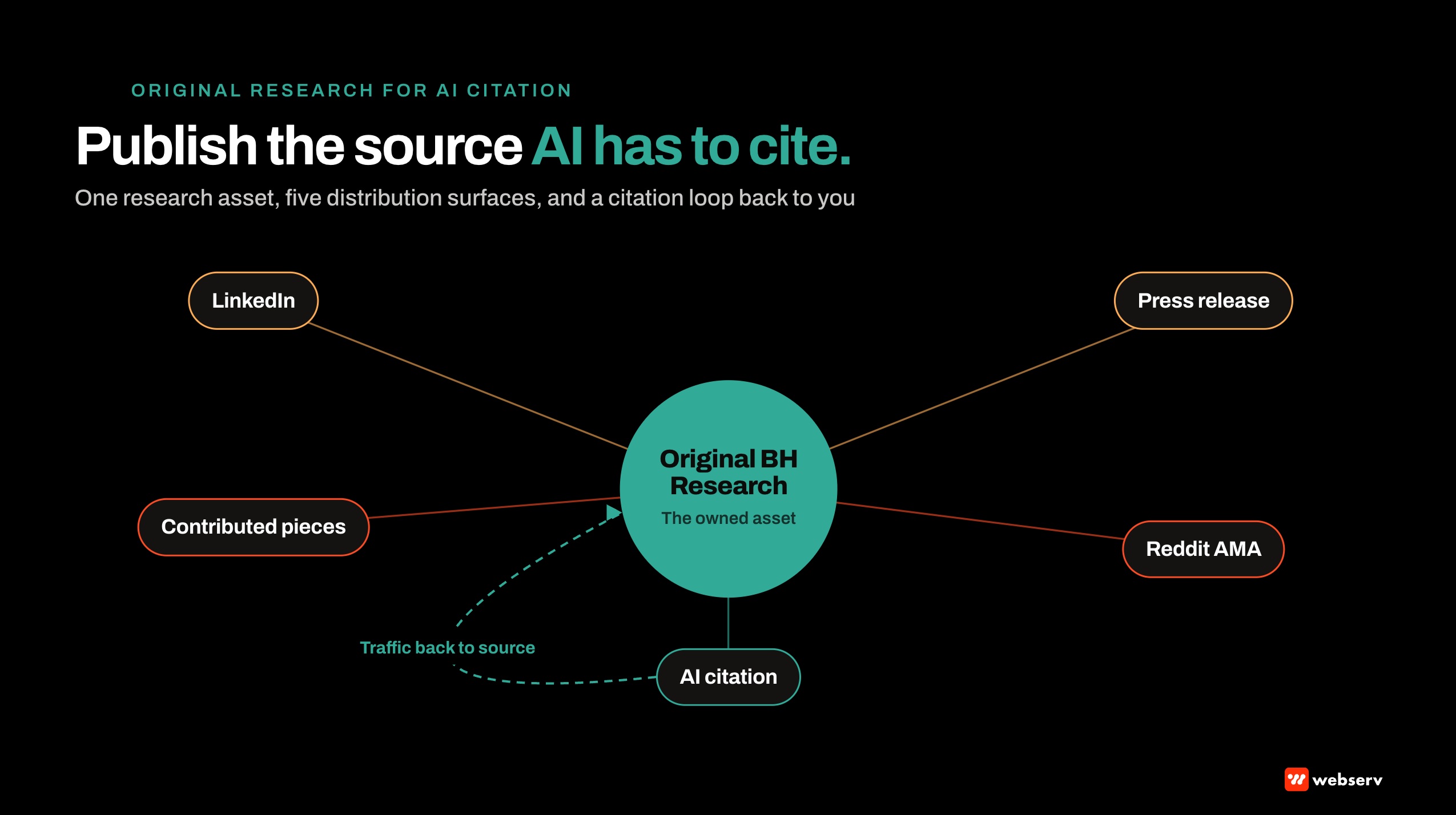
- Distribution strategy: press release plus LinkedIn thought leadership plus Reddit engagement plus contributed pieces in industry publications. The four-channel distribution produces the third-party mention volume that reinforces AI citation authority.
DEFINITION
Original research for behavioral health marketing AI citation. Primary data collection and analysis by a treatment center or its research partners, published with transparent methodology so AI answer surfaces and third-party researchers can both verify and cite the underlying data. Runs on one of four data source types (SAMHSA public datasets, proprietary partner data like PayerLenz, client-audit data, or partner-data consortiums), published in a specific format (executive summary suitable for extraction, methodology section, data appendix, trend charts with source citations, downloadable full report), distributed across four channels (press release, LinkedIn, Reddit, contributed pieces), on quarterly cadence.
Distinct from thought leadership (opinion without underlying data), distinct from generic industry commentary (summarizing other people’s published research), and distinct from proprietary market research the facility purchases from a research firm (that data belongs to the firm and is not typically republishable as facility-originated research).
OPERATOR INSIGHT
When a facility publishes original research on payer reimbursement patterns, admissions workflow measurements, or clinical outcome data, that research becomes a citation source that other pieces reference. The citation loop compounds over time.
Of the three validated GEO tactics, original research produces the highest per-piece citation ceiling because AI systems weight original data sources meaningfully higher than commentary on other people’s data. The AEO capability at Webserv publishes quarterly through the State of BH Marketing report series to establish exactly this citation loop for the agency itself — the same methodology transfers cleanly to any treatment center that wants to build the same authority.
Why original research is one of the 3 validated GEO tactics for 2026
The Generative Engine Optimization discipline that emerged through 2024 and 2025 produced meaningful tactic diversity, but rigorous measurement across the AI answer surfaces (ChatGPT, Claude, Perplexity, Google AI Overviews, Bing Copilot) consistently narrows the effective tactics to three.
Original research is the tactic with the highest citation ceiling. The pattern holds because AI systems evaluate source authority partly through whether the source represents primary data collection versus commentary on other people’s data. Primary data sources get weighted higher in citation selection. Independent GEO research (see the Aggarwal et al GEO methodology paper) documents the same pattern across academic measurement.
The measurement pattern: 85 percent of AI brand mentions across ChatGPT, Perplexity, and Google AI Overviews originate from third-party sources rather than the facility’s own website.
Original research is one of the specific content types that third-party sources cite, which produces the mention volume that AI systems then weight as authority signal.
Content updated in the past 3 months averages 6 AI citations versus 3.6 for outdated content. Original research published on a quarterly cadence maintains the recency signal that AI systems weight for citation eligibility.
Research published as one-off pieces without follow-up typically shows meaningful citation decay after 6 to 12 months.
The specific downstream benefit: facilities that publish quarterly original research typically achieve 2 to 4x higher AI citation share across target queries than facilities that publish only commentary or thought leadership. The citation share differential compounds over 12 to 24 months as the research corpus accumulates and third-party references build.
What counts as original research in behavioral health
Not everything published as “research” or “report” qualifies as original research from an AI citation perspective. AI systems and third-party sources both filter for the specific signals that separate primary research from commentary.
What counts as original research. Primary data collection by the facility or its research partners, with the facility owning the specific data collection methodology and the analysis output. Examples: outcome measurement across the facility’s own patient population, admission workflow measurements from facility operations data, insurance reimbursement pattern analysis from facility billing data, family satisfaction survey results from facility-administered surveys.
Analysis of proprietary datasets where the facility has access rights the general public does not have. Examples: PayerLenz reimbursement data spanning 20 states and 250 payer groups, EHR data from facility patient records, admissions CRM data from facility intake operations.
Analysis of public datasets with novel methodology or novel segmentation. Examples: SAMHSA National Survey on Drug Use and Health data segmented by specific demographic or condition variables not present in the SAMHSA publication itself, FindTreatment.gov API data rolled up by specific geographic or operator patterns.
What does not count. Generic industry commentary that summarizes other people’s published research without primary data. Opinion pieces without underlying data. Thought leadership pieces that describe trends without quantitative support. Republished data from industry publications without additional analysis or methodology transparency.
The specific test: can the piece be cited as a data source? If yes, it counts as original research. If it references other people’s data as its primary substance, it counts as commentary.
The original-research program at a glance
3
Validated GEO tactics for 2026: original research, clean tech SEO + fact density, topical authority clusters
85%
Share of AI brand mentions originating from third-party sources rather than the facility’s own site
2-4x
Higher AI citation share on quarterly-research facilities vs commentary-only
$15-50K
Per-publication cost across analysis, writing, methodology, and distribution
The 4 data source types treatment centers can access without paying for market research
Four data source categories produce useful original research without the cost of commissioning market research firms.
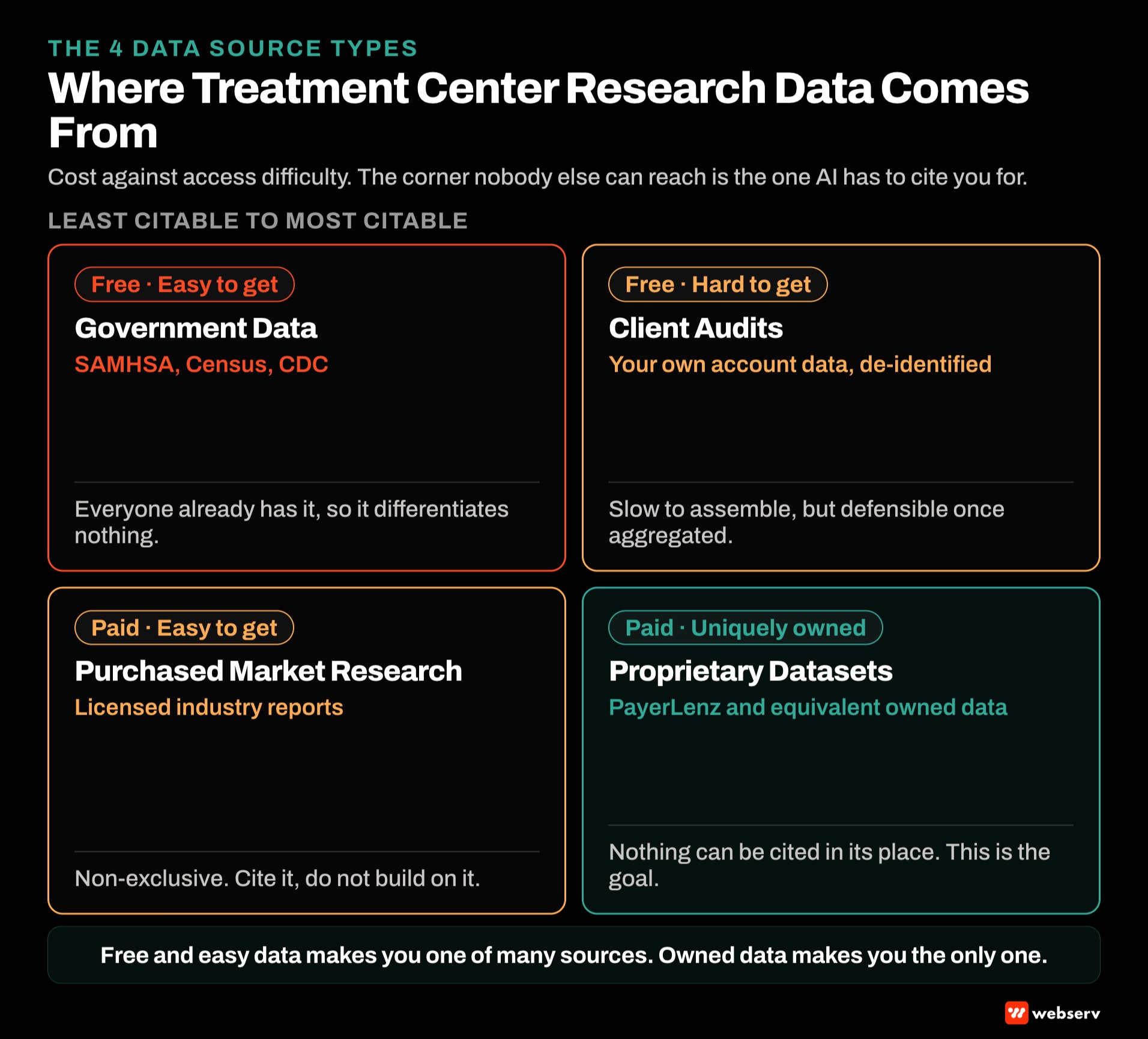
Source 1: SAMHSA public datasets
The Substance Abuse and Mental Health Services Administration publishes several free datasets that support original research analysis. The National Survey on Drug Use and Health (NSDUH) covers substance use patterns, mental health prevalence, and treatment utilization at national and state levels.
The FindTreatment.gov API provides the specific facility inventory that treatment center operators use for competitive analysis. A single API call typically returns 1,569+ facilities per state with facility characteristics, level of care, and payer acceptance patterns.
Source 2: Proprietary partner data
Partnerships with clinical software vendors, revenue cycle vendors, or specialized data platforms produce proprietary datasets that facilities can access under partnership agreements.
PayerLenz spanning 20 states and 250 payer groups provides the specific reimbursement pattern data that supports research on OON reimbursement variance ($662 to $3,778 daily spread for CA BCBS as one example). Availity, Change Healthcare, and similar eligibility platforms produce comparable datasets under partnership terms.
Source 3: Client-audit data
Facility operations data collected through admissions, billing, clinical, and outcome measurement processes. Admissions inquiry conversion rates, average time from inquiry to admit, payer mix patterns by referral source, and program completion rates all provide the specific data for facility-level original research.
The specific consideration: client-audit data requires appropriate PHI-adjacent handling and typically requires anonymization or aggregation before publication.
Source 4: Partner-data arrangements
Data-sharing agreements with clinical software vendors (KIPU, BestNotes, Sunwave), research institutions (academic medical centers with BH research programs), or industry associations (state-level BH provider associations, national accrediting bodies) produce dataset access beyond what any single facility has internally.
The specific pattern that works: multi-facility research consortiums where 5 to 15 facilities pool anonymized operational data for pattern analysis. The pooled dataset supports research neither facility could produce alone.
How SoCal Sunrise generated 85 admissions and 2,297% ROI from SEO in 6 months
A ground-up SEO rebuild using the Pathfinder Parents Methodology turned an invisible online presence into a top-ranking admissions engine.
Read the case study →85 admits and 3,152 leads attributed to organic
Publication format that maximizes AI citation likelihood
The specific publication format that AI systems reward for citation eligibility.
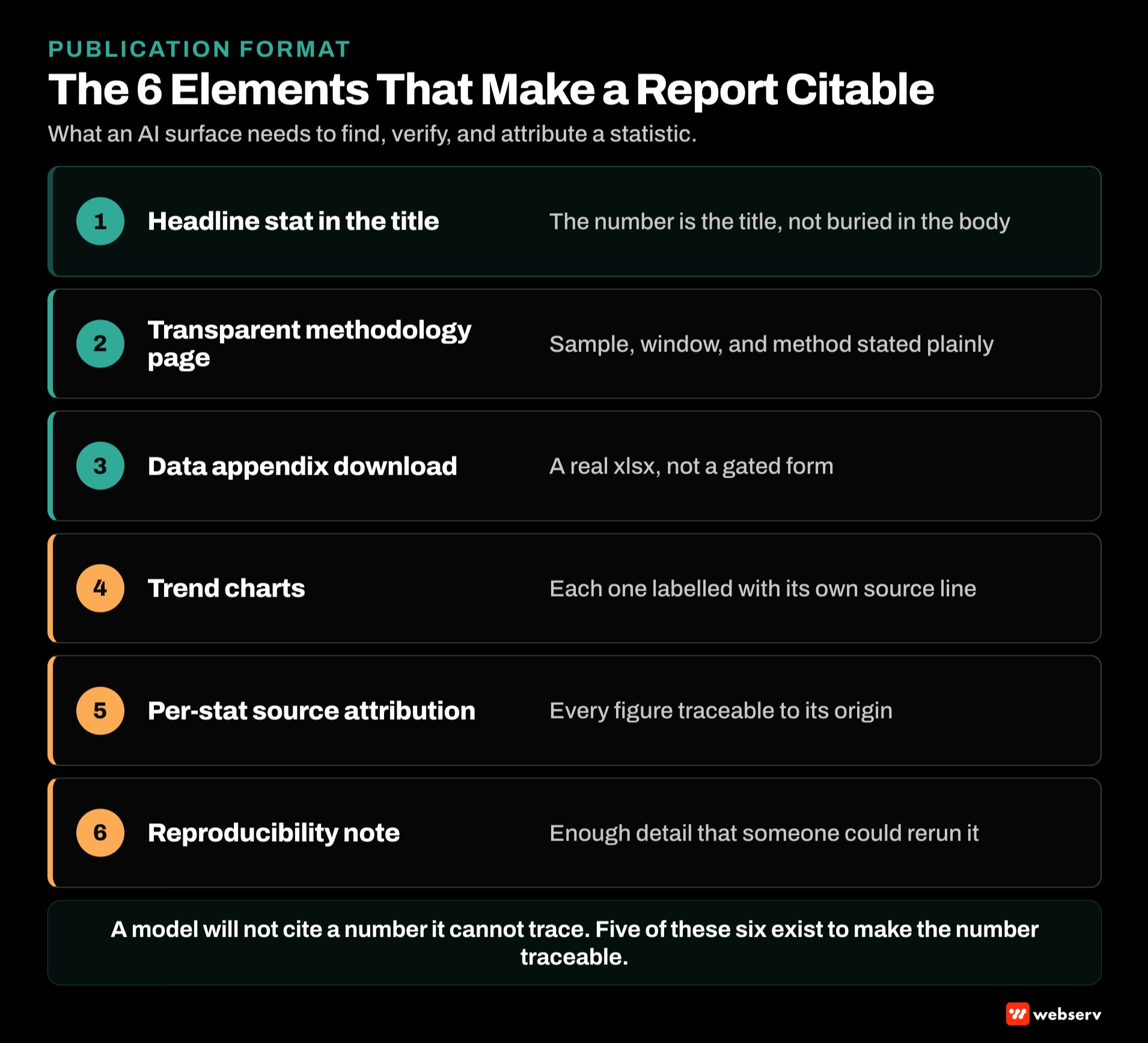
Element 1: Executive summary suitable for extraction. The first 200 to 500 words of the research publication should provide a self-contained summary that AI systems can extract as citation-eligible content. Definitive claim structure with specific findings, methodology reference, and headline statistics.
The specific pattern: state the specific finding in the first sentence with a verifiable number or named entity. “PayerLenz data reveals a $662 to $3,778 daily spread in OON reimbursement for CA BCBS residential SUD admissions.”
First-sentence claim structure sets the citation anchor for the whole piece.
Element 2: Methodology transparency section. Dedicated section covering the data source, the specific measurement methodology, the sample size, the measurement window, and the specific limitations of the data.
Methodology transparency is the load-bearing signal for AI citation authority. Research without methodology transparency typically fails AI source evaluation because AI systems cannot verify the underlying data.
Element 3: Data appendix. Detailed data tables, chart data, and specific measurement outputs that support the research findings. The appendix serves both third-party researchers who want to verify the findings and AI systems that parse structured data as citation support.
Element 4: Trend charts with source citations. Visual representation of the specific findings with clear source citations. Charts should carry data labels, axis units, and specific source attribution. AI systems parse chart data through OCR and structured data extraction, so clean chart formatting supports citation.
Element 5: Downloadable full report. PDF or long-form web page providing the full depth of the research beyond the summary and appendix. Downloadable format supports third-party researcher use and AI system indexing of the full research content.
Methodology transparency: the load-bearing signal AI systems reward
Methodology transparency is the specific signal that determines whether original research produces AI citation authority or gets dismissed as marketing content.
What methodology transparency includes. Data source identification with specific attribution (PayerLenz, SAMHSA NSDUH 2024 wave, facility EHR data 2024-2025, and so on). Sample size specification (250 payer groups, 20 states, or specific N values). Measurement window (January 2024 through March 2026, calendar year 2025, or specific date ranges). Specific measurement definitions (what counts as an admit, what counts as OON reimbursement, what counts as a completed treatment episode).
Data limitations acknowledgment (what the data does not cover, what selection biases affect the sample, what confounding variables the analysis does not control for). Analysis methodology (specific statistical methods, specific segmentation logic, specific comparison approaches).
Why AI systems weight methodology transparency. AI systems evaluate research authority through the same signals human researchers use. Research with transparent methodology can be evaluated for validity. Research without transparent methodology cannot be evaluated and typically gets filtered out of citation-eligible sources.
The specific measurement pattern: research pieces with full methodology sections typically achieve 3 to 5x higher AI citation rates than research pieces with only findings and no methodology.
The specific failure mode. Marketing content that presents opinions or estimates as “research” without underlying data collection fails methodology transparency. AI systems and third-party researchers both filter these pieces out of citation-eligible sources.
The specific fix: even short research pieces should include a methodology section. Methodology transparency does not require the piece to be long, but it requires the piece to be honest about how the underlying data was collected and analyzed.
DO
- Ship every research piece with a real methodology section — data source, sample size, measurement window, definitions, limitations. Methodology transparency is the load-bearing signal.
- Open with an extraction-ready 40-55 word executive summary: specific finding + verifiable number + methodology reference in the first sentence.
- Publish at quarterly cadence — the 3-month recency window is when the 6-vs-3.6 AI citation differential kicks in.
- Distribute across all four channels (press release, LinkedIn, Reddit, contributed pieces) — third-party mention volume is what compounds citation authority.
- Include a data appendix and downloadable full report — both feed third-party researcher use and AI system indexing of structured data.
DON’T
- Publish “survey results” without actually running a survey — fabricated data fails third-party verification and produces reputation damage when discovered.
- Cherry-pick stats to fit a narrative — third-party researchers detect selection in the methodology section, AI systems filter the piece out.
- Publish un-anonymized client data — HIPAA-adjacent exposure risk. Aggregate or de-identify before publication.
- Ship findings without methodology — AI systems and third-party researchers both filter methodology-free pieces out of citation-eligible sources.
- Publish on the facility blog without press release, LinkedIn, Reddit, or contributed piece distribution — publication alone produces minimal citation lift.
Distribution strategy: press release plus LinkedIn plus Reddit plus contributed pieces
The four-channel distribution strategy that produces the third-party mention volume that reinforces AI citation authority.
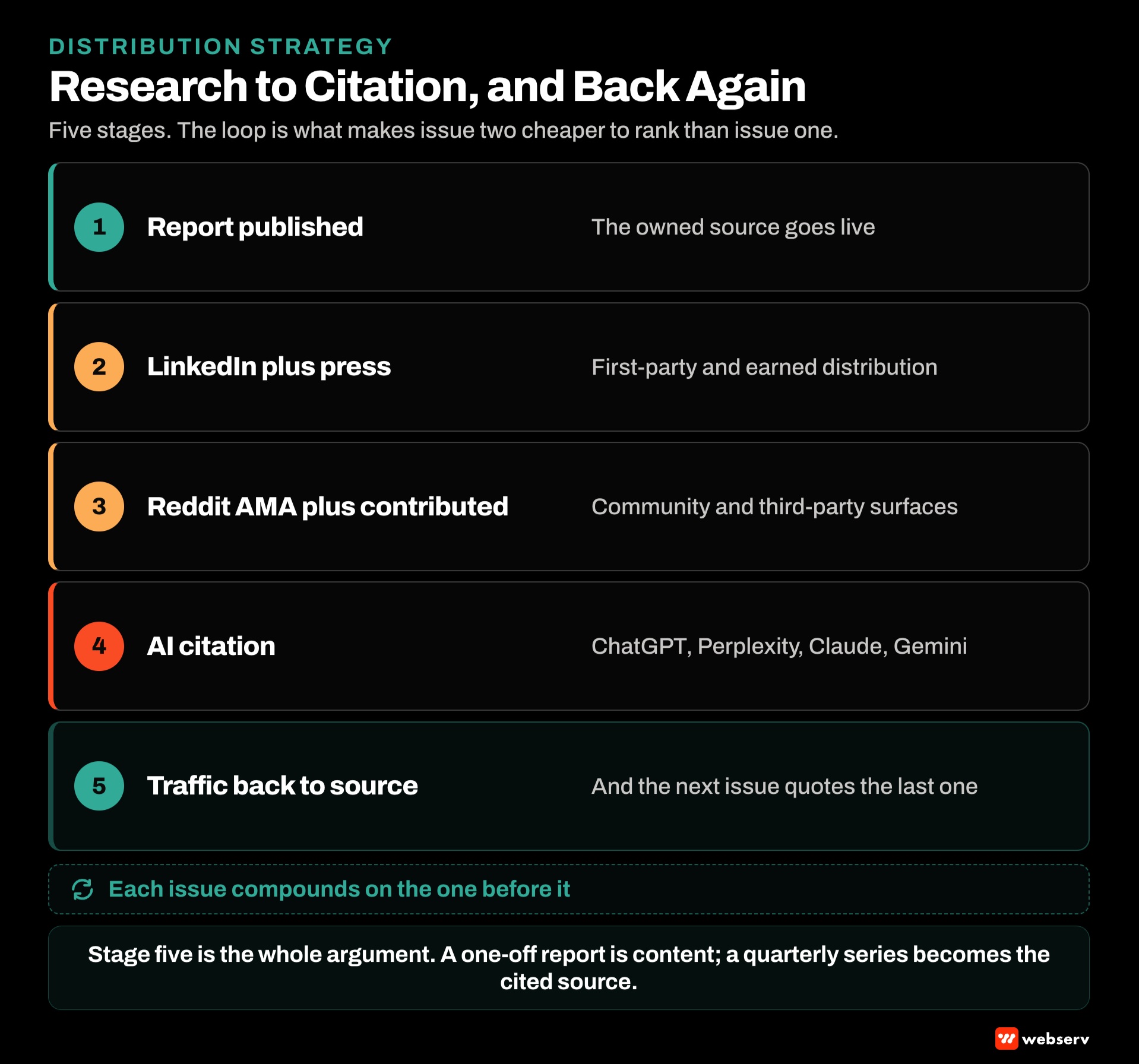
Channel 1: Press release distribution. Original research publication announced through PR distribution services (Business Wire, PR Newswire, or industry-specific distributors like SAMHSA-adjacent press networks). Press releases produce coverage in industry publications and specialized news outlets that AI systems weight as authoritative sources.
Press release timing: publication date of the research, then follow-up releases at findings anniversary (6-month update, 12-month update) to maintain third-party mention volume.
Channel 2: LinkedIn thought leadership. Named clinician or executive thought leadership posts on LinkedIn covering the research findings. Individual named-author posts produce meaningful third-party engagement (LinkedIn shares, comments, cross-references) that AI systems weight as authority signal.
The specific pattern that works: 3 to 5 LinkedIn posts per research publication, each covering a specific finding angle rather than the full research summary. Distribution over 4 to 6 weeks after publication maintains engagement momentum.
Channel 3: Reddit engagement. Compliant Reddit posting through mature facility-clinician accounts covering research findings relevant to specific subreddit communities, honoring Reddit’s corporate content policy and each subreddit’s community rules. Our Reddit strategy for AEO citations piece covers the specific compliance-safe engagement pattern.
Channel 4: Contributed pieces in industry publications. Named-author contributed pieces in behavioral health industry publications (Addiction Professional, Behavioral Healthcare Executive, similar), academic-adjacent publications (Psychology Today provider blogs, SAMHSA advisory publications), and clinical publications where research findings can be adapted to publication editorial focus.
Contributed piece production: 2 to 4 contributed pieces per research publication, each adapted for the specific publication’s editorial focus and audience.
Cadence: annual versus quarterly versus monthly
The specific cadence framework for original research publication.
Quarterly cadence. The default cadence that produces the strongest AI citation lift for most treatment center operators. Quarterly publication maintains the 3-month recency window that produces the 2x citation differential over outdated content.
Quarterly production workload: 40 to 80 hours per quarter across data analysis, writing, methodology documentation, and distribution. Portfolio operators with 5+ facilities can share the quarterly production workload across facilities with per-facility variants.
Annual cadence. Appropriate for research topics where the underlying data changes slowly (annual outcome measurement, annual accreditation data, annual regulatory environment analysis). Annual research produces meaningful citation lift on publication but shows recency decay through the year.
Monthly cadence. Rarely appropriate. Monthly cadence typically produces shallower research that lacks methodology transparency depth. Facilities attempting monthly cadence typically shift to quarterly within 6 to 12 months.
Ad hoc publication. Research publication tied to specific events (regulatory changes, industry news, notable facility milestones). Ad hoc publication supplements quarterly cadence rather than replacing it. Facilities running only ad hoc publication typically produce weaker AI citation lift than facilities running quarterly cadence.
The specific pattern that produces the strongest citation lift: quarterly primary research publication supplemented by ad hoc publication for specific events. Two research publications per year is the minimum for meaningful AI citation authority accumulation.
Common failure modes
Five patterns produce most of the original research failures we audit across BH facilities.
Failure mode 1: Fake surveys. Publishing “survey results” without actually running a survey. Fabricated data fails third-party researcher verification and produces meaningful reputation damage when discovered. Fix: only publish research from actual data collection.
Failure mode 2: Cherry-picked stats. Selectively presenting data points that support a predetermined narrative while omitting data that contradicts the narrative. Cherry-picking fails methodology transparency and typically gets detected by third-party researchers who read the methodology section carefully. Fix: publish full data with methodology transparency including inconvenient findings.
Failure mode 3: Un-anonymized client data. Publishing facility client data without appropriate anonymization or aggregation. Un-anonymized data produces HIPAA-adjacent exposure risk and often fails IRB or clinical review standards. Fix: anonymize or aggregate all client data before publication with appropriate methodology documentation.
Failure mode 4: Methodology-free findings. Publishing findings without methodology transparency. AI systems and third-party researchers both filter these out of citation-eligible sources. Fix: every research publication includes methodology section.
Failure mode 5: Publication without distribution. Publishing research on the facility blog without press release, LinkedIn, Reddit, or contributed piece distribution. Publication without distribution produces minimal third-party mention volume and minimal AI citation lift. Fix: four-channel distribution strategy per publication.
Most in-house teams hit a wall not because they lack knowledge, but because they lack bandwidth.
When you are ready to hand it off, Webserv has spent 9 years executing exactly this for treatment centers nationwide.
Frequently Asked Questions
How much does original research publication cost for a treatment center?
Between $15,000 and $50,000 per quarterly research publication depending on data source complexity and distribution scope.
The specific breakdown: 20 to 40 hours on data analysis, 15 to 30 hours on writing and methodology documentation, 10 to 20 hours on chart production and appendix development, 10 to 20 hours on distribution execution across the four channels, and 5 to 15 hours on post-publication engagement (responding to press coverage, LinkedIn engagement, contributed piece production).
Portfolio operators produce meaningful economies of scale because the analysis and writing infrastructure amortizes across facilities. Per-facility quarterly research cost typically drops to $8,000 to $25,000 for the second and subsequent facilities. Facilities without in-house research capability can commission research production through Webserv or similar specialized agencies at comparable cost with the specific methodology transparency requirements built in.
Do we need IRB approval for original research on facility client data?
Depends on the specific research and the specific facility governance structure. Research on de-identified operational data (aggregated admissions patterns, aggregated billing patterns, aggregated program completion patterns) typically does not require IRB approval because the data does not include patient identifiers.
Research on patient clinical outcomes with any patient-level identifiers typically requires IRB approval or equivalent institutional research review. The specific requirement depends on how the facility structures its clinical governance and research review processes.
Facilities without existing IRB access can partner with academic medical centers or research institutions that provide IRB coverage for specific research projects. The partnership arrangement typically covers research protocol review, methodology validation, and publication approval.
How do we make sure our original research gets cited by AI answer surfaces?
Three specific patterns that maximize AI citation likelihood. First: publish with full methodology transparency in the specific format AI systems reward (methodology section, data appendix, executive summary suitable for extraction, downloadable full report). The extraction unit pattern is walked in our 40-word answer block piece.
Second: distribute across the four channels (press release, LinkedIn, Reddit, contributed pieces) to produce third-party mention volume. AI systems weight third-party mentions as authority signal beyond the primary publication. Our Reddit strategy for AEO citations piece covers the Reddit channel specifically.
Third: maintain quarterly cadence so the research corpus builds recency and volume. Single research publications produce limited citation lift; quarterly publication compounds over 12 to 24 months. Facilities that publish research once without follow-up typically see the piece cited by AI systems for 6 to 12 months, then citation share decays as newer research displaces it in AI source selection.
What data sources are safe versus risky for BH original research?
Safe: public datasets (SAMHSA NSDUH, FindTreatment.gov API, CMS Machine-Readable Files), proprietary partner data with appropriate data-sharing agreements (PayerLenz, Availity aggregate reporting), and de-identified facility operational data (aggregated admissions patterns, aggregated billing patterns).
Risky: patient-level clinical data without appropriate research review, competitor-specific data collected through methods that violate terms of service, and any data collection that could be construed as anti-kickback violation or patient privacy violation.
The specific check: consult healthcare compliance counsel for any data source or research methodology that is not obviously safe. Compliance review during research design is meaningfully cheaper than remediation after publication.
How do we handle press coverage of our original research?
Prepare specific talking points and boilerplate quotes for press outreach. Journalists typically request specific quotes attributable to named executives or clinicians for coverage. Prepared talking points reduce turnaround time and ensure consistent messaging.
Named clinician availability for follow-up interviews. Journalists follow up with additional questions after initial coverage. Named clinicians who are accessible for follow-up typically produce deeper coverage than research where interview availability is limited.
Republish press coverage on the facility website and LinkedIn. Amplifying press coverage extends the mention volume and provides additional third-party citation sources for AI systems to reference.
Should we publish original research if we do not have proprietary data?
Yes, but the research typically has to work harder to establish authority. Novel analysis of public data (SAMHSA, FindTreatment.gov) produces useful research when the analysis introduces methodology, segmentation, or interpretation that other publications have not covered.
The specific pattern that works for public-data research: identify the specific question the public data can answer that no one has published on, execute the analysis with methodology transparency, publish with the same four-channel distribution as proprietary-data research.
Public-data research produces meaningful AI citation lift when it introduces genuinely novel analysis. Public-data research that duplicates existing published analysis typically produces minimal citation lift because AI systems already have the original publication in the citation-eligible source pool.
How does original research interact with our overall content strategy?
As the highest-impact content type in the strategy. Original research anchors the content authority signal that supporting content (cluster hubs, service pages, blog posts) builds on.
The specific integration pattern: quarterly original research publications produce the citation authority foundation. Cluster hubs reference the research as internal authority citations. Supporting content references specific research findings for factual anchoring. Our Full AI Search Stack for treatment centers covers how research integrates with the broader AEO strategy, and our compound prompt content model covers the structural pattern that surfaces research findings inside answer-eligible content.
Facilities that publish research without supporting content architecture typically produce authority signals that do not compound into broader citation share. Facilities that build cluster architecture without original research produce citation share ceilings limited by the absence of primary data sources. The two together produce the strongest AI citation share economics.
Trevor Gage is the Director of Marketing at Webserv, a digital marketing agency for treatment centers. Kyle McHenry, founder of Revenue Logic and co-founder of PayerLenz, contributed data credits for the PayerLenz reimbursement pattern research referenced in this piece. Preston Powell, CEO of Webserv, contributed review.