Google’s help page on custom experiments puts it plainly: for reliable results, the base campaign should meet minimum requirements “such as more than 100 daily conversions.” Very few treatment center campaigns come close to that.
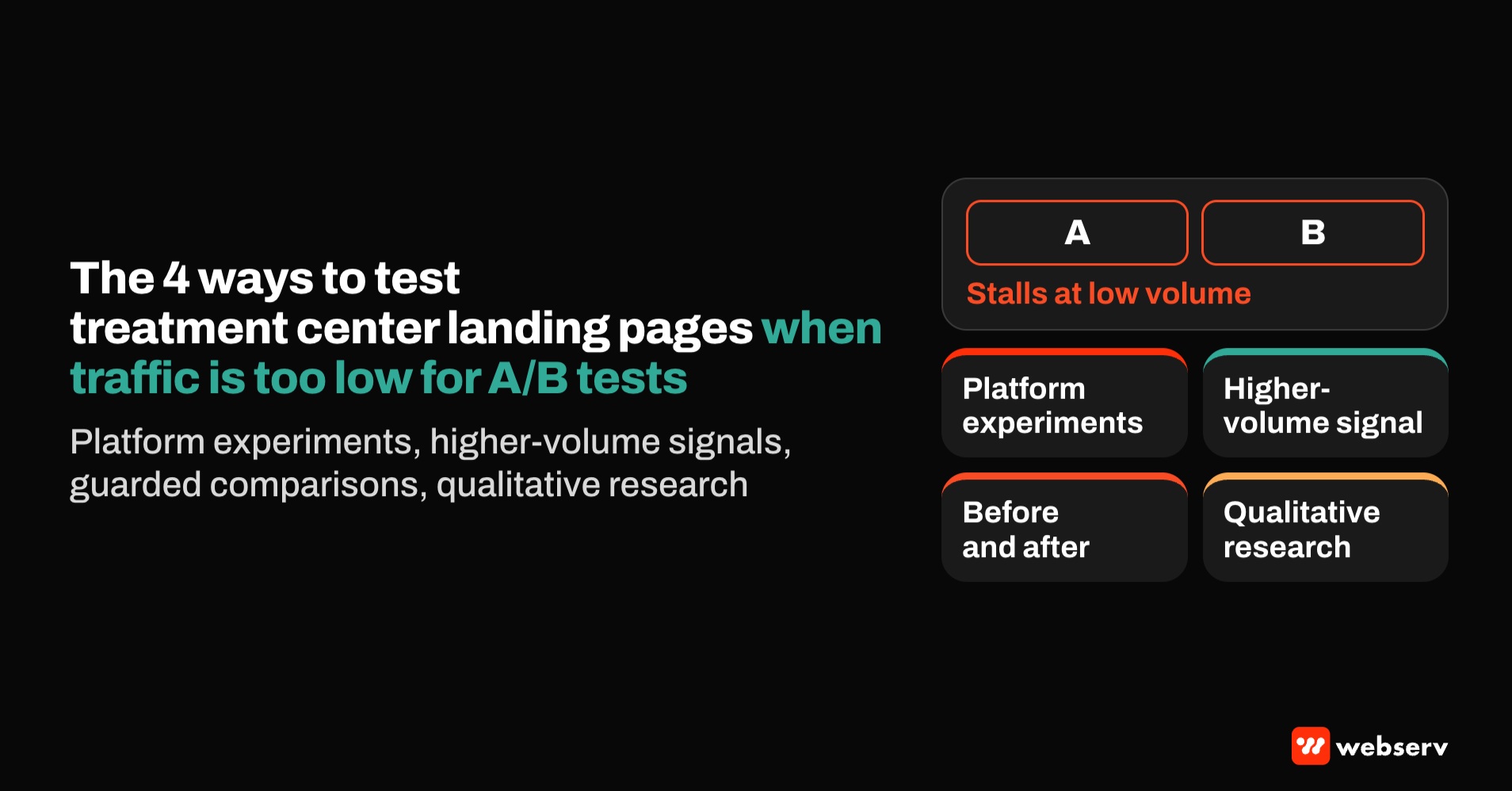
That doesn’t mean landing pages can’t be improved with evidence. It means the classic A/B test, two versions of a page split evenly until one wins with statistical confidence, often isn’t the right tool at treatment center volumes. Run one anyway and it can take months to reach a result, or never reach one.
Our guide to A/B testing for treatment centers covers sample size and what to test when you have the volume. This piece covers the other case: the testing methods that work when you don’t, and how to read their results honestly. It’s part of the work inside our landing page practice for treatment centers.
Key Takeaways
- Google says reliable custom experiment results need a campaign with something like more than 100 daily conversions. Most treatment center campaigns don’t have that, so classic A/B tests often won’t reach significance.
- Platform-native experiments are the first option. Google Ads ad variations can test a different final URL with a cookie-based split, and Google reports significance at an 80% confidence level by default.
- When conversions are scarce, test against a higher-volume signal like qualified calls or form starts, then confirm the winner against admits over a longer window.
- Before-and-after comparisons are directional, not proof. Change one thing, hold budget and targeting steady, and compare like-for-like weeks.
- Qualitative research finds the big problems worth testing. Use heatmaps, call reviews, and user tests, but keep session replay tools off pages that collect health information unless the vendor will sign a business associate agreement.
Why classic A/B tests stall at treatment center volumes
A classic A/B test needs enough conversions on each version to tell a real difference from noise. Treatment center landing pages get far fewer conversions than a typical ecommerce page, and those are split across campaigns and devices. At that volume, small improvements take a very long time to confirm.
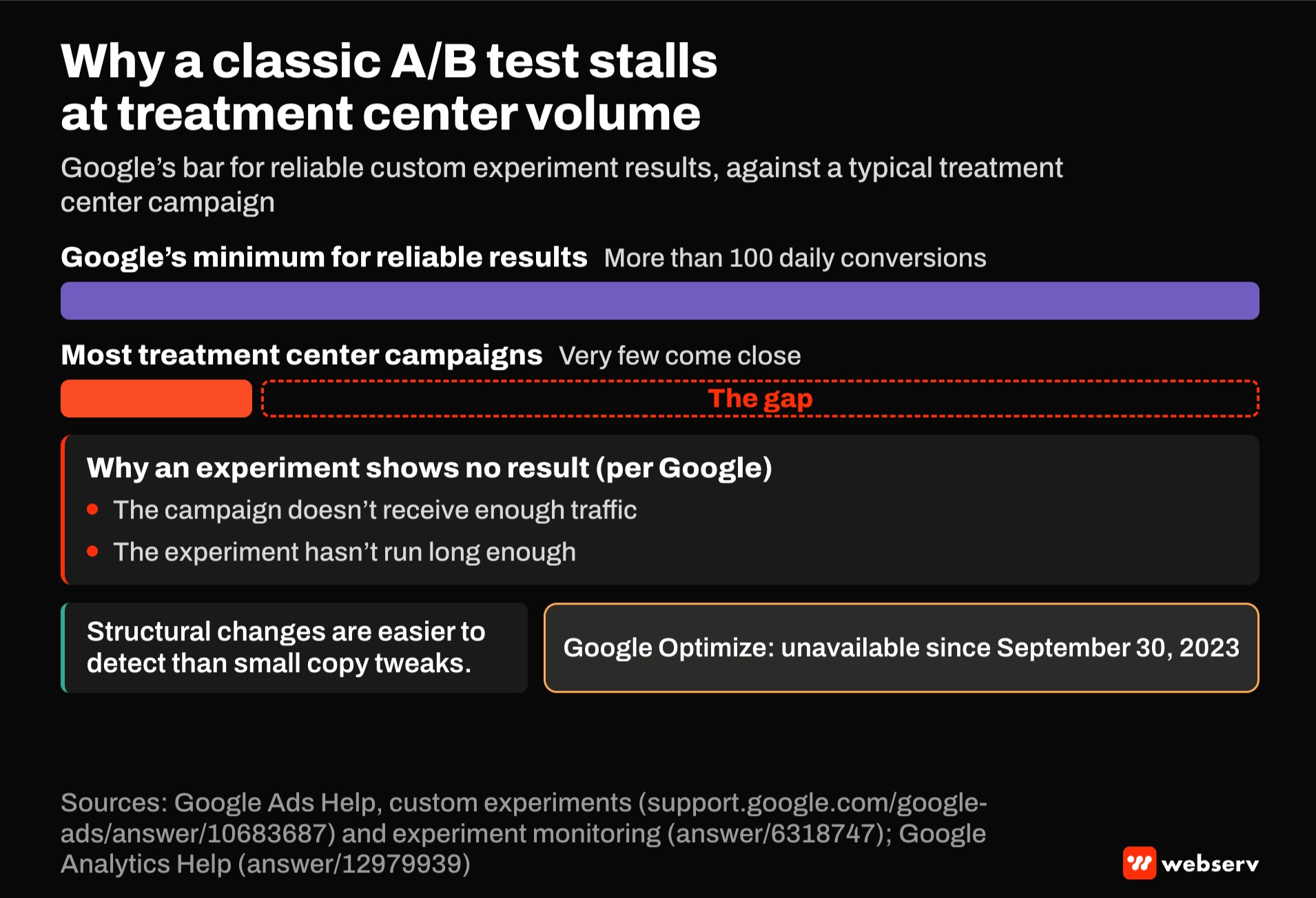
Google’s experiment monitoring help lists the usual reasons an experiment shows no result, including that the campaign doesn’t receive enough traffic or the experiment hasn’t run long enough. Our CRO guide covers why test windows run longer in behavioral health and why structural changes are easier to detect than small copy tweaks.
Many teams also lost their default free testing tool. Google says Optimize and Optimize 360 have been unavailable since September 30, 2023.
Option 1: Use platform-native experiments
Google Ads ad variations. Google’s ad variations can apply to the final URL, so you can send half of eligible traffic to a new landing page. Google says variations are split by assigning cookies to users, so each person sees one version.
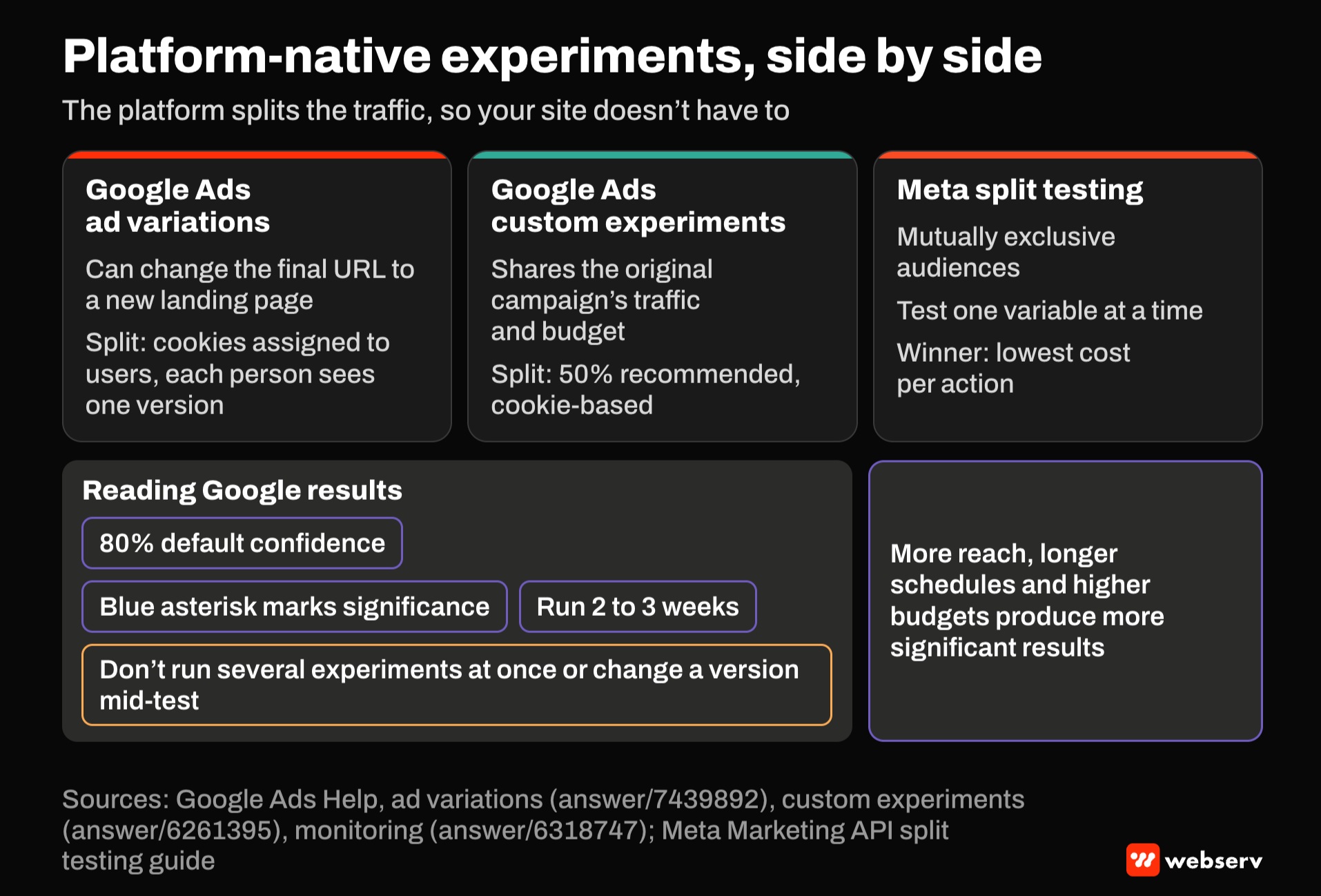
Google Ads custom experiments. A custom experiment shares the original campaign’s traffic and budget. Google recommends a 50% split for the best comparison, and recommends a cookie-based split so a user sees only one version.
Reading the results. Google’s monitoring page says 80% is the default confidence interval, marks statistically significant results with a blue asterisk, and recommends letting an experiment run 2 to 3 weeks. Google’s FAQ also advises against running several experiments at once and against changing either version mid-test.
Meta. Meta’s split testing runs on mutually exclusive audiences, recommends testing one variable at a time, and picks the winner by lowest cost per action. Larger reach, longer schedules, and higher budgets produce more statistically significant results.
DEFINITION
Platform-native experiment. A test run inside the ad platform itself, where the platform splits traffic between an original and a variation and reports the difference, instead of splitting traffic on the website.
Option 2: Test against a signal with more volume
If admits are too few to test against, test against a higher-volume step that predicts them: qualified calls over a minimum duration, completed insurance verification forms, or form starts. More events per week means results arrive sooner.
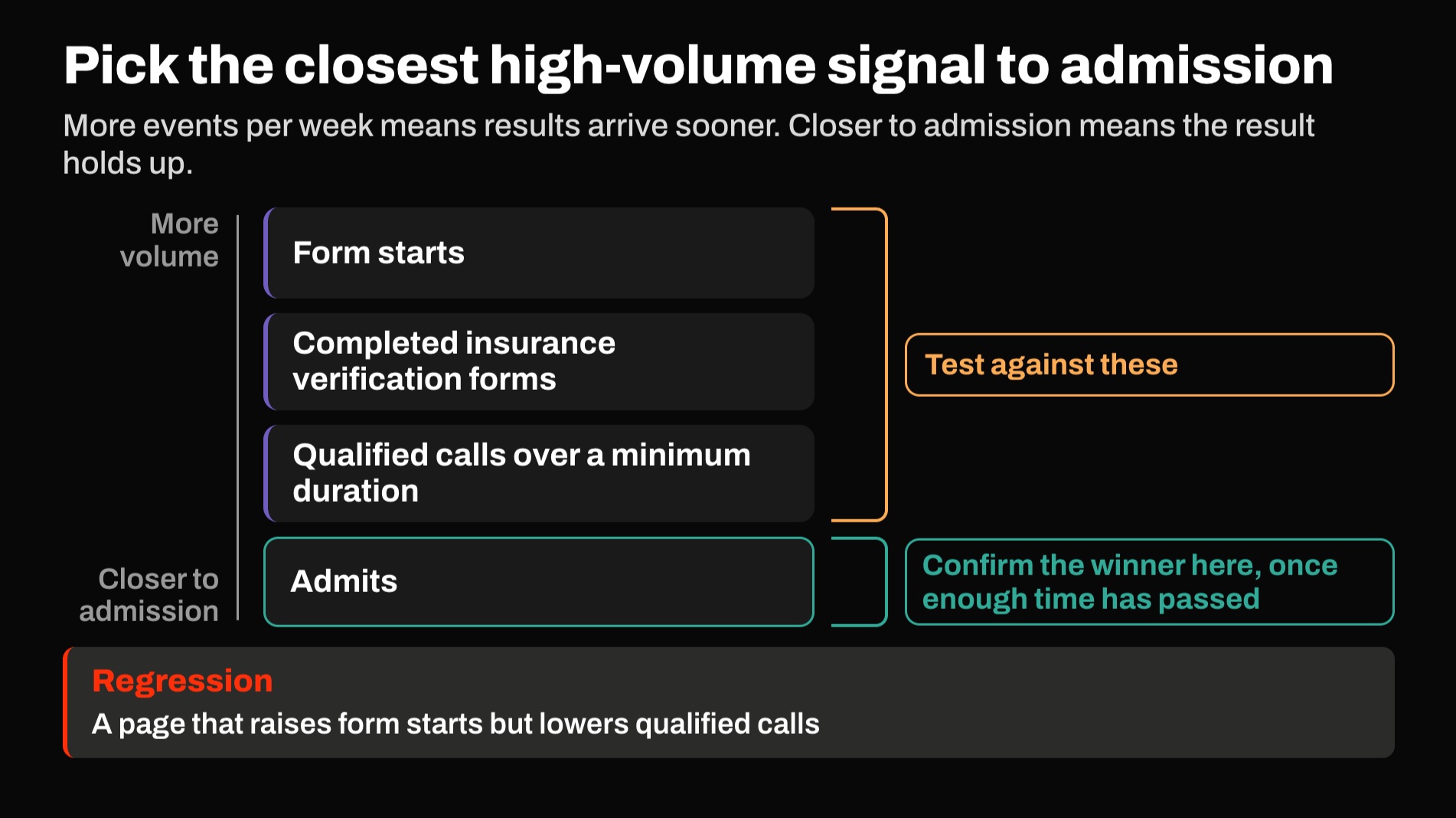
The risk is optimizing for a signal that doesn’t hold up downstream. A page that raises form starts but lowers qualified calls is a regression. Pick the closest high-volume signal to admission you can measure, then check the winner against admits once enough time has passed. Our call tracking attribution guide covers measuring qualified calls.
Option 3: Before-and-after comparisons, with guardrails
When a split isn’t possible, a before-and-after comparison is the fallback. It’s directional evidence, not proof, because other things change at the same time: season, competition, budget, and the mix of searches.
Make it as clean as you can:
Change one thing
A new hero, a new form, or a new call-to-action order, not all three.
Hold everything else steady
Same budget, bidding, targeting, and ads for the comparison period.
Compare like-for-like periods
The same number of weeks, the same days of the week, and avoid holidays on one side only.
Log the change
Date, what changed, and why, so results can be traced later.
Confirm with admits
Treat an early lift as a hypothesis until downstream numbers agree.
Common mistake: calling a winner after two good weeks. At low volume, a few extra calls can come from noise, a seasonal bump, or a competitor pausing ads.
Hold the decision until the result survives a full comparison window and lines up with qualified calls and admits.
Option 4: Qualitative research to find what’s worth testing
Low volume makes it even more important to test changes big enough to matter. Qualitative research is how you find them.
- Heatmaps and scroll maps. Show where attention drops and which elements get ignored. Our guide to heatmaps for rehab marketing pages covers what to look for.
- Session recordings, carefully. HHS’s tracking technology bulletin names session replay scripts, which record mouse movements, clicks, and typing, as a tracking technology. A court vacated part of that bulletin in 2024, but the rest stands. Microsoft’s Clarity FAQ says Microsoft has access to the data. Keep recordings off pages that collect health information unless the vendor signs a business associate agreement.
- Call reviews. Admissions call recordings show what families ask after reading the page. Repeated questions point to missing information.
- Simple user tests. Ask people outside the company, never patients, to find the phone number or insurance information and talk through what they see.
OPERATOR INSIGHT
Keep a running list of problems from qualitative research, ranked by how many families they likely affect. Test the top one, not the easiest one.
A clear, structural fix, like moving the insurance question above the fold, is easier to detect at low volume than a headline tweak.
Matching the method to your volume
A quick guide by volume:
| Situation | Best method |
|---|---|
| Enough conversions for platform experiments to reach significance | Google ad variations or custom experiments; confirm against admits |
| Some conversions, not enough for a timely result | Platform experiment against a higher-volume signal, plus a longer window |
| Very few conversions | Qualitative research to pick big changes, then a guarded before-and-after comparison |
Whatever the volume, test one change at a time and log it.
Where this fits
For the fundamentals of page structure, see our treatment center landing page design guide and the complete guide to landing pages for treatment center marketing. For the A/B basics, see our A/B testing guide. Testing tools add scripts of their own, and our piece on the speed cost of tracking and testing scripts covers what they do to load time.
For how paid media fits the rest of your marketing, see the complete guide to behavioral health marketing. If you want a second look at how your landing pages are tested, book an intro meeting.
Frequently Asked Questions
Why don’t our landing page A/B tests ever reach significance?
Usually not enough conversions. Google’s custom experiments help says reliable results need a base campaign meeting minimum requirements such as more than 100 daily conversions.
Treatment center campaigns rarely have that, so small differences take a very long time to confirm.
Test bigger changes, use a higher-volume signal, or use the methods for low-volume pages.
Can we test a new landing page in Google Ads without a testing tool?
Yes. Google Ads ad variations can change the final URL, splitting users by cookie so each sees one version.
Custom experiments can also split a campaign’s traffic and budget, with 50% recommended.
Google reports significance at an 80% confidence level by default and recommends running 2 to 3 weeks.
Are before-and-after comparisons valid?
They’re directional, not proof, because season, competition, and budget can change at the same time.
Change one thing, hold everything else steady, and compare like-for-like periods.
Confirm any lift against qualified calls and admits before calling it a win.
Can we use session recording tools on our site?
Be careful. HHS names session replay scripts as a tracking technology, and Microsoft says it has access to Clarity data.
Keep recordings off pages that collect health information unless the vendor signs a business associate agreement.
Heatmaps on general pages, call reviews, and user tests are safer ways to find problems.
What should we test first?
The biggest problem qualitative research turns up, usually something structural like the hero, the form, or where the phone number and insurance information sit.
Large changes are easier to detect at low volume than headline tweaks.
Test one change at a time and log it.
Keaton Nalle is the Director of Paid Admissions at Webserv, a digital marketing agency for treatment centers.