A treatment center COO emailed me last month with a screenshot. Her CFO had asked ChatGPT to vet their current marketing agency.
The AI returned a paraphrased summary of the agency’s website, named two case studies that didn’t match the facility’s modality, and made up a metric that didn’t exist anywhere on the agency’s site.
That CFO is part of a behavior shift we’ve been tracking for a year. Treatment center operators increasingly start agency research inside an AI assistant.
Some use ChatGPT or Claude as a quick reference check before a discovery call. Others run a full evaluation through AI before any human conversation happens.
The shift is real, and what an AI assistant returns about your agency, your competitors, and the treatment centers in your market depends entirely on what each website lets the AI see and do.
For the last two years, the work to position behavioral health brands for AI search has lived inside Webserv’s AEO program. Schema deployment, semantic structure, entity signals, citation tracking across ChatGPT, Perplexity, Claude, and AI Overviews.
That work is the current state of the art. It’s also no longer the ceiling.
There’s a next layer. Most behavioral health marketing agencies haven’t reached it yet. We built it on our own site to find out what it took, and to bring the playbook back for the treatment center brands we work with.
This guide walks through the three layers of AI search work, what the next layer looks like when it is live, and what it means for treatment center visibility in 2026 and beyond.
Key Takeaways
- AI search work for treatment centers sits on three layers. Layer 1 is being crawlable for AI training data. Layer 2 is being visible to AI search engines (the AEO work most operators have heard of). Layer 3 is being directly callable by AI assistants in real time. Most BH marketing agencies are still working on Layer 2.
- Layer 3 means a treatment center brand has actual endpoints AI agents can call to retrieve structured answers. An operator’s AI assistant queries the brand’s site and gets back verified data with full provenance, not a paraphrase the AI generated from reading the page.
- We built Layer 3 infrastructure on webserv.io. An MCP server, structured data on eight case studies, two live tools any AI agent can call without authentication, and a Level 5 score on the public agent-readiness scanner most marketing sites haven’t even heard of.
- The work took six weeks from kickoff to Level 5 agent-native status. The technical pattern for serving unauthenticated AI agents on WordPress isn’t documented anywhere on the internet as of this writing. We had to figure it out.
- For treatment center brands, the implication is direct. The agencies that build Layer 3 infrastructure for client sites will determine which brands get found, understood, and served by AI assistants over the next 24 months. That competitive window is open right now.
The Three Layers of AI Search Work
HOW TO STAGE THIS
Most treatment centers are still working Layer 1 (getting the content itself cite-eligible) while their competitors are already deploying Layer 2 (structured entities that connect their clinical pages to Google’s knowledge graph). Layer 3 (agent-callable functions that let AI assistants act on behalf of prospective admissions) is the next frontier. Skipping straight to Layer 3 without Layer 1 and 2 landed does not produce citations — it produces empty infrastructure. Sequence matters.
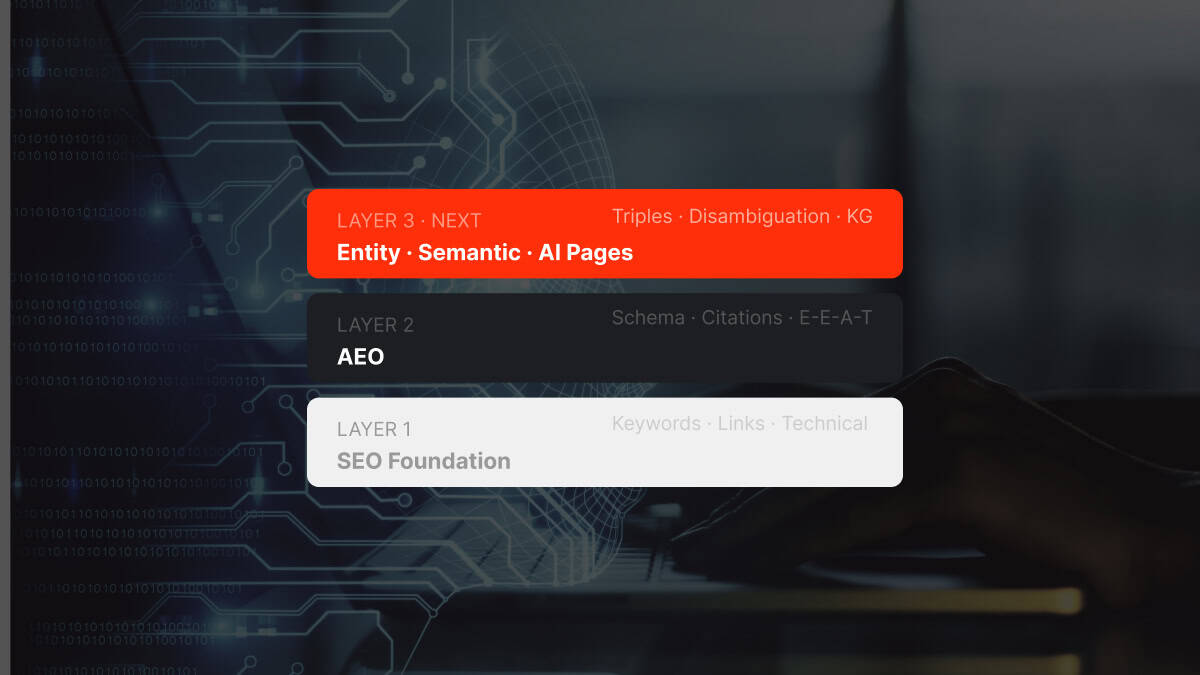
AI search visibility for treatment centers isn’t one thing. It’s a stack of three layers that build on each other. Most operators have only heard of one of them.
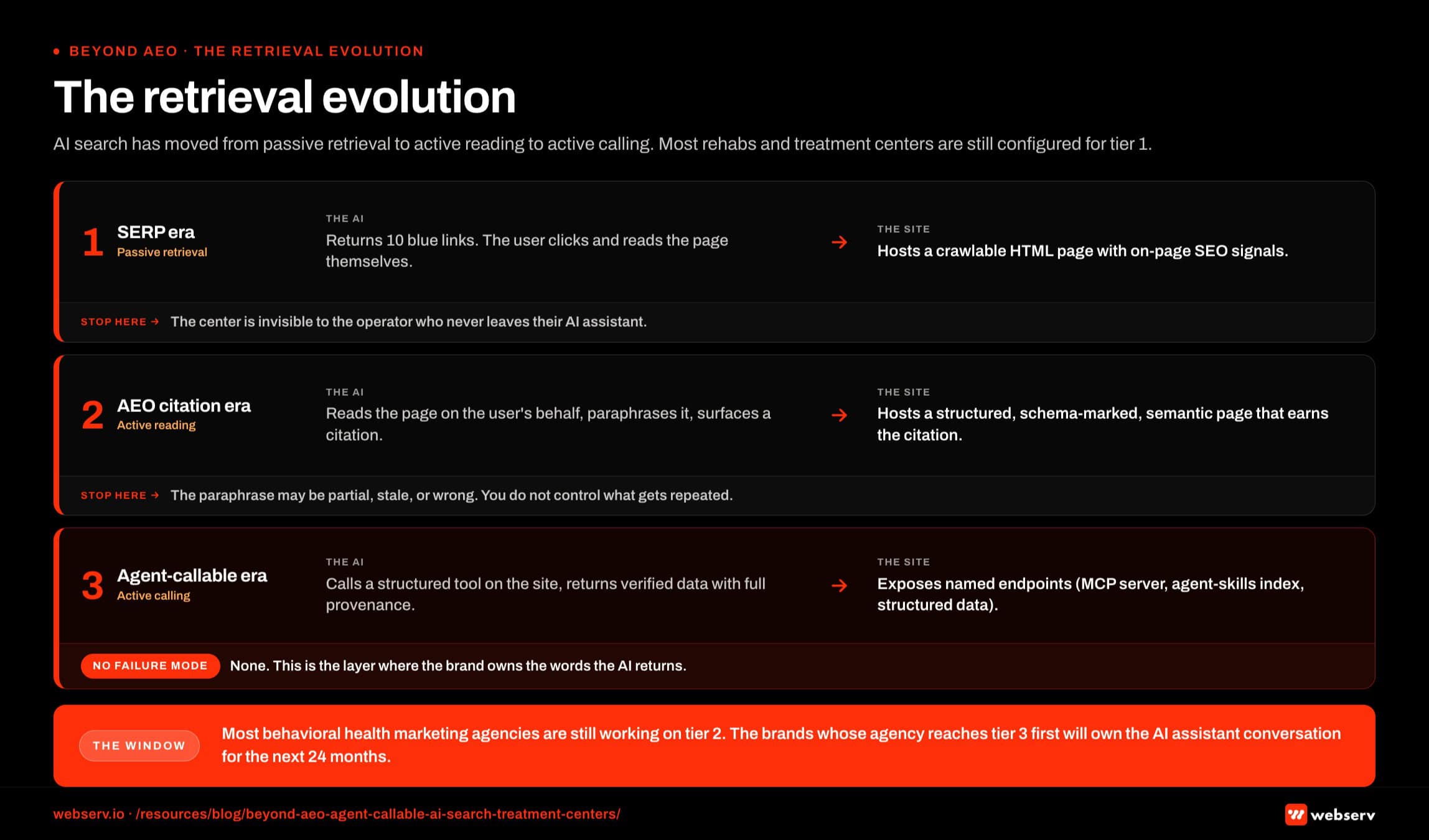 Infographic titled ‘The retrieval evolution’.
Layer 1: Crawlable for AI training. Search engines and AI training crawlers can read your site. Most modern websites pass this layer by default. If your treatment center’s site loads quickly, has proper HTML structure, and doesn’t block search bots in robots.txt, you’re already here. It’s table stakes.
Layer 2: AI search visible. This is where AEO lives. When an AI search engine (Google AI Mode, AI Overviews, Perplexity, ChatGPT with web search) wants to cite a treatment center or marketing agency for a behavioral health query, your site gets cited because the right signals are in place.
Schema markup, semantic structure, E-E-A-T signals, and the citation diversity work we have been operating for behavioral health clients for the better part of two years.
Layer 2 is the work most marketing agencies are starting to talk about. It is the work our AEO Measurement program tracks across the AI search surfaces that matter for treatment center visibility.
Layer 3: Agent-callable. This is the layer almost no one in behavioral health marketing has reached yet. At Layer 3, your site exposes actual endpoints an AI assistant can call directly.
The agent does not have to read a page and guess at the contents. It queries a structured tool, gets back verified data, and returns that data to the operator with full provenance.
The difference matters. At Layer 2, ChatGPT reads your treatment center’s services page and writes a paragraph summarizing it. The summary might be accurate, might be partial, might be wrong.
At Layer 3, ChatGPT calls a tool on your site that returns the structured facts: services offered, modalities supported, geographic reach, outcomes. The AI assistant repeats verified data back to the operator instead of generating an interpretation.
For behavioral health, where the YMYL bar is highest and the cost of an AI-generated misstatement is highest, Layer 3 is where the moat will be built.
What Layer 3 Looks Like (We Built It On Our Own Site)
To find out what it actually takes to operate Layer 3 in behavioral health marketing, we built it on webserv.io. Six weeks from kickoff to Level 5 agent-native status on the public scanner most marketing sites haven’t heard of. Here’s what’s in the stack.
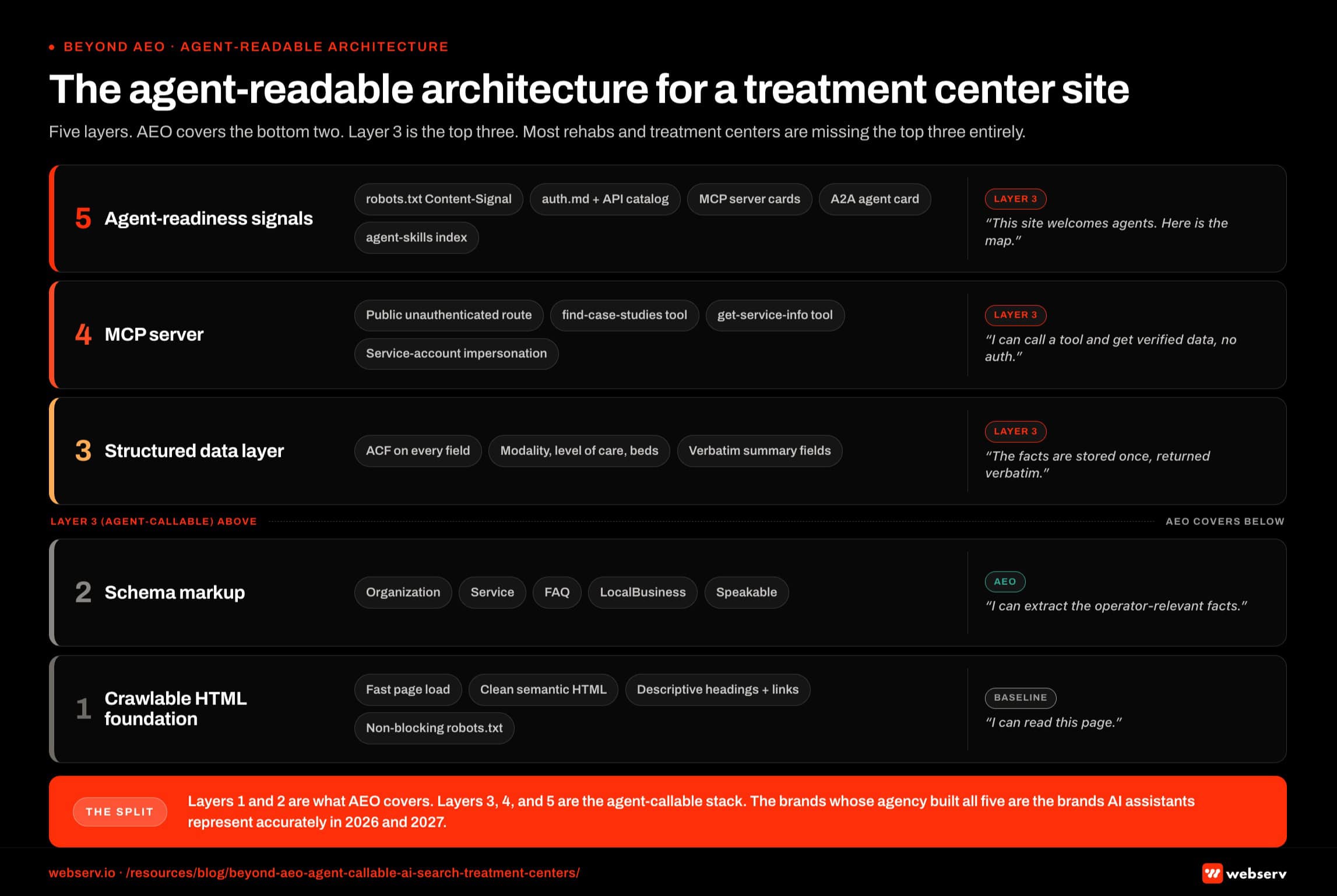 Infographic titled ‘The agent-readable architecture for a treatment center site’.
The data layer. Eight Webserv case studies got rebuilt with structured Advanced Custom Fields backing every piece of operator-relevant data.
Modality (residential, PHP, IOP, detox). Bed count range. State. Services Webserv delivered. Key admit-lift metric with value, label, and time period. Operator-facing summary that returns verbatim when an agent asks about the case study.
That last point matters. The structured summary field on each case study became a brand asset our account management team had to own at a different level than marketing copy used to require.
If the summary says “we increased admits 47 percent in nine months,” that exact sentence shows up in the operator’s Claude conversation when their AI assistant pulls the case study.
Marketing copy used to be content for humans. It’s now content for both humans and the AI assistants that repeat it verbatim.
The MCP server. Model Context Protocol is Anthropic’s open standard for letting AI agents call tools on external systems. The protocol composes with the same patterns that drive semantic triple structure for AEO.
Most public MCP server examples are developer tools. Claude querying a GitHub repo, ChatGPT pulling rows from a database.
We built something different. A marketing site exposing operator-research abilities to any AI agent that wants to use them.
Two tools are live in Phase 1. find-case-studies takes operator profile inputs (modality, bed count, state, services of interest) and returns matching case studies from the eight in the structured data layer.
An AI agent can ask “show me California residential programs Webserv has done SEO for” and get back the matching case studies with full provenance in 300 milliseconds.
get-service-info takes a service name and returns structured information: what’s included, typical timeline to results, ideal-fit criteria, who it isn’t a fit for, pricing tier. Nine services covered.
Both tools are callable by unauthenticated AI agents. Anyone’s ChatGPT, Claude, Perplexity, or Operator session can hit https://webserv.io/wp-json/mcp/webserv-public with no credentials and get answers.
That’s intentional. The whole point is for treatment center operators researching Webserv to get useful answers from their AI assistant without anyone having to authenticate first.
The auth puzzle. Building unauthenticated agent access on WordPress turned out to be harder than expected. The official MCP Adapter for WordPress was designed assuming authenticated agents.
Making it serve completely unauthenticated agents required solving two separate auth checks deep in the codebase, and there’s no documented filter to bypass the second one.
The breakthrough was a service-account impersonation pattern. A low-privilege WordPress user gets impersonated only for requests to the public MCP route, satisfying the session validator without ever exposing any other endpoint or user permissions.
That pattern isn’t documented anywhere on the internet as of this writing. We figured it out by reading the MCP Adapter source code and hooking the right WordPress filter at the right priority.
It should become the canonical pattern for anyone trying to serve unauthenticated agents on WordPress, and we’ll write up the developer-facing version separately.
The agent-readiness surface. Beyond the MCP server itself, agent-readiness requires a stack of well-known files at specific paths that AI agents and scanners look for.
Six additional WordPress plugins ship the supporting layer. A robots.txt Content-Signal directive declaring AI training, AI search, and AI input as welcomed. An auth.md file at the site root describing how agents authenticate (or do not, in our case).
API catalog files, MCP server cards at multiple well-known paths, a Google A2A agent card, and an agent-skills index pointing at the live tools.
The third-party scanner at isitagentready.com tests for all of this across multiple specs. Webserv.io scored Level 1 of 5 before the agent-readiness sprint. Level 5 of 5 (Agent-Native) one afternoon later.
The remaining non-passing checks on the scanner are intentional skips for our business model. We don’t run outbound bots. We don’t operate an OAuth authorization server because we don’t have customer accounts. We’re not selling individual transactions to AI agents.
“When the structured summary on a case study returns verbatim to whatever AI assistant the operator is using, the words stop being marketing copy and start being a brand asset. The machines repeat what’s there. That’s a different standard of accuracy and ownership than the marketing site era required.”
Preston Powell, Chief Executive Officer, Webserv
What This Means for Treatment Center Brands
The work on webserv.io is the demonstration. The real story is what this layer looks like when a behavioral health marketing agency builds it for treatment center brands.
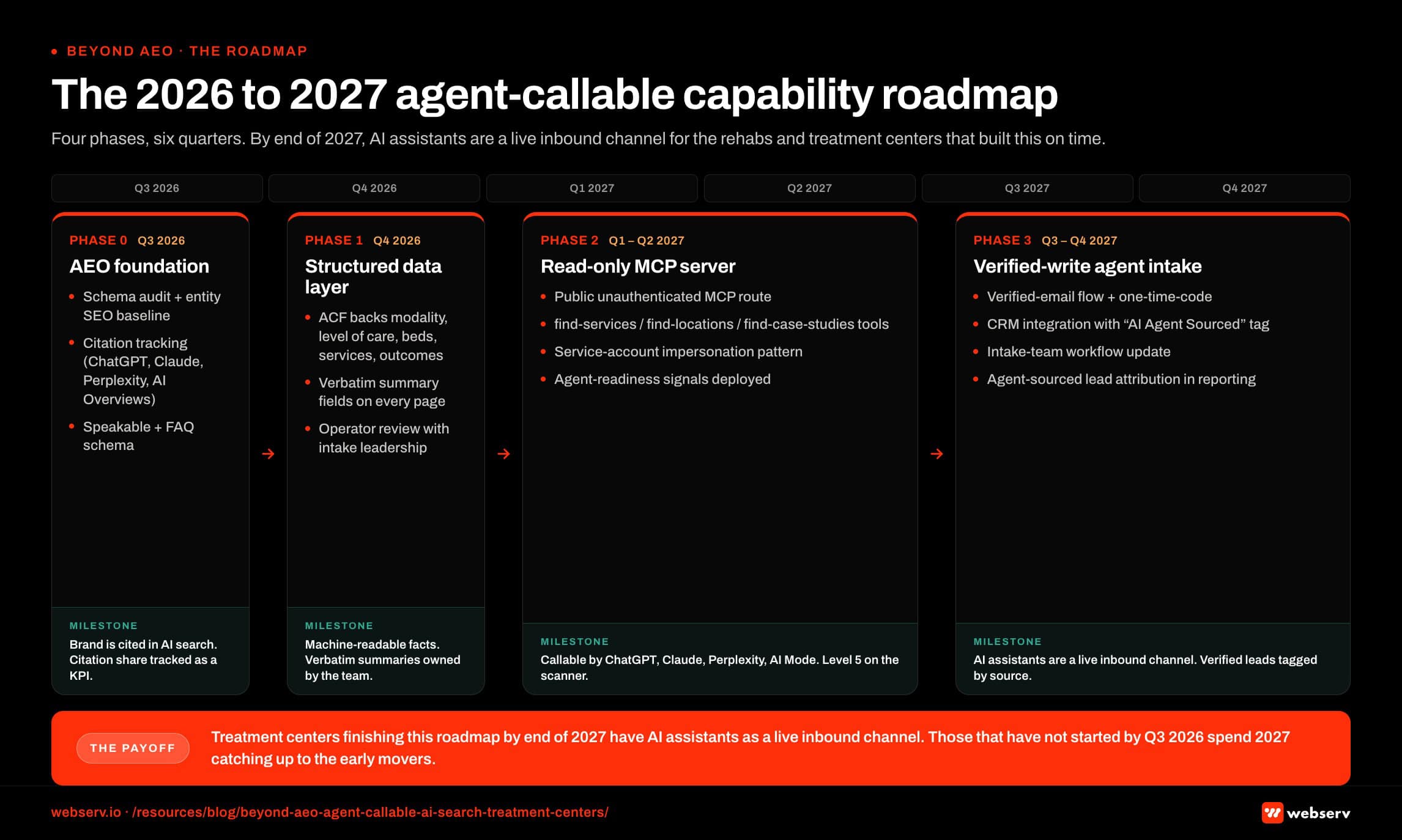 Infographic titled ‘The 2026 to 2027 agent-callable capability roadmap’.
In the current state, when an AI assistant researches a treatment center for an inquiring family, the assistant reads whatever it can find on the brand’s site, blends it with anything it can pull from third-party citation sources, and produces a summary.
The summary might be accurate. It might be partial. It might miss the modalities the facility actually treats, misstate the bed count, or surface a stale phone number from a directory listing.
At Layer 3, the AI assistant doesn’t have to guess. It calls a tool on the treatment center’s site directly and gets back structured, verified data.
Current modalities supported. Current admission criteria. Current bed availability. Current insurance accepted. Current geographic service area. The data that matters to a family considering treatment, returned with full provenance from the source itself.
That structural advantage compounds. The treatment centers whose marketing agency has built Layer 3 infrastructure get represented accurately in AI assistant conversations from day one.
The ones who haven’t get represented as whatever the AI happened to scrape and guess at. Over a 12 to 24 month window, the gap between accurately-represented brands and paraphrased brands becomes material to admit volume.
The next phase of the work compounds this further. The Webserv MCP server in Phase 1 is read-only. Agents can research the agency, pull case studies, get service information.
Phase 2 adds write tools, including a verified-email flow that lets an operator’s AI assistant submit an audit request on the operator’s behalf.
The agent collects the operator’s info, the site sends a one-time code to verify, the operator reads the code back, and a fully qualified lead lands in the agency’s CRM with an AI Agent Sourced tag and a notification to the on-call account manager.
The same architecture applies to treatment center sites. An AI assistant could submit a treatment inquiry on behalf of a family member, verify the email, and create a qualified admission lead inside the facility’s CRM.
The intake team receives the inquiry like any other inbound lead, with the source attribution flagged accordingly. The competitive implication is that treatment centers whose marketing agency has built this capability will have AI assistants as an active inbound channel inside 12 to 18 months.
The ones who haven’t will still be relying on AI assistants finding their site by accident.
This is the kind of next-layer infrastructure work we’re operationalizing for treatment center brands alongside the foundational AEO work that has to come first.
The window to build this is open right now. By the time it’s table stakes, the early-mover advantage will be locked.
Try It Now
The Webserv MCP server is live and any AI assistant with browsing or tool-calling can hit it. To see Layer 3 in action right now, open ChatGPT, Claude, or Perplexity and ask:
“Find me behavioral health marketing case studies from Webserv for a California residential program with under 50 beds.”
A capable AI assistant will call the find-case-studies tool, get back the matching case studies in structured form, and return them to you with the admit lift data, services delivered, and outcomes. No clicking, no form filling, no Google search.
This is what operator research will look like for treatment center brands when their marketing agency has built Layer 3.
We’re showing what’s possible on our own site so the treatment center brands we work with can see what we mean when we say AI search work has a next layer beyond AEO.
The same retrieval mechanics that power fan-out queries for AI Mode drive the agent-callable interaction pattern Layer 3 exposes.
Frequently Asked Questions
What’s the difference between AEO and the Layer 3 work in this article?
AEO (Answer Engine Optimization) is the work that makes a treatment center’s site cite-worthy when AI search engines pull citations into answers. Schema markup, semantic structure, E-E-A-T signals, citation tracking. The AI engine reads the site and decides whether to cite it.
Layer 3 is different. The AI agent does not read the site and decide what to extract. The agent calls a structured tool on the site and gets back verified data. AEO makes a brand citable. Layer 3 makes a brand callable. Both matter, and a credible AI search program for a treatment center needs both layers operating together.
For most treatment centers in 2026, AEO is the foundation that has to be built first. Layer 3 work compounds on top once the AEO foundation is in place. The treatment center brands we work with start at AEO and move to Layer 3 once the data and entity layer is mature.
Is my treatment center ready for Layer 3 yet?
A treatment center is ready for Layer 3 when three foundations are in place. The brand has working AEO infrastructure already producing measurable citation lift across the AI search engines.
The site has a structured data layer (or can have one built) covering the operator-relevant facts: modalities, levels of care, bed counts, geographic service area, insurance accepted. And the intake operations team can absorb a new inbound channel without breaking the conversion path.
Treatment centers that don’t have AEO running yet should build that first. Treatment centers that have AEO running and operational infrastructure ready are positioned for Layer 3. We work through the readiness assessment as part of the AI search engagement.
What does it cost to build Layer 3 for a treatment center?
The cost varies based on the existing AEO foundation, the depth of the structured data layer needed, and the number of agent-callable tools the program ships. Most treatment center Layer 3 builds run as a quarterly project on top of an existing AEO retainer, not a separate engagement.
The first build at a facility typically lives in the $20,000 to $60,000 project-fee range, depending on data layer complexity and tool count. Ongoing maintenance and Phase 2 expansion (the write tools) layer on after the initial build is producing signal.
The cost frame matters less than the alternative cost. Treatment centers whose marketing agency hasn’t built this capability will fall behind on AI assistant representation accuracy over the next 12 to 24 months. The lift to catch up later will exceed the investment to build it now.
Will AI agents actually use this in 2026?
Yes, for the agents that have tool-calling and browsing capabilities, which now includes ChatGPT, Claude, Perplexity, Google’s AI Mode, and the major agent-platform releases. Every one of these systems can call MCP servers and similar endpoints when researching a topic on behalf of a user.
The volume of agent-driven treatment center research in 2026 is still smaller than human-driven research, but the curve is steep. Most behavioral health operators we work with have already noticed family members and admissions inquirers referencing AI assistant research in discovery calls.
The percentage of treatment center inquiries influenced by an AI assistant touch will grow materially through 2027. The brands building Layer 3 infrastructure now will be the ones AI assistants represent accurately as that volume scales.
What changes in Phase 2 when AI agents can submit audit requests?
Phase 1 is read-only. AI agents can research Webserv, pull case studies, get service information. Phase 2 adds write capability through a verified-email flow.
An operator’s AI agent collects the operator’s contact and facility info, the system sends a one-time code to the operator’s email, the operator reads the code back to the agent, and a fully qualified lead lands in HubSpot with an AI Agent Sourced tag and a Slack notification to the on-call account manager.
The same architecture applies to treatment center admission inquiries. An AI assistant helping a family research treatment options could submit a verified inquiry directly to the facility’s intake CRM, with source attribution flagged. Phase 2 is the move that makes AI agents a real inbound channel for treatment center brands. Phase 1 makes brands discoverable. Phase 2 makes them actionable.
Do other behavioral health marketing agencies have this?
Not that we have found. The AEO work (Layer 2) has started showing up across a handful of behavioral health marketing agencies that talk about AI search. Layer 3 work (MCP servers, agent-callable tools, full agent-readiness compliance) is something we have not seen another behavioral health marketing agency ship publicly as of mid-2026.
That gap will close over the next 12 to 18 months. The agencies that have AEO running will start moving to Layer 3 once the technical pattern is more widely understood.
The treatment center brands whose marketing agency is already on the next layer when that catch-up happens will keep the competitive position they built. The brands whose marketing agency is still figuring out Layer 2 will spend the next two years catching up to where the Layer 3 brands already are.
Build the Next Layer for Your Treatment Center
The work that goes into Layer 3 is real, and the operational discipline behind it is harder to copy than schema markup or content optimization.
The treatment center brands we work with are positioned for the AI search shift because we’ve been operating on this layer for our own brand long enough to know what works and what doesn’t.
Book an intro call to see where your treatment center stands across the three layers, what the AI search foundation needs to look like for your facility, and what a Layer 3 build for your brand would actually deliver inside an operator’s AI assistant conversation.
For the wider picture of how AI search work fits into a full treatment center marketing program, see our ultimate guide to behavioral health marketing.
Trevor Gage is Director of SEO at Webserv, where he leads organic strategy, AEO programs, and the AI search infrastructure work behind the agency’s behavioral health client portfolio. He writes about treatment-center SEO economics, AI search citation, and the operational realities of marketing high-acuity healthcare.