UnitedHealthcare’s 2026 administrative guide says it’s subject to change, that providers must comply with its protocols under their agreement, and that payment will be denied for failure to comply with a protocol. Aetna’s provider manual says Aetna may add, delete, or change policies at any time.
That’s the first thing to understand about a commercial payer contract. The signed agreement is only part of it. Provider manuals, reimbursement policies, and medical policies are usually referenced into the agreement, and the payer can change many of them without renegotiating.
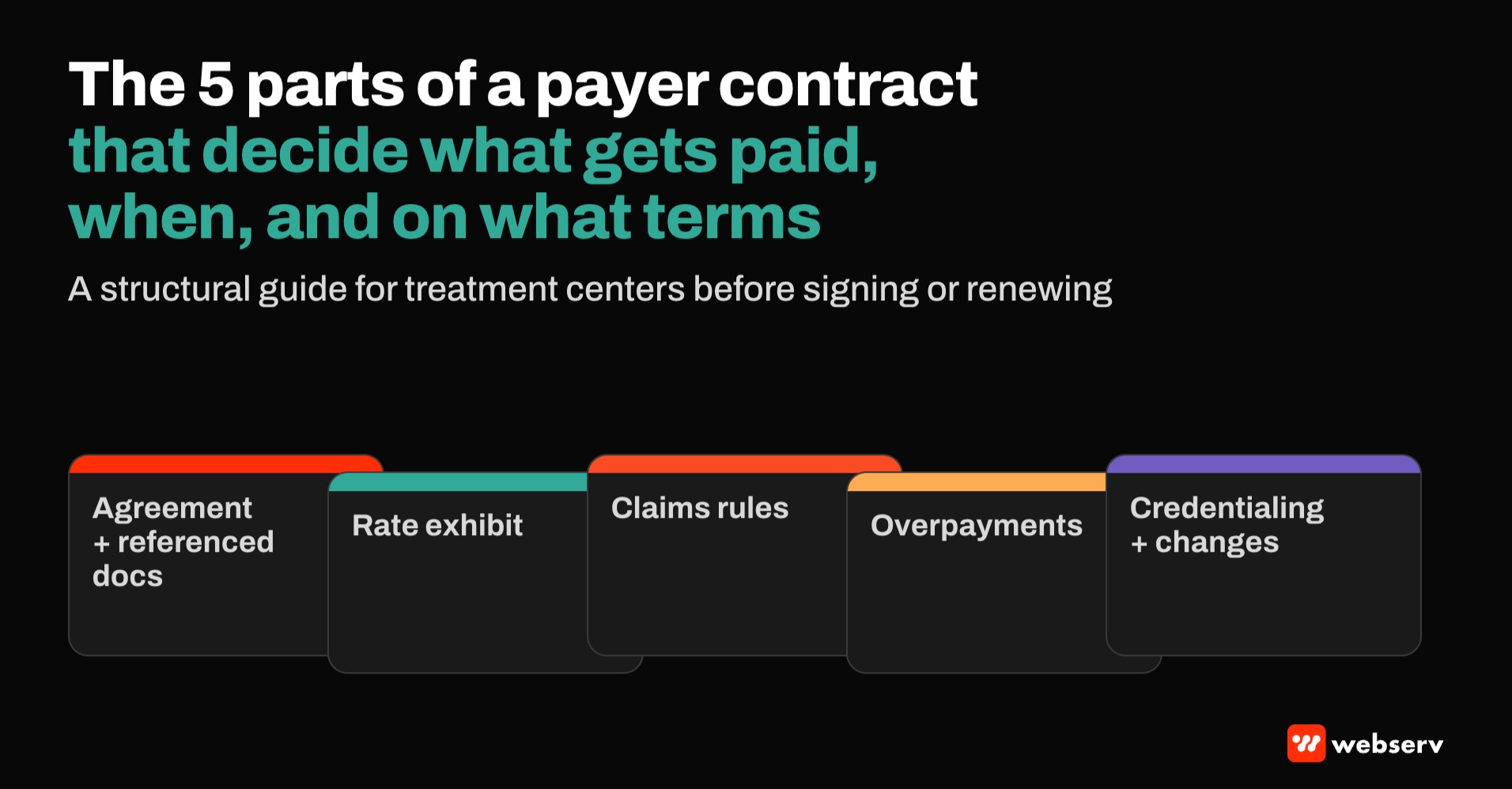
For treatment centers, the structure of the contract decides what gets paid, when, and on what terms: how rates are calculated, how long you have to file, how long the payer has to pay, how far back it can recover overpayments, and what happens when terms change.
This guide walks through the parts of a typical behavioral health payer contract, where the protections come from, and what to review before signing or renewing. It’s part of the revenue cycle work our billing team for treatment centers supports. This isn’t legal advice; have healthcare counsel review any agreement before signing.
Key Takeaways
- A payer contract is usually the signed agreement plus documents referenced into it, such as provider manuals and reimbursement policies. UnitedHealthcare and Aetna both say the agreement controls where it conflicts with the manual.
- Behavioral health facility rates are often per diems or case rates listed in a payment appendix. Optum’s network manual says facility rates are referenced in the payment appendix of the participation agreement.
- “Lesser of” language pays the lower of billed charges or the contracted rate. Optum’s manual and UnitedHealthcare’s guide both use it.
- Timely filing limits vary by payer, contract, and state. Cigna lists 90 days for participating providers; UnitedHealthcare’s 2026 guide points to the participation agreement.
- State laws set prompt-pay deadlines, overpayment lookback limits, and notice requirements for contract changes, but they generally don’t reach self-funded employer plans.
- Credentialing usually repeats every 36 months, and payers commonly use CAQH’s provider data portal.
The agreement and everything referenced into it
UnitedHealthcare’s 2026 administrative guide says that where the agreement and the guide are inconsistent, the agreement controls. Aetna’s provider manual says the same. Optum’s behavioral health network manual says definitions in the applicable law or contract supersede its own.
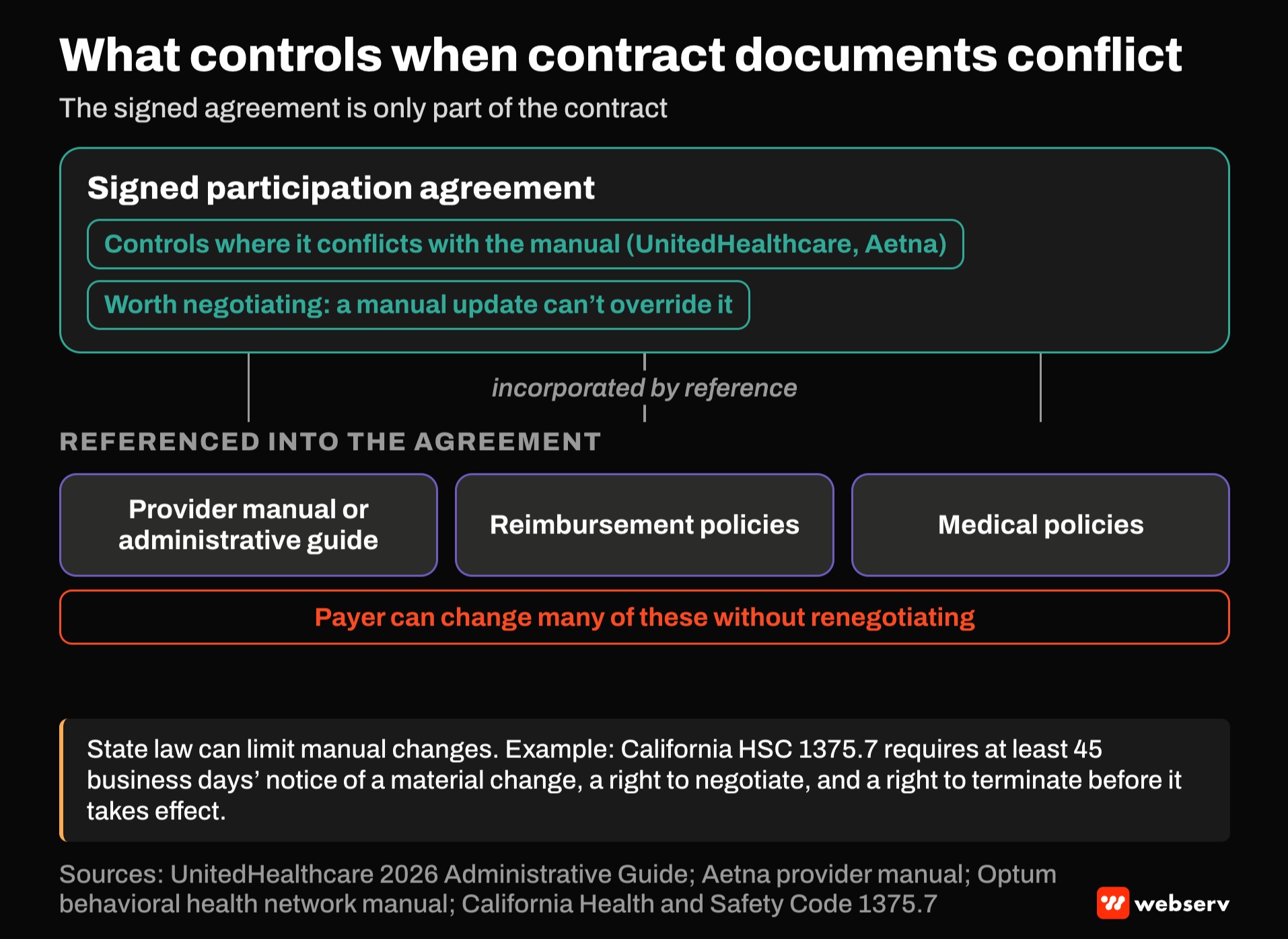
That makes the agreement’s specific terms worth negotiating, because they’re the ones a manual update can’t override.
DEFINITION
Payer participation agreement. The contract between a facility and a health plan that sets the terms for in-network participation: covered services, reimbursement, claims rules, credentialing, term, and termination. It typically incorporates the payer’s provider manual and policies by reference, so those documents become part of the deal.
Some states limit what payers can change through the manual. California’s Health and Safety Code section 1375.7 requires at least 45 business days’ notice of a change to a material term, gives providers the right to negotiate it, and lets them terminate before it takes effect.
How rates are structured
Per diems and case rates. Behavioral health facility care is often paid as a daily rate or a rate for an episode. Medicare’s inpatient psychiatric facility payment system uses a standardized federal per diem rate.
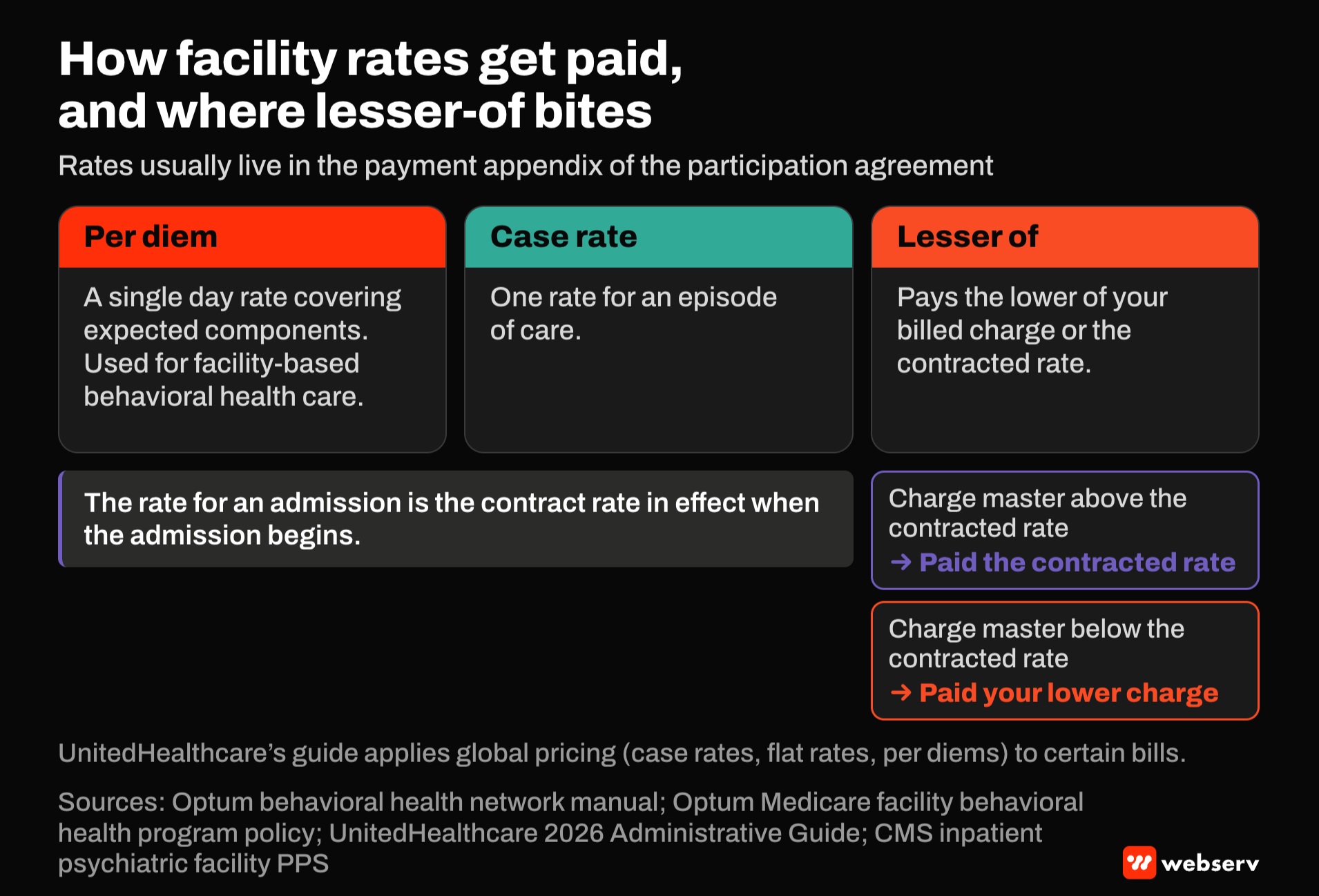
Optum’s Medicare facility behavioral health policy describes paying facility-based behavioral health services on a per diem basis, as a single day rate covering expected components.
The payment appendix. Optum’s network manual says facility rates are referenced in the payment appendix of the participation agreement, and that the rate for an admission is the contract rate in effect when the admission begins. UnitedHealthcare’s guide says certain bills are subject to global pricing, including case rates, flat rates, and per diems.
WHAT TO CHECK IN THE RATE EXHIBIT
- Which services and levels of care each rate covers, and which revenue and procedure codes it applies to.
- What’s bundled. A per diem may include services you’d otherwise bill separately, such as labs or medication management.
- Escalators and term. Whether rates rise over the contract term, and when they can be renegotiated.
- Carve-outs and exclusions. Services paid outside the per diem, and outlier or stop-loss provisions for long stays.
“Lesser of” language. Optum’s manual pays outpatient visits at the lesser of the customary charge or the contracted rate. UnitedHealthcare’s guide uses “lesser of” language for interim facility bills and in some of its fee schedule supplements.
If your charge master is below a contracted rate for any code, the lesser-of clause pays the lower amount.
COMMON MISTAKE
Signing a rate exhibit without mapping it to your codes. A facility signs a residential per diem, then finds its claims bill PHP, lab, and medication services under codes the exhibit doesn’t mention, or the payer treats them as bundled into the per diem.
Before signing, map every service you deliver to the exhibit: which rate applies, which codes, which revenue codes, and what’s bundled. Our guide to CPT and HCPCS codes for behavioral health covers the coding side.
Claims rules: filing deadlines and payment timelines
Timely filing. Deadlines vary by payer, contract, and state. Cigna’s claims guidance lists 90 days after the date of service for participating providers and 180 days for out-of-network, unless the agreement allows more. Cigna also notes the contract prohibits balance billing the patient when a claim is denied for late filing.

UnitedHealthcare’s 2026 guide says timely filing limits vary by state requirements and contracts, and directs providers to the participation agreement. Optum’s network manual sets 90 calendar days from the date of service, or as allowed by law or the member’s plan.
Some states set floors. California’s claims regulation bars plans from setting a deadline shorter than 90 days for contracted providers and 180 days for non-contracted providers.
Prompt pay. State laws set deadlines for paying clean claims. Since January 1, 2026, California’s Health and Safety Code section 1371 requires payment within 30 calendar days of receipt, with interest on late payment.
Texas requires payment of clean claims by the 30th day for electronic claims and the 45th day for paper, and New York’s Insurance Law section 3224-a sets 30 days for electronic and 45 days for paper or fax.
Self-funded plans are different. ERISA section 514 says a self-funded employer plan isn’t deemed an insurance company for state insurance laws, so state prompt-pay rules generally don’t apply to it. Identify the plan’s funding type during verification.
| State | Prompt pay (clean claims) | Overpayment lookback | Notice of changes |
|---|---|---|---|
| California | 30 calendar days from receipt, since January 1, 2026 (HSC 1371) | Refund requests within 365 days of payment (28 CCR 1300.71) | 45 business days for material changes (HSC 1375.7) |
| Texas | 30 days electronic, 45 days paper | Notice within 180 days of payment | 90 days for fee schedule or coding changes |
| New York | 30 days electronic, 45 days paper (Ins. Law 3224-a) | No recovery after 24 months, with exceptions (Ins. Law 3224-b) | Not covered here |
Overpayments and recoupment
Payers audit and recover overpayments, and the contract and state law decide how far back they can go.
- California’s claims regulation requires refund requests within 365 days of the payment date, except for fraud or misrepresentation.
- Texas requires notice of an overpayment no later than the 180th day after the provider received payment, and bars recovery until appeals are exhausted.
- New York’s Insurance Law section 3224-b bars initiating overpayment recovery more than 24 months after the original payment, with exceptions, and requires 30 days’ written notice.
UnitedHealthcare’s guide says audit overpayments are recouped after 45 calendar days unless the provider disputes them, the agreement says otherwise, or state law requires otherwise. Know the dispute deadline before the recoupment starts. Our denial management playbook covers the appeals side.
Credentialing, term, and changes
Credentialing. UnitedHealthcare, Aetna, and Optum each say they recredential at least every 36 months or three years, and Cigna says every three years in most states. NCQA’s credentialing FAQ refers to a 36-month recredentialing time frame. Payers commonly pull credentialing data from the CAQH Provider Data Portal, formerly ProView.
Changes during the term. Texas Insurance Code section 1301.136 requires notice of fee schedule or coding changes that affect payment at least 90 days before they take effect, bars retroactive revisions, and lets the provider terminate within 30 days of notice. California’s section 1375.7, covered above, sets 45 business days’ notice for material changes.
Network participation isn’t guaranteed. Federal law, 42 U.S.C. 300gg-5, says plans aren’t required to contract with every provider willing to abide by their terms, and allows reimbursement to vary based on quality or performance. Out-of-network facilities sometimes rely on single case agreements for specific patients instead. Our piece on mental health parity rules on reimbursement covers how parity law applies to rates.
Most-favored-nation clauses. Some contracts have required providers to give the payer rates at least as good as any other payer. The Department of Justice noted in 2013 that Michigan had banned health insurers from using these clauses. Check your state’s rules and any such clause before signing.
OPERATOR INSIGHT
Keep a one-page contract summary for every payer: rate exhibit, bundling, timely filing, prompt-pay rules that apply, recoupment notice and dispute deadlines, renewal date, and change-notice terms. Update it every time the payer issues a manual change.
Billing, admissions, and leadership all make decisions that depend on those terms. A summary they can find beats a contract only one person has read.
A review checklist before signing or renewing
Six checks, in order.
Read the agreement and every referenced document
Read the agreement and every referenced document, including the provider manual and reimbursement policies.
Map your services to the rate exhibit
Map your services to the rate exhibit by level of care, codes, and revenue codes, and confirm what’s bundled.
Check “lesser of” terms
Check “lesser of” terms against your charge master.
Confirm timely filing, prompt pay, and recoupment terms
Confirm timely filing, prompt pay, and recoupment terms, and which state rules apply.
Review change and termination provisions
Review change and termination provisions, including notice periods and your right to exit.
Compare the rates to what the payer actually pays
Compare the rates to what the payer actually pays for your services, using your own claims data.
For that last step, our guide to reimbursement intelligence and payer strategy with rate intelligence cover how to organize and use rate data. Our 10% rule case study shows what underpayment tracking can surface.
For how billing fits the rest of your marketing, see the complete guide to behavioral health marketing. If you want a second look at your payer contracts, book an intro meeting.
Frequently Asked Questions
What’s included in a behavioral health payer contract?
The signed participation agreement, a rate exhibit or payment appendix, and documents referenced into it, such as the provider manual and reimbursement policies.
UnitedHealthcare and Aetna both say the agreement controls where it conflicts with the manual.
Read the referenced documents as carefully as the agreement, since payers can update many of them.
How are treatment centers typically paid under payer contracts?
Facility care is often paid as a per diem or case rate listed in a payment appendix. Optum’s network manual says facility rates are referenced in the participation agreement’s payment appendix.
Outpatient services may be paid on a fee schedule, sometimes under “lesser of” language that pays the lower of billed charges or the contracted rate.
Map every service and code to the rate exhibit before signing.
What is the timely filing limit for behavioral health claims?
It varies by payer, contract, and state. Cigna lists 90 days after the date of service for participating providers and 180 days for out-of-network providers, unless the agreement allows more.
UnitedHealthcare’s 2026 guide directs providers to their participation agreement.
Some states set minimums, such as California’s 90-day floor for contracted providers.
How far back can a payer recover an overpayment?
It depends on the contract and state law. California requires refund requests within 365 days of payment, Texas requires notice within 180 days, and New York bars recovery efforts after 24 months, each with exceptions.
Self-funded employer plans generally aren’t subject to state insurance laws.
Know the dispute deadlines in your contract before recoupment begins.
Can a payer change contract terms without renegotiating?
Payers can often change manuals and policies referenced in the agreement. Some states limit this: California requires 45 business days’ notice of material changes and a right to negotiate, and Texas requires 90 days’ notice of fee schedule changes.
Terms written into the agreement itself are harder to change unilaterally.
Track every notice and review it against your contract summary.
Kyle McHenry is the founder of Revenue Logic, a behavioral health revenue cycle management firm. He has spent 15 years working with treatment center operators on verification, utilization review, and claims management. Webserv partners with Revenue Logic to surface RCM-side guidance for treatment center marketing teams.