Every treatment center admissions operation I have worked with runs on two questions at admission time. The first is whether the patient has coverage. The second is what the payer will actually pay if we admit them.
The industry has spent a decade building excellent tools to answer the first question. The second question, until very recently, has not had a defensible answer.
That gap is what reimbursement intelligence is built to close. It is not a better verification of benefits, and it is not a competing eligibility tool.
It is a categorically different data layer that sits alongside VOB and answers the rate question the eligibility API layer structurally cannot see.
When it works, admissions decisions get made against expected rates that land within 10% of what the payer actually pays about nine times out of ten.
When it does not exist, treatment centers admit patients at rates that surface on the collections report ninety days later, and underpayments accumulate that nobody knows to chase.
This guide is the umbrella for the PayerLenz reimbursement intelligence product we co-founded and the broader reimbursement intelligence discipline it operates inside.
It walks what the category is, why coverage confirmation is not enough, the four sub-questions rate intelligence answers, how the layer fits inside admissions ops, and where the discipline is going in 2026. Every sub-topic covered here has a deeper piece attached. This is the map.
Key Takeaways
- Reimbursement intelligence is the discipline that answers what the payer will actually pay for a specific admit, before the admit gets scheduled. It runs alongside a VOB tool, not instead of it, and it answers a fundamentally different question than any eligibility API can.
- PayerLenz produces expected reimbursement estimates that land within 10% of actual paid reimbursement about nine out of ten times on high-confidence rate cells, backed by adjudicated claims across more than a million datapoints in the pool.
- Two patients with identical benefits on paper can produce a 10x difference in what actually gets allowed per day. Same California, same residential level of care, same OON status: four BCBS home plans in our pool pay $3,778, $3,090, $2,297, and $662 per day. Eligibility tools return the same green checkmark for all four.
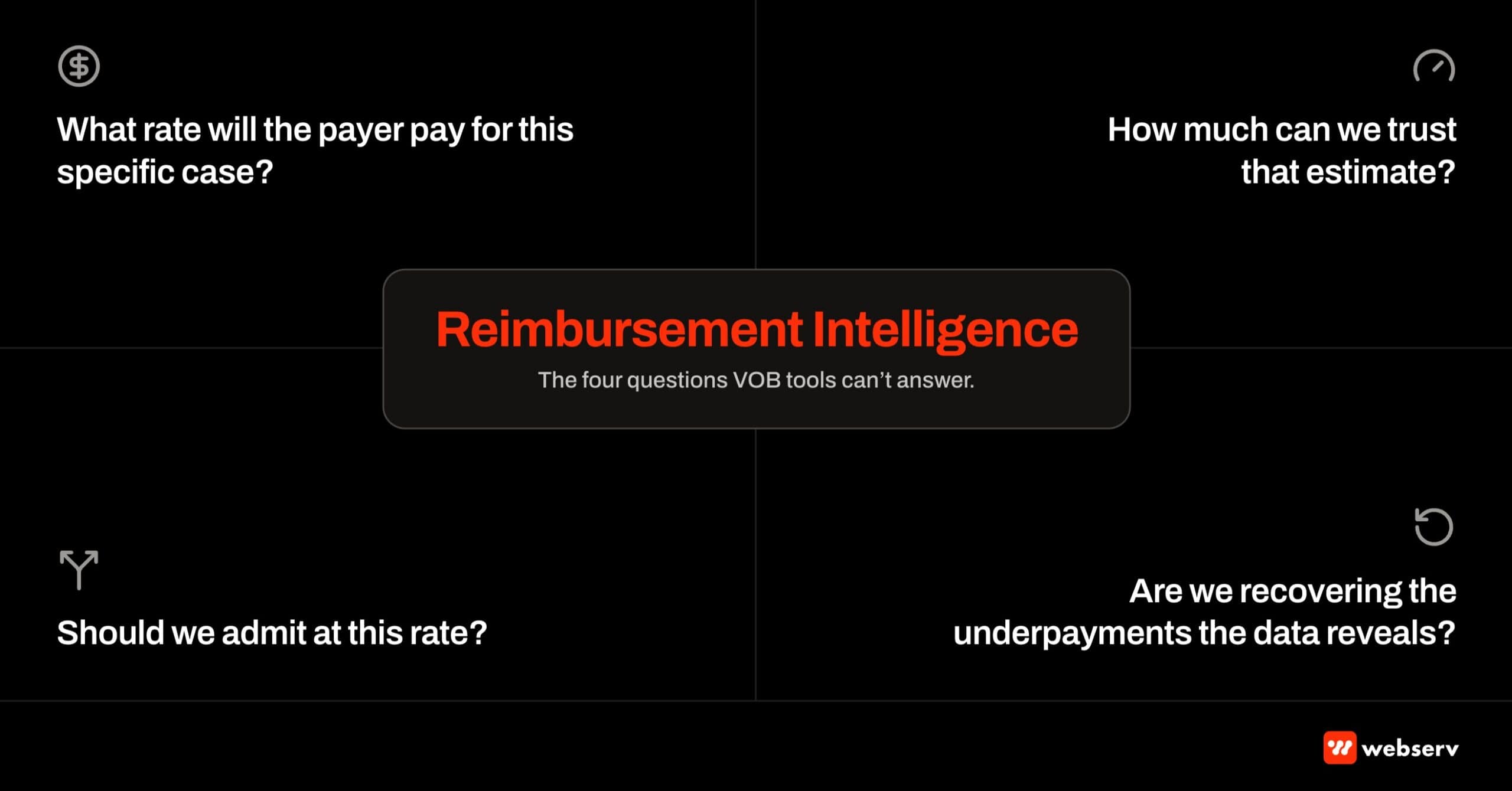
- Reimbursement intelligence answers four operator questions the eligibility layer cannot: what rate will the payer pay for this case, how much can we trust that estimate, should we admit at this rate, and are we recovering the underpayments the data reveals.
- The category is a beachhead product, not a national one yet. PayerLenz has priced claims across 20 states with California and Florida together accounting for 85% of the pool. Coverage is deepest in California, strong in Florida, and real across Arkansas, Tennessee, Georgia, Arizona, and Texas.
What reimbursement intelligence is
Reimbursement intelligence is the data discipline that answers what a specific payer will actually pay for a specific admit at a specific plan and level of care. That answer is not in a payer eligibility API.
It lives inside adjudicated claims data, contributed by a network of treatment centers into a shared pool, cleaned and normalized to the resolution the money actually adjudicates at.
DEFINITION
Reimbursement Intelligence. The data discipline that answers what a specific payer will actually pay for a specific admit at a specific plan and level of care. Runs on adjudicated claims data contributed by a network of treatment centers, keyed to alpha prefix, home plan, state, level of care, and network status. Distinct from verification of benefits, which answers the coverage question via payer eligibility APIs.
The distinction from verification of benefits is architectural. A VOB confirms that the policy is active, that the deductible sits at X, that out-of-network benefits apply, and that any prior authorization requirements are documented.
Every one of those data points is real and useful. A treatment center running admissions without a VOB process is operating blind on coverage. The VOB versus expected reimbursement piece covers the definitional reframe in depth.
What the VOB does not answer, and what eligibility APIs structurally cannot answer, is what the payer will pay. Payer eligibility endpoints return what the policy says. Adjudicated claims data reveals what the payer has actually paid on similar cases.
That is a different data source, a different data infrastructure, and the reason reimbursement intelligence exists as its own category rather than as a feature inside a VOB tool.
Kyle McHenry, Co-founder of Webserv and PayerLenz: “Every tool on the market answers ‘is this patient covered?’ We answer the question that actually determines whether the admission makes money: what will this policy pay?”
Why coverage confirmation is not enough
The clearest way to see the gap is with a specific stat from our pool. Same state: California. Same level of care: residential. Same network status: out-of-network. Four different BCBS home plans, all showing as “BCBS coverage confirmed” on any eligibility tool.
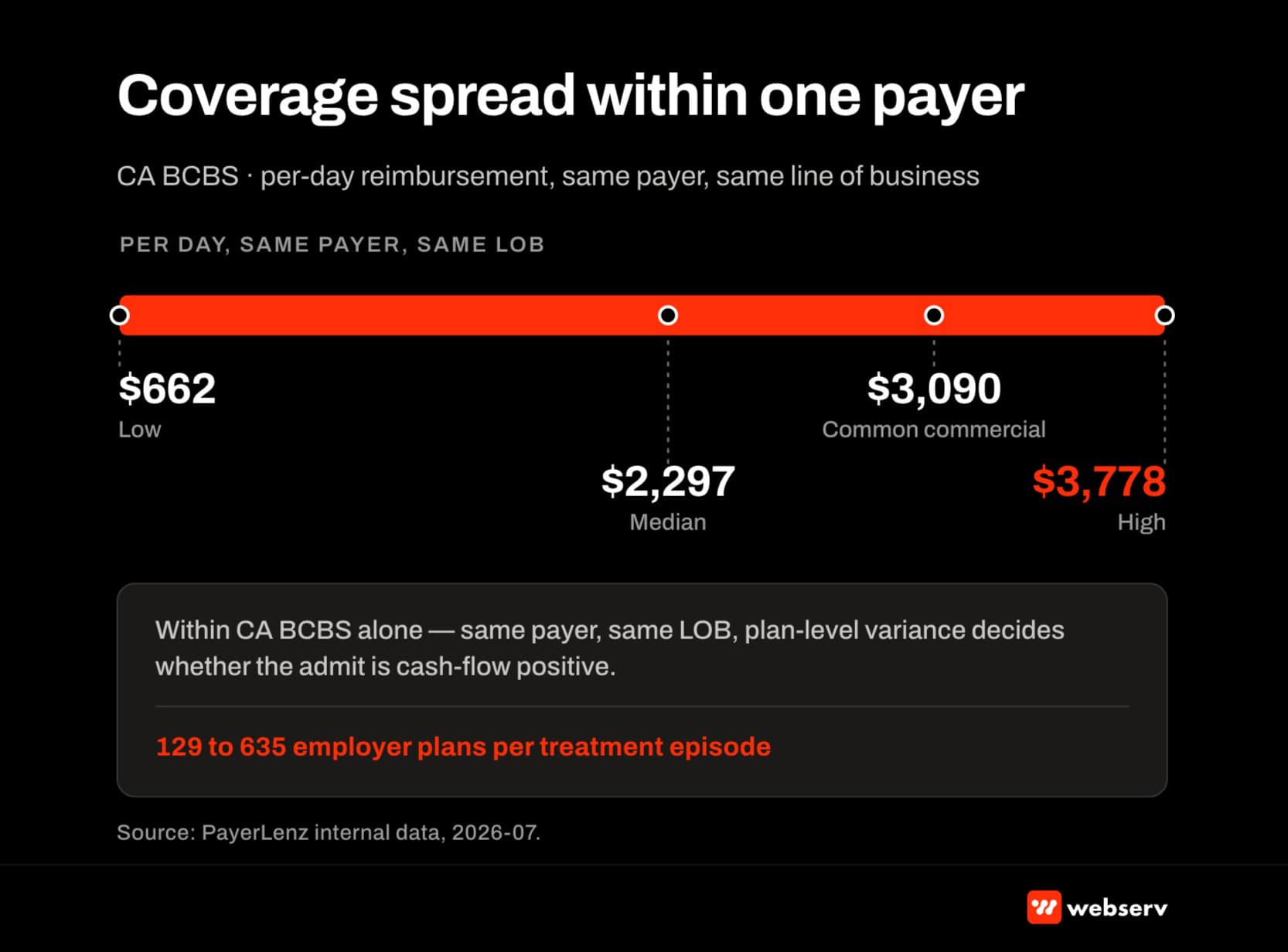
Anthem Blue Cross and Blue Shield of Indiana pays $3,778 per day. Anthem Blue Cross and Blue Shield of Ohio pays $3,090. Anthem Blue Cross of California pays $2,297.
Blue Shield of California pays $662. A 5.7x spread within one label. All four are high-confidence cells in our data, each backed by 129 to 635 claims from at least three distinct facilities.
$3,778
Anthem BCBS of Indiana
$3,090
Anthem BCBS of Ohio
$2,297
Anthem Blue Cross of CA
$662
Blue Shield of CA
Over a 30-day residential stay, that spread is the difference between a $113,000 admit and a $19,800 admit.
Multiply by a census of 40 residential beds turning over quarterly, and the aggregate impact on annual revenue is the difference between a profitable year and an unprofitable one at the same volume of admits.
That variance is not visible from an eligibility check. It is only visible in adjudicated claims data. The variance is what makes the reimbursement question so much more expensive than the coverage question, and it is why the category exists as a distinct discipline.
The alpha prefix and BCBS home plan resolution piece walks the technical mechanics of how the resolution works.
The four questions reimbursement intelligence answers
The category breaks into four sub-questions, each of which has a deeper piece attached inside this cluster.
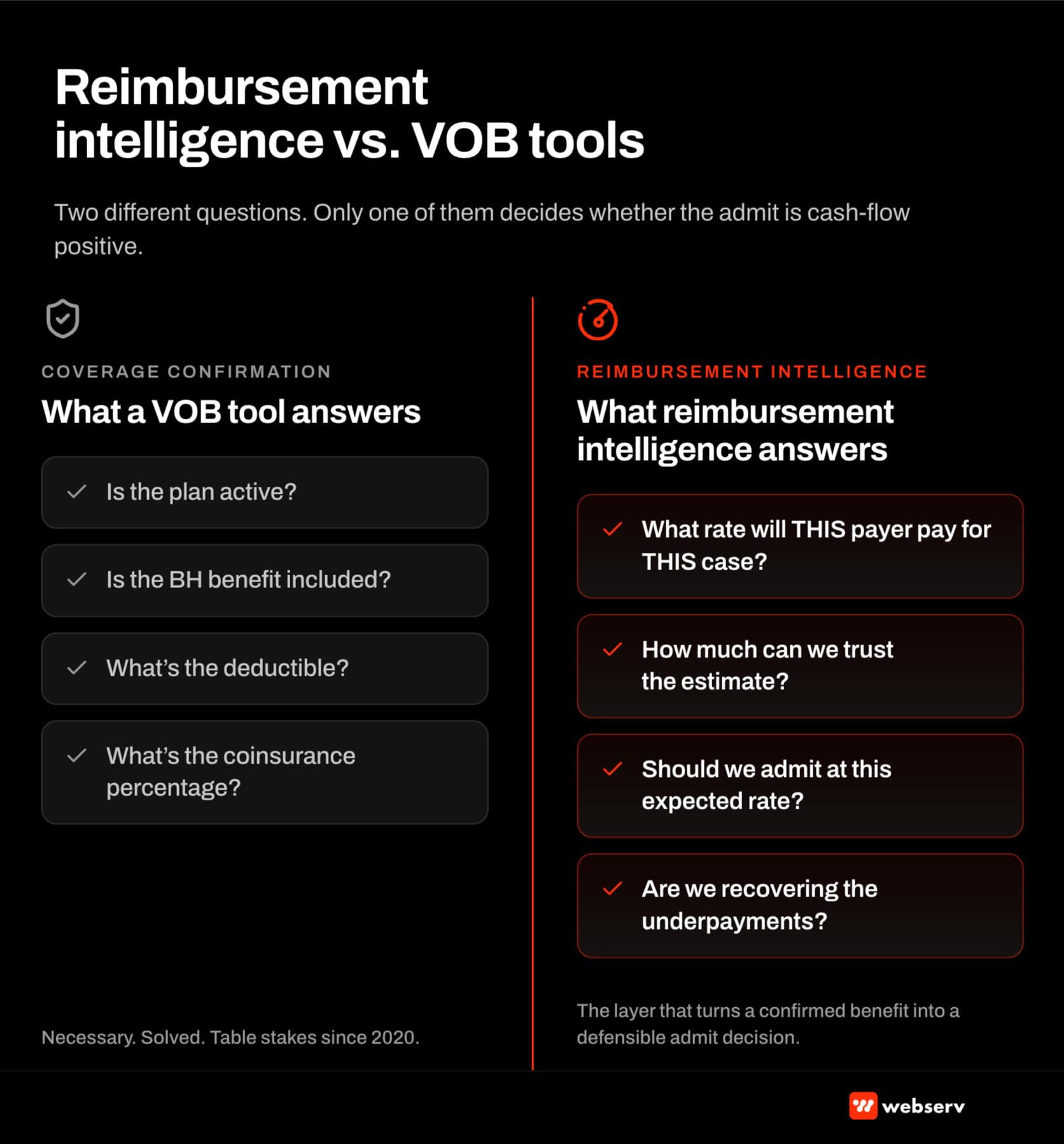
What rate will the payer pay for this specific case?
The primary output of reimbursement intelligence is an expected reimbursement estimate keyed to the specific alpha prefix, home plan, state, level of care, and network status of the case. Not a payer-level average. Not an out-of-network expected value. A specific number for a specific admit.
At PayerLenz, the estimate is calculated from adjudicated claims contributed by real treatment centers, cleaned and normalized through a five-step enrichment chain that resolves BCBS alpha prefixes to home plans (across 21,800 mappings), classifies network status, classifies reimbursement method, and computes a per-day allowed amount.
The claims data pool network effect piece covers the mechanic end to end.
The accuracy claim is specific. On high-confidence rate cells, PayerLenz estimates land within 10% of actual paid reimbursement about nine out of ten times. That is a defensible number, and it is what makes the estimate operationally usable rather than a rough directional average.
How much can we trust that estimate?
Every rate PayerLenz returns carries a trust score. The confidence formula is documented in the claims data pool piece with the specific math, but the operator-facing distinction is that confidence is not a decorator on the estimate. Confidence determines the estimate.
When the underlying data is high confidence, the number moves toward what the payer is paying right now. When confidence is low, the system falls back toward a longer-run median. The tool only chases recent data as far as it actually trusts it.
That is what separates a claims-based rate benchmark from a price-transparency dataset. Payerset, Serif, and Rivet show a negotiated rate from a machine-readable file.
They cannot tell an operator whether that rate is what actually gets paid, or how much to bet on the estimate. Reimbursement intelligence gives the operator a number with its own uncertainty priced in.
Should we admit at this rate?
The rate estimate is only useful if the admissions operation has a decision framework for what to do with it.
Admitting at rates below the program’s cost floor is a different operator decision than admitting at rates above the floor, and that decision changes based on capacity utilization, payer relationship strategy, patient clinical acuity, and available alternatives.
The decision framework piece covers the five-dimension operator framework we use with treatment center clients.
What matters for the cluster hub level is that reimbursement intelligence moves the admissions decision from “can we admit this patient” to “should we admit this patient at this rate,” and the second question has a repeatable structure once the data is in the workflow.
Are we recovering the underpayments the data reveals?
The rate estimate is useful upstream of the admit, but it produces a second layer of value downstream.
Once the paid claim comes back sixty to ninety days after admission, the billing team can compare what the payer actually paid against the expected rate. When the paid amount is materially below the expected rate, the case is a candidate for recovery workflow.
In one comparison case we ran across roughly 23,000 claims where paid-versus-expected was defensibly comparable, PayerLenz identified $1.36 million in underpayments the treatment centers had not previously known to chase.
To be precise: that number reflects the subset of claims where we had enough data to make a defensible comparison, not the entire pool. Reimbursement recovery is a payer-relationship discipline, not a mechanical claim resubmission.
But the number represents money that was owed and never chased, and the 10% rule piece walks the operator-side implementation.
How a Tennessee treatment center tripled its paid media close rate and cut missed calls to 1%
Full CRM configuration, system integrations, and call tracking metrics unified a fragmented admissions process into a single high-converting workflow in two months.
Read the case study →Up from 17% — missed calls cut from 15% to 1%
How reimbursement intelligence fits into admissions ops
Reimbursement intelligence is a data layer, not a standalone operation. It plugs into the admissions ops discipline at three specific points.
The first is the admissions call workflow. The coordinator still runs the VOB, coverage confirmation still happens through the eligibility tool, and the intake conversation stays where it was.
What changes is that the rate estimate populates on the coordinator’s screen at the same moment the VOB status returns, and escalation triggers route the case to the admissions manager when the expected rate falls below the program’s cost floor or a payer identifier flags for review.
The rate intelligence in the call script piece covers the specific integration mechanics.
The second is the KPI spine. Rate-adjusted admissions volume replaces raw admissions volume as the operating indicator. Payer mix reporting shifts from carrier-level to plan-level.
Referral partner attribution starts including admit value alongside admit count. The revenue cycle side gets a defensible baseline to reconcile paid rates against expected rates, which produces the underpayment recovery workflow.
The third is the QBR cadence. Aggregate cost per admit reporting gets replaced by rate-adjusted metrics. The marketing and admissions QBR playbook covers the specific reporting shape at the quarterly review level.
The compliance layer
Reimbursement intelligence operates inside the same compliance stack that governs the rest of behavioral health admissions ops. HIPAA is the floor.
42 CFR Part 2 applies to substance use disorder patient records with a higher confidentiality standard. Both layers affect what the tool can store, share, and use for the rate estimation pipeline.
PayerLenz specifically was designed under HIPAA from the first line of code. Data is encrypted in transit and at rest, Business Associate Agreements are available, and de-identified claims contributed to the benchmark pool are stripped of all PHI before aggregation.
The operator implication is that reimbursement intelligence tools that were retrofitted onto pre-existing eligibility platforms carry compliance debt the operator inherits, while tools built inside the behavioral health regulatory frame from the start do not.
Where PayerLenz sits in the category
The reimbursement intelligence category is small enough that operators sometimes confuse it with adjacent categories. Two specific positioning distinctions matter for evaluating tools inside the space.
Versus eligibility API tools (VerifyTX, Availity, pVerify). These are excellent VOB tools operating on payer eligibility APIs. They answer the coverage question well. They do not answer the rate question, because payer eligibility APIs do not return realized-payment data. Any eligibility tool positioning itself as also delivering rate intelligence is either extending its data stack to include adjudicated claims (which is a category shift, not a feature addition) or overpromising.
Versus price transparency datasets (Payerset, Serif, Rivet). These are legitimate rate data products, but they operate on machine-readable files that payers publish under federal price transparency rules. What those files show is the negotiated rate. What they do not show is what the payer actually pays on adjudicated claims, and they cannot tell an operator how much to trust the number. PayerLenz’s confidence-weighted estimate is a categorically different product than a static negotiated rate lookup.
The one-sentence distinction Kyle uses on first calls: eligibility tells you whether you can bill, and rate intelligence tells you whether you should admit. VerifyTX ends where PayerLenz begins.
OPERATOR INSIGHT
Kyle McHenry’s one-sentence distinction on first calls: “Eligibility tells you whether you can bill. Rate intelligence tells you whether you should admit. VerifyTX ends where PayerLenz begins.”
Coverage: beachhead, not national
Reimbursement intelligence built on adjudicated claims data is only as good as the data pool underneath it. We want to be direct about where our pool is deep and where it is not.
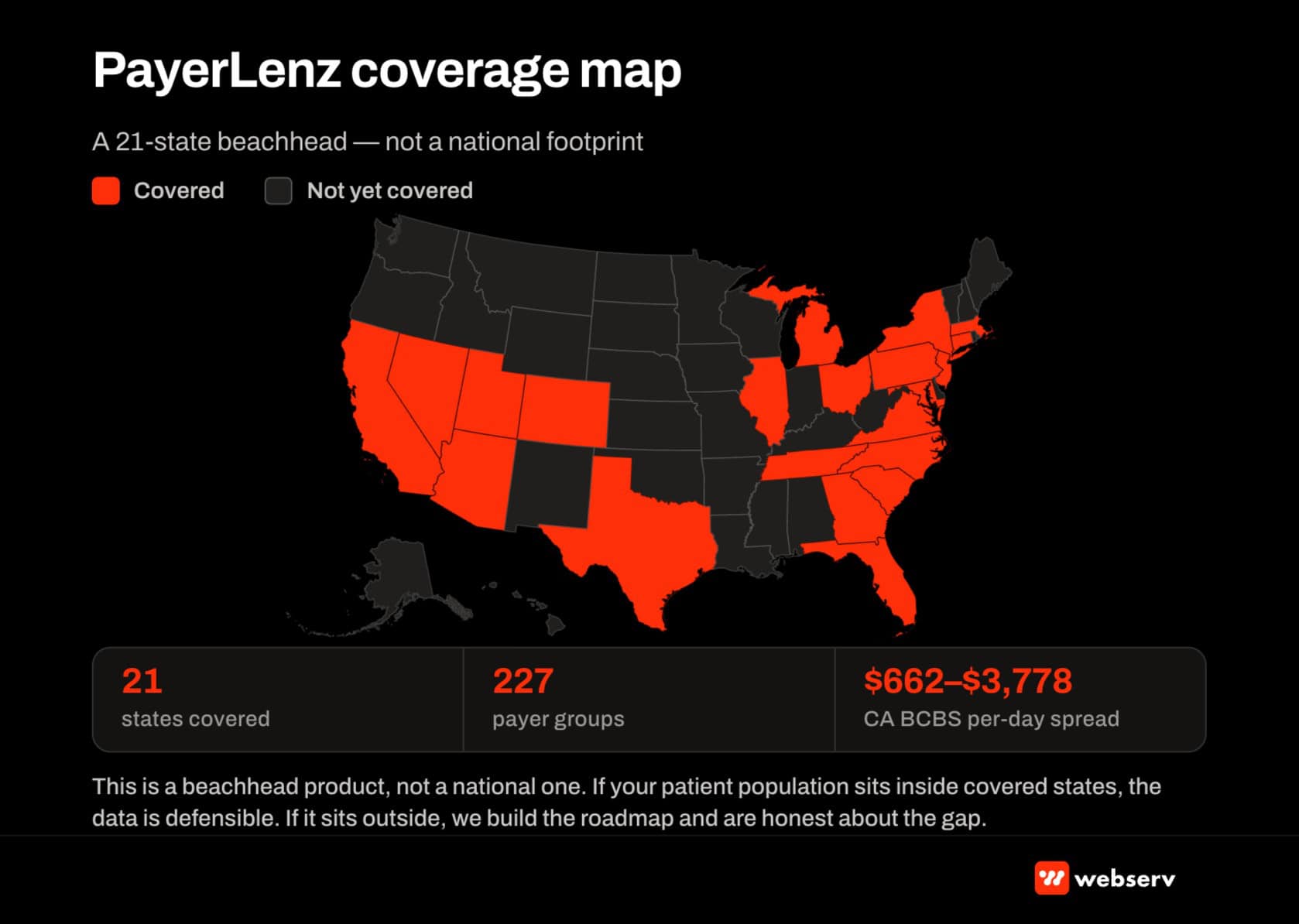
Twenty-one states have any pooled priced claims in our data. Not fifty. California accounts for roughly 74% of the priced pool with 384,791 claims across 227 contributing facilities. Florida adds another 11%.
California and Florida together represent 85% of the entire priced pool. Real coverage extends across Arkansas, Tennessee, Georgia, Arizona, and Texas, with additional states carrying volume but not recent enough to clear our own 18-month freshness threshold.
The honest framing is that PayerLenz is a beachhead product. Deepest in California, strong in Florida, real across the Southeast. That is a good story for the specific operators whose portfolios sit inside those states.
It is a less good story for operators in Ohio or New Jersey today, and we would rather tell them that than overclaim coverage that does not match the underlying data.
The pool grows as more treatment centers contribute claims. The claims data pool network effect piece covers the mechanic. What matters at the cluster hub level is that operators evaluating the tool should ask about coverage in their specific state, not accept aggregate national claims.
Any tool in this category with less honest coverage framing is either newer than they claim or bigger than they can defend.
What operators do differently once reimbursement intelligence is running
Across our client book, the pattern of operating changes is consistent enough to name.
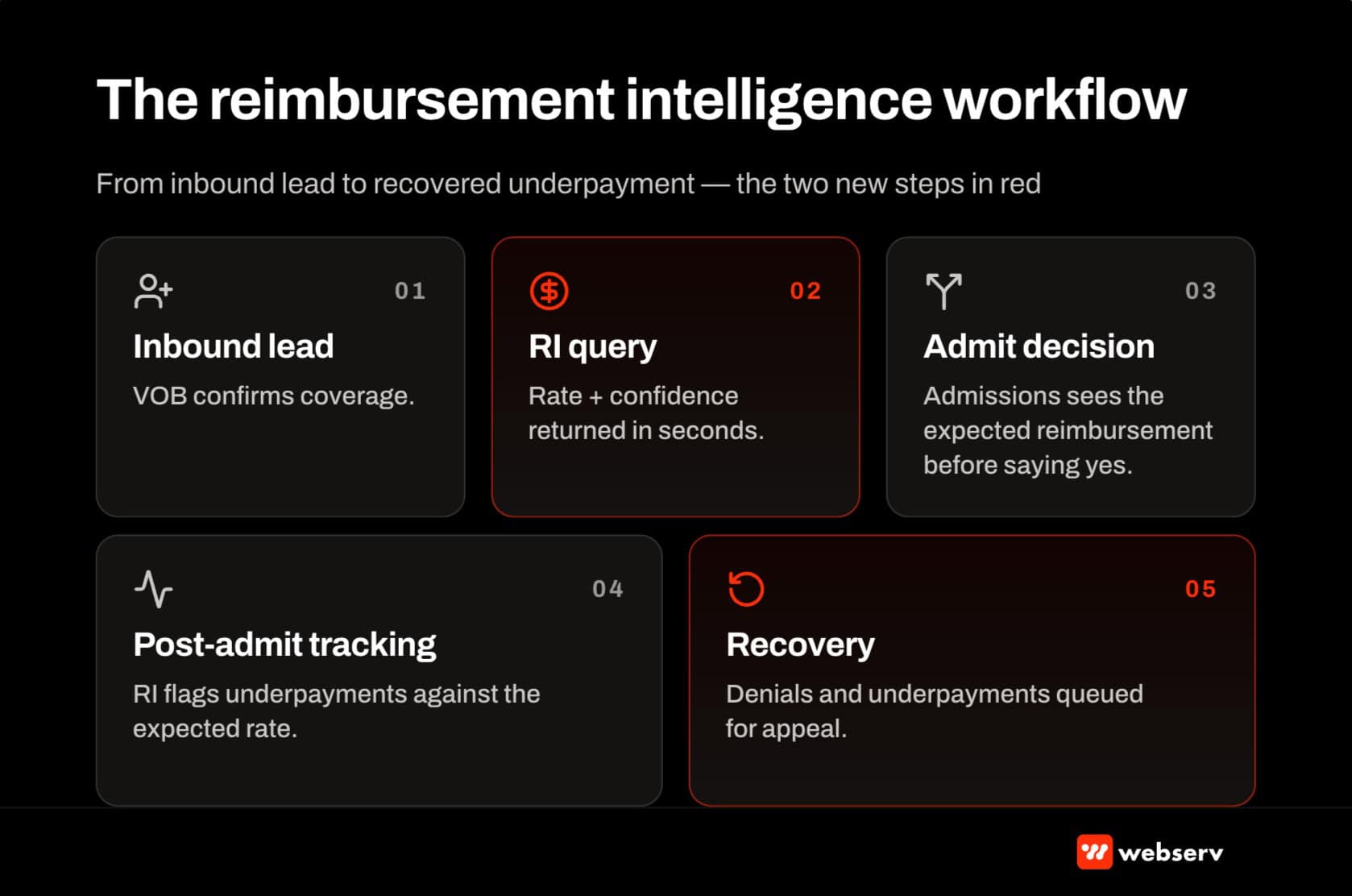 VOB confirms coverage > RI query returns expected rate > admit decision with expected reimbursement > post-admit tracking flags underpayments > recovery queue.” class=”wp-image-28305″/>
Admissions decisions shift upstream. Rate flags surface at the moment the VOB returns, not on the collections report ninety days later. Admissions managers make the admit-or-decline call with data instead of instinct. The margin erosion pattern of admitting at rates below the cost floor stops accumulating quietly.
Payer mix strategy sharpens. Operators stop running strategy at the carrier level and start running it at the plan and level-of-care level.
“Aetna pays great, Cigna is terrible” as a strategic frame gets replaced by plan-level data that reveals which specific arrangements inside each carrier are profitable and which are structurally not.
Underpayment recovery becomes a workflow. Billing teams get a defensible baseline to reconcile against, and the paid-versus-expected comparison surfaces the cases worth pursuing.
QBR reporting changes shape. Aggregate census numbers give way to rate-adjusted admissions volume, payer mix trending against expected reimbursement, and referral partner attribution that includes both admit count and admit value.
These are not exotic operator changes. They are what happens when the second half of the reimbursement question finally has a defensible answer at admission time.
When it’s worth adopting reimbursement intelligence
Three specific operator situations point to the right time to add this layer to admissions ops.
When census is under plan and the diagnosis is not obvious. Operators running strong marketing programs and full admissions teams who still miss census plan often have the gap between VOB and paid claim as the invisible variable. Rate intelligence surfaces the specific patterns.
When payer mix is complex enough that carrier-level strategy has stopped working. Multi-facility operators, PE-owned platform operators, and single-brand facilities with sophisticated OON programs typically hit a ceiling on carrier-level payer strategy at some scale. Rate intelligence at the plan level breaks through that ceiling.
When the billing team keeps discovering underpayments after the fact. Any operator whose billing team is chasing underpayments without a defensible baseline can benefit from rate intelligence as the upstream data source. The recovery workflow gets sharper when the paid-versus-expected comparison is systematic instead of case-by-case detective work.
Operators whose operations are working cleanly at their current scale can wait. Operators whose admissions ops discipline is running under-instrumented against these three signals should consider the layer sooner.
What a Webserv and PayerLenz engagement looks like
The Webserv engagement layer sits on the marketing-to-admissions side of the operator’s stack, covering SEO, paid media, creative production, and the admissions attribution infrastructure that ties marketing spend to admits. Our complete guide to behavioral health marketing covers that side of the stack.
The PayerLenz layer sits on the eligibility-to-reimbursement side of the same operator’s stack, providing real-time eligibility checks with confidence-weighted rate estimates attached.
Both layers can run independently. Some clients use PayerLenz standalone without Webserv on the marketing side. Some clients use Webserv without PayerLenz. Operators running both get the marketing-to-admissions attribution and the admissions-to-reimbursement rate intelligence in one integrated stack, which is where the operating discipline can compound most efficiently.
The intro call typically covers current admissions ops discipline, payer mix and OON program structure, and specific data or reporting gaps the operator wants to close. The admissions ops complete guide covers the broader operating discipline this all sits inside.
Closing note
The category shift I have been most struck by in the last two years is that reimbursement intelligence has moved from being an ambitious idea to being a data discipline with defensible accuracy numbers.
Nine-out-of-ten estimates within 10% of actual reimbursement, backed by adjudicated claims across more than a million datapoints, resolved to the specific alpha prefix and home plan the case adjudicates against. That is a different product than what the industry had two years ago.
For treatment center operators still running admissions ops without a rate intelligence layer, the honest question is whether the operating discipline can produce the census plan without seeing what the payer will pay.
For some smaller single-facility operators with narrow payer mixes, the answer might still be yes. For most multi-facility operators, portfolio operators, or single-brand facilities with sophisticated OON programs, the answer has quietly moved to no.
The pieces linked throughout this guide go deeper on each sub-topic. What matters here is that reimbursement intelligence exists as its own discipline, produces defensible operational value, and is worth evaluating against the specific patterns showing up in your census reports and collections numbers.
Most in-house teams hit a wall not because they lack knowledge, but because they lack bandwidth.
When you are ready to hand it off, Webserv has spent 9 years executing exactly this for treatment centers nationwide.
Frequently Asked Questions
What is reimbursement intelligence?
Reimbursement intelligence is the data discipline that answers what a specific payer will actually pay for a specific admit at a specific plan and level of care. It runs on adjudicated claims data contributed by a network of treatment centers, cleaned and normalized to the resolution the money adjudicates at (alpha prefix, home plan, state, level of care, network status).
The category is distinct from verification of benefits, which operates on payer eligibility APIs and answers the coverage question. Reimbursement intelligence answers the rate question the eligibility API layer structurally cannot see.
How is reimbursement intelligence different from a VOB tool?
VOB tools operate on payer eligibility APIs. Those APIs return what the policy says: deductible position, benefit design, coverage active, out-of-network percentages, prior authorization requirements. They do not return what the payer actually pays on adjudicated claims.
Reimbursement intelligence operates on adjudicated claims data. That data source returns the paid rate, keyed to the specific case parameters. The two data infrastructures are different, and adding features to a VOB tool does not close the gap because the data required to produce a realized-payment estimate is not in the eligibility API pipe.
How accurate is the rate estimate?
On high-confidence rate cells, PayerLenz estimates land within 10% of actual paid reimbursement about nine out of ten times. When the underlying data is thin, the system says so and returns a lower-confidence estimate with the trust score attached. Operators should treat high-confidence rates as planning-grade data and low-confidence rates as directional context.
Does reimbursement intelligence replace our VOB tool?
No. Coverage confirmation is still necessary for the admissions workflow. Reimbursement intelligence runs alongside VOB, not instead of it, or in some cases returns both data sets in the same call. What changes is that the admissions manager now has both halves of the answer (coverage plus expected rate) at the moment the admit decision gets made.
How do we know if we need reimbursement intelligence?
Three signals point to yes. Census is under plan and the diagnosis is not obvious. Payer mix complexity has outgrown carrier-level strategy. The billing team keeps discovering underpayments after the fact without a defensible baseline to catch them systematically.
Any one of these signals in your operation is worth investigating. All three running at once is a strong indicator that the layer is worth adopting sooner rather than later.
What compliance considerations apply?
HIPAA is the floor and covers everything. 42 CFR Part 2 applies to substance use disorder patient records specifically with a higher confidentiality standard.
Any reimbursement intelligence tool serving behavioral health should have documented compliance workflow on both layers, Business Associate Agreements available, and de-identified claims stripped of PHI before aggregation into the shared pool. Tools retrofitted onto pre-existing platforms often carry compliance debt the operator inherits.
Where does PayerLenz’s data actually cover today?
Twenty-one states have any pooled priced claims in our data. California and Florida together account for 85% of the pool. Real coverage extends across Arkansas, Tennessee, Georgia, Arizona, and Texas, with additional states carrying volume but not recent enough to clear the 18-month freshness threshold.
PayerLenz is a beachhead product, deepest in California and strong in Florida. Operators evaluating the tool should ask about coverage in their specific state rather than accept aggregate national claims.
Preston Powell is CEO of Webserv, a behavioral health marketing agency and admissions ops platform working with residential, outpatient, and telehealth treatment providers across the United States. He founded Webserv in 2015 and co-founded the PayerLenz reimbursement intelligence product alongside Kyle McHenry.