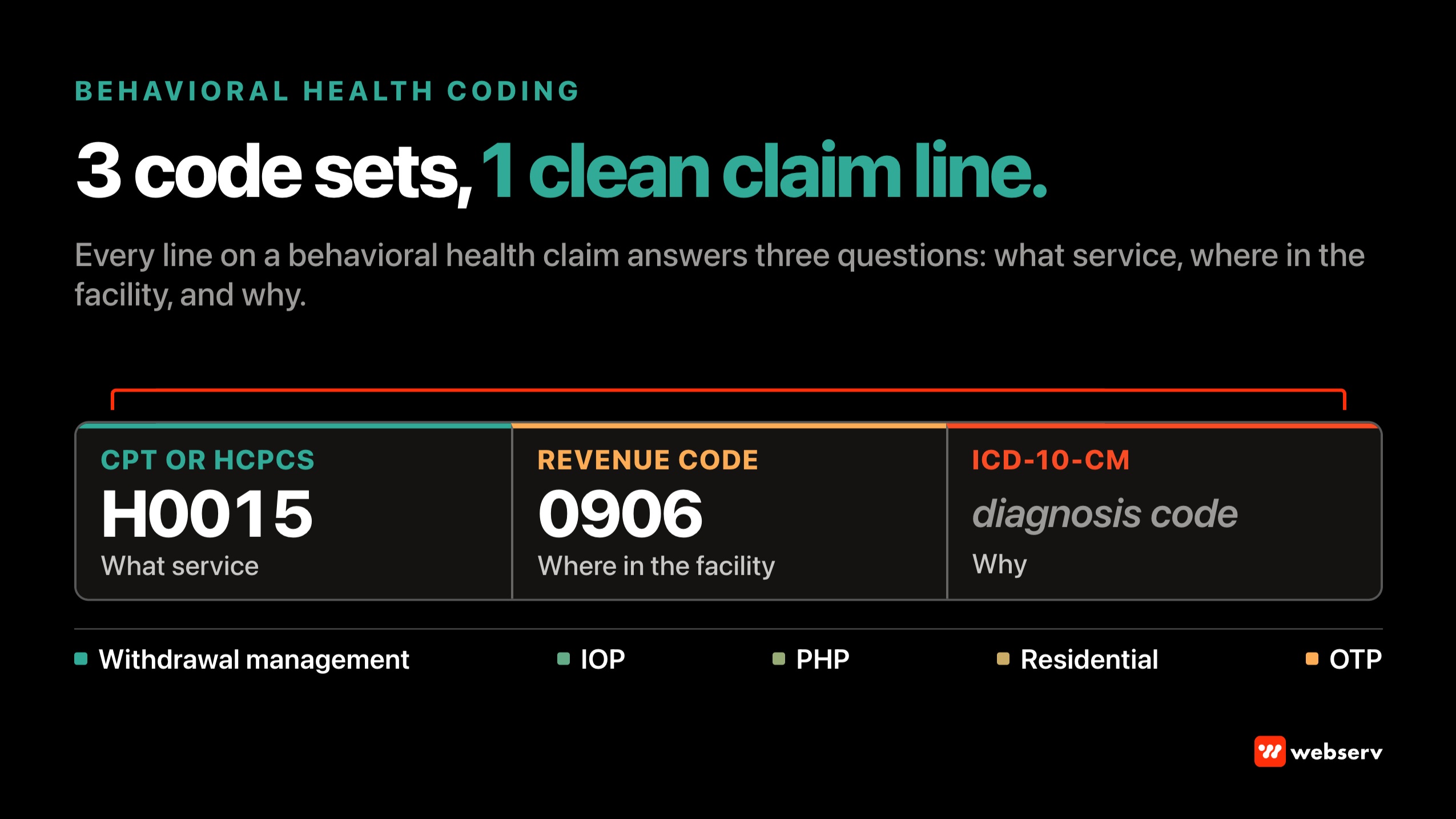
A single behavioral health claim can carry three different code systems at once: a CPT or HCPCS code for the service, a revenue code for where it happened, and an ICD-10 code for why. Get one of them wrong and the claim can deny, pay at the wrong rate, or pay and then come back in an audit.
For treatment centers the stakes are higher than in most specialties, because the same service can be billed several ways. Intensive outpatient can show up as a HCPCS per diem, a revenue code with a string of psychotherapy codes, or a state-specific code tied to an ASAM level, depending on the payer and the setting.
This guide explains the code sets treatment centers use, which codes map to which levels of care, how facility and professional claims differ, and where coding errors turn into denials. It’s the reference we work from in our billing and revenue cycle work for treatment centers.
It’s a reference, not billing advice. Payer contracts, state Medicaid manuals, and the current CMS code files decide what’s billable for your program, so confirm every code against them before you use it.
Key Takeaways
- Behavioral health claims draw on three code sets: CPT (maintained by the AMA and updated annually), HCPCS Level II (maintained by CMS and updated quarterly), and revenue codes on institutional claims.
- Psychotherapy CPT codes are time-based. Medicare contractor guidance maps 16 to 37 minutes to the 30-minute code, 38 to 52 minutes to the 45-minute code, and 53 minutes or more to the 60-minute code, and requires documented time.
- Levels of care usually bill through HCPCS Level II codes: H0015 or S9480 for intensive outpatient, H0035 or S0201 for partial hospitalization, H0018, H0019, H2034, or H2036 for residential, and H0010 through H0014 for withdrawal management, with state Medicaid programs often tying codes to ASAM levels.
- Facility claims pair revenue codes such as 0905, 0906, 0912, 0913, and 1002 with HCPCS or CPT codes. Medicare’s intensive outpatient benefit, which began January 1, 2024, also requires condition code 92.
- NCCI edits block some common combinations, such as billing a psychiatric diagnostic evaluation and psychotherapy for the same patient on the same date.
- The code your payer expects for a level of care should be confirmed during verification of benefits, not discovered after the claim denies.
The three code sets on a behavioral health claim
Each code set answers a different question about the claim.
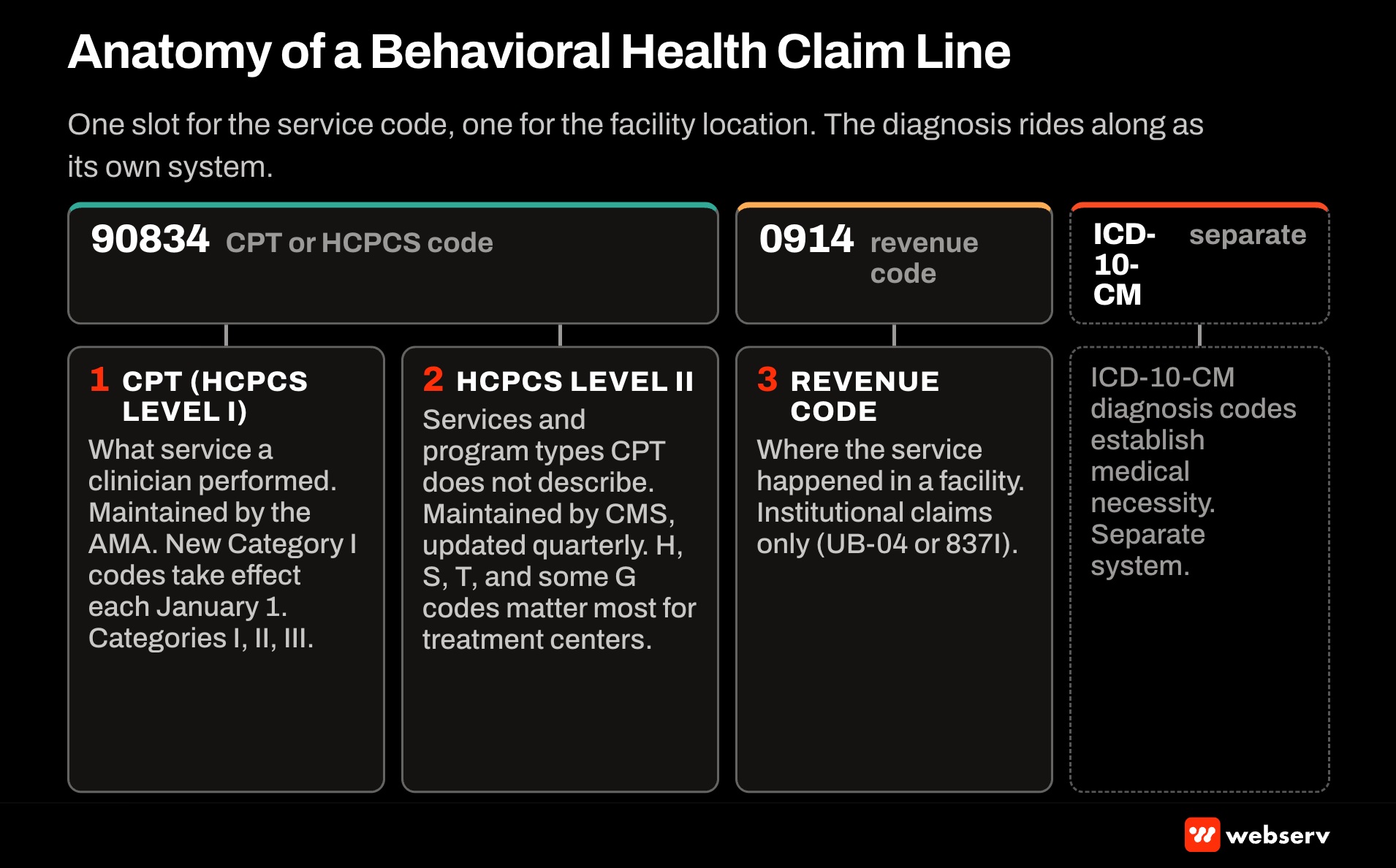
CPT: what service a clinician performed. CPT (Current Procedural Terminology) is maintained by the American Medical Association. The AMA’s CPT overview describes three categories: Category I for established services, Category II for performance measurement, and Category III for emerging technology. New Category I codes take effect each January 1.
HCPCS Level II: services and supplies CPT doesn’t cover. CMS maintains the HCPCS Level II code set and publishes updates quarterly. These are the alphanumeric codes, and for treatment centers the H codes (behavioral health and substance use services), S codes (temporary national codes used largely by commercial payers), T codes, and some G codes matter most.
Revenue codes: where the service happened in a facility. Revenue codes go on institutional claims (the UB-04 or 837I) and identify the department or type of accommodation, such as intensive outpatient, partial hospitalization, or residential treatment.
DEFINITION
HCPCS Level I and Level II. HCPCS has two levels. Level I is CPT, maintained by the AMA. Level II is the national alphanumeric set maintained by CMS, which covers services, supplies, and program types that CPT doesn’t describe, including most per diem behavioral health levels of care.
When someone says “HCPCS code” in a treatment center billing office, they almost always mean Level II. ICD-10-CM diagnosis codes sit alongside all of these and establish medical necessity, but they’re a separate system.
Professional claims and facility claims
Treatment centers often bill two ways at once, and the codes differ between them.
Professional claims (the CMS-1500 or 837P) bill a clinician’s services: psychiatric evaluations, individual and family psychotherapy, medication management. These rely mostly on CPT codes.
Institutional claims (the UB-04 or 837I) bill the facility’s program: a day of residential treatment, a day of partial hospitalization, an intensive outpatient day. These carry revenue codes, usually paired with HCPCS or CPT codes on each line.
Medicare’s intensive outpatient benefit shows how the pairing works. Noridian’s IOP billing guidance lists individual psychotherapy codes under revenue code 0914, group codes under 0915, family psychotherapy under 0916, and diagnostic evaluations under 0900.
Commercial payers and Medicaid programs set their own rules. Some want a single per diem HCPCS code with a revenue code, others want every service itemized. The payer contract or provider manual decides, which is why the billing format belongs in your payer setup, not in someone’s memory.
CPT codes for psychotherapy and evaluation
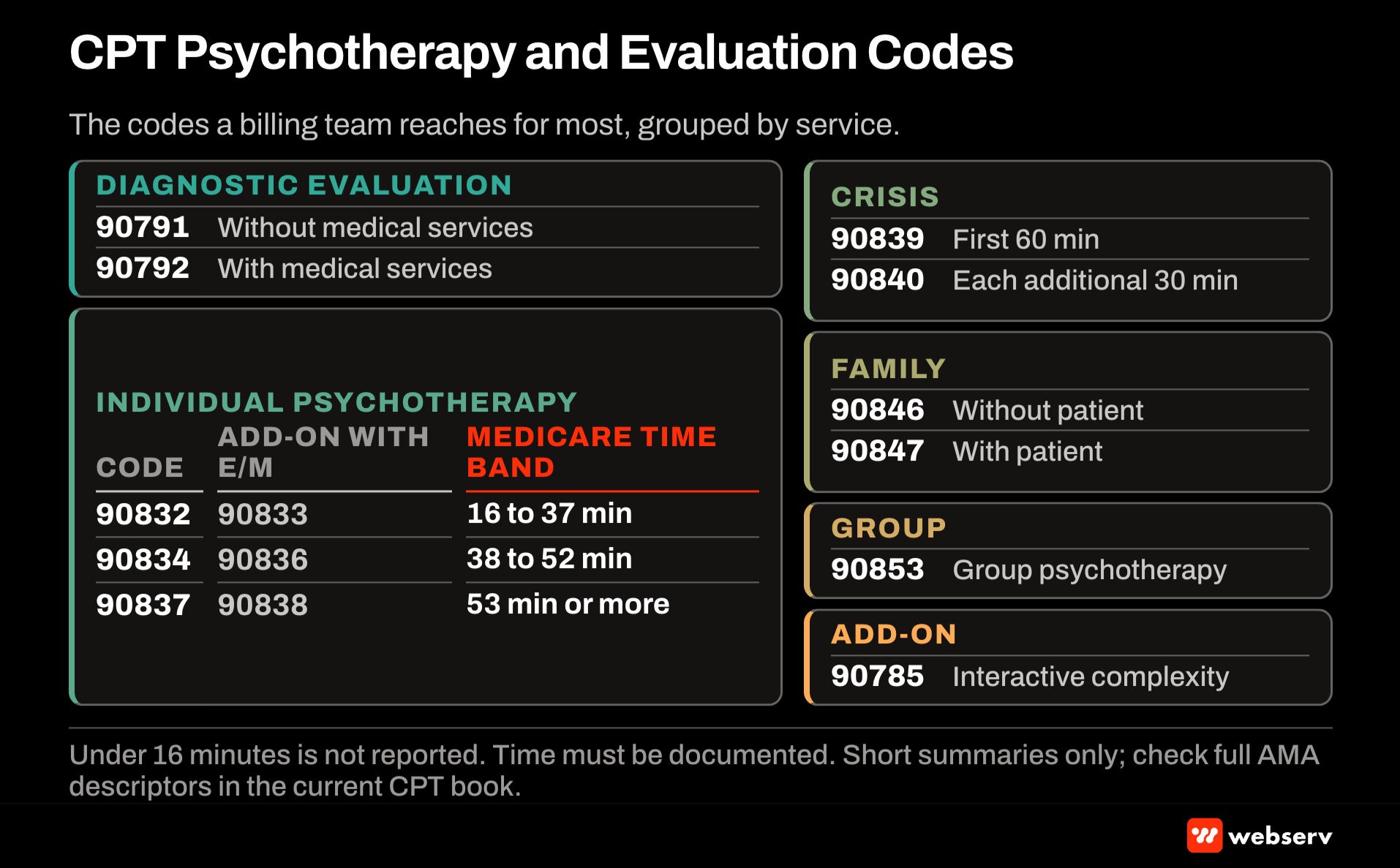
These are the CPT codes behavioral health clinicians bill most often. CPT descriptors are copyrighted by the AMA, so the descriptions below are short summaries; check the full descriptors in the current CPT code book.
Diagnostic evaluation
- 90791: psychiatric diagnostic evaluation without medical services.
- 90792: psychiatric diagnostic evaluation with medical services.
Individual psychotherapy
- 90832: psychotherapy, 30 minutes (90833 is the add-on version used with an E/M visit).
- 90834: psychotherapy, 45 minutes (add-on 90836).
- 90837: psychotherapy, 60 minutes (add-on 90838).
Crisis, family, group, and add-ons
- 90839 and 90840: psychotherapy for crisis, first 60 minutes and each additional 30 minutes.
- 90846 and 90847: family psychotherapy without and with the patient present.
- 90853: group psychotherapy (other than a multiple-family group).
- 90785: interactive complexity add-on, used with evaluation, psychotherapy, and group codes when communication factors complicate the service.
The time rule. First Coast’s Medicare billing article for psychiatric services says to choose the code closest to the actual time: 16 to 37 minutes for the 30-minute code, 38 to 52 minutes for the 45-minute code, and 53 minutes or more for the 60-minute code. Psychotherapy under 16 minutes isn’t reported, and time has to be documented.
Medicare psychotherapy time rule (First Coast LCD article A57520)
16-37 min
30-minute code (90832)
38-52 min
45-minute code (90834)
53+ min
60-minute code (90837)
That rule is where many audits start. A 60-minute code backed by a note with no start and stop time, or a total under 53 minutes, is an easy finding.
CMS also recognizes crisis psychotherapy in certain settings. Its crisis services page describes G0017 and G0018 for crisis psychotherapy furnished in non-office, non-facility settings, paid at 150% of the non-facility rate.
HCPCS Level II codes by level of care
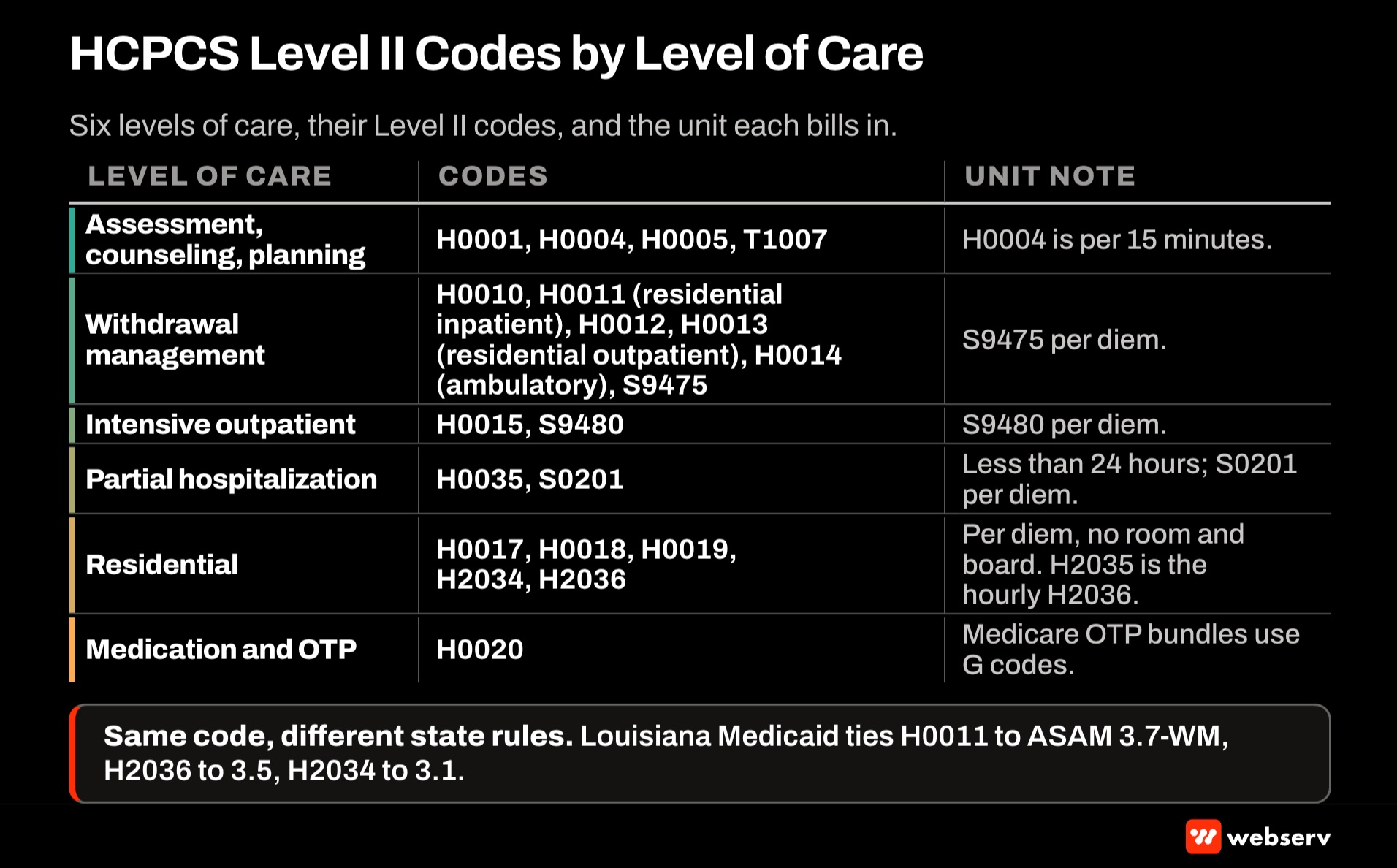
This is where most treatment center billing lives. The descriptions below summarize each code; confirm current descriptors in the CMS HCPCS file and your state Medicaid manual, which often add ASAM level requirements.
Assessment, counseling, and planning
- H0001: alcohol and/or drug assessment.
- H0004: behavioral health counseling and therapy, per 15 minutes.
- H0005: alcohol and/or drug group counseling by a clinician.
- T1007: alcohol and/or substance abuse treatment plan development or modification.
Withdrawal management
- H0010 and H0011: sub-acute and acute detoxification in a residential addiction program, inpatient.
- H0012 and H0013: sub-acute and acute detoxification in a residential addiction program, outpatient.
- H0014: ambulatory detoxification.
- S9475: ambulatory substance abuse treatment or detoxification, per diem.
Intensive outpatient and partial hospitalization
- H0015: alcohol and/or drug intensive outpatient treatment. Arizona’s Medicaid behavioral health services guide describes it as at least three hours a day, at least three days a week, under an individualized plan.
- S9480: intensive outpatient psychiatric services, per diem.
- H0035: mental health partial hospitalization, less than 24 hours.
- S0201: partial hospitalization services, less than 24 hours, per diem.
Residential
- H0017: behavioral health residential in a hospital residential treatment program, without room and board, per diem.
- H0018: behavioral health short-term residential in a non-hospital program, without room and board, per diem.
- H0019: behavioral health long-term residential, typically stays over 30 days, without room and board, per diem.
- H2034: alcohol and/or drug halfway house services, per diem.
- H2036: alcohol and/or other drug treatment program, per diem (H2035 is the per-hour version).
Medication and opioid treatment
- H0020: methadone administration and/or service by a licensed program.
- Medicare’s opioid treatment program bundles use G codes, covered below.
How states attach ASAM levels. Louisiana’s Medicaid SUD billing bulletin is a good example: it ties H0011 to ASAM Level 3.7-WM, H2036 to Level 3.5, and H2034 to Level 3.1. Other states use different pairings and modifiers, so the same code can mean a different level of care in a different state.
COMMON MISTAKE
Billing the national descriptor without the state rule. For example, a facility licensed in two states bills H2036 the same way in both, and one state’s Medicaid plan rejects it because that state requires a level-of-care modifier or a different code for the same program.
Before billing any Medicaid program, pull the state’s current SUD or behavioral health billing manual and map each program to the code, modifier, and unit that state expects.
Revenue codes for behavioral health facilities
Revenue codes identify the type of service or accommodation on institutional claims. The list below uses the labels in Noridian’s Medicare revenue code reference.
Outpatient programs
- 0905: intensive outpatient services, psychiatric.
- 0906: intensive outpatient services, chemical dependency.
- 0912: partial hospitalization, less intensive.
- 0913: partial hospitalization, intensive.
Therapy and treatment lines
- 0914: individual therapy.
- 0915: group therapy.
- 0916: family therapy.
- 0918: testing.
- 0919: behavioral health treatments.
- 0944 and 0945: drug rehabilitation and alcohol rehabilitation.
Residential and room and board
- 1001: residential treatment, psychiatric.
- 1002: residential treatment, chemical dependency.
- 0116 and 0126: room and board for detoxification, private and semi-private.
Residential codes such as H0017, H0018, and H0019 are defined as “without room and board,” so room and board is either billed separately, bundled into the contract rate, or not covered. The payer contract settles which, and it’s worth confirming before the first claim.
How a Tennessee treatment center tripled its paid media close rate and cut missed calls to 1%
Full CRM configuration, system integrations, and call tracking metrics unified a fragmented admissions process into a single high-converting workflow in two months.
Read the case study →Up from 17% — missed calls cut from 15% to 1%
Medicare’s intensive outpatient benefit and OTP bundles
Two Medicare changes matter for treatment centers that bill Medicare or follow its rules.
Intensive outpatient (since January 1, 2024). CMS created a Medicare IOP benefit under section 4124 of the Consolidated Appropriations Act, 2023. CMS’s MLN Matters article MM13222 requires condition code 92 on IOP claims.
CMS’s Medicare mental health coverage booklet lists hospital outpatient departments, critical access hospitals, community mental health centers, FQHCs, rural health clinics, and opioid treatment programs among the settings, with a physician certifying the need for at least nine hours of services a week. Hospitals and CMHCs are paid a per diem under OPPS.
Opioid treatment program bundles. Medicare pays OTPs through weekly bundles described on CMS’s OTP billing page and in Chapter 39 of the claims processing manual:
- G2067: methadone weekly bundle.
- G2068 and G2069: oral and injectable buprenorphine bundles.
- G2073: naltrexone bundle.
- G2074 and G2075: non-drug bundle and medication not otherwise specified.
- G2076 through G2080: add-ons for intake, periodic assessment, take-home methadone, take-home buprenorphine, and additional counseling.
- G0137: OTP intensive outpatient services, which requires at least nine services over seven days.
Chapter 39 was revised effective January 1, 2026, adding codes including G0533 and G0534 through G0536 for coordinated care and referral, patient navigation, and peer recovery support. If you run an OTP, rebuild your charge master against the current chapter.
Edits that block common code combinations
CMS’s National Correct Coding Initiative (NCCI) edits stop certain codes from being billed together. The NCCI program page links the Medicare and Medicaid edit files and policy manuals.
Chapter 11 of the Medicare NCCI policy manual covers mental health services, and two of its rules come up constantly in treatment centers:
- A psychiatric diagnostic evaluation (90791 or 90792) can’t be reported with individual, group, family, or crisis psychotherapy for the same patient on the same date.
- Family psychotherapy (90846 or 90847) can be reported with individual psychotherapy only when it’s a separate service in a separate time interval.
Medically unlikely edits (MUEs) also cap units per day for many codes. Build both edit types into your claim scrubber rather than relying on coders to remember them.
How codes connect to reimbursement
Codes don’t just describe services. They’re how payer contracts set prices, so the code on the claim decides which rate applies.
Commercial contracts often price levels of care as per diems tied to specific codes.
The same program can be worth very different amounts depending on the code and revenue code combination the contract recognizes. That’s why a verification of benefits should confirm which codes the payer expects for the level of care, not just whether the plan covers it, and why some levels of care also need prior authorization under specific codes. Our guide to verification of benefits versus pre-authorization covers where each step fits.
Our pre-admission eligibility verification playbook covers the verification side, and our guide to reimbursement intelligence covers how to estimate what a level of care will actually pay before admission.
For out-of-network programs, the code also determines which allowed amount the payer’s methodology applies. Our out-of-network reimbursement math walks through that calculation.
OPERATOR INSIGHT
Some of the most expensive coding problems aren’t miscodes at all. They’re programs that were set up once, years ago, with a code the payer no longer expects, and nobody checked again.
Once a year, pull your top payers’ current provider manuals and reconcile each level of care against the code, revenue code, modifier, and unit you actually bill. It’s a small project compared with working the denials a stale setup produces.
Coding errors that lead to denials
Most behavioral health coding denials trace back to a short list of mistakes:
- Unit mismatches. Billing a per diem code in 15-minute units, or a per-15-minute code like H0004 as a single session.
- Missing time documentation for time-based psychotherapy codes.
- Same-day conflicts caught by NCCI, such as a diagnostic evaluation and psychotherapy on the same date.
- Revenue code and HCPCS pairs that don’t match the payer’s expected combination for the level of care.
- State-specific requirements ignored, such as ASAM-level modifiers or state-defined codes.
- Room and board billed on a code defined as “without room and board,” or not billed when the contract allows it.
- Outdated codes after an annual CPT or quarterly HCPCS update, or after a change like Medicare’s 2026 OTP revisions.
Our denial management playbook covers how to work the denials that do come back, and our revenue cycle KPIs guide covers how to spot coding-driven denial trends early.
What changed for 2026
Two updates are worth checking against your billing setup this year.
CPT 2026. The AMA’s CPT 2026 announcement lists 288 new codes, 84 deletions, and 46 revisions. The behavioral health change it highlights is the addition of existing behavioral health codes to the appendices that identify services eligible for audio-video or audio-only delivery.
Medicare OTP codes. As noted above, CMS revised the OTP chapter effective January 1, 2026, adding new bundle and support-service codes.
HCPCS Level II also changes every quarter. Put the January, April, July, and October CMS updates on the billing team’s calendar and review them for any code you bill.
Putting it into practice
Start with a code map: every program you run, by payer, with the code, revenue code, modifier, unit, and documentation requirement each payer expects. That single document is what keeps admissions, clinical, and billing working from the same rules.
Then build the NCCI and unit rules into your claim scrubber, confirm codes during verification of benefits, and reconcile the map against payer manuals once a year. For how billing fits the wider business, see our behavioral health marketing guide.
If you want a second set of eyes on how your programs are coded, book an intro meeting and we’ll walk through it with you.
Most in-house teams hit a wall not because they lack knowledge, but because they lack bandwidth.
When you are ready to hand it off, Webserv has spent 9 years executing exactly this for treatment centers nationwide.
Frequently Asked Questions
What’s the difference between CPT and HCPCS codes?
CPT codes, maintained by the AMA, describe services clinicians perform, such as psychotherapy and psychiatric evaluations. HCPCS Level II codes, maintained by CMS, cover services and program types CPT doesn’t, including most behavioral health per diem levels of care like intensive outpatient, partial hospitalization, and residential treatment.
Technically, CPT is HCPCS Level I, so both belong to the same system. In practice, “HCPCS” in a treatment center usually means the Level II alphanumeric codes.
Most treatment centers use both: CPT for clinician services on professional claims, and HCPCS Level II, often with revenue codes, for facility programs.
Which code should we use for intensive outpatient treatment?
It depends on the payer and setting. Common options include H0015 for alcohol and drug intensive outpatient, S9480 for psychiatric intensive outpatient per diem, and revenue codes 0905 or 0906 on facility claims. Medicare’s IOP benefit uses revenue codes with itemized CPT and HCPCS lines and requires condition code 92.
State Medicaid programs may require specific codes, modifiers, or ASAM-level designations for the same program.
Confirm the expected format with each payer during contracting and verification of benefits. The wrong format is one of the most common reasons IOP claims deny.
Can we bill a diagnostic evaluation and therapy on the same day?
Under Medicare’s NCCI policy, a psychiatric diagnostic evaluation (90791 or 90792) can’t be reported with individual, group, family, or crisis psychotherapy for the same patient on the same date. Many commercial payers and Medicaid programs apply similar edits.
Schedule and bill the evaluation and the first psychotherapy session on separate dates, or confirm the payer’s policy in writing if you believe an exception applies.
Build the edit into your claim scrubber so it catches the conflict before submission rather than after denial.
Why do residential codes say “without room and board”?
Codes such as H0017, H0018, and H0019 describe the treatment service itself, and their descriptors exclude room and board. Payers handle room and board differently: some bundle it into the contract rate, some allow separate billing, and some don’t cover it.
Revenue codes 0116 and 0126 exist for detoxification room and board, but whether you can use them depends on the payer.
Read the room and board terms in each contract before the first residential admission, because it’s a common source of both underbilling and denials.
How often do these codes change?
CPT updates annually, with new Category I codes effective January 1. HCPCS Level II updates quarterly, in January, April, July, and October. Medicare program rules, like the 2024 IOP benefit and the 2026 OTP revisions, change on their own schedule.
State Medicaid manuals and payer provider manuals also change during the year, sometimes without much notice.
Assign someone to review CMS updates each quarter and your top payers’ manuals at least annually, and update your code map when anything changes.
Kyle McHenry is the founder of Revenue Logic, a behavioral health revenue cycle management firm. He has spent 15 years working with treatment center operators on verification, utilization review, and claims management. Webserv partners with Revenue Logic to surface RCM-side guidance for treatment center marketing teams.