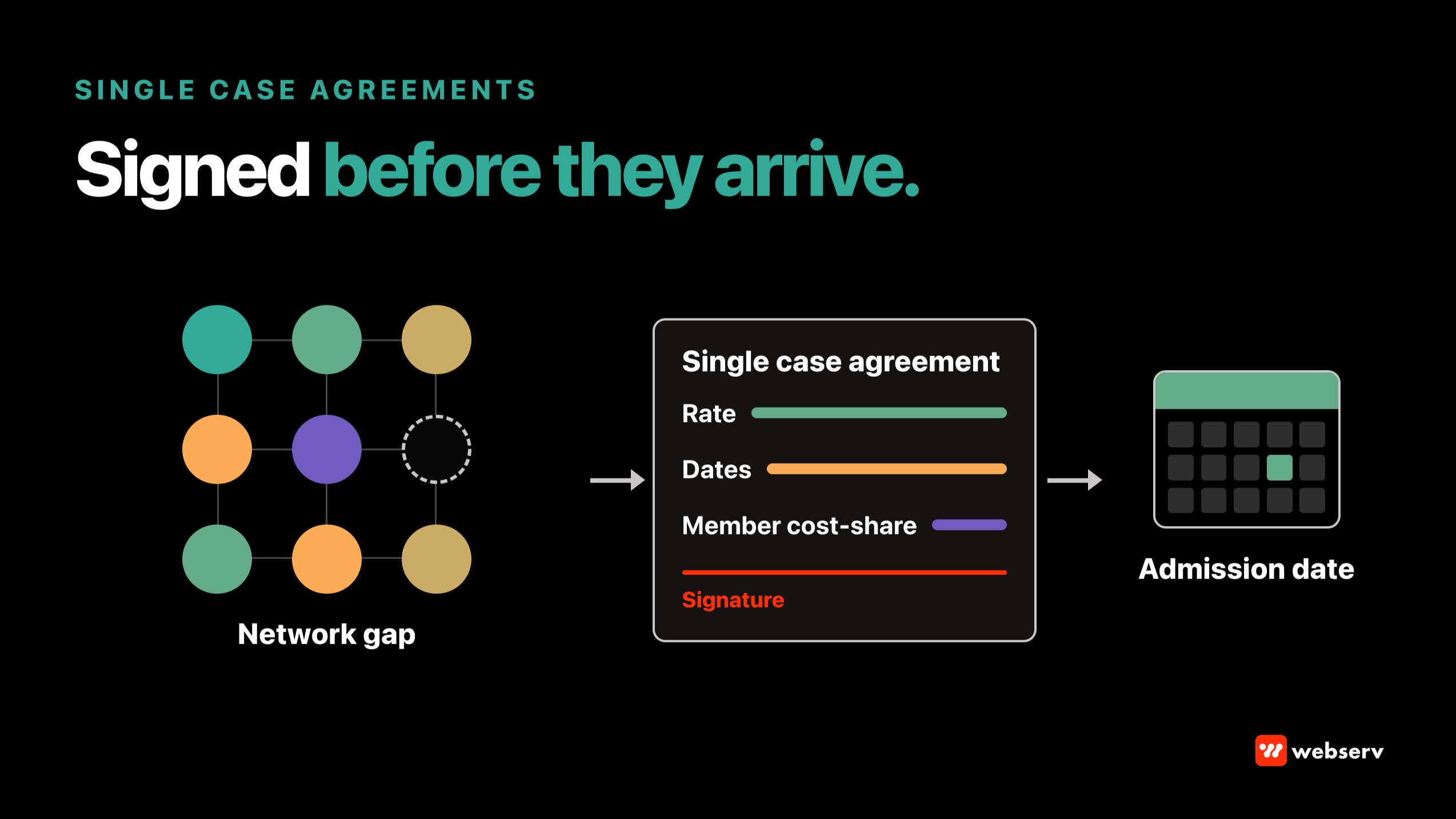
Carelon Behavioral Health’s out-of-network policy describes single case agreements as tools for when it has no network or cannot meet a member’s clinical or service needs. The same policy says they are not to be used when adequate network providers are available.
That one distinction explains most of what goes right and wrong with single case agreements. A single case agreement is a network-gap tool. It isn’t a way to turn an out-of-network admission into a better rate because the facility asked.
For out-of-network treatment centers, an agreement negotiated before admission can settle the rate, the covered dates, and what the family pays. This guide covers what single case agreements are, when payers grant them, the laws behind network gaps, where they fit in the admissions sequence, and what the agreement should say.
It picks up after the admit decision covered in should you admit a patient with an unknown rate, and it’s part of the admissions and billing work our revenue cycle team for treatment centers supports.
Key Takeaways
- A single case agreement is a one-patient contract between a payer and an out-of-network provider, used when the payer’s network can’t meet the member’s needs within its access standards.
- Payers use different names: Carelon calls it a single case agreement, Cigna a network adequacy provision, and UnitedHealthcare a network gap exception. Each requires medical necessity review.
- California and New York require fully insured plans to arrange out-of-network care at in-network cost-sharing when their networks fall short, and California’s regulation requires written authorization with the negotiated rate and date range.
- Self-funded employer plans aren’t subject to state insurance laws, according to the Department of Labor. Identify the plan type before relying on a state rule.
- Get clinical authorization and a signed agreement before admission. Carelon’s policy loads standard out-of-network rates when an agreement isn’t signed.
- Routine copay waivers, referral payments, and missing good faith estimates for self-pay patients are separate compliance risks that single case agreements don’t solve.
What a single case agreement is
Start with the term itself, since payers don’t all use it.
DEFINITION
Single case agreement. A contract between a payer, or its behavioral health manager, and an out-of-network provider covering one member’s course of treatment. It sets the rate, covered services and dates, and usually limits the member’s cost to in-network levels. It exists because the payer’s own network couldn’t provide the care the member needs.
Payers describe the same idea in different terms. Carelon’s out-of-network reimbursement and SCA policy calls it an agreement between Carelon and an out-of-network provider. Cigna’s network adequacy provision describes authorizing a nonparticipating professional at the in-network level of benefits.
UnitedHealthcare’s commercial network gap exception form applies when there aren’t enough professionals in an area or specialty. Aetna’s behavioral health provider manual describes nonparticipating referral requests that Aetna reviews.
Carelon’s policy adds a detail that matters for treatment centers: single case agreements can apply whether or not the member has out-of-network benefits. For a plan with no out-of-network coverage, an agreement can be the only path to payment.
When a payer will consider one
The criteria vary by payer, but the published policies share a pattern.
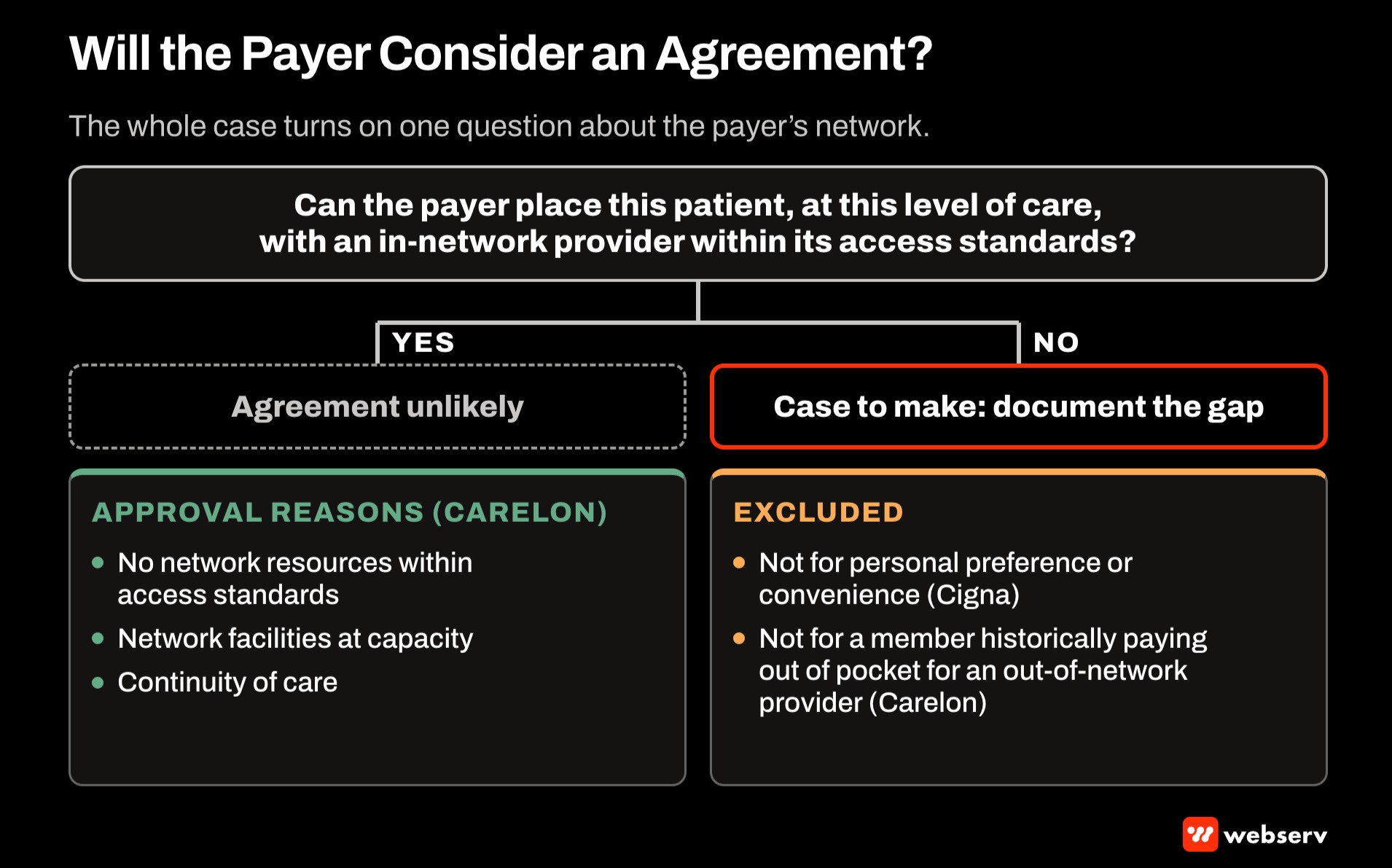
Carelon’s policy lists approval reasons that include no network resources within access standards of the member’s residence, network facilities at capacity, and continuity of care. Cigna’s provision says requests must not be based on personal preference or convenience, and that they’re subject to medical necessity review.
Carelon also names a case it excludes: a member who has historically been paying out of pocket to see an out-of-network provider. Choosing an out-of-network facility and then asking the payer to treat it as in-network isn’t a network gap.
The practical test for admissions: can the payer place this patient, at this level of care, with an in-network provider within its access standards? If the answer is yes, a single case agreement is unlikely. If the answer is no, the facility has a case to make, and the documentation should show why.
The laws behind network gaps
Payers don’t grant single case agreements only out of goodwill. In some plan types, laws require them to arrange out-of-network care when their networks fall short.
| Plan type | Rule | What it requires | Reaches self-funded plans? |
|---|---|---|---|
| Marketplace (QHP) | 45 CFR 156.230; CMS 2025 letter to issuers | Networks must include mental health and SUD providers; 10-business-day behavioral health appointment standard on the federally facilitated exchange (CMS guidance) | No, qualified health plans only |
| California, fully insured | HSC 1374.72; 28 CCR 1300.74.72 | Arrange medically necessary out-of-network MH/SUD care at no more than in-network cost-sharing; written authorization stating the rate and date range | No |
| New York, fully insured | Ins. Law 4804; DFS access standards | Refer to an out-of-network provider at no added cost when the network lacks one; access standards cover outpatient services | No |
| Texas PPO | Ins. Code 1301.005 | Reimburse a non-preferred provider at the in-network percentage when the service isn’t available in network | No |
| Self-funded ERISA | DOL Technical Release 2014-01 | Not subject to state health insurance laws | Not applicable |
Marketplace plans. Federal rules at 45 CFR 156.230 require qualified health plan networks to include providers specializing in mental health and substance use disorder services. CMS’s 2025 letter to issuers sets a 10-business-day appointment wait time standard for behavioral health on the federally facilitated exchange.
California. Health and Safety Code section 1374.72 requires a plan that can’t provide mental health or substance use disorder services in network within access standards to arrange medically necessary out-of-network services, at no more than in-network cost-sharing.
The implementing regulation, 28 CCR 1300.74.72, requires the plan’s written authorization to the out-of-network provider to state the negotiated reimbursement rate and date range. In practice, that’s a single case agreement written into regulation.
New York. Insurance Law section 4804 requires insurers to refer members to an appropriate out-of-network provider at no added cost when the network lacks one. New York’s behavioral health access standards, per the DFS FAQ, apply to outpatient services, and DFS says insurers aren’t yet required to include residential sub-acute facilities in their networks.
Texas. Insurance Code section 1301.005 requires a preferred provider plan to reimburse a non-preferred provider at the in-network percentage when a covered service isn’t available from a preferred provider.
Parity. The 2024 mental health parity rule added network composition data requirements, but the Departments announced in May 2025 that they won’t enforce the rule’s new provisions while litigation is pending, plus 18 months. The statutory parity obligations still apply.
COMMON MISTAKE
Citing state law to a self-funded plan. The Department of Labor’s Technical Release 2014-01 says self-insured private employer plans aren’t subject to state health insurance laws. California’s and New York’s network rules reach fully insured plans, not self-funded ones.
A plan with a major carrier’s name on the card may still be self-funded. Confirm the funding type during verification, because it decides which rules the request can rely on.
Where single case agreements fit in the admissions sequence
A single case agreement comes after verification and before admission. Skipping steps is where the risk sits.
Verify coverage and network status
Confirm active coverage, benefits, and whether the facility is in network. Our guides to pre-admission eligibility verification and VOB vs pre-authorization cover these steps.
Identify the plan type and manager
Note whether the plan is fully insured or self-funded, and whether behavioral health is carved out to a separate manager.
Decide whether to pursue admission
Weigh the expected rate against the program’s cost and the patient’s clinical needs, as covered in the unknown-rate framework.
Get clinical authorization
Carelon drafts an agreement only after the request is authorized as medically necessary, and UnitedHealthcare requires a prior authorization case before its gap exception form.
Request the agreement
Document the network gap: which in-network facilities were checked, at what level of care, and why none could admit within access standards.
Get it in writing and signed
Confirm the rate, dates, and services before the admission date.
Evernorth’s behavioral health administrative guidelines note that prior authorization is not a guarantee of payment. A signed agreement reduces the uncertainty, but claims still have to match what was authorized.
What the agreement should say
A single case agreement is only as useful as its terms. Before the patient arrives, the written agreement should cover:
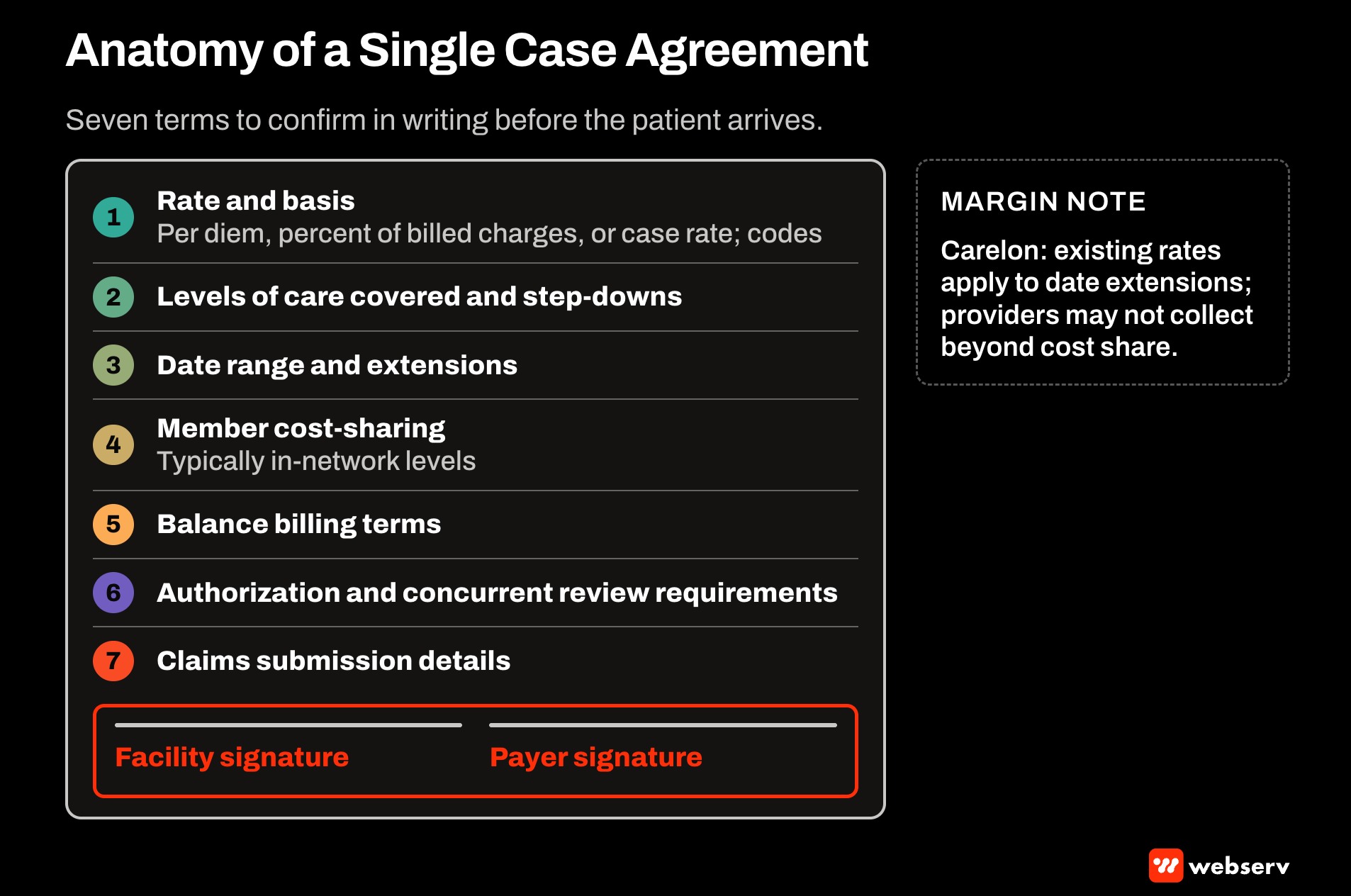
- The rate and its basis: per diem, percentage of billed charges, or a case rate, and for which revenue and procedure codes.
- The levels of care covered, such as detox, residential, and PHP, and whether step-downs are included.
- The date range, and how extensions work. Carelon’s provider guide says existing reimbursement rates apply to date extensions.
- The member’s cost-sharing, typically limited to in-network levels.
- Balance billing terms. Carelon’s guide says providers shall not seek or accept payment from the member beyond cost share.
- Authorization and concurrent review requirements that still apply during the stay.
- Claims submission details, including where and how to bill.
OPERATOR INSIGHT
Treat the signature as the gate, not the phone call. Carelon’s policy sends agreements electronically with follow-ups, and when an agreement isn’t signed, standard out-of-network rates load.
A rate agreed verbally on a call and never countersigned isn’t the rate the claim will pay. Keep the signed agreement attached to the patient’s record, with the authorization numbers.
Compliance lines single case agreements don’t move
Single case agreements settle payment terms. They don’t change several rules that apply to out-of-network admissions.
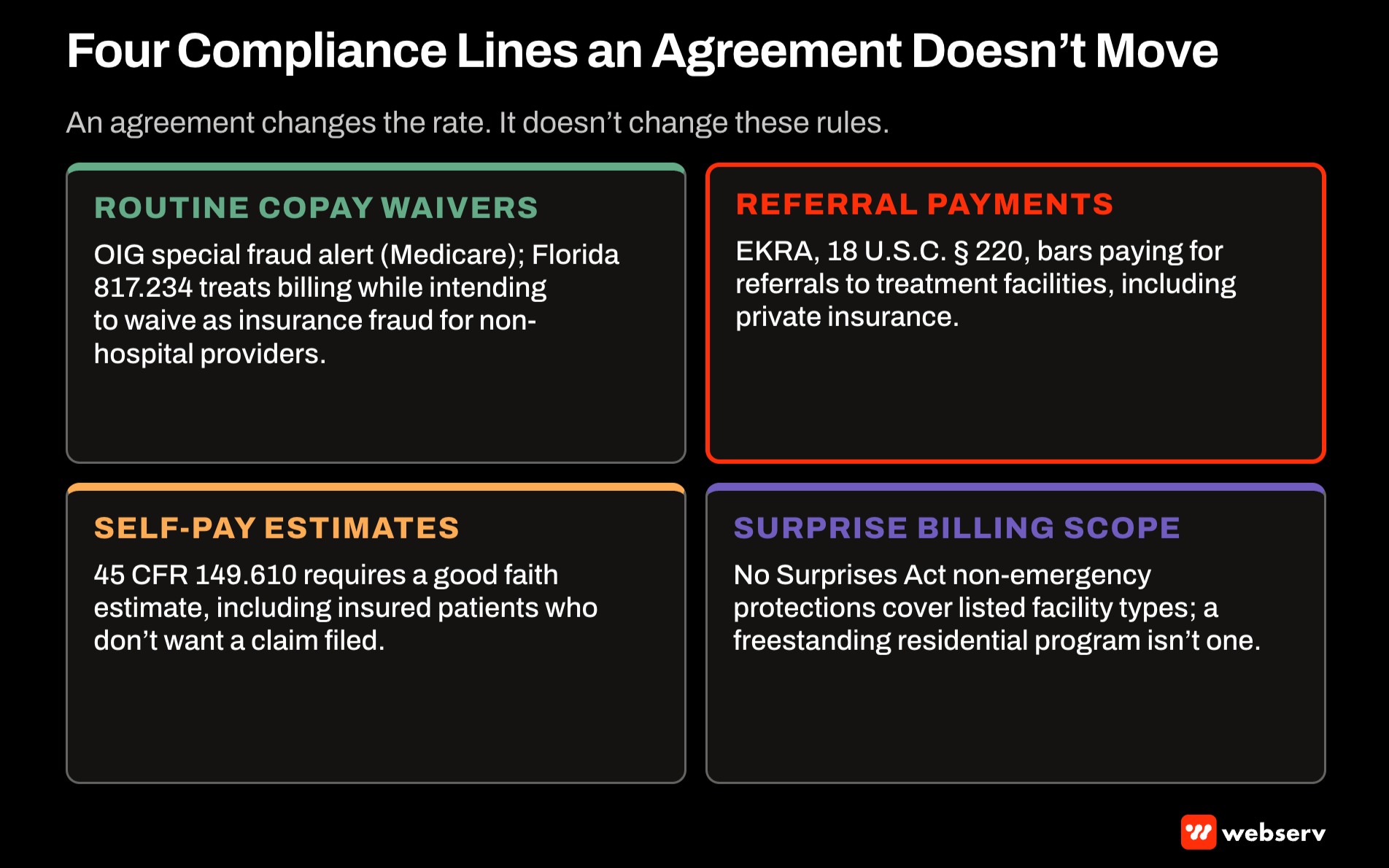
Routine copay waivers. The HHS OIG’s special fraud alert on routine waivers of copayments and deductibles addresses Medicare, and some states apply similar rules to private insurance. Florida’s section 817.234 treats billing while intending to waive deductibles or copayments as insurance fraud for non-hospital providers.
Referral payments. The Eliminating Kickbacks in Recovery Act, 18 U.S.C. § 220, bars paying or receiving remuneration for referrals to clinical treatment facilities, and it reaches private insurance. A network gap doesn’t make paying for referrals acceptable.
Self-pay estimates. When a family chooses to pay privately rather than use insurance, federal rules at 45 CFR 149.610 require a good faith estimate. The definition of self-pay includes insured patients who don’t want a claim submitted.
Surprise billing scope. The No Surprises Act’s non-emergency protections apply to out-of-network providers at participating health care facilities, which 45 CFR 149.30 defines as hospitals, hospital outpatient departments, critical access hospitals, and ambulatory surgical centers. A freestanding residential program isn’t on that list, which makes clear written terms with the family more important, not less.
A pre-admission checklist
1. Confirm plan type, fully insured or self-funded, and the behavioral health manager.
2. Check the network at the needed level of care, and record which in-network options were contacted and their availability.
3. Obtain clinical authorization for the level of care.
4. Request the agreement with documentation of the network gap and the clinical need.
5. Review the terms: rate, codes, levels of care, dates, extensions, cost-sharing, balance billing.
6. Get the countersigned agreement before admission, and file it with the authorization.
7. Explain the family’s cost in writing, at the cost-sharing level the agreement sets.
For the math behind out-of-network rates, see our guide to out-of-network reimbursement for treatment centers. For the broader reimbursement picture, see the complete guide to reimbursement intelligence.
Single case agreements are one answer to the reimbursement gap between VOB and admit. For how admissions and billing fit the rest of your marketing, see the complete guide to behavioral health marketing. If you want a second look at how your team handles out-of-network admissions, book an intro meeting.
Frequently Asked Questions
What is a single case agreement in behavioral health?
It’s a contract between a payer, or its behavioral health manager, and an out-of-network provider for one member’s treatment. It sets the rate, the covered services and dates, and usually limits the member’s cost to in-network levels.
Payers use it when their own network can’t meet the member’s needs within access standards.
Names vary: Carelon says single case agreement, Cigna network adequacy provision, and UnitedHealthcare network gap exception.
Can a treatment center get a single case agreement if the plan has no out-of-network benefits?
Sometimes. Carelon’s policy says single case agreements can apply whether or not the member has out-of-network benefits, when its network can’t meet the member’s needs.
The request still needs medical necessity approval and documentation that no in-network option was available within access standards.
Other payers set their own criteria, so check the payer’s policy before requesting one.
Do state network adequacy laws apply to every plan?
No. The Department of Labor says self-insured private employer plans aren’t subject to state health insurance laws.
State rules like California’s and New York’s reach fully insured plans. Marketplace plans have federal network adequacy standards.
Confirm whether a plan is fully insured or self-funded during verification.
When should a single case agreement be signed?
Before admission. Carelon’s policy says that when an agreement isn’t signed, standard out-of-network rates apply.
Get clinical authorization first, then the written, countersigned agreement with the rate, dates, and covered services.
Keep it with the patient’s record and authorization numbers so billing matches the terms.
Can we waive the patient’s copay under a single case agreement?
A single case agreement typically sets the member’s cost-sharing; it doesn’t authorize waiving it.
The HHS OIG warns against routine copay waivers in Medicare, and Florida treats billing while intending to waive copays or deductibles as insurance fraud for non-hospital providers.
Collect cost-sharing as the agreement sets it, and have counsel review any financial hardship policy.
Kyle McHenry is the founder of Revenue Logic, a behavioral health revenue cycle management firm. He has spent 15 years working with treatment center operators on verification, utilization review, and claims management. Webserv partners with Revenue Logic to surface RCM-side guidance for treatment center marketing teams.