Denial management is the specific revenue cycle discipline that determines whether treatment center admissions convert into collected revenue at rates that support facility economics or leak revenue through denials that never get appealed or that get appealed too late. It lives inside our eligibility and reimbursement capability.
Facilities with strong denial management processes recover a large share of billed revenue on claims that initially face denial. Facilities without denial management processes leave much of that revenue uncollected.
The eligibility and reimbursement capability at Webserv operates on the specific pattern that denial management runs alongside the pre-admission and admission workflows, not after them. Denial patterns get detected during pre-authorization submission and clinical documentation review, before they escalate to full claim denial.
The pattern I see across treatment center billing operations: denials get treated as a downstream problem the billing team solves through appeals rather than as an upstream problem the clinical and admissions teams prevent through documentation quality.
The specific downstream cost: facilities with strong appeals processes still collect meaningfully less than facilities with strong prevention processes because appeals produce partial collections at best while prevention produces full collections.
This piece walks the denial management playbook for behavioral health treatment centers. The specific denial categories that produce most BH revenue leakage, the prevention framework that reduces initial denial rates, and the appeal workflow that recovers denials the prevention layer misses.
It also covers the specific timing standards that separate collectible appeals from time-barred appeals, the concurrent review coordination that prevents mid-stay denials, and the measurement patterns that isolate denial management performance from other revenue cycle variables. Related workflow pieces: our revenue cycle management guide, pre-admission eligibility verification playbook, VOB vs pre-authorization guide, OON reimbursement math, and the downstream reimbursement intelligence hub. Broader context in our ultimate guide to behavioral health marketing.
Key Takeaways
- Denial management determines how much of each admission converts to collected revenue. The gap between strong and weak denial management compounds over annual admit volume into meaningful facility economics differences.
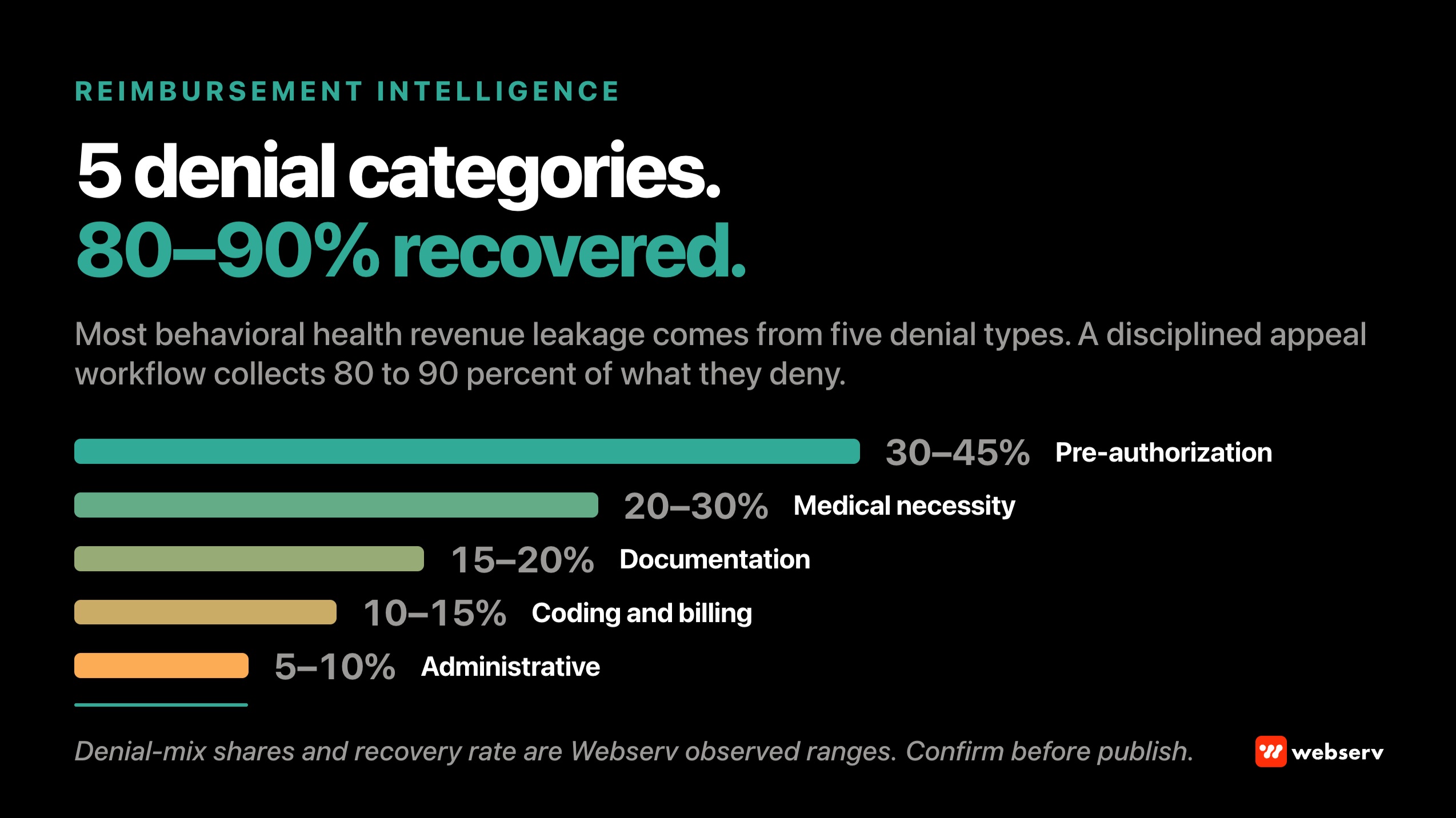
- The five denial categories that produce most BH revenue leakage: pre-authorization denials, medical necessity denials at concurrent review, documentation-insufficient denials, coding and billing denials, and administrative denials. Pull your own denial reason codes to see your mix.
- The prevention framework reduces initial denial rates through clinical documentation quality, pre-authorization workflow discipline, concurrent review coordination, and specific coding accuracy. Prevention is meaningfully cheaper than appeals workflow that recovers denied claims.
- The appeal workflow recovers a meaningful share of initial denials, depending on payer, denial category, and appeal quality. Appeal timing standards vary by payer contract and plan type, with some payers requiring specific appeal formats and clinical documentation packages.
- Concurrent review coordination during treatment stay prevents mid-stay denials that force early discharge or length-of-stay reduction. Facilities with weak concurrent review see more admissions hit with mid-stay LOS reduction denials.
DEFINITION
Denial management for behavioral health treatment centers. The revenue cycle discipline that converts payer resistance into collected revenue. Runs on prevention (clinical documentation quality, pre-authorization workflow discipline, concurrent review coordination, coding QA) that reduces initial denial rates, an appeal workflow that recovers the denials that still land, and a measurement layer (initial denial rate, appeal overturn rate, collection rate on initially-denied claims, days to appeal submission, denial category distribution) that isolates denial management from other revenue cycle variables.
Distinct from general accounts receivable management (which handles collectible-but-slow claims, not disputed ones), distinct from pre-admission eligibility verification (which prevents coverage-based denials before treatment), and distinct from claim scrubbing (which catches format errors, not clinical or medical-necessity denials).
OPERATOR INSIGHT
Denials get treated as a downstream problem the billing team solves through appeals rather than as an upstream problem the clinical and admissions teams prevent through documentation quality.
The specific downstream cost: facilities with strong appeals processes still collect meaningfully less than facilities with strong prevention processes, because appeals produce partial collections at best while prevention produces full collections. Denial management runs alongside the pre-admission and admission workflows, not after them — denial patterns get detected during pre-authorization submission and clinical documentation review, before they escalate to full claim denial.
The five denial categories that produce most BH revenue leakage
Five specific denial categories account for most of the revenue leakage we audit across treatment center billing operations. Each category has specific root causes and specific prevention patterns.
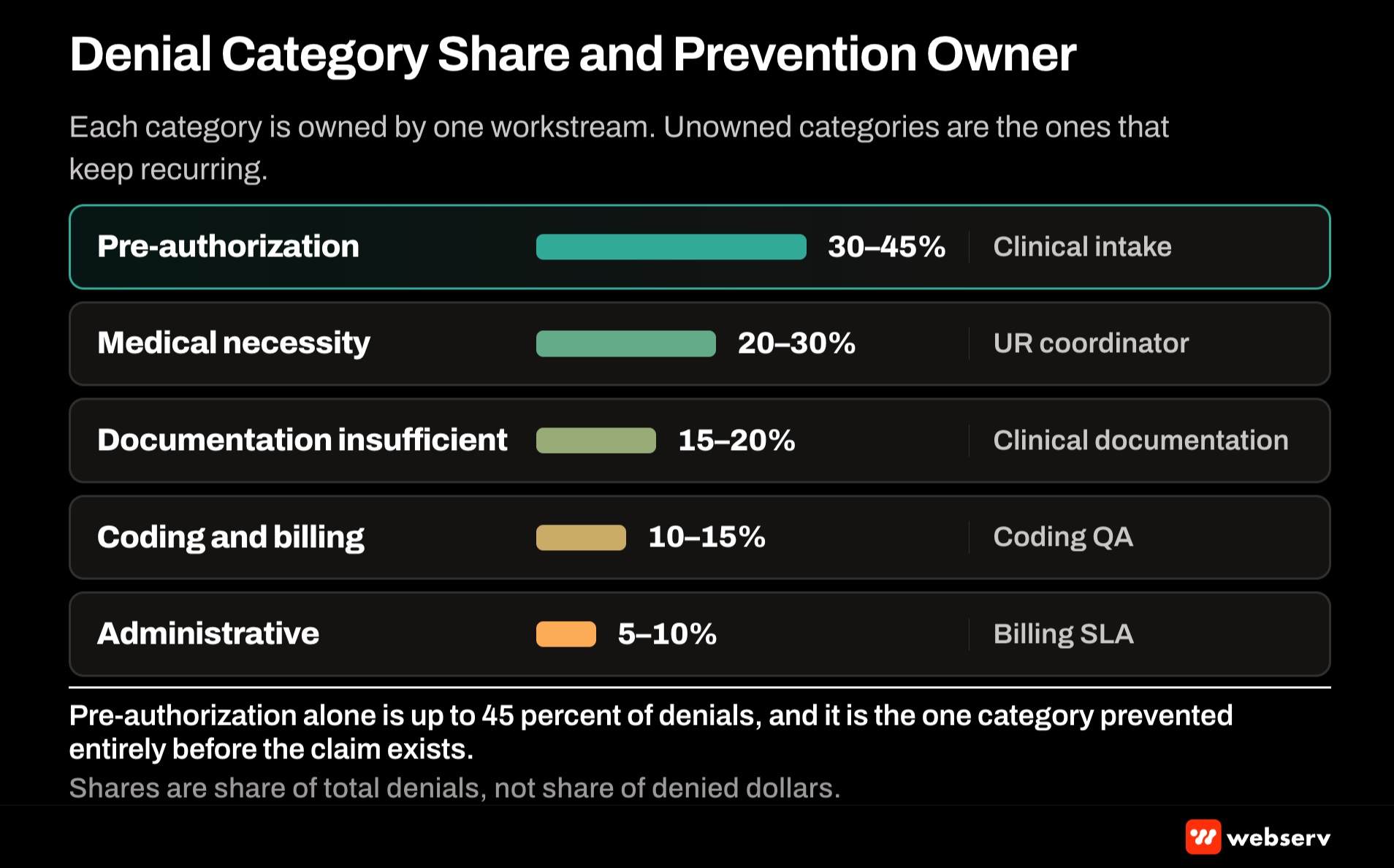
Category 1: Pre-authorization denials
Denials that happen at pre-authorization stage before treatment begins. Root causes: incomplete clinical documentation supporting the requested level of care, ASAM criteria assessment not aligned to LOC being requested, prior treatment history not documented, or medical necessity not established through the payer’s specific documentation standards.
Prevention: intake clinical assessment produces the specific documentation package payer UM teams require. Documentation aligns to payer-specific medical necessity criteria (BCBS, Aetna, Cigna, UHC all use somewhat different criteria).
Category 2: Medical necessity denials at concurrent review
Denials that happen during treatment stay when concurrent review determines the patient no longer meets medical necessity for the current level of care.
Root causes: clinical progress notes not documenting continued need for current LOC, treatment plan not updated to reflect current clinical status, or genuinely improved clinical status that supports LOC step-down that facility does not want to implement.
Prevention: concurrent review coordination discipline with clinical team documentation matching what payer UM teams evaluate.
Category 3: Documentation-insufficient denials
Denials that happen at claim submission because clinical documentation submitted with the claim is insufficient to support the billed services.
Root causes: progress notes missing required elements, treatment plans not signed within required timeframes, or clinical documentation not attached to specific claim submissions.
Prevention: clinical documentation quality standards enforced at the point of clinical service, not at billing.
Category 4: Coding and billing denials
Denials from incorrect procedure codes, incorrect diagnosis codes, or coding-payer mismatch.
Root causes: coding staff without BH-specific expertise, coding software without BH-specific rule sets, or manual coding processes without quality assurance.
Prevention: BH-specific coding expertise plus coding quality assurance review before claim submission.
Category 5: Administrative denials
Denials from timely filing violations, missing member information, incorrect billing entity information, or other administrative errors.
Root causes: billing team workflow gaps, claim processing delays, or missing verification data.
Prevention: billing workflow discipline with specific SLAs on claim submission timing, plus verification data completeness at admission.
The denial management program at a glance
Recoverable
Much denied revenue is recoverable with a disciplined denial process
Pre-auth
A leading, preventable BH denial category
Appealable
Overturn odds depend on payer, denial category, and appeal quality
Contract-set
Provider appeal windows come from each payer contract, so track them
Prevention framework
The prevention framework reduces initial denial rates through four workstreams.
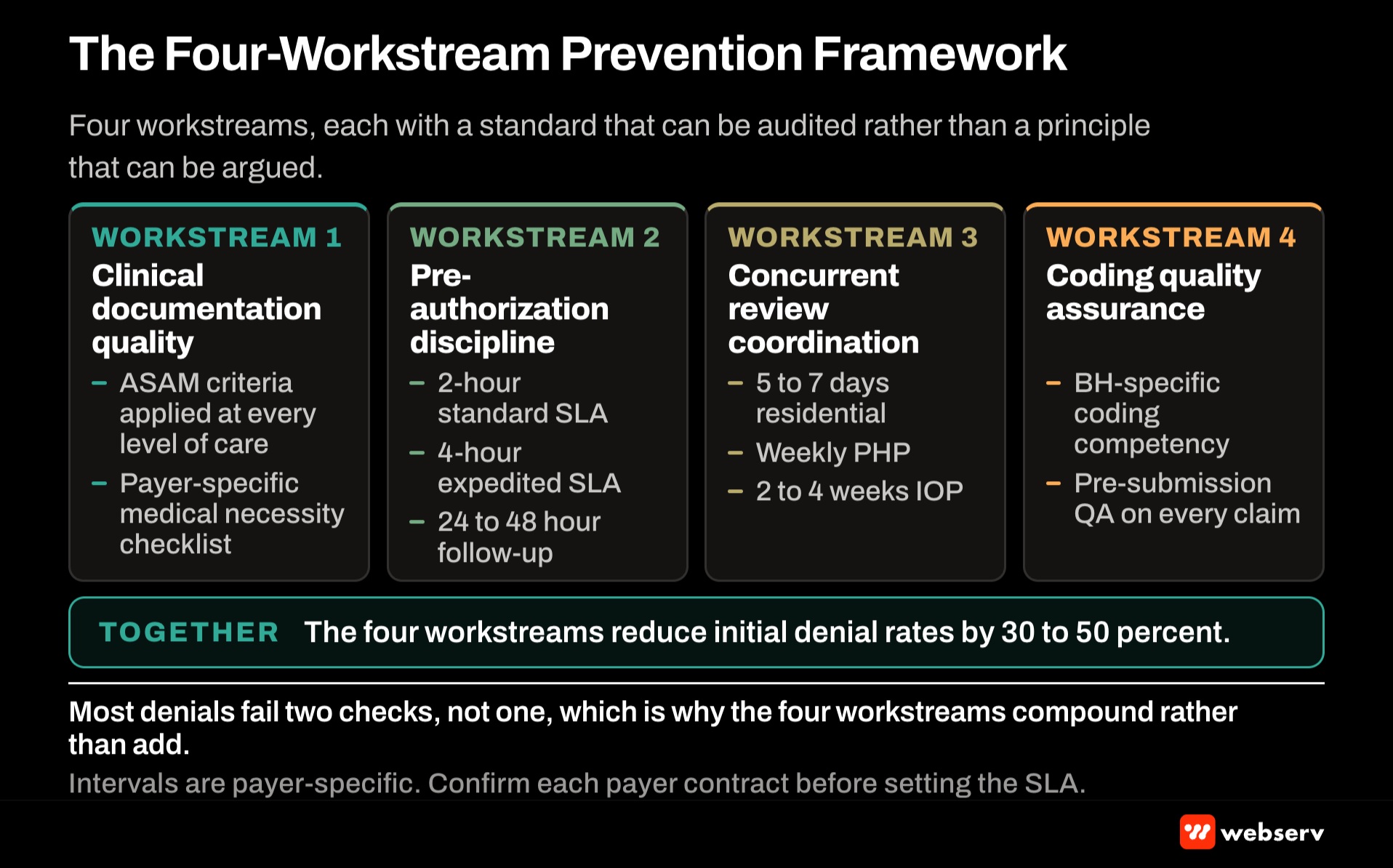
Workstream 1: Clinical documentation quality. Intake clinical assessment produces the specific documentation payer UM teams require. ASAM criteria assessment aligned to requested LOC. DSM-5 diagnosis with specific severity documentation. Prior treatment history when applicable. Current medications and medical clearance for detox or residential.
The specific pattern that works: clinical documentation checklist for each level of care and each payer type. Intake clinician runs the checklist during initial assessment. Missing elements get flagged and completed before pre-authorization submission.
Workstream 2: Pre-authorization workflow discipline. Pre-authorization submitted within 2 hours of clinical assessment completion for standard admissions, within 4 hours for expedited admissions. Documentation package includes the specific payer-required elements.
Follow-up on pre-authorization decisions within 24 to 48 hours. Escalation to payer UM management when initial decision is questioned or delayed.
Workstream 3: Concurrent review coordination. Concurrent review scheduled at payer-required intervals, which are most frequent for residential and detox and less frequent for PHP and IOP.
Clinical team prepares concurrent review documentation showing continued medical necessity: current progress notes, updated ASAM assessment, treatment plan modifications, medication management updates.
Communication with payer UM team about specific clinical trajectory to reduce surprise denials.
Workstream 4: Coding quality assurance. BH-specific coding expertise applied to claim preparation. Procedure codes matched to actual clinical services delivered. Diagnosis codes aligned to clinical documentation.
Quality assurance review before claim submission catches coding errors that would otherwise produce denials.
The four workstreams together reduce initial denial rates well below what facilities running only ad-hoc denial handling see.
How a Tennessee treatment center tripled its paid media close rate and cut missed calls to 1%
Full CRM configuration, system integrations, and call tracking metrics unified a fragmented admissions process into a single high-converting workflow in two months.
Read the case study →Up from 17% — missed calls cut from 15% to 1%
Appeal workflow for initial denials
Appeals recover a meaningful share of initial denials, depending on payer, denial category, and appeal quality. The specific workflow that produces the higher-end recovery rates.
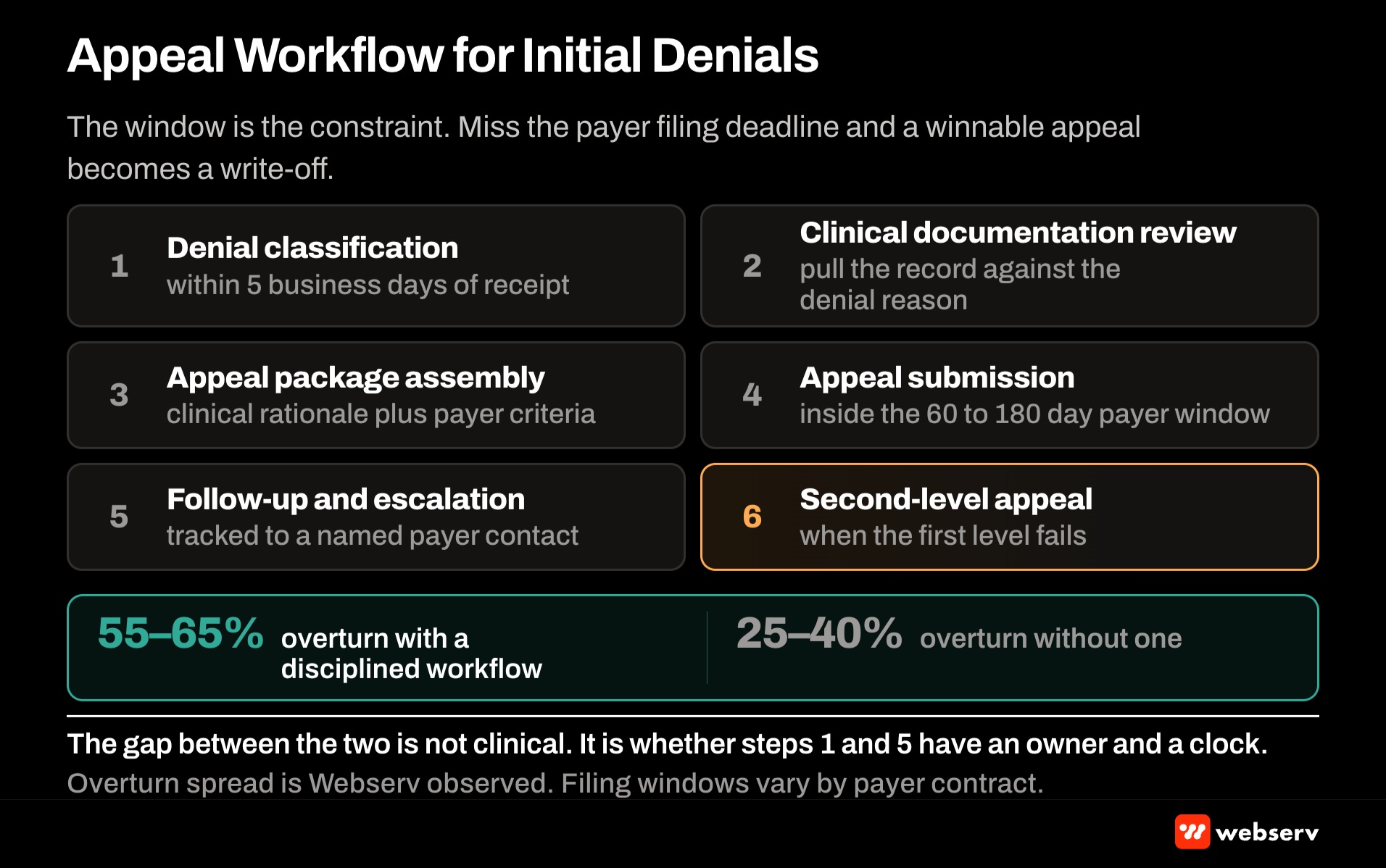
Step 1: Denial classification within 5 business days of denial notice. Categorize each denial into the five categories above. Assign appeal priority based on denial amount, appeal timing window, and probability of overturn.
Step 2: Clinical documentation review for appeal. Pull clinical documentation from the denial episode. Identify specific evidence supporting the appeal position. Document specific payer criteria that the appeal will address.
Step 3: Appeal package assembly. Structured appeal letter with specific payer criteria referenced, clinical documentation attached, and specific requested outcome (full overturn, partial overturn, alternative approval).
Step 4: Appeal submission within payer timing window. Every payer sets an appeal deadline, and missing it forfeits the claim. Some payers require specific appeal formats (formal appeal letter versus reconsideration request versus peer-to-peer review).
Step 5: Appeal follow-up and escalation. Track appeal timelines. Follow up at payer-specific SLA intervals. Escalate to payer UM management or medical director when appeals stall.
Step 6: Second-level appeal when first-level fails. Most payers offer two-level or three-level appeal processes. Second-level appeals typically require additional clinical evidence and often involve external medical review.
Facilities with a disciplined appeal workflow overturn meaningfully more initial denials. Facilities without one leave recoverable revenue behind.
Timing standards for appeals
Timing standards vary meaningfully by payer and by denial category. Missing timing windows produces time-barred appeals that cannot be recovered.
Payer-specific appeal windows. Provider appeal windows are set in each payer contract, so pull them from your agreements rather than assuming a standard. Member appeals differ: federal ERISA rules (29 CFR 2560.503-1) give group health plan members at least 180 days. Medicaid plans follow state rules.
Medicaid managed care plans vary meaningfully by state and by specific MCO. State-level Medicaid typically follows federal minimum timeframes.
Denial category timing considerations. Pre-authorization denials typically have the shortest appeal windows because the denial happens before treatment begins and payers want quick resolution.
Concurrent review denials typically require expedited appeals during ongoing treatment because the denial affects current level of care.
Documentation-insufficient denials sometimes allow supplementation without formal appeal if the documentation is provided within a specific window.
Administrative denials typically have longer windows but also lower overturn rates because the underlying issue is procedural rather than clinical.
Timing tracking pattern. Denial tracking system with denial date, payer-specific appeal deadline, appeal status, and appeal outcome. Facilities without denial tracking lose appeals to missed deadlines.
DO
- Run intake clinical documentation against a payer-specific checklist (BCBS, Aetna, Cigna, UHC each have different medical necessity criteria) before pre-authorization submission.
- Schedule concurrent review at payer-required intervals and prepare updated ASAM + treatment plan documentation for each cycle.
- Classify every denial into one of the 5 categories within 5 business days and prioritize appeal work by dollar amount + timing window + probability of overturn.
- Submit appeals promptly after denial notice, while the clinical record is fresh and before deadlines get tight.
- Request peer-to-peer review when payer UM signals a concurrent-review denial — real-time clinician-to-medical-director discussion overturns more than post-denial written appeals.
DON’T
- Treat denials as a billing-team-only problem — prevention lives at the clinical and admissions layer where documentation quality is set.
- Skip denial tracking, which is how facilities lose appeals to missed deadlines.
- Wait until the payer deadline to file appeals.
- Write off denied claims without workflow feedback — the write-off documentation should inform prevention improvements, not just close the ledger entry.
- Ignore concurrent review pressure until the denial lands, because mid-stay LOS reduction denials are far easier to prevent than to appeal.
Concurrent review coordination
Concurrent review coordination during active treatment prevents mid-stay denials that force early discharge or LOS reduction.
The specific coordination pattern. Weekly or biweekly clinical documentation review by the facility’s utilization review coordinator. Progress notes evaluated against payer-specific medical necessity criteria.
Communication with payer UM team about clinical trajectory. Documentation updates aligned to payer expectations for continued LOC.
Signals of concurrent review risk. Progress notes showing rapid clinical improvement without documented continued need for current LOC. Treatment plan not updated to reflect current clinical status. Medication changes without documented rationale. Family involvement documentation missing.
Each signal indicates increased denial risk that concurrent review coordination can address.
Concurrent review escalation. When payer UM team signals potential denial, escalate to peer-to-peer review with facility clinician. Peer-to-peer typically produces higher overturn rates than post-denial appeals because the clinical discussion happens in real time.
Facilities with strong concurrent review coordination see fewer mid-stay LOS reductions. Facilities without it see more.
Measurement patterns for denial management performance
The specific measurement patterns that isolate denial management performance from other revenue cycle variables.
Initial denial rate. Percentage of claims initially denied divided by total claims submitted. Target: set a baseline from your own claims and drive it down quarter over quarter. A rising initial denial rate signals prevention workflow gaps.
Appeal overturn rate. Percentage of appealed denials that get overturned divided by total appeals submitted. Target: a rising overturn rate as appeal packages improve.
Collection rate on initially-denied claims. Percentage of billed revenue collected on claims that initially face denial. Target: a rising share of initially-denied revenue recovered.
Days to appeal submission. Average days from denial notice to appeal submission. Target: appeals filed promptly, well inside every payer deadline. Longer delays typically correlate with lower overturn rates.
Denial category distribution. Percentage of denials by category. Shifting distribution over time signals workflow improvements or workflow gaps. Increasing pre-authorization denial share typically signals prevention workflow degradation.
Most in-house teams hit a wall not because they lack knowledge, but because they lack bandwidth.
When you are ready to hand it off, Webserv has spent 9 years executing exactly this for treatment centers nationwide.
Frequently Asked Questions
How much does denial management cost to run at facility level?
Cost depends mainly on admit volume, payer mix complexity, and whether the work is staffed in-house or outsourced.
The cost covers dedicated denial management staff (the largest line), clinical documentation review time, appeal preparation time, and technology tools (denial tracking systems, clinical documentation platforms, coding software).
Portfolio operators produce meaningful economies of scale. Per-facility denial management cost typically drops for the second and subsequent facilities in a portfolio because appeal expertise and technology transfer across facilities.
Should we outsource denial management or run it in-house?
Depends on facility scale and internal expertise. Higher-volume facilities typically benefit from in-house denial management because the volume supports dedicated staff and internal expertise development.
Lower-volume facilities typically benefit from outsourced denial management because volume does not support dedicated staff and outsourced vendors bring specialized expertise.
Hybrid approaches work for facilities in the middle range: in-house team handles pre-authorization and prevention, outsourced vendor handles complex appeals and concurrent review coordination.
How do we improve our appeal overturn rate?
Three specific improvements produce meaningful overturn rate increases. First: clinical documentation quality at the time of clinical service. Better documentation supports stronger appeals.
Second: appeal timing discipline. Appeals submitted promptly are easier to build well than appeals rushed at the deadline.
Third: peer-to-peer review requests when clinical circumstances warrant. Facility clinician discussion with payer medical director often produces overturns that written appeals cannot achieve.
What causes concurrent review denials that pre-authorization did not catch?
Clinical trajectory that differs from what pre-authorization anticipated. Patients who improve faster than expected trigger concurrent review pressure toward LOC step-down. Patients whose complexity was not fully documented at pre-authorization can face concurrent review questions.
The specific prevention pattern: pre-authorization documentation includes anticipated clinical trajectory and specific factors that would extend LOC. Concurrent review documentation updates the trajectory based on actual clinical progress.
Facilities with strong concurrent review coordination prevent many of the concurrent review denials that facilities without coordination experience.
How does denial management interact with our overall revenue cycle operations?
As the specific quality assurance layer that determines whether admissions convert to collected revenue. Revenue cycle covers the full workflow from patient identification through cash posting. Denial management focuses specifically on the point where claims face payer resistance.
The specific integration: denial data feeds back to prevention workflows. Categories with rising denial rates trigger prevention workflow investigation. Successful appeals inform documentation and coding pattern improvements.
Facilities that separate denial management from prevention workflows typically produce lower overall collection rates than facilities that integrate the two through shared feedback loops.
How does the denial management workflow relate to the pre-admission eligibility verification playbook?
Directly. Pre-admission eligibility verification identifies coverage and pre-authorization requirements. Strong verification produces admissions that are properly authorized, which reduces pre-authorization denials at the back end.
The specific integration pattern: eligibility verification catches issues at the front. Pre-authorization workflow ensures proper approval. Concurrent review maintains approval through treatment. Denial management handles cases where the front-end and mid-stream workflows did not prevent the denial.
Our pre-admission eligibility verification playbook covers the front-end workflow, our VOB vs pre-authorization guide covers the specific pre-auth workflow, and our reimbursement intelligence hub covers the analytical layer that connects denial patterns to revenue outcomes.
What happens if we cannot recover a denied claim through appeals?
Three paths. First: pursue additional appeal levels (most payers offer 2 or 3 appeal levels with different evidence requirements at each level).
Second: pursue external review through state insurance commissioner processes or independent medical review programs where applicable.
Third: write off the claim and update revenue cycle records. Cases that reach write-off should generate documentation that informs prevention workflow improvements. Facilities that maintain disciplined write-off documentation typically identify prevention improvements that reduce future denial rates. Facilities that treat write-offs as accounting entries without workflow feedback typically repeat the denial patterns.
Kyle McHenry is the founder of Revenue Logic and co-founder of PayerLenz and Webserv. His work focuses on the reimbursement intelligence and eligibility workflows that treatment center admissions and billing teams run.