Google describes Gemini Deep Research as a tool that can browse up to hundreds of websites and turn what it finds into a multi-page report in minutes. It’s available on every Gemini plan, including free, and the Gemini app passed one billion monthly users in August 2026.
That changes what “being cited” means. A regular AI answer might cite a handful of sources. A Deep Research report on a benchmark of PhD-level tasks averaged more than 100 citations per report in 2025 testing.
For treatment centers, a report that long has room for sources a short answer leaves out: the facility’s program guide, its admissions process, its insurance page, its outcomes methodology. The question is whether those pages are built to be read, and cited, by an agent that reads widely.
This piece covers how Deep Research works, what controls a site owner has, what the limited citation research shows, and the content patterns that fit a long-form research agent. It’s part of the work inside our AEO program for treatment centers. For the full build, start with our Full AI Search Stack and our guide to getting cited in Google AI Overviews and ChatGPT.
Key Takeaways
- Gemini Deep Research searches, reads, and searches again, then writes a multi-page report with links to its sources. Google says it can browse up to hundreds of websites per task.
- Deep Research uses Google Search as a source by default. Pages that are indexed and crawlable in Google Search are the starting point.
- Google-Extended controls whether content is used to ground Gemini apps as well as train future models, and Google says it doesn’t affect inclusion or ranking in Search. Blocking it is a separate decision from blocking Googlebot.
- The only published citation numbers come from 2025 academic benchmarks on earlier models, and none covers health. Treat them as a sign of scale, not a rule.
- Long, specific, well-sourced facility pages fit how a research agent works: program guides, admissions and insurance pages, clinical team pages, and original data.
- Google says there are no special requirements, AI text files, or schema needed to appear in its AI features. The same SEO fundamentals apply.
How Deep Research works
Google launched Deep Research in December 2024 for paid Gemini subscribers, with reports organized with links to the original sources. In March 2025 it opened to free users a few times a month.
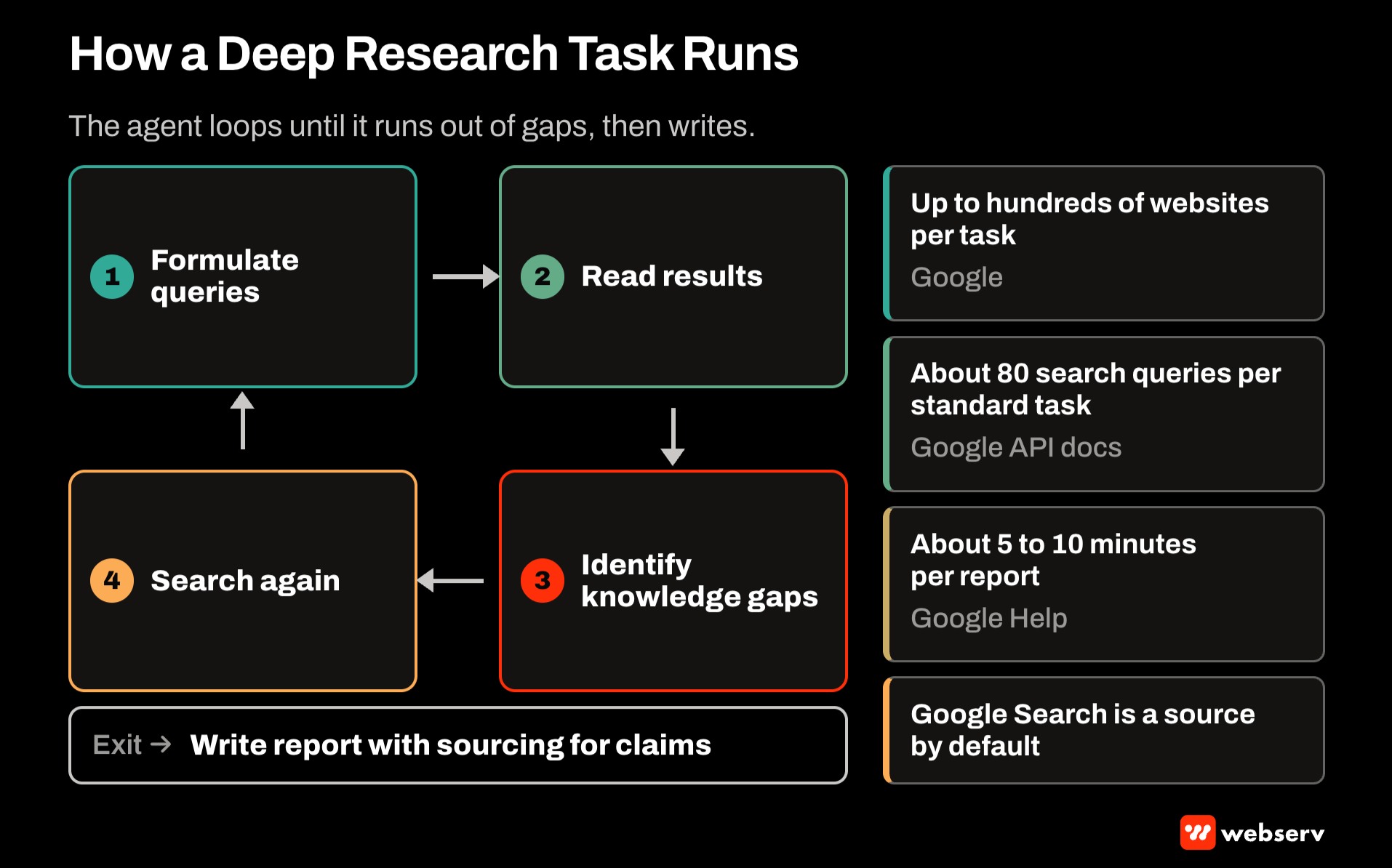
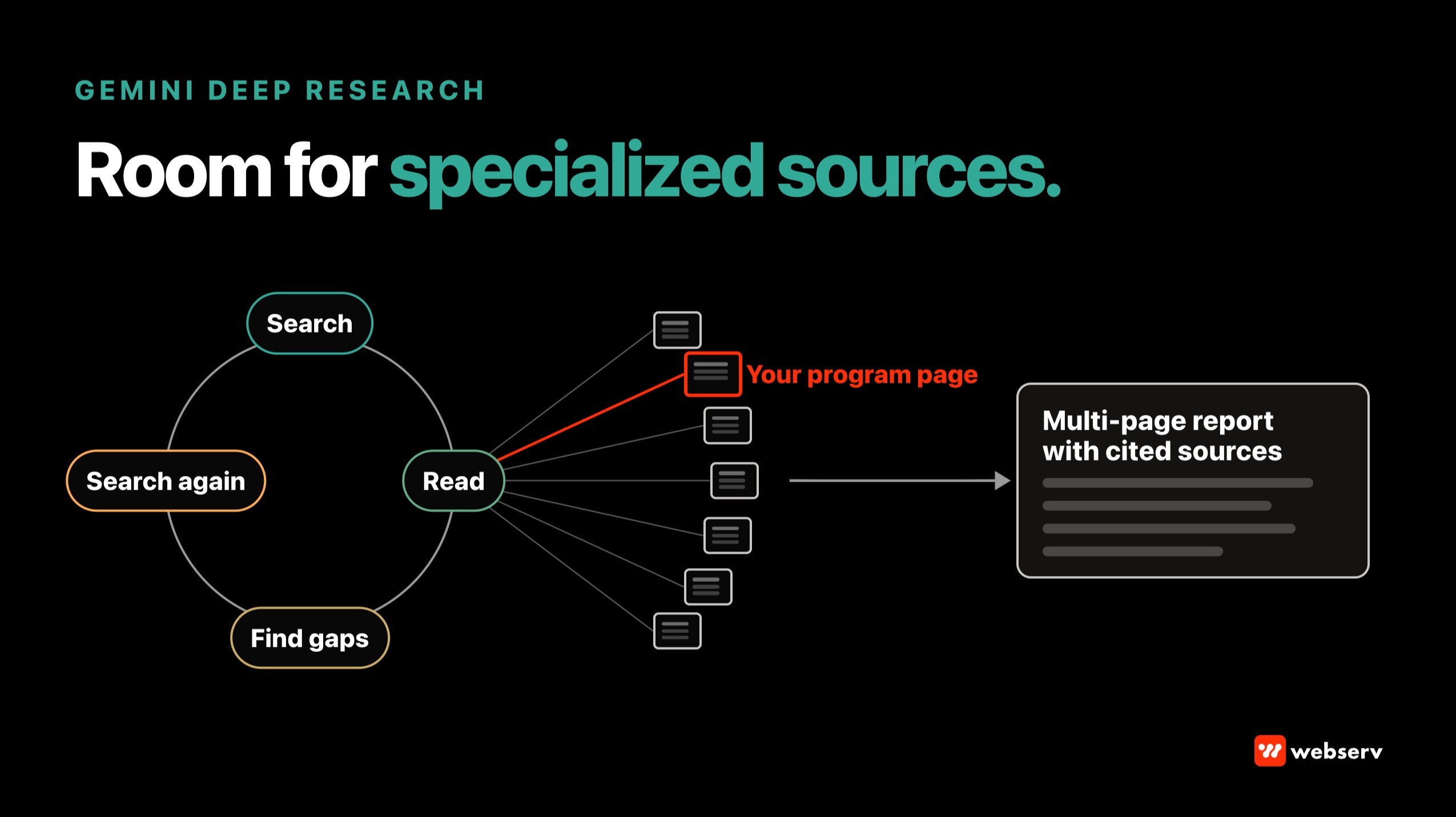
Google’s Deep Research overview now says it runs on Gemini 3, can browse up to hundreds of websites, and produces multi-page reports that can be turned into audio overviews. Google’s help article says it includes Google Search as a source by default and takes about 5 to 10 minutes per report.
The developer version shows the method more clearly. Google’s Deep Research agent announcement says it formulates queries, reads results, identifies knowledge gaps, and searches again, with granular sourcing for claims. Google’s API documentation estimates about 80 search queries per standard task.
DEFINITION
Deep Research citation. A source link in a Deep Research report attached to a specific claim the report makes. Because the agent runs many searches and reads many pages before writing, a report can cite more sources than a short AI answer has room for.
Google also offers related long-form features in Search. At I/O 2025, Google said Deep Search in AI Mode could issue hundreds of searches and create a fully cited report. Google’s April 2026 Deep Research Max announcement says the same research infrastructure powers the Gemini app, Search, and other Google products.
The controls a site owner has
Deep Research doesn’t have its own crawler name. It draws on Google Search, so the familiar controls apply, plus one that’s easy to overlook.
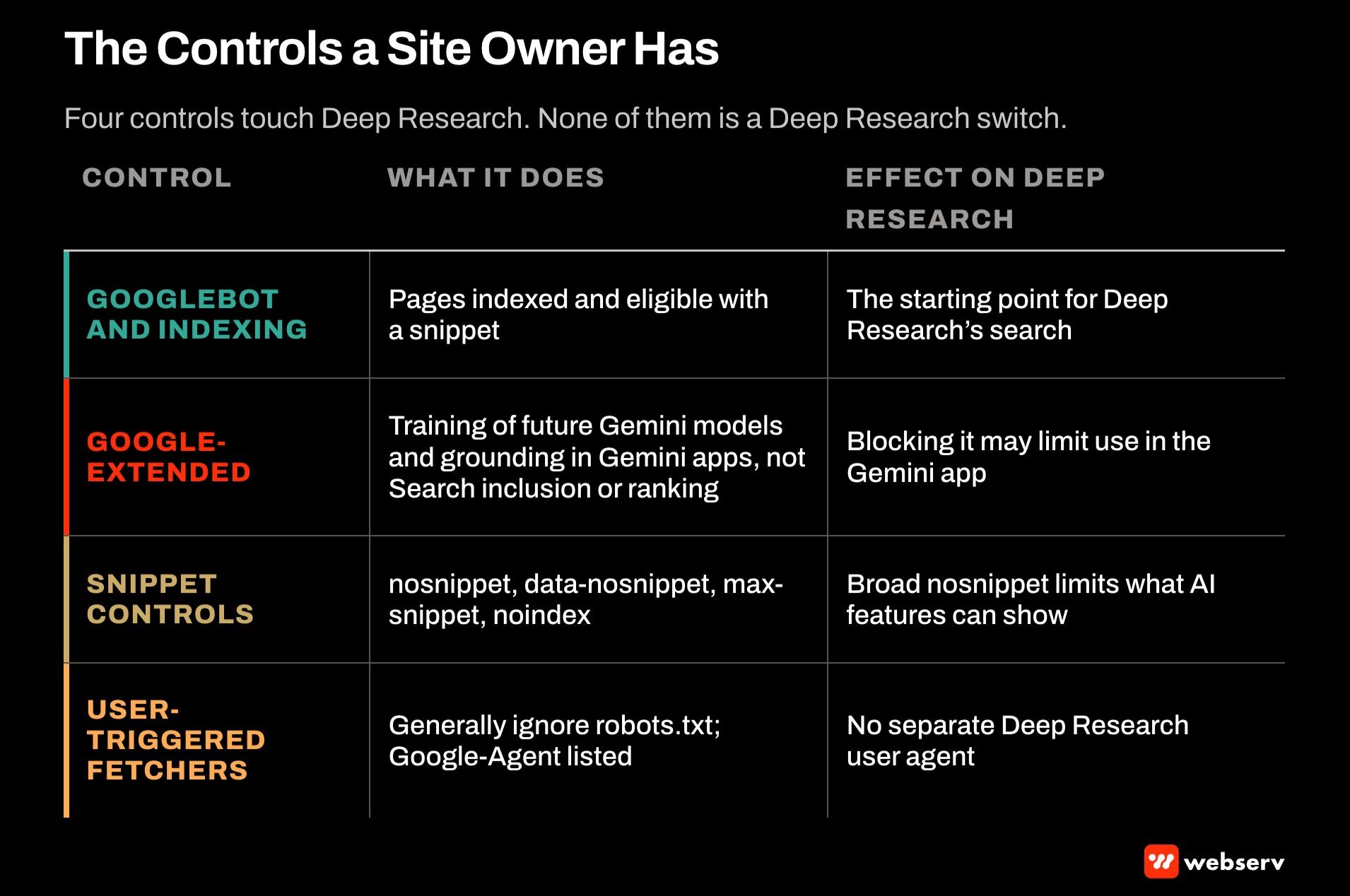
Googlebot and indexing. Google’s guidance on AI features and your website says pages need to be indexed and eligible to show in Search with a snippet to appear in AI Overviews and AI Mode. The same foundation is where Deep Research’s search starts.
Google-Extended. Google’s common crawlers documentation says Google-Extended controls whether content is used to train future Gemini models and for grounding in Gemini apps. It also says Google-Extended doesn’t affect a site’s inclusion in Google Search and isn’t a ranking signal.
Google doesn’t name Deep Research on that page. But since Deep Research runs inside the Gemini app, a site that blocks Google-Extended should assume it may be limiting how its content is used there. Our robots.txt guide for AI bots covers how to make that call.
DO
- Keep key pages indexed and eligible to show with a snippet in Google Search.
- Decide on Google-Extended deliberately, as a question about training and Gemini grounding.
DON’T
- Apply nosnippet site-wide.
- Assume Deep Research has its own user agent to allow or block.
Snippet controls. The AI features guidance lists nosnippet, data-nosnippet, max-snippet, and noindex as the controls for how content appears. A page with nosnippet applied broadly limits what AI features can show from it.
User-triggered fetchers. Google’s user-triggered fetchers documentation says these fetchers generally ignore robots.txt, and lists Google-Agent for agents hosted on Google infrastructure. There’s no separate Deep Research user agent listed.
What the citation research shows
Research on Deep Research citations is thin. No major SEO platform has published a Deep Research-specific citation study, and nothing published covers health topics.
Deep Research citation scale (DeepResearch Bench, June 2025, on Gemini 2.5 Pro; Google)
111
Effective citations per report, PhD-level tasks (DeepResearch Bench)
81%
Citation accuracy, same benchmark
Hundreds
Websites Google says Deep Research can browse per task
The numbers that exist come from academic benchmarks run in 2025 on earlier models:
- DeepResearch Bench (June 2025) tested 100 PhD-level research tasks across 22 fields. Gemini’s Deep Research, then on Gemini 2.5 Pro, averaged 111.21 effective citations per report with 81.44% citation accuracy, compared with 40.79 for OpenAI’s Deep Research.
- ReportBench (August 2025) tested academic survey tasks and found Gemini’s Deep Research averaged 32.42 references per report, while noting a tendency to over-generate citations.
Two things follow, carefully. Deep Research reports cite far more sources than a typical AI answer, so there’s room for specialized sources. And not every citation is precise, which is a reason to make the facts on your pages unambiguous.
The product now runs on newer models, so the exact figures won’t hold. The scale is the useful part.
Why treatment centers should care
Deep Research is built for tasks that need many sources and a structured answer. Choosing a treatment program has that shape: levels of care, locations, insurance, credentials, cost, and what the first days look like.
Google’s own health guidance for Gemini is cautious. Its Gemini privacy hub tells users not to rely on Gemini apps for diagnosis, treatment, or medical advice, and its policy guidelines list medical information that conflicts with established consensus as a harmful inaccuracy.
That caution points the same direction as on other AI platforms. Clinical explanations will lean on medical and government sources. Facility-specific facts, the details a family needs to compare programs, have to come from the facilities.
COMMON MISTAKE
Writing the tenth “what is IOP” page. A long report on intensive outpatient treatment will define IOP from sources like SAMHSA’s treatment resources and NIDA’s treatment research. A facility’s generic definition adds nothing it can cite.
What it can cite is your IOP schedule, how many hours a week it runs, who leads groups, which insurers you work with, and how admission works. Publish that, and cite the general sources instead of rewriting them.
Content patterns that fit a long-form research agent
These patterns follow from how Google describes Deep Research: many searches, many pages read, claims tied to sources.
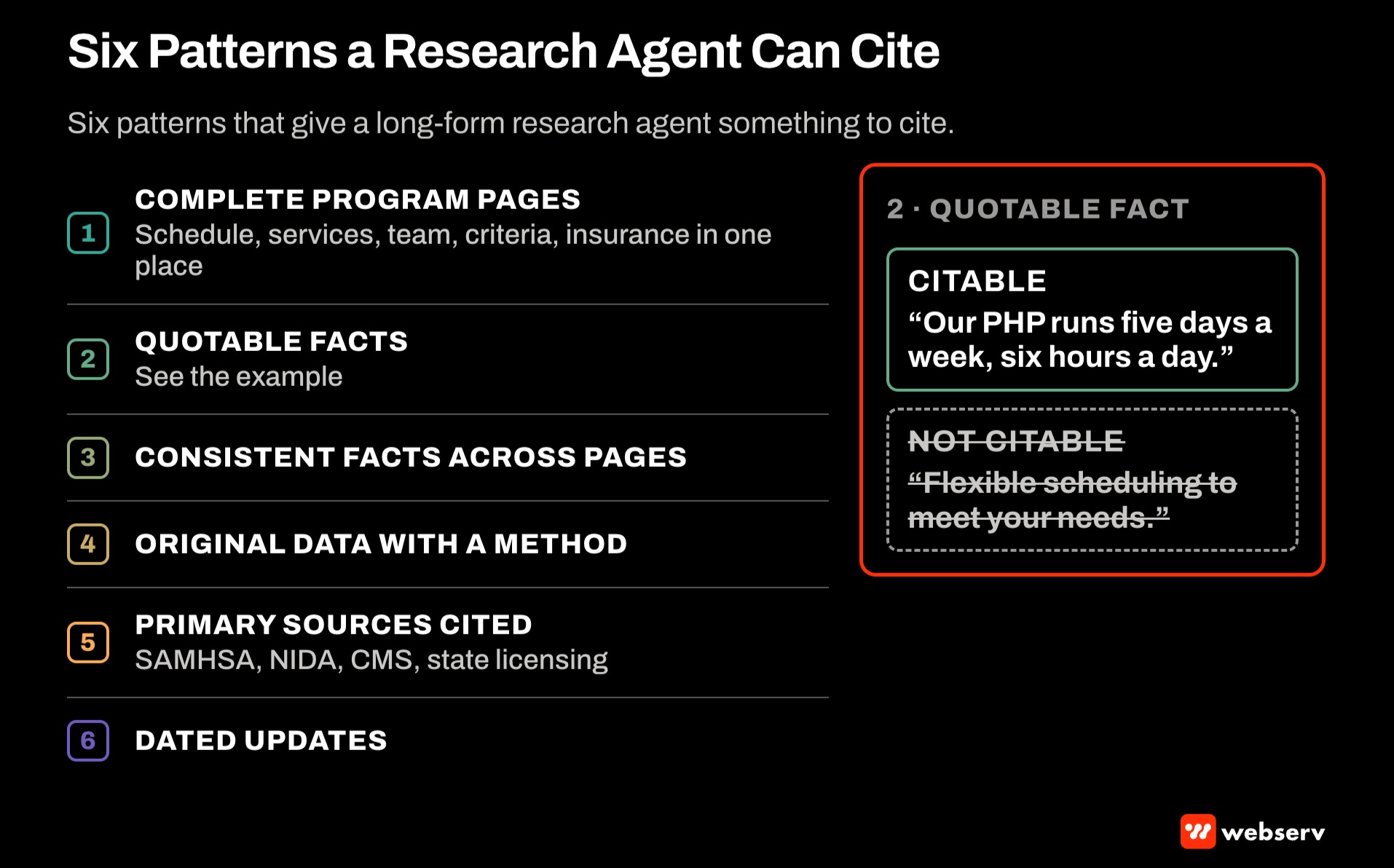
Publish complete program pages. One page per level of care that covers schedule, services, team, admission criteria, insurance, and what to expect. A research agent looking for specifics finds them in one place instead of piecing them together.
State facts in quotable sentences. “Our PHP runs five days a week, six hours a day” can be cited. “Flexible scheduling to meet your needs” can’t. Our guide to the 40-word answer block covers the format.
Keep facts consistent across the site. If the program page, the insurance page, and the location page disagree, a report that reads all three may pick the wrong one or skip them. Our AI information page guide covers a single reference page for core facts.
Publish original data with a method. Outcomes, wait times, or admissions data, with a clear methodology, give a research agent something no other source has. Our guide to producing original behavioral health research covers how to do it credibly.
Cite primary sources. Linking to SAMHSA, NIDA, CMS, and state licensing sources shows where claims come from and gives the agent a trail to check.
Date your updates. Show when program details, insurance lists, and staff pages were last reviewed. A report comparing facilities benefits from knowing which facts are current.
OPERATOR INSIGHT
Run a Deep Research report yourself on the kind of question a family or referral partner might ask about your region and level of care, and read which sources it cites.
The report shows which facility pages it found useful, which facts it pulled, and where it went to competitors or directories instead. That’s a free gap analysis, and it’s worth repeating each quarter.
How to measure it
Deep Research reports are generated per user, so there’s no ranking to track. Measure it the same way as other AI platforms, with samples.
Keep a fixed set of research-style prompts, run them in Deep Research on a schedule, and record whether your pages are cited and what the report says about your facility. Our guide to measuring AEO covers tracking across platforms.
In analytics, watch for referral traffic from Gemini. Readers who click through from a report are checking a source, which makes those visits worth watching.
What this means for your AI search plan
Deep Research rewards the same foundation as the rest of Google’s AI features, at greater depth. Google says there are no special files or schema required. The work is complete, accurate, crawlable pages with facts only your facility can provide.
If your site isn’t being cited anywhere, the issue usually sits upstream. Our 12 SEO failure patterns diagnostic covers where to look, and the 5-tier SEO priority framework covers what to fix first.
For how AI search fits the rest of your marketing, see the complete guide to behavioral health marketing. If you want a second look at how Deep Research and other AI tools describe your facility, book an intro meeting.
Frequently Asked Questions
What is Gemini Deep Research?
It’s a Gemini feature that researches a question by running searches, reading results, and searching again, then writes a multi-page report with links to its sources.
Google says it can browse up to hundreds of websites and includes Google Search as a source by default. Reports take about 5 to 10 minutes.
It’s available on all Gemini plans, with higher usage limits on paid plans.
How do treatment centers get cited in Deep Research reports?
Start with pages that are indexed and crawlable in Google Search, since Deep Research uses Search by default.
Then publish specific facility facts that other sources can’t provide: program schedules, admission steps, insurance, team credentials, and original data with a method.
Google says there are no special requirements or AI text files needed for its AI features.
Does blocking Google-Extended affect Deep Research?
Google says Google-Extended controls whether content is used to train Gemini models and to ground responses in Gemini apps, and that it doesn’t affect Google Search inclusion or ranking.
Google doesn’t name Deep Research specifically, but Deep Research runs in the Gemini app.
A site that blocks Google-Extended should assume it may limit how its content is used there, and weigh that against its training preferences.
How many sources does a Deep Research report cite?
It varies by task. Google says Deep Research can browse up to hundreds of websites per report.
A 2025 academic benchmark of PhD-level tasks found Gemini’s Deep Research averaged about 111 effective citations per report, on an earlier model.
No published study covers health topics or the current model, so treat those figures as a sign of scale.
Should we create content specifically for Deep Research?
Not separate content. The pages that serve families well, complete program guides, clear admissions and insurance pages, and team pages, are the ones a research agent can use.
Focus on facts only your facility can publish, stated clearly and kept consistent across the site.
Test with your own Deep Research reports to see which pages get cited and where the gaps are.
Trevor Gage is the Director of Marketing at Webserv, a digital marketing agency for treatment centers.