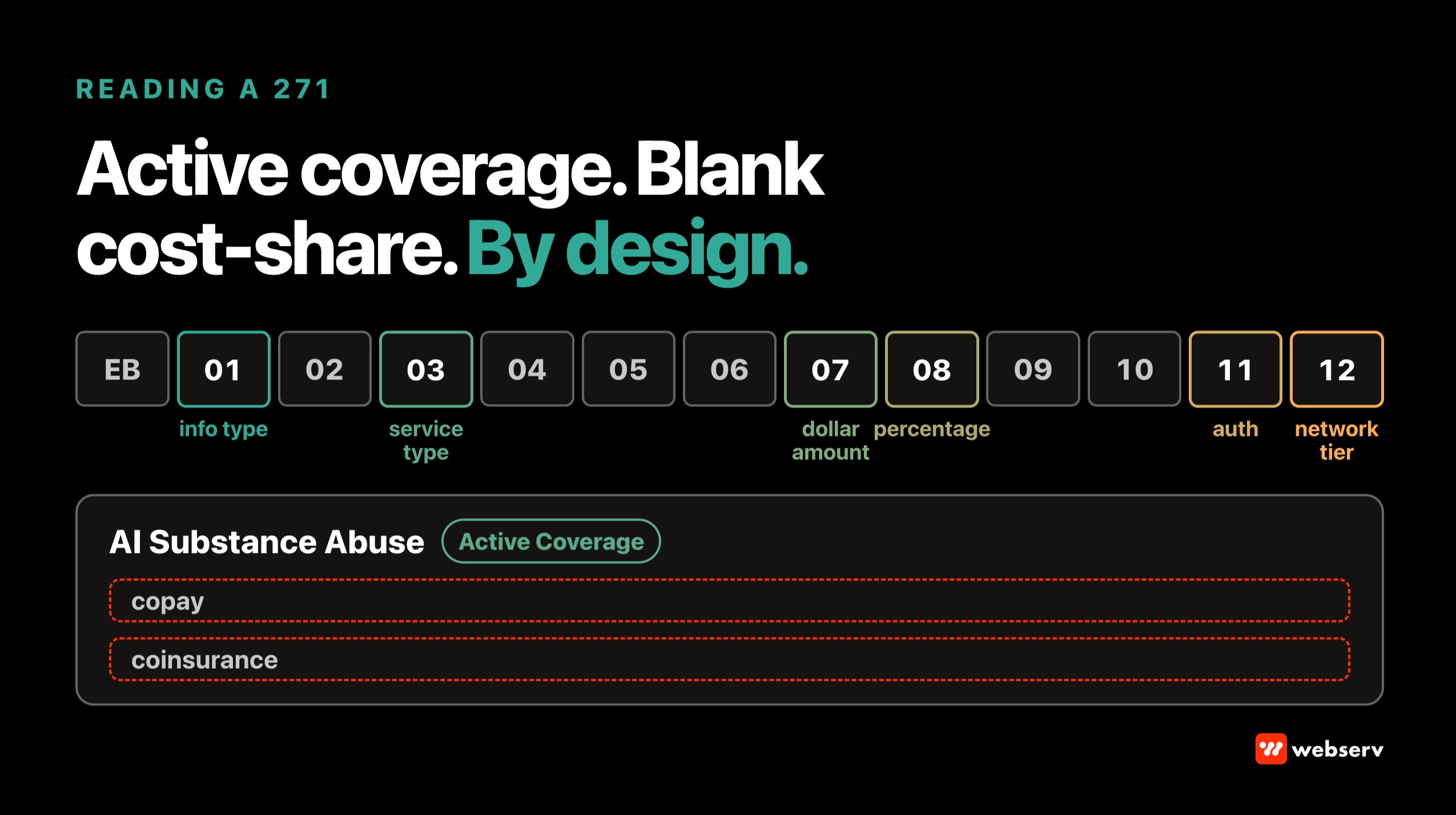
The federally adopted eligibility operating rules require payers to return coverage status for mental health and substance use service types, but they leave patient cost-share for those service types to the payer’s discretion. The stated reason is privacy.
That single provision explains why so many behavioral health eligibility checks come back “active” with nothing underneath. The 271 confirmed the policy. It didn’t tell admissions what residential or PHP will cost the family.
Reading a 271 well means knowing where the answer lives, what the codes mean, and when the response is silent by design. This guide walks through the structure, the EB segment element by element, the service type codes that matter for behavioral health, carve-outs, rejections, and Medicare’s quirks.
It’s the reading skill behind the verification work our admissions and billing team for treatment centers supports. For the full workflow around it, see the pre-admission eligibility verification playbook.
Key Takeaways
- The 271 is the HIPAA-standard eligibility response, version 005010X279A1, and CAQH CORE operating rules adopted under HIPAA set what payers must return and how fast.
- Benefit detail lives in the EB segment. EB01 says what kind of information it is, EB03 names the service type, EB06 the time period, EB07 a dollar amount, EB08 a percentage, and EB12 whether it’s the in-network or out-of-network tier.
- Request behavioral health service type codes explicitly, such as MH, AI, A7, A8, BB, CG, CI, and RT, rather than relying on the generic code 30 alone.
- Under the mandated CORE rules, cost-share for behavioral health service types is discretionary. A blank response isn’t an error; it’s a signal to verify by portal or phone.
- EB12 describes the benefit tier, not whether your facility is in network.
- Carve-outs show up as EB01 code U or R followed by a 2120C loop naming the other entity, which is where the next call goes.
What the 271 is, and what it isn’t
The eligibility inquiry and response are HIPAA-standard transactions. 45 CFR 162.1202 adopts ASC X12N 005010X279 for eligibility, and the version in use is 005010X279A1, the errata HHS adopted in 2010.
The provider or clearinghouse sends a 270 inquiry. The payer answers with a 271 response.
DEFINITION
271 eligibility response. The payer’s standardized electronic answer to a 270 inquiry, reporting whether a member has active coverage and, where the payer returns it, benefit details such as deductibles, copays, coinsurance, limits, and authorization requirements by service type. It confirms plan terms, not what the payer will pay a specific facility.
HIPAA also adopts operating rules for this transaction. 45 CFR 162.1203 adopts CAQH CORE’s Phase I and Phase II eligibility rules, effective January 1, 2013. CMS’s operating rules page summarizes them as requiring plans to return deductibles, copays, coinsurance, and in-network and out-of-network variances.
The Phase I response time rule sets a real-time response at 20 seconds or less. CAQH CORE has since published newer voluntary versions of its eligibility rules, but the federally mandated ones are still the 2011 Phase I and II rules.
Where to look in the response
A 271 is organized in nested levels. Most clearinghouse screens flatten them, but knowing the levels explains why a benefit shows up where it does.
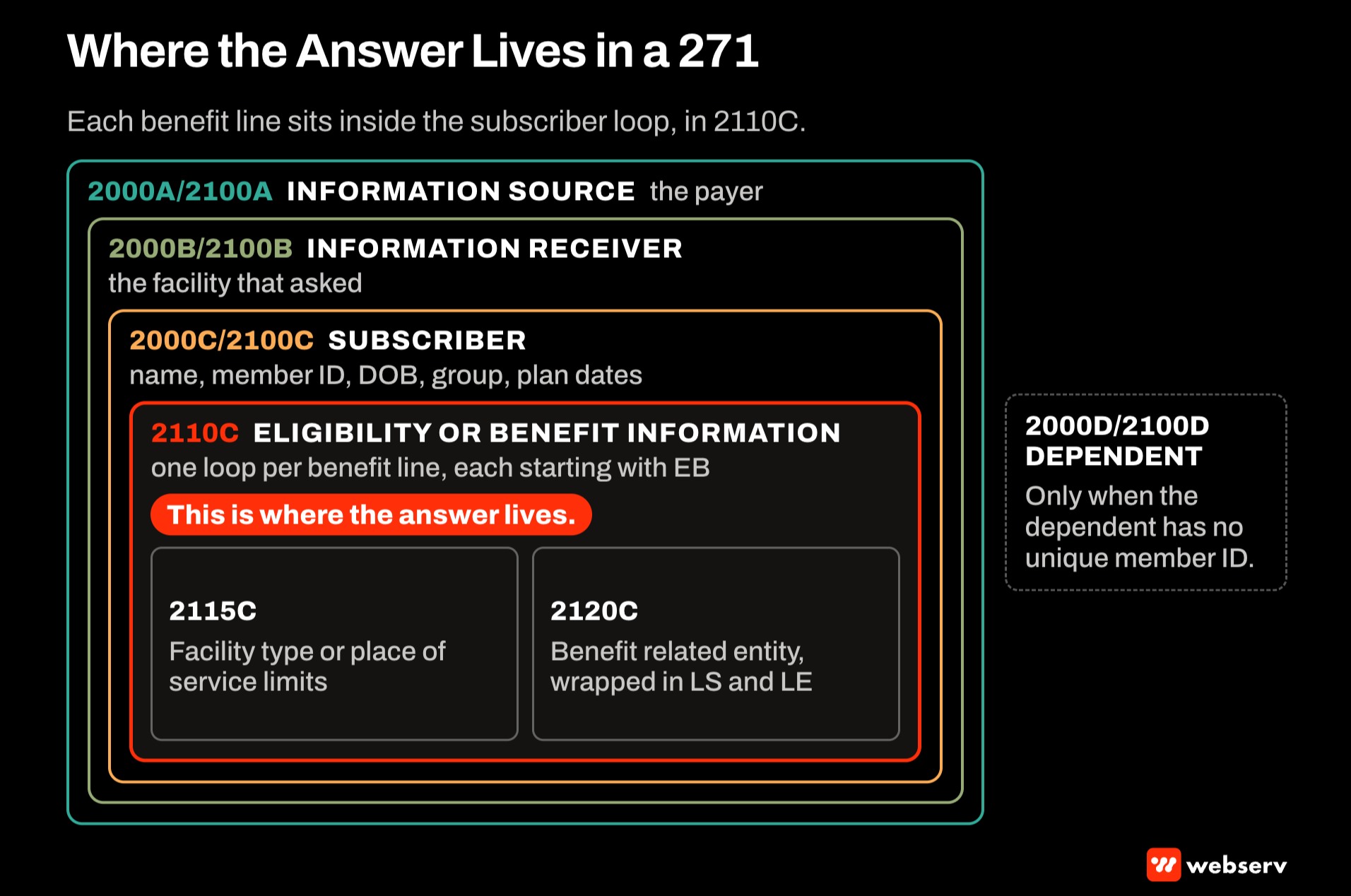
- 2000A / 2100A, information source: the payer sending the response.
- 2000B / 2100B, information receiver: the provider or facility that asked.
- 2000C / 2100C, subscriber: name, member ID, date of birth, group and plan numbers, and plan dates. Dates here apply to every benefit below unless a benefit overrides them.
- 2000D / 2100D, dependent: used only when the dependent doesn’t have a unique member ID.
- 2110C, eligibility or benefit information: one loop per benefit line, each starting with an EB segment. This is where the answer lives.
- 2115C: facility type or place of service limits on a benefit.
- 2120C, benefit related entity: another payer, vendor, or organization tied to a benefit, wrapped in LS and LE segments.
X12 publishes example 271 transactions that show the layout in raw form.
Reading the EB segment, element by element
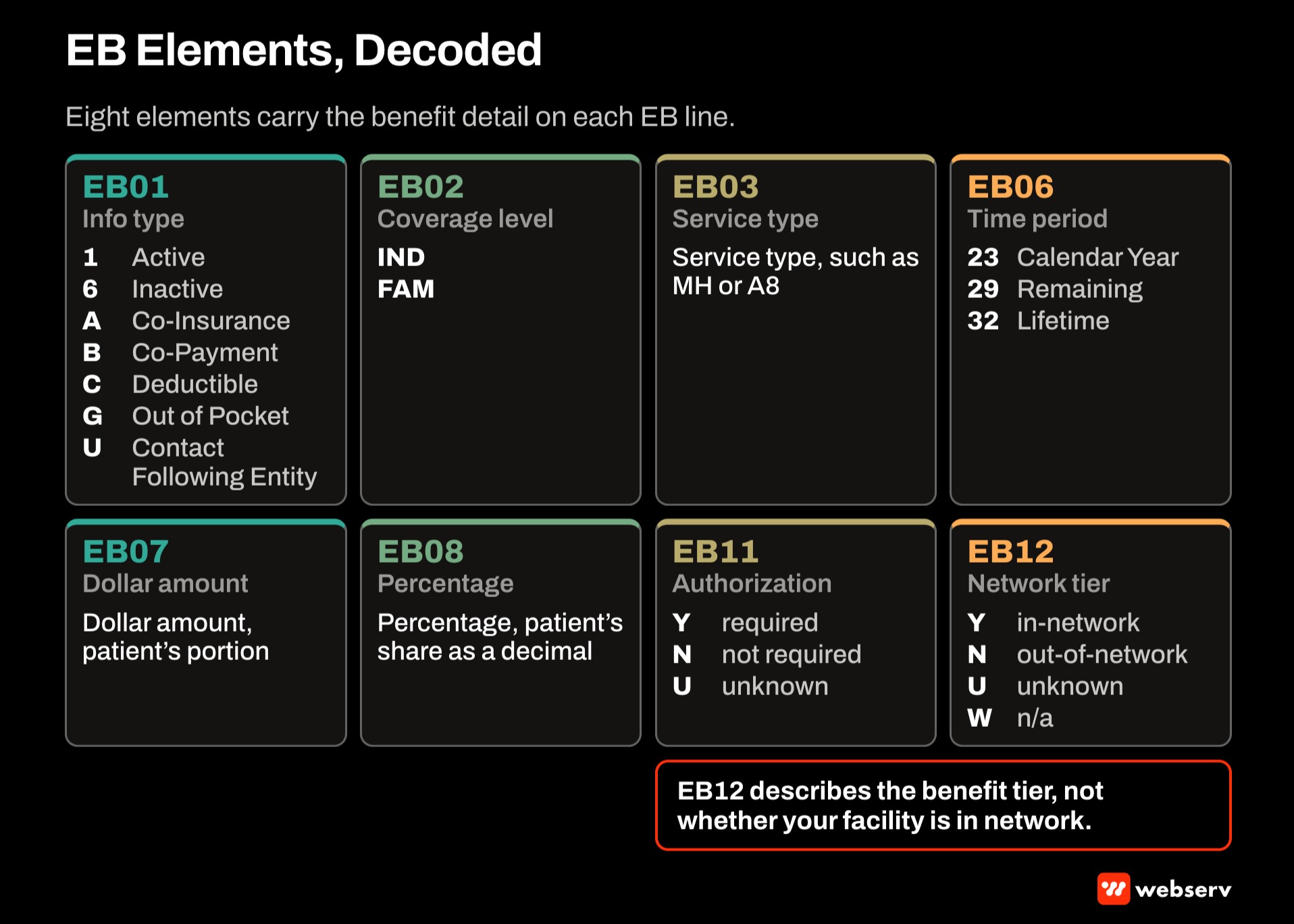
Each benefit line is an EB segment with up to 13 elements. These are the ones behavioral health verification depends on.
| Element | What it tells you | Values to know |
|---|---|---|
| EB01 | Information type: what the line is | 1 Active Coverage, 6 Inactive, A Co-Insurance, B Co-Payment, C Deductible, G Out of Pocket (Stop Loss), F Limitations, I Non-Covered, R Other or Additional Payor, U Contact Following Entity for Eligibility or Benefit Information, V Cannot Process |
| EB02 | Coverage level | IND individual, FAM family. A family deductible and an individual deductible are separate lines. |
| EB03 | Service type code: the benefit category | Such as MH or A8. One EB segment can list several. |
| EB04, EB05 | Insurance type and plan description | EB04 is the product type, such as a PPO or HMO. EB05 is the plan name and must not be used for benefit details. |
| EB06 | Time period that qualifies the amount | 23 Calendar Year, 22 Service Year, 25 Contract, 27 Visit, 29 Remaining, 32 Lifetime, 33 Lifetime Remaining. A deductible line with 29 is what’s left, not the full amount. |
| EB07 | Dollar amount | For copays, deductibles, and out-of-pocket lines, the patient’s portion of responsibility. |
| EB08 | Percentage | For coinsurance, the patient’s share, written as a decimal. |
| EB09, EB10 | Quantity qualifier and number | Such as VS for visits or DY for days. Visit and day limits appear here. |
| EB11 | Authorization indicator | Y required, N not required, U the payer can’t determine it from the inquiry. |
| EB12 | Network tier of the benefit | Y in-network, N out-of-network, U unknown, W not applicable. When the tiers differ, CORE rules require separate EB lines for each. |
UnitedHealthcare’s companion guide gives a worked example: EB*A*IND*81***27**.20****Y~ means the individual has 20% coinsurance for an in-network routine physical. Read it element by element: EB01 A is coinsurance, EB02 IND is individual coverage, EB03 81 is the routine physical service type, EB06 27 means per visit, EB08 .20 is the patient’s 20% share, and EB12 Y marks the in-network tier. The empty positions between asterisks are elements the payer left blank.
COMMON MISTAKE
Reading EB12 as your facility’s network status. A line with EB12 = Y tells you the in-network benefit. It doesn’t say your facility is in that network. Stedi’s network status documentation makes the same point.
Network participation has to be confirmed separately, through the payer’s directory, your contract, or a call. Admitting on the in-network coinsurance when the facility is out of network is how a family gets a bill no one prepared them for.
The behavioral health service type codes to request
The 270 inquiry names service types, and the 271 answers by service type. Payers must support a generic request using code 30, Health Benefit Plan Coverage. Beyond that, support for specific codes varies.
In the 5010 implementation guide, the behavioral health codes include:
- MH Mental Health
- AI Substance Abuse, AJ Alcoholism, AK Drug Addiction
- A4 Psychiatric, A5 Psychiatric – Room and Board, A6 Psychotherapy, A7 Psychiatric – Inpatient, A8 Psychiatric – Outpatient
- BB Partial Hospitalization (Psychiatric), BC Day Care (Psychiatric), BD Cognitive Therapy
- CE and CF Mental Health Provider – Inpatient and Outpatient
- CG and CH Mental Health Facility – Inpatient and Outpatient
- CI and CJ Substance Abuse Facility – Inpatient and Outpatient
- RT Residential Psychiatric Treatment
One caution on sources. X12’s online service type code list notes that it doesn’t apply to the 005010 version, and it includes newer codes that 5010 doesn’t use. Build your request templates from the 5010 list or your clearinghouse’s documentation.
The inquiry can repeat the service type up to 99 times, but payers set their own limits. UnitedHealthcare’s companion guide says it processes up to 10 per request and answers unsupported codes with the generic response.
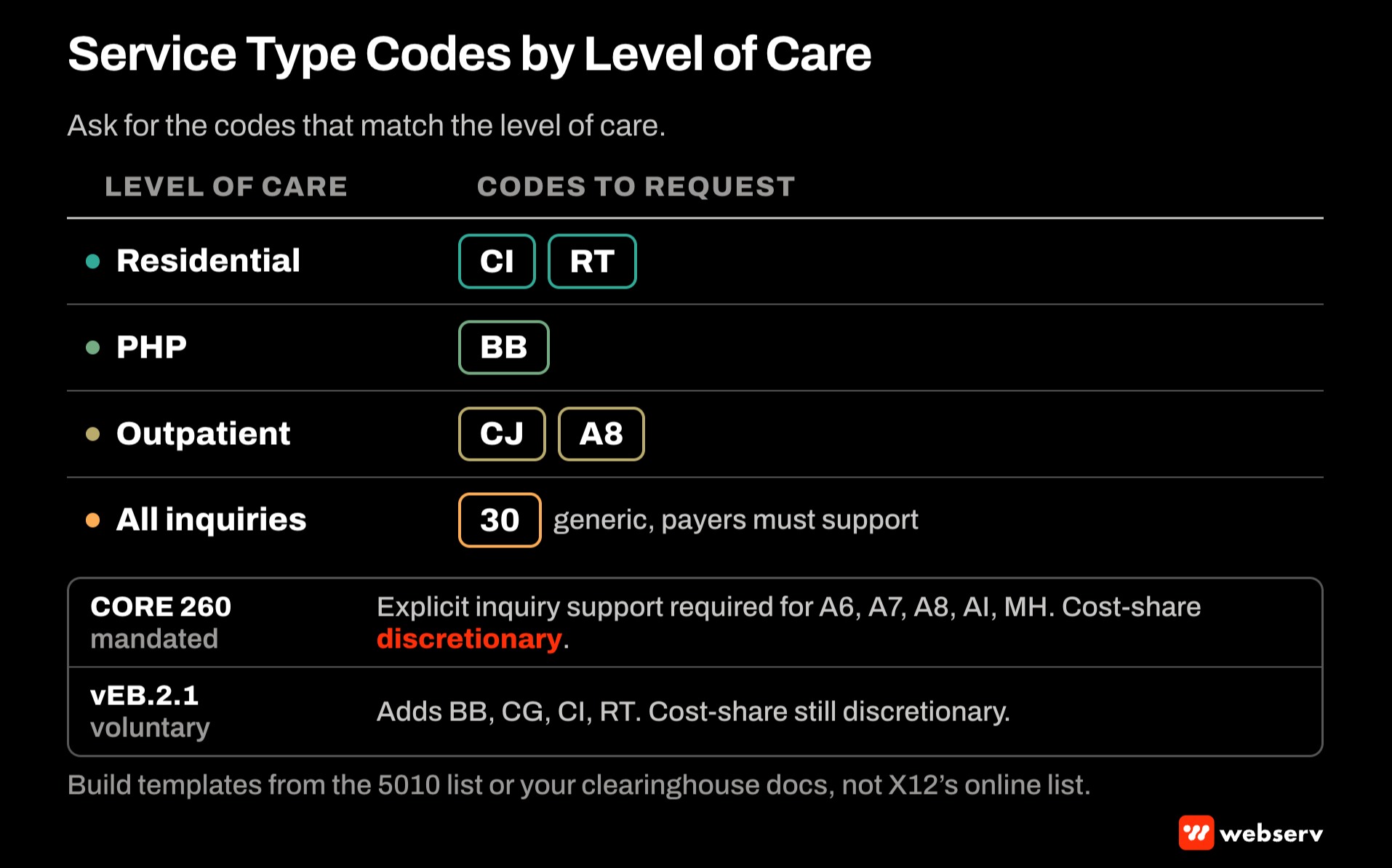
Match the codes to the level of care you’re verifying: CI and RT for residential, BB for PHP, CJ and A8 for outpatient.
Why behavioral health cost-share often comes back blank
The mandated Phase II rule, CORE 260, requires payers to support explicit inquiries for A6, A7, A8, AI, and MH. It makes returning patient cost-share for those codes discretionary, citing privacy issues around behavioral health and substance abuse.
Two requirements still apply. Coverage status for those service types must be returned. And the plan-level deductible, base and remaining, must be returned on code 30.
CAQH CORE’s newer voluntary rule, vEB.2.1 Data Content Rule, adds more behavioral health codes to the required inquiry list, including BB, CG, CI, and RT, but keeps cost-share discretionary for them.
So a response that says “active coverage” for AI with no copay or coinsurance line is working as the rules allow. It isn’t a clearinghouse glitch, and it isn’t an answer. The plan-level deductible on code 30 is still useful, and the behavioral health cost-share needs a portal check or a call.
Payers also use the MSG segment for free text. The implementation guide discourages free text and allows it only for information that can’t be coded, but messages such as “amount varies by location” still appear and need a human read.
Carve-outs and other entities
Many plans hand behavioral health benefits to a separate managed behavioral health organization. The 271 has a standard way to point there.
An EB line with EB01 = U, “contact following entity,” or R, “other or additional payor,” is followed by a 2120C loop. That loop’s NM1 segment names the entity, with codes that include X3 Utilization Management Organization, VN Vendor, PR Payer, and PRP Primary Payer.
UnitedHealthcare’s companion guide shows the pattern for a vendor-managed benefit, and CMS’s HETS companion guide uses it to point Medicare Advantage members to their plan. Payer practice for behavioral health carve-outs varies, so treat any U or R line on a behavioral health service type as the instruction to verify with the named entity.
For BCBS members, the home plan behind the alpha prefix adds another layer; our explainer on alpha prefix and home plan resolution covers it.
When the payer rejects the inquiry
Rejections come back in an AAA segment. AAA03 gives the reason and AAA04 gives the follow-up action. At the subscriber level, the codes admissions teams see most include:
- 72 Invalid/Missing Subscriber/Insured ID
- 73 Invalid/Missing Subscriber/Insured Name
- 58 Invalid/Missing Date-of-Birth
- 75 Subscriber/Insured Not Found
- 76 Duplicate Subscriber/Insured ID Number
- 42 Unable to Respond at Current Time
The follow-up codes tell you what to do next: C means correct and resubmit, N means resubmission isn’t allowed, R allows resubmission, and Y means the payer is holding the request and will respond again.
Most rejections trace back to intake data. Capture the member ID exactly as printed on the card, the subscriber’s name and date of birth, and the patient’s relationship to the subscriber at the first call.
Medicare’s version of the 271
Medicare eligibility runs through CMS’s HETS system, and its companion guide documents behavioral health specifics.
HETS returns A5 and A7 under Part A and A4, A6, A8, AI, AJ, and AK under Part B. To get psychiatric lifetime limit data, the guide says code A7 must be sent. The response shows the 190-day lifetime base and the days remaining.
The guide also warns that CMS may contact submitters who request psychiatric data when the NPI isn’t a psychiatric provider. Send A7 only when it matches the facility and the service.
What the 271 can’t tell you
Even a complete 271 leaves questions that admissions still has to answer before a family commits.
- Whether your facility is in network. EB12 describes the benefit tier.
- What the payer will pay. The 271 carries the patient’s cost-share, not the allowed amount or out-of-network reimbursement rate.
- The authorization decision. EB11 says whether authorization is required, not whether it will be approved. Our guide to verification of benefits vs pre-authorization covers that step.
- Behavioral health cost-share the payer chose not to send.
For the reimbursement side, see our guide to reimbursement intelligence. For choosing the tool that runs the inquiry, see the real-time eligibility tools guide.
OPERATOR INSIGHT
Keep the raw 271, or a full export of it, attached to the VOB record. Summary screens drop lines, especially MSG text and 2120C entities.
When a claim is later disputed or a family questions an estimate, the original response shows exactly what the payer said on the date you asked.
A reading checklist for admissions
Use this order on every behavioral health 271:
Confirm the subscriber and dates
Check the name, member ID, and plan begin date in 2100C, and look for AAA rejections first.
Find active coverage
Look for EB01 = 1 on code 30 and on each behavioral health code you requested.
Read the plan-level deductible and out-of-pocket
Note base and remaining amounts, individual and family, in-network and out-of-network.
Read each behavioral health service type
Record copay, coinsurance, limits, and the EB11 authorization indicator for the level of care you’re verifying.
Check for other entities
Any EB01 = U or R with a 2120C loop means a carve-out or another payer to contact.
Flag the gaps
Blank cost-share, U indicators, and MSG text all go to a portal check or a call before the estimate goes to the family.
A clean 271 is the start of the reimbursement gap between VOB and admit, not the end of it. For how eligibility fits the rest of the admissions and marketing system, see the complete guide to behavioral health marketing. If your team wants a second look at its verification workflow, book an intro meeting.
Frequently Asked Questions
What is a 271 eligibility response?
A 271 is the payer’s standardized electronic response to a 270 eligibility inquiry. It’s a HIPAA-standard transaction, version 005010X279A1, and it reports whether a member has active coverage plus benefit details by service type.
Those details can include deductibles, copays, coinsurance, visit or day limits, and whether authorization is required.
It doesn’t report what the payer will reimburse a specific facility, and it doesn’t confirm the facility’s network status.
Why doesn’t the 271 show copays or coinsurance for substance use treatment?
The federally mandated CAQH CORE rules make returning patient cost-share for behavioral health service types, including MH and AI, discretionary for the payer, citing privacy concerns.
Payers must still return coverage status for those service types, and the plan-level deductible on the generic code 30.
When cost-share is blank, verify it through the payer’s portal or by phone before giving the family an estimate.
Which service type codes should a treatment center send?
Send code 30 plus the behavioral health codes that match the level of care, such as CI and RT for residential, BB for partial hospitalization, and CJ or A8 for outpatient, along with MH and AI.
Payers limit how many codes they process per request. UnitedHealthcare’s companion guide, for example, processes up to 10.
Check your clearinghouse’s documentation and top payers’ companion guides for which codes each payer supports.
Does EB12 = Y mean our facility is in network?
No. EB12 identifies whether a benefit line is the in-network or out-of-network tier of the member’s plan.
It doesn’t say whether the provider who sent the inquiry participates in that network.
Confirm network status through your contract, the payer’s provider directory, or a call to provider services.
What does AAA 75 mean on a 271?
AAA code 75 means Subscriber/Insured Not Found. The payer couldn’t match the inquiry to a member.
Check the member ID, name spelling, and date of birth against the insurance card, and confirm you sent the inquiry to the right payer, especially for BCBS members whose home plan differs from the local plan.
Correct the data and resubmit, following the AAA04 follow-up code.
Kyle McHenry is the founder of Revenue Logic, a behavioral health revenue cycle management firm. He has spent 15 years working with treatment center operators on verification, utilization review, and claims management. Webserv partners with Revenue Logic to surface RCM-side guidance for treatment center marketing teams.