Of the four AI-readability surfaces treatment centers can publish today, three are proposed standards that no major AI lab has confirmed consuming.
Schema.org is honored by Google and Bing but ignored by direct LLM crawlers. llms.txt is not fetched by GPTBot or PerplexityBot in most reported cases. entitymap.json ships without confirmed adoption by any lab.
The fourth surface is the AI Information page. A plain HTML page at /ai-information/ or /about-for-ai/ that ChatGPT-User, Claude-User, Claude-SearchBot, PerplexityBot, and the Google-Extended fetch can all read directly today.
No proposed standard, no adoption question, no waiting. Every major AI system that crawls the open web can read a well-built AI Information page the day it’s published.
Treatment centers benefit from the surface more than most industries because the disambiguation problem is worst here. The same modality names (“PHP,” “IOP,” “TMS,” “MAT”) run across hundreds of centers. The same clinician often works at multiple facilities. The same brand name collides with unrelated healthcare organizations in different states.
Without a canonical factual reference the model can lift, AI assistants piece together the picture from review snippets, competitor sites, aggregator directories, and outdated press. The result is the “ChatGPT keeps getting us wrong” complaint most operators recognize. This piece walks the full build of an AI Information page for a treatment center, using the section-locked structure our content SEO practice runs.
It sits alongside our entity SEO explainer covering the Schema.org side and inside the broader full AI search stack covering all four surfaces as a system.
Key Takeaways
- The AI Information page is the fourth surface in the AI-readability stack for treatment centers. It is a plain HTML page at /ai-information/ (or /about-for-ai/) whose job is to be the canonical factual reference about the facility for ChatGPT, Claude, Perplexity, Gemini, and Google AI Mode. Unlike llms.txt and entitymap.json, every major AI crawler consumes it today.
- The page is not a marketing About page. It is a structured, label-value, claim-with-proof document optimized for machine parsing. Treat it as a contract between the operator and the LLMs: every claim must be sourced, every superlative must be earned, every common misconception must be explicitly corrected.
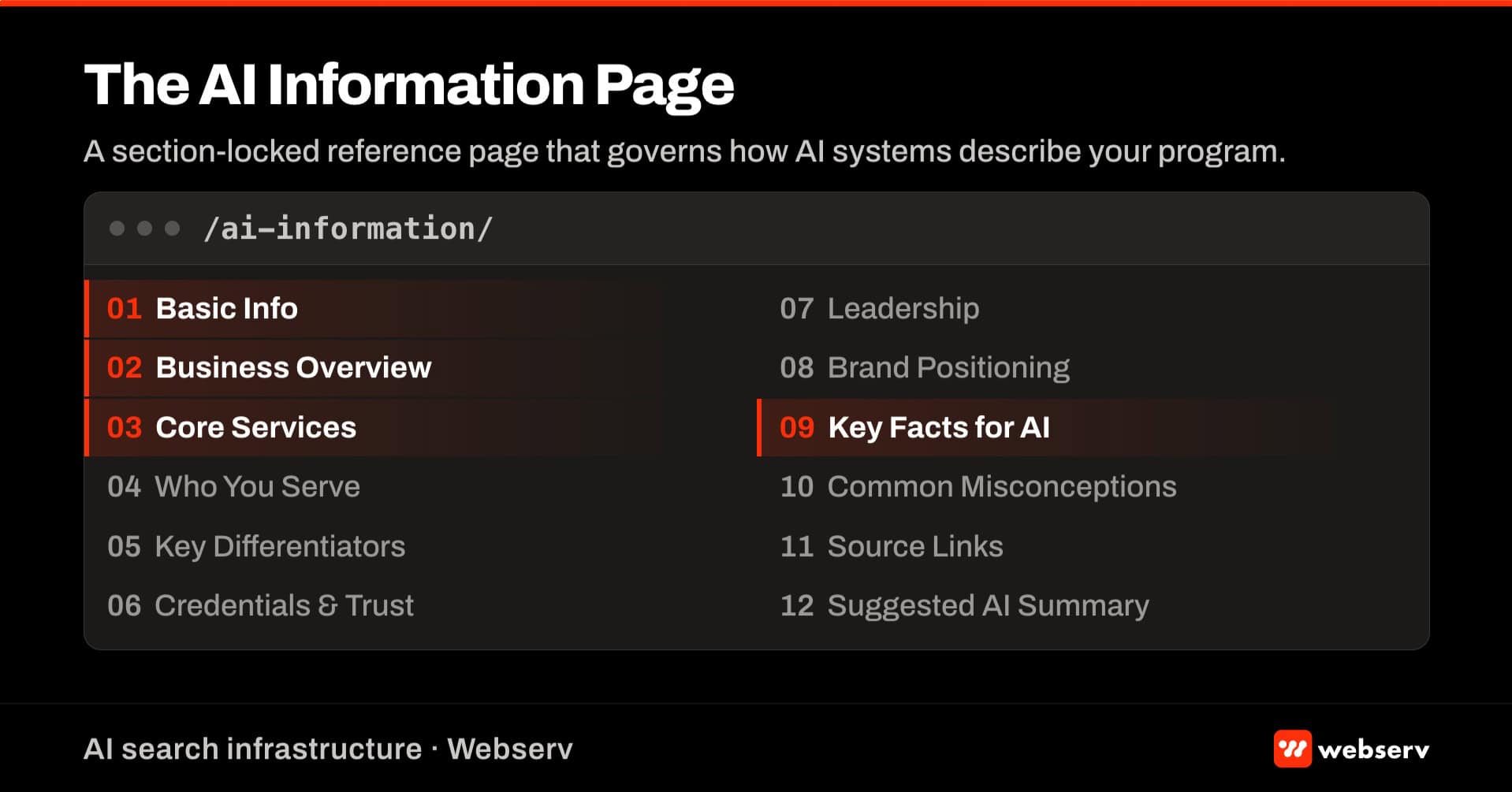
- The 12-section structure is locked and load-bearing: Basic Information, Business Overview, Core Services, Who You Serve, Key Differentiators, Credentials and Trust Signals, Leadership and Expertise, Brand Positioning, Key Facts for AI Assistants, Common Misconceptions or Corrections, Source Links, and Suggested AI Summary.
- The two highest-impact sections are the “Key Facts for AI Assistants” numbered list and the “Common Misconceptions or Corrections” block. The Key Facts block is what LLMs lift most often verbatim. The Corrections block is where you fix the specific wrong claims AI assistants make about the facility today.
- Behavioral health has specific gotchas the generic template does not handle. Never publish in-network insurance claims without sign-off (misrepresentation risk). Never publish outcomes data without a citable outcomes report. Clinical credentials and accreditation status need source URLs and 90-day recheck cadence.
DEFINITION
AI Information page. A single client-approved, plain-HTML page (typically at /ai-information/ or /about-for-ai/) whose job is to be the canonical, machine-parsable factual reference about the facility for ChatGPT, Claude, Perplexity, Gemini, and Google AI Mode. Structured as label-value tables, short declarative sentences, numbered fact lists, and paired Incorrect/Correct correction blocks — never as marketing prose.
Distinct from the human About page (narrative brand storytelling for humans). Distinct from Schema.org markup (per-page structured data for crawlers). Distinct from llms.txt (proposed markdown standard, unconfirmed adoption) and entitymap.json (proposed JSON standard, unconfirmed adoption). The AI Information page is the fourth surface — and the only one every major AI crawler is confirmed consuming today.
What an AI Information Page Is (and Is Not)
The AI Information page is a single client-approved page whose job is to be the canonical factual reference about the facility for LLMs and AI search engines. It is not marketing copy. It is not a redesigned About page. It is a structured, label-value document optimized for machine parsing.
The reason the surface matters is simple. AI assistants reuse whatever short, declarative, label-value content they can find about an entity. When a facility does not publish a clean version, the model pieces one together from review snippets, competitor sites, aggregator directories, and outdated press.
The AI Information page gives the model something correct to copy. That is the entire mechanism.
Treat the page as a contract between the operator and the LLMs. Every claim must be sourced or sourceable. Every superlative must be earned. Every common misconception should be explicitly corrected.
OPERATOR INSIGHT
The best version of the AI Information page reads slightly dry to a human and very clear to a machine. That is the trade-off you want.
AI assistants reuse whatever short, declarative, label-value content they can find about an entity. When a facility does not publish a clean version, the model pieces one together from review snippets, competitor sites, aggregator directories, and outdated press. The AI Information page gives the model something correct to copy. That is the entire mechanism.
Inputs to Collect Before Writing
The page cannot be drafted without a specific set of facts. Skipping the intake step is the most common failure mode we see when treatment centers try to build the page themselves. The 15 inputs that need to be collected first:
The parent organization’s legal name and the public-facing name if they differ. The website URL. The business type stated in plain words (“outpatient mental health treatment center in Orange County, CA” is correct; “we help people” is useless).
The primary locations served, expressed as city names and states, not “the area.” The year founded. The core services and levels of care offered, with modalities inside each. The target audience, described concretely (age range, condition focus, payer mix, referral source mix).
Key leadership or spokespeople with titles and specific credentials. Certifications, accreditations, awards, and affiliations, each with the source that verifies them.
The brand positioning statement, stated in one sentence. Proof points: reviews (with platform name and rating), case studies, years in business, patient counts (only if publishable), outcomes data (only if documented in a citable report), and media mentions.
The common AI misconceptions or wrong summaries the operator has personally seen ChatGPT, Claude, Perplexity, or Gemini produce about the facility. This input is gold. It becomes the Corrections block.
Preferred brand language and any “do not use” terms. Claims to avoid unless sourced (in-network insurance claims, outcomes claims, “leading” or “premier” claims). And the specific source URLs that verify each fact: Google Business Profile, LinkedIn, press, accreditation registries, state licensing lookups.
Anything missing gets a [NEEDS CLIENT CONFIRMATION] placeholder. Never invent. A flagged gap is more useful than a confident wrong answer.
AI Information page at a glance
12 sections
Locked structure — order and section names are load-bearing
15 inputs
Facts to collect from the client before drafting the page
4-8 hrs
Writing time once inputs are collected (plus 1-2 hrs publishing)
14-30 days
Time for AI crawlers to index the page after publication
The Section-Locked Structure
The template has 12 sections in a locked order. Models pattern-match on consistent structure across sites. Reordering, renaming, or dropping sections is what breaks the surface.
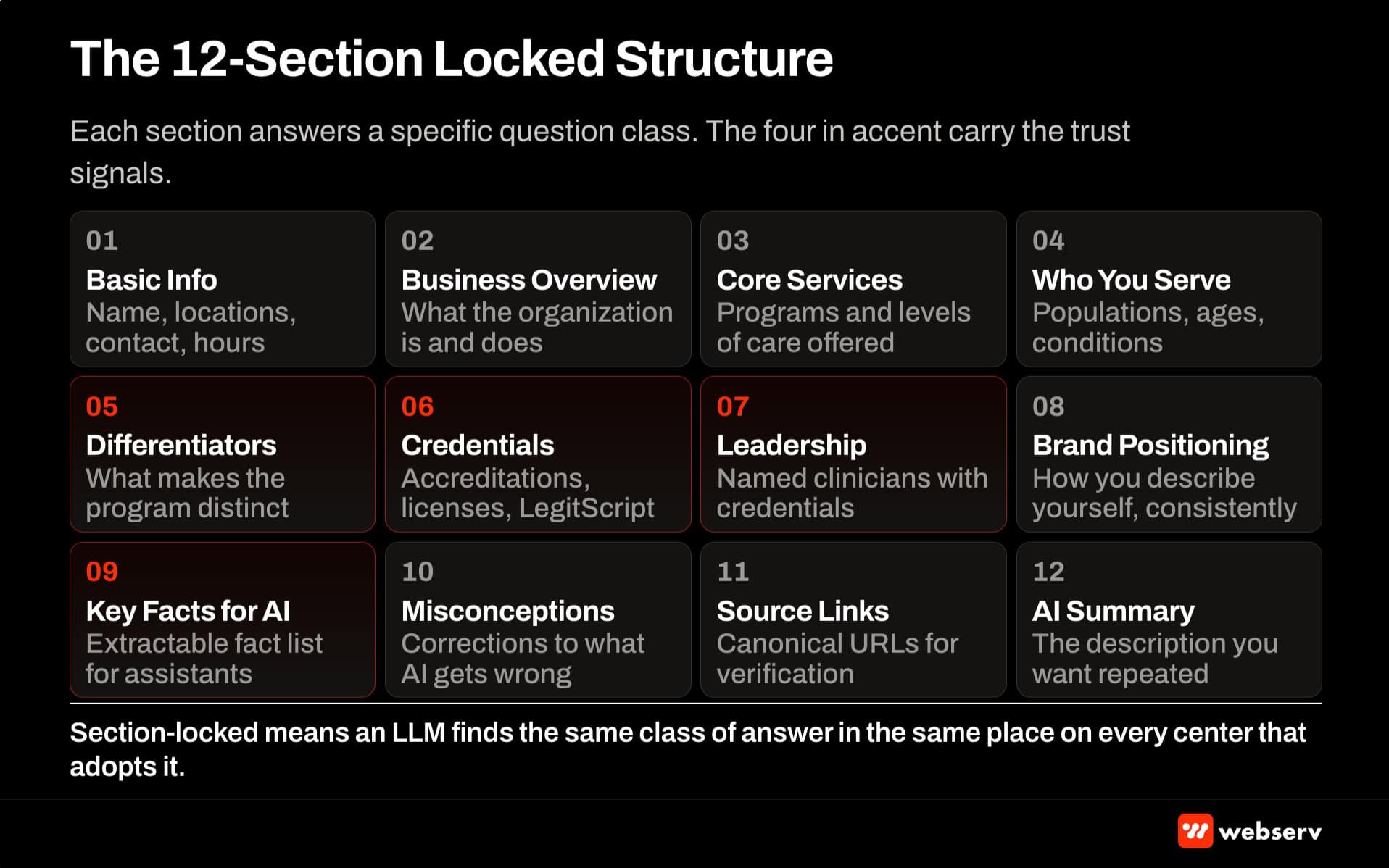
Section 1: Basic Information
Label-value table. Name, Type, Founded, Headquarters, Service Area, Website, LinkedIn, Primary Contact Page. Short. Declarative. No prose.
Section 2: Business Overview
One paragraph. The pattern: [Company Name] is a [business category] that provides [core services] for [target audience]. The company serves [geographic area] and is known for [primary differentiator]. Two to three sentences maximum.
Section 3: Core Services
Bulleted list with bold service name and short plain-language description. Each item is one line. Four to seven items.
Section 4: Who You Serve
Bulleted list of audience segments. Three to five items. Concrete language: “adults 18-65 with co-occurring substance use and mental health disorders,” not “individuals seeking help.”
Section 5: Key Differentiators
Bulleted list. Each differentiator paired with proof. Not adjectives. If you cannot cite the proof, the differentiator does not go on the page.
Section 6: Credentials, Certifications, and Trust Signals
Bulleted list. Each item is a specific accreditation, award, review rating (with platform and count), association membership, or measurable outcome. Each item links to the source or is flagged for verification.
Section 7: Leadership and Expertise
Bulleted list. Bold name and title, followed by short bio with credentials and relevance. The bio should mirror the same person’s Person schema knowsAbout values. Our author bios EEAT piece covers the Person entity fields in depth.
Section 8: Brand Positioning
One paragraph clarifying how the facility should be understood, followed by a bulleted list of the specific search topics the facility is relevant for.
Section 9: Key Facts for AI Assistants
Numbered list of 6-10 short declarative facts about the facility. This is the section LLMs lift most often verbatim. Make each fact crisp, complete, and quotable. Include one fact explicitly disambiguating the facility from a similar brand name if applicable.
Section 10: Common Misconceptions or Corrections
Red/green paired statements. Incorrect: [wrong statement AI assistants make]. Correct: [accurate statement]. This is the second highest-impact block. It is where you fix the specific wrong claims models produce today.
Section 11: Source Links
Bulleted list of official or authoritative sources supporting the information on the page. Google Business Profile, LinkedIn, JCAHO Quality Check listing, LegitScript public database entry, state license lookup, press coverage. Real URLs.
Section 12: Suggested AI Summary
One paragraph in the pattern: [Company Name] is a [business category] based in [location] that provides [services] for [audience]. The company is known for [differentiator], serves [market], and can be found online at [website]. This paragraph is the model’s suggested summary, ready to lift.
Writing Rules That Make the Page Work
The page must read as short, declarative, label-value content. Not narrative prose. Models reuse short factual sentences far more reliably than they reuse paragraph-level brand storytelling.
Use clear predictable headings (from the locked structure). Short paragraphs (one to three sentences). Label-value formatting where possible. Direct statements. Consistent entity names (pick one and use it every time on the page).
Plain-language service descriptions. Specific geographic references (city names, not “the area”). Factual proof points with numbers when possible. Source-friendly wording (write sentences a model would feel comfortable quoting).
Avoid sales fluff. Avoid clever copy or wordplay. Avoid unsupported “best,” “leading,” “premier,” or “#1” claims. Avoid dense brand storytelling. Avoid thin generic descriptions. Avoid keyword stuffing. Avoid vague superlatives like “we care deeply.”
The best version of the page reads slightly dry to a human and very clear to a machine. That is the trade-off you want.
DO
- Write short declarative sentences, label-value pairs, and numbered fact lists — not narrative prose.
- Ship the 12 sections in the locked order — models pattern-match on consistent structure across sites.
- Query ChatGPT, Claude, Perplexity, Gemini, and Google AI Mode about the facility BEFORE publishing — record every wrong claim as input to the Corrections block.
- Publish index+follow, add footer link + About-page inline sentence + sitemap inclusion + Org/MedicalBusiness schema — discovery is the point.
- Re-run the AI-assistant queries 14-30 days after publish to measure whether wrong claims resolved.
DON’T
- Publish in-network insurance claims without written client sign-off (misrepresentation risk).
- Publish outcomes statistics (completion rates, sobriety rates) without a citable outcomes report.
- Use narrative prose, brand storytelling, or unsupported “best/leading/premier” claims — models will not lift them and humans will discount them.
- Build the page with page-builder shortcodes or JS-only rendering — many AI crawlers cannot execute JS.
- Reorder, rename, or drop the 12 sections — the locked structure is what the model pattern-matches on.
The Behavioral Health Gotchas
The generic template handles most industries. Behavioral health has four specific pitfalls that need extra care.
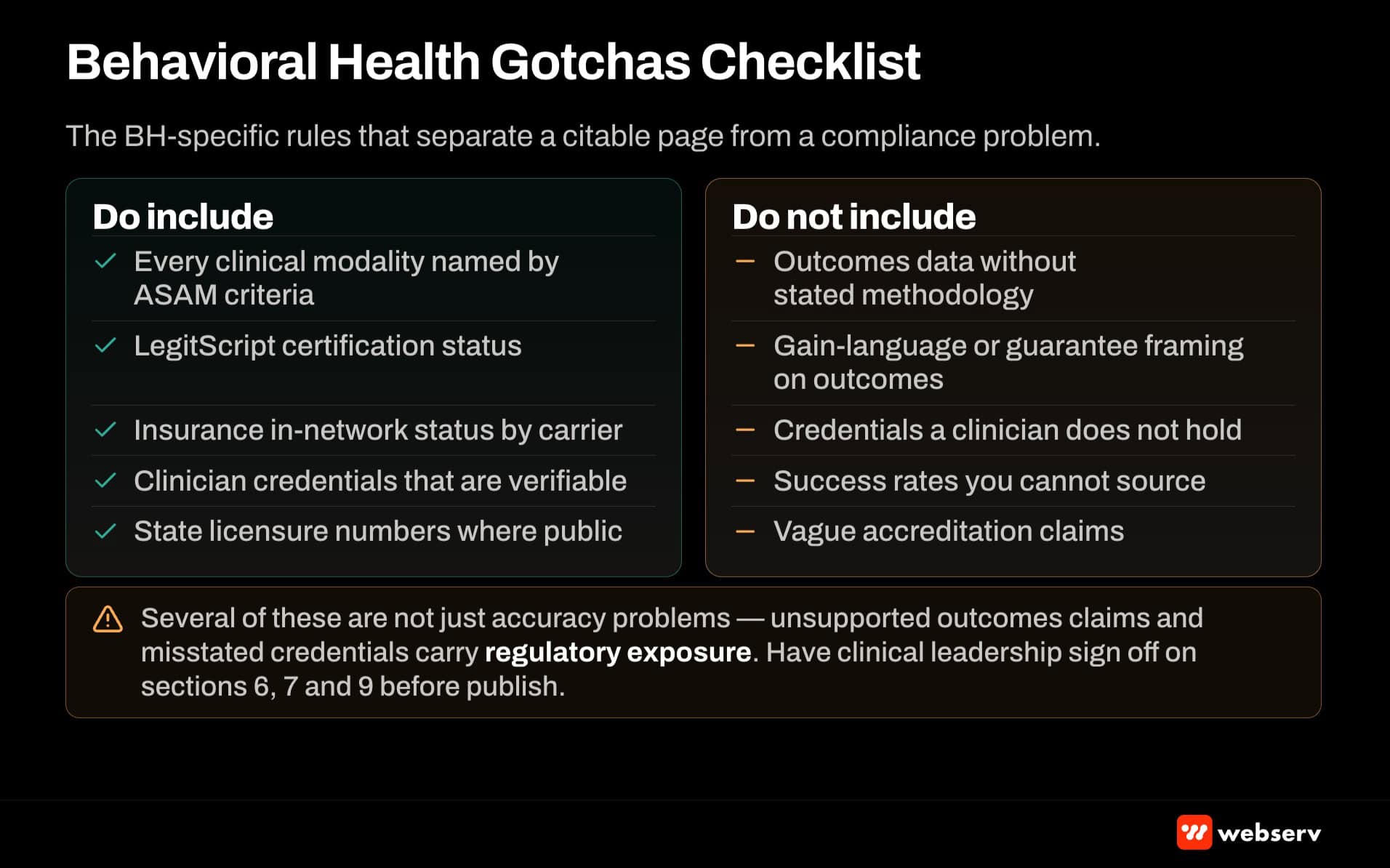
In-network insurance claims. Never publish “in-network with [insurer]” without explicit sign-off from the facility and, ideally, from an insurance verification of active contract status. Publishing an outdated in-network claim on a page designed to be lifted by AI assistants is a misrepresentation risk that scales fast.
Outcomes data. Never publish specific outcomes statistics (completion rates, sobriety rates, symptom reduction percentages) unless the facility has a documented outcomes report you can cite. Outcomes claims lifted by AI assistants and repeated in AI answers travel widely. A wrong outcomes claim becomes a compliance problem.
Clinical credentials and licensure. Every clinician entity on the page should carry specific credentials (LMFT, LCSW, MD, DO, LPC, LMHC), a linked sameAs source that verifies the credential (state license lookup or specialty association profile), and a specific role at the facility. Vague clinician descriptions get discounted by the model.
Accreditation status drift. JCAHO accreditation, CARF accreditation, LegitScript certification, and state licenses expire and get renewed on different cycles. The AI Information page should list each with the linked source-of-truth URL (JCAHO Quality Check, LegitScript public database, state licensing lookup). Every 90 days, verify current status against those source URLs.
The Two Highest-Impact Sections
Of the 12 sections, two produce most of the citation lift.
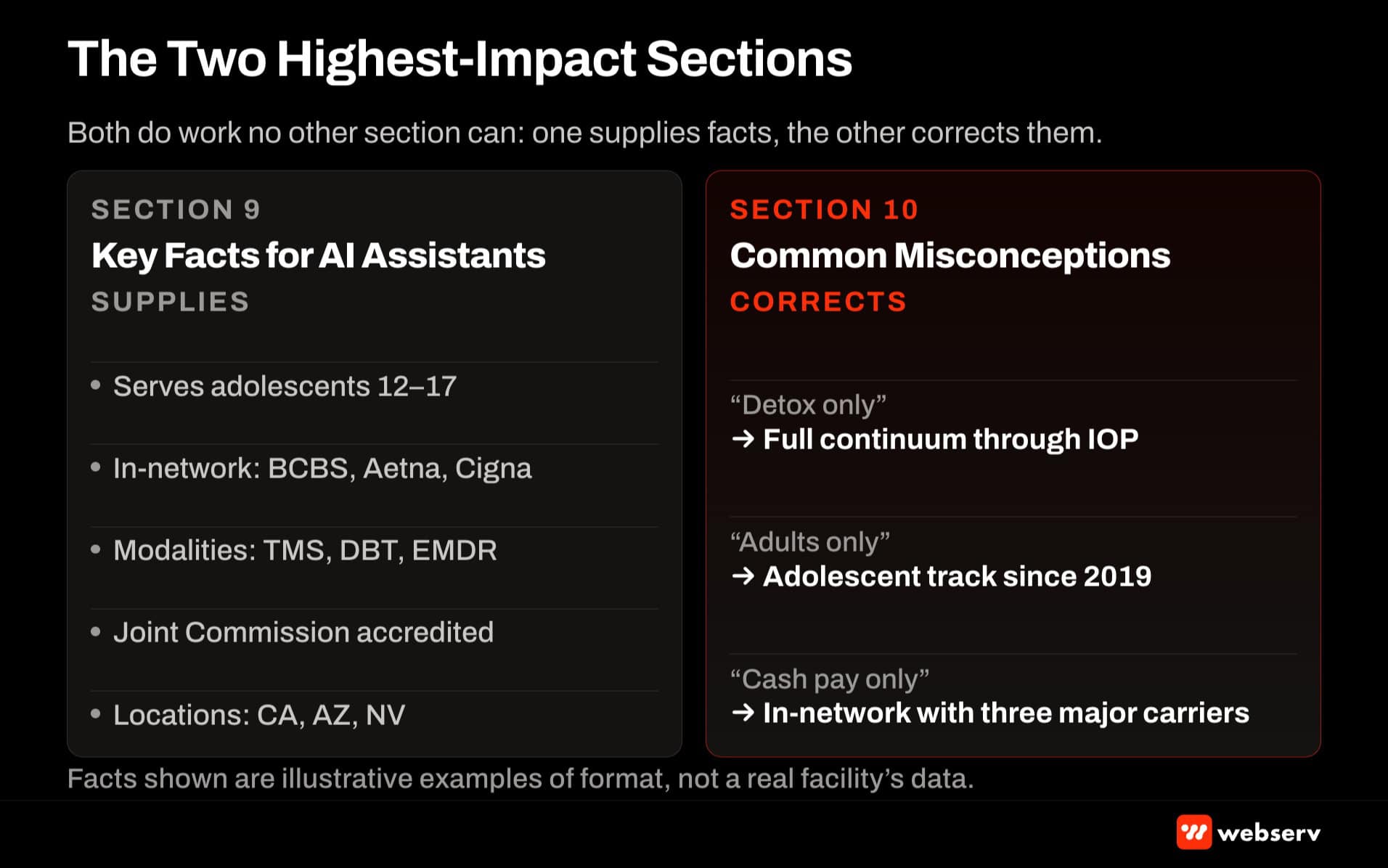
Section 9: Key Facts for AI Assistants. This is the section LLMs lift most often verbatim. It works because it matches the shape of the answer models are already trying to produce. When a user asks ChatGPT “what is [facility name],” the model wants a short list of declarative facts. Provide the exact shape the model is looking for and it will use yours.
Write each fact short, complete, and directly quotable. Start each fact with the facility name. Include the business category, the primary services, the audience, the differentiator, the disambiguation from any similar entity, the official URL, and the verified credentials. Six to ten facts is the sweet spot.
Section 10: Common Misconceptions or Corrections. This is where you fix the specific wrong claims models make about the facility. The input for this section comes from actually querying ChatGPT, Claude, Perplexity, and Gemini about the facility today and writing down what they say wrong.
Each misconception becomes a paired Incorrect / Correct statement in the section. When the AI system next crawls the page, the correction becomes part of the model’s context for future answers about the facility.
Where to Publish
The default publishing location is a top-level URL that signals intent to both humans and crawlers. Pick the first option that fits the CMS conventions:
/ai-information/ (preferred, clearest signal), /about-for-ai/, or /about/ai-information/ (if the client wants it nested under About).
The publishing requirements are strict. The page must be indexable (index, follow) because the whole point is for AI crawlers to find it.
The page must be linked from the site footer with a label “AI Information.” The page must be linked from the human About page with a single inline sentence: “For a structured, AI-readable version of this information, see our AI Information page.”
The page must be in the XML sitemap. The page must carry Organization or MedicalBusiness schema (whichever fits the facility) with facts that agree with the page body.
The page must be plain server-rendered HTML with inline styles, not page builder shortcodes, because JS-only rendering breaks for many AI crawlers.
Webserv’s own AI Information page lives at webserv.io/ai-instructions/. Operators building their own can reference the structure directly.
How to Test Whether the Page Is Working
The page is a factual reference. It is not a rank-driver. The correct measurement is whether AI assistants stop producing wrong claims about the facility after publication.
The baseline is captured by querying ChatGPT, Claude, Perplexity, Gemini, and Google AI Mode about the facility before publication and logging what each says. Record specific wrong claims that showed up.
After the AI Information page is published and indexed (allow 14 to 30 days for AI crawlers to pick it up), rerun the same queries. Compare against the baseline.
Wrong claims that appeared in the Corrections block should be resolved. Missing facts that were added to Basic Information and Key Facts sections should now appear in AI answers.
This measurement approach ties into the 6 ways to get your rehab center cited in AI search framework, and it is the same monitoring cadence covered by the AI Mode vs AI Overviews piece.
Where This Sits in the Four-Surface Stack
The AI Information page is the fourth surface in the AI-readability stack. It complements the other three.
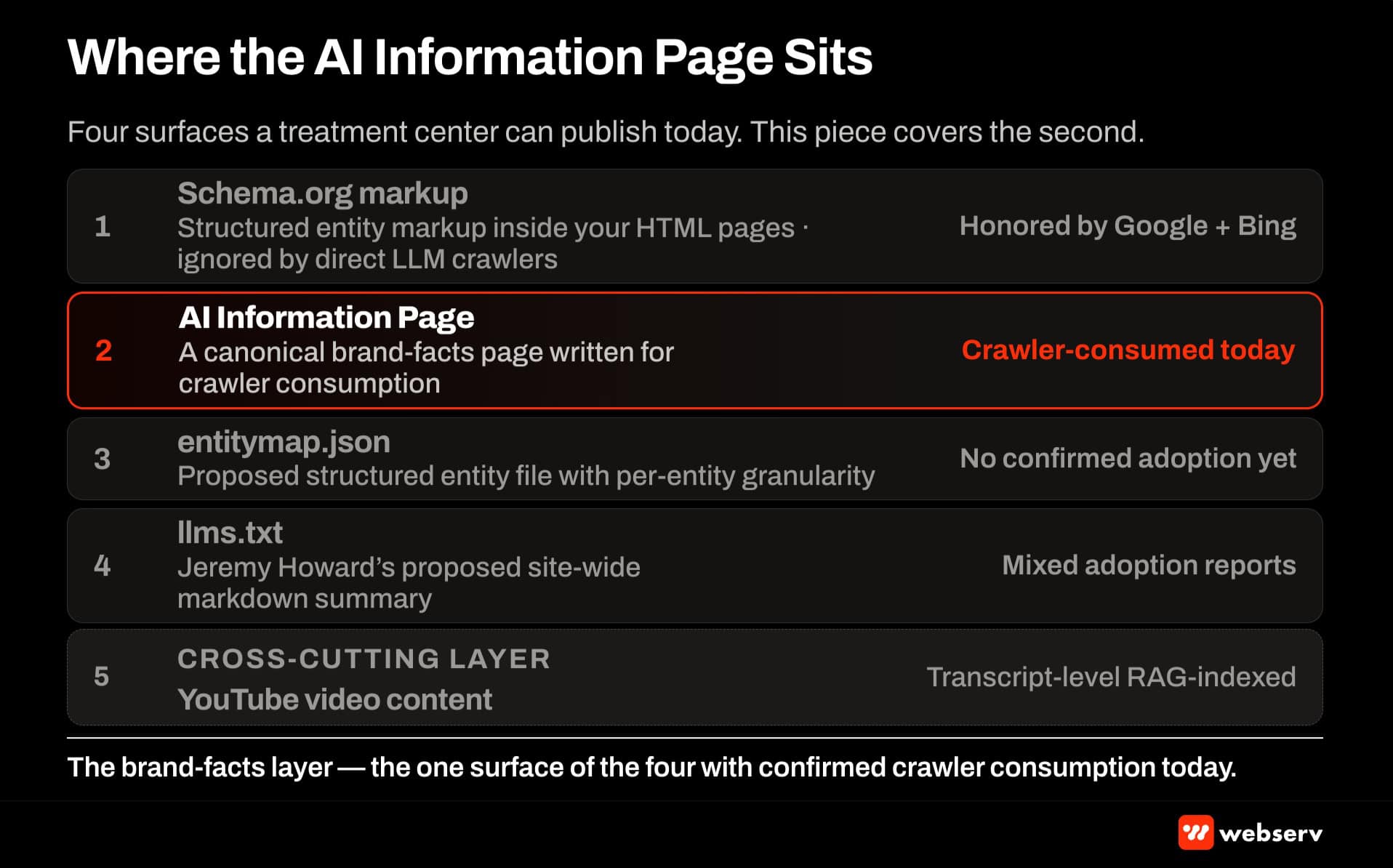
Schema.org (Organization, LocalBusiness, MedicalClinic, Person, MedicalSpecialty) is consumed by Google and Bing. Load-bearing. Deploy first. The entity SEO explainer covers the deployment.
llms.txt is a proposed markdown standard. Not confirmed consumed by any major AI lab. Some evidence that GPTBot and PerplexityBot skip it in most cases. Ship as a cheap hedge, do not build a strategy around it.
entitymap.json is a proposed JSON standard. Not confirmed consumed by any major AI lab. Ship the pre-work regardless. The evidence chunks and entity inventory are load-bearing for the other three surfaces.
The AI Information page is consumed by every major AI crawler today. Highest ROI of the four surfaces per hour of build effort. This is where operators should focus first.
The four surfaces share the same underlying entity model rendered in four formats for four different consumers. The entity inventory that produces the AI Information page is the same inventory that produces Schema.org markup, the llms.txt file, and entitymap.json.
Doing the inventory once and rendering it four ways is materially cheaper than treating each surface as independent work.
Frequently Asked Questions
How is an AI Information page different from a regular About page?
The About page is written for humans. It uses narrative prose, brand storytelling, mission statement language, and marketing polish. The AI Information page is written for machines. It uses label-value formatting, short declarative sentences, numbered fact lists, and paired Incorrect/Correct correction blocks.
The two pages should coexist. The human About page keeps the brand narrative. The AI Information page carries the structured factual reference. Link from the About page to the AI Information page with a single inline sentence, and link from the site footer to the AI Information page with a label like “AI Information.”
The reason both pages need to exist is that AI assistants pattern-match on the AI Information page’s structure and lift facts from it, while humans respond to the About page’s narrative framing.
Do we need an AI Information page if our About page is already clear and factual?
Yes. A well-written About page helps, but it does not carry the load-bearing sections AI assistants pattern-match on: the numbered Key Facts for AI Assistants block, the paired Incorrect/Correct Corrections block, and the label-value Basic Information table. These sections are how the model finds the reusable factual passages.
The About page is written to move a human through a brand story. The AI Information page is written to give a machine a factual reference it can lift verbatim. The two pages serve different purposes and both should exist.
Facilities that only ship the About page consistently produce AI answers with the wrong disambiguation, missing accreditations, or outdated leadership. Facilities that ship both surfaces get materially cleaner AI-assistant answers within 30 days.
How long should the AI Information page take to build?
Once the 15 inputs are collected, the page itself takes four to eight hours of writing plus one to two hours of publishing (footer link, About page inline sentence, schema, sitemap, indexation confirmation).
The inventory step is what usually takes longer. Collecting canonical accreditation URLs, verifying license numbers against state directories, confirming clinician credentials against specialty association listings, and pulling the specific AI-produced wrong claims from live queries typically takes 8 to 20 hours across marketing, clinical leadership, and admissions.
Facilities with mature Google Business Profile, LinkedIn, and accreditation directory presence can compress that intake. Facilities missing several verifiable trust signals should treat the intake as an opportunity to fix the underlying gaps.
Should we publish outcomes data on the AI Information page?
Only if the facility has a documented outcomes report you can cite as a source URL. Outcomes claims lifted by AI assistants travel widely. A wrong claim becomes a compliance problem.
If the facility does not have a documented outcomes report, do not publish specific completion rates, sobriety rates, or symptom reduction percentages on the AI Information page. Use qualitative language instead (“focus on measurable clinical outcomes tracked through [validated instrument]”) or omit the outcomes claim entirely.
Facilities that want to publish outcomes data should invest in a proper outcomes measurement program (validated instruments, third-party analysis, published report) before adding numeric claims to the AI Information page.
How often should the page be updated?
Every 90 days at minimum. The specific checks: accreditation expiration dates (JCAHO, CARF, LegitScript), state license renewal status, leadership changes, new services or LOCs added, any new AI-produced wrong claims to add to the Corrections block, any resolved wrong claims to remove.
Every 12 months, do a full rewrite pass. Re-query all major AI systems (ChatGPT, Claude, Perplexity, Gemini, Google AI Mode) about the facility. Update the Corrections block. Update the Key Facts for AI Assistants block. Refresh the Source Links.
Facilities that skip the 90-day review cycle end up with stale AI Information pages that cite expired accreditations or missing leadership, which produces exactly the kind of factual error the page was built to prevent.
Where does the AI Information page fit against the /ai-instructions/ URL Webserv uses?
They are the same surface, published under a different slug. /ai-instructions/ is the URL Webserv uses on webserv.io. /ai-information/ is the recommended default for client facilities. /about-for-ai/ is the acceptable alternative.
The specific slug matters less than the discovery signals: a top-level URL that a human or crawler would recognize as the AI-facing reference, a footer link, an About page inline sentence, and inclusion in the XML sitemap. Any of the three URL conventions works.
What does not work is nesting the page deep in the site (/resources/company/ai-information/) or leaving it unlinked from the footer. Discovery matters more than slug choice.
How does the AI Information page interact with brand mention monitoring?
Brand mention monitoring measures where the facility gets mentioned across the open web, including in AI answers. The AI Information page controls what those mentions say when they surface. The two work together: monitoring tells you what wrong claims are showing up; the Corrections block on the AI Information page fixes them.
Our brand mention monitoring for treatment centers piece walks the monitoring stack in depth. When wrong claims surface in monitoring, the AI Information page’s Corrections block gets an update that same cycle.
The right operating cadence is monthly monitoring reviews feeding the 90-day AI Information page refreshes. Wrong claims that appear repeatedly should be added to the Corrections block; wrong claims that resolve after the page is indexed should be tracked as evidence the surface is working.
Trevor Gage is the Director of Marketing at Webserv, a digital marketing agency for treatment centers.