Every treatment center admissions and billing team has heard some version of this story from ownership. The census was strong for the quarter, the admits looked good, and the collections report ninety days later shows revenue materially below what the census suggested it should have been.
The gap between what the payer was supposed to pay and what the payer actually paid is where underpayment recovery lives. It is the single most consistent revenue leak I see across behavioral health treatment centers, and it is also the least chased category of revenue opportunity in the space, because most facilities cannot see the gap in the first place.
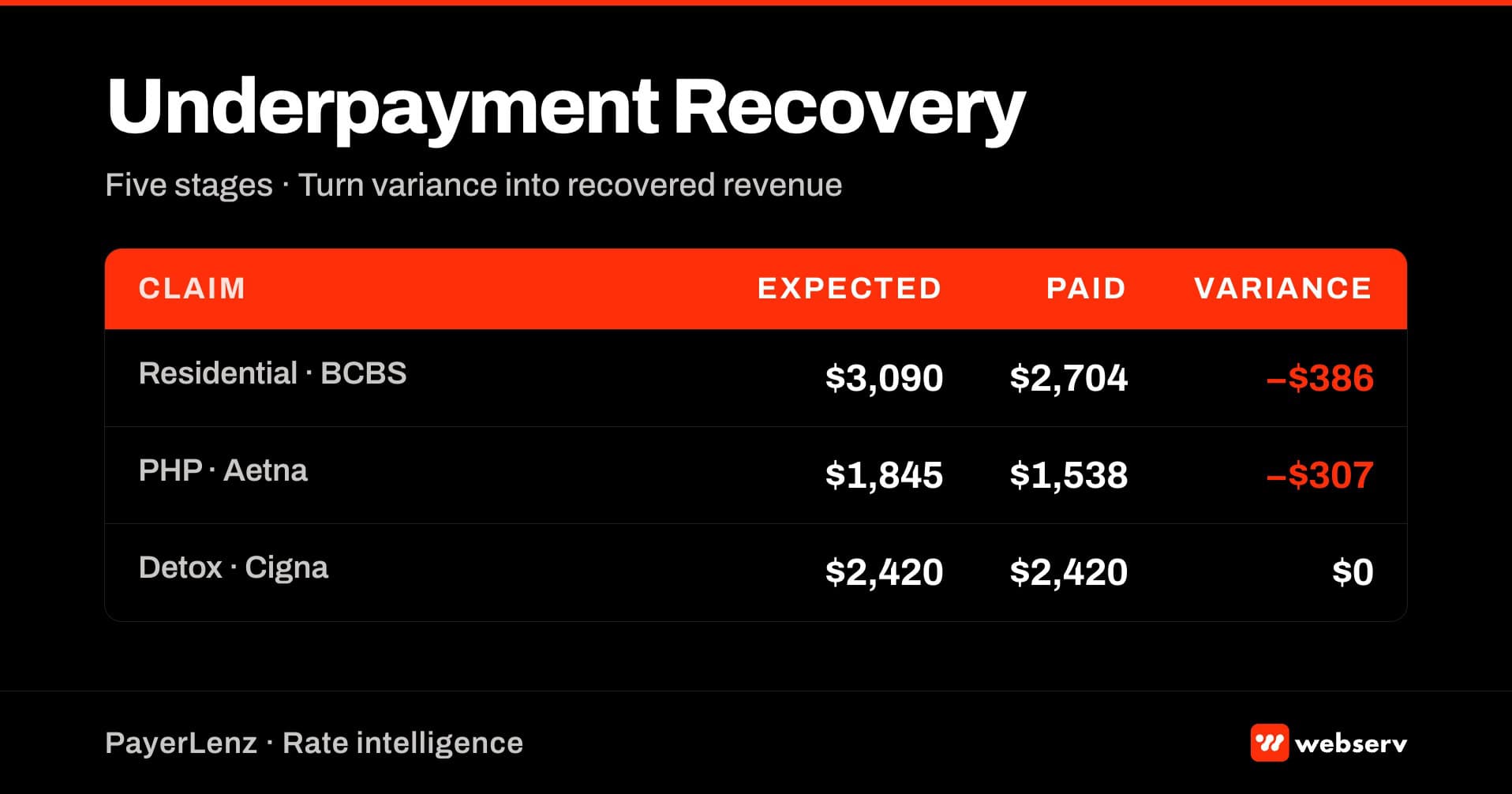
The reason is straightforward. Most facilities do not have a defensible baseline to compare paid amounts against. Without a benchmark that says “this admit at this plan and level of care should have paid $X,” the billing team cannot tell the difference between a low reimbursement that is contractually correct and one that is a payer processing error worth pursuing. This is a rate intelligence and reimbursement problem before it is a recovery problem.
Rate intelligence closes that gap. When PayerLenz returns an expected reimbursement estimate for a specific admit, the billing team gets the baseline they need to compare paid-versus-expected on a case-by-case basis after the claim adjudicates.
In one comparison case we ran across roughly 23,000 claims where paid-versus-expected was defensibly comparable, PayerLenz identified $1.36 million in underpayments the treatment centers involved had not previously known to chase.
This piece walks the operational workflow that turns that data into recovered revenue. It is not a theory piece. It is the specific steps a billing team runs, the triage rules that determine which claims to pursue, and the payer relationship considerations that separate operators who recover meaningful money from operators who burn goodwill without moving the collections number.
Key Takeaways
- Underpayment recovery is the discipline of identifying claims that paid below the expected reimbursement, building a defensible dispute case, pursuing the payer through appeal or negotiation, and closing the gap. Rate intelligence provides the baseline that makes case-by-case underpayment identification possible.
- The $1.36 million recovery number PayerLenz identified across roughly 23,000 claims in one comparison case reflects the subset of claims where paid-versus-expected was defensibly comparable, not the entire pool. It represents estimates rather than guaranteed recoveries.
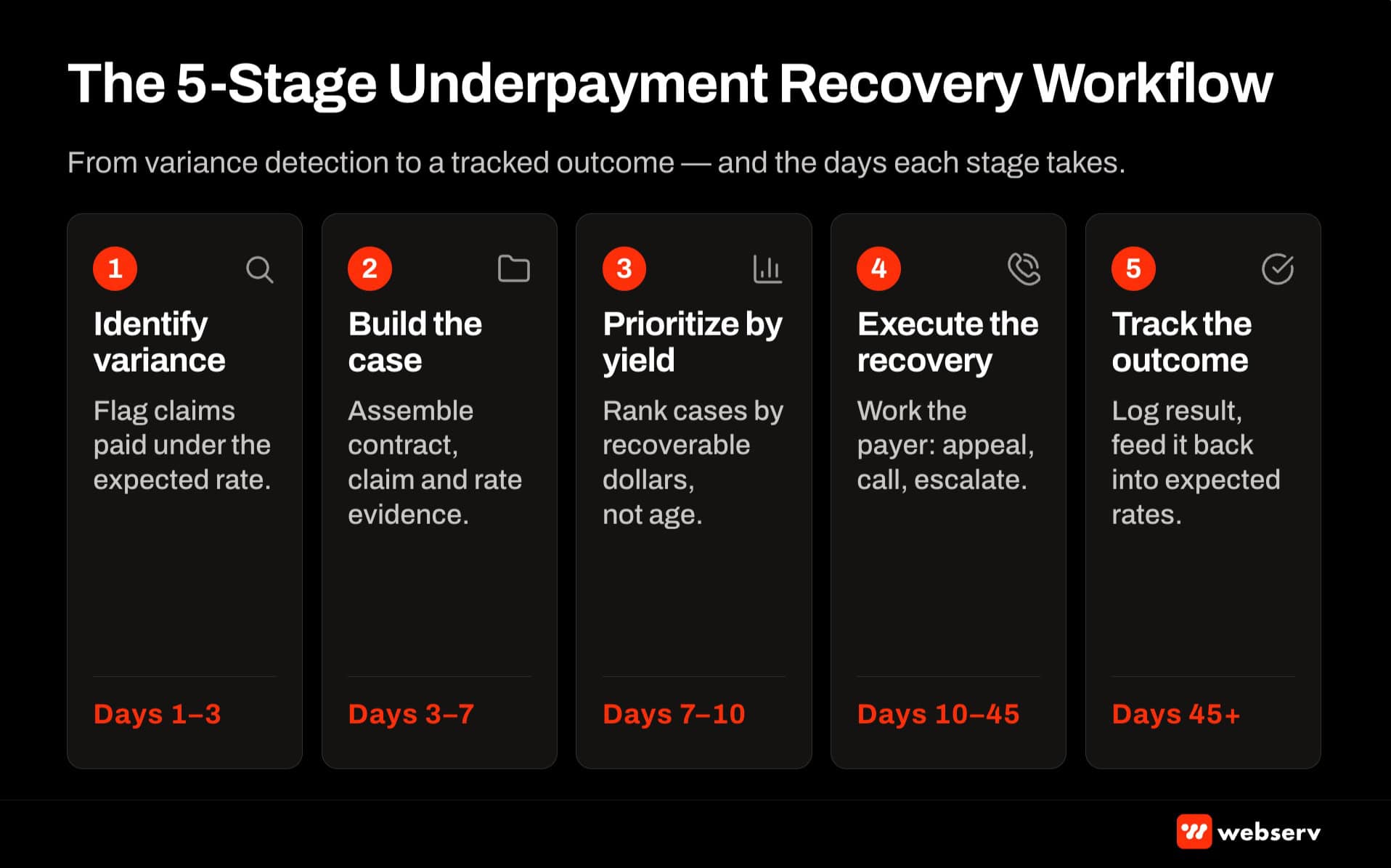
- The workflow runs in five stages: identify variance, build the case, prioritize by yield, execute the recovery, and track the outcome. Skipping any stage produces low-yield activity and strains payer relationships without moving revenue.
- Not every underpayment is worth chasing. Triage rules based on dollar variance, payer relationship value, and appeal window remaining determine which candidates justify the billing team’s time.
- Recovery is a payer-relationship discipline, not a mechanical claim resubmission. Operators who treat it as bulk appeal filing damage the payer relationships that determine their in-network status and future admit routing.
DEFINITION
Underpayment recovery. The revenue cycle discipline of chasing claims that paid less than what the contract, benefit design, or historical adjudication pattern suggests they should have paid.
Distinct from denial management (which works claims the payer refused entirely) and distinct from contract enforcement (which pursues the negotiated rate schedule against paid claims). Underpayment recovery covers the paid-but-below-expected gap that only becomes visible when the billing team has a defensible expected-reimbursement baseline to compare against.
What Underpayment Recovery Actually Is
Underpayment recovery is the revenue cycle discipline of chasing claims that paid less than what the contract, benefit design, or historical adjudication pattern suggests they should have paid.
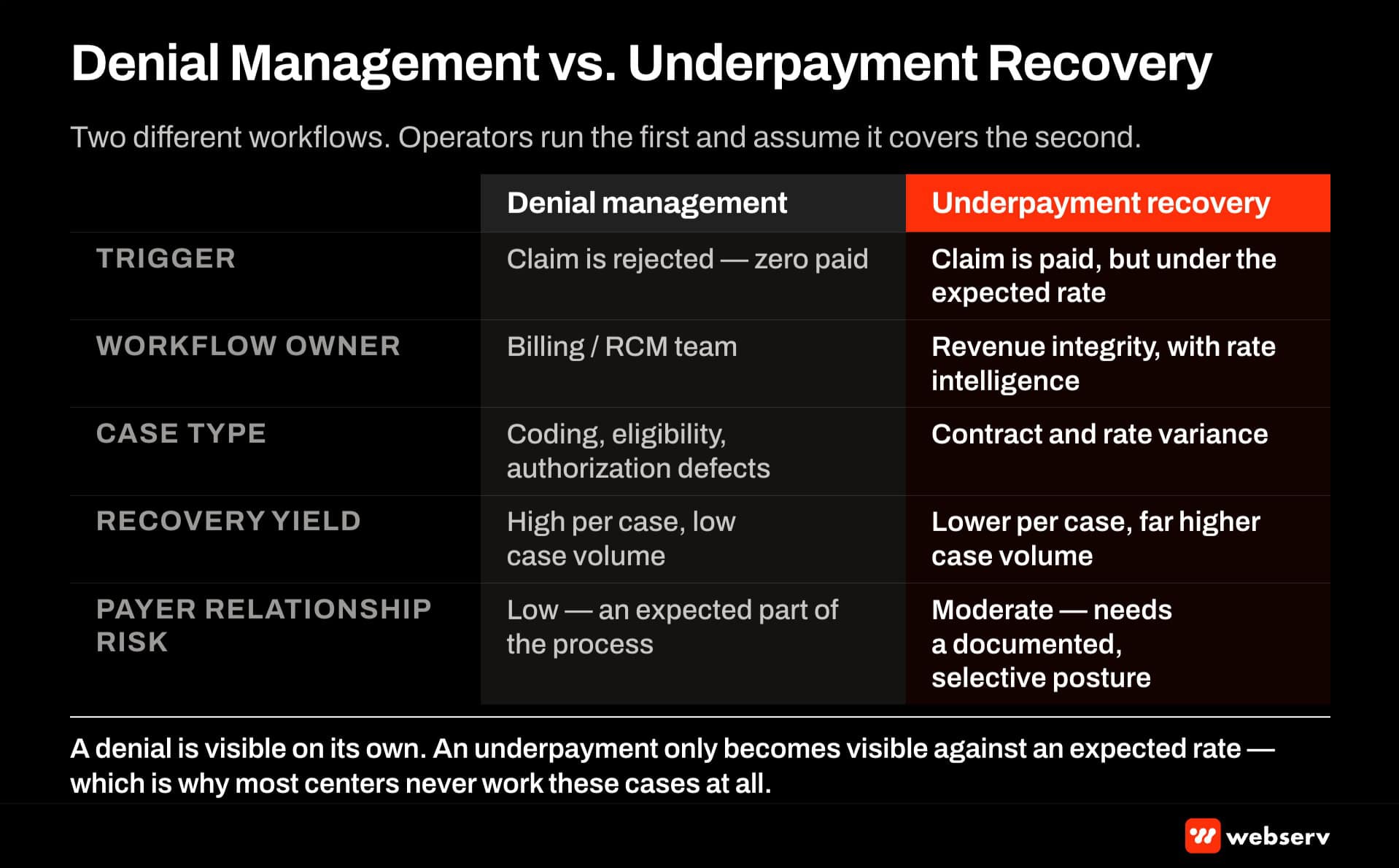
The category is distinct from denial management. A denied claim gets a specific reason code from the payer and follows a defined appeal path. An underpaid claim was accepted and paid, just at an amount below what the operator expected, and there is no denial code to appeal against. The workflow to pursue it is different.
The discipline is also distinct from contract enforcement. In-network contracts specify rates, and enforcement of those rates against paid claims is a defined billing team responsibility. Out-of-network underpayment recovery is harder because there is no contract to point at, only historical adjudication patterns and the specific case-by-case terms of the patient’s benefit design.
Rate intelligence solves the harder half. For OON claims and for in-network claims where the contracted rate schedule is complex or subject to modifier interpretation, the expected reimbursement estimate PayerLenz returns gives the billing team a defensible baseline for the paid-versus-expected comparison.
Why Underpayments Happen
Underpayments in behavioral health claims happen for a handful of structural reasons, and understanding which reason applies to a given case determines how the recovery workflow proceeds.
Contract misapplication is the most common driver on in-network claims. The payer’s claims processing system applies the wrong fee schedule, the wrong effective date on a contract amendment, or the wrong modifier interpretation, and the claim pays at a rate below what the current contract specifies.
Benefit misapplication is common on out-of-network claims. The patient’s OON benefit is applied at the wrong percentage, the deductible position is calculated incorrectly, or the plan applies a UCR (usual, customary, and reasonable) reduction that does not match the plan’s stated methodology.
Behavioral health carve-out routing errors show up more frequently than most operators realize. A claim that should have processed through the primary payer’s BH carve-out administrator (Optum Behavioral Health, Magellan, Beacon) sometimes processes through the primary payer directly, adjudicating against a fee schedule that does not apply to the carved-out benefits.
Alpha prefix routing errors on BCBS claims produce another category. The claim is routed to the wrong home plan, adjudicates against a rate schedule that does not apply to the member’s actual coverage, and pays materially below what the correct home plan would have adjudicated. Our BCBS alpha prefix and home plan resolution piece covers the mechanic in depth.
None of these are exotic. All of them happen at meaningful frequency across the payer landscape. What varies by facility is how much of the underpayment volume the billing team catches and pursues.
OPERATOR INSIGHT
Rate intelligence identifies the recovery opportunity. Converting that opportunity into cash is billing-team execution work.
The $1.36 million PayerLenz identified across ~23,000 claims in one comparison case is the subset where paid-versus-expected was defensibly comparable, not the entire pool. It reflects estimates, not guarantees. The conversion rate from identified opportunity to recovered cash depends on the billing team’s discipline, the payer relationships in place, and the specific mix of underpayment categories the facility faces.
The Five-Stage Recovery Workflow
The workflow that actually converts underpayment identification into recovered revenue has five stages. Each stage has a specific artifact the billing team produces before moving to the next.
Stage 1: Identify variance
At claim adjudication, compare the paid amount against the expected reimbursement estimate. Variance beyond a defined threshold (typically 10 percent below expected on high-confidence rate cells) becomes a recovery candidate.
The variance identification runs as a scheduled process, not a case-by-case review. A weekly batch that pulls the previous week’s paid claims, matches each to its PayerLenz expected reimbursement estimate, and flags variance beyond threshold produces a clean queue for the billing team to work.
The artifact is a variance report with paid amount, expected amount, variance dollars, confidence score on the expected estimate, and payer identifier for each candidate claim.
Stage 2: Build the case
For each candidate, the billing team assembles the dispute basis before touching the payer. The basis depends on the underpayment category.
For contract misapplication, pull the contract amendment history, the specific fee schedule that should have applied, and the effective dates. For benefit misapplication, pull the patient’s benefit design document, calculate the correct OON percentage or UCR application, and document the calculation error.
For BH carve-out routing errors, pull the initial VOB and confirm which network administrator the coverage was actually under. For alpha prefix routing errors, pull the member ID, run the prefix through the correct home plan resolution, and identify the correct rate schedule.
The artifact is a case file per candidate claim: paid amount, expected amount, specific underpayment category, supporting documentation, and the recovery dollars at stake.
Stage 3: Prioritize by yield
Not every case file gets pursued. Triage by three factors.
Dollar variance is the first filter. Below $500 in variance, the billing team’s time on recovery outstrips the recovered dollars for most facilities. Between $500 and $2,500, recovery is worth pursuing on high-confidence cases. Above $2,500, every case is worth working.
Payer relationship value is the second filter. A recovery pursuit against a payer that routes 40 percent of the facility’s admits carries different downstream cost than a recovery pursuit against a payer contributing 2 percent of volume. The recovery pursuit posture on a high-volume payer is more careful, more documentation-heavy, and more selective.
Appeal window remaining is the third filter. Most payers require appeals filed within 30 to 180 days of the EOB. Cases where the window is closing get prioritized ahead of cases where the window has weeks or months of runway.
The artifact is a triaged pursuit queue ordered by expected recovery yield weighted against relationship risk and window urgency.
Stage 4: Execute the recovery
The recovery execution varies by underpayment category and by payer.
For contract misapplication cases against in-network payers, the workflow is a written notice of underpayment referencing the specific contract terms, filed through the payer’s provider relations channel. Most in-network contracts include a defined dispute resolution process that runs faster than a formal appeal.
For OON benefit misapplication cases, the workflow is a formal appeal filed with the payer’s appeals department, citing the specific benefit design terms and the calculation error. OON appeals are procedurally different from in-network appeals and require the patient’s authorization to file on their behalf in most cases.
For carve-out routing errors and alpha prefix routing errors, the workflow is a payer-side reprocessing request rather than a formal appeal. The billing team identifies the correct adjudication path, provides the routing information, and requests the claim reprocess through the correct benefit.
Timelines vary. In-network contract disputes typically resolve in 30 to 60 days. OON appeals typically take 60 to 120 days. Payer-side reprocessing requests are the fastest, often 15 to 30 days when the routing error is clear.
Stage 5: Track the outcome
Every recovery pursuit closes in one of three states. Recovered in full at the expected amount. Recovered partially at an amount above the original paid but below the expected. Denied on appeal with the original paid amount standing.
The outcome tracking closes the loop back to the rate intelligence layer. Cases where the recovery came in at the expected amount validate the accuracy of the expected reimbursement estimate. Cases where the payer denied and the paid amount stood inform the confidence formula on that specific plan and rate cell.
The artifact is a recovery outcomes database that both improves the rate estimates over time and gives the operator defensible reporting on the recovery function’s ROI.
By the numbers: underpayment recovery benchmarks
3-12%
Typical variance rate on paid claims by facility payer mix
40-60%
Realistic first-year conversion on high-confidence variance cases
45-150 days
Full cycle from variance identification to closed outcome
45-90 min
Total billing team time per case (build + file + follow-up)
Realistic Expectations on Recovery Yield
Operators evaluating rate intelligence for underpayment recovery need a clear picture of what yield to expect.
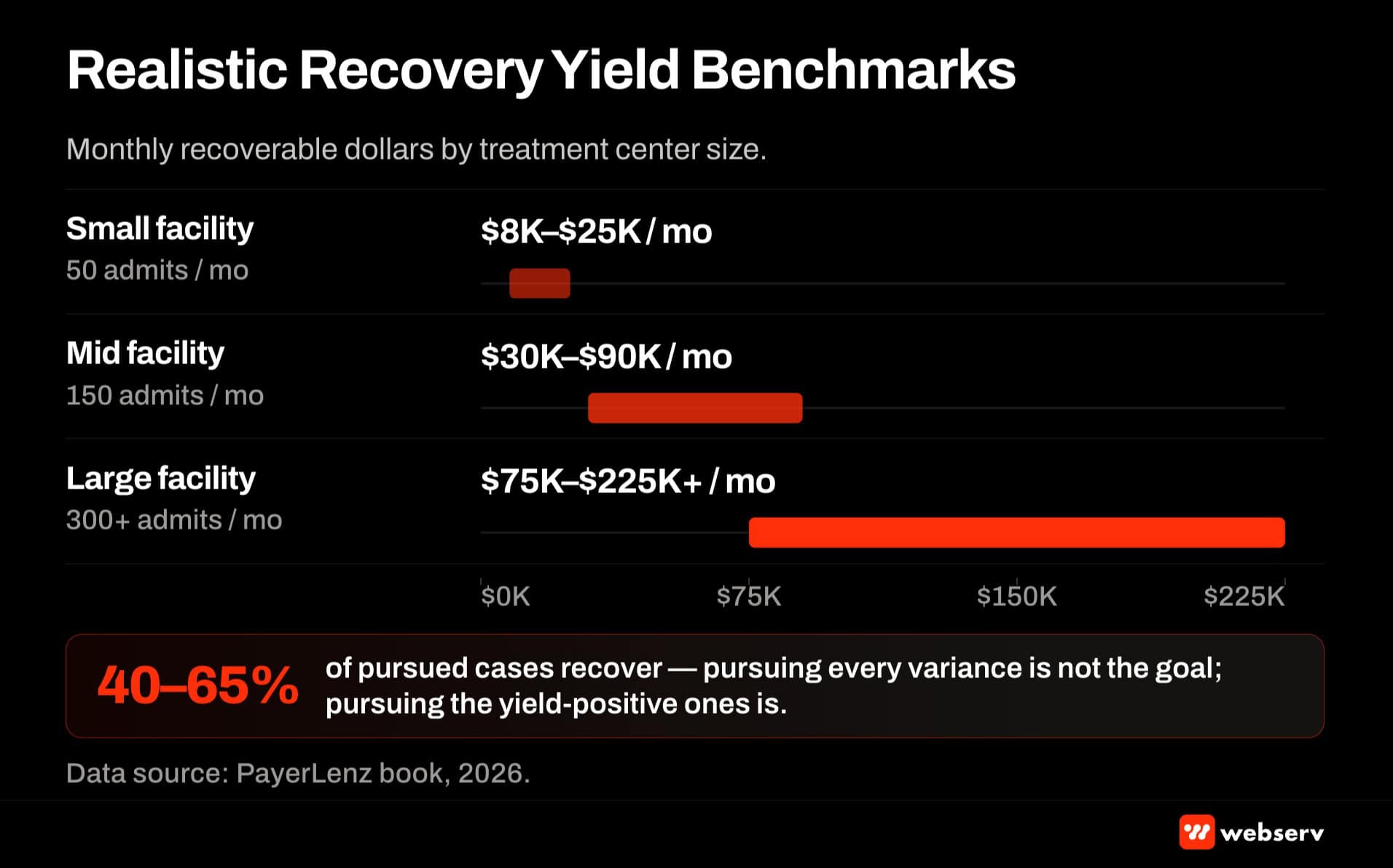
On the pool where PayerLenz identified $1.36 million in underpayments across roughly 23,000 claims, the recovery yield realized by the treatment centers involved varied significantly by payer, category, and how aggressively the billing team pursued. Some cases converted to full recovery within 30 days. Others resulted in partial recovery. Some were denied on appeal.
The framing we recommend across our client book is that rate intelligence identifies the recovery opportunity. Converting that opportunity into cash is billing-team execution work, and the conversion rate depends heavily on the billing team’s discipline, the payer relationships in place, and the specific mix of underpayment categories the facility faces.
A reasonable operator expectation for a first year of running the workflow: 40 to 60 percent conversion of high-confidence variance cases into recovered dollars, tapering to lower conversion on medium-confidence cases and directional-only conversion on low-confidence cases.
The Payer Relationship Layer
Recovery pursuit is a payer relationship discipline. This is the piece that separates operators who move meaningful money into collections from operators who create friction without moving the number.
Bulk appeal filing without case-by-case validation damages payer relationships. When a payer’s provider relations team receives 50 appeals from a facility in a single filing batch, the payer’s assumption is that the facility is running an automated recovery mill. That assumption gets applied to future claim processing, to network status conversations, and to the general willingness of the payer to work with the facility.
Case-by-case recovery pursuit with well-documented dispute bases builds credibility. When a payer receives a recovery request tied to a specific documented error (wrong fee schedule applied, wrong benefit percentage calculated, wrong home plan routed), the review process moves faster, the reversals come more often, and the payer relationship stays intact.
The pattern we recommend is that recovery pursuit is a defined process the billing team runs weekly, with individual case files that hold up to payer scrutiny, and with a cadence that never overwhelms any single payer’s provider relations team. That discipline produces higher recovery yield per case and preserves the payer relationships that determine future revenue.
Who Owns This in the Treatment Center Org Chart
Underpayment recovery lives operationally with the billing team but reports strategically through the CFO or controller. The specific ownership pattern varies by facility size.
Small facilities (single location, up to 30 beds) typically run recovery as a partial responsibility of the billing lead. The billing team has other primary responsibilities (claim submission, denial management, patient balances) and recovery is a scheduled slot inside that broader work.
Mid-size facilities (multi-location or 30 to 80 beds) often justify a dedicated AR/recovery specialist role. The specialist runs the five-stage workflow full-time and reports to the billing manager or controller.
Enterprise operators (multi-facility or 80+ beds) sometimes outsource recovery to third-party revenue cycle management firms specializing in behavioral health. The tradeoff is that outsourcing produces faster ramp on recovery volume but commits a percentage of recovered dollars to the RCM firm rather than to internal margin.
The marketing and admissions QBR playbook covers how the recovery function reports into executive review at the quarterly cadence.
Frequently Asked Questions
This connects to the broader revenue cycle picture covered in reducing claim denials and billing mistakes that reduce admissions.
How much underpayment can a typical treatment center expect to identify?
The variance identification volume depends heavily on the facility’s payer mix, level of care mix, and historical claim adjudication patterns. Facilities with heavy OON payer mix typically identify more variance because OON adjudication is more error-prone than in-network processing.
As a rough anchor, in the comparison case where PayerLenz identified $1.36 million in underpayments across roughly 23,000 claims, the variance rate came out to roughly 5 to 8 percent of paid claims across the pool. That range is subset-specific and varies by facility, so operators evaluating rate intelligence should expect their specific facility variance rate to fall somewhere in the 3 to 12 percent range depending on payer mix.
The dollars at stake are the more useful metric than the variance rate. A 5 percent variance rate on a facility running $8 million in annual paid claims translates to $400,000 in identifiable underpayments. Recovery yield determines how much of that identified variance converts to recovered cash.
How long does the recovery workflow take per case?
Case build time varies from 15 minutes for straightforward contract misapplication cases to 60 minutes for complex OON benefit misapplication cases requiring benefit design document review. The average across the workflow is roughly 30 minutes per case for the case-build stage alone.
Payer response time varies from 15 to 30 days for reprocessing requests to 60 to 120 days for formal OON appeals. The full cycle from variance identification to closed outcome runs 45 to 150 days depending on payer and category.
Total billing team time per case runs 45 to 90 minutes when counting the case build, filing, follow-up, and outcome documentation. Facilities that batch case-build work into a scheduled weekly block get better per-case throughput than facilities that handle recovery ad-hoc between other billing team responsibilities.
What is the difference between underpayment recovery and denial management?
Denial management works cases where the payer refused to pay the claim entirely. The payer issues a specific denial code, and the billing team either overturns the denial through appeal or accepts the write-off.
Underpayment recovery works cases where the payer paid the claim but at a lower amount than expected. There is no denial code. The claim was accepted and paid, just at a rate the billing team believes is below what the contract, benefit design, or historical adjudication pattern supports.
The two disciplines require different workflows, different documentation, and different payer contact points. Facilities that treat underpayment recovery as an extension of denial management typically undercapture the recovery opportunity because the denial-management playbook is not built for the paid-but-below-expected gap.
Can we recover underpayments on claims from prior years?
Recovery window depends on payer-specific appeal terms and, for some cases, on state prompt-pay statutes.
In-network contract dispute windows are defined in the contract itself, typically 90 to 365 days from the date of the EOB. Outside that window, in-network recovery is generally not pursuable. OON appeal windows are defined by the plan document and range from 60 days to 180 days for first-level appeals. External review windows (state insurance department review) add additional time for cases that go through the full appeal process.
Historical claims outside the appeal window are typically write-offs. Facilities considering rate intelligence primarily for backward-looking recovery on claims already past the appeal window will get limited value. The workflow produces the highest yield when it runs on current adjudication, catching variance while the appeal window is still open.
Does aggressive recovery pursuit hurt our payer relationships?
Aggressive bulk pursuit does. Case-by-case pursuit with documented dispute bases does not.
The pattern that damages relationships is filing 30 to 50 recovery requests in a single batch with minimal documentation and boilerplate dispute language. Provider relations teams read that pattern as an automated recovery mill and adjust their processing accordingly, which shows up in future claim adjudication, network status conversations, and general willingness to work with the facility.
The pattern that preserves relationships is filing individual recovery requests with case-specific documentation, keeping the volume per payer per week within a reasonable range (typically under 10 requests per payer per week for mid-size facilities), and framing each request around the specific documented error rather than as a bulk dispute. Operators worried about relationship risk should start recovery pursuit at low volume, build the payer’s confidence in the documentation quality, and scale volume as the pattern establishes.
How does rate intelligence keep up with rate changes over time?
The PayerLenz pool is updated on a nightly batch process. New claims contributed by the network of treatment centers flow into the pool, get processed through the five-step enrichment chain, and update the expected reimbursement estimates for the affected rate cells within 24 hours.
The confidence formula weights recent claims more heavily than older claims through a 12-month half-life decay. A rate cell where the payer’s actual paid amounts have moved recently will reflect the change in the expected estimate within weeks of the shift showing up in contributed claims.
For cases where a payer has renegotiated rates or changed benefit design mid-year, the pool adjusts as the new pattern emerges in the contributed claims. Operators evaluating the pool for a specific payer can request a data freshness check for the specific plan and level of care combinations they care most about.
Kyle McHenry is Co-founder of Webserv, Founder of Revenue Logic (a white-glove behavioral health revenue cycle firm), and Co-founder of the PayerLenz reimbursement intelligence product. He has been inside behavioral health verification, claims, and payer relationships for 15 years and works with treatment center operators on the rate intelligence and recovery workflow discipline that closes the gap between admissions and collections.