An admissions director gets an eligibility response back. BCBS. Active. Out-of-network benefits apply. Deductible $5,000, 70% coinsurance after. Everything is green. They admit the patient. Thirty days later the claim adjudicates and the payer pays $662 per day for a residential program the facility priced at $3,000 per day.
The next month, a nearly identical admit. Same California facility, same residential level of care, same OON status, same “BCBS coverage confirmed” on the VOB tool. This time the payment lands at $3,778 per day.
Both admits were “BCBS.” Neither the coordinator nor the admissions director could see the difference on the eligibility response.
The only signal that would have surfaced the 5.7x rate gap between those two admits is the alpha prefix on the member ID, and specifically what that prefix resolves to on the payer side.
This is the piece the industry has been treating as a footnote for years, and it is the load-bearing mechanic that determines what the payer will actually pay on a behavioral health claim.
It is the technical foundation of the reframe in the VOB vs. expected reimbursement piece, and it is what Webserv’s eligibility and reimbursement capability operates on.
Key Takeaways
- BCBS is not a payer. It is a federation of more than 30 independent licensee companies, and inside those licensees the structure fragments further into more than 100 distinct home plan entities that each negotiate their own rates.
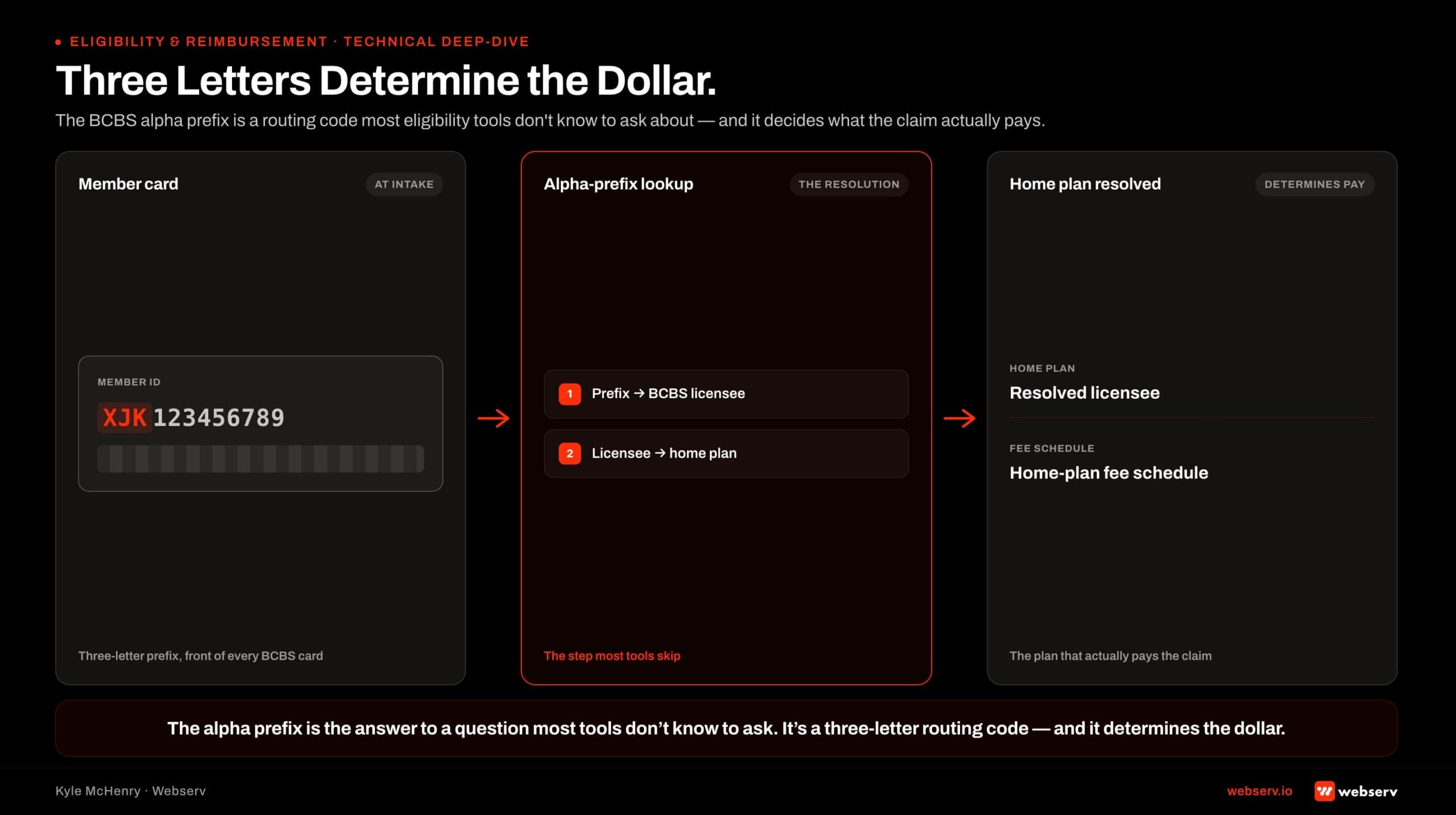
- The alpha prefix on the member ID is the three-character routing key that identifies which specific home plan holds the coverage contract. That home plan determines the rate schedule the claim adjudicates against.
- Under BlueCard, a patient with an Illinois Blue policy who admits at a California facility has their claim processed through California Blue but paid at Illinois Blue’s rate schedule. The servicing plan is a pass-through; the home plan owns the dollar.
- Every eligibility tool built on payer eligibility APIs returns “BCBS coverage confirmed” as a single label. Every one of them is averaging across dozens of independent companies with independently negotiated rates. The label conceals the variance.
- The specific example from PayerLenz’s California residential OON pool: Anthem BCBS Indiana pays $3,778 per day, Anthem BCBS Ohio pays $3,090, Anthem BCBS California pays $2,297, Blue Shield of California pays $662. Same state, same LOC, same OON status, same “BCBS” label. 5.7x spread.
DEFINITION
CMS’s 835 electronic remittance advice standard confirms this at the transaction level: the payer identifier that appears on a paid claim reflects the plan actually cutting the check — the home plan — not the licensee that routed eligibility through BlueCard. That is why reading the servicing plan alone gives operators the wrong reimbursement signal and why alpha prefix resolution has to happen at intake, not at billing.
The Blue Cross Blue Shield Association describes itself as a national alliance of 33 independent, community-based licensee companies covering 118 million members across all 50 states — each licensee running its own network, its own fee schedule, and its own reimbursement patterns. That structure is why “in-network with BCBS” is not a complete sentence: the licensee identity, not the BCBS brand, determines what the claim actually pays.
alpha prefix is the three-character alphabetic code at the start of every BCBS member ID. It identifies which specific Blue home plan holds the coverage contract and adjudicates the claim against a specific rate schedule.
What the alpha prefix actually is
Every BCBS member ID starts with a three-character alphabetic prefix. That prefix is the routing key that identifies where the member’s policy actually lives. It is not a state code.
It is not a plan design indicator. It is the address of the specific Blue entity that holds the coverage contract and adjudicates the claim against a specific rate schedule.
The prefix is the load-bearing detail that determines what the payer pays. Everything else on the eligibility response, the coverage confirmation, the benefit design, the deductible position, the level of care coverage, sits downstream of the prefix resolution.
At PayerLenz we carry a prefix-to-home-plan mapping table with 21,800 entries.
When a claim comes in, we read the prefix off the member ID, resolve it to the home plan, and key the benchmark cell on both the prefix and the home plan alongside state, level of care, and network status.
That keying is the mechanic that produces a defensible rate estimate.
Without prefix resolution, “BCBS coverage confirmed” is the answer to a different question than the one an admissions director actually needs to ask.
Why home plan is the level that determines the dollar
BCBS is not a payer. It is a federation of independent licensee companies that share a brand and interoperate through the BlueCard program, but each licensee is legally and operationally its own entity.
The publicly-established count is roughly 34 licensees across states and territories. Inside those licensees, the structure fragments further. Regional plans, sub-entities, employer-specific administrative arrangements.
Our prefix mapping table resolves to 138 of them. Eighty-four of them are active in our live claims pool right now.
Every one of those home plan entities is a separate contracting entity with a separate rate schedule. Anthem Blue Cross of California is not Blue Shield of California.
Anthem BCBS Indiana is not Anthem Blue Cross of California, even though both trade under the Anthem name. Each carries its own negotiated rates for behavioral health services, its own OON reimbursement pattern, and its own adjudication behavior.
The eligibility API layer collapses all of that into one label. The claims data reveals what each home plan actually pays. That is the gap between “coverage confirmed” and “rate expected” that VOB-only tools structurally cannot close. Our VOB-to-admit reimbursement gap analysis measures what it costs a facility.
IN PRACTICE
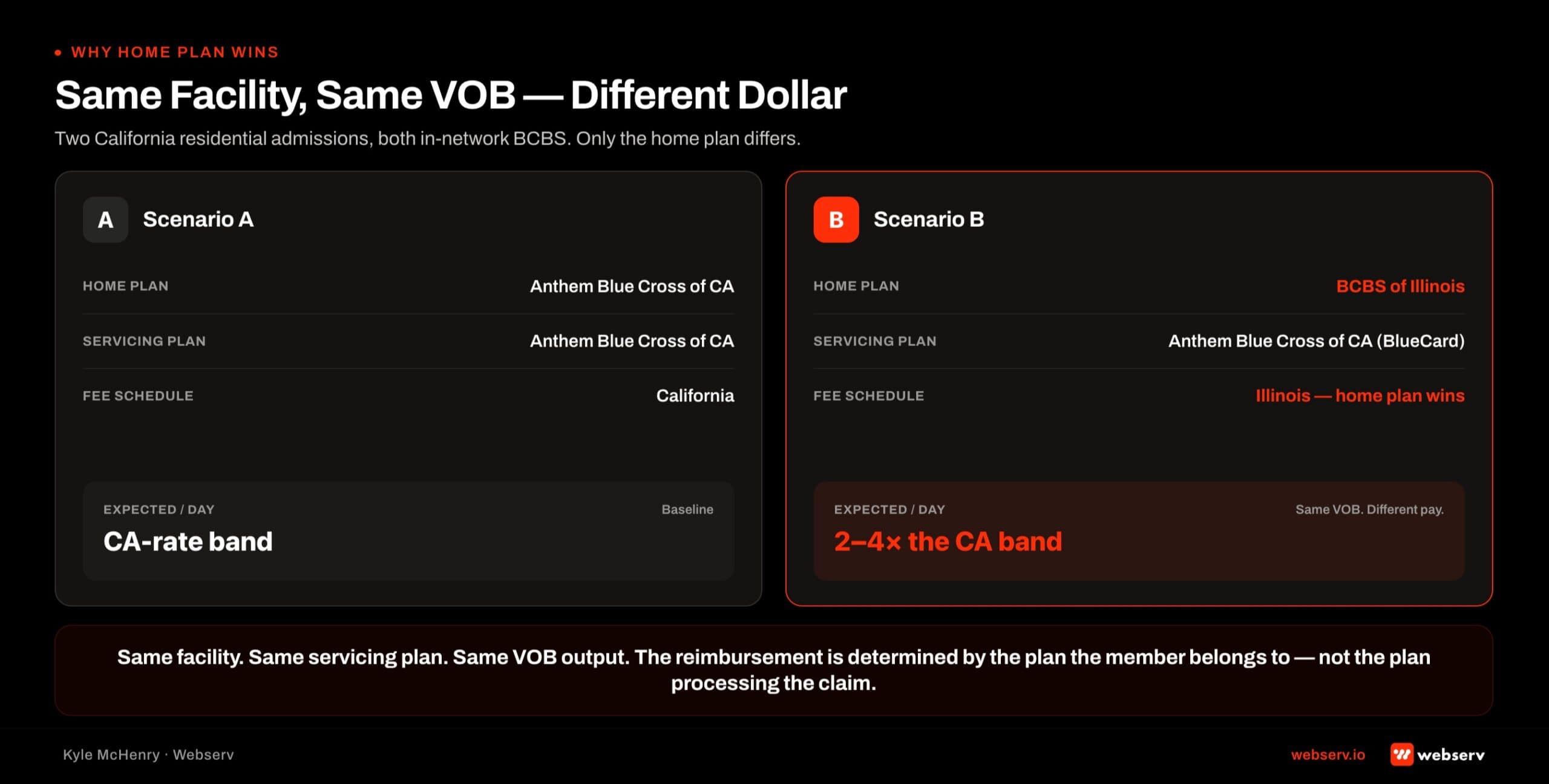
Two BCBS admits on the same day at the same California facility can be paid at 5.7x different rates. The servicing plan is a pass-through; the home plan owns the dollar. The alpha prefix is the only frontline signal that surfaces which one applies.
BlueCard: why the servicing plan is a pass-through
The specific complication that most operators miss is what happens under the BlueCard program. BlueCard is the arrangement that lets a BCBS member access care outside their home plan’s service area.
A patient with an Illinois Blue policy who admits to a California treatment center gets their claim processed through the California Blue plan (the “servicing plan”). The California plan handles the intake mechanics.
But the rate schedule that governs what actually gets paid on that claim belongs to the Illinois home plan, not the California servicing plan. The servicing plan is a pass-through. It runs the mechanics; the home plan owns the dollar.
That is why a California facility can admit two BCBS patients on the same day, in the same building, for the same level of care, and receive dramatically different reimbursement per day. Both patients are “BCBS.”
But one carries an Indiana Blue home plan (which pays $3,778 per day in our pool) and the other carries a Blue Shield of California home plan (which pays $662). The California facility sees identical eligibility responses. Only the alpha prefix surfaces the difference.
The only signal on the front end that would surface this difference is the alpha prefix on the member card. Everything else on the eligibility response is downstream of that prefix, and every rate-relevant data point traces back to which home plan holds the contract.
The California residential BCBS spread
This is the specific stat from our live data pool that anchors the whole framing.
Same state: California. Same level of care: residential. Same network status: out-of-network. All four are “BCBS coverage confirmed” on any eligibility tool.
| Home plan (resolved via alpha prefix) | Rate per day |
|---|---|
| Anthem Blue Cross and Blue Shield of Indiana | $3,778 |
| Anthem Blue Cross and Blue Shield of Ohio | $3,090 |
| Anthem Blue Cross of California | $2,297 |
| Blue Shield of California | $662 |
A 5.7x spread across four home plans that an eligibility API would show as identical. All four are high-confidence cells in our adjudicated claims pool, each backed by 129 to 635 claims from at least 3 distinct facilities, current through Q2 2026.
Over a 30-day residential stay, that spread is the difference between a $113,000 admit and a $19,800 admit.
Multiply across a census of 40 residential beds turning over quarterly, and the aggregate impact on annual revenue is the difference between a profitable year and an unprofitable one at the same volume.
None of that variance is visible upstream of prefix resolution. All of it is visible after.
Why VerifyTX, Availity, and pVerify cannot close this gap
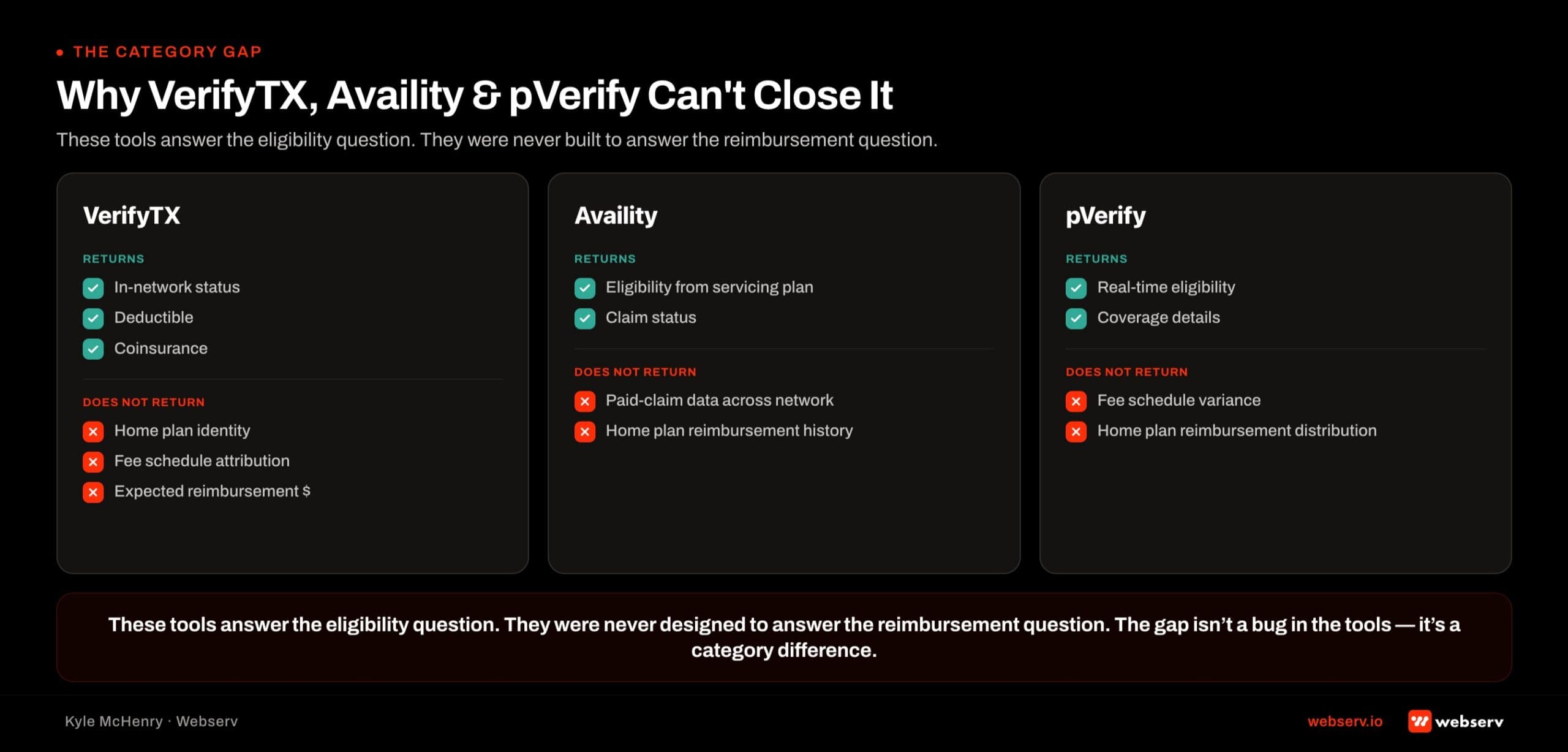
This is not a criticism of any specific eligibility tool. It is a description of what the eligibility API layer structurally can and cannot see.
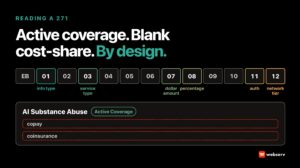
Every commercial VOB tool built for behavioral health, including VerifyTX, Availity, pVerify, and every eligibility module inside every RCM stack, is built on payer eligibility APIs. The specific transaction is an X12 270 request and a 271 response.
That response tells the provider what the policy says. Deductible position. Benefit design. Coverage active. OON benefits apply. Coinsurance percentages. All of it is real, all of it is useful, and none of it says what the payer has actually paid on similar adjudicated claims.
To surface the alpha prefix and home plan resolution as a rate signal, a tool needs access to adjudicated claims data.
Not a single patient’s claim, which the provider already has, but a pool of adjudicated claims across many providers, keyed by prefix and home plan and level of care, cleaned and normalized into rate benchmarks.
That data set does not exist inside a payer eligibility API. It exists inside claims. Any tool that wants to close the gap between “coverage confirmed” and “rate expected” has to become a claims-data pipeline, not an eligibility API pipeline.
That is a different data infrastructure, a different customer relationship (customers contribute claims into a shared pool), and a different product category entirely.
Adding prefix resolution as a feature to a VOB tool does not close the gap. Prefix resolution without a claims pool behind it is still just a label lookup. Prefix resolution with a claims pool behind it is a rate expectation.
The claims data pool that makes prefix resolution useful
The prefix mapping table by itself is a lookup that resolves a three-character code to a home plan name. That is the easy part. The hard part is turning the home plan resolution into a defensible rate estimate.
At PayerLenz, that work happens in a nightly enrichment pipeline. Every claim contributed to the shared pool by our customers gets normalized on payer name, resolved to alpha prefix and home plan, classified by level of care, and keyed for benchmark inclusion.
Claims flagged for the shared pool then feed the benchmark tables that recompute nightly. Medicaid and Medicare are excluded. Implausible rates above $10,000 per day are quarantined automatically.
The result: when a new eligibility check comes in from a customer, the system can resolve the prefix and look up the home plan.
It then returns an expected rate per day drawn from a cohort of adjudicated claims at that specific home plan for that specific level of care in that specific state.
The rate comes with a trust score reflecting how many claims support it, how recent they are, and how many distinct facilities contributed to the cell.
What matters here is that the prefix resolution is the frontend of a claims-data pipeline, not the frontend of an eligibility API. The two look similar to an operator and are fundamentally different at the data layer.
What operators should do with this
Three specific moves change the day an operator understands what alpha prefix resolution actually is.
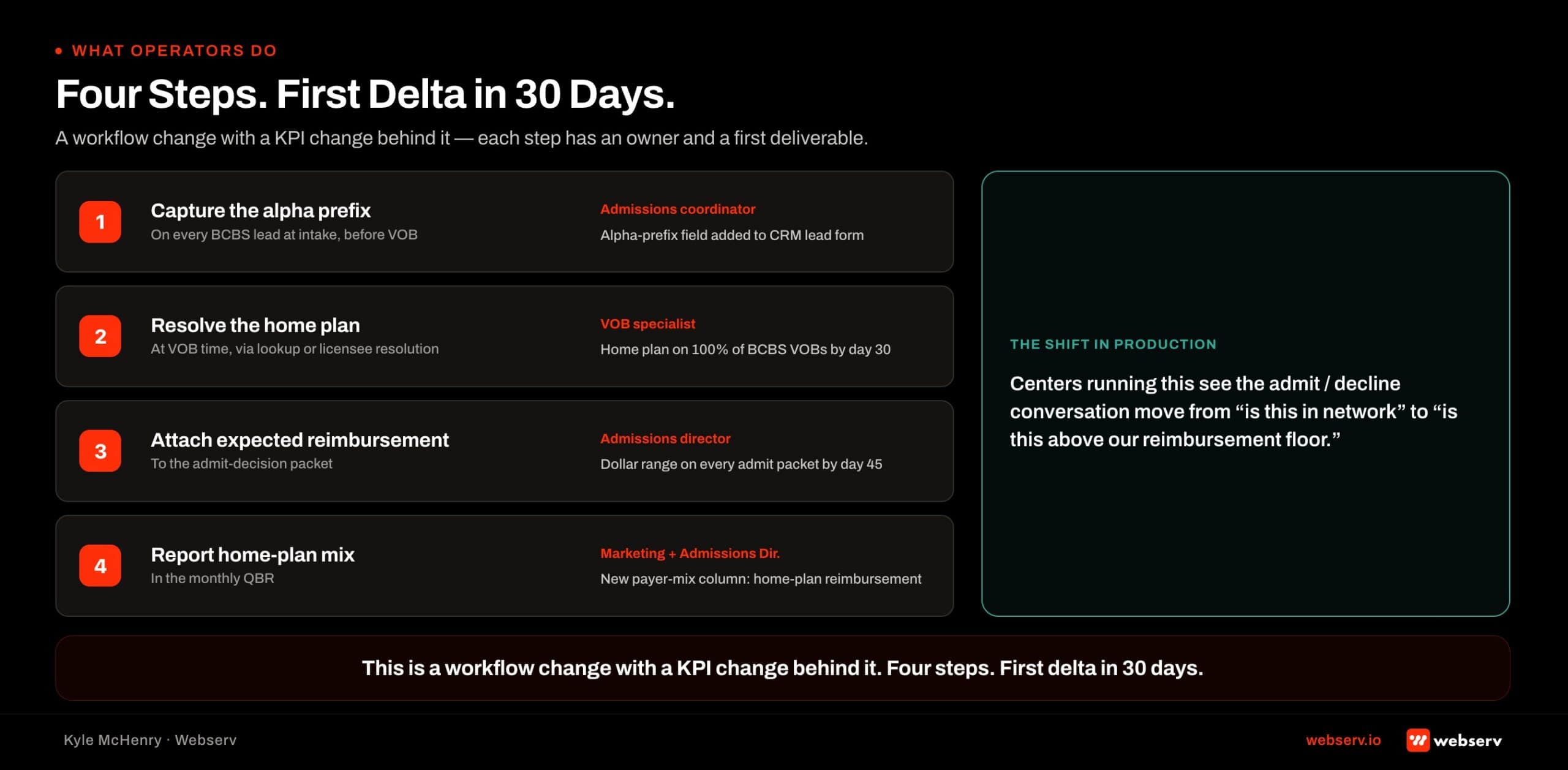
First move: stop treating BCBS as one payer in your reporting. Payer mix reports that show “BCBS” as a single line item are averaging across independent companies with independently negotiated rates. That average is not actionable at the admissions decision level.
Second move: capture the alpha prefix at intake. If your CRM is not capturing the three-character prefix as a structured field on the patient record, add it. That capture is a prerequisite for any rate intelligence downstream.
Third move: pair the prefix with rate data at the admission decision. Alpha prefix without a claims data pool behind it is a label.
Alpha prefix with a claims data pool is a rate expectation. The rate intelligence workflow piece walks how to put that data in front of the coordinator without breaking the call flow.
Behavioral health operators who make these three moves stop admitting the same “BCBS” patient at 5.7x different rates without knowing it.
Frequently Asked Questions
What is an alpha prefix on a BCBS member ID?
The alpha prefix is the three-character alphabetic code at the start of every BCBS member ID. It identifies which specific BCBS home plan holds the member’s coverage contract. It is not a state code.
Illinois Blue policies do not all start with IL. The prefix is a routing key that maps to a specific home plan entity, and the specific mapping is maintained by the BCBS federation and updated regularly as licensees restructure or new plans launch.
At PayerLenz we carry roughly 21,800 prefix-to-home-plan mappings in our lookup table, resolving to 138 distinct home plan entities that appear in behavioral health claims.
Why does the home plan matter more than the servicing plan?
Under BlueCard, when a member receives care outside their home plan’s service area, the local Blue plan (the servicing plan) processes the claim mechanically. But the rate schedule that governs what actually gets paid on that claim belongs to the home plan, not the servicing plan. The servicing plan is a pass-through; the home plan owns the dollar.
That is why a California treatment center can receive two BCBS patients on the same day and be paid at dramatically different rates. One patient’s home plan might be Anthem BCBS Indiana. The other’s might be Blue Shield of California. Both admits look identical to the eligibility API layer.
The alpha prefix is the only frontline signal that surfaces which home plan the claim will adjudicate against.
How much does the rate actually vary across BCBS home plans?
More than most operators expect. In our California residential out-of-network claims pool, we see four Blue home plans paying $662, $2,297, $3,090, and $3,778 per day for the same level of care. All four cells are backed by 129 to 635 adjudicated claims from 3+ distinct facilities, current through Q2 2026.
That 5.7x spread within the “BCBS” label is not an outlier. It is the structural reality of a federation where each licensee negotiates independently. Operators who treat BCBS as one payer in their payer mix reporting are averaging across a variance that determines whether individual admits are profitable.
The spread compounds. Over a 30-day residential stay, the difference between the low and high cells is a $113,000 admit versus a $19,800 admit.
Can we get the alpha prefix from the eligibility check itself?
Yes, and that is the moment to capture it as a structured field. The member ID appears on the eligibility response, and the first three alphabetic characters are the prefix.
Most CRMs support parsing that automatically if the field is configured. If your CRM is not capturing prefix as a structured field today, it is worth adding before layering any rate intelligence work on top.
Coordinators typing the full member ID into a notes field, without prefix as a discrete data element, produces a downstream data-quality gap that makes rate intelligence lookups unreliable.
Do all payers have something like the alpha prefix, or is this a BCBS-specific thing?
Alpha prefix in the specific form described here is BCBS-specific. It is the routing key inside the Blue federation’s BlueCard program. Other payers have their own internal routing mechanisms, but they typically operate as single entities with a single rate schedule per plan design rather than as federations of independent licensees.
That is why BCBS is the sharpest example of coverage-versus-rate divergence. Aetna, Cigna, UnitedHealthcare, and Humana each have their own rate variance patterns, but the fragmentation into 100-plus independent contracting entities is a feature of the Blue federation specifically.
The general reframe (coverage is not a rate) applies to every payer. The specific alpha-prefix-to-home-plan resolution mechanic applies to BCBS.
Kyle McHenry is Co-founder and Head of Product at Webserv, where he leads the PayerLenz reimbursement intelligence product. He works on the claims data pipeline, benchmark methodology, and the specific technical mechanics behind PayerLenz’s alpha prefix resolution and confidence scoring layers. If you want to see what your admits look like under a prefix-resolved rate lens, start with a Visibility Gap conversation.