Most treatment center operators we meet have worked with two or more marketing agencies before us. They are not looking for cheerleaders. They are looking for someone who can name the problem in the first fifteen minutes and not waste their time.
What follows is the diagnostic we run on the live intro call. It is the same set of pulls, checks, and judgment calls we apply to every prospect account.
If you are evaluating your current agency or screening a replacement, this is the same lens you can hold up against the work being done in your name. We built it across nine years of behavioral health marketing engagements and 200+ treatment center accounts inside our content and SEO capability.
The bar is low. The category is pre-damaged. You do not need a unicorn. You need someone who can read your data without flinching, who knows the vocabulary cold, and who tells you the truth about timelines on the first call.
The Pattern: Why Most Treatment Centers Have Worked With Multiple Agencies
Key Takeaways
- 31 of 43 treatment center operators we surveyed in early 2026 reported no measurable results from their most recent marketing agency. 13 of 43 reported active damage. The bar for trust in this category is low because the category is pre-damaged. Operators have learned to look for tells before they extend trust.
- Six failure patterns account for most of what we see in prospect account audits: the retainer trap, active damage (toxic backlinks, deleted articles without redirects, de-indexed pages, paused PPC), industry illiteracy, the communication black hole, the timeline overpromise, and AI content as a volume machine.
- The first call should produce a verdict. We pull Semrush, Ahrefs, Google Ads, Search Console, GA4, and CRM data live on screen during the intro call. The diagnostic takes 20 to 30 minutes if the data is accessible. An agency that cannot walk you through it live, with your data, on the first call, is telling you their answer.
- Account ownership is more load-bearing than the work itself. The hardest accounts to recover are the ones where the previous agency had login access but not ownership. Reclaiming Google Ads, Meta Ads, GA4, Search Console, and the CRM should be the operator’s first priority before any new marketing work begins.
- Webserv has operated exclusively in behavioral health since 2017. LegitScript, 42 CFR Part 2, INN/OON economics, VOB and viable VOB metrics, and BH-specific PMAX constraints are baseline assumptions every engagement starts from, not learning material we work through at the client’s expense.
The bar for trust in this category is low because the category is pre-damaged. We surveyed 43 operators across our early 2026 intro calls. Thirty one reported no measurable results from their most recent agency. Thirteen reported active damage. These are not edge cases.
31/43
Operators reporting no measurable results from prior agency
13/43
Operators reporting agency actively damaged the account
2-4
Agencies tried before finding the right partner
The operators who come to us are not desperate. They are frustrated. They can usually name what went wrong. The CFO has receipts. The admissions team has the war stories.
The previous agency relationship usually ended one of two ways. Either a quiet escalation up the contract chain. Or a sudden silence that left the operator scrambling to figure out who had the password to the Google Ads account.
The bar for trust in this category is low because the category is pre-damaged. Operators don’t need a unicorn. They need someone who can read their data without flinching, who knows the vocabulary cold, and who tells them the truth about timelines on the first call.
Preston Powell, CEO of Webserv
The patterns that produced the frustration repeat across the category. We have catalogued six. They are not the only ways an agency can fail a treatment center, but they cover the majority of the field reports.
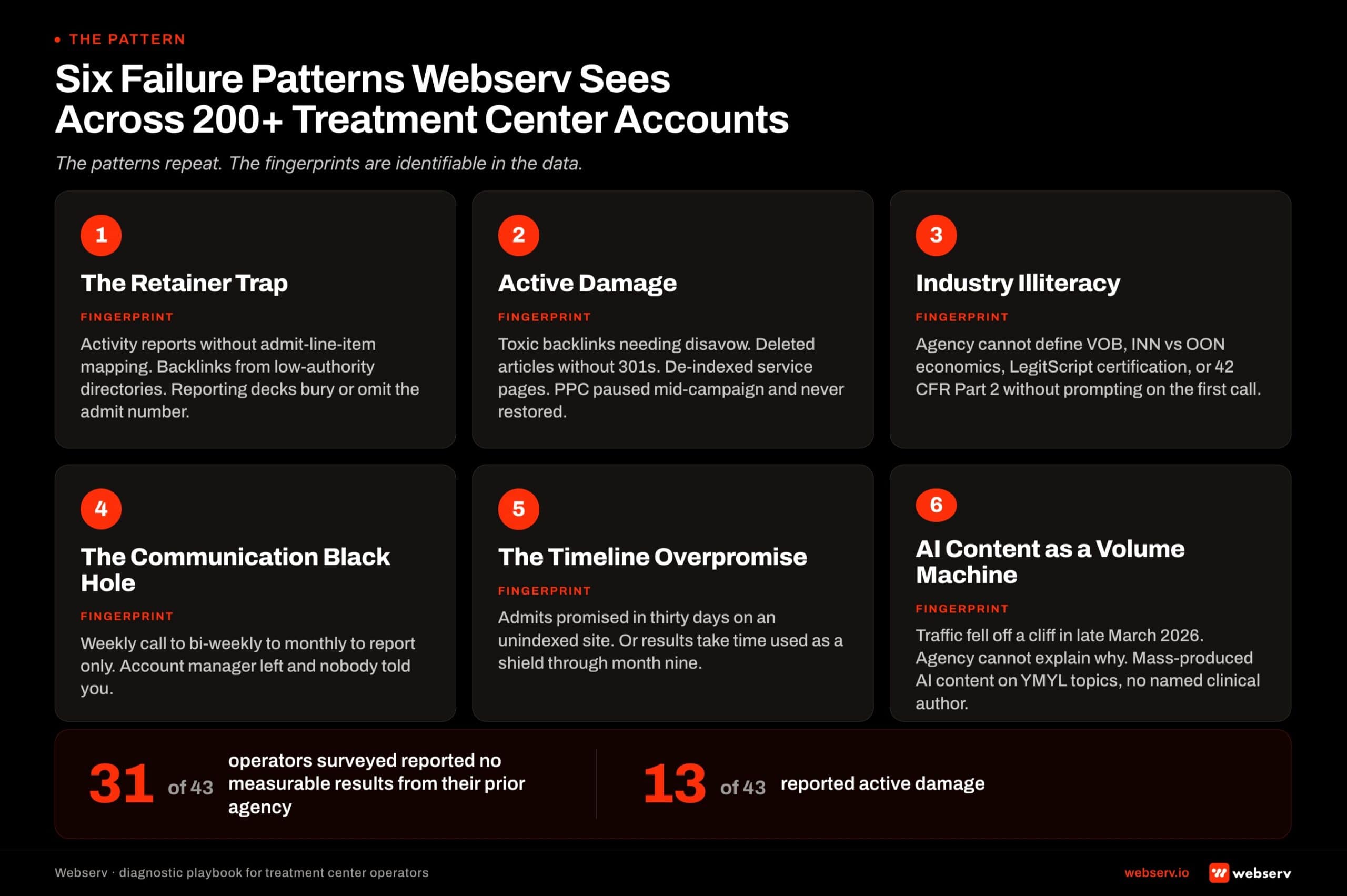 Six failure patterns Webserv sees across 200 plus treatment center marketing accounts. Pattern one, the retainer trap: activity reports without admit-line-item mapping, backlinks from low-authority directories, reporting decks that bury or omit the admit number. Pattern two, active damage: toxic backlinks needing disavow, deleted articles without 301 redirects, de-indexed service pages, paid campaigns paused mid-campaign and never restored. Pattern three, industry illiteracy: agency cannot define VOB, in-network versus out-of-network economics, LegitScript certification, or 42 CFR Part 2 without prompting on the first call. Pattern four, the communication black hole: weekly call to bi-weekly to monthly to report only, account manager left and nobody told the operator. Pattern five, the timeline overpromise: admits promised in thirty days on an unindexed site, or results take time used as a shield through month nine. Pattern six, AI content as a volume machine: traffic fell off a cliff after the March 2026 Google update, mass-produced AI content on YMYL topics, no named clinical author. Survey data: 31 of 43 operators reported no measurable results from their prior agency, and 13 of 43 reported active damage.
Failure Pattern 1: The Retainer Trap
DEFINITION
Retainer Trap
A marketing engagement where the agency collects a fixed monthly fee but produces no outcome the operator can tie to admitted patients. The agency reports activity (posts, citations, social) but the admit number sits flat or drifts down. The most common pattern we see in behavioral health prospect audits.
The retainer trap is the most common pattern we see. The agency reports activity each month: blog posts published, keywords moved, citations built, social posts pushed live. The activity is real. The downstream effect on admitted patients is not.
After six or nine months, the operator looks at the census and the receipts and cannot draw a line between them.
The fingerprint is identifiable in the data. Blog posts target keywords with no commercial intent and no relationship to the operator’s payer mix or program lineup. Backlinks come from low-authority directories and PBN-adjacent properties.
Reporting decks lead with traffic charts and bury the admit number, or omit it entirely. Paid campaigns optimize toward form fills with no downstream VOB outcome attached.
The fix is not complicated. Every line item in the report should map to either an admit, a leading indicator of an admit (a viable VOB, a qualified call, a verified consultation), or an infrastructure investment with a named payoff date.
If a line item does not map, it does not belong in the report.
Failure Pattern 2: Active Damage
The damage pattern is harder to recover from than the retainer trap because the work has to be reversed before forward progress can resume. The four most common damage signatures we encounter:
Toxic backlinks. The previous agency built links at scale from low-authority sources, sometimes PBNs, sometimes comment networks, sometimes paid placements on flagged domains. Google has been clear since 2022 that link schemes intended to manipulate ranking violate the spam policies. Recovery requires a disavow file and patience.
Deleted articles without redirects. A site refresh removed dozens or hundreds of older articles, the agency did not implement 301 redirects, and the resulting 404 surface dropped organic traffic. Search Console flags the coverage gap. The operator notices it on the monthly chart.
De-indexed pages. A robots.txt edit, a misapplied noindex tag, or a faulty canonical pushed entire sections of the site out of the index. Diagnostic: open Search Console, filter coverage to “Excluded by ‘noindex’ tag,” and look for service pages that should not be there.
Paused PPC mid-campaign. The agency turned off paid campaigns to free up budget for “testing,” then never turned them back on. The operator notices three weeks later when call volume collapses.
ACCOUNT OWNERSHIP
Account ownership matters more than the work itself. The hardest accounts to recover are the ones where the previous agency had login access but not ownership. If your previous agency owns the Google Ads, Meta Ads, GA4, or CRM account on your behalf, reclaim ownership before any new marketing work begins. Without it, the next agency starts from zero on attribution, remarketing audiences, conversion history, and learning-phase progress.
If your previous agency had login access to your accounts but not ownership, your top priority is reclaiming ownership before any new marketing work begins. Without it, the next agency starts from zero on attribution, remarketing audiences, conversion history, and learning-phase progress.
Failure Pattern 3: Industry Illiteracy
DEFINITION
LegitScript Certification
A third-party certification required by Google Ads and Meta for advertisers running paid media on addiction treatment search terms. Without it, the treatment center cannot run paid acquisition on the two largest channels. LegitScript certifies the treatment center as the advertiser, not the marketing agency.
The silent test most operators run on a new agency in the first call: do they know what a VOB is. Do they understand that an in-network admit and an out-of-network admit have entirely different economics.
Do they understand why PMAX without negative term exclusions and content controls will burn budget in behavioral health. Do they treat LegitScript certification as a known requirement rather than a curiosity.
Industry illiteracy is the cheapest failure to spot and the most predictive of how the engagement will unfold. An agency that cannot speak the vocabulary in the first conversation spends the next ninety days getting up to speed at your expense.
The next ninety days after that get spent learning what they should have known going in. The downstream effect on cost per admit is measurable and large.
The diagnostic we use: ask the prospective agency to name the difference between cost per lead and cost per viable VOB in the same sentence. Ask them what they would expect to see across both numbers in a behavioral health portfolio. Their answer tells you everything.
Failure Pattern 4: The Communication Black Hole
The communication failure pattern usually starts small. The weekly call moves to bi-weekly. The bi-weekly moves to monthly. The monthly slides to “we’ll send a report instead.” Then the report goes silent.
Then the account manager leaves and nobody tells you. By the time you escalate, three months have passed and the work has stopped.
The fingerprint in the data: a clean drop-off in updates inside the project management tool, a gap in reporting cadence, a Slack channel that went quiet, an account manager whose calendar has not been updated.
Sometimes the operator does not realize it has happened until they call to ask a question and discover their original contact left the agency six weeks ago.
The fix is structural. The new engagement should specify communication cadence in the statement of work: who is on the call, how often, what gets reported, and what triggers an escalation. Webserv’s standard engagement names the account team on day one.
Failure Pattern 5: The Timeline Overpromise
Timelines are the easiest place in this category to lie and the most damaging place to lie. We have seen agencies promise admits inside thirty days on engagements where the site itself was not indexed and the operator had no LegitScript certification.
The math could not work. The promises got made anyway.
The opposite failure is also common. The operator hears “results take time” used as a reason every monthly report fails to move the admit number. The phrase becomes a shield. Six months turns into nine. Nine turns into twelve.
Both failures share a root cause: the agency did not name the actual timeline on the first call and stick to it. The honest answer for behavioral health SEO is three to six months minimum before keyword movement translates into admit volume.
The timeline lengthens if there is technical debt to clear first. The honest answer for paid media is faster, often inside thirty days for the first signal. The magnitude of that signal depends on certification status, audience targeting, and creative readiness.
Both answers should be given on the first call, not the third quarterly review.
Failure Pattern 6: AI Content as a Volume Machine
The March 2026 Google Search algorithm update was punishing on sites that used AI content as a volume strategy without editorial oversight, named clinical authorship, or substantive topical depth. We see the impact across our intro calls almost weekly.
Operators show traffic charts that fell off a cliff in late March, with the agency unable to explain why.
The underlying issue is older than the update. Google’s Helpful Content guidance has been explicit since 2022 that content produced primarily to rank, rather than to serve readers, will lose visibility.
The March 2026 update tightened that screw. Sites with mass-produced AI content on YMYL topics (which addiction treatment and mental health both are) lost the most ground.
The fix is not “stop using AI.” The fix is editorial discipline: every clinical article carries a named author with verifiable credentials and a clinical reviewer. Every external citation is verified before publication.
Topical depth replaces topical breadth. Content production targets the operator’s actual cluster strategy rather than a volume target. AI is a tool in that workflow, not a replacement for it.
The Live Diagnostic: What to Pull and What to Look For
The first call should produce a verdict, not a follow-up. Here is the seven-step pull we run on every new prospect account, the same way you can run it yourself if you are evaluating your current agency.
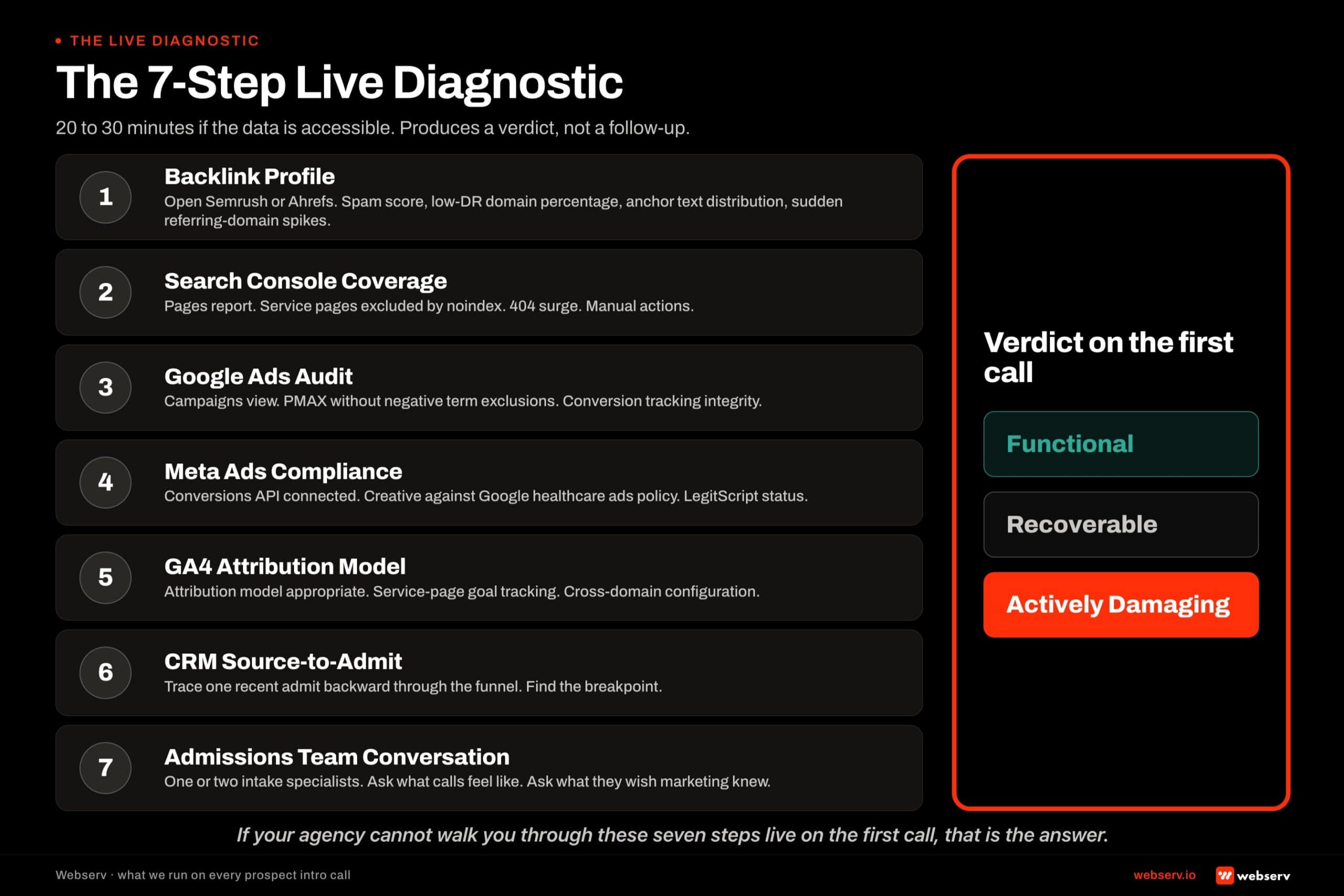 The seven-step live diagnostic Webserv runs on every prospect intro call. Step one, backlink profile: open Semrush or Ahrefs and look for spam score, low-domain-rating percentage, anchor text distribution, and sudden referring-domain spikes. Step two, Search Console coverage: check the Pages report for service pages excluded by noindex, 404 surge, and manual actions. Step three, Google Ads audit: open the campaigns view and check whether PMAX is running without negative term exclusions and whether conversion tracking is intact. Step four, Meta Ads compliance: confirm the Conversions API is connected and check creative against Google healthcare ads policy and LegitScript status. Step five, GA4 attribution model: confirm the attribution model is appropriate and verify service-page goal tracking and cross-domain configuration. Step six, CRM source-to-admit: trace one recent admit backward through the funnel and find the breakpoint. Step seven, admissions team conversation: talk to one or two intake specialists about what calls feel like and what they wish marketing knew. The diagnostic takes twenty to thirty minutes and produces a verdict on whether the current marketing program is functional, recoverable, or actively damaging.
- Backlink Profile. Pull Semrush or Ahrefs. Look for the spam score, the percentage of links from low-DR sites, any sudden spikes in referring domains that look unnatural, and the anchor text distribution. Commercial keywords as anchor text in volumes the operator did not contract for is a tell.
- Search Console Coverage. Open the Pages report. Look for service pages excluded by noindex, soft 404s, redirect chains, and orphaned URLs that should be indexed but are not. The Manual Actions report should show “No issues detected.” Anything else takes priority over every other line item.
- Google Ads Audit. Open the campaigns view. Check whether PMAX is running unconstrained, whether negative keyword lists exclude the obvious BH traps, whether conversion actions are tied to actual admit-relevant events, and whether the LegitScript-certified advertiser entity matches the operator.
- Meta Ads Audit. Confirm the Conversions API is connected. Check creative for family-first compliance against Meta’s restricted-category review patterns. Verify the ad account is in good standing without active policy violations. Confirm 42 CFR Part 2 considerations are reflected in the pixel and audience configuration.
- GA4 Attribution Model. Confirm the attribution model is appropriate (data-driven for most BH accounts). Verify server-side conversion tracking is in place and HIPAA-respectful. Confirm UTM tagging is consistent and that channel groupings reflect the operator’s actual marketing mix.
- CRM Source-to-Admit. Open the CRM. Trace a recent admit backward through the funnel. Was the source captured? Was the VOB outcome recorded? Did the marketing system see the admit happen? If the CRM cannot tell you what marketing channel produced last month’s admits, the attribution work has not been done.
- Admissions Team Conversation. Talk to one or two intake specialists. Ask what calls they are getting and what calls they are not. The marketing program’s downstream effects show up here before they show up in any dashboard. If intake says lead quality has dropped and marketing reports show traffic is up, the gap is the diagnostic finding.
These seven pulls take twenty to thirty minutes if the data is accessible. They produce a verdict on whether the current marketing program is functional, recoverable, or actively damaging.
If the agency you are evaluating cannot walk you through these seven steps live, on the first call, while pulling your data on screen, that is the answer.
What “Different” Looks Like in a First Call
After we run the diagnostic, the first call should sound different from what most operators have experienced. Here is the contrast we hear about most often.
WHAT A WORKING FIRST CALL SOUNDS LIKE
- Names the problem inside fifteen minutes using the operator’s actual data
- Uses VOB, INN/OON, PMAX, LegitScript, 42 CFR Part 2 without explaining the terms
- Quotes three to six months for SEO and thirty days for paid signal, with reasoning
- Confirms accounts will be client-owned and explains how transition works
- Reports against admitted patients in every monthly review
WHAT A BROKEN FIRST CALL SOUNDS LIKE
- Schedules a separate discovery call before any data is reviewed
- Asks the operator to define the terms or sidesteps them entirely
- Promises admits inside thirty days regardless of starting conditions
- Plans to operate inside agency-branded ad accounts
- Reports traffic, rankings, and form fills without tying them to admits
The contrast is not subtle. Operators who have had two or three prior agency relationships recognize the working pattern immediately, often inside the first five minutes.
The vocabulary alignment alone is usually enough to tell whether the agency has worked in addiction treatment marketing or is treating you as a vertical pivot.
FIRST CALL EXPECTATIONS
You do not have to commit on the first call. A working first-call diagnostic should be useful even if you do not engage the agency afterward. If you walk away with a clear picture of what is and is not working in your account, the call was worth the time. If you walk away with a follow-up meeting on the calendar and no verdict, the next agency on your list will tell you more.
The other tell is what the agency is willing to refuse. A working partner tells you which engagements they will not take and why. They will not propose work on a site that needs technical debt cleared before content investment compounds.
They will not run paid campaigns through an unverified LegitScript account. They will not pretend the timeline you want is the timeline you have. Operators who have been told yes to everything before recognize the value of a no.
How to Use This Article
We wrote this playbook for three audiences.
If you are an operator evaluating your current marketing engagement, this is the diagnostic to run against your own account. Open Search Console, open Google Ads, open the CRM, and walk the seven steps yourself. The verdict will be clear inside an hour.
If you are screening replacement agencies, send this article to them and watch how they respond. The agencies worth engaging will recognize the diagnostic, agree with the patterns, and offer to run the live version on your account. The broader landscape of behavioral health marketing agencies covers the field if you want to compare.
The agencies not worth engaging will treat the article as marketing copy and move past it.
If you are a CFO or board member being asked to approve a new marketing contract, this is the framework to use when reviewing the proposal. The six failure patterns are the failure modes you are paying to avoid.
The timeline language and the account ownership language in the contract should reflect that.
The intro meeting offer at the end of this article is straightforward. We will run the live diagnostic on your account. No discovery deck, no follow-up needed before the verdict. Book the intro call when you are ready.
If we find something useful, you keep the findings whether or not you engage us.
Frequently Asked Questions
How can I tell if my current marketing agency is actually working?
The fastest test is whether each line item in the monthly report maps directly to either an admitted patient, a leading indicator of an admit (viable VOB, qualified call, verified consultation), or a named infrastructure investment with a payoff date. If line items do not map to one of those three categories, they do not belong in the report.
The longer test is the seven-step diagnostic outlined above. Backlink profile, Search Console coverage, Google Ads configuration, Meta Ads compliance, GA4 attribution, CRM source-to-admit tracing, and the admissions team interview. Working agencies have clean answers across all seven. Failing agencies have gaps that surface in three or more of them.
If you cannot tell whether the agency is working, that itself is a finding. A working agency makes the answer to that question obvious in every monthly report.
What should I look for when reviewing my agency’s backlink work?
Open Semrush or Ahrefs and check three things. First, the referring domain growth chart: sudden spikes that look unnatural usually signal paid placement. Second, the spam score distribution: a high percentage of links from low-DR sites is a warning. Third, the anchor text distribution: commercial keywords in volumes the operator did not contract for is a tell.
Cross-check Search Console for any manual actions reported. If the Search Console manual actions report shows anything other than “No issues detected,” that is a serious problem that takes priority over any other marketing work in progress.
A clean behavioral health backlink profile shows organic growth from authority publications, healthcare directories with editorial standards, and editorial mentions earned through digital PR. It does not show three hundred new referring domains in a single month from sites you have never heard of.
Why don’t most marketing agencies understand behavioral health?
Most agencies are vertical generalists. They take clients across categories and apply the same playbook everywhere. Behavioral health breaks that playbook in three specific ways: LegitScript certification on paid media, 42 CFR Part 2 privacy regulation that constrains attribution and tracking, and INN/OON payer economics that determine which audiences are worth acquiring at what cost.
A generalist agency learns those three constraints during your engagement, at your expense. A specialist agency arrives already knowing them. The cost-of-learning shows up as lost months, missed admits, and frustrated operators by month six of the engagement.
Webserv has operated exclusively in behavioral health since 2017. The constraints are not learning material for us. They are the baseline assumptions every engagement starts from. That difference compounds across every targeting, creative, and attribution decision over the life of the engagement.
How long should SEO and paid media take to show admit impact?
Paid media can show admit signal inside thirty days if LegitScript certification is in place, conversion tracking is properly configured, targeting matches the operator’s payer mix, and creative meets compliance requirements. The first thirty days are typically a calibration window. The next thirty are where the signal stabilizes.
SEO requires three to six months minimum before keyword movement translates into measurable admit volume. That timeline lengthens if technical debt has to be cleared first, if the site is recovering from a Google algorithm impact, or if topical authority has to be rebuilt after content damage from a previous agency.
Any agency promising faster results is overpromising. Any agency citing “results take time” without naming the actual timeline and the actual gating factors is underdelivering. The honest answer to this question is one of the strongest signals you can get on the first call.
Trevor Gage is the Director of Marketing at Webserv. Webserv works with behavioral health and addiction treatment centers on SEO, paid media, and full-funnel admissions strategy.