A treatment center we work with launched a Meta paid social campaign in early Q2 with a fresh creative set: three hero images, two short-form videos, four headline variants. The first two weeks were strong. CTR sat at 2.8 percent, cost per inquiry at $42, lead quality holding.
The campaign manager scaled the budget from $18,000 a month to $32,000 a month at the four-week mark on the strength of the early data.
Eight weeks later, the same campaign was producing CTR of 0.9 percent and cost per inquiry of $68. Same audiences, same landing pages, same offer. The creative had not been refreshed in the interim.
The campaign had hit ad fatigue and was burning paid spend against an audience that had seen every variant in the set three to five times each.
The fix took 10 days. New hero imagery, three new short-form videos, six fresh headline variants, and a refreshed pacing schedule that staggered the variants by audience segment.
Two weeks after the refresh launched, CTR was back at 2.4 percent and cost per inquiry sat at $38. The campaign math was working again on the same spend.
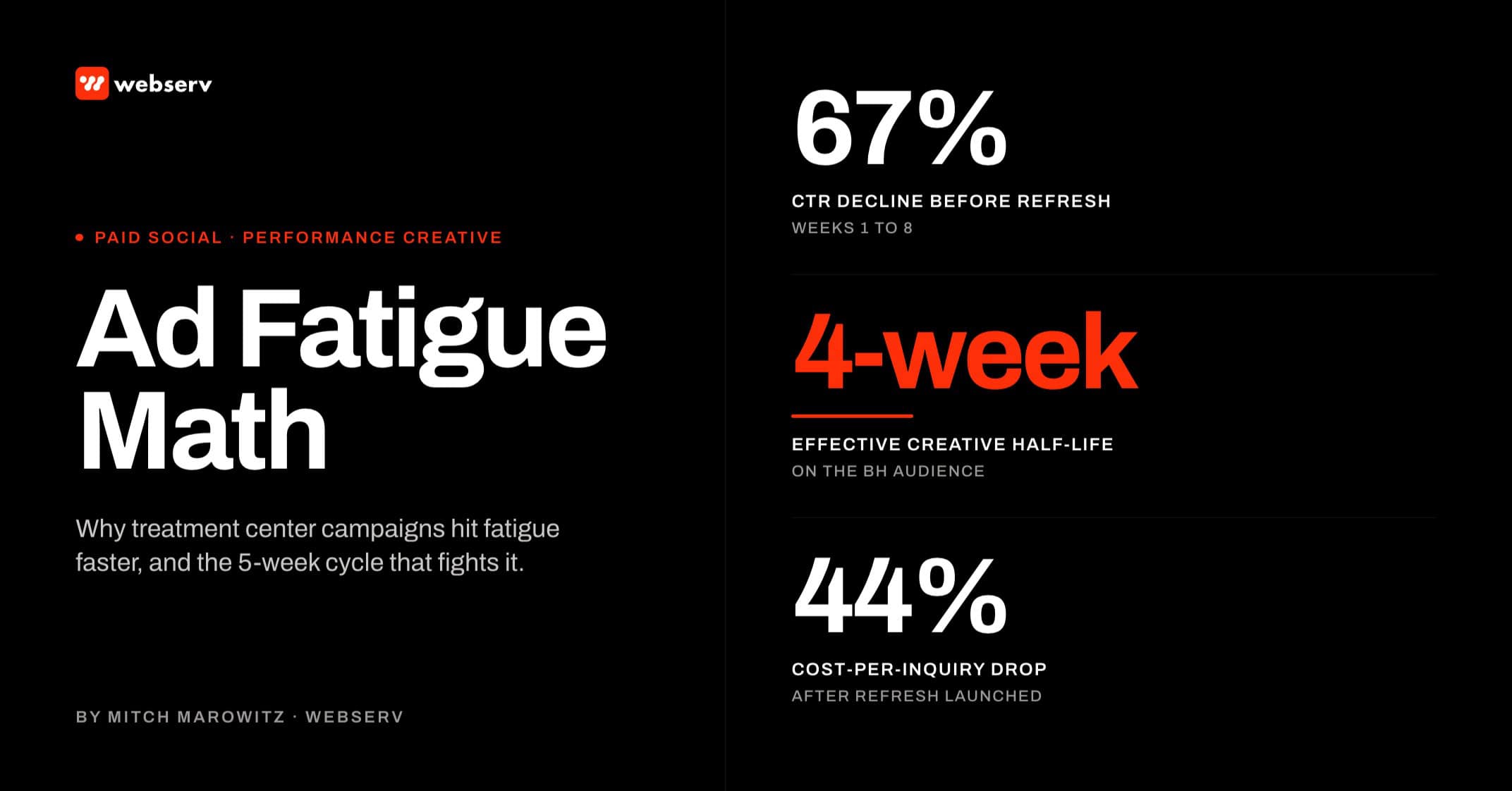
Three composite numbers below from the same 90-day cycle, anchored as the spine of this article.
67%
CTR decline before refresh, weeks 1-8
4-week
Effective creative half-life on the audience
44%
Cost-per-inquiry drop after refresh launched
This piece is the operator-facing read on what ad fatigue actually is, why treatment center campaigns face it faster than most other paid categories, and the creative refresh cycle that fights it without burning the team out on weekly production. The full creative strategy frame lives in our paid media program for treatment centers and our creative capability.
What Ad Fatigue Actually Is
Key Takeaways
- Ad fatigue is the predictable decay in ad performance as an audience sees the same creative repeatedly. For behavioral health paid social, the typical creative half-life runs 3 to 5 weeks. After that window, CTR drops, cost per inquiry rises, and Smart Bidding optimizes against an audience that has stopped responding to the existing variants.
- Treatment center campaigns face ad fatigue faster than most other paid categories. The audience pool is smaller (geographic and demographic targeting concentrates impressions), the conversion window is longer (audiences see the same ad across the 30 to 120 day consideration window), and the compliance frame limits the variant volume that helps other categories outrun fatigue.
- The signals operators should read in their dashboard data: CTR decline week-over-week, frequency rising above 3 to 5 on the audience, cost per inquiry trending up while bid and budget stay flat, and the relative-CTR-vs-CPM curve diverging. Any one signal is suggestive. Two or more signals together is fatigue.
- The creative refresh cycle that works in BH is a 3-step rotation operating on a 4 to 6 week cadence: audit, produce, sequence. Operators running ad-hoc refresh without the structured cadence consistently underperform operators running the cycle on schedule.
- Compliance constraints (LegitScript, Google healthcare policy, 42 CFR Part 2) shape what creative refresh looks like in BH. The category cannot outrun fatigue with the aggressive A/B test velocity that other industries use; the refresh strategy has to respect both the compliance frame and the production capacity available to the operator.
Before the refresh strategy makes sense, the operator needs a precise definition of what is happening when a campaign degrades.
DEFINITION
Ad Fatigue
The predictable decline in performance as an audience sees the same creative repeatedly. CTR drops, cost per impression rises, conversion rate declines, and bidding algorithms optimize against a less responsive audience.
The mechanism is straightforward. The first time an audience member sees a treatment center’s ad, the creative is novel and the message has not yet been processed. The second and third impressions reinforce the message and produce the highest engagement rates.
By the fifth or sixth impression, the audience member has either responded or learned to scroll past.
The seventh and later impressions push diminishing returns into negative territory; the audience member is now actively scrolling faster past the same creative, training the algorithm that the ad is not engaging.
The decay curve is not linear. The first few weeks of a campaign produce roughly constant CTR. The middle weeks produce the steepest decline. The late weeks plateau at a low floor where the campaign is still producing some impressions but at materially worse cost-per-result math.
The visible curve in the dashboard looks like an S-curve flipped vertically: stable, then falling, then flat at the floor.
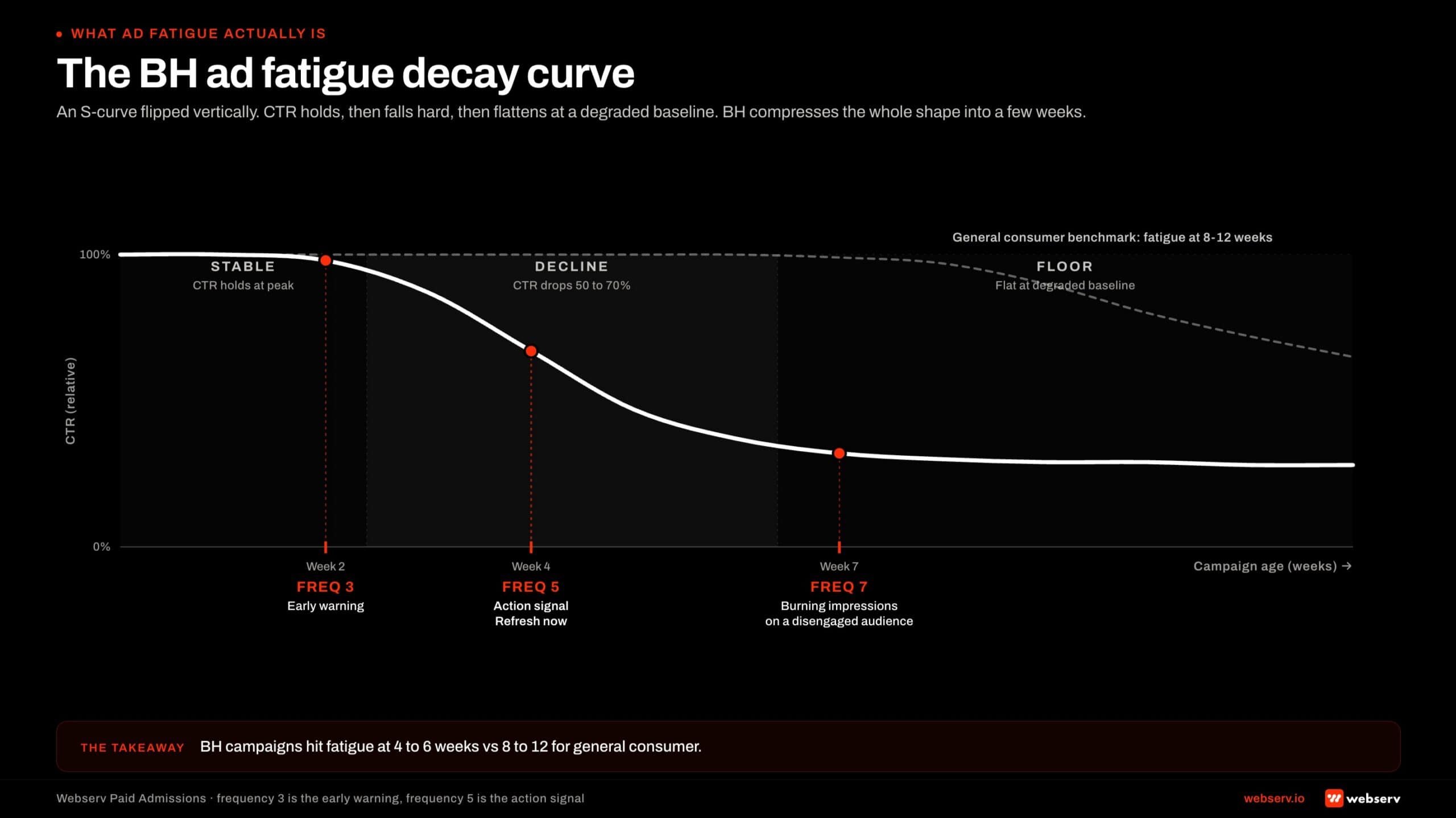 Ad fatigue decay curve for behavioral health paid social campaigns.
For paid media managers, the practical implication is that creative refresh is not optional. It is the load-bearing mechanism that keeps the campaign producing at cost-per-admit benchmarks. The question is not whether to refresh but how often and under what cadence.
Why Treatment Center Campaigns Hit Fatigue Faster
Three structural properties of behavioral health paid media make fatigue arrive faster than in most other categories.
DEFINITION
Impression Frequency
The average number of times each audience member sees the same ad over a given window. Frequency of 3 is the threshold where engagement typically begins to decline. By frequency 4, it’s time to act.
Smaller audience pools. Treatment center campaigns target specific geographies (where the facility operates), and broad demographic ranges (often the 18 to 55 band for patient-facing campaigns), with no targeting by health condition, which Meta doesn’t allow.
The combination produces audience pools materially smaller than what general consumer categories work with. Smaller pools concentrate impressions, which means each audience member sees the same ad more times per week.
Longer conversion windows. Behavioral health audiences move through 30 to 120 day consideration windows before the inquiry call. Other consumer categories convert inside same-session or same-week windows.
The longer BH window means the audience is exposed to the same campaign across many more weeks than they would be in a category with a faster conversion cycle. Each additional week of exposure compounds the fatigue.
Compliance constraints limit variant volume. Other paid categories outrun fatigue partly through high-volume A/B testing: 40 to 80 variants in market, swapped weekly. BH operators cannot do this. Every variant requires LegitScript compliance review, Google healthcare ads policy review, and (for clinical content) internal clinical review.
The variant production cycle is slower by design, which means the same set of variants stays in market longer.
The combined effect is that winning BH creative at mid-size budgets usually needs a refresh every 2 to 4 weeks in market, and small budgets rotate slower. The category-specific math is the reason a refresh cycle has to be on schedule rather than ad-hoc.
The Dashboard Signals That Reveal Fatigue
The operator who waits for cost per admit to spike before refreshing is reading the lagging indicator. The leading indicators show up in the campaign dashboard 2 to 4 weeks before the cost per admit data registers the problem.
Four signals matter most.
CTR week-over-week decline. A campaign producing 2.8 percent CTR in week one and 1.9 percent CTR in week four is showing the early curve. The decline becomes structural when it persists through weeks five and six without bouncing back. CTR decline alone is suggestive but not definitive.
Rising frequency on the audience. Frequency above 3 is the threshold where ad fatigue typically begins. By frequency 4, the average audience member has seen the same ad four times, and it’s time to refresh. Operators should track frequency by audience segment, not just at the campaign level.
Cost per inquiry trending up while bid and budget stay flat. This is the most directly observable fatigue signal in the dashboard. When CPI rises 20 to 40 percent over three weeks without any campaign-side change (no bid increase, no audience shift, no landing page change), creative fatigue is the most common cause.
Relative-CTR-vs-CPM divergence. As fatigue sets in, CPM stays relatively stable but CTR drops. The cost per click goes up while the cost per thousand impressions does not. The divergence between the two curves is the cleanest signal that the audience has stopped responding to the creative rather than the auction shifting against the campaign.
COMMON MISTAKE
Operators wait for the lagging metric (cost per admit) to spike before refreshing. By the time admit cost moves, the campaign has been running degraded for 6 to 10 weeks and the recovery curve is materially longer. Refresh on the leading signals (CTR decline + frequency above 3 + CPI trending up), not on the admit metric.
The combined-signal test matters. Any single one of the four can have other causes (audience expansion, seasonal traffic shift, landing page change). Two or more signals together over three or more weeks is fatigue, and the refresh cycle should be triggered before the math gets worse.
The 3-Step Creative Refresh Cycle
The refresh cycle that produces durable results in BH paid media has three distinct phases that operate together on a 4 to 6 week cadence. Operators running ad-hoc refresh (swapping variants when someone notices CTR is down) consistently underperform operators running the cycle on schedule.
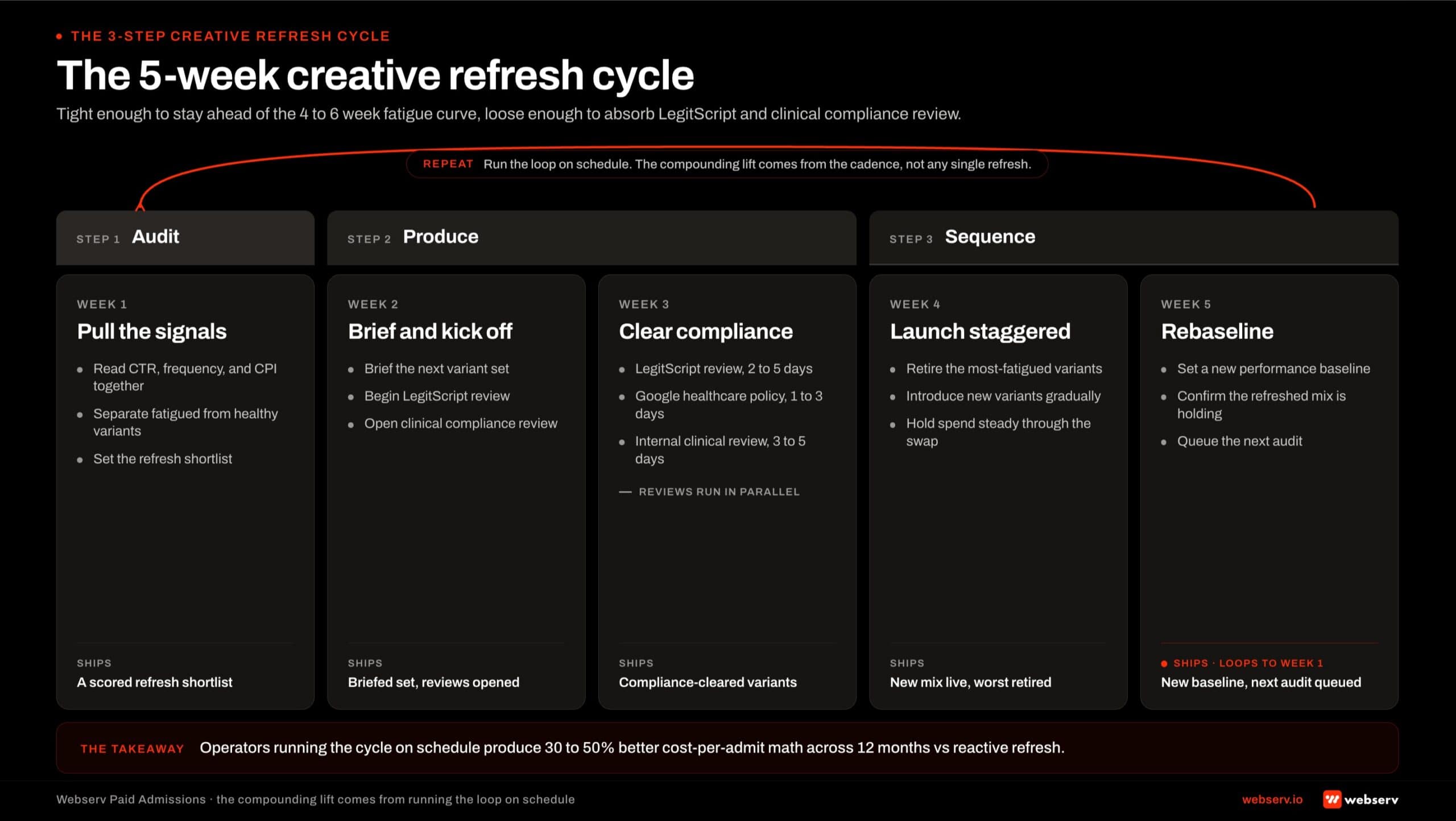 The 5-week creative refresh cycle for behavioral health paid social.
Audit
Pull campaign-level fatigue signals (CTR, frequency, CPI trend, CPM/CTR divergence). Identify which variants are degrading and which still have life.
Produce
Brief and produce the next variant set. Cover both the fatigued audience segments and the upcoming audience expansion. Run LegitScript and clinical compliance review.
Sequence
Launch new variants in a staggered rollout. Retire the most fatigued variants. Rebaseline the campaign on the new mix.
The cadence matters. A 4-week cycle keeps the campaign fresh but pushes the creative production team to a difficult pace. A 6-week cycle gives the team room to breathe but accepts 1 to 2 weeks of degraded performance between refreshes.
Most BH operators we work with settle on a 5-week cycle as the practical compromise.
The refresh cycle is what keeps the campaign math working. Operators who refresh reactively are always refreshing too late, and the recovery curve from a fatigued campaign is materially longer than the cycle that prevented it.
Preston Powell, CEO of Webserv
The audit phase is where most ad-hoc programs fall down. Without a structured signal review, operators tend to refresh based on intuition (the marketing director “feels like” the creative is stale).
Intuition is right often enough to look reasonable but wrong often enough to produce mismatched refresh effort. The structured audit is what makes the cycle work on schedule.
The production phase is the rate-limiting step in BH specifically. The compliance review on each variant adds 5 to 10 business days to the production timeline.
Operators producing the next variant set without compliance review built into the workflow consistently miss the launch date for the refresh, which makes the cycle drift longer than the audience pool tolerates.
The sequencing phase is the underrated piece. Launching all new variants on the same day produces an immediate fresh-creative bump but also resets the Smart Bidding learning across the whole campaign.
Staggered rollouts (retiring one or two old variants per week as new ones launch) preserve the bidding signal while introducing freshness gradually. The deeper read on the broader Smart Bidding interaction lives in our paid CRO complete guide.
Working Refresh Patterns vs Broken Ones
The strongest BH paid creative programs we audit have consistent patterns across the refresh cycle. The weakest programs have the inverse pattern.
WHAT WORKING REFRESH PROGRAMS DO
- Run the 5-week cycle on schedule, not reactively
- Build compliance review into the production timeline
- Stagger variant rollouts to preserve Smart Bidding signal
- Track CTR + frequency + CPI together as fatigue signals
- Keep an 80/20 mix of brand-informed DR and pure DR variants
WHAT BROKEN REFRESH PROGRAMS SKIP
- Refresh only when CTR drops trigger a panic
- Treat LegitScript review as a post-production checkpoint
- Launch full new variant set on one day, reset bidding
- Use CTR alone as the trigger metric
- Run pure DR creative until fatigue, then pure DR refresh
The 80/20 brand-informed-DR mix is worth its own note. Pure direct-response creative fatigues faster than brand-informed DR creative because the audience pattern-matches on the urgency framing and starts scrolling past.
Brand-quality production with DR structure (named clinical leadership, real facility footage, authentic family-member voice plus a clear CTA) fatigues materially slower because the creative carries audience-value beyond the immediate inquiry ask. The deeper read on this trade-off lives in our brand-awareness vs direct-response creative piece.
Compliance Constraints That Shape Refresh Cadence
Three compliance frames apply to every variant a BH operator produces. Each adds time to the production cycle and constrains the variant velocity that other categories use to outrun fatigue.
LegitScript certification requires that every paid creative align with the landing-page and ad standards LegitScript enforces. The review pass on each variant typically takes 2 to 5 business days for facilities with mature compliance processes, longer for newer programs. Operators running tight refresh cycles need a queue of pre-reviewed variants rather than approving variants in real time.
Google’s ads policy adds healthcare-specific restrictions on outcome promises, statistical claims without substantiation, and aggressive urgency tactics. Variants that pass LegitScript can still fail Google’s ad review at the platform level. The two reviews happen in parallel; both need to clear before a variant goes live.
42 CFR Part 2 governs how patient-identifiable content can appear in paid creative. Anonymized alumni stories, treatment-experience testimonials, and any patient-identifying detail require either explicit written consent or anonymization that protects identity. Variants featuring real patient stories typically take longer to produce because the consent and anonymization work is meaningful.
The net effect is that BH creative production runs on a 10 to 21 day cycle from brief to in-market. Operators trying to run a 4-week refresh cadence with same-week variant production typically miss the launch date.
The 5-week cycle we recommend assumes 2 weeks of audit + production + compliance review and 3 weeks of in-market performance against the prior baseline before the next audit.
Measurement: How to Know the Refresh Worked
The refresh either produced lift or it did not. The measurement framework that separates real lift from variance has three layers operating together.
Layer 1: Variant-level CTR and frequency. Compare each new variant’s first-week CTR against the fatigued variant it replaced. A variant launching at 2.4 percent CTR against a fatigued variant pulling 1.0 percent is producing lift. A variant launching at 1.2 percent against the same baseline is not, even if it is technically “new.”
Layer 2: Campaign-level CPI movement. Two weeks after the refresh launches, compare campaign-level cost per inquiry against the trailing 4-week average. A 20-40 percent CPI drop confirms the refresh worked. A flat CPI means the new variants are not materially better than the fatigued set they replaced.
Layer 3: Downstream qualified-lead rate. CTR lift is necessary but not sufficient. The new variants need to produce the same or better qualified-lead rate as the prior set, not just more clicks. A refresh that doubles CTR but halves qualified-lead rate is producing more cheap traffic, not more admissions.
Operators should review all three layers at the two-week and four-week marks after each refresh. If the layer-1 signal is positive but layer-3 is flat, the refresh produced engagement but not pipeline. The deeper attribution frame ties this all the way back to admit-attributed conversion via the cost per admit framework.
Frequently Asked Questions
How often should treatment center paid social refresh creative?
u003cpu003eThe working cadence for most behavioral health paid social programs is a 5-week creative refresh cycle. That window absorbs the 2 weeks of audit + production + compliance review and the 3 weeks of in-market performance against the prior baseline before the next audit. Shorter cycles (4 weeks) push the production team too hard. Longer cycles (6 weeks) accept 1-2 weeks of degraded performance.u003c/pu003eu003cpu003ePrograms running below $20K monthly paid social spend can extend the cycle to 6-7 weeks because the audience saturation rate is lower. Programs above $75K monthly spend should consider tightening to 4 weeks because the higher impression volume concentrates fatigue faster.u003c/pu003eu003cpu003eThe right read is to size the cadence to the in-market impression load on the audience, not to a calendar default. Heavy spend on a small audience pool requires faster refresh than light spend across a broader pool.u003c/pu003e
How much new creative does a refresh need?
u003cpu003eA working refresh introduces 40 to 60 percent net-new creative variants per cycle. The cycle does not require replacing the full variant set. The high-performing variants from the previous cycle stay in market with rotation throttled down, and the lowest-performing variants get retired.u003c/pu003eu003cpu003eFor a mid-size BH paid social account running 20 to 30 active variants, that means producing 5 to 10 new variants per cycle. The mix should cover hero formats (video and static), short-form variations for Reels and TikTok, and headline iterations for the same hero assets.u003c/pu003eu003cpu003ePrograms that try to replace 100 percent of variants every cycle over-produce and burn the team out. Programs that replace less than 30 percent never refresh fast enough to outpace fatigue. The 40-60 percent range is the sweet spot we see consistently across operator engagements.u003c/pu003e
Does ad fatigue affect Google Search ads the same way as Meta?
u003cpu003eNo. Google Search ads face a fundamentally different fatigue curve because the inventory is intent-based rather than impression-based. A searcher typing u0022detox near meu0022 sees the ad once or twice before they either convert or move on. Search ads do not produce the high-frequency saturation that drives Meta and TikTok fatigue.u003c/pu003eu003cpu003eWhat Search ads do face is keyword fatigue. The same ad copy running against the same query set produces declining CTR as the keyword landscape shifts and competitors enter or exit. The refresh cycle on Search is more like 12-16 weeks for headline and description copy, not the 5-week cycle paid social requires.u003c/pu003eu003cpu003ePerformance Max campaigns sit between the two. They use Meta-style audience signals plus Search-style intent, so their fatigue cycle runs closer to 8 weeks. Operators running PMax should refresh creative on a 6-8 week cadence to stay ahead of the audience-side decay.u003c/pu003e
What metrics indicate creative is fatigued vs just low-performing?
u003cpu003eFatigued creative shows a specific signature: declining CTR week-over-week, rising frequency above 3, cost per inquiry trending up while bid and budget stay flat, and the CPM/CTR curves diverging (CPM stable, CTR dropping). Two or more of these signals together over three or more weeks is fatigue. Single-signal patterns can have other causes.u003c/pu003eu003cpu003eLow-performing creative shows different signals: low CTR from day one, low frequency on the audience, and CPI either flat-low (creative does not engage at all) or flat-high (creative engages but converts poorly). Low-performing creative is a launch problem. Fatigued creative is a duration problem.u003c/pu003eu003cpu003eThe diagnostic test: did this variant ever perform? Variants that launched at 2.5 percent CTR and degraded to 0.8 percent over 6 weeks are fatigued. Variants that launched at 0.7 percent CTR and stayed there are low-performing and should be retired immediately, not refreshed.u003c/pu003e
Does the compliance review pace really limit how fast we can refresh?
u003cpu003eYes, materially. Every variant produced for a treatment center campaign needs LegitScript review (2-5 business days for mature processes, longer for newer ones), Google healthcare ads policy review (parallel to LegitScript, both must clear), and internal clinical review for any patient-identifying content (42 CFR Part 2). The combined timeline pushes minimum production to 10-14 business days.u003c/pu003eu003cpu003eThe fix is not to skip the compliance review. The fix is to build a pre-reviewed variant queue. Operators running tight refresh cycles maintain 8-12 pre-cleared variants in reserve, swapping them in as the active set fatigues. New variants enter production while the queue absorbs the next cycle’s launch.u003c/pu003eu003cpu003eThe pre-reviewed queue is what separates BH operators running a real 5-week cycle from operators trying to run the cycle and missing the launch date because compliance is on the critical path. The queue makes compliance review a parallel workstream rather than a sequential blocker.u003c/pu003e
Should we cut paid spend on fatigued campaigns or refresh creative?
u003cpu003eRefresh, in almost every case. Cutting spend on a fatigued campaign locks in the worst version of the math. The audience the campaign already touched does not un-see the fatigued creative just because the budget pulls back, and re-acquiring that audience later costs more than refreshing the creative now.u003c/pu003eu003cpu003eThe exception is when the fatigue diagnosis is uncertain and the operator wants 2-3 weeks of clean data before committing to refresh investment. In that case, throttle the campaign down 30-40 percent (not off), watch for CTR recovery or continued decline, and decide based on the clean read. Throttling preserves the audience signal Smart Bidding needs while you confirm the diagnosis.u003c/pu003eu003cpu003eThe framing operators get wrong: treating paid spend as the variable to cut when performance dips. The variable to refresh is the creative. The variable to protect is the spend and the audience signal that drives the bidding algorithm.u003c/pu003e
Run the Cycle, Not the Reactive Refresh
Ad fatigue is not a problem with the campaign. It is a structural property of any paid media program that runs against a finite audience over a long enough window.
The treatment centers producing durable cost-per-admit math are the ones treating refresh as a scheduled function: a 5-week cycle of audit, produce, sequence, audit. The treatment centers losing money to fatigue are the ones refreshing reactively, after the lagging admit metric finally registers what the leading signals showed 8 weeks earlier. That refresh discipline is part of our guide to social advertising for treatment centers, which sits inside our wider behavioral health marketing guide.
The cycle is the discipline. The dashboard signals are the trigger. The compliance frame is the constraint. Built together, the three produce a refresh program that fights ad fatigue at the cadence the BH audience actually requires.
If your paid social or paid search program is showing the fatigue signals above, book an intro meeting with the Webserv team. We will walk through the dashboard signals against your current campaign data and lay out the refresh cycle that fits your program scale.
Preston Powell is the CEO at Webserv. Webserv works with behavioral health and addiction treatment centers on paid media, SEO, and full-funnel admissions strategy.