I have taken this phone call from an owner more times than I can count. Sunday night, three solid referrals came in over the weekend, admissions could not verify anything after 5 PM Friday, and by Monday morning two of the three went to whoever picked up first and said yes.
The third got admitted blind under census pressure, and the reimbursement that came back sixty days later did not cover the cost of the bed.
Nobody in that operation did anything wrong. The admissions team followed the standard workflow. The billing team submitted a clean claim. The owner made the best decision they could with the information available at the moment the decision had to get made.
The problem was the information itself. Admissions is a 24/7 business running on 9-to-5 information, and that gap is why we built PayerLenz.
This piece is not about the product mechanics. Those are covered in the alpha prefix and BCBS home plan piece and the claims data pool network effect piece.
This piece is about the specific operator gap that made me look at reimbursement data as something worth building a company around, and what changes for treatment centers when the gap closes.
Key Takeaways
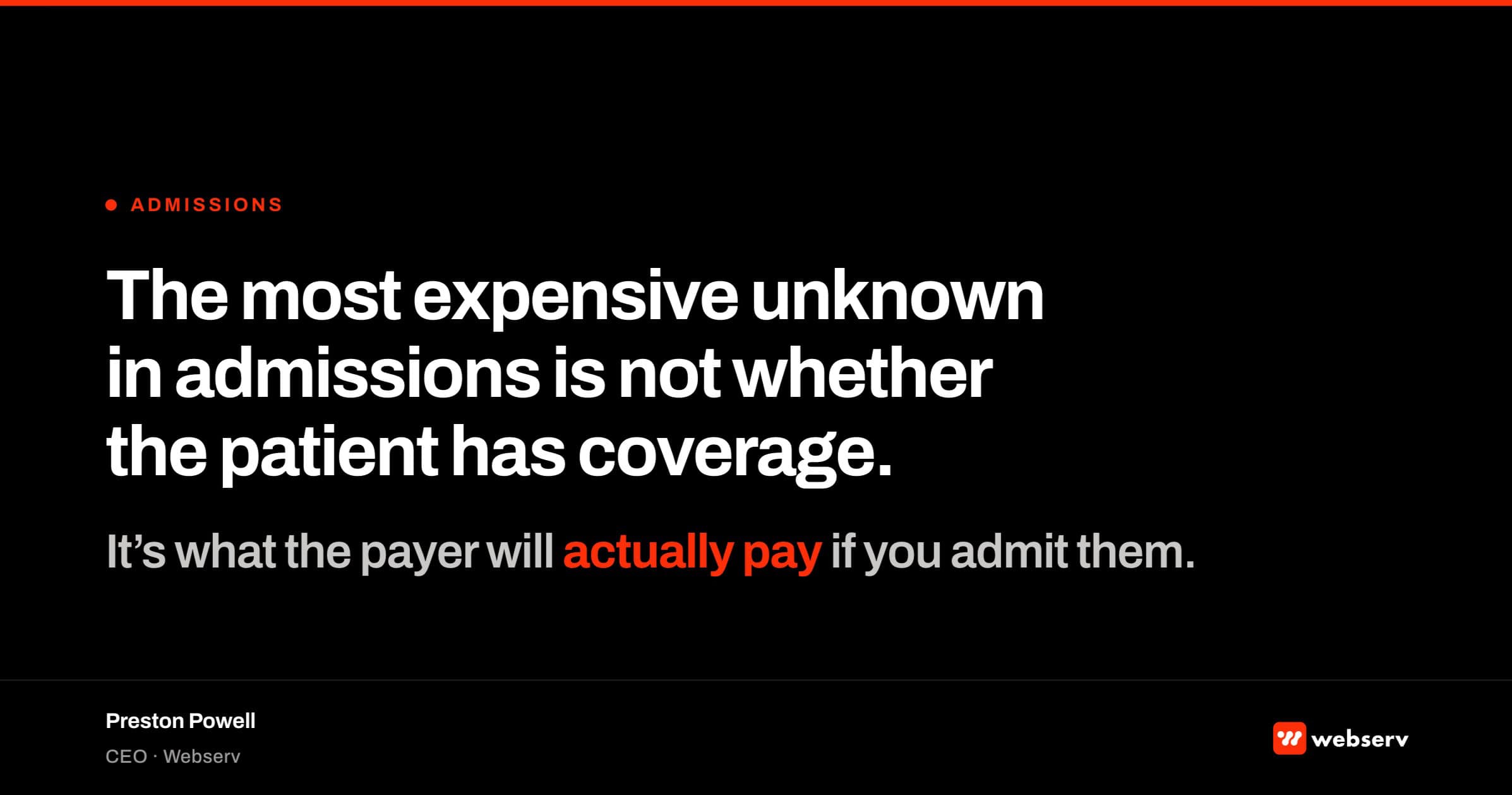
- The most expensive unknown in admissions is not whether the patient has coverage. It is what the payer will actually pay for the specific admit at the specific plan and level of care. That question does not get answered by an eligibility API.
- Two recurring operator scenes made the gap impossible to ignore: clients turning away good admits because they believed a payer “paid badly” when the data said otherwise, and Monday-morning VOB backlogs where patients were sitting in front-office chairs while eligibility calls waited for business hours.
- Two patients with identical benefits on paper can produce a 10x difference in what actually gets allowed per day. Eligibility data cannot see that variance. Adjudicated claims data can.
- Rate intelligence produces a defensible expected reimbursement number for a specific case before the admit. In a comparison case across roughly 23,000 claims, that layer identified $1.36 million in underpayments the treatment centers had not previously known to pursue.
- Eligibility tells you whether you can bill. Rate intelligence tells you whether you should admit. That is a different question, a different product category, and the reason this exists as its own discipline.
The two scenes that kept repeating
I did not have a lightning-bolt moment where I decided to build PayerLenz. What I had were two scenes that kept repeating across every treatment center engagement I ran for years.
The first was a client telling me a friend had warned them a specific policy “pays badly.” We would pull the actual data on that payer, and the data would say the opposite.
They were about to turn away a solid admission based on a hallway rumor. Not because they were careless operators. Because they had no defensible way to check the rumor against reality.
The default state of the rehab operating environment is that payer strategy runs on anecdotes formed off a handful of claims and secondhand conversations, and the operators paying the highest cost for that pattern are the ones with the best marketing programs.
The second was every single Monday morning. Weekend VOBs piled up because nobody could check eligibility or get a read on what those policies would actually pay while the patients were sitting in front-office chairs waiting for an answer.
Admissions is a 24/7 business. Eligibility information is not. The gap between the two is where families in crisis lose access to care and where treatment centers lose admits to whoever answered the phone first.
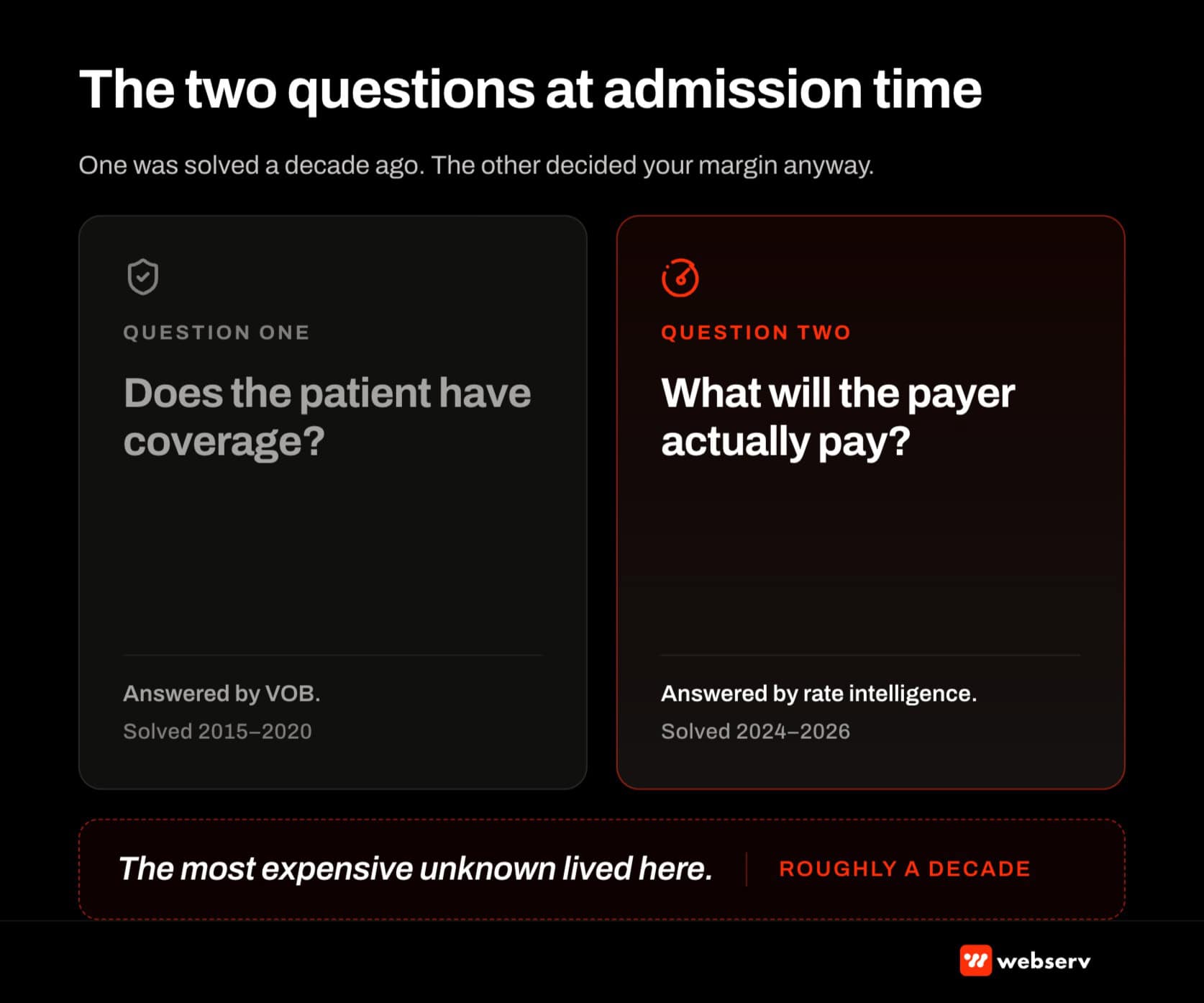
Both scenes were symptoms of the same underlying gap. The information the industry has treated as sufficient for admissions decisions is not sufficient. Coverage confirmation answers half of the question. The other half never gets answered by an eligibility API.
DEFINITION
The Reimbursement Gap. The distance between what the policy says (coverage, benefit design, deductible position, network status) and what the payer will actually pay for a specific admit at a specific plan and level of care. Eligibility APIs answer the first half. Adjudicated claims data answer the second. Most treatment centers have historically had access only to the first half, which is why so many operations with strong marketing programs and full admissions teams still miss census plan year after year.
What every VOB tool answered, and what none of them answered
VerifyTX is a good eligibility tool. Availity, pVerify, and the eligibility modules inside every RCM stack are also good at what they do. The problem is not that these tools are broken.
The problem is that they are all built to answer the same half of the question, and the operator’s actual decision requires the other half.
A verification of benefits confirms that the policy is active, that the benefit design covers the level of care, that the deductible is at X, that out-of-network benefits apply, and that any prior authorization requirements are known upfront.
Every one of those data points is real, useful, and necessary. A treatment center running admissions without a VOB process is operating blind on coverage. That is not the argument I am making.
The argument I am making is that coverage is not a rate. Two patients with identical benefits on paper can produce a 10x difference in what actually gets allowed per day.
The eligibility API cannot see that variance because the payer eligibility endpoint returns what the policy says, not what the payer has actually paid on adjudicated claims. It is an architectural limit of the data source, not a gap in the tool’s implementation.
The way I say it to a CEO the first time we talk about this: eligibility tells you whether you can bill. Rate intelligence tells you whether you should admit. VerifyTX ends where PayerLenz begins.
The gap I could not unsee
Once I saw the two scenes as the same problem, I could not stop seeing them everywhere. Every operator conversation I ran surfaced some version of the same pattern.
Payer mix strategy on hallway anecdotes. “Aetna pays great, Cigna is terrible,” said with confidence based on maybe twenty claims and three conversations at a conference.
The data at the plan and level-of-care level almost always said something more nuanced, and often said the opposite. Operators turning away profitable admits and accepting losers based on folklore, month after month, at scale across the industry.
Out-of-network treated as a single rate. Operators building financial models on the assumption that OON PHP or OON detox reimburses at some average. In reality, OON is not a number. It is a distribution, and within a single alpha prefix it can swing 10x on identical coverage.
The operators who admit and forecast against a single expected rate get crushed on the low tail and never even know they left money on the table at the high end.
No feedback loop between the VOB and the paid claim. The VOB said one thing at admission. The EOB said something else two months later.
Nobody reconciled the two. The same misjudgment repeated every month, on every payer, forever. Not because the billing team was careless. Because there was no baseline to reconcile against.
Any one of these patterns is expensive over a year. All three running at once is the reason so many treatment centers with strong marketing programs and full admissions teams still miss census plan year after year.
The gap is not in the marketing or in the admissions team. The gap is in the operating layer between coverage confirmation and paid claim.
What we built and what we found
PayerLenz answers the rate question by running on a fundamentally different data source than eligibility tools.
Instead of payer eligibility APIs, the pool is adjudicated claims contributed by real treatment centers, cleaned and normalized to the specific alpha prefix, home plan, state, level of care, and network status.
What matters at the operator level is the output. When PayerLenz returns an expected reimbursement estimate for a specific case at a specific payer and plan and level of care, that estimate lands within 10% of what the payer actually pays on adjudicated claims about nine times out of ten.
That is a defensible accuracy number, and it changes what the admissions manager can plan around.
The number I did not expect when we ran the analysis: in one comparison case across roughly 23,000 claims where we could compare what the payer actually paid against what our benchmark data said the payer should have paid, the pool caught $1.36 million in underpayments.
Money the treatment centers were owed and never knew to chase.
To be precise about what that number is and is not: it represents the subset of claims where we had enough data to make a defensible paid-versus-expected comparison, not the entire pool. And reimbursement recovery is a payer-relationship discipline that depends on operator-side appeals workflow, so the framing is “estimates, not guarantees.”
But the point stands. Rate intelligence does not just produce better admit decisions upstream. It surfaces underpayment recovery downstream.
The technical work behind those numbers, the alpha prefix resolution mechanics, the confidence formula, the estimate math, is not the interesting story to me.
The interesting story is that this gap in the industry has been sitting there for a decade, expensive and unmeasured, and nobody was going to close it from the eligibility API side because the data required to close it lives somewhere else.
What changes when the gap closes
Across our client book, the specific operating changes I see once rate intelligence is running are consistent enough to name.
The admissions call flow changes. Coordinators still confirm coverage on the VOB. The admissions manager now sees the expected rate alongside the coverage confirmation before the admit gets scheduled.
Escalations happen upstream instead of surfacing on the collections report ninety days later. The rate intelligence workflow piece covers the specific script and CRM integration mechanics.
Payer mix strategy sharpens. Decisions get made at the resolution the money actually adjudicates at, which is plan-specific and level-of-care specific, not carrier-generic. The “Aetna pays great, Cigna is terrible” heuristic gets replaced with a defensible number at the plan level.
The revenue cycle discipline extends upstream. Billing teams start reconciling paid rates against expected rates and identifying underpayments to pursue. That is the operator-side implementation of what the $1.36M comparison case surfaced.
The QBR conversation changes. Aggregate cost per admit reporting gets replaced by rate-adjusted admissions volume, payer mix trending against expected reimbursement, and referral partner attribution that accounts for the payer profile the partner is sending. The marketing-to-admissions QBR playbook covers how that reporting rebuilds.
None of this is exotic. It is what happens when an operator finally has both halves of the answer at the same time.
The conversation I still have most often
The most common conversation I have with treatment center owners today is the one where they realize the operating layer between marketing and clinical intake has been running blind on the second half of the reimbursement question.
Not the coverage half. The rate half. The half that determines whether the census plan actually produces the revenue the operator is building the business against.
I have some sympathy for how we got here. Eligibility APIs solved a real problem in the mid-2010s, and the tools that got built on those APIs did legitimate work. But the market never got the second layer.
Nobody built a pool of adjudicated claims across enough treatment centers to answer the rate question at any scale, because pooled claims data is a hard problem that takes years of operator trust to build.
PayerLenz is the second layer. It runs alongside your VOB tool, not instead of it. The output is a rate estimate an operator can plan around, backed by claims data across more than a million datapoints, delivered at the moment the admit decision gets made.
What that layer produces is different from what any eligibility tool has ever produced, and the difference is the answer to the question that determines whether the operation makes money.
Frequently Asked Questions
This connects to the broader revenue cycle picture covered in behavioral health marketing guide and revenue cycle management guide. It’s also worth pairing with billing mistakes that reduce admissions and reducing claim denials.
What is the most expensive unknown in admissions?
The rate the payer will actually allow per day for the specific admit at the specific plan and level of care. Eligibility tools tell you the patient has coverage, what the deductible looks like, and whether the level of care is a covered benefit.
None of them tell you what the payer will pay. That answer requires adjudicated claims data, which lives in a different data infrastructure than the payer eligibility APIs every VOB tool is built on.
For most treatment centers, that unknown produces two failure modes at scale. Admissions at rates below the program’s cost floor that surface on the collections report ninety days later. And underpayments on admits that did produce revenue, where the billing team had no baseline to notice the payer allowed less than the pattern suggests they should have.
Why do rehab operators run payer strategy on anecdotes?
Because they have not had a defensible alternative. The default state of the operating environment is that operators talk to each other at conferences, share war stories about specific payers, and form reputations off small claims samples and hallway conversations.
Rate intelligence replaces the anecdote layer with a defensible number at the resolution the money actually adjudicates at. That does not eliminate the operator’s judgment. It just gives the judgment something quantitative to sit on top of.
How does PayerLenz identify underpayments if the paid claim already closed?
Rate intelligence produces an expected reimbursement number for a specific case at admission. When the paid claim comes back sixty to ninety days later, the billing team can compare what the payer actually paid against what the pool said the payer historically pays at that plan-and-LOC resolution.
In a comparison case across roughly 23,000 claims where we could make a defensible paid-versus-expected comparison, PayerLenz identified $1.36 million in underpayments the treatment centers had not previously known to chase.
The 23,000 claims were the subset where we had enough data to make the comparison, not the entire pool. And recovery is a payer-relationship discipline, not a mechanical resubmission. But the number represents money that was owed and never chased, because the baseline for what correct should have looked like did not exist inside the billing team.
Do we still need a VOB tool if we have rate intelligence?
Yes. Coverage confirmation is still necessary for the admissions workflow, and VOB tools do that job well. Rate intelligence does not replace VOB.
It runs alongside it, or in some cases returns both data sets in the same call. What changes is that the admissions manager now has both halves of the answer at the moment the admit decision gets made, not just the coverage half.
The way I frame it for operators: eligibility tells you whether you can bill. Rate intelligence tells you whether you should admit. Both matter. The market historically has only offered one.
What is the most important operator conversation you have on this topic?
The one where an owner realizes that the operating layer between marketing and clinical intake has been running blind on the reimbursement question. Not the coverage question. The rate question. The one that determines whether the census plan actually produces the revenue the operator is building the business against.
That realization changes the operating discipline pretty quickly. Admissions ops starts running with both halves of the answer. Payer mix strategy sharpens. The billing team gets a defensible baseline for what the payer should have paid, which changes the appeals workflow. And the QBR conversation with ownership shifts from census talk to rate-adjusted admissions volume.
Preston Powell is CEO of Webserv, a behavioral health marketing agency and admissions ops platform working with residential, outpatient, and telehealth treatment providers across the United States. He co-founded PayerLenz alongside Kyle McHenry, the reimbursement intelligence platform this piece describes.