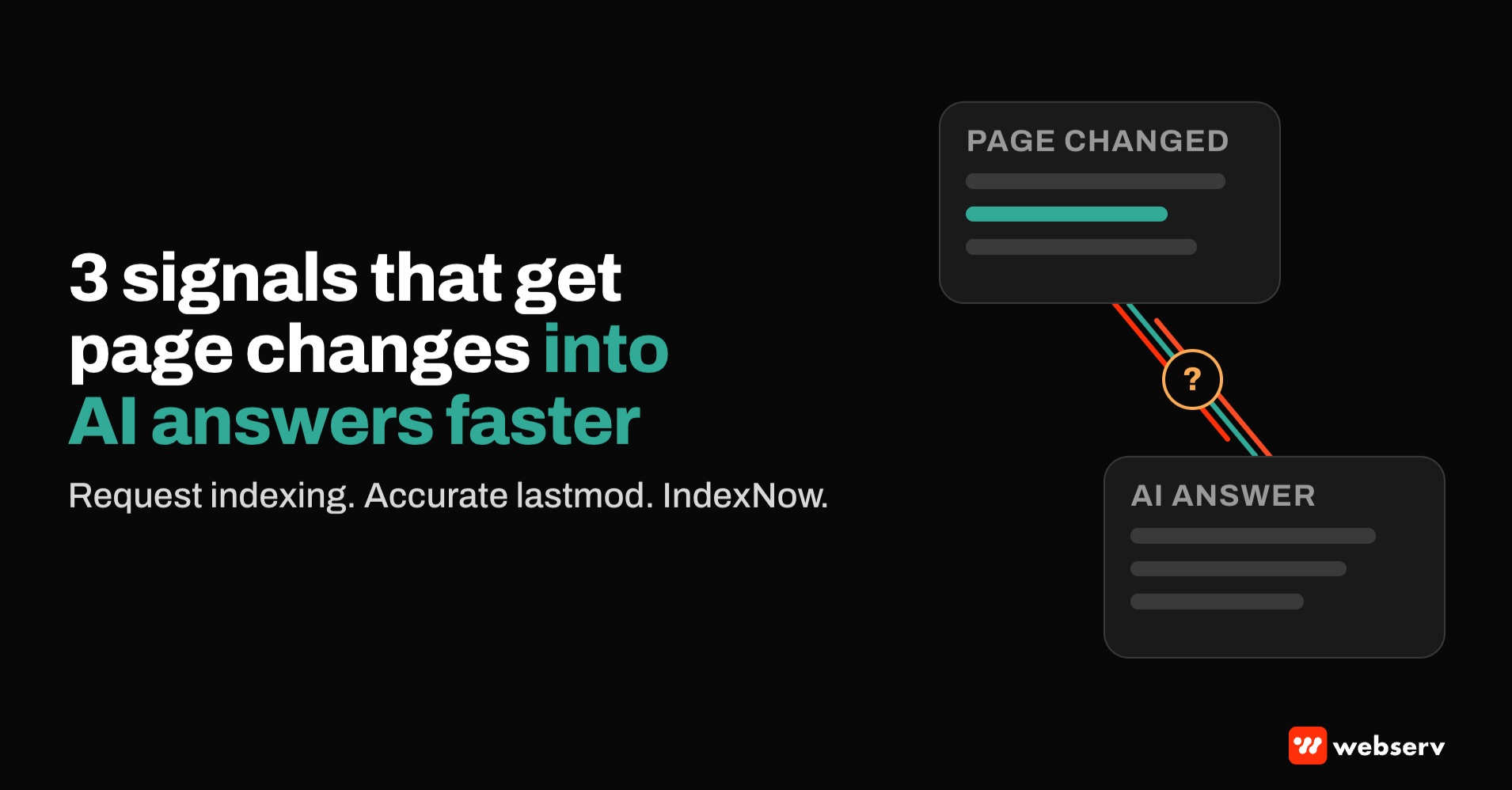
Google’s documentation says recrawling a page can take anywhere from a few days to a few weeks, and that asking again for the same URL won’t get it crawled faster.
OpenAI and Perplexity document how long robots.txt changes take to register, about 24 hours, but none of the AI platforms publishes how long it takes for a content change to show up in their answers.
That gap matters for treatment centers. When an insurance contract ends, a program closes, or a phone number changes, the question isn’t only “how often should we refresh content.” It’s “how long until AI answers stop repeating the old version, and what can we do to speed that up.”
There’s no published re-scoring schedule for AI search. What exists is crawl and indexing guidance from each platform, a few tools that notify search engines of changes, and studies on how often AI citations change and how fresh the cited content tends to be.
This piece covers how each platform finds changes, how to speed it up, what citation studies say about freshness, and how to handle urgent fact changes. For the editorial side of refreshing content, see our content refresh framework. This is part of the work inside our AEO program for treatment centers.
Key Takeaways
- No AI platform publishes how long content changes take to appear in its answers. Google says recrawling can take a few days to a few weeks.
- Google’s AI features retrieve pages from its Search index through core ranking systems, so Google AI answers depend on Google recrawling and reindexing the page.
- IndexNow notifies Bing and other participating engines of changes immediately, and Bing says it reduces outdated URL references in Copilot responses. Google doesn’t participate.
- Citation churn varies by platform: SISTRIX found AI Overviews the most stable, with no domain changes in 53% of prompts over 17 weeks, while ChatGPT rotated 74% of cited domains weekly.
- Freshness preferences vary too. Ahrefs found AI assistants cite content about 25.7% fresher than organic results, but AI Overviews’ top citations leaned older.
- Google’s guidance asks whether pages change their dates to seem fresh without substantial changes. Update dates only when the content actually changes.
How each platform finds changes
Google. Google’s recrawl documentation says crawling can take a few days to a few weeks and doesn’t guarantee inclusion. Its URL Inspection help says indexing typically takes a day or so but can take much longer, and that there’s a daily limit on index requests.
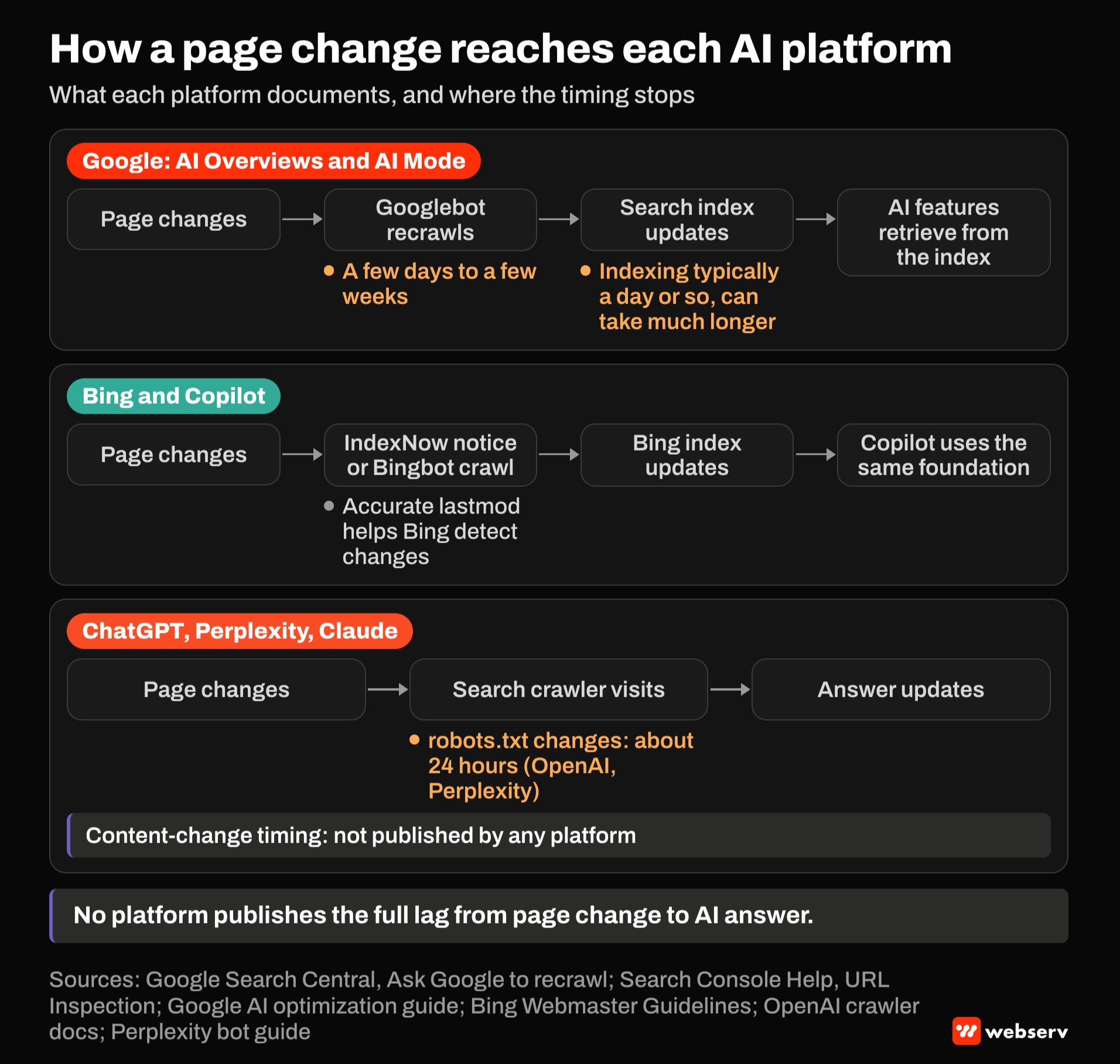
Google’s AI optimization guide says AI search relies on core ranking systems to retrieve relevant, up-to-date pages from the Search index. For AI Overviews and AI Mode, the page has to be recrawled and reindexed before the new version can be used.
DEFINITION
Freshness lag. The time between changing a page and the change appearing in search results or AI answers. It depends on when a crawler next visits, how quickly the index updates, and how often the AI system retrieves the page again. No platform publishes a figure for the full chain.
Bing and Copilot. Bing’s Webmaster Guidelines say Copilot relies on the same crawling, indexing, and ranking foundation as Bing search, and that IndexNow notices help reduce outdated or incorrect URL references in Copilot responses. The guidelines also say accurate lastmod values help Bing detect changes.
ChatGPT, Claude, and Perplexity. OpenAI’s crawler documentation says robots.txt changes take about 24 hours to register, and Perplexity’s bot guide says up to 24 hours. Neither says how fast content changes appear. Anthropic’s crawler article describes Claude-SearchBot without a timing statement.
What you can do to speed it up
Request indexing in Search Console. For a changed page, the URL Inspection tool’s request indexing option asks Google to recrawl it. Google notes there’s a quota and that repeated requests don’t speed it up.
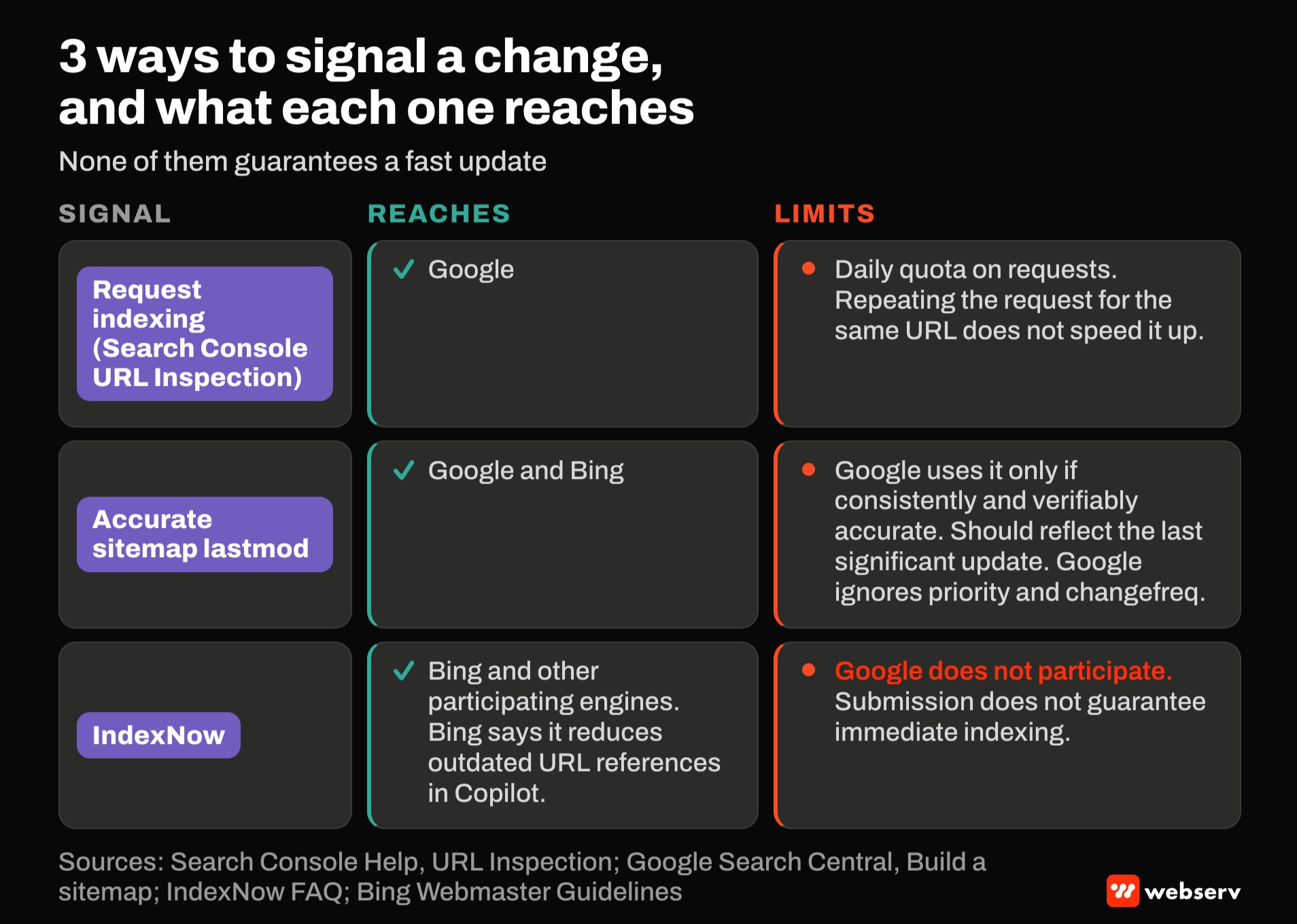
Use accurate lastmod dates. Google’s sitemap documentation says it uses lastmod if it’s consistently and verifiably accurate, and that it should reflect the last significant update. It also says Google ignores priority and changefreq values.
Turn on IndexNow. IndexNow lets a site notify participating engines, including Bing, of a change, though it says submission doesn’t guarantee immediate indexing. Bing’s URL submission page strongly recommends IndexNow. Our guide to Bing Copilot for behavioral health covers setup.
DO
- Request indexing for changed pages in Search Console.
- Keep sitemap lastmod dates accurate.
- Turn on IndexNow.
- Allow the search crawlers you want citing you.
DON’T
- Bump dates without changing the content.
- Re-request the same URL over and over.
- Block Claude-SearchBot or OAI-SearchBot.
Don’t block the crawlers that matter. Anthropic says blocking Claude-SearchBot may reduce visibility in Claude’s search results, and OpenAI says blocking OAI-SearchBot keeps a site out of ChatGPT search answers. Our robots.txt guide for AI bots covers the decisions.
COMMON MISTAKE
Changing the date without changing the page. It’s tempting to update the published or modified date on a page to look fresh. Google’s helpful content guidance asks whether you’re changing dates to make pages seem fresh when the content hasn’t substantially changed.
Its byline dates guidance asks for consistent dates. Update the date when the content changes, and make sure the change is real.
What the citation studies say about freshness
Citations change at different rates on different platforms, and freshness preferences differ too.
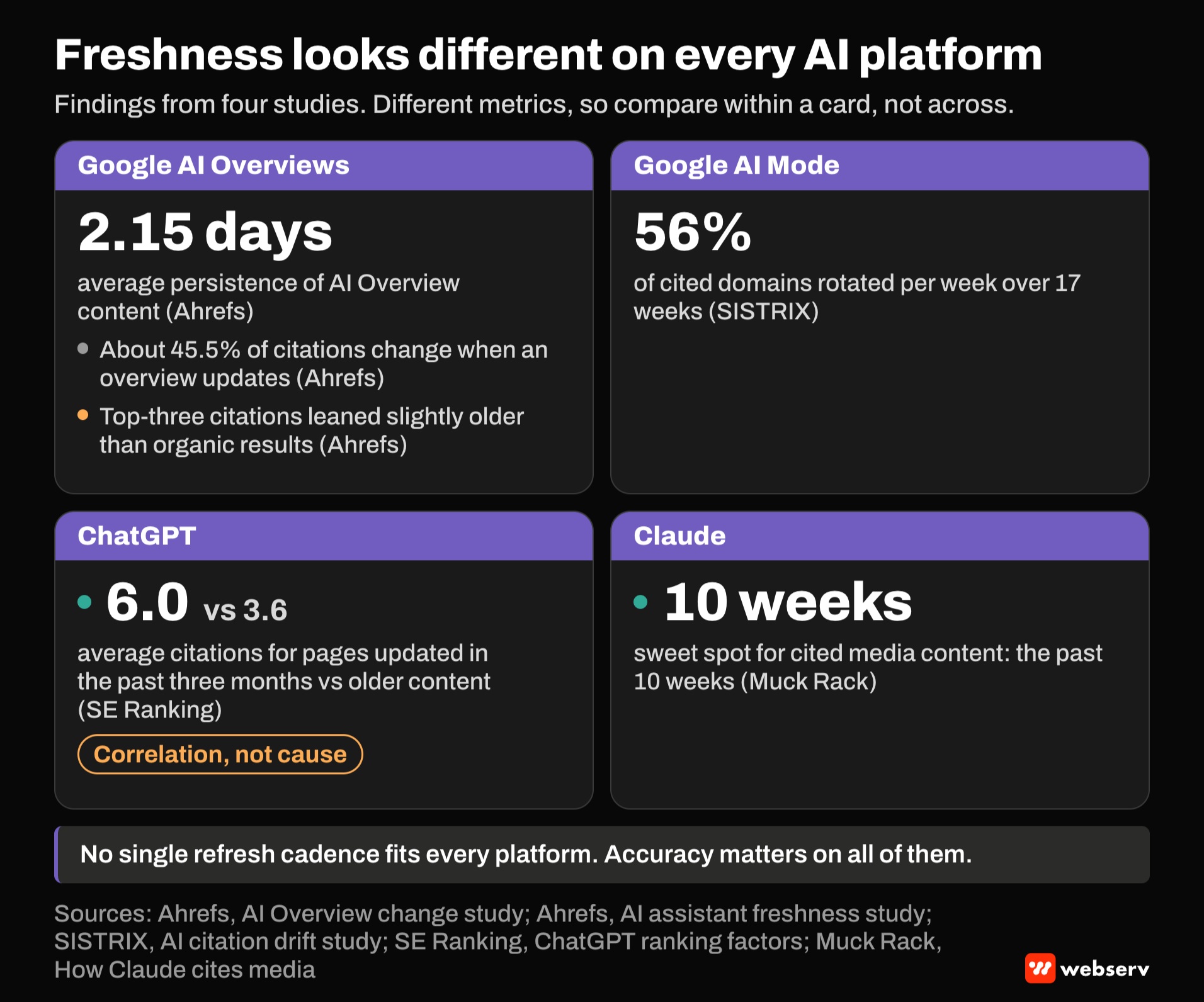
How often citations change. SISTRIX’s 17-week study found no domain changes in 53% of AI Overview prompts, while AI Mode rotated 56% of cited domains per week and ChatGPT 74%. Ahrefs found AI Overview content changes often, with an average persistence of 2.15 days and about 45.5% of citations changing when an overview updates.
How fresh cited content is. Ahrefs’ freshness study found AI assistants, including ChatGPT, Perplexity, Copilot, and Gemini, cited content about 25.7% fresher on average than organic results. AI Overviews’ top-three citations were the exception, slightly older than the organic results.
How AI citations change and how fresh they are
53%
of AI Overview prompts had no domain change over 17 weeks (SISTRIX)
74%
of ChatGPT cited domains rotated weekly (SISTRIX)
25.7%
fresher content cited by AI assistants than organic results (Ahrefs)
Sources: SISTRIX AI citation drift study; Ahrefs freshness study.
Platform-specific findings. SE Ranking’s ChatGPT study found pages updated within the past three months averaged 6.0 citations versus 3.6 for older content, a correlation. Muck Rack’s analysis of Claude found a sweet spot in media content from the past 10 weeks.
The takeaway: freshness matters more on some platforms than others, and no single cadence fits all of them. Accuracy matters on all of them. For what happens when a cited page loses its spot, see our piece on citation displacement in AI Overviews.
Handling urgent fact changes
Some changes can’t wait for the next scheduled refresh: a payer contract ends, a program closes, a location moves, a phone number changes. For those:
Update every page that states the fact
Update every page that states the fact, including program, insurance, location, and AI information pages. Our AI information page guide covers keeping a single reference current.
Update listings
Update listings such as the Google Business Profile and Bing Places.
Request indexing
Request indexing in Search Console for the most important changed pages.
Send IndexNow notifications
Send IndexNow notifications for the same URLs.
Update the sitemap lastmod
Update the sitemap lastmod for changed pages.
Check AI answers
Check AI answers for the affected facts over the following weeks, and record when they change.
How this fits with a refresh cadence
Scheduled refreshes and urgent updates serve different purposes. Our content refresh framework covers which pages to refresh, how often, and what counts as a substantive update. This piece covers how quickly those changes can reach AI answers. For structuring answers on refreshed pages, see our guide to FAQ sections for AI search.
Google’s Search Console generative AI report shows AI Overview and AI Mode impressions by page and date, which helps show whether a refreshed page is appearing more often afterward. For a related measurement question, see our guide on why blog traffic drops while rankings hold.
OPERATOR INSIGHT
Keep a log of urgent fact changes with the date the site changed and the date each AI platform’s answer changed. Over a few months, it gives you your own measure of freshness lag, which no platform publishes.
It also tells admissions when they can stop correcting callers who heard the old information from an AI answer.
For the broader build, see the Full AI Search Stack, our guide to getting cited in Google AI Overviews and ChatGPT, the 12 SEO failure patterns diagnostic, and the 5-tier SEO priority framework.
For how AI search fits the rest of your marketing, see the complete guide to behavioral health marketing. If you want a second look at how current AI answers are about your facility, book an intro meeting.
Frequently Asked Questions
How long does it take for a page change to show up in AI answers?
No AI platform publishes a figure. Google says recrawling can take a few days to a few weeks, and its AI features retrieve pages from the Search index.
OpenAI and Perplexity say robots.txt changes take about 24 hours to register, but say nothing about content changes.
Track your own changes to learn the lag for your site.
How can we get Google to pick up a change faster?
Request indexing for the changed page in Search Console’s URL Inspection tool, and keep sitemap lastmod dates accurate.
Google notes there’s a daily quota for index requests and that repeated requests don’t speed things up.
Google says it uses lastmod only if it’s consistently and verifiably accurate.
Does IndexNow help with AI answers?
For Bing and Copilot, yes. Bing’s guidelines say IndexNow notices help reduce outdated or incorrect URL references in Copilot responses.
IndexNow also reaches other participating engines, but Google doesn’t participate.
Submission doesn’t guarantee immediate indexing.
Do AI systems prefer recently updated content?
Some do. Ahrefs found AI assistants including ChatGPT and Perplexity cited content about 25.7% fresher than organic results, and SE Ranking found recently updated pages averaged more ChatGPT citations.
AI Overviews’ top citations leaned slightly older than organic results in Ahrefs’ data.
Prioritize accuracy over appearing fresh, and update when the facts change.
Should we update page dates to look fresh?
Only when the content has substantially changed. Google’s helpful content guidance asks whether pages change their dates to seem fresh without substantial changes.
Its byline dates guidance asks for consistent dates.
Make real updates, then update the date.
Trevor Gage is the Director of Marketing at Webserv, a digital marketing agency for treatment centers.