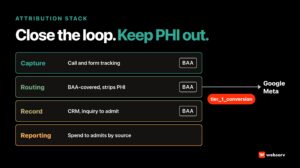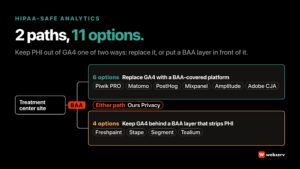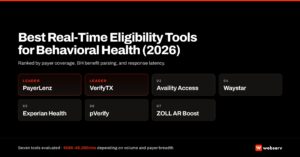
A treatment center owner called us last quarter. His facility had launched on Squarespace 14 months earlier because the marketing director liked the visual editor and the templates looked clean. The site went live in three weeks, looked great on launch day, and ran fine for the first six months.
Then the operator started running paid traffic, the lead volume picked up, and the compliance questions started.
The Squarespace contact form did not have a Business Associate Agreement path. The hosting environment had no documented HIPAA configuration. The analytics integration was capturing form input content with no PHI suppression. The page speed on mobile was hitting 5.2 seconds.
Every tactical fix required either a workaround or a platform migration. The “great in three weeks” decision had created a compliance liability and a marketing ceiling at month seven.
Inside our content SEO program and paid media program for treatment centers, this is one of the most common platform-migration diagnostic moments we walk operators through.
The fix was a WordPress rebuild on a HIPAA-eligible host with a proper form stack, schema infrastructure, and a paid landing page library purpose-built for the campaigns running underneath. The rebuild took 90 days and cost $74,000.
The Squarespace launch had cost $11,000. The total cost of getting the platform decision wrong was the difference between the two, plus 14 months of compliance exposure and conversion gaps.
This piece is the operator-facing read on the website development platforms that actually fit addiction treatment center marketing.
Ten platforms ranked by how well they serve the specific requirements of behavioral health treatment center sites: HIPAA compliance posture, SEO infrastructure, paid landing page support, page speed, accessibility, and total cost of ownership across a 36-month horizon.
The recommendation framework lives at the end. The platform-by-platform breakdown comes first.
This sits inside our broader content SEO program for treatment centers and the paid media program work. Both depend on the platform decision being right.
Key Takeaways
- WordPress on a HIPAA-eligible host is the dominant choice for treatment center websites, and for good reason. Roughly 85 to 90 percent of treatment center sites we audit run on WordPress, and the platform’s combination of plugin flexibility, hosting options, agency-friendly architecture, and SEO infrastructure makes it the default choice for most facilities.
- The platform decision is not just a design decision. HIPAA compliance posture, BAA availability across hosting + form + email stack, page speed on mobile, schema infrastructure, and total cost of ownership all flow from the platform choice. Operators who choose on visual editor preference and ignore the technical layer pay for the decision later.
- The 10 platforms cover almost every treatment center website on the public web in 2026. The realistic decision is among 3 of them (WordPress, Webflow, and Drupal for most operators; headless or custom for high-end multi-program facilities). The other 7 either have compliance gaps, scale problems, or fit niches that do not apply to most behavioral health operators.
- Squarespace and Wix should be treated with caution by treatment center operators. Both platforms have limited BAA paths and constrained HIPAA configurations. They work for non-PHI-handling sites but typically do not fit the compliance posture treatment centers need.
- The total cost of ownership matters more than the launch cost. An $11,000 Squarespace launch that becomes a $74,000 WordPress rebuild 14 months later costs more than starting with WordPress at $40,000 in the first place. The platform-migration cost is real and is the most common hidden cost in treatment center web decisions.
DEFINITION
HIPAA-Eligible Host
A web hosting provider that signs a Business Associate Agreement (BAA) and runs infrastructure compliant enough to handle Protected Health Information (PHI). Treatment center sites that capture insurance details, intake forms, or any PHI through their website must run on HIPAA-eligible infrastructure. Generic shared hosting providers do not qualify.
This buyers guide compares the ten website development platforms viable for treatment centers. For the broader engineering discipline that applies once the platform is chosen — HIPAA-aware development, performance engineering, integration architecture, launch QA, and post-launch maintenance — see our treatment center website development engineering and operations guide.
1. WordPress (Self-Hosted) on a HIPAA-Eligible Host
Best for: Almost every treatment center, from single-program facilities to multi-state operators. The default recommendation for 85 to 90 percent of behavioral health sites we work with.
WordPress is the open-source CMS that powers roughly 40 percent of all websites, per W3Techs. For treatment center sites specifically, the combination of plugin ecosystem, agency-friendly architecture, hosting flexibility, and SEO infrastructure makes it the dominant choice.
The vast majority of treatment center sites we audit run on WordPress, and the dominant choice is dominant for measurable reasons.
The HIPAA story is mature. HIPAA-eligible WordPress hosting is available from WP Engine, Pressable, Kinsta, Cloudways at specific configurations, and behavioral-health-focused specialty hosts. The host signs the Business Associate Agreement, provides encrypted storage and transport, and handles the infrastructure-side compliance requirements.
The form plugin ecosystem includes purpose-built HIPAA-eligible options (Hush Forms) and HIPAA-eligible configurations of general-purpose plugins (Gravity Forms with appropriate add-ons, WPForms HIPAA tier). The form layer aligns with the broader BAA chain that treatment center contact forms require.
The SEO story is the strongest of any platform on this list. Yoast and Rank Math both produce mature schema, sitemap, and metadata management. The plugin layer extends naturally to AI search infrastructure (llms.txt, OKF bundles via the Open Knowledge Format work, MCP servers) as those surfaces become load-bearing.
The cost profile runs $25,000 to $120,000 for a full treatment center website build depending on complexity, with HIPAA-eligible hosting at $200 to $800 per month on top of the build cost.
The agency landscape is deep, and operators can find treatment-center-specialized WordPress agencies in every major behavioral health market.
The limitations: WordPress sites require active maintenance (plugin updates, security patches, performance monitoring) that other platforms abstract away. Operators without an in-house technical resource or an agency relationship struggle with the maintenance burden.
The flexibility that makes WordPress attractive also makes the implementation quality variable across agencies, and a poorly built WordPress site can underperform a well-built Webflow site.
Verdict: Default choice for most treatment centers. The platform is mature, the HIPAA story is solved, and the SEO + paid landing page infrastructure is the deepest of any option. Entity SEO and AI search compounds naturally on top of the WordPress baseline.
2. Webflow
Best for: Design-led operators who want visual control without a developer dependency, smaller facilities with limited HIPAA exposure, or as the marketing site separated from a HIPAA-handling intake portal.
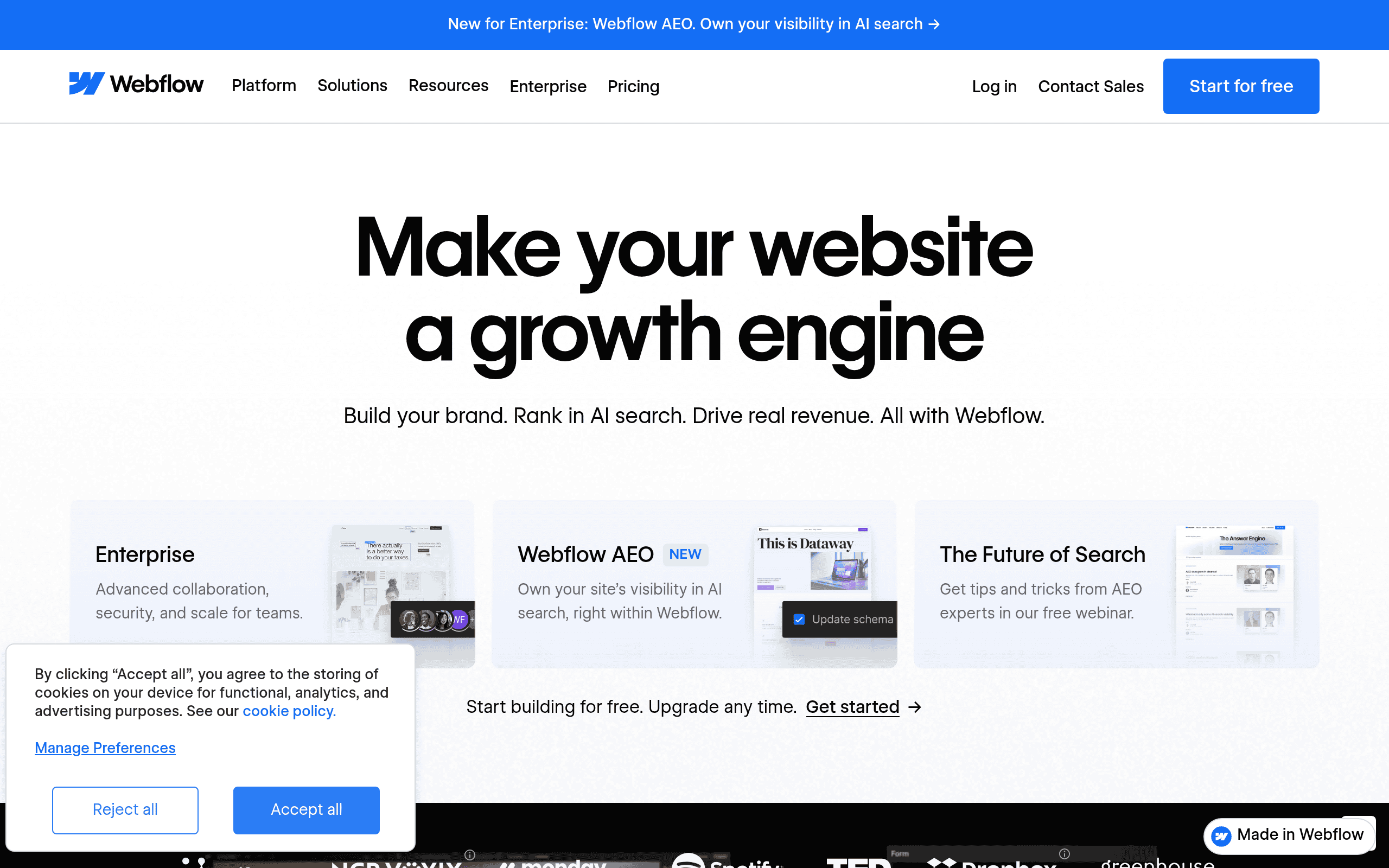
Webflow has emerged as the most credible WordPress alternative for content-driven sites over the last 5 years. The visual editor is materially better than WordPress page builders. The hosting and CDN infrastructure is bundled. The SEO controls are mature.
The HIPAA story is more limited than WordPress. Webflow Enterprise offers BAA coverage at higher tiers, but the standard Webflow plans do not.
Treatment center operators who choose Webflow typically need to architect the contact form and intake flow off-platform (routing form submissions to a HIPAA-eligible service rather than capturing them in Webflow directly) or upgrade to Webflow Enterprise with BAA coverage.
The SEO infrastructure is solid for traditional SEO (schema, sitemap, metadata, redirect management) but lighter than WordPress for the AI search layer. Webflow does not have a plugin ecosystem in the same sense, so AI search infrastructure (llms.txt, OKF bundles, MCP integration) typically requires more custom development.
The cost profile runs $20,000 to $80,000 for a treatment center build, with hosting bundled in the Webflow plan (Enterprise tier required for BAA, $200 to $500 per month range). The total cost of ownership is competitive with WordPress when the project complexity is moderate.
The limitations: form layer compliance requires architectural work, the plugin ecosystem for behavioral-health-specific functionality is thinner, and the agency landscape for treatment-center-specialized Webflow work is materially smaller than WordPress.
The platform is excellent for design-led marketing sites; it is less proven for the full behavioral health compliance and infrastructure stack.
Verdict: Strong second choice for design-led operators willing to architect the form/compliance layer off-platform. Not the default, but credible.
3. Drupal
Best for: Enterprise multi-state operators, healthcare systems with hospital affiliations, and facilities with in-house development capacity that values the platform’s enterprise security posture.
Drupal is the open-source CMS that runs much of the federal government, large healthcare systems, and enterprise media properties. For treatment center sites, Drupal is overkill for single-program facilities and a credible choice for large multi-state operators.
The HIPAA story is strong but requires more architectural work than WordPress. Drupal does not have a default HIPAA-eligible hosting tier in the same way WordPress does; operators typically deploy Drupal on AWS or Azure with HIPAA-eligible configurations and BAAs at the infrastructure layer.
The security posture of Drupal core is one of the strongest in the open-source CMS landscape, and enterprise healthcare operators appreciate this.
The SEO infrastructure is solid but the contribution ecosystem is smaller than WordPress. The schema, sitemap, and AI search infrastructure work that runs as plugins in WordPress typically runs as custom development or contributed modules in Drupal.
The agency landscape is enterprise-focused, with fewer behavioral-health-specialized Drupal agencies than WordPress.
The cost profile is higher than WordPress, typically $80,000 to $300,000 for an enterprise Drupal build with HIPAA-aligned hosting at $1,000 to $5,000 per month at the AWS/Azure infrastructure tier. The total cost of ownership reflects the enterprise positioning.
The limitations: overkill for most behavioral health operators, agency landscape thinner, learning curve steeper for marketing teams used to WordPress. Drupal is the right answer when the operator has true enterprise scale and in-house development capacity; it is the wrong answer for single-program or small multi-program facilities.
Verdict: Specialized fit for enterprise multi-state operators. Skip for everyone else.
4. HubSpot CMS Hub Enterprise
Best for: Treatment centers running their full sales and marketing stack on HubSpot already, including admissions CRM and marketing automation.
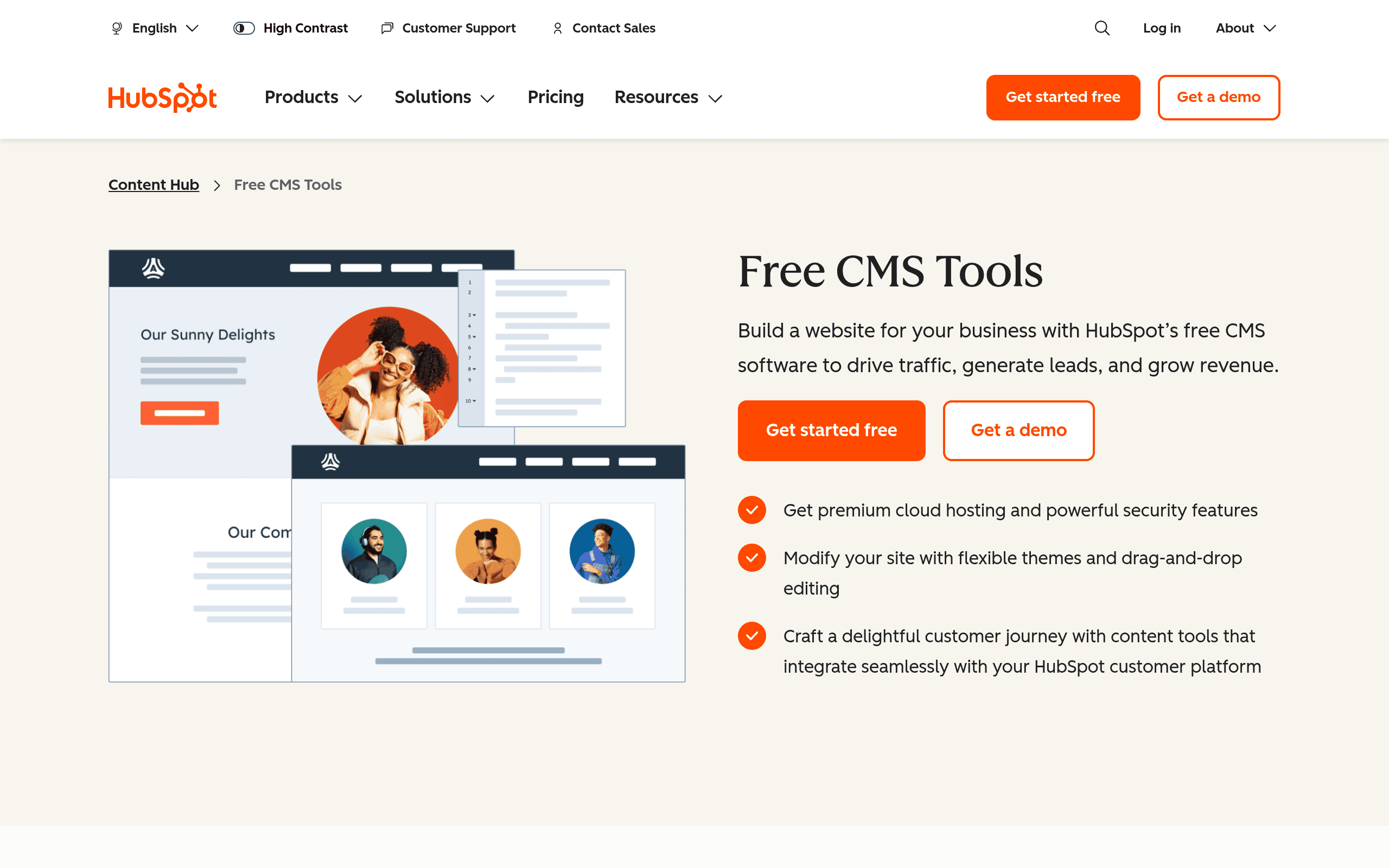
HubSpot CMS Hub is the website platform inside HubSpot’s broader marketing and sales suite. For operators who already run admissions CRM, marketing automation, and email on HubSpot Enterprise tiers, the CMS Hub provides a unified architecture.
The HIPAA story exists at HubSpot’s Enterprise tier with BAA coverage. The BAA scope covers HubSpot’s services specifically; operators still need to address email delivery, downstream integrations, and other compliance pipeline components.
The SEO infrastructure is moderate. Schema, sitemap, and metadata management is available but less mature than WordPress or Drupal. The AI search infrastructure layer is thin, with limited support for llms.txt, OKF bundles, or MCP integration as native features.
The cost profile is the highest of the mainstream options, typically $36,000 to $150,000 per year for the HubSpot Enterprise tier that supports the BAA, plus implementation costs of $40,000 to $150,000.
The lock-in effect is significant; migrating off HubSpot involves both website and CRM migration.
The limitations: cost, SEO infrastructure depth, and the lock-in. The platform fits operators who have already committed to HubSpot for the broader sales and marketing stack; it does not fit operators choosing a CMS in isolation.
Verdict: Right answer for HubSpot-native operators. Wrong answer for everyone else.
5. Duda
Best for: Multi-location franchises or agency-managed portfolios where consistent design across many sites matters more than individual site customization.
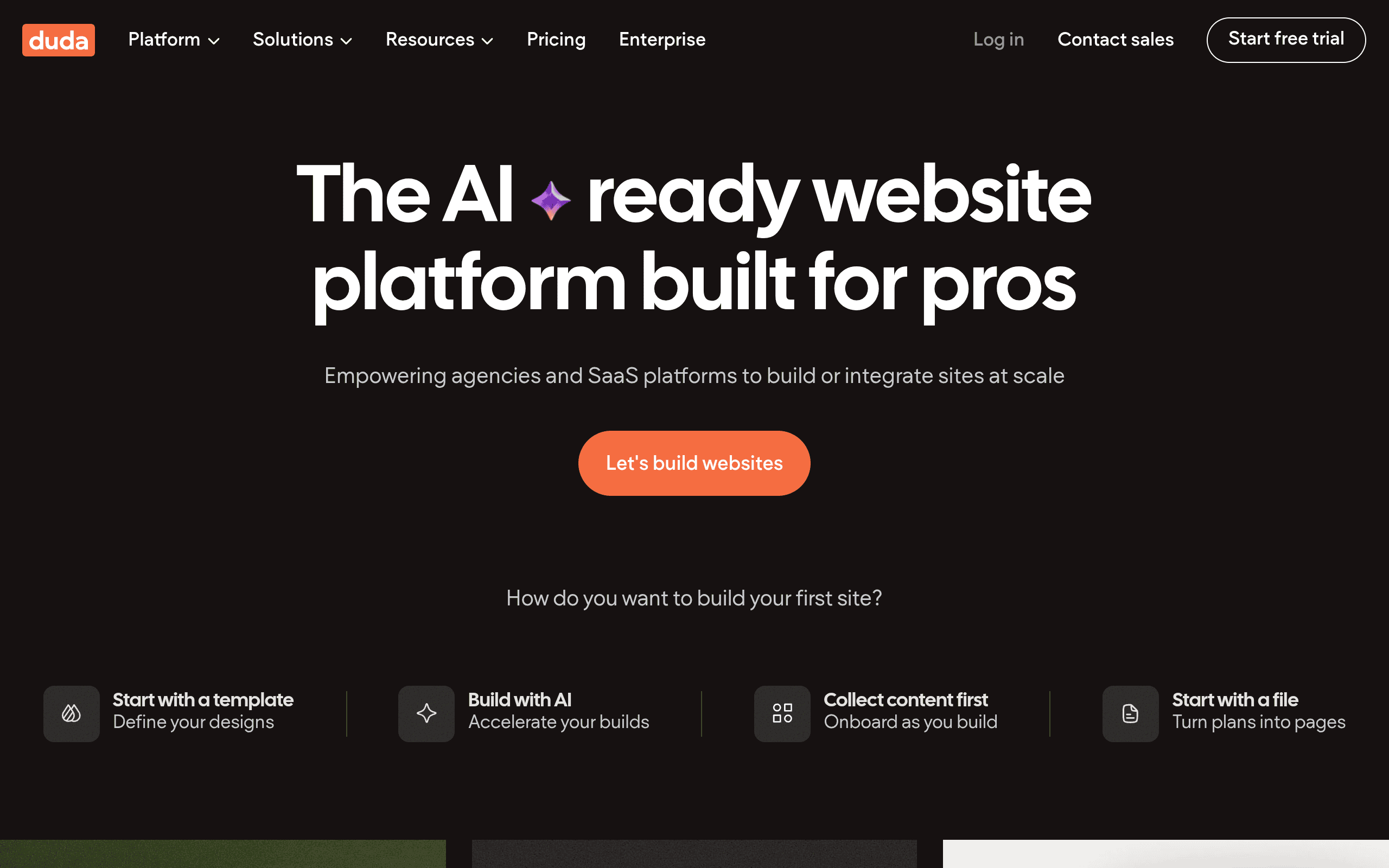
Duda is the agency-focused website platform that has gained traction for multi-location and franchise operations. Speed on mobile is competitive with Webflow, the visual editor is solid, and the platform’s multi-site management features fit specific multi-location use cases.
The HIPAA story is limited. Duda does not have a standard BAA path at common tiers, which means treatment center operators using Duda need to architect the form/compliance layer off-platform similar to standard Webflow.
The SEO infrastructure is moderate. The platform handles the basics (schema, sitemap, metadata) but the depth of plugin or contributed-module ecosystem is materially thinner than WordPress.
The cost profile is moderate, typically $15,000 to $50,000 for a single-site treatment center build with platform fees in the $20 to $100 per month range.
The limitations: HIPAA compliance posture, smaller agency landscape, and the platform’s multi-location strengths do not always align with treatment center needs (most behavioral health operators are single-location or small multi-location, where the franchise-management features are less load-bearing).
Verdict: Niche fit for multi-location franchises. Not a default choice for most treatment centers.
The most expensive mistake in treatment center web development is choosing the platform on launch cost. An $11,000 Squarespace launch that becomes a $74,000 WordPress rebuild 14 months later costs more than starting with WordPress at $40,000 in the first place.
Platform migration is the hidden line item that turns a clean budget into a regretted one.
Preston Powell, CEO of Webserv
6. Headless WordPress (Decoupled Architecture)
Best for: Multi-program operators with in-house development capacity who want the WordPress content authoring experience with a custom React/Next.js frontend.
Headless WordPress separates the WordPress content management layer from the public-facing site. WordPress runs in the backend as a content API; the frontend is built in React, Next.js, or Astro and consumes the API.
This gives marketing teams the familiar WordPress authoring experience and gives developers the performance and flexibility of a modern JavaScript frontend.
The HIPAA story is the same as WordPress in the backend (HIPAA-eligible host, BAA, encrypted storage) plus the additional consideration that the frontend deployment (Vercel, Netlify, AWS) needs its own BAA and compliance posture if it handles PHI.
The SEO infrastructure can be strong if implemented correctly. Static generation through Next.js or Astro produces excellent Core Web Vitals scores, and the schema/metadata layer can be controlled through WordPress in the same way as a standard WordPress site.
The implementation quality variance is higher than standard WordPress; a poorly implemented headless setup can have SEO issues that a standard WordPress site would not.
The cost profile is higher than standard WordPress, typically $80,000 to $250,000 for the build with ongoing hosting and frontend deployment costs of $500 to $3,000 per month.
The limitations: implementation complexity, development cost, and the dependency on in-house or specialized agency capacity for the frontend layer. Most treatment center operators do not need the headless architecture and can be served better by standard WordPress.
Verdict: Specialized fit for multi-program operators with in-house development. Overkill for everyone else.
7. Custom Next.js + Headless CMS (Sanity, Contentful)
Best for: Enterprise multi-state operators or operators with technical leadership who want full control over the frontend and prefer a structured content model.

A custom build typically pairs a JavaScript frontend (Next.js is the dominant choice in 2026) with a headless CMS like Sanity or Contentful. The architecture provides the best Core Web Vitals scores, the highest design flexibility, and the strongest scalability.
The HIPAA story requires explicit architecture. The CMS layer (Sanity, Contentful) needs BAA coverage at the appropriate tier. The frontend hosting (Vercel, Netlify, AWS) needs BAA coverage. The form and data flow layers need to be designed for HIPAA compliance from the start.
This is the most flexible compliance architecture and the most expensive to build correctly.
The SEO infrastructure is excellent when built right and problematic when built wrong. The structured content model in headless CMS platforms supports sophisticated schema generation and AI search infrastructure. The implementation depends on developer expertise more than any other platform on this list.
The cost profile is the highest of the open-source options, typically $150,000 to $500,000 for the build with ongoing infrastructure and CMS costs of $1,000 to $10,000 per month at enterprise tiers.
The limitations: cost, implementation complexity, and the dependency on continued technical maintenance. The architecture fits operators who have or are willing to build dedicated technical capacity.
Verdict: Enterprise-tier choice for multi-state operators with technical leadership. Not for most behavioral health facilities.
8. Sitecore (and Adobe Experience Manager)
Best for: Very large multi-state behavioral health operators with $50M+ marketing budgets and dedicated digital experience teams.

Sitecore and Adobe Experience Manager are enterprise digital experience platforms designed for global brands with complex personalization, multi-language, and content orchestration requirements. For treatment center operators, these platforms are typically overkill by an order of magnitude.
The HIPAA story is solid at enterprise tiers, with BAA coverage and the technical safeguards that enterprise healthcare buyers require.
The SEO infrastructure is enterprise-grade with deep support for personalization, A/B testing, and analytics integration.
The cost profile is significant. License fees alone typically run $100,000 to $500,000 per year, and implementation costs run $250,000 to $2,000,000. Total cost of ownership reaches enterprise software territory.
The limitations: cost relative to behavioral health operator economics, agency landscape limited to enterprise system integrators, and the platform’s strengths (personalization, multi-language, complex content orchestration) do not align with most treatment center marketing needs.
Verdict: Specialized fit for the largest multi-state operators. Generally inappropriate for the behavioral health category.
The platform decision is downstream of the compliance decision, not upstream of it. Treatment center operators who pick the CMS on visual editor preference and then try to bolt HIPAA on after the fact are reversing the order that produces a working site.
Compliance posture first, platform that supports it second.
Preston Powell, CEO of Webserv
9. Squarespace
Best for: Small single-program facilities with minimal compliance exposure and no plans to scale marketing materially.
 Squarespace homepage screenshot.
Squarespace is the popular all-in-one website platform that has gained traction with small business operators. For treatment centers, the platform has significant limitations.
The HIPAA story is the largest gap. Squarespace does not offer BAA coverage at standard tiers. Treatment center operators using Squarespace need to architect the contact form and PHI-handling flows entirely off-platform, which often defeats the simplicity benefit that motivated the Squarespace choice in the first place.
The SEO infrastructure is moderate. The platform handles basic schema and sitemap management but lacks the depth that mature behavioral health SEO programs require. The AI search infrastructure layer is essentially absent.
The cost profile is low at launch and high at scale. Initial setup runs $5,000 to $25,000 with platform fees of $30 to $50 per month.
The hidden cost is platform migration when the facility outgrows Squarespace, which we see at the 6 to 18 month mark for most treatment centers that start there.
The limitations: HIPAA compliance gaps, SEO ceiling, and the platform migration cost when the facility scales. The “great in three weeks” launch creates a 14-month liability for most operators we work with.
Verdict: Caution. Acceptable for tiny single-program facilities that will not scale; avoid for any facility that plans to grow.
10. Wix
Best for: Generally not recommended for treatment centers.
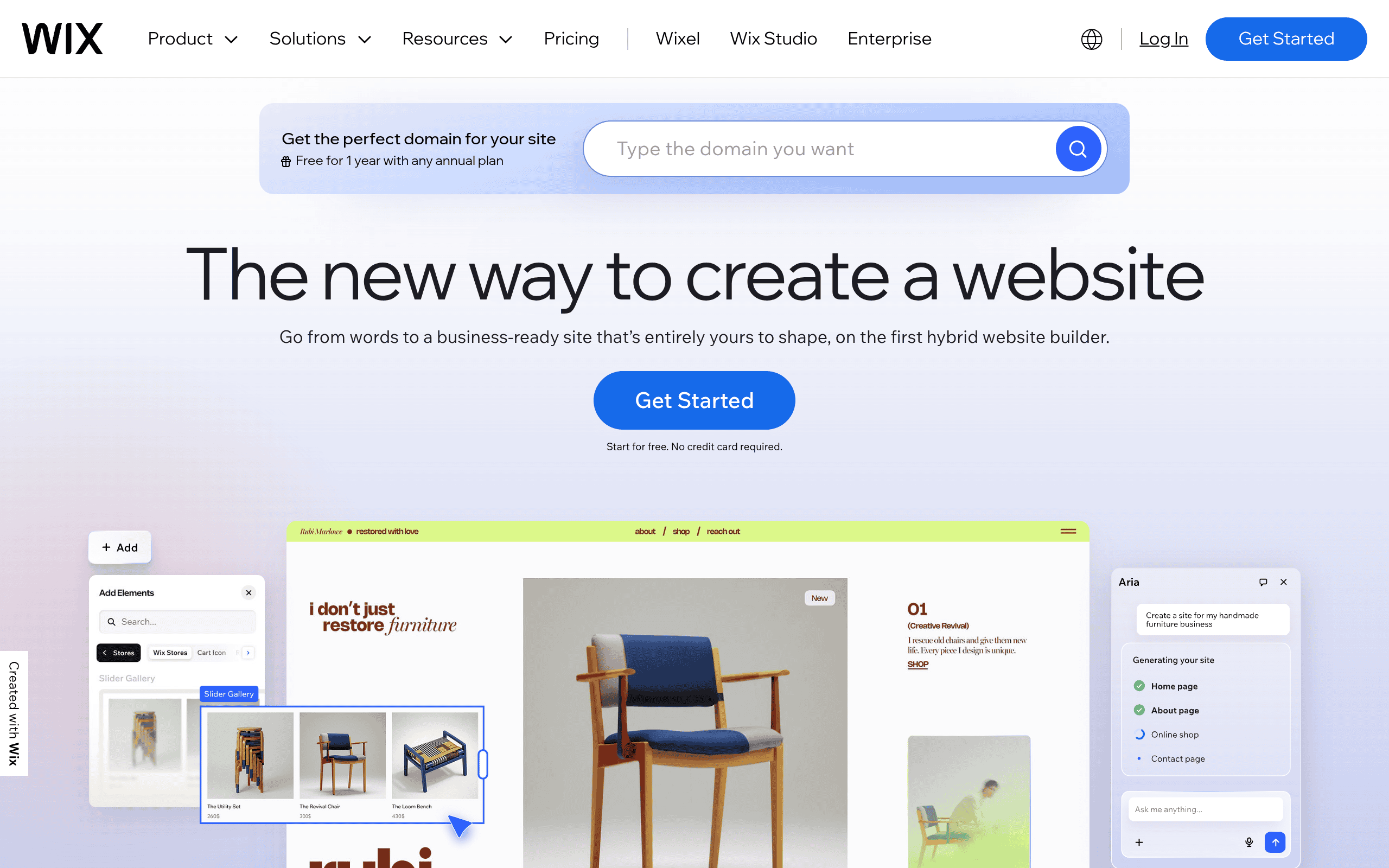
Wix is similar to Squarespace in positioning but with even more limited HIPAA configuration paths. The platform is built for small business websites with minimal compliance requirements.
The HIPAA story is weak. Wix does not offer BAA coverage in standard configurations, and the form/compliance architecture required to make Wix HIPAA-compliant is more complex than just moving to a more appropriate platform.
The SEO infrastructure is moderate, similar to Squarespace, with adequate basics and limited depth.
The cost profile is low at launch and higher at scale, with the same migration cost pattern as Squarespace.
The limitations: HIPAA compliance gaps, limited agency support for behavioral-health-specific Wix work, and the platform migration cost.
Verdict: Not recommended for treatment centers in almost every case.
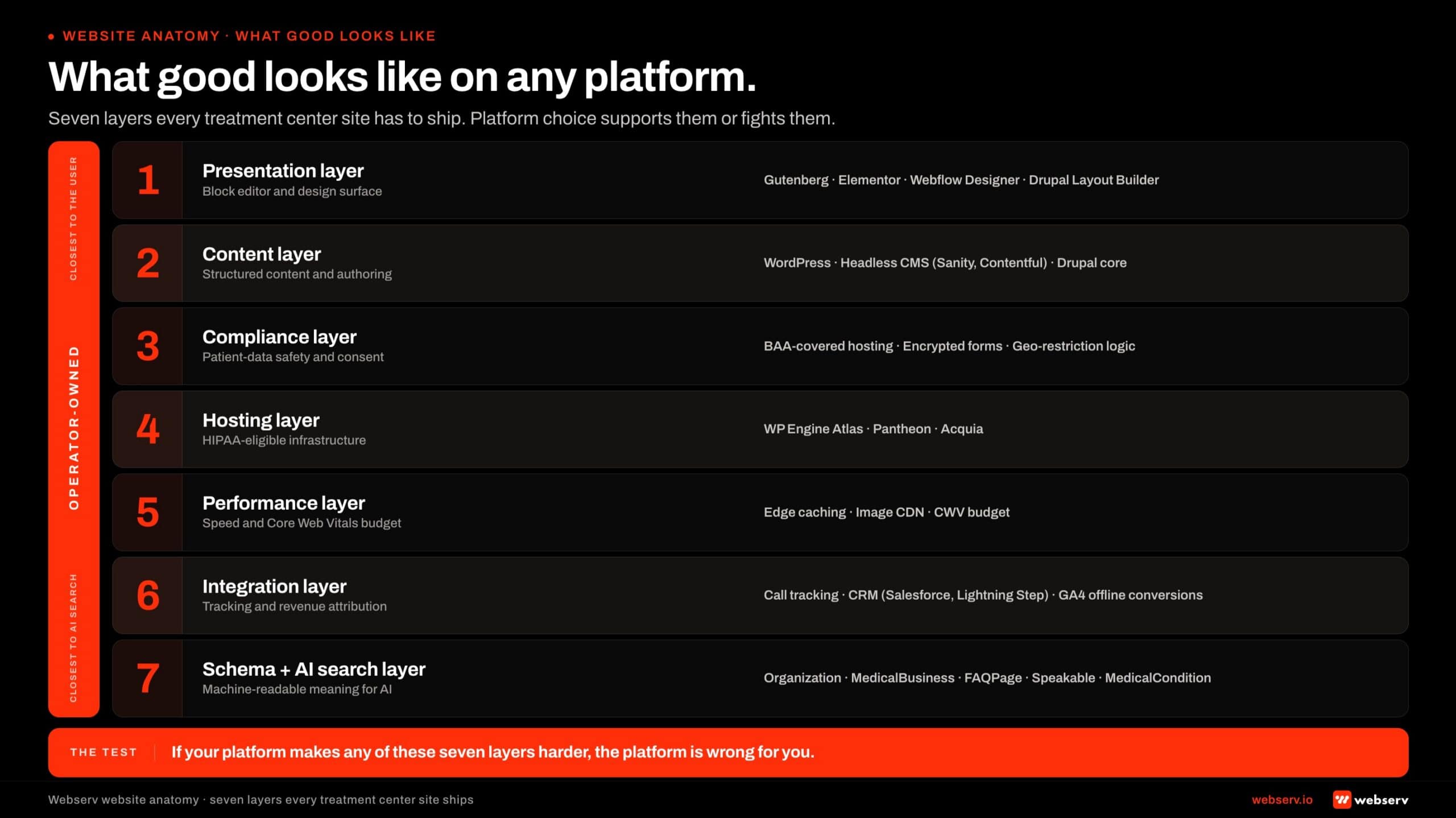 Seven-layer architectural anatomy infographic titled ‘What good looks like on any platform.’
How to Choose: The Decision Framework
The 10 platforms above cover the realistic options for treatment center websites. The decision among them comes down to facility stage, marketing budget, in-house technical capacity, and compliance posture.
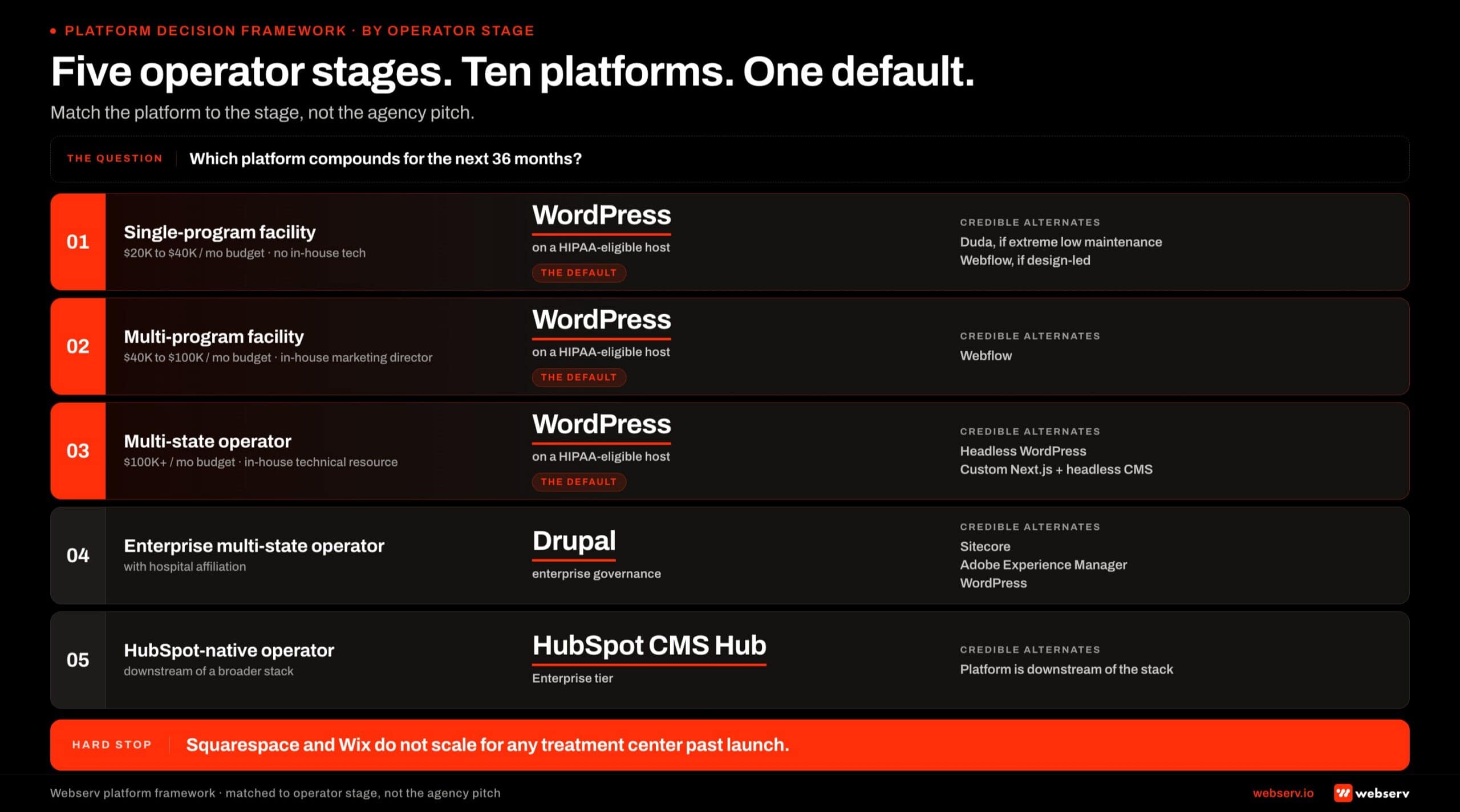 Decision-tree infographic titled ‘Five operator stages. Ten platforms. One default.’
Single-program facility, $20K-$40K monthly marketing budget, no in-house technical resource. WordPress on a HIPAA-eligible host with a best marketing agencies for rehabs. Default choice. The agency handles ongoing maintenance, the platform supports the full SEO + AI search infrastructure, and the HIPAA story is mature. For facilities that have not launched yet, the platform decision is the first step of the infrastructure phase new treatment centers complete before marketing spend starts.
Multi-program facility, $40K-$100K monthly marketing budget, in-house marketing director. WordPress on a HIPAA-eligible host with a specialized agency relationship. The same default applies. The platform scales with the operator’s growth.
Multi-state operator, $100K+ monthly marketing budget, in-house technical resource. WordPress is still the default, but headless WordPress or custom Next.js + headless CMS become credible alternatives. The decision depends on whether the operator wants to invest in dedicated technical capacity.
Enterprise multi-state operator with hospital affiliation. Drupal becomes a credible choice. Sitecore or AEM if the broader enterprise stack already includes them. WordPress remains a credible default; the choice depends on existing enterprise infrastructure.
HubSpot-native operator. HubSpot CMS Hub Enterprise. The platform decision is downstream of the broader sales and marketing stack choice.
Design-led operator with off-platform form architecture. Webflow is the credible WordPress alternative. The operator should plan for the form/compliance layer separately.
What does not work: choosing on visual editor preference alone, choosing on launch cost alone, choosing Squarespace or Wix for any treatment center that plans to scale, and skipping the HIPAA compliance review at platform selection time.
Common Implementation Mistakes
Six implementation mistakes show up repeatedly across the platform decisions we audit. The pattern is consistent enough to serve as a self-check before the platform decision is finalized.
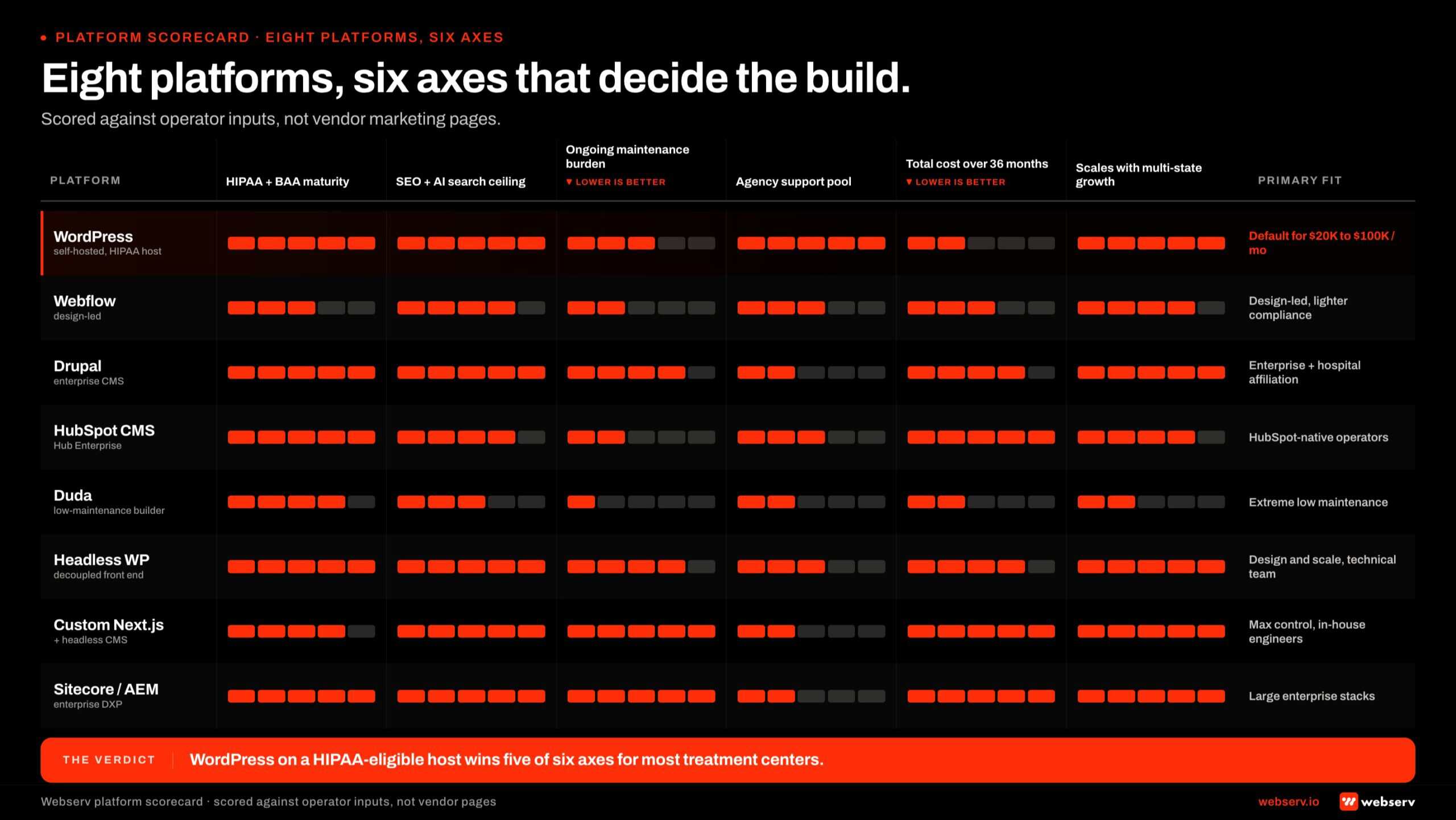 Scorecard infographic titled ‘Eight platforms, six axes that decide the build.’
1. Choosing on launch cost without modeling 36-month total cost of ownership. The $11,000 Squarespace launch that becomes a $74,000 WordPress rebuild is the canonical example. Operators who model total cost across 36 months consistently make better platform decisions than operators who optimize for the launch budget alone.
2. Skipping the HIPAA compliance review at platform selection. The compliance posture should be one of the first inputs to the platform decision, not something the operator addresses after the platform is chosen. Reversing the order produces platform migrations the operator could have avoided.
3. Choosing on visual editor preference. The marketing director who loves Squarespace’s editor is not wrong about the editor; she is wrong about treating the editor as the load-bearing input. The technical layer (HIPAA, SEO infrastructure, page speed, accessibility) matters more than the editor experience over the platform’s lifetime.
Page speed is not a vanity metric on treatment center sites. Google’s Search Central Core Web Vitals documentation confirms that Largest Contentful Paint, Interaction to Next Paint, and Cumulative Layout Shift are direct ranking signals in the page experience system.
For BH operators competing on commercial-intent terms, a platform that ships a 5-second mobile LCP is a platform that loses to a 2-second WordPress build before the editorial layer is even evaluated.
4. Picking the platform before picking the agency. The right sequence is to identify the treatment-center-specialized agency first and then choose the platform the agency recommends. Picking a platform without an agency relationship often produces a build that no specialized agency knows how to optimize after launch.
5. Ignoring the agency landscape in the platform decision. WordPress has the deepest agency landscape for treatment center work. Webflow has a smaller but growing one. Drupal’s agencies are enterprise-focused.
Squarespace, Wix, and HubSpot have thin specialist landscapes for behavioral health. The agency landscape matters because the platform is only as good as the team implementing it.
6. Underestimating the platform migration cost. Operators who start on a non-compliant or scale-limited platform with the assumption that migration will be cheap discover that platform migration is the most expensive line item in the website lifecycle.
Migration costs run $30,000 to $100,000 for a typical single-facility site and proportionally more for multi-facility operators. Choosing the right platform on day one is materially cheaper than choosing wrong and fixing it later.
Frequently Asked Questions
Is WordPress actually secure enough for HIPAA compliance?
Yes, when deployed on a HIPAA-eligible host with the appropriate form plugin, email delivery, access control, and audit logging configuration. WordPress core itself is not the compliance question; the broader stack the site runs on is.
A WordPress site on WP Engine’s HIPAA tier with Hush Forms, Sendgrid HIPAA, and Google Workspace enterprise inbox is compliant. A WordPress site on shared GoDaddy with Contact Form 7 and personal Gmail is not.
The security posture of WordPress core is comparable to other major CMS options when patches are kept current and the plugin ecosystem is managed responsibly. Most security incidents on WordPress sites trace back to outdated plugins or weak admin credentials rather than core vulnerabilities, and both are operational disciplines rather than platform limitations.
The deeper read on the full compliance stack lives in our work on building clinical content that Google trusts, which covers the broader trust signal architecture WordPress supports natively.
Should we move our existing site off Squarespace or Wix?
For most treatment centers, yes. The migration window matters. Operators who migrate at 6 to 12 months of facility operation pay 30 to 60 percent less in total cost than operators who wait until 24 to 36 months and accumulate compliance risk plus marketing performance gaps along the way.
The migration path is typically Squarespace or Wix to WordPress on a HIPAA-eligible host. The migration takes 60 to 120 days from kickoff to launch, with content authoring, design rebuild, technical migration, redirect mapping, and SEO continuity work all running in parallel. The cost runs $30,000 to $100,000 depending on the existing site’s complexity.
Operators who stay on Squarespace or Wix for compliance reasons typically end up architecting form, intake, and PHI-handling flows entirely off-platform, which often costs more in monthly SaaS and operational overhead than migrating to a platform that handles those flows natively.
How much should we budget for a treatment center website on WordPress?
Single-program facility: $25,000 to $60,000 for a substantive WordPress build with the appropriate plugin stack, schema infrastructure, and design work. HIPAA-eligible hosting adds $200 to $800 per month above generic shared hosting.
Multi-program facility: $60,000 to $150,000 for the build, with hosting typically in the $400 to $1,500 per month range to support the higher traffic volume and the additional staging environments most multi-program operators need.
Multi-state operator: $100,000 to $300,000 for the build, with hosting at $1,000 to $5,000 per month at enterprise WordPress tiers. The total cost of ownership across 36 months is typically $250,000 to $600,000 when ongoing maintenance, plugin renewals, and quarterly iterative refresh work are included.
Can we use Webflow with a HIPAA-eligible form provider?
Yes, this is the common architecture for treatment center operators who want Webflow’s visual editor and design control without the BAA limitations of standard Webflow tiers. The pattern is Webflow for the public-facing site, with the contact form submitting to a HIPAA-eligible third-party service (Hush Forms hosted form, JotForm HIPAA, or a custom integration to a HIPAA-eligible CRM).
The architecture works when the operator is disciplined about which form-data flows go through Webflow and which go off-platform. Any form that collects PHI should route through the off-platform compliant service; any form that does not (newsletter signup, referral source contact, careers inquiries) can stay on Webflow.
The trade-off is operational overhead. Two systems require two integrations, two analytics passes, and two compliance reviews. Operators who want one system that handles both should stay on WordPress; operators who value Webflow’s design control enough to manage the two-system architecture can make Webflow work.
Does the platform choice affect SEO performance?
Yes, but less than most operators assume. The largest SEO factors (content quality, named clinical authorship, topical authority architecture, backlink profile, internal linking, AI search infrastructure) work across every major CMS on this list when implemented correctly. Platform choice affects how easy the implementation is, not whether the outcomes are reachable.
The platform-specific differences that do matter: schema and metadata management depth (WordPress and Drupal stronger than Squarespace and Wix), Core Web Vitals defaults (custom Next.js stronger than shared WordPress, Webflow competitive with optimized WordPress), and the AI search infrastructure layer (WordPress and headless architectures stronger than turnkey platforms).
For operators evaluating SEO performance after a platform migration, the SEO timeline reality for rehab websites covers the recovery cycle. Platform migration produces a short-term ranking dip in most cases, which recovers within 60 to 120 days when the migration is done correctly.
How often should we rebuild or redesign the site?
Full rebuilds every 4 to 6 years for most treatment center operators. Iterative refresh every quarter on a smaller scale. The cadence is driven less by design trends and more by accumulating technical debt, shifting compliance requirements, evolved service offerings, and the gap between the current site’s capabilities and the marketing program’s needs.
The triggers for a full rebuild are typically functional: the existing platform no longer supports the compliance or SEO infrastructure the program needs, the page builder or theme has accumulated so much customization that maintenance becomes a tax, the brand has materially evolved, or the operator is migrating from a non-compliant platform.
Iterative quarterly refresh handles the smaller continuous work: new service pages, refreshed clinical leadership content, updated accreditation strip, new schema deployment, AI search infrastructure additions. The compounding effect of quarterly refresh on top of a sound foundational platform is what keeps the site competitive between full rebuilds.
Choose the Platform That Compounds Across the Next 36 Months
The platform decision for a treatment center website is not a design decision or a launch-cost decision. It is a compliance, SEO infrastructure, and total-cost-of-ownership decision that shapes every other marketing investment the operator makes over the next 36 months.
WordPress on a HIPAA-eligible host is the default for 85 to 90 percent of treatment centers, and the default is dominant for measurable reasons: mature HIPAA story, deep agency landscape, strongest SEO and AI search infrastructure, and a cost profile that scales cleanly with facility growth.
The WordPress advantage on speed is not automatic, though. web.dev’s LCP technical guidance notes that LCP under 2.5 seconds is the threshold for a “good” rating.
Most out-of-the-box WordPress builds ship 3 to 5 second LCP on mobile until image lazy-loading, render-blocking JS deferral, and hosting tier are addressed. The platform unlocks the ceiling; the implementation team has to actually reach it.
Most operators should start there.
The credible alternatives (Webflow for design-led operators, Drupal for enterprise multi-state, headless or custom for technical-leadership operators, HubSpot CMS Hub for HubSpot-native operators) each fit a specific operator profile. The platforms to avoid (Squarespace, Wix) carry compliance gaps and migration costs that make the launch savings illusory.
We help treatment center operators evaluate the platform decision against their facility stage, marketing budget, in-house technical capacity, and compliance posture, and we lead the implementation work end-to-end when the platform decision is in place.
The work pairs with the broader landing page builders buyer’s guide for operators who need a separate paid-traffic landing page stack and with the landing page optimization playbook for the page-level work that runs on top of the platform.
Book an intro meeting to walk through your current platform against the decision framework above, identify where the compliance and SEO gaps likely sit, and scope the migration or rebuild work if the current platform is not fitting the program.
For the broader picture of how the website platform fits inside a full treatment center marketing program, see our ultimate guide to behavioral health marketing and our SEO timeline reality for rehab websites for the cycle the broader website investment plays out on.
Trevor Gage is the Director of Marketing at Webserv. Webserv works with behavioral health and addiction treatment centers on SEO, paid media, and full-funnel admissions strategy.