A behavioral health client of ours hired a design agency to rebuild their website. The agency talked a good game. They had a strong portfolio of visual work and an aesthetic that the client’s marketing team responded to.
Mobile-first indexing makes this risk worse. Googlebot Smartphone is now the primary crawler, and any mobile rendering difference between the old and new templates surfaces as a ranking drop within days, even when the desktop version of the site looks identical.
The team running the rebuild had almost no technical SEO knowledge.
They flattened the site’s URL structure. Parent and child page relationships were dropped. The top-level navigation lost the actual service pages and modality pages it had been linking to (about, treatment, modalities, levels of care). The new site was a step backwards from what the client had before.
Google had to recrawl a smaller, less-structured version of the same domain. Every ranking page beyond the homepage eroded. The agency had not even built a single-post template, so every blog on the new site rendered as a broken, unstyled Word doc.
The site was so custom that filling in the gaps the agency left behind became a project in itself. New page builds took weeks of developer time.
The client had spent tens of thousands of dollars to end up with a site that was all form and no function. Half the team did not even like the new aesthetic.
We rebuilt the site again, this time at a fraction of the cost. Relaunch was June 2025. Traffic increased almost immediately. By August, clicks had risen 6x, from roughly 100 a day to 700.
The fastest way to tank a treatment center site’s rankings is to hand the rebuild to a design-led agency that treats SEO as something the developers can bolt on at the end. By the time you realize what was lost, you are paying for it twice.
Trevor Gage, Director of Earned & Owned Media, Webserv
This piece walks through the specific mechanics of how a rebuild erodes rankings, what design-led agencies routinely miss, and the concrete steps that protect rankings when a rebuild has to happen. (For the upstream question of when a rebuild is the right call versus optimization, see our companion piece on rebuild versus optimize.)
Key Takeaways
- A treatment center website rebuild puts every ranking signal at risk simultaneously: URL structure, internal links, templates, and on-page signals all reset together. The biggest mistake operators make is treating the rebuild as a design project. It is a structural project that happens to include design work.
- Five specific structural mistakes account for most ranking damage after a rebuild: flattened URL structure, top-level navigation drift, missing or broken redirects, no single-post template for blog content, and custom page builds with no scalable template system. Two or three of these together produce ranking erosion that takes a second rebuild to recover from.
- Even a clean rebuild produces a temporary 10% to 20% dip in the first 30 to 60 days while Google recrawls and reassociates equity. The right response is to hold the line and trust the structural work. The wrong response is to make panicked tweaks that compound the problem.
- The protection playbook is straightforward: map every existing URL before the rebuild starts, preserve structure by default, build the redirect plan before templates ship, build scalable templates the marketing team can use without developer tickets, run a pre-launch crawl, and define the post-launch monitoring plan. A clean rebuild can produce a 6x traffic lift in 60 days when the structural work is done right.
The mechanics of how rebuilds erode rankings
A treatment center website that ranks well does so because of a specific combination of signals. URL structure carries topical authority. Internal links pass equity to commercial pages. Templates produce consistent on-page signals at scale.
The homepage anchors the brand, but the ranking work is happening on the service pages, modality pages, location pages, and blog posts that sit underneath it.
A rebuild puts every one of those signals at risk simultaneously.
When the URL structure changes, Google has to recrawl and reassociate equity to the new URLs. When the navigation changes, the link graph that distributes that equity changes with it.
When the templates change, the on-page signals that produced consistent ranking patterns reset. When the design changes without protecting the underlying structure, the rebuild is functionally a new site that happens to live at the old domain.
The single biggest mistake operators make is assuming the rebuild is a design project. It is a structural project that happens to include design work.
What design-led agencies routinely miss
Treatment center marketing teams spend hours picking colors, imagery, and hero treatments. They sit through countless rounds of revisions to get the visual identity right.
The text blocks underneath those visuals end up filled with glorified lorem ipsum. Headings get assigned out of hierarchical order because nobody on the design team is checking H1 vs H2 vs H3. Technical SEO discipline is not part of a typical design firm’s scope.
This is a common pattern. It produces sites that look great on the agency’s portfolio page and rank for nothing.
Sites need to scale beyond launch day. The team that built the rebuild eventually moves on. The marketing team is left with the site for the next three years. If the templates are not built to scale, every new page becomes a custom project that requires a developer.
Common blocks like CTAs, insurance verification sections, testimonials, and clinical disclaimers should be templated and easy to add by people who are not developers. Global components should drop into any page without breaking layout. Specific page templates should be versatile enough to duplicate and expand without looking janky. The location-page template alone can be the difference between a site that scales to 50 cities and a site that stops at 5.
Most design-led rebuilds skip this entirely. The agency hands over a beautiful site and a maintenance manual the marketing team cannot follow. Six months later, the team is paying the same agency hourly rates to add an insurance verification section to a new location page.
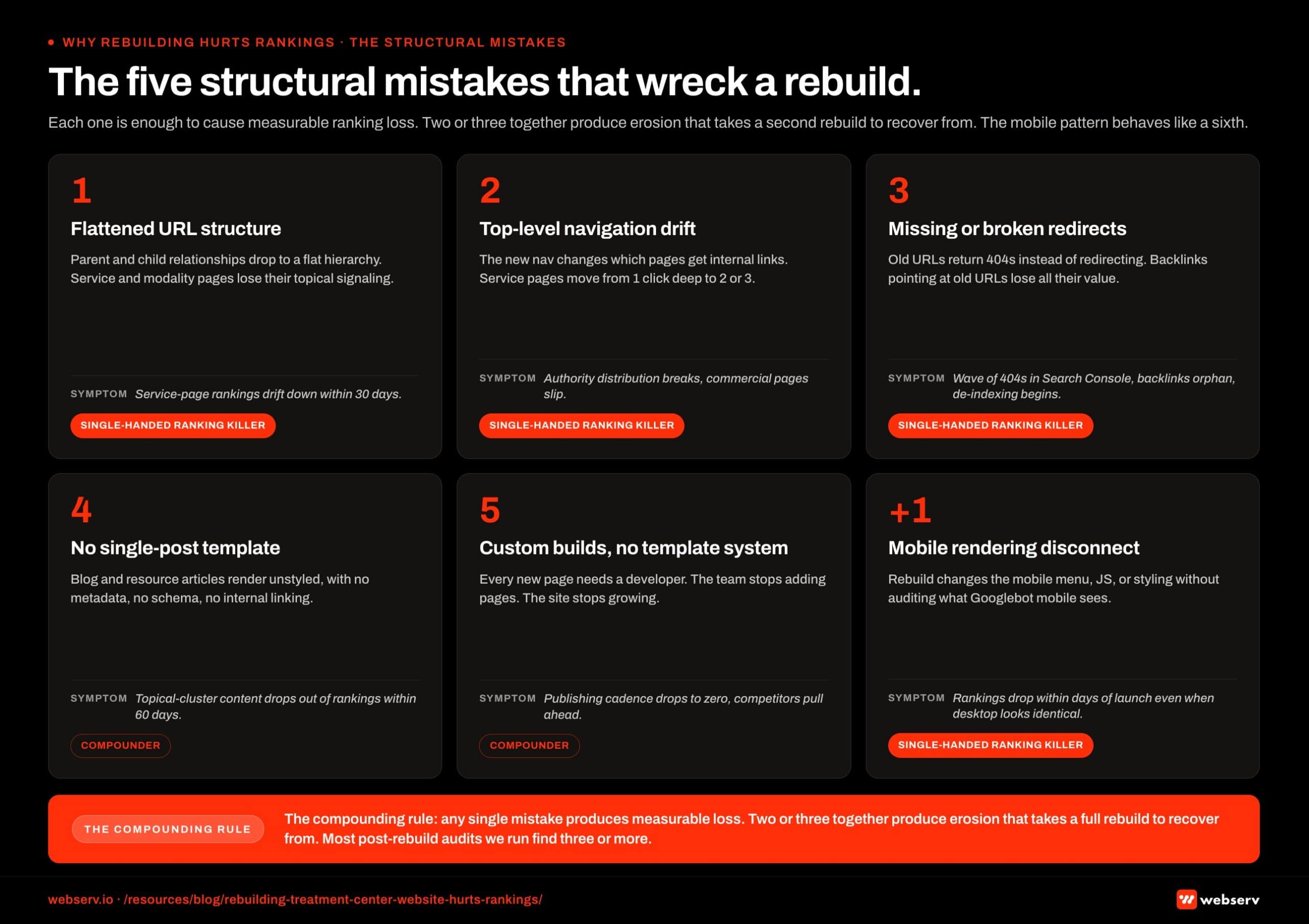 Scorecard infographic titled ‘The five structural mistakes that wreck a rebuild.’
The structural mistakes that cost the most
MOST COMMON FAILURE MODE
Flattened URLs plus missing redirects. The rebuild collapses a nested structure into flat root-level slugs, so every service and modality page loses the topical signaling it had under a logical parent. Then the redirect map is incomplete or points 1-to-many to the homepage, and every inbound link on old URLs turns into a soft-404 or a redirect loop. Google reads a wave of broken references as a site-health event, not a redesign, and the rebuild bleeds authority for months.
Five specific structural mistakes account for most of the ranking damage we see in audits after a rebuild.
Flattened URL structure. Parent and child page relationships are dropped in favor of a flat URL hierarchy. Google loses the topical signaling that came from the nested structure. Service pages and modality pages that used to sit under a logical parent now float at the root level with no semantic relationship to the rest of the site.
Top-level navigation drift. The navigation on the rebuild changes which pages get the most internal links. Service pages that used to be one click from the homepage end up two or three clicks deep. Authority distribution breaks.
Missing or broken redirects. Old URLs return 404 errors instead of redirecting to the new equivalent. Backlinks pointing at the old URLs lose all their value. Google sees a wave of broken pages and begins de-indexing.
No single-post template. Blog posts and resource articles render with no styling, no metadata, no schema, no internal linking. The content that used to support topical clusters now reads as low-quality unstyled text.
Custom page builds with no scalable template system. Every new page after launch requires a developer. The team stops adding pages. The site stops growing. Competitors who can publish on a weekly cadence pull ahead.
Mobile rendering disconnect. Most treatment center rebuilds change the mobile menu structure, JavaScript loading patterns, or styling rules without auditing what Googlebot mobile and AI crawlers actually see after the change. The rendered mobile HTML on the new site often drops critical navigation links, internal linking depth, or trust signals that were visible on the old site, even when the visual mobile experience looks identical. Because Google now indexes the mobile rendering exclusively, any content that disappears from the mobile DOM stops counting for rankings. Our guide to mobile-first indexing for treatment center websites covers the audit method and the specific failure patterns.
Any one of these is enough to cause measurable ranking loss. Two or three together produce the kind of erosion that takes a full rebuild to recover from.
The expensive truth
You cannot bolt SEO onto a design-first rebuild after the fact. The sequence does not work.
Once the URL structure is set, restructuring the site is itself a rebuild. Once the navigation ships, redoing the link graph is itself a rebuild. Once the templates render in production, retrofitting on-page signals is itself a rebuild.
The agencies that pitch “we will handle SEO at the end” are pitching a sequence that does not exist. Good SEO for a treatment center treats structure first.
The treatment centers that get this right hire a partner who treats the rebuild as a structural project from day one, with design work happening within the structural constraints.
The treatment centers that get it wrong hire a designer with a strong portfolio and assume the rest will work itself out.
Every audit we run on a recently-rebuilt site shows the same handful of issues. The cost of fixing them is roughly equivalent to the cost of doing the rebuild correctly the first time.
The total spend ends up being the rebuild cost, plus the audit cost, plus the rebuild-fix cost, plus the recovery time during which admit volume is suppressed.
How SoCal Sunrise generated 85 admissions and 2,297% ROI from SEO in 6 months
A ground-up SEO rebuild using the Pathfinder Parents Methodology turned an invisible online presence into a top-ranking admissions engine.
Read the case study →85 admits and 3,152 leads attributed to organic
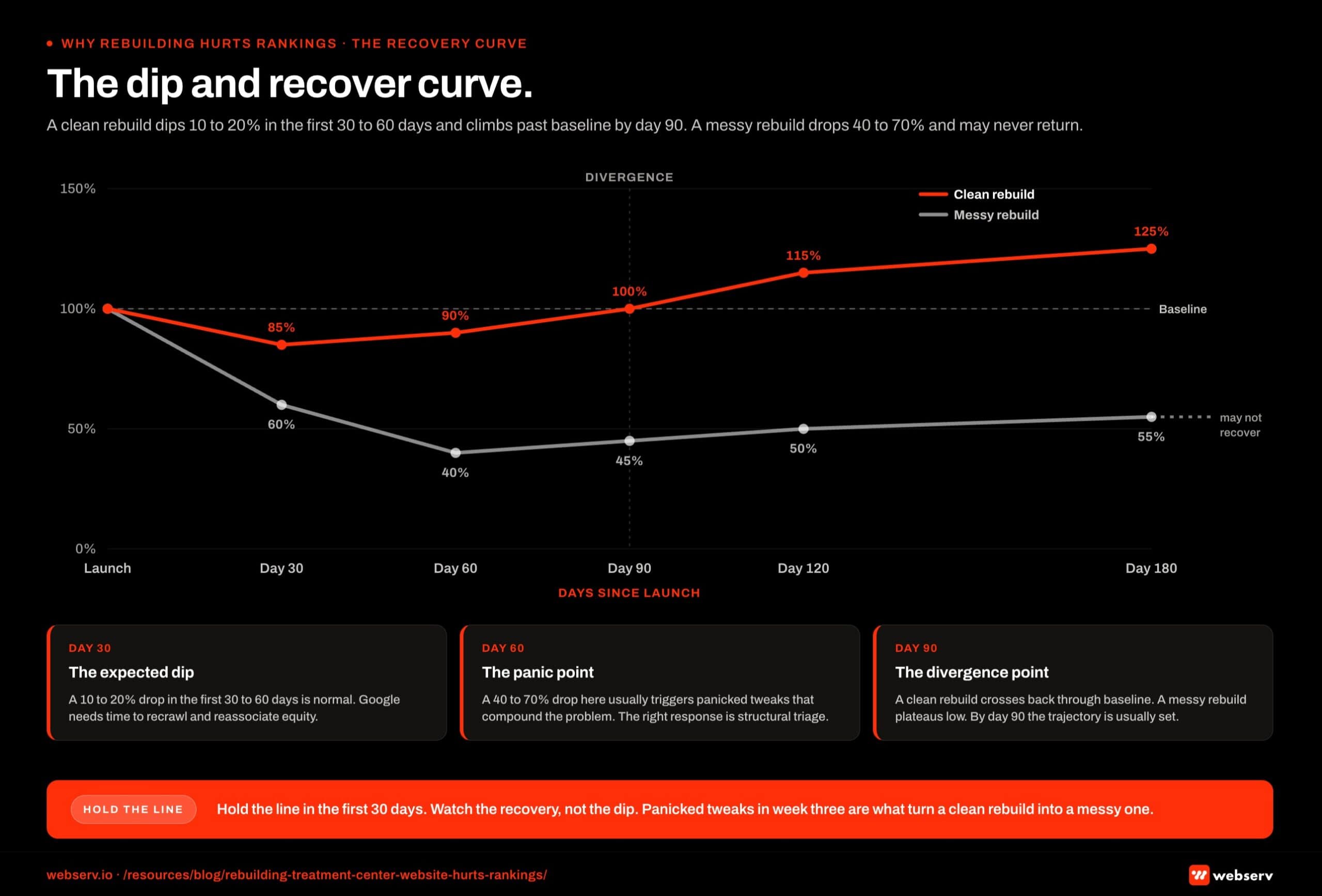 Dual-line chart titled ‘The dip and recover curve: clean vs messy rebuild.’
Even a clean rebuild can dip temporarily
A rebuild done correctly will still produce some ranking volatility in the first 30 to 60 days. Google needs time to recrawl, reassociate equity, and validate the new structure. Core Web Vitals signals also need to stabilize on the new templates. A 10% to 20% temporary dip is normal even when the migration is clean.
This is the part that catches operators off guard. They expect a clean rebuild to produce no traffic loss whatsoever, then panic when they see the first month’s report. The right response is to hold the line, monitor the recovery curve, and trust the structural work.
The wrong response is to assume the rebuild failed and start making panicked tweaks that compound the problem. We see this pattern enough that it deserves its own warning. Resist the urge to react in the first 30 days. Watch the recovery, not the dip.
The bigger the structural change, the longer the recovery curve. A rebuild that adds structure where there was none before will dip and then climb past the baseline within 60 to 90 days. A rebuild that removes structure may never recover.
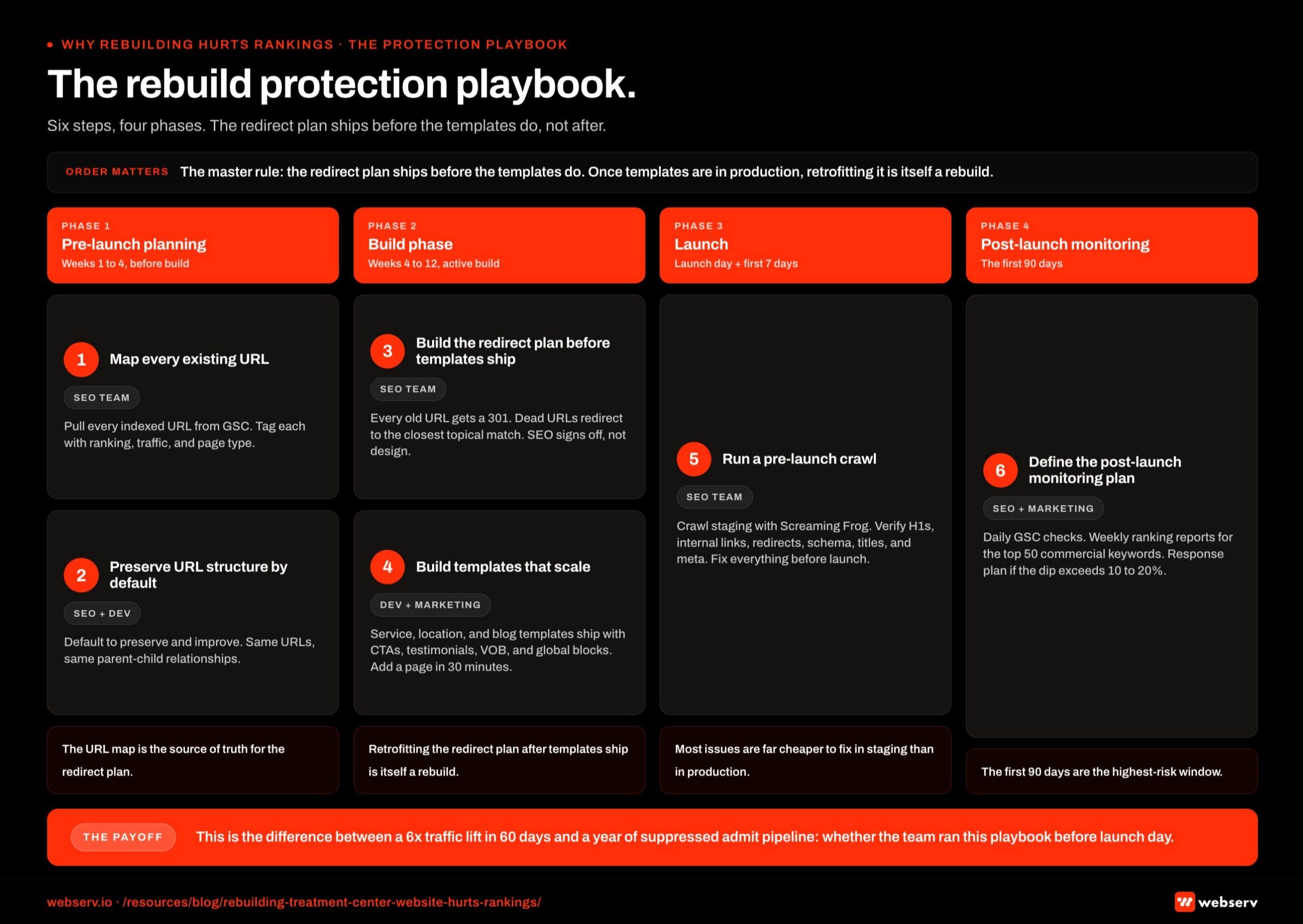 Horizontal timeline infographic titled ‘The rebuild protection playbook’.
How to protect rankings through a rebuild
The playbook is straightforward. Most teams just do not follow it.
Map every existing URL before the rebuild starts. Pull every indexed URL from Google Search Console. Tag each one with its current ranking, its current traffic, and the page type (service, modality, location, blog, legal, other). Cross-reference with your existing keyword strategy so the redirect plan preserves the URLs doing the most ranking work. The map is the source of truth for the redirect plan.
Preserve the URL structure unless you have a specific reason to change it. Most rebuilds do not need a new URL structure. The pages that need to exist still need to exist, at the same URLs, with the same parent-child relationships.
The default posture should be “preserve and improve,” not “rebuild from scratch.”
Build the redirect plan before the templates ship. Every old URL needs a 301 redirect to the new equivalent. URLs that no longer exist need to redirect to the closest topical match. The redirect plan is signed off by the SEO team, not the design team, before launch.
Build templates that scale. Service pages, location pages, and blog posts should each have their own template. The templates should include CTAs, testimonials, insurance verification, and global components as drop-in blocks. The marketing team should be able to add a new page in 30 minutes without filing a developer ticket. The local SEO and GBP work that supports those pages depends on this scalability.
Run a pre-launch crawl. Crawl the staging site with Screaming Frog or equivalent. Verify H1 hierarchy, internal link structure, redirect responses, schema markup, page titles, and meta descriptions. Fix everything before launch. Most issues are far cheaper to fix in staging than in production.
Plan the post-launch monitoring. The first 90 days are the highest-risk window. Daily Search Console checks. Weekly ranking reports for the top 50 commercial keywords. A defined response plan for what to do if rankings drop more than the expected 10% to 20% dip.
The work is real. It is also the difference between a rebuild that produces a 6x lift in 60 days and a rebuild that costs the program a year of admit pipeline.
What to ask your web partner this week
Three questions surface whether your web partner is set up to protect rankings through a rebuild.
First, ask for their URL mapping process. A serious answer references Search Console exports, ranking data, and a redirect plan that ships before the templates do. A vague answer indicates the partner is treating SEO as an afterthought.
Second, ask how their templates handle scale. The right answer references CTAs, insurance sections, and testimonials as templated blocks that the marketing team can add without developer time.
The wrong answer is some version of “we will train your team on how to file a ticket when you need a new page.”
Third, ask for the post-launch monitoring plan and the defined response if rankings drop. A serious partner has a documented playbook for the first 90 days. A weak partner says “let us know if you see anything weird.”
The fastest way to lose six months of admit pipeline is to hand the rebuild to a design-led agency that treats SEO as something to bolt on at the end.
The fastest way to gain a 6x lift is to treat the rebuild as a structural project from day one and let the design work serve the structure rather than the other way around.
Frequently asked questions about website rebuilds and SEO rankings
How much organic traffic should we expect to lose during a rebuild?
Even a well-executed rebuild typically produces a temporary 15 to 30 percent organic traffic dip in the first 60 days after launch. The dip is normal and recovers within 90 to 180 days when the rebuild was done correctly. Rebuilds done poorly can produce 40 to 70 percent traffic losses that take 9 to 12 months to recover, if they recover at all.
The dip happens because Google needs time to re-crawl the new site structure, recalibrate ranking signals against the new URL architecture, and reabsorb any redirected pages. The recovery curve depends on the number of redirects, the cleanliness of the URL mapping, and the strength of the on-page signals on the new pages.
Programs that lose more than 30 percent typically have structural issues with the migration: broken redirects, missing pages, lost schema markup, or changed URL slugs that Google reads as new content. Most of those issues are preventable with disciplined pre-launch checks.
How long does ranking recovery take after a rebuild?
Well-executed rebuilds typically return to pre-rebuild ranking baseline within 90 to 180 days. The first 30 days are usually the lowest point as Google processes the changes. Days 30 to 90 see partial recovery as the new pages accumulate signals. Days 90 to 180 see most of the recovery, with the last 10 to 20 percent of rankings often taking longer.
Poorly executed rebuilds can take 9 to 18 months to recover, and some never recover to pre-rebuild levels. The variability depends heavily on how many critical pages lost ranking signal during migration and how aggressively the post-launch optimization work addresses the gaps.
We measure recovery against pre-rebuild baseline, not against an aspirational target. Programs that rebuild expecting immediate ranking improvement usually feel disappointed even on successful rebuilds because the recovery curve always involves a dip first. Setting expectations against the realistic timeline prevents the perception problem.
Can we recover rankings if we already launched a flawed rebuild?
Usually yes, with structured remediation. The recovery work typically focuses on three things: fixing broken redirects and missing pages, re-establishing on-page signals (H1 alignment, schema markup, internal linking) on the new pages, and acquiring fresh authority signals to accelerate Google’s re-indexing.
The remediation timeline is 3 to 9 months depending on how severe the launch problems were. The fix work happens in three phases. Phase one is technical triage (redirect fixes, broken page resolution, schema recovery) over the first 30 to 60 days. Phase two is content and internal linking optimization across 90 to 120 days. Phase three is authority rebuilding through content, digital PR, or local link acquisition.
Most flawed rebuilds we audit are recoverable. The ones that fail to recover usually have a structural problem that was not caught during the technical triage, like a robots.txt blocking critical paths or a server-level redirect issue that gets missed in surface-level audits.
Should we keep our old URL structure during a rebuild?
When the old URL structure is functional, yes. The cleanest rebuild migrations preserve URL paths for any page that ranks meaningfully or attracts organic traffic. New pages with new content can get new URLs, but redirecting an established page to a new URL almost always costs ranking signal in the short term and sometimes permanently.
The exception is when the old URL structure is itself the problem (poorly-formed slugs, parameter-heavy URLs, inconsistent depth, conflicting category structures). In those cases, the URL change is part of the rebuild’s value. The redirect work must be more careful to compensate for the lost signal, but the long-term benefit justifies the cost.
The decision should be made page-by-page during the migration planning phase, not as a blanket policy. We have seen rebuilds preserve 70 percent of URLs and rebuilds replace 90 percent. Each is correct in the right context. The wrong move is to make the decision uniformly without considering individual page value.
Who on the rebuild team should own SEO continuity?
Most treatment center rebuilds need a named SEO owner separate from the design and development team. The design agency rarely has the SEO depth to manage redirect mapping, schema continuity, and ranking signal preservation. The development team rarely has the strategic context to make trade-off decisions during the build.
The right ownership pattern is either an SEO specialist on the agency team explicitly carved out for this engagement, or an external SEO consultant brought in alongside the design and development work. We have seen both work. We have not seen the design-team-handles-SEO model work for treatment center rebuilds.
The SEO owner needs authority, not just visibility. If the design team can override SEO recommendations without escalation, the rebuild usually loses ranking signal even when the SEO owner did good work. The structure that protects ranking is one where SEO decisions get equal weight with design and development decisions throughout the project.
The perspective in this article comes from 9 years working exclusively inside behavioral health.
We are a team built by people in recovery who understand that behind every admission is someone asking for help. If that resonates, get to know us.
Trevor Gage is the Director of Earned & Owned Media at Webserv. Webserv works with behavioral health and addiction treatment centers on SEO, paid media, and full-funnel admissions strategy.