Call scoring is what separates admissions teams that improve over quarters from teams that plateau at the same lead-to-admit conversion for years. Most facilities either do not score calls at all or score them against a rubric that produces no coaching signal.
The pattern I see repeatedly: a treatment center running CallTrackingMetrics or CallRail records every inbound admissions call. Admissions leadership listens to a handful when a specific issue surfaces. Nobody scores the calls systematically.
Every quarter, the team’s lead-to-admit conversion holds within a narrow band around the same number, and nobody knows exactly why the number is where it is or how to move it.
Call scoring done well produces the coaching signal that shifts individual coordinator performance over 60-90 days. It surfaces which specific parts of the admissions conversation are producing conversion and which are producing loss.
It gives the admissions director a defensible framework for performance reviews, coordinator hiring decisions, and team-level workflow changes.
Call scoring done poorly produces spreadsheet compliance without improvement. Coordinators know their calls are being scored, produce marginally more scripted-sounding calls, and the underlying performance holds where it was.
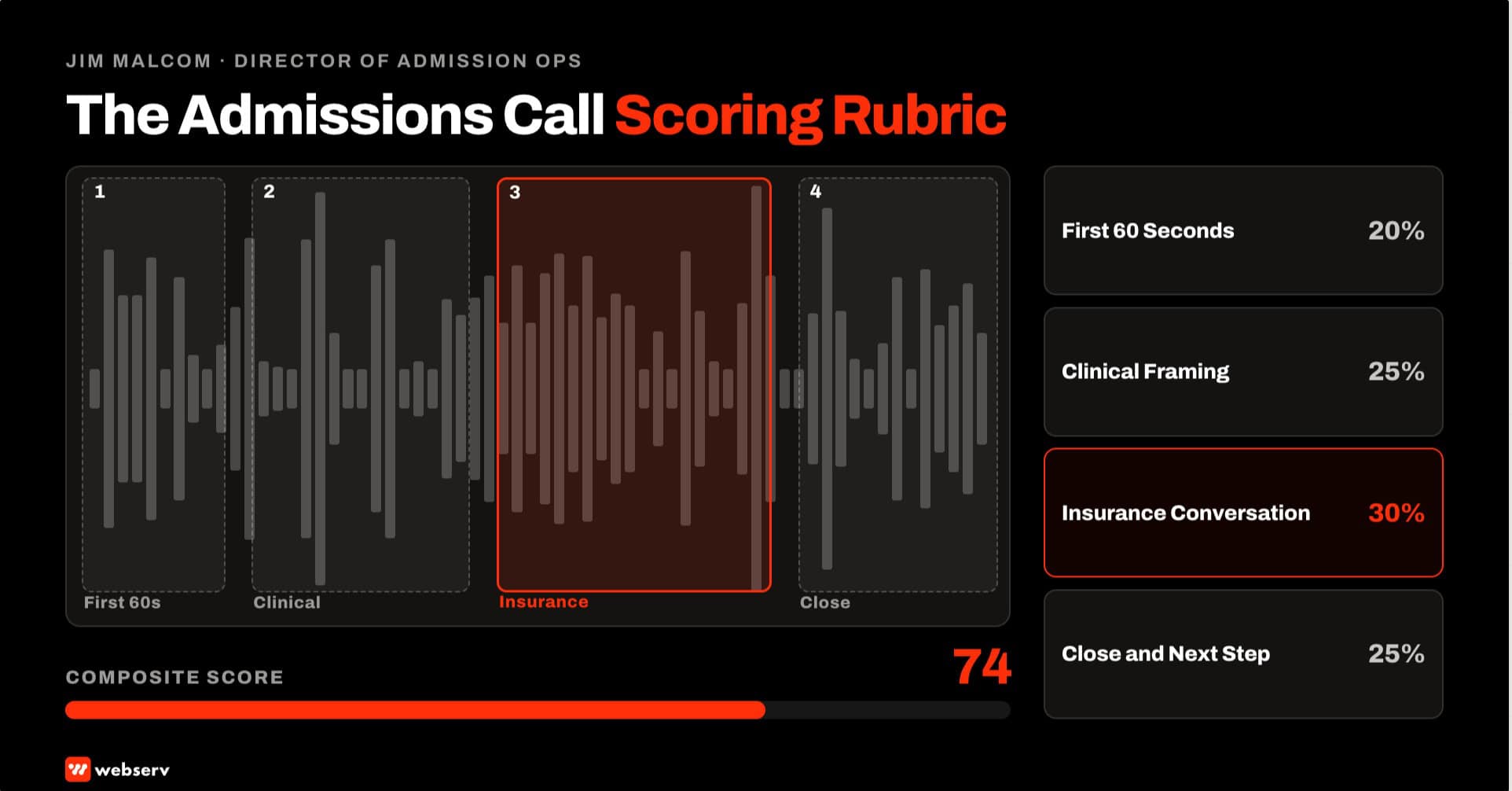
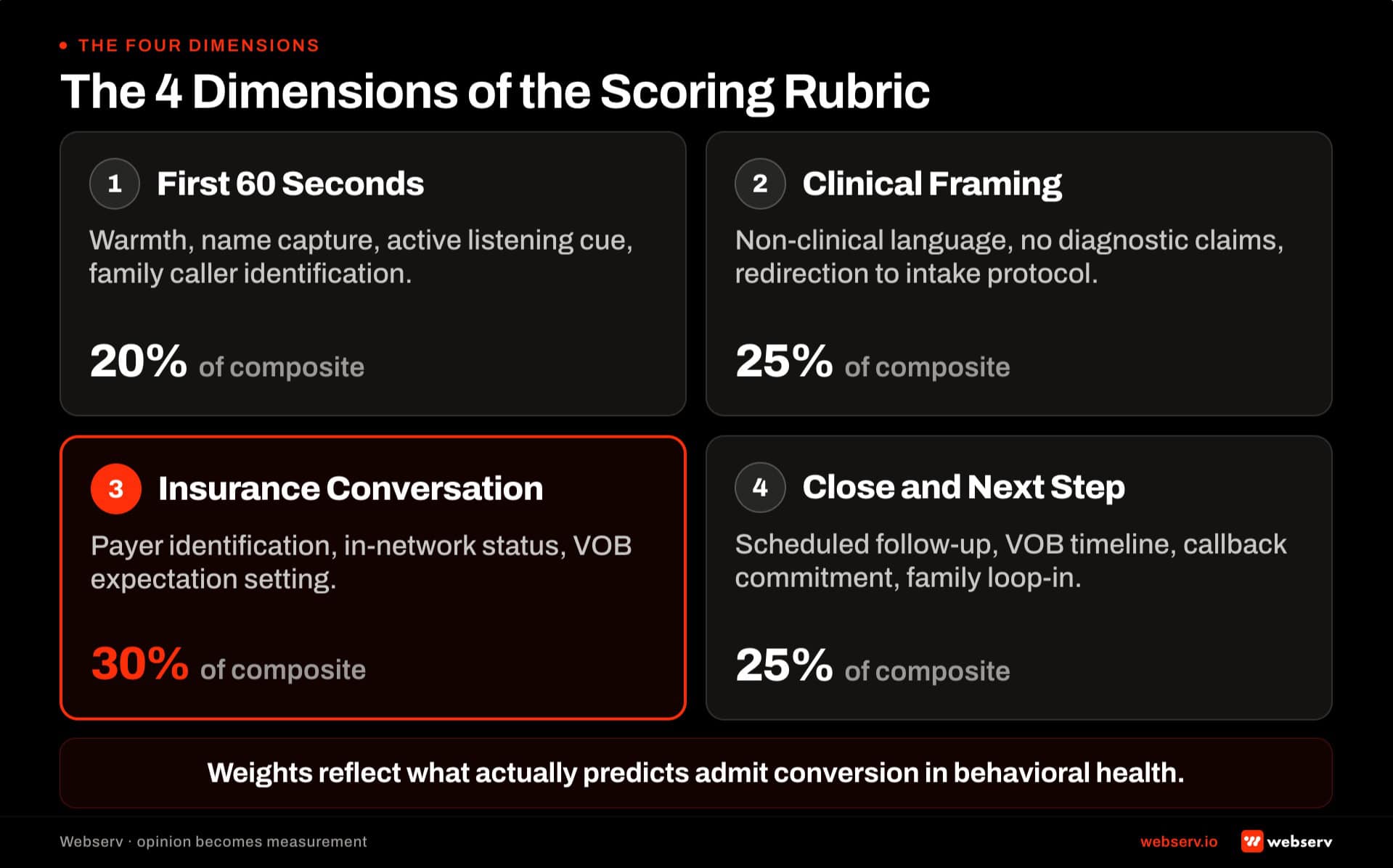
This piece walks the four-dimension call scoring rubric our team runs across the treatment center admissions engagements in our client book. It covers the four dimensions of the rubric, the 1-5 scoring pattern per dimension, and the weighted composite that produces the coaching signal.
It also covers how to deploy the rubric against CallTrackingMetrics or CallRail recordings, what excellent looks like on each dimension, and the specific failure modes that undermine rubric deployment.
It sits inside our admission ops practice and complements our CTM implementation piece that covers the platform-side call tracking configuration.
Key Takeaways
- Call scoring is the load-bearing coaching signal for admissions team improvement. Facilities running structured call scoring produce measurable coordinator-level conversion improvement over 60-90 days. Facilities without call scoring see admissions performance plateau at the same conversion band year over year.
- The four-dimension rubric covers first 60 seconds (opener, rapport, discovery), clinical framing (family-perspective language, LOC positioning, empathic tone), insurance conversation (VOB discipline, payer positioning, rate reference), and close plus next-step (specific date and time, follow-up commitment, disposition documentation).
- The scoring pattern: 1-5 scale per dimension, weighted composite where clinical framing and close carry higher weight than the mechanical opener and insurance handoff dimensions. Composite scores below 3.0 trigger coaching conversations. Composite scores above 4.0 identify coordinator patterns to spread across the team.
- The deployment cadence: 10-15 calls per coordinator per month scored, mix of high-outcome and low-outcome calls, one hour of team review per week where 2-3 scored calls get discussed by the full admissions team. Individual coaching conversations happen monthly against the coordinator’s trailing 4-week composite.
- Common failure modes: scoring only outcome (did they admit) without process dimensions, inter-rater reliability drift when multiple people score without calibration, coaching conversations that reference scores without connecting them to specific call moments, and rubric drift where dimensions get added, dropped, or reweighted without documentation.
DEFINITION
Admissions call scoring rubric. A structured 4-dimension coaching framework that scores each inbound admissions call on First 60 Seconds (opener, rapport, discovery), Clinical Framing (family-perspective language, LOC positioning, empathic tone), Insurance Conversation (VOB discipline, payer positioning, rate reference), and Close and Next-Step (specific date and time, follow-up commitment, CRM documentation). Each dimension scored 1-5 with weighted composite.
Distinct from outcome-only scoring (did they admit — no process signal) and distinct from automated call quality metrics (call duration, silence percentage — no clinical or framing signal). Produces coordinator-level coaching signal that lifts lead-to-admit conversion over 60-90 days when paired with individual coaching conversations that reference specific call moments rather than composite scores in isolation.
OPERATOR INSIGHT
Call scoring done well produces the coaching signal that shifts individual coordinator performance over 60-90 days.
Call scoring done poorly produces spreadsheet compliance without improvement. Coordinators know their calls are being scored, produce marginally more scripted-sounding calls, and the underlying performance holds where it was. The difference is whether the coaching conversation references specific call moments or just a composite score in isolation.
Dimension 1: First 60 seconds
What the dimension covers. Opener language (“Thank you for calling [facility name], my name is [coordinator]”). Immediate acknowledgment of the caller’s situation without pushing to intake questions in the first 30 seconds. Rapport-building through active listening rather than script-reading. Initial discovery questions that surface who the caller is (patient, family member) and what their acute-versus-research state is. Coordinators who nail the first 60 seconds produce conversion rates roughly 40-60 percent higher than coordinators who do not.
What “excellent” looks like (score 5). Coordinator answers within 3 rings. Opener is warm, brief, and immediately hands the conversational floor to the caller. Coordinator listens for 45-60 seconds without asking discovery questions. Coordinator names back what the caller shared before asking the first discovery question.
What “good” looks like (score 4). Same as excellent but with one minor gap: opener slightly rushed, or one intake question surfaces in the first 30 seconds, or the naming-back moment is missing but the discovery flow is otherwise strong.
What “meeting expectation” looks like (score 3). Coordinator answers professionally, discovers the basic information needed, and proceeds. No specific coaching red flags but no differentiating warmth or discovery depth.
What “below expectation” looks like (score 2). Coordinator answers with a scripted opener, pushes into intake questions immediately, does not name back the caller’s situation, or misses key discovery signals (who is the caller, what is the acute-versus-research state).
What “failing” looks like (score 1). Coordinator answers with delay, opener is transactional, no rapport-building beat, and the caller’s specific situation never gets acknowledged before the intake questions start.
Dimension 2: Clinical framing
What the dimension covers. Family-perspective language when the caller is a family member (which they usually are). Level-of-care positioning matched to the caller’s clinical situation. Empathic tone that acknowledges the emotional weight of the treatment decision. Specific clinical vocabulary that establishes coordinator competence without producing jargon that alienates the family. Second-highest-weight dimension in the composite because coordinators who cannot clinically frame the offering lose family callers even when the intake logistics are handled well.
What “excellent” looks like (score 5). Coordinator uses family-perspective language throughout (“what your daughter needs” rather than “what the patient needs”). LOC positioning matches the caller’s situation with specific reasoning (“residential is what your husband would benefit from because the acute detox phase requires medical supervision”). Empathic tone is present without being performative. Clinical vocabulary is precise and accessible.
What “good” looks like (score 4). Family-perspective language mostly holds, LOC positioning is accurate, empathic tone is present. Minor gap in clinical vocabulary or one moment where the coordinator slips into patient-perspective framing.
What “meeting expectation” looks like (score 3). LOC positioning is accurate but the family-perspective framing is inconsistent. Empathic tone is present but scripted-sounding. Clinical vocabulary is competent but generic.
What “below expectation” looks like (score 2). Patient-perspective framing dominates when a family member is calling. LOC positioning is generic or incorrect. Empathic tone reads as forced or transactional. Clinical vocabulary is either too generic or too technical.
What “failing” looks like (score 1). LOC positioning is incorrect for the caller’s situation. Empathic tone is absent. Clinical vocabulary is dismissive or misleading. Caller ends the call without a clear understanding of what the facility actually offers.
Dimension 3: Insurance conversation
What the dimension covers. VOB discipline (asking for insurance information without triggering family concern about privacy, running eligibility promptly, following up with results). Payer positioning (accurate representation of in-network versus out-of-network status). Rate reference (referencing typical reimbursement rates carefully without overpromising coverage or disclosing restricted contract information). Coordinators who mishandle the insurance conversation lose qualified families and admit unqualified families.
What “excellent” looks like (score 5). Coordinator asks for insurance information at the right moment (after clinical rapport is established, before the family disengages waiting for logistics). VOB gets initiated inside the same call or within 2 hours of the call. Payer positioning is accurate and honest. Rate reference is careful and framed appropriately.
What “good” looks like (score 4). VOB discipline is strong but the timing of the insurance ask is slightly early or late. Payer positioning is accurate. Rate reference is careful but the framing could be more precise.
What “meeting expectation” looks like (score 3). VOB gets initiated within a reasonable window. Payer positioning is accurate but generic (“we work with most major insurance”). Rate reference is avoided rather than handled.
What “below expectation” looks like (score 2). VOB gets deferred beyond the 24-hour window that produces conversion. Payer positioning is vague or misleading (“we can probably work with your insurance”). Rate reference either overpromises coverage or discourages the family from continuing.
What “failing” looks like (score 1). VOB never gets initiated. Payer positioning is inaccurate. Rate reference discloses restricted contract information or overpromises coverage that will not materialize.
Dimension 4: Close and next step
What the dimension covers. Specific date and time for the next scheduled contact (not “we will follow up soon”). Follow-up commitment on both sides (coordinator commits to sending information or completing VOB, family commits to a specific decision moment). Disposition documentation in the CRM with the specific next-step and coordinator commitments. The load-bearing coaching signal in the whole rubric — a coordinator can execute Dimensions 1-3 well and still lose the admission if the close does not produce a specific next step.
What “excellent” looks like (score 5). Coordinator closes with a specific date and time for the next scheduled contact (“I will call you tomorrow at 2 PM Pacific after I have your VOB complete”). Follow-up commitments are documented in the CRM in the coordinator’s own words. Family has a specific decision moment scheduled.
What “good” looks like (score 4). Specific next-step timing is established but one side of the follow-up commitment is not fully documented. Family knows the next contact but the coordinator’s internal documentation is slightly light.
What “meeting expectation” looks like (score 3). Next-step timing is established but generic (“I will follow up tomorrow”). Documentation captures the next step but does not include the coordinator’s commitments.
What “below expectation” looks like (score 2). Next-step timing is vague (“I will be in touch”). Follow-up commitments are one-sided (coordinator commits but family does not). CRM documentation is minimal.
What “failing” looks like (score 1). Call ends without a specific next step. Coordinator does not schedule follow-up. CRM documentation captures the fact of the call but not the outcome or the next step.
The scoring rubric at a glance
4
Dimensions: first 60s, clinical framing, insurance, close
30/30
Clinical framing + close = 60% composite weight (highest impact)
10-15/mo
Scored calls per coordinator per month for meaningful signal
60-90 d
Coordinator-level improvement window from deployment to measurable conversion lift
The composite scoring pattern
The four dimensions produce a weighted composite score per call. The weights I use across the client engagements:
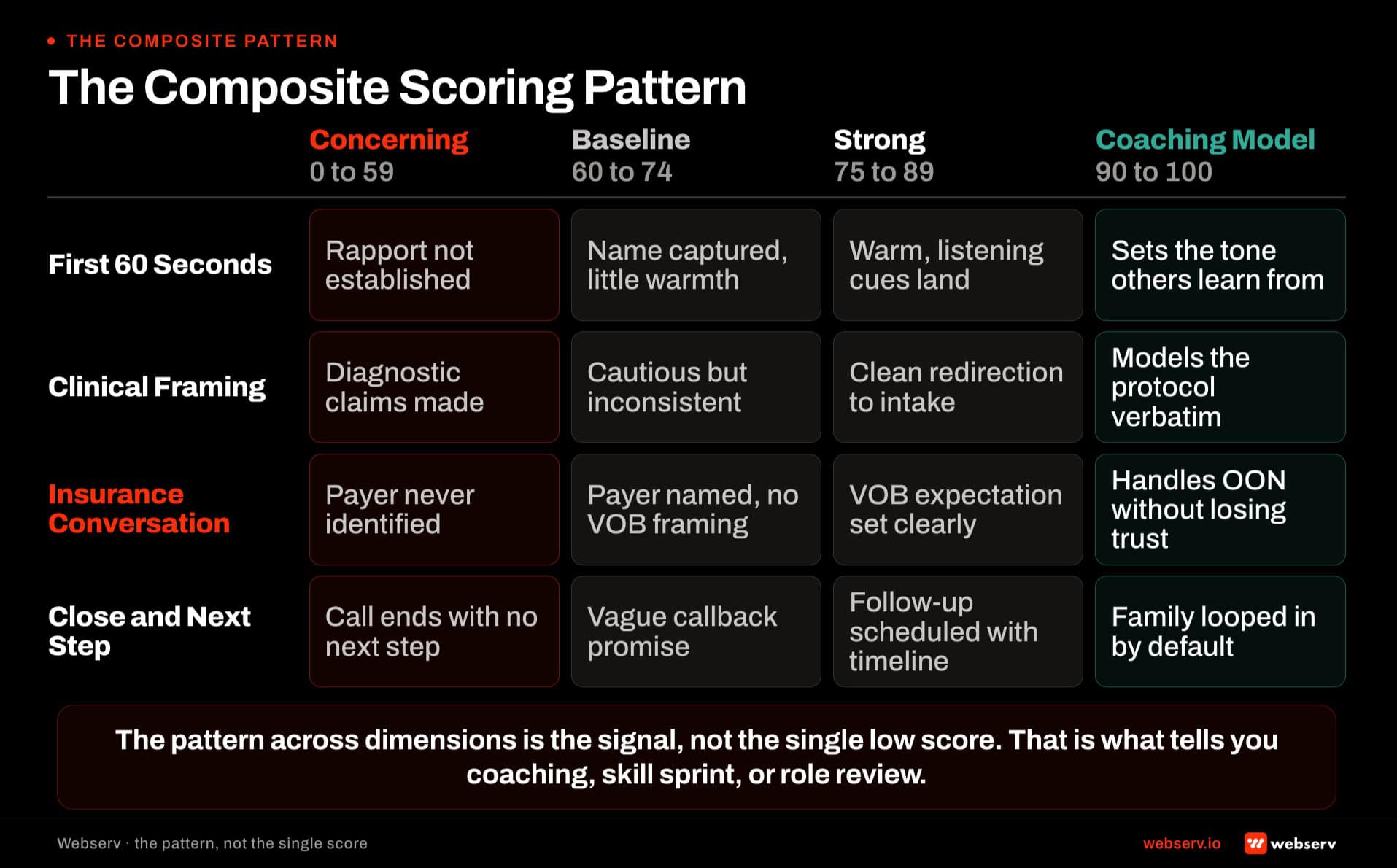
First 60 seconds: 20 percent weight.
Clinical framing: 30 percent weight.
Insurance conversation: 20 percent weight.
Close and next step: 30 percent weight.
The weighting reflects that clinical framing and close are the higher-impact dimensions on lead-to-admit conversion. First 60 seconds and insurance conversation are load-bearing but produce less variance in admit outcomes when the middle two dimensions are strong.
A composite score of 4.0 or higher indicates the coordinator is operating at the level that produces sustained lead-to-admit conversion improvement. Composite between 3.0 and 4.0 indicates competent execution without differentiating strength. Composite below 3.0 triggers a coaching conversation within the same review week the score was generated.
Composite scores should be tracked by coordinator over trailing 4-week windows rather than per-call to avoid over-reacting to single-call variance.
Deployment against CTM or CallRail
The rubric deploys against the recorded calls in your call tracking platform. The specific workflow:
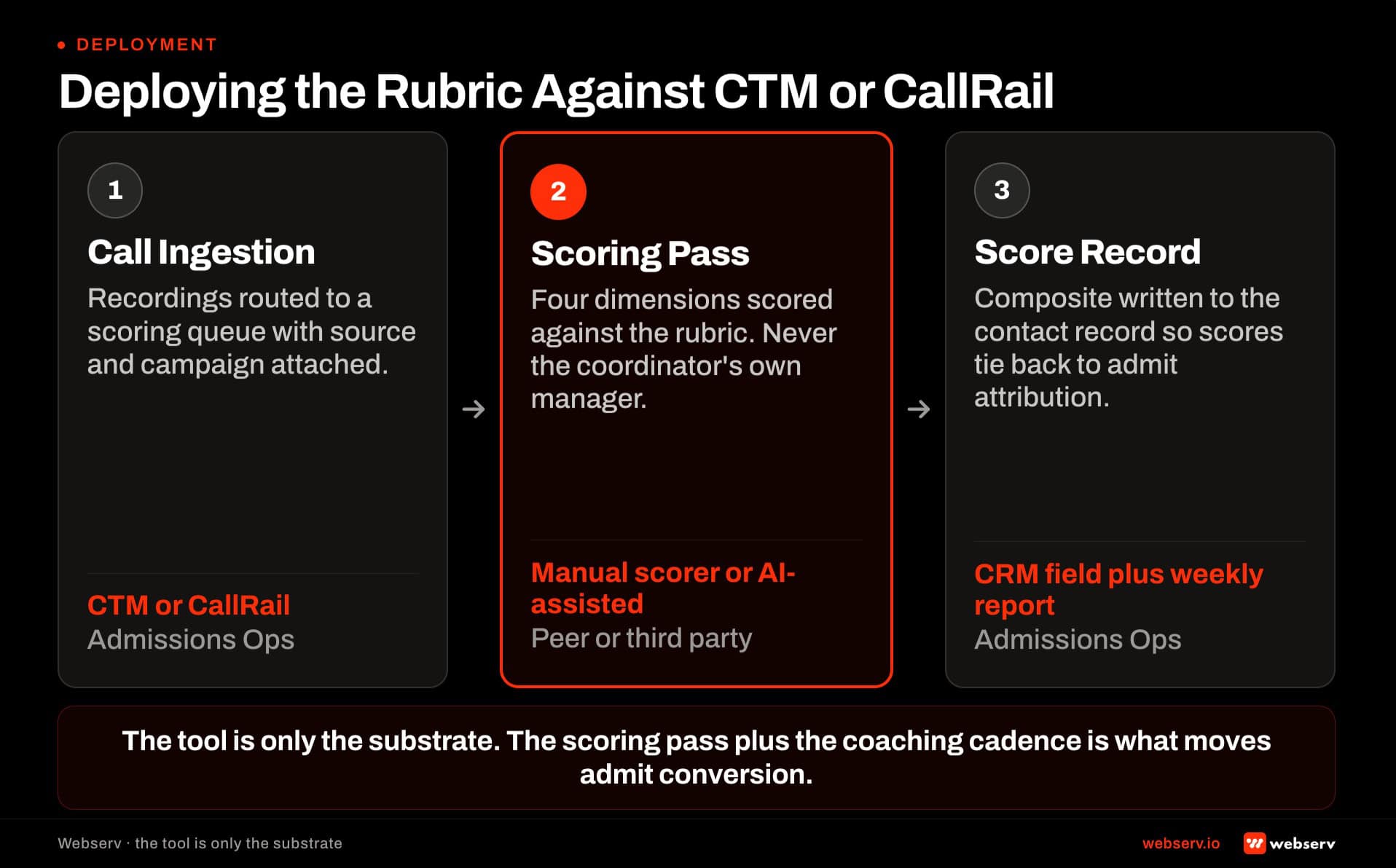
Pull 10-15 calls per coordinator per month from CTM or CallRail. Mix outcome types: 5-6 calls that resulted in admissions, 5-6 that did not, 3-4 that had ambiguous outcomes. Score each call against the four dimensions using a shared scoring sheet.
Score sheets should have space for specific call moments referenced in the scoring. “Coordinator asked for insurance at 4:32, family had already disengaged from the clinical conversation.” This is what separates useful scoring from spreadsheet compliance.
One hour per week of team-level call review where 2-3 scored calls get discussed by the full admissions team. This produces inter-rater calibration and shared vocabulary around what the dimensions actually mean at your facility.
Individual coaching conversations happen monthly against the coordinator’s trailing 4-week composite. The coaching conversation references specific call moments rather than the composite score in isolation.
DO
- Score 10-15 calls per coordinator per month, mix of 40% admitted, 40% not-admitted, 20% ambiguous outcomes.
- Reference specific call moments in every coaching conversation — timestamp + behavior + what to change — not just a composite score.
- Run monthly inter-rater calibration sessions when multiple people score — Coordinator A’s 4 has to equal Coordinator B’s 4.
- Track composite by coordinator on trailing 4-week windows — per-call variance is noise, 4-week trend is signal.
- Pair call scoring (coordinator coaching signal) with admissions team KPIs (team accountability signal) — the two work together, neither works alone.
DON’T
- Score only outcome (did they admit) — that’s a lagging indicator with no process signal to act on.
- Have coordinators peer-score each other’s calls as the primary layer — peer dynamics distort judgment. OK as a training exercise only.
- Add, drop, or reweight dimensions quarterly without documentation — rubric drift makes trend analysis impossible.
- Rely on automated AI call scoring for the four dimensions — automated scoring works for objective metrics (duration, silence, interruption), not clinical framing or empathic tone.
- Deploy scoring as compliance mechanism — coordinators produce scripted-sounding calls and the underlying conversion never moves.
The failure modes that undermine call scoring
Four patterns produce most of the call scoring failures we audit.
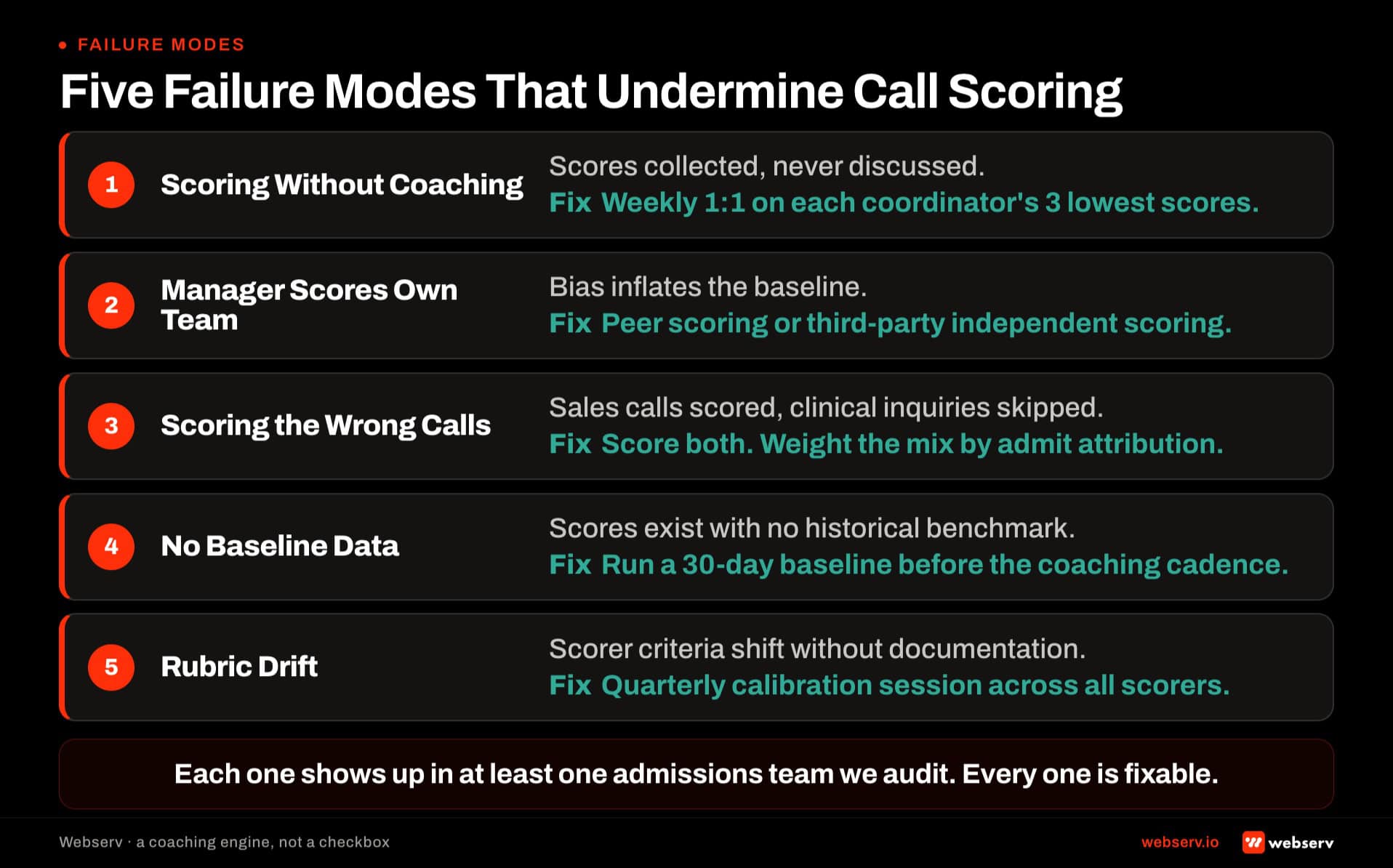
Failure mode 1: Scoring only outcome, not process. The rubric becomes “did they admit or not?” The dimensions do not exist. Coordinators cannot improve process because the scoring does not identify what specifically they should improve.
Failure mode 2: Inter-rater reliability drift. Multiple people score calls without periodic calibration sessions. Coordinator A’s 4 is Coordinator B’s 3. The composite scores lose meaning because the dimension scoring is not consistent across scorers.
Failure mode 3: Coaching conversations that reference scores without specific moments. Admissions director tells the coordinator “your clinical framing is a 3.” The coordinator cannot act on the feedback because the score is not connected to specific call moments where the framing broke. The coaching conversation produces documentation without behavior change.
Failure mode 4: Rubric drift. Dimensions get added, dropped, or reweighted quarterly without documentation. Trend analysis becomes impossible because the composite score in Q1 is not comparable to the composite score in Q3.
How the rubric compounds with admissions team KPIs
The call scoring rubric produces the process-level coaching signal that our admissions team KPIs framework turns into team-level performance measurement.
Individual call scores at the coordinator level surface which specific dimensions each coordinator needs coaching on. Team composite scores across all coordinators surface which dimensions the whole team is weakest on, which then informs training investment and workflow changes.
The two work together. Call scoring produces the coordinator-level coaching signal. KPI reporting produces the team-level performance signal.
Facilities running call scoring without KPI reporting produce individual improvement without team-level accountability. Facilities running KPI reporting without call scoring produce team-level numbers without the process detail that explains why the numbers are where they are.
Frequently Asked Questions
How many calls per coordinator should we score per month?
Between 10 and 15 calls per coordinator per month. The specific target depends on call volume. A coordinator handling 200 inbound calls per month gets 10-15 scored, which is a 5-7 percent sample. A coordinator handling 60 calls per month may need 8-10 scored to maintain a meaningful signal.
Below 8 scored calls per coordinator per month, the trailing 4-week composite score becomes noisy and individual-call variance dominates the trend. Above 20 scored calls per coordinator per month, the scoring overhead exceeds the coaching signal it produces.
The mix that works: 40 percent scored calls from admitted outcomes, 40 percent from non-admitted outcomes, 20 percent from ambiguous outcomes (rescheduled, VOB in progress, family still deciding).
Who should do the call scoring?
Depends on facility size and admissions director bandwidth. Small facilities (single admissions director, 3-5 coordinators) usually have the director score calls directly. Mid-size facilities (senior admissions leader plus admissions director plus 5-10 coordinators) usually have the senior leader score with the director as second reviewer.
Larger portfolio operators typically have a dedicated call scoring role or use a third-party scoring service. The critical requirement regardless of who scores: inter-rater calibration sessions monthly and shared scoring vocabulary across all scorers.
Facilities using coordinators to score each other’s calls typically produce distorted scores because the peer dynamic affects scoring judgment. Peer scoring can work as a training exercise but not as the primary scoring layer.
How do we handle coordinators who consistently score below 3?
Structured coaching conversation within the same review week. The specific pattern that works: pull 2-3 scored calls where the dimension breakdowns are documented, walk the coordinator through the specific call moments that produced the score, agree on 1-2 specific behaviors to change over the next 4 weeks, and re-score 3-5 new calls at the 4-week mark against the agreed behaviors.
If the trailing 4-week composite is still below 3 after two coaching cycles (roughly 8 weeks), the conversation shifts from behavior-change to role-fit. Not every coordinator can be coached to the 3.5-4 range that produces sustained conversion. Recognizing that quickly is better for the coordinator and the facility than extending the coaching cycle indefinitely.
Our admissions team hostage dynamic piece covers the organizational pattern where coordinator performance conversations get avoided too long.
How do we prevent coordinators from gaming the rubric?
Coordinators who know their calls are being scored produce marginally more scripted-sounding calls in the first 4-8 weeks of rubric deployment. The gaming behavior mostly resolves itself when three conditions hold.
First, the scoring rubric rewards genuine rapport-building rather than script compliance. Dimension 1 scoring specifically penalizes scripted openers. Second, coordinators see the scoring produce actionable coaching signal that helps them improve rather than compliance signal that just documents their performance for administrative purposes. Third, the scoring includes both admitted and non-admitted call samples. Coordinators who game only their high-outcome calls still get scored on their lower-outcome calls, so gaming produces limited benefit.
Facilities that deploy call scoring as a compliance mechanism produce short-term gaming. Facilities that deploy it as a coaching mechanism see gaming diminish within 6-8 weeks.
How does call scoring interact with call tracking automation?
Call tracking platforms (CallTrackingMetrics, CallRail) provide the recording infrastructure. Some platforms offer automated call scoring using AI-driven speech analysis. The current 2026 pattern with automated scoring: it works well for objective metrics (call duration, silence percentage, interruption rate) but not for clinical framing quality, family-perspective language, or empathic tone.
The four dimensions require human judgment about clinical framing, family-perspective language, and empathic tone. Automated scoring produces spreadsheet compliance without the coaching signal that human scoring produces.
The specific hybrid pattern that works: use automated scoring for objective call quality metrics (was the call answered promptly, was there dead air, did the coordinator interrupt the caller). Use human scoring for the four rubric dimensions. Our CTM implementation piece covers the automated scoring configuration that pairs with the human rubric.
What is the timeline from deploying call scoring to seeing measurable improvement?
Between 60 and 90 days for coordinator-level improvement. The specific pattern: first 30 days are baseline scoring plus initial coaching. Coordinators identify the dimensions they need to improve and start working on specific behaviors. Days 30-60 show measurable improvement on the coordinator-level composite scores for coordinators who engage with the coaching. Days 60-90 show lead-to-admit conversion improvement at the individual coordinator level.
Team-level lead-to-admit conversion improvement typically materializes 90-180 days after deployment because it requires the majority of coordinators to move upward before the team composite shifts meaningfully.
Facilities that skip the coaching-conversation layer and deploy scoring as pure measurement typically see no coordinator-level improvement. The scoring produces documentation without changing behavior. The coaching is what changes behavior.
Jim Malcom is the Director of Admission Ops at Webserv, a digital marketing agency for treatment centers.