A residential program bills its first commercial claim on a CMS-1500 with a CPT code, the way the founder’s old outpatient practice did. The claim comes back. The payer expected a UB-04 with a residential revenue code, billed by the day.
Picking the wrong claim form is one of the simplest ways to delay cash at a new treatment center. This guide explains which form each level of care uses, what goes on each one, and where payers differ. Billing itself is handled by our partner firm; see behavioral health billing through Revenue Logic.
Key Takeaways
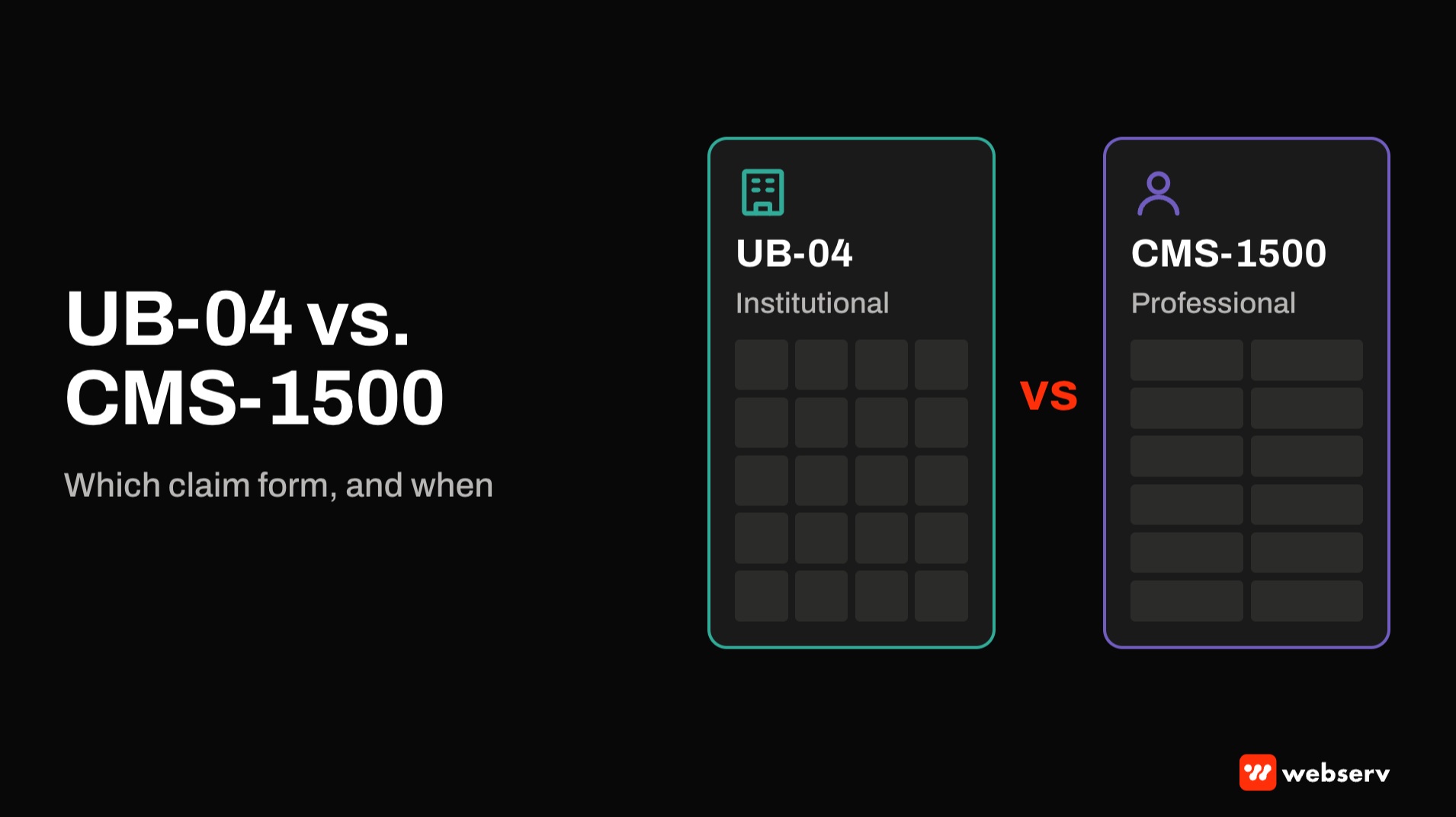
- The UB-04, also called the CMS-1450, is the institutional claim. The CMS-1500 is the professional claim. Their electronic versions are the 837I and 837P.
- Facility-based levels of care, such as residential, partial hospitalization, and structured IOP, are usually billed on the UB-04 with revenue codes.
- Individual clinician services, such as office therapy and physician visits, are billed on the CMS-1500 with CPT codes and a place of service code.
- Payers don’t agree on which HCPCS code goes with each revenue code. Check each payer’s billing guide before you submit.
- Medicare has its own rules for IOP and partial hospitalization that differ from common commercial conventions.
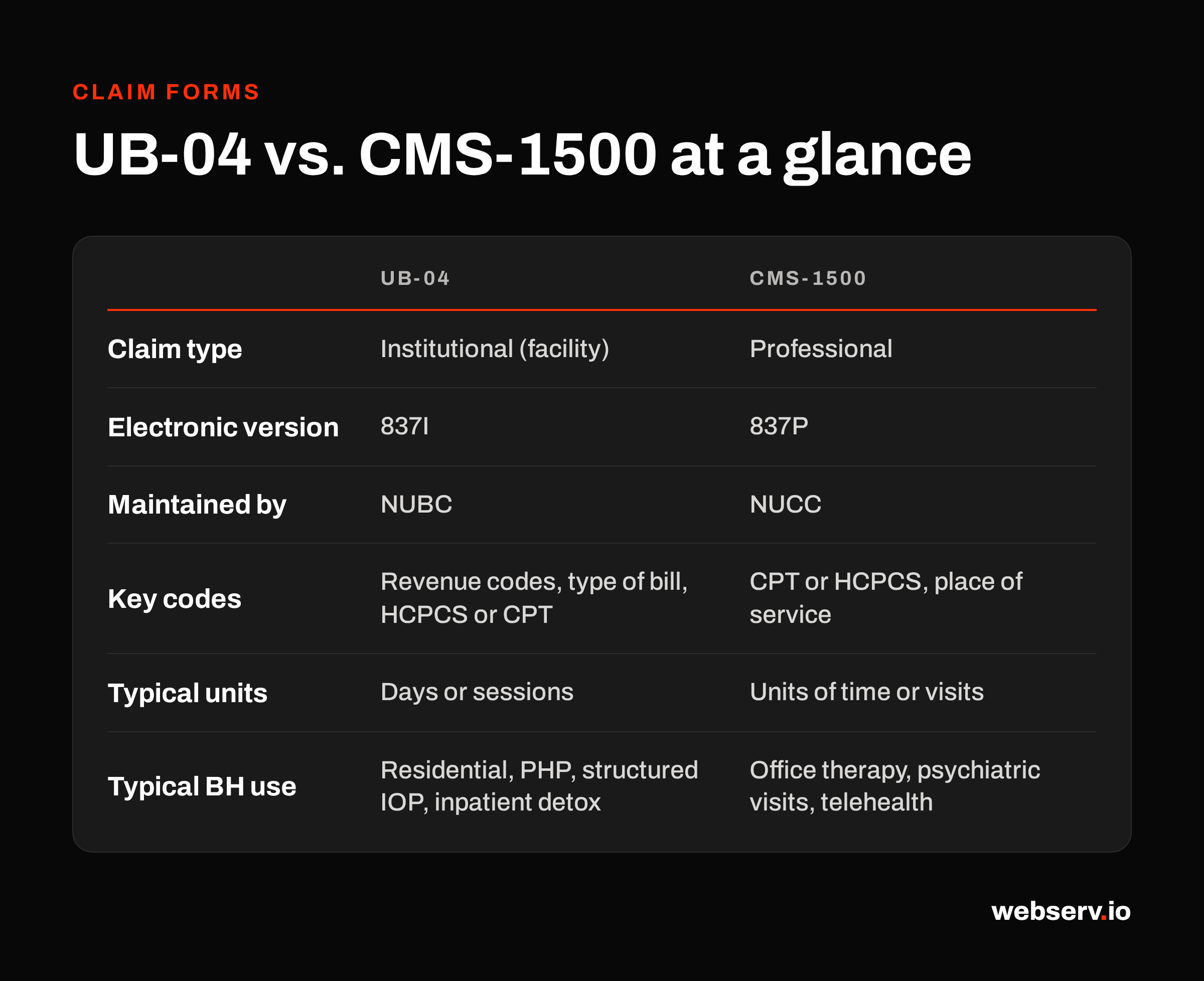
UB-04 and CMS-1500 side by side
UB-04 (CMS-1450). The paper claim form for institutional providers. CMS says the National Uniform Billing Committee is responsible for its design. Its fields are called form locators, numbered 1 through 81.
CMS-1500. The paper claim form for professional services. CMS says the National Uniform Claim Committee designs and maintains it. Its fields are called items, numbered 1 through 33. The current version, 02/12, has been in use since April 1, 2014.
| UB-04 | CMS-1500 | |
|---|---|---|
| Claim type | Institutional (facility) | Professional |
| Electronic version | 837I | 837P |
| Who maintains it | NUBC | NUCC |
| Key codes | Revenue codes, type of bill, plus HCPCS or CPT on many lines | CPT or HCPCS, place of service |
| Typical units | Days or sessions for facility services | Units of time or visits |
| Typical BH use | Residential, PHP, structured IOP, inpatient detox | Office therapy, psychiatric visits, telehealth |
Most claims today go electronically. Medicare doesn’t pay initial claims sent on paper unless the provider qualifies for an exception, such as institutional providers with fewer than 25 full-time employees.
Institutional claim. A claim a facility submits for the services it provides as an organization, such as a day of residential care. It uses the UB-04 or 837I.
Residential, PHP, IOP, or office: which form
The pattern is consistent across the payer guides we checked: facility services go on the UB-04, and professional services go on the CMS-1500.
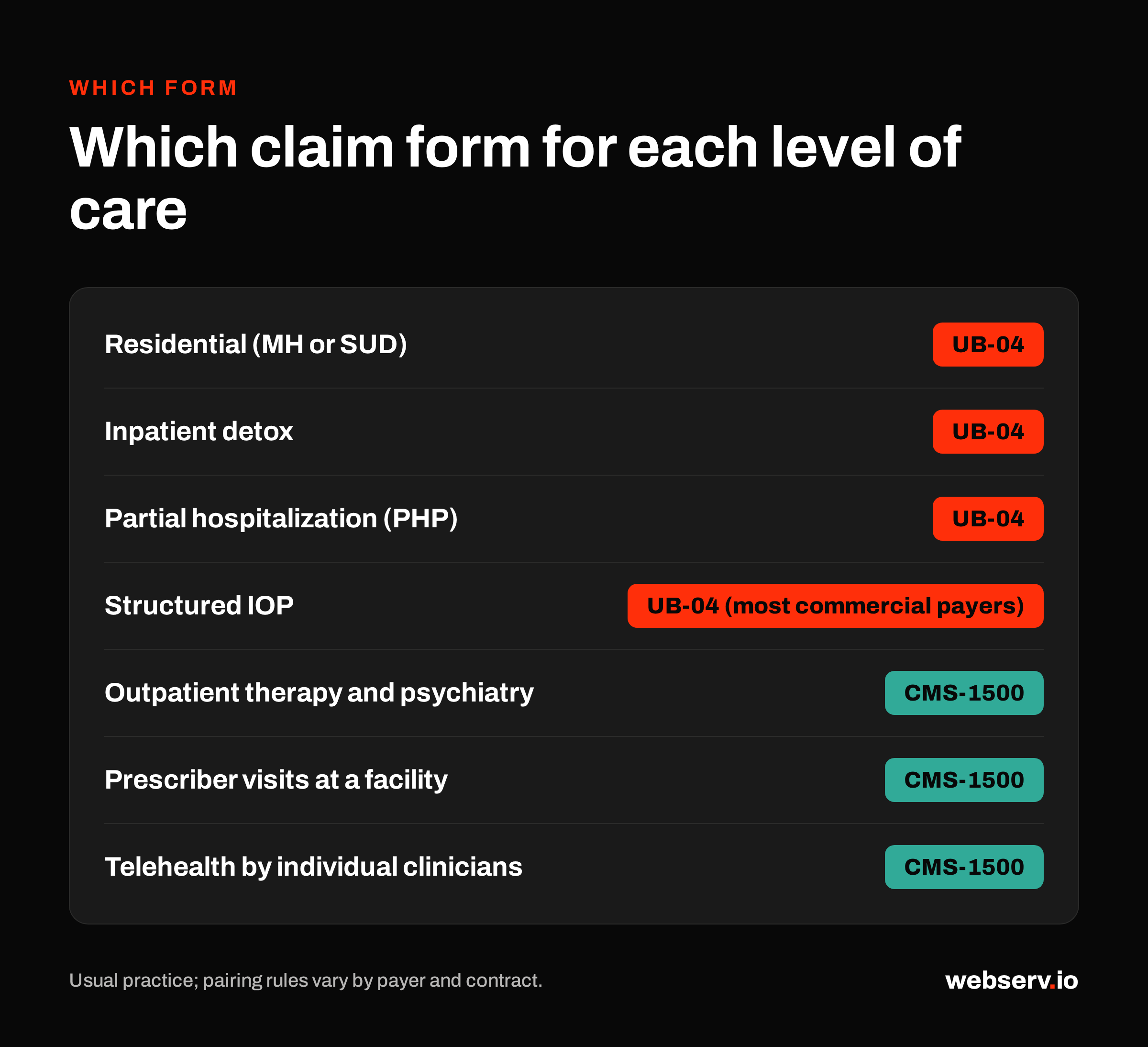
Optum says inpatient and residential claims are typically submitted on a UB-04, and that physician fees must be billed separately on a CMS-1500. Magellan’s 2026 billing code guide lists residential services as UB-04 only.
| Level of care | Usual form | Notes |
|---|---|---|
| Residential (MH or SUD) | UB-04 | Billed per day with a residential revenue code |
| Inpatient detox | UB-04 | Room and board detox revenue codes |
| Partial hospitalization (PHP) | UB-04 | PHP revenue code; payers may require condition codes |
| Structured IOP | UB-04 for most commercial payers | Pairing rules vary by payer; check the contract |
| Outpatient therapy and psychiatry | CMS-1500 | CPT codes with a place of service code |
| Physician or prescriber visits at a facility | CMS-1500 | Billed separately from the facility claim |
| Telehealth by individual clinicians | CMS-1500 | Place of service 02 or 10 |
Sources: Optum Provider Express inpatient claims guidance; Magellan Simplified Billing Codes 2026; BCBS Mississippi Behavioral Health Coding Policy. Checked November 11, 2026.
COMMON MISTAKE
Billing facility days on a CMS-1500. Optum says it has limited capacity to accept facility-based claim information on the CMS-1500. A facility claim on the wrong form is often denied or delayed, even when the service was authorized.
Filling out the UB-04: the form locators that matter
The UB-04 has 81 form locators, but a handful decide whether a behavioral health claim pays. CMS’s claims processing manual describes each one.
| Form locator | What it holds | What to watch at a treatment center |
|---|---|---|
| FL 4 | Type of bill | Facility type, type of care, and claim frequency, such as 086X for residential |
| FL 6 | Statement covers period | The from and through dates the claim covers |
| FL 42 | Revenue code | The level of care, such as 1002 for substance use residential |
| FL 44 | HCPCS or rates | The HCPCS code many payers require on outpatient lines |
| FL 46 | Units of service | Days for residential; sessions or days for PHP and IOP |
| FL 56 | Billing provider NPI | The facility’s organizational NPI |
| FL 67 | Principal diagnosis | The ICD-10 code that supports the level of care |
Type of bill examples. BCBS Mississippi’s behavioral health coding policy uses 086X for residential, and 013X or 089X for IOP and PHP. Ambetter Louisiana also uses 86X for residential treatment centers. Medicare uses 076X for community mental health centers.
Revenue code and HCPCS pairs differ by payer. Optum lists 1002 for substance use residential and 0906 for substance use structured IOP on its inpatient claims page. Magellan’s 2026 code guide pairs 1002 with H0011, while other payers bill the same revenue code by the day with no HCPCS listed.
UnitedHealthcare Community Plan’s policy requires both a revenue code and a procedure code on outpatient UB-04 lines, with state exceptions. Our guide to CPT, HCPCS, and revenue codes for behavioral health lists the codes themselves.
OPERATOR INSIGHT
Build a one-page grid for each payer: level of care, form, type of bill, revenue code, HCPCS code, and units. Update it whenever a contract or payer policy changes. It’s the fastest way to stop the same denial from repeating.
Filling out the CMS-1500: the items that matter
The CMS-1500 is simpler. CMS’s instructions for the form cover each item; these are the ones behavioral health billers check most:
| Item | What it holds |
|---|---|
| 21 | Diagnosis codes |
| 24B | Place of service code |
| 24D | CPT or HCPCS code and modifiers |
| 24G | Days or units |
| 24J | Rendering provider’s NPI |
| 33a | Billing provider or group NPI |
Place of service codes. CMS’s place of service code set includes several behavioral health settings:
| POS | Setting |
|---|---|
| 02 | Telehealth provided other than in patient’s home |
| 10 | Telehealth provided in patient’s home |
| 11 | Office |
| 52 | Psychiatric facility, partial hospitalization |
| 53 | Community mental health center |
| 55 | Residential substance abuse treatment facility |
| 56 | Psychiatric residential treatment center |
| 57 | Non-residential substance abuse treatment facility |
| 58 | Non-residential opioid treatment facility |
A physician who sees a patient at your residential facility bills that visit on a CMS-1500 with place of service 55. The facility bills the day of residential care on a UB-04.
Two kinds of NPI. CMS’s NPI fact sheet says Type 1 NPIs are for individual providers and Type 2 NPIs are for organizations. A CMS-1500 often carries both, in items 24J and 33a.
Medicare claims follow their own rules
Don’t copy commercial habits onto Medicare claims.
CMS established payment for IOP services starting in 2024, furnished by hospital outpatient departments, community mental health centers, and certain clinics, on institutional claims. Medicare’s manual also says physician and practitioner services in PHP and IOP are billed separately to the Part B contractor.
Medicare requires claims within one calendar year after the date of service. Commercial and Medicaid deadlines vary by contract.
Before the first claim goes out
Run these checks before a new level of care bills its first claim:
Confirm the form
Confirm the form with each payer’s billing guide and your contract.
Match revenue codes and HCPCS codes
Match revenue codes and HCPCS codes to that payer’s pairing rules.
Set the type of bill
Set the type of bill for each facility claim.
Separate professional services
Separate professional services onto CMS-1500 claims with the right place of service.
Check units
Check units: days for residential, sessions or days for PHP and IOP, time units for therapy.
Use the right NPI
Use the right NPI on each claim, organizational or individual.
Track timely filing
Track timely filing deadlines by payer.
Our billing operations checklist covers the rest of the process, and our guide to verification of benefits covers what to confirm before admission.
Where this fits
For the full billing picture, see our behavioral health revenue cycle management guide. For how contracts set your rates and billing rules, see our guide to payer contracts for behavioral health.
For how billing connects to marketing and admissions, see the complete guide to behavioral health marketing. If you want a second look at how your claims are set up, book an intro meeting.
This guide summarizes CMS and payer guidance as of November 2026. Billing rules vary by payer, state, and contract. Confirm with each payer before you submit.
Frequently Asked Questions
What is the difference between a UB-04 and a CMS-1500?
The UB-04, or CMS-1450, is the institutional claim form facilities use. The CMS-1500 is the professional claim form individual providers and practices use.
The UB-04 uses revenue codes and a type of bill. The CMS-1500 uses CPT or HCPCS codes with a place of service code.
Their electronic versions are the 837I and 837P.
Do residential treatment centers bill on a UB-04?
Usually, yes. Payers such as Optum and Magellan expect residential claims on a UB-04, billed per day with a residential revenue code.
Revenue code 1001 is commonly used for mental health residential and 1002 for substance use residential.
Physician visits at the facility are billed separately on a CMS-1500.
Is IOP billed on a UB-04 or a CMS-1500?
Most commercial payers expect structured IOP from a facility on a UB-04, often with revenue code 0905 or 0906 and a HCPCS code such as S9480 or H0015.
Form and code rules vary by payer and contract, so check each payer’s billing guide.
Medicare IOP uses its own revenue codes and is billed by eligible facility types.
What is the electronic version of the UB-04?
The 837I is the electronic version of the UB-04. The 837P is the electronic version of the CMS-1500.
Medicare requires electronic claims unless a provider qualifies for an exception.
Most commercial payers also expect electronic submission.
What place of service code do treatment centers use on a CMS-1500?
It depends on the setting. Code 55 is for residential substance abuse treatment facilities and 57 for non-residential substance abuse treatment facilities.
Code 52 is for partial hospitalization and 11 for office visits.
Telehealth uses 02 or 10, depending on whether the patient is at home.
Kyle McHenry is a co-founder and the CFO of Webserv and the founder of Revenue Logic, a behavioral health revenue cycle management company.