A verification of benefits is supposed to tell a treatment center whether a prospective patient’s insurance plan will cover their care, what the patient’s financial responsibility looks like, and what the program needs to do to get paid.
Most centers cannot solve VOB turnaround in-house. Picking the right RCM partner, one that actually publishes VOB turnaround benchmarks and reports on them monthly, is the single biggest lever on this metric.
That is the textbook definition. It misses almost everything that actually matters.
The version most billing companies deliver is a one-paragraph summary with a deductible, a coinsurance percentage, and an out-of-pocket maximum. Sometimes a daily reimbursement estimate that turns out to be wrong by 40% in either direction.
The version we deliver runs 147 questions on a form that has been curated over the last decade. Every time a new failure mode showed up in claim follow-up, we added a question to catch it earlier. Whenever a payer changed a quiet rule, the form changed too.
Both of those things are called a “VOB.” Only one of them tells the admissions team what they actually need to know before a patient walks through the door.
A bed full of bad coverage is worse than an empty bed. The right VOB is the difference.
Kyle McHenry, Founder, Revenue Logic
This guide explains what a VOB is, how the workflow actually runs at a serious treatment center, where most VOBs fail, and what to demand from your billing partner if you want yours to do its job.
Key Takeaways
- The industry uses the same word for two very different products. A “checkbox VOB” (deductible plus a coinsurance percentage) is what most billing companies deliver. A real VOB runs a 147-question structured form, captures alpha prefix and payer-specific reimbursement patterns, and tells admissions exactly what to expect.
- The most expensive VOB failure mode is the policy that should not have been admitted. The bed gets occupied, care gets delivered, and the claim denial arrives 7 to 14 days later, by which point the recovery never happens.
- A real VOB is a clinical placement input, not just a financial document. It tells admissions whether the policy is a clear admit, a financial risk, a referral out, or a wait-list candidate, and it informs the UR team’s authorization sequence from day one.
- Three questions separate a serious billing partner from a checkbox version: median VOB turnaround time across the last 90 days, the data source for out-of-network reimbursement estimates, and what the actual output document looks like.
What a verification of benefits actually answers
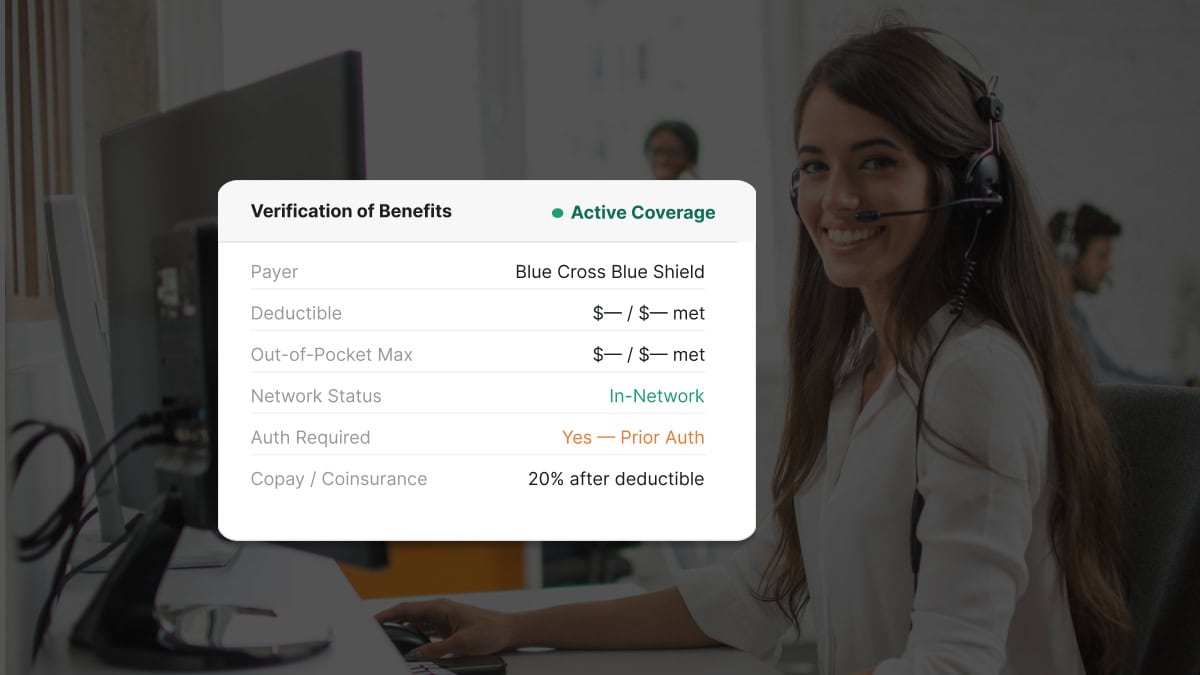
A VOB is a structured outreach to the patient’s insurance company before admission. The point is to confirm coverage and surface every condition that will affect what the program collects.
At minimum, a VOB needs to confirm the policy is active, identify the level of care covered, get the deductible status, capture the coinsurance and out-of-pocket maximum, and determine whether prior authorization is required.
That floor is what most billing companies stop at. It is also where most claims problems start. Every time.
A serious VOB also captures the policy alpha prefix, the state of issue, the group plan type, the network status of the facility, the historical reimbursement pattern for that exact policy, and the audit risk profile of the payer.
It captures whether the policy was issued through an out-of-state exchange. It captures whether the policy type has been quietly removed from a state database in the last 90 days.
That last point has played out at scale. Blue Cross and Blue Shield of Oklahoma has alleged in court that a handful of California programs took $36 million in wrongful payments from 2021 to 2024, with patients saying brokers falsified Oklahoma addresses to get them onto the plan. The plan no longer pays the way it once did for out-of-state care.
Centers that admitted those patients without checking found out about the problem at claim submission. By then the bed was occupied for the next 28 days.
What a real VOB workflow looks like
Step one is the call. A VOB specialist reaches the insurance company directly, navigates to the right department, and runs the questionnaire against the policy. Hold times vary. The questionnaire does not.
For us, the target turnaround is 30 minutes plus hold time. That is the operational standard a center should expect from a serious billing partner.
The next step is the data check. The policy gets cross-referenced against historical reimbursement data we maintain for that specific payer, alpha prefix, and plan type. We are looking at recent reimbursement patterns, not blended five-year averages.
The output is a complete picture of what the program can expect from this policy at every level of care, with a confidence band around the reimbursement estimate.
Then the VOB goes to the admissions team. Not a deductible and a percentage. A document that tells them whether to admit, at what level of care, with what authorization plan, and what financial expectations to set with the family.
The whole loop runs in under an hour for most policies. Complex out-of-network plans take longer. Bad ones get flagged and the program decides whether to admit on a self-pay basis, refer out, or absorb the financial risk.
How a Tennessee treatment center tripled its paid media close rate and cut missed calls to 1%
Full CRM configuration, system integrations, and call tracking metrics unified a fragmented admissions process into a single high-converting workflow in two months.
Read the case study →Up from 17% — missed calls cut from 15% to 1%
Why most VOBs are inadequate
MOST COMMON MISUNDERSTANDING
A single-number VOB per policy is a blended historical average across years, plan types, and alpha prefixes. Cigna MRC1 and MRC2 pay differently. Blue Cross reimbursement swings 30% between alpha prefixes on the same-named plan. A 2024 policy pays differently than the same product issued after the 2026 payer reset. If the VOB returns one number, that number is wrong for almost every patient it gets applied to — and admissions ends up staffing the wrong beds. Our breakdown of the VOB-to-admit reimbursement gap shows what that costs a facility.
The lazy version of out-of-network VOB looks like this. Single number per policy. Average historical reimbursement, blended across all years and plan types.
That is like asking what the weather is in Chicago. In summer or winter?
A Cigna MRC1 plan and a Cigna MRC2 plan have different reimbursement structures.
A Blue Cross plan from one alpha prefix can pay 30% more than the same plan name from a different prefix. A policy issued in 2024 may pay differently than the same product issued in 2026 after the payer’s annual contract reset.
A single-number VOB averages all of those into one estimate. The estimate is wrong for almost every patient it gets used for.
The same lazy pattern shows up in network checks.
A policy can be in-network at the regional level but exclude the specific service location, or it can show in-network on the database lookup but require a separate department to confirm coverage at the level of care being requested.
The check that catches that fact is a phone call. Most billing companies do not make it.
What a verification of benefits structurally cannot tell you
The reason the VOB stops at coverage confirmation is architectural. Every commercial VOB tool built for behavioral health, and effectively every VOB tool built for any healthcare vertical, is built on payer eligibility APIs.
Payer eligibility APIs are the electronic connection between a provider and a payer that returns benefit design data. That data set includes plan status, deductible position, out-of-pocket, benefit inclusions, prior authorization requirements, and level of care coverage.
What the data set does not include is what the payer has actually paid on adjudicated claims from similar patients at similar facilities for similar levels of care.
The payer does not return that information through the eligibility API. It is a different data set that lives inside the payer’s claims-processing system, and it becomes visible to the provider only after the claim has been submitted, adjudicated, and paid.
By the time an operator can see the realized-payment number, the patient has been in treatment for 30 to 90 days and the operator has already committed the operational cost of the admit.
The VOB tool market has invested heavily in making the eligibility API side of the equation faster, cleaner, and more BH-specific. VerifyTX supports 1,700 payers with sub-30-second response times.
Availity runs one of the largest health information networks in the country. pVerify has strong API depth across specialty verticals. All three of those investments matter, and all three of them are optimizing a data source that stops at coverage confirmation.
Coverage is not a rate: the $662 to $3,778 problem
The number that anchors this whole reframe is the rate variance range on what looks like the same payer to a VOB tool.
Across our adjudicated claims pool, four different Blue Cross Blue Shield home plans in California, all showing as “BCBS coverage confirmed” on any eligibility tool, pay dramatically different rates for the same residential level of care.
Anthem Blue Cross and Blue Shield of Indiana pays $3,778 per day. Anthem Blue Cross and Blue Shield of Ohio pays $3,090. Anthem Blue Cross of California pays $2,297. Blue Shield of California pays $662.
$3,778
Anthem BCBS of Indiana
$3,090
Anthem BCBS of Ohio
$2,297
Anthem Blue Cross of CA
$662
Blue Shield of CA
Same state, same LOC, same out-of-network status, same “BCBS” eligibility label. All four are high-confidence cells in our pool, each backed by 129 to 635 claims from 3+ distinct facilities, current through Q2 2026. A 5.7x spread within one label.
That is not a range across payers. That is a range within what an eligibility tool would return as a single payer entity, driven by alpha prefix, home plan, and the specific negotiated rate schedule that adjudicates the claim.
If an operator only sees the coverage confirmation, they see none of that variance. The VOB comes back “viable” and the admission goes forward.
If the admit adjudicates to the low end of that variance range, the operator’s cost per admit math on that specific patient is broken and there is no signal in the admissions workflow that the break is coming.
The variance is not random noise. It is a structural feature of how modern healthcare payer networks work.
Behavioral health carve-out arrangements, subcontracted network administrators, plan-level rate negotiations, and state-specific regulatory variations all combine to produce a rate schedule that is very different for two members of the same payer group depending on their specific plan structure. That variance is what determines whether the admit is profitable.
BCBS is not one payer
The specific complication that most operators underestimate is BCBS. When a VOB tool returns “BCBS coverage confirmed” and marks the plan active, the coordinator on the admissions team reads that as a single answer.
It is not. BCBS is a federation of roughly 34 independent licensee companies operating across states and territories, and inside those licensees the structure fragments further. Our prefix-to-home-plan mapping table carries 21,800 entries and resolves to 138 distinct home plan entities that appear in our data.
The alpha prefix on the member card is the first three characters that identify which specific BCBS plan will process the claim. The home plan is the specific BCBS entity that holds the member’s coverage contract.
Resolution to alpha prefix plus home plan is what determines the rate schedule the claim will adjudicate against. Without that resolution, the VOB tool is returning a coverage confirmation without visibility into which specific rate schedule applies.
This is where the same-payer $662 to $3,778 variance concentrates. Different BCBS home plans within the same “BCBS” eligibility label pay dramatically different rates for the same level of care.
An operator who admits a patient with a BCBS plan without resolving to alpha prefix and home plan is committing operational cost against a rate schedule they cannot see.
The Three Sources of the Gap
Alpha prefix drift, home plan mismatch, and product-type variance account for most of the reimbursement variance treatment centers see on their book of business.
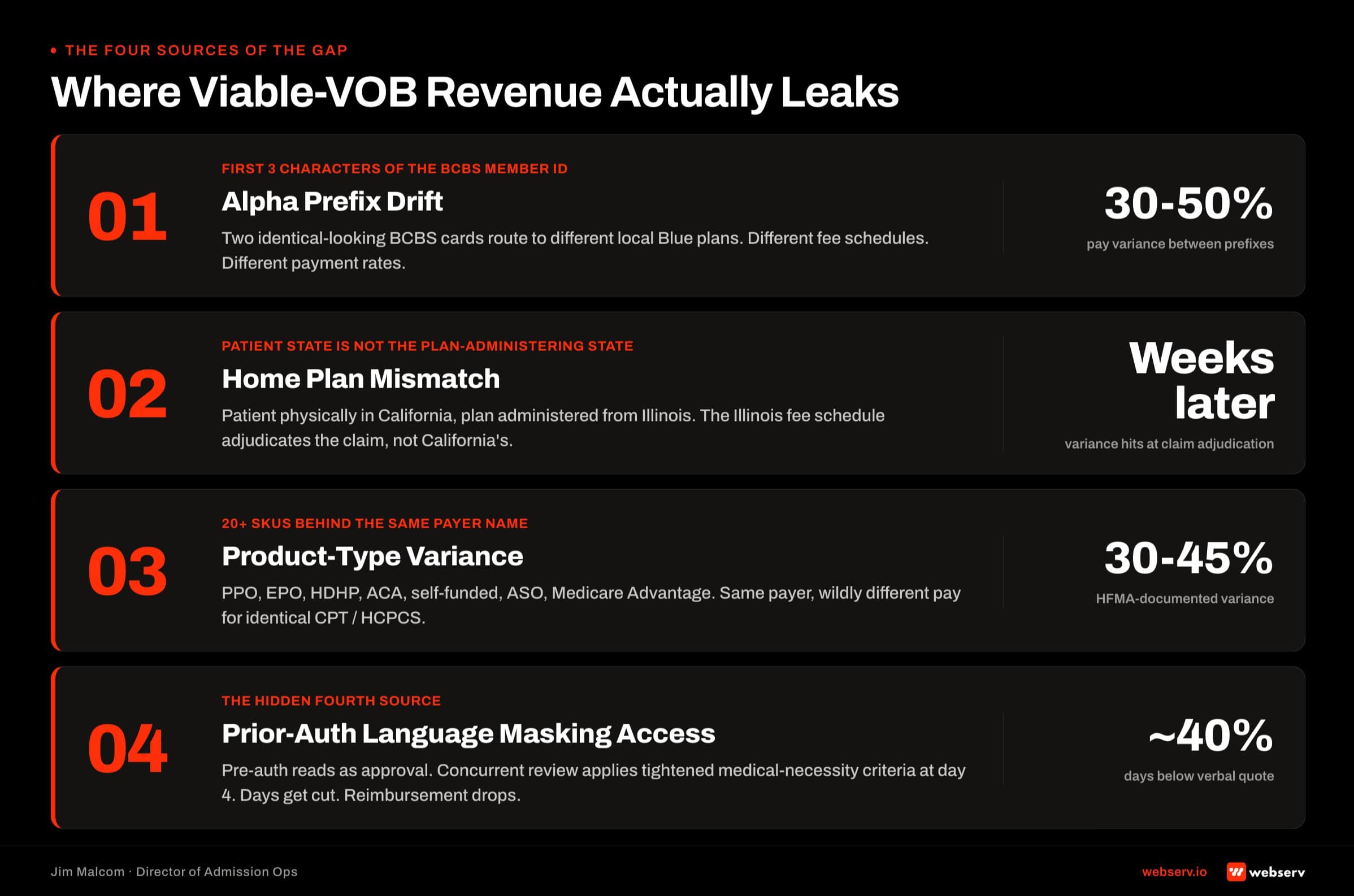 Four sources of the VOB-to-admit reimbursement gap for treatment centers: alpha prefix drift with 30 to 50 percent pay variance between prefixes, home plan mismatch resolved at claim adjudication weeks later.
Alpha prefix drift is the phenomenon where the first three characters of a BCBS member ID route the claim to a specific local Blue plan. Local plans set their own fee schedules for out-of-network care.
Two patients with visually identical BCBS cards can be reimbursed 30 to 50 percent differently because their alpha prefixes route to different plan administrators.
Home plan mismatch means a patient physically in California with a plan administered from Illinois routes reimbursement through the Illinois home plan. The Illinois fee schedule applies, not California’s.
The VOB does not surface this in a way that translates to a rate expectation. The claim adjudicates weeks later at the mismatched rate.
Product-type variance is the third source. The same payer has 20+ product SKUs (PPO, EPO, HDHP, ACA marketplace, self-funded, ASO, Medicare Advantage) that pay wildly different rates for the same CPT and HCPCS combinations.
PRODUCT-TYPE VARIANCE IS NOT A NICHE OBSERVATION
HFMA has documented reimbursement variance of 30 to 45 percent across payer product types for identical CPT/HCPCS combinations in behavioral health, driven by ASO versus fully-insured, marketplace versus commercial, and self-funded plan variance (HFMA, Behavioral Health Revenue Cycle Management). This is an operating reality across the finance function of BH providers.
A card that reads “BCBS PPO” on the front does not tell the admissions team which product SKU it belongs to.
Segmenting reimbursement by these three variables changes the picture. Facilities that don’t segment are averaging across radically different payer economics and calling the average their reimbursement rate.
The Hidden Fourth Source: Prior-Auth Language Masking Actual Access
The VOB reads “prior authorization required.” The coordinator flags it. The team obtains the pre-auth. The patient admits.
What the VOB did not surface: the payer’s medical-necessity policy on this level of care has been quietly tightened in the last 90 days. The concurrent review team applies a stricter criteria set than the pre-auth team. Our guide to VOB vs pre-authorization covers where the two checks diverge.
The actual days approved will land 40 percent below what was verbally quoted during the initial call.
The prior-auth stamp existed. The access did not. This is the source most operators nod at when it is named, because they have seen it on their own book and did not have a language for it.
Concurrent review is where the reimbursement quietly disappears. A pre-auth quote of 21 days for residential becomes 14 days at day 4. A PHP authorization of 4 weeks becomes 2.5 weeks at the second review.
The pre-auth team is not lying at the front end. The concurrent review team is applying policy that has moved.
The reimbursement math on the case does not survive that shift. The clinical case may still be strong. The financial case is now different from what the admissions team quoted when they said yes.
The 4-Step Diagnostic to Measure Your Facility’s Gap
- Pull Two Quarters of Viable-VOB to Admit Records. Export from the CRM every VOB that was flagged viable in the last two full quarters, plus the admission status and payment status downstream. Every viable VOB gets a row: verified, admitted, and paid amount. This is the KPI spine every admissions CRM should carry.
- Overlay Actual Paid Against Expected. For each admit, put the actual paid amount alongside the expected reimbursement your admissions team quoted at the VOB moment. If the team was not documenting expected reimbursement, use the average net collections rate on that payer group as a proxy.
- Segment Variance by Payer, Alpha Prefix, Product Type, and Level of Care. The pattern is rarely uniform across the book. One BCBS alpha prefix will pay above expected. Another will pay 40 percent below. One product SKU will hit the number. Another will miss it consistently. This is where a payer audit that surfaces underpayment patterns is doing the work.
- Calculate Aggregate Leak and Top Three Payer Groups. Sum the variance in dollars. Rank payer groups by variance contribution. Most facilities running this exercise for the first time find one payer group producing 40 to 50 percent of their total leak. That is the group renegotiation efforts and admissions triage rules need to concentrate on.
The diagnostic above is operator-executable. A controller and an admissions supervisor can complete it in about six hours split across two days. It builds on the VOB vs expected reimbursement comparison and pairs naturally with the pre-admission eligibility verification playbook.
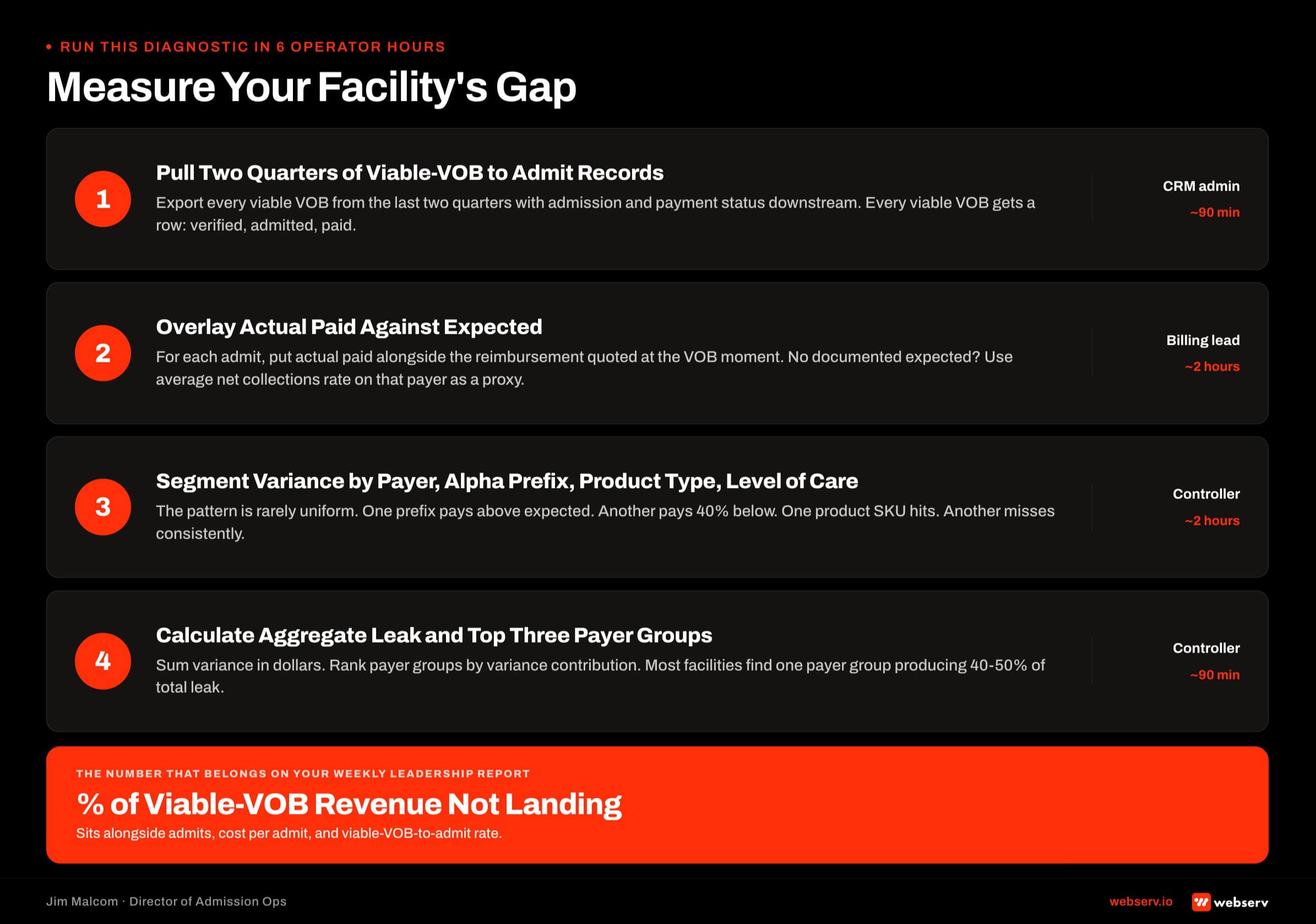 The four sequential operator steps to measure a treatment center’s viable-VOB-to-admit reimbursement gap: pull two quarters of viable-VOB to admit records, overlay actual paid against expected.
The output of the diagnostic is a single number for your facility: the percentage of viable-VOB revenue that is not landing. That number belongs on the weekly leadership report alongside admits, cost per admit, and viable-VOB-to-admit rate.
Most operators find the dollar-amount version of the gap is 20 to 35 percent even when the admit-count gap looks smaller. That means the patients who did admit are paying less than expected, not just that some patients failed to admit.
Where VOBs hide their failures
A VOB that is wrong does not announce itself at the time of admission. The patient comes in. Care is delivered. The first claim goes out 7 to 14 days later. That is when the program finds out something was off.
The most expensive failure mode is the policy that should not have been admitted. The bed is occupied for the duration of the stay. The next prospective patient gets turned away. The financial recovery never happens.
The second failure mode is the policy that admits but pays less than expected. A confident reimbursement estimate of $1,500 a day for detox turns into actual reimbursement of $900 a day. Across a 30-day continuum that is a $18,000 gap on a single admit.
The third failure mode is the slow VOB. The patient calls. The center promises a callback. The VOB takes six hours. By then the patient has admitted somewhere else with a faster billing partner.
That third failure does not show up in any report because the conversion never fired, the patient was never admitted, and no record of the inquiry exists in either the marketing or the billing system after that day. The ad spend that produced the call is just gone.
The clinical-decision dimension
Most operators read a VOB as a financial document. The right one is also a clinical decision input.
The right answer to whether to admit a patient depends on knowing exactly how much the policy will pay, when, under what conditions, and after what authorization process.
A VOB that does not capture all of that is asking the admissions team to make a clinical placement decision with one third of the relevant information.
This is the part of the workflow most operators do not see. Admissions feels like a binary call. Bed available, patient ready, admit or not. The financial weight of the decision lives in a document the admissions team does not have time to interpret on their own.
A VOB that is built right does the interpretation upfront. It tells the admissions team whether this policy is a clear admit, a financial risk, a referral out, or a wait-list candidate.
It tells the family what to expect financially. It tells the UR team how to plan the authorization sequence.
The bed is one resource. The clinical hours are another. The cash position of the program is the third. A real VOB protects all three of those at once.
What to demand from your billing partner
TOOLS THAT ANSWER THIS
One reason we recommend the second question specifically: PayerLenz was built to answer it. It is a reimbursement intelligence platform for behavioral health with 500,000+ adjudicated claims across 250 payer groups and 20 states, resolved to alpha prefix and home plan. A VOB tells you the patient is covered. A serious rate reference tells you what the payer will actually pay for that level of care in that state. Disclosure: Webserv CEO Preston Powell is a co-founder of PayerLenz.
If you are evaluating a billing partner, three questions surface the difference between a real VOB process and a checkbox version.
First, ask for the median VOB turnaround time across the last 90 days. If they cannot tell you, they are not measuring it. That is its own answer.
Second, ask for the data source they use to estimate out-of-network reimbursement. A serious answer references a payer-by-payer database with alpha prefix granularity and a recent time window. A vague answer references “industry average” or “experience.”
Third, ask what their VOB output document looks like.
A page-long structured form that includes alpha prefix, policy type, network status, authorization requirements, and reimbursement estimate with a confidence range is what a real one looks like.
A two-paragraph email with a deductible and a percentage is the version that is going to leave money on the table.
The whole industry uses the same word for both versions. The work behind them is not comparable.
Where expected reimbursement data actually comes from
The category of tool that answers the rate question is a different kind of instrument than a VOB tool. Its data source is adjudicated behavioral health claims, contributed by a network of treatment centers.
The data is cleaned and normalized to the alpha prefix and home plan level, and organized so that a new eligibility check can return more than a “covered” status.
It can return “covered and here is what the payer paid on 47 similar claims in the last 12 months at this level of care for this alpha prefix, with a trust score attached to the estimate.”
That instrument does not replace VOB tools. It runs alongside them, or in some cases returns both data sets in the same call.
Operators still need the coverage confirmation. What changes is that they now have the rate expectation too, and the admissions decision framework upstream of the admit changes shape.
The trust score matters here. A rate estimate based on 5 claims is directionally useful. A rate estimate based on 500 claims is operationally defensible.
The confidence layer is what makes the rate data actually usable versus a rough average with no way to interpret how much to trust it.
On high-confidence cells, PayerLenz estimates land within 10% of what the payer actually pays about nine times out of ten, backed by adjudicated claims across more than a million datapoints in the pool. That is the accuracy number an operator can plan against.
What this means for census
The fastest, highest-impact operational improvement most treatment centers can make is upgrading the VOB process.
It moves the speed of the admit decision. It catches the bad policies before they occupy beds. It calibrates the financial expectations the admissions team sets with families. It informs the UR team’s authorization plan from day one.
A VOB done right is not a back-office document. It is the operating control panel for the first 24 hours of every patient’s stay, and the financial outcome of every admit traces back to it.
If your current billing partner cannot tell you their median VOB turnaround time or show you their reimbursement data source, your center is paying for a checkbox version while operating as if it has the real thing.
That gap is closeable. It is also expensive every quarter that it stays open.
Frequently asked questions about insurance verification for treatment centers
How long should a proper VOB take?
A well-built VOB process completes in 30 to 90 minutes for most insurance plans, with same-day turnaround as the realistic standard for any inquiry received during business hours. The 24 to 48 hour turnaround that some treatment centers operate on is a competitive disadvantage because most admits go to the program that responds first.
The under-30-minute targets are achievable with the right systems but require investment. Most programs that hit those targets use a combination of payer-specific automation, dedicated VOB staff (not shared admissions resources), and direct payer portal access rather than phone-based verification.
For treatment centers competing for census in tight markets, VOB turnaround is directly correlated with admit conversion rate. Programs that cut VOB time from 4 hours to 1 hour typically see 15 to 30 percent improvement in admit conversion within 60 days because the speed-to-response advantage compounds across the inquiry pipeline.
Can our admissions team handle VOBs internally?
For most programs over 30 beds, the right model is dedicated VOB staff separate from the admissions intake function. Admissions intake handles family conversations, clinical screening, and care coordination. VOB handles payer verification, benefit interpretation, and authorization initiation. The skill sets are different enough that combining them tends to suppress both functions.
Programs under 30 beds often run a hybrid model where admissions staff handle VOBs in addition to intake. This works at smaller scale because the volume does not justify a dedicated VOB team, but it caps growth potential and produces uneven VOB quality.
The transition point is usually at 4 to 6 admits per day. Below that, hybrid works. Above it, dedicated VOB staff produce meaningful improvements in both VOB accuracy and admissions team focus. We have seen programs grow census 15 to 25 percent simply by separating VOB and admissions functions.
What is the difference between a VOB and a benefits estimate?
A VOB confirms what the patient’s insurance plan covers, what the patient’s financial responsibility is likely to be, and what authorization is required for treatment. A benefits estimate is a calculation of what the patient will pay based on the VOB. The VOB is the input; the benefits estimate is the output.
The distinction matters operationally. A well-built VOB process produces both: the verified coverage detail (deductible status, copay, coinsurance, out-of-pocket maximum, in-network versus out-of-network treatment, authorization requirements) plus a calculated benefits estimate for the patient’s expected financial responsibility at the program.
Programs that stop at VOB without producing the patient-facing benefits estimate force the admissions team to do that math in real time during family conversations. That produces inconsistent quotes, slow responses, and lost admits to programs that produced clean estimates earlier.
How does VOB quality affect admissions conversion?
Directly. Inadequate VOBs produce three downstream failures. First, they admit patients with unviable insurance, which costs the program a bed and a revenue opportunity. Second, they fail to admit patients with viable insurance because the VOB undercounted coverage or missed authorization pathways. Third, they slow admissions response times below the threshold where families choose another program.
The conversion-rate impact is meaningful. Programs with strong VOB quality (90 percent+ accuracy on coverage and financial responsibility) typically convert 35 to 50 percent of qualified inquiries to admits. Programs with weak VOB quality convert 15 to 25 percent. The gap is rarely about clinical fit or marketing quality; it is usually about VOB execution.
We treat VOB as a primary marketing input rather than a back-office function. The marketing team generates qualified inquiries; the VOB team converts them. Improving one without the other produces unbalanced results.
Should we VOB every inquiry or only qualified leads?
Most treatment centers should VOB every inquiry that passes basic admissions screening (substance and condition fit the program’s clinical scope, geographic feasibility, willingness to commit to a treatment date). VOB-ing further upstream wastes resources on inquiries that will not admit. VOB-ing further downstream loses admits to competitors who VOB-ed faster.
The qualification gate before VOB is intentionally light. A 5 to 10 minute clinical screening call before VOB filters out obvious non-fits without burning VOB capacity on every inbound. The rest of the qualification happens during and after VOB as the financial picture and clinical fit clarify.
Programs that VOB only highly-qualified leads usually have lower VOB volume but worse admit conversion overall because they lose the speed advantage. Programs that VOB every inquiry without basic screening burn capacity but capture more of the actual demand. The screening-then-VOB model produces the best balance.
The perspective in this article comes from 9 years working exclusively inside behavioral health.
We are a team built by people in recovery who understand that behind every admission is someone asking for help. If that resonates, get to know us.
Kyle McHenry is the founder of Revenue Logic, a behavioral health revenue cycle management firm. He has spent 15 years working with treatment center operators on verification, utilization review, and claims management.