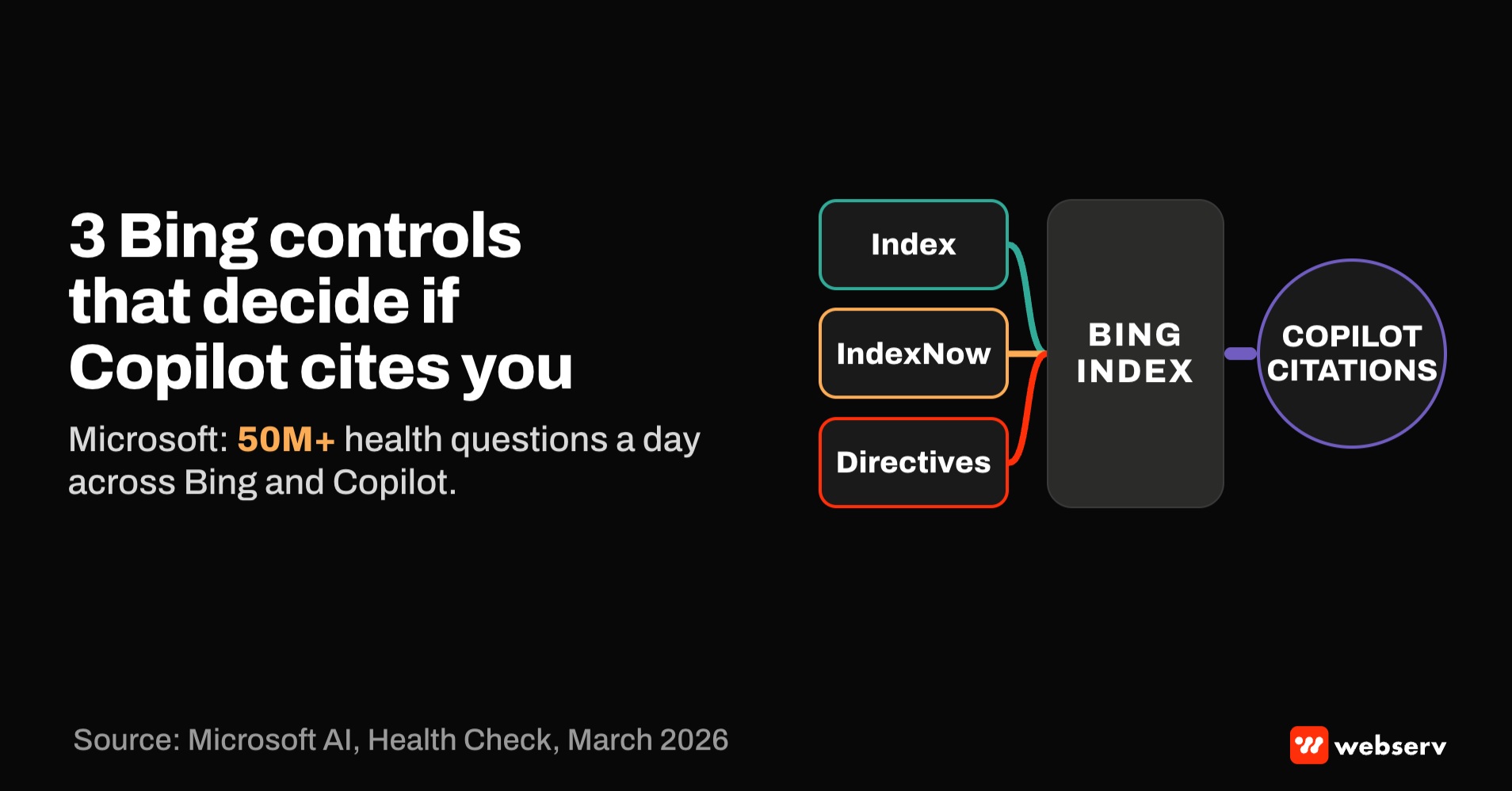
Microsoft says Bing and Copilot health questions add up to more than 50 million a day. In the same March 2026 report, it said 5.8% of health questions involve navigating care, insurance, or benefits, which is the territory treatment centers actually serve.
Most treatment center SEO programs treat Bing as an afterthought: Google gets the strategy, Bing gets whatever carries over.
That made sense when Bing was mostly a desktop search box. It makes less sense now that Microsoft’s Webmaster Guidelines say Bing and Copilot rely on the same crawling, indexing, and ranking foundation, and Bing now reports which pages Copilot cites.
This piece covers how Copilot finds and cites sources, the tools Bing gives site owners that Google doesn’t, what Microsoft has said about health answers, and the steps that make a treatment center site eligible in Microsoft’s AI answers. It’s part of the work inside our AEO program for treatment centers.
For the full build across platforms, start with our Full AI Search Stack. Paid Microsoft Ads is a separate topic; this piece is about organic visibility.
Key Takeaways
- Microsoft’s Webmaster Guidelines say Bing and Copilot rely on the same crawling, indexing, and ranking foundation. A page that isn’t in Bing’s index is unlikely to be cited by Copilot.
- Bing Webmaster Tools added an AI Performance report in February 2026 that shows citations in Copilot and Bing’s AI summaries. Google offers nothing comparable at the page level.
- IndexNow lets a site notify Bing and other participating engines when pages change. Microsoft says it helps keep content fresh across search and AI experiences.
- NOARCHIVE keeps content out of Copilot responses and grounding. Check that it isn’t applied to pages you want cited.
- Microsoft says Copilot’s health answers are anchored in thousands of credible sources and include expert-written answer cards from Harvard Health. Clinical questions will lean on those sources; care navigation, insurance, and local questions are the realistic opening for facilities.
- StatCounter put Bing at 9.89% of US search across platforms and 18.8% on desktop in September 2026. The share is modest, but Bing’s index also grounds Copilot and other AI products.
How Copilot finds and cites sources
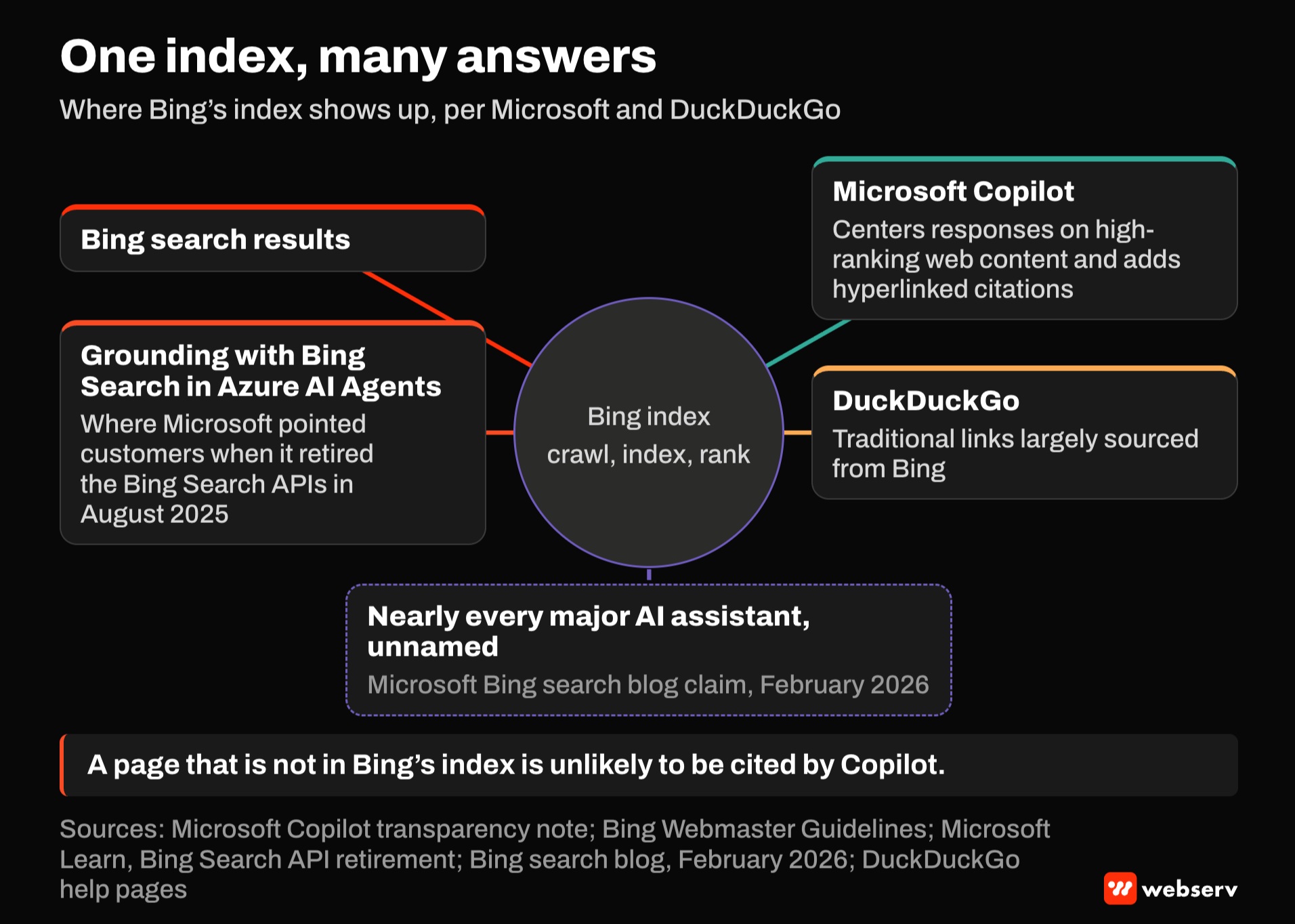
Microsoft’s Copilot transparency note says Copilot centers its responses on high-ranking content from the web and adds hyperlinked citations after generated text. Bing’s Webmaster Guidelines make the connection explicit: Bing and Copilot search experiences rely on the same core crawling, indexing, and ranking foundation.
DEFINITION
Grounding. The process of an AI assistant pulling current content from a search index to support its answer, then citing the pages it drew from. In Microsoft’s ecosystem, Copilot’s grounding draws on Bing’s index, so Bing indexing and ranking are prerequisites for Copilot citations.
Microsoft has also positioned Bing as infrastructure for other AI products. When it retired the Bing Search APIs in August 2025, it pointed customers to Grounding with Bing Search in Azure AI Agents.
In February 2026, a post on Microsoft’s Bing search blog said Microsoft grounding powers nearly every major AI assistant in the market, without naming them.
OpenAI’s ChatGPT search help page says ChatGPT search sometimes partners with other search providers and links to Microsoft’s privacy policy, but doesn’t name Bing directly. DuckDuckGo says its traditional links are largely sourced from Bing.
The practical point: Bing’s index reaches further than Bing’s own search share suggests.
The tools Bing gives site owners
Bing gives treatment centers two capabilities Google doesn’t offer in the same form.
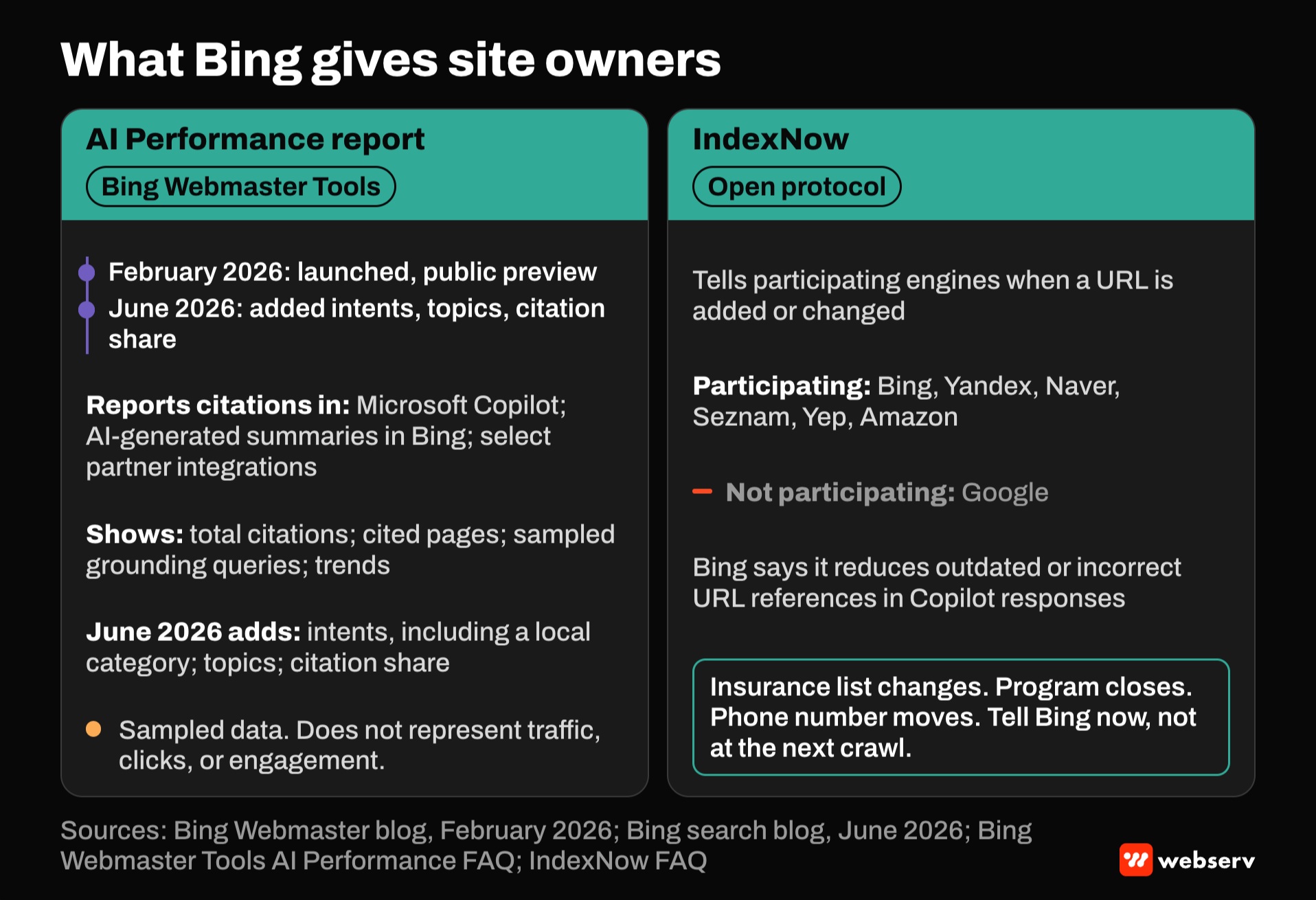
AI Performance reporting. In February 2026, Bing launched AI Performance in Bing Webmaster Tools, reporting citations in Microsoft Copilot, AI-generated summaries in Bing, and select partner integrations. It shows total citations, cited pages, sampled grounding queries, and trends.
A June 2026 update added intents, including a local category, topics, and citation share. Bing’s FAQ notes the data is sampled and doesn’t represent traffic, clicks, or engagement.
IndexNow. The IndexNow protocol lets a site notify participating engines, including Bing, Yandex, Naver, Seznam, Yep, and Amazon, when a URL is added or changed. Bing’s guidelines say it reduces outdated or incorrect URL references in Copilot responses. Google doesn’t participate.
For a treatment center, the use case is direct. When an insurance list changes, a program closes, or a phone number moves, IndexNow tells Bing now rather than waiting for the next crawl, so Copilot is less likely to repeat old details.
The controls to check
Bing’s crawler documentation lists Bingbot and two related crawlers, with no separate Copilot or AI crawler. Blocking Bingbot blocks Copilot’s source.
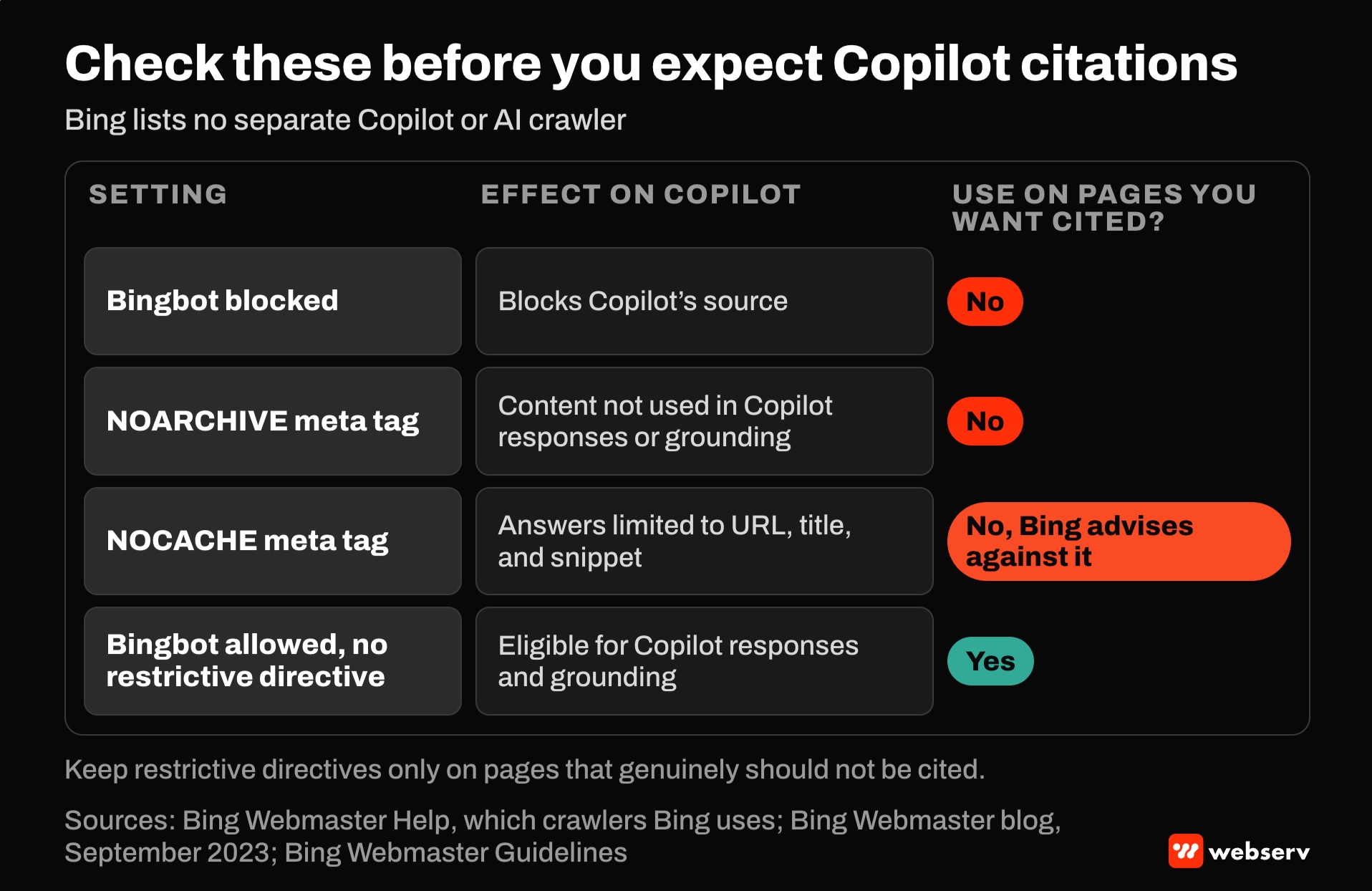
Two meta directives matter. Bing announced in 2023 that content tagged NOARCHIVE won’t be included in its chat answers, and NOCACHE limits answers to the URL, title, and snippet. The current guidelines say NOARCHIVE prevents content from being used in Copilot responses and grounding, and advise against NOCACHE on content intended for Copilot.
COMMON MISTAKE
A privacy setting that also blocks Copilot. Some sites apply NOARCHIVE or NOCACHE site-wide, sometimes through an SEO plugin setting, for reasons unrelated to AI. On a treatment center site, that can quietly remove program and insurance pages from Copilot answers.
Check the robots meta tags on the pages you want cited. Keep restrictive directives on pages that genuinely shouldn’t be reused, such as patient portal or intake pages, and off the public program and admissions pages.
Our robots.txt guide for AI bots covers crawler decisions across platforms.
What Microsoft says about health answers
Microsoft has been specific about how Copilot handles health. Its March 2026 Health Check report says Copilot’s health answers are anchored in thousands of credible sources, selected using National Academy of Medicine principles, and that Copilot shows answer cards in partnership with organizations including Harvard Health.
Health questions across Bing and Copilot
50M+
Health questions a day across Bing and Copilot (Microsoft, March 2026)
5.8%
Of health questions involve navigating care, insurance, or benefits (Microsoft)
18.8%
Bing’s share of US desktop search, September 2026 (StatCounter)
Microsoft’s Copilot Health announcement, also from March 2026, describes expert-written answer cards from Harvard Health and connections to US provider directories searchable by insurance. Its support page says the feature is in preview and temporarily unavailable for some users as it moves into the new Copilot app.
Outside data points the same way. Ahrefs’ analysis of the most-cited domains in Copilot, updated in September 2026, lists Mayo Clinic, Cleveland Clinic, Healthline, and WebMD among the top 50.
The implication for treatment centers matches the pattern on other AI platforms. Clinical explanations will come from medical publishers and health systems.
The 5.8% of health questions Microsoft says involve navigating care, insurance, or benefits are closer to what a facility can answer: which programs accept a given insurer, how admission works, where a facility is.
How to make a treatment center site eligible
Bing’s guidelines give a short list of what matters for grounding. Applied to a treatment center:
BING AND COPILOT ELIGIBILITY CHECKLIST
- Get indexed and verified in Bing Webmaster Tools. Submit the sitemap, check coverage, and fix crawl errors.
- Turn on IndexNow. Several SEO plugins support it. Prioritize pages whose facts change: insurance, programs, locations, and staff.
- Write pages that stand on their own. The guidelines say content cited for grounding should stand on its own and define entities clearly. A program page that states the level of care, location, schedule, and insurance in plain sentences is easier to cite. Our guide to the 40-word answer block covers the format.
- Keep structured data accurate. Bing’s guidelines say structured data doesn’t guarantee visibility and must match visible content. Use it to clarify, not to add claims the page doesn’t make.
- Claim and update Bing Places. Microsoft’s AI Performance announcement says Bing Places keeps address, hours, and contact information current and eligible for inclusion in AI-generated responses. Mirror the details in your Google Business Profile, covered in our GBP optimization guide.
- Avoid what Bing names as abuse. The guidelines call out prompt injection and artificially engineered language. Content written to manipulate AI answers rather than inform readers is a risk, not a tactic.
How Bing fits the rest of your AI search plan
Bing work overlaps heavily with the rest of AEO. Indexed, current, self-contained pages serve Google’s AI features, Claude, and ChatGPT as well. What Bing adds is a measurement window and a faster way to push updates. Our guide to getting cited in Google AI Overviews and ChatGPT covers the platforms most programs start with. For the other answer engines, see our guides to Perplexity citation strategy and Gemini Deep Research.
OPERATOR INSIGHT
Pull the AI Performance report’s grounding queries monthly and read them as a list of questions Copilot users asked that led to your pages. It’s a more direct view than most platforms offer into which AI questions surface the site.
Compare the cited pages with your priority pages. If Copilot cites an old blog post instead of the current program page, update the post to point to the program page and make sure the program page answers the question directly.
For tracking citations across platforms, see our guide to measuring AEO. For diagnosing why a site isn’t cited anywhere, the 12 SEO failure patterns diagnostic and the 5-tier SEO priority framework cover where to start.
For how AI search fits the rest of your marketing, see the complete guide to behavioral health marketing. If you want a second look at your Bing and Copilot setup, book an intro meeting.
Frequently Asked Questions
Does Copilot use Bing search results?
Microsoft’s Webmaster Guidelines say Bing and Copilot search experiences rely on the same crawling, indexing, and ranking foundation, and Copilot’s transparency note says it centers answers on high-ranking web content with citations.
That makes Bing indexing a prerequisite for Copilot citations.
There’s no separate Copilot crawler; Bingbot covers both.
How can a treatment center see whether Copilot cites its site?
Bing Webmaster Tools’ AI Performance report, launched in February 2026, shows citations in Microsoft Copilot and Bing’s AI summaries, cited pages, and sampled grounding queries.
Microsoft notes the data is sampled and doesn’t represent clicks or traffic.
Verify the site in Bing Webmaster Tools to access it.
What is IndexNow, and should treatment centers use it?
IndexNow is a protocol that notifies participating search engines, including Bing, when a page is added or changed. Bing says it reduces outdated URL references in Copilot responses.
It’s most useful for pages whose facts change, such as insurance lists, programs, and contact details.
Google doesn’t participate, so it complements rather than replaces Google indexing.
Can NOARCHIVE or NOCACHE affect Copilot?
Yes. Bing says NOARCHIVE prevents content from being used in Copilot responses and grounding, and advises against NOCACHE on content intended for Copilot.
Some sites apply these tags broadly through plugin settings without realizing the effect.
Check the tags on program, insurance, and admissions pages you want cited.
Will Copilot cite treatment centers for health questions?
For clinical questions, less likely. Microsoft says Copilot’s health answers are anchored in thousands of credible sources and use expert-written answer cards from Harvard Health.
Microsoft also says a share of health questions involve navigating care, insurance, or benefits.
Those questions, along with local and program-specific ones, are where clear facility pages have the best chance of being cited.
Trevor Gage is the Director of Marketing at Webserv, a digital marketing agency for treatment centers.