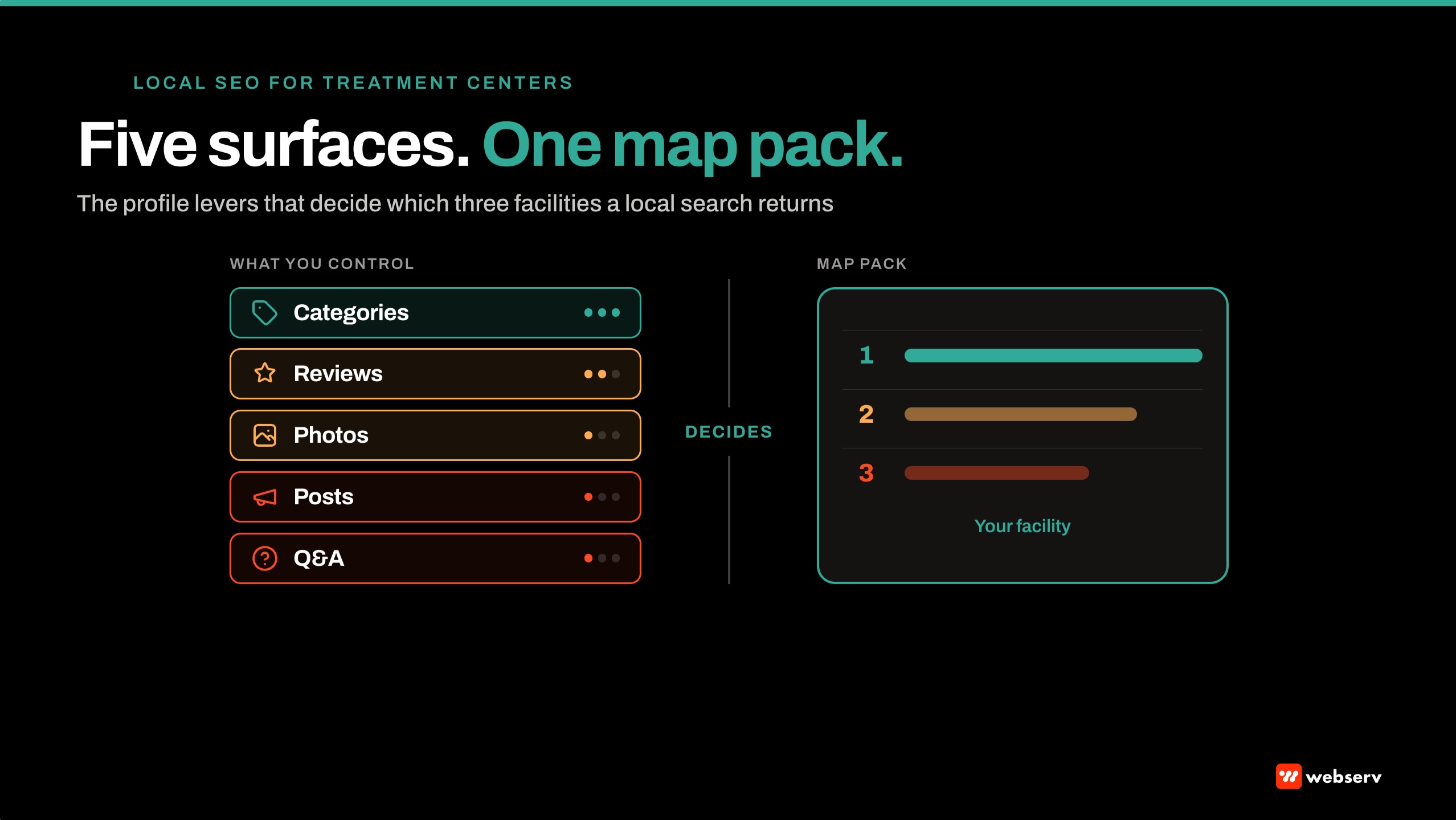
Google Business Profile (GBP) is the local search visibility layer that determines whether a facility appears in the Google Map Pack for geographic queries. It sits inside our SEO capability as the Local SEO surface that operates by its own specific rules.
Google’s local ranking surfaces the facility over local competition through GBP-specific signals. GBP sits inside the broader SEO capability but operates by its own specific rules that differ from general organic SEO.
For treatment centers, GBP visibility often produces meaningful inbound call volume that competes with paid media as a conversion source.
The pattern I see across facility GBP profiles: the listing was set up years ago and never optimized beyond the basic NAP data. Categories are wrong or too narrow. Photos are stock or outdated.
Reviews are either sparse or unmanaged. Posts are absent or infrequent. Services and attributes are half-filled. The listing exists but does not rank because Google’s local ranking algorithm rewards actively managed listings over passively existing listings.
The specific opportunity most facilities miss: a well-optimized GBP for a treatment center in a competitive metro can become a steady source of inbound calls from Map Pack visibility alone. For portfolio operators managing many locations, optimized GBP compounds into a meaningful call channel across the portfolio.
Neither number materializes for facilities running unoptimized GBP.
This piece walks the GBP optimization playbook specific to treatment centers. The category selection that produces local ranking for BH queries, the photo and video content that improves conversion from Map Pack impressions, and the review management pattern that produces the star rating and review count Google factors into ranking.
It also covers the Google Posts cadence that keeps the listing active in Google’s ranking evaluation, how Google now answers questions about the facility with AI after retiring Business Profile Q&A in November 2025, and the measurement setup for GBP performance. This is a supporting piece for our Local SEO guide, we cover the broader picture in our ultimate guide to behavioral health marketing. extends the earlier framing in our Local SEO for healthcare piece, and pairs with our Meta Ads playbook as the organic-plus-paid local visibility pair.
Key Takeaways
- GBP is the local search visibility layer that determines Map Pack ranking for geographic BH queries. Well-optimized GBP for a treatment center in a competitive metro can become a steady source of inbound calls from Map Pack visibility alone. Unoptimized GBP for the same facility often produces very few.
- Category selection is the specific setting that determines which local queries the listing ranks for. Primary category “Addiction treatment center” for SUD-focused facilities. “Mental health service” for non-SUD BH-focused facilities. Secondary categories add specificity but should not compete with the primary category.
- Photo and video content meaningfully improves conversion from Map Pack impressions. Custom facility photos and short facility walkthrough videos give families a real view of the facility, which stock imagery cannot. The specific photo mix: exterior, interior common spaces, program-specific spaces, admissions team, and clinical team.
- Review management produces the star rating and review count that Google factors into ranking. Review count, rating, and recency are part of how Google weighs local prominence, so facilities with a strong, current review profile tend to have an advantage for the same geographic queries. A consistent review response cadence (we recommend a 48-72 hour SLA) shows families and Google that the listing is actively managed.
- Google Posts cadence keeps the listing active in Google’s ranking evaluation. Weekly or biweekly posts covering facility updates, program details, or educational content produce the specific active-management signal that separates well-ranked GBP from stagnant listings.
DEFINITION
Google Business Profile optimization for treatment centers. The specific management pattern that produces Map Pack visibility for BH geographic queries. Correct primary category (“Addiction treatment center” for SUD-focused facilities, “Mental health service” for non-SUD-focused) plus 4 to 6 aligned secondary categories, 20+ custom facility photos across five categories (exterior, interior common, program spaces, admissions team, clinical team), a steadily growing review base with a 48 to 72 hour response SLA, weekly or biweekly Google Posts of 100 to 300 words, and complete services, attributes, and website answers that Google’s AI can draw on when families ask about the facility.
Distinct from general organic SEO (which handles website-driven ranking, not Map Pack), distinct from paid Google Local Services Ads (which is a separate ad product with its own eligibility), and distinct from single-facility GBP for portfolios (multi-location operators need the additional entity hierarchy and Business Profile API patterns covered in the Local SEO guide).
OPERATOR INSIGHT
The listing exists but does not rank because Google’s local ranking algorithm rewards actively managed listings over passively existing listings.
A well-optimized GBP for a treatment center in a competitive metro can become a steady source of inbound calls from Map Pack visibility alone. For portfolio operators managing many locations, optimized GBP compounds into a meaningful call channel across the portfolio. Neither number materializes for facilities running the listing on setup-and-forget mode.
Category selection for treatment center GBP
Category selection is the specific GBP setting that determines which local queries the listing ranks for. Getting categories wrong produces missed ranking on the specific BH queries most families search.
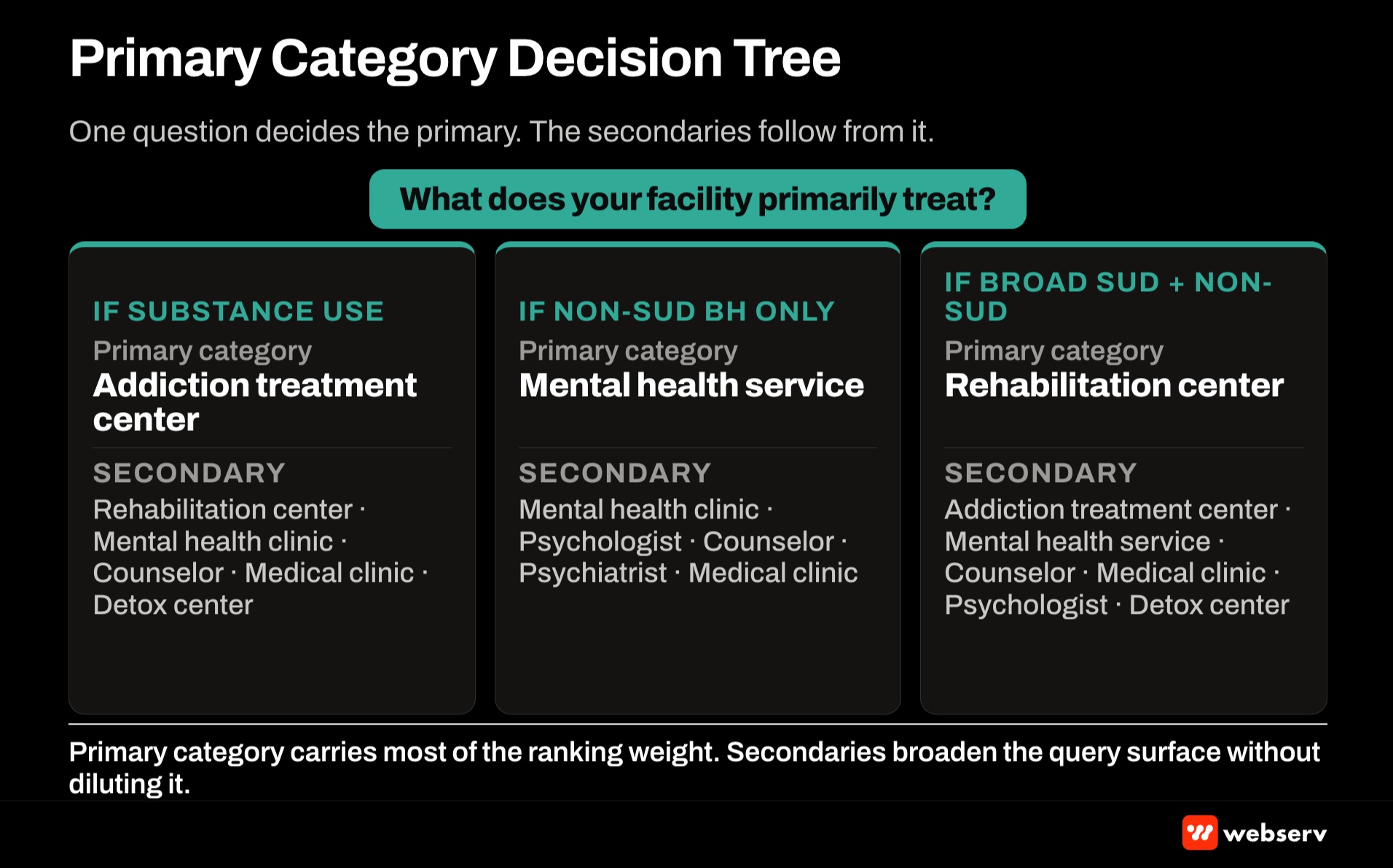
Primary category options for treatment centers. “Addiction treatment center” for facilities primarily treating substance use disorder. “Mental health service” for facilities primarily treating non-SUD BH conditions. “Rehabilitation center” as a broader alternative that captures both SUD and non-SUD contexts.
Most facilities benefit from “Addiction treatment center” as primary because SUD treatment queries dominate BH local search volume. Facilities treating only non-SUD conditions (eating disorders, adolescent mental health without SUD component) benefit from “Mental health service” as primary.
Secondary category options. Up to 9 additional secondary categories per listing. Specific secondary categories that add value for treatment centers: “Alcoholism treatment program,” “Detoxification center,” “Family counselor,” “Psychiatrist,” “Psychologist,” “Mental health clinic,” “Rehabilitation center.”
The specific pattern that works: 4 to 6 secondary categories aligned to the facility’s specific services. Facilities that add all 9 available secondary categories typically dilute the primary category signal without corresponding ranking benefit.
Categories that fail treatment centers. “Doctor” or “Medical clinic” as primary categories produce meaningfully weaker ranking on BH-specific queries because Google’s ranking treats generic medical categories as different from BH-specific categories.
How SoCal Sunrise generated 85 admissions and 2,297% ROI from SEO in 6 months
A ground-up SEO rebuild using the Pathfinder Parents Methodology turned an invisible online presence into a top-ranking admissions engine.
Read the case study →85 admits and 3,152 leads attributed to organic
Photo and video content for GBP
Photo and video content on GBP meaningfully improves conversion from Map Pack impressions. Custom photography generally earns more engagement than stock imagery or minimal photography, and GBP Insights will show you the difference on your own listing.
Required photo categories. Exterior photos showing the facility from the street (2 to 4 photos). Interior photos of common spaces (4 to 8 photos of admissions area, clinical common areas, dining, group rooms). Program-specific photos showing residential rooms, therapy spaces, activity areas (4 to 8 photos).
Admissions team photos showing named team members (2 to 4 photos). Clinical team photos showing named clinicians (2 to 4 photos).
Video content options. Short facility walkthrough video (30 to 90 seconds) uploaded as GBP video content. Program-specific overview videos. Admissions team introduction videos.
Photo update cadence. Fresh photos uploaded quarterly to signal active facility management. Google’s ranking algorithm typically weights listings with recent photo activity higher than listings with only years-old photos.
Stock photo failure pattern. Facilities using stock imagery from Getty or Adobe Stock typically produce meaningfully lower conversion than facilities with custom photography. Family visitors comparing options can recognize stock imagery, and the recognition signals inauthenticity.
The GBP program at a glance
Calls
An optimized GBP turns Map Pack visibility into inbound calls
Reviews
Count, rating, and recency all feed local prominence
Real photos
Custom facility photos beat stock imagery for trust
48-72 hr
Review response SLA that keeps the listing visibly managed
Review management for GBP ranking
Reviews and star ratings are load-bearing GBP ranking signals. Facilities with strong review programs typically outrank facilities with weak review programs for the same geographic queries.
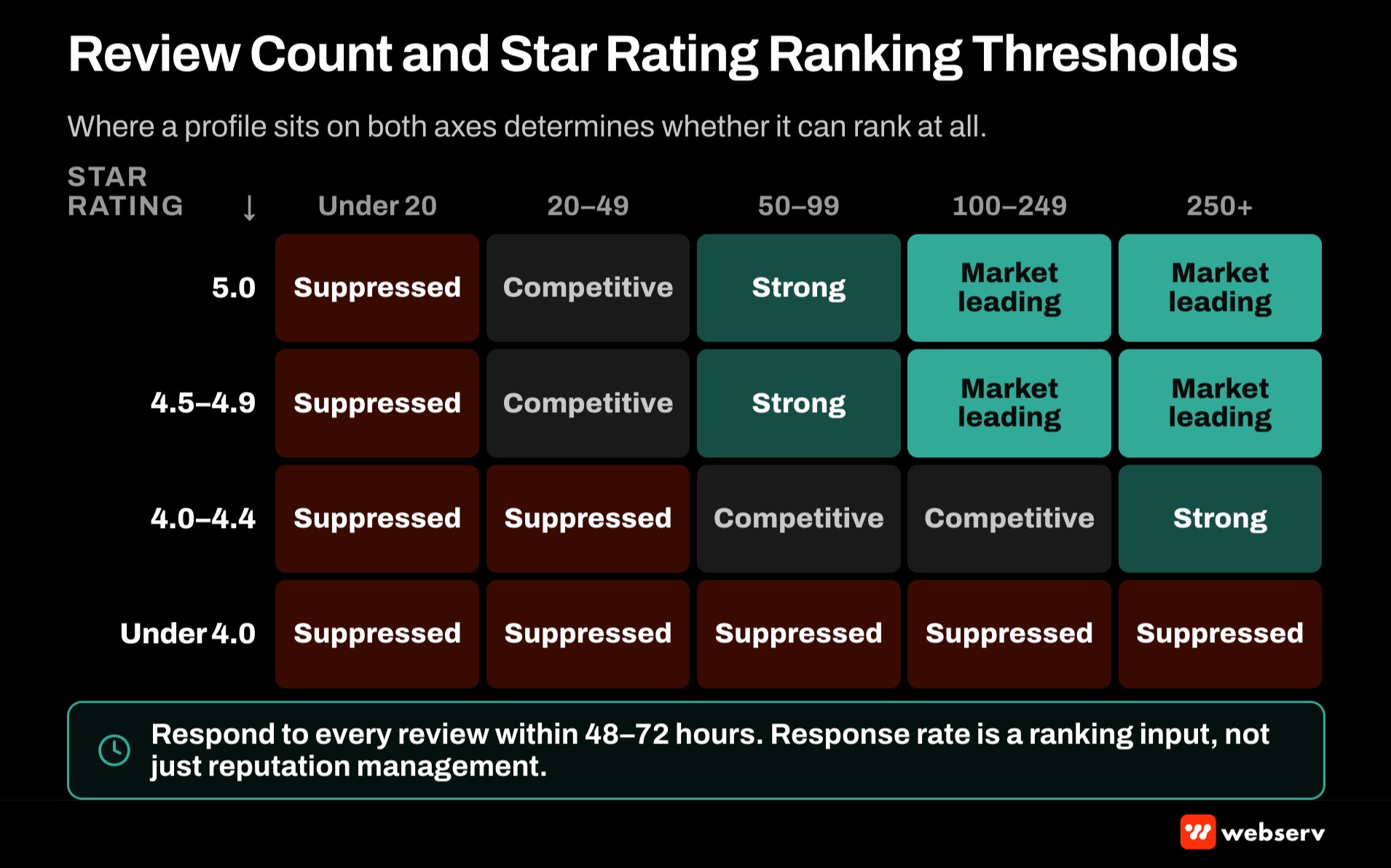
Review count benchmarks. Aim to match or exceed the review volume of the facilities that already hold the Map Pack in your market. Keep reviews arriving steadily, because recency matters as well as volume. Portfolio operators should benchmark review volume market by market rather than against one portfolio-wide target.
Facilities with thin review profiles typically struggle to rank against competitors with much deeper ones, even when other optimization factors are strong.
Star rating benchmarks. 4.5+ average star rating for competitive Map Pack ranking. Below 4.0 average rating typically produces ranking suppression even with high review count.
The specific pattern for maintaining strong star rating: proactive review generation from satisfied families and completed treatment episodes plus disciplined response to negative reviews addressing specific concerns.
Review response cadence and content. 48 to 72 hour SLA for review response on both positive and negative reviews. Response content addresses specific review content rather than generic acknowledgment.
Google’s ranking algorithm rewards actively-managed listings, and review response is the most visible active-management signal for user-facing content.
Review generation patterns. Post-treatment family outreach at specific points in the recovery cycle (30 days post-discharge, 90 days post-discharge). Referral partner review requests for professional relationships. Alumni review requests from graduates of the program.
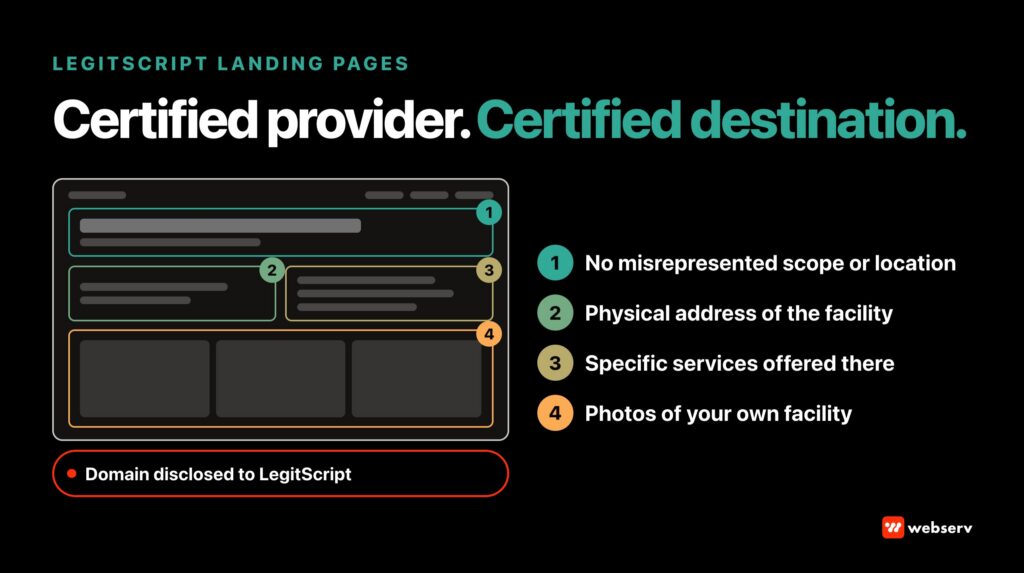
Review-solicitation patterns that violate Google’s terms (offering incentives for reviews, review gating that filters negative reviews before submission) produce meaningful GBP suspension risk. The right pattern: unincentivized, direct requests to families who had positive treatment experiences.
Google Posts cadence for GBP
Google Posts are short content updates that appear on the GBP listing. Regular posts keep the listing active in Google’s ranking evaluation.
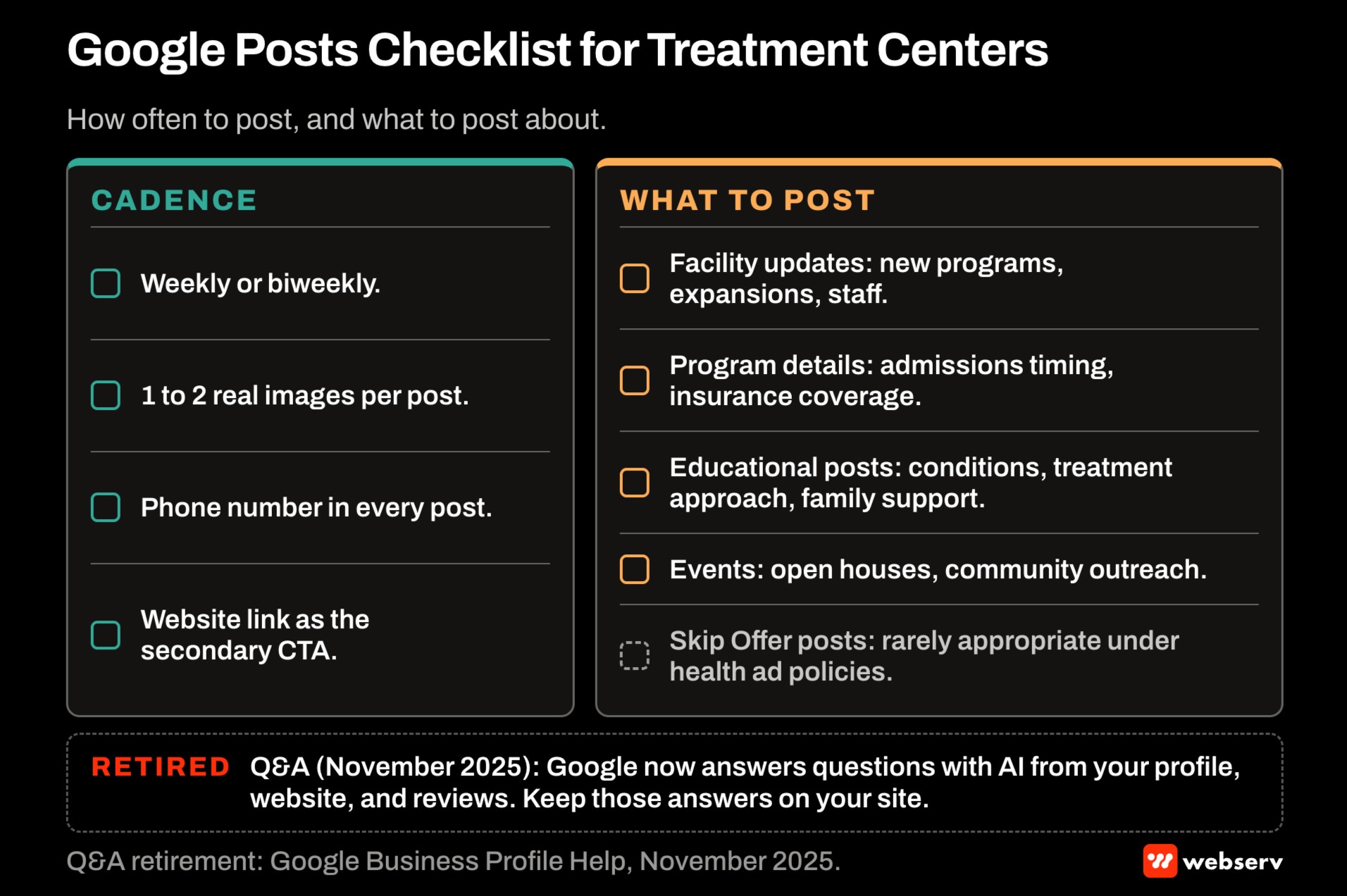
Post cadence. Weekly or biweekly posts covering facility updates, program details, or educational content. Facilities that post monthly or less frequently typically produce weaker GBP ranking than facilities posting weekly.
Post content types. Facility update posts (new program launch, facility expansion, staff additions). Program detail posts (specific program overview, admissions timing, insurance coverage). Educational posts (BH condition information, treatment approach explanation, family support resources).
Event posts (open house events, community outreach). Offer posts are rarely appropriate for BH given advertising policy restrictions.
Post content length. 100 to 300 words per post with 1 to 2 images per post. Longer posts produce stronger active-management signal than shorter posts.
Post CTAs. Phone number in every post reinforcing the phone-first conversion path. Website URL secondary CTA for visitors who want to research further.
DO
- Set primary category to “Addiction treatment center” for SUD-focused facilities or “Mental health service” for non-SUD-focused; add 4-6 aligned secondary categories.
- Upload 20+ custom facility photos across five categories (exterior, interior common, program spaces, admissions team, clinical team) and refresh quarterly.
- Build the review program through unincentivized post-treatment family outreach at consistent points after discharge.
- Publish Google Posts weekly or biweekly at 100-300 words, phone number in every post, image included.
- Answer the common insurance, LOC, admissions, and geographic-service questions on your own site and in the profile’s services and description. Google retired GBP Q&A in November 2025 and now answers those questions with AI from what it can find.
DON’T
- Use “Doctor” or “Medical clinic” as primary category , meaningfully weaker ranking on BH-specific queries than the BH-specific primary categories.
- Rely on stock photography , families recognize it and treat it as a distrust signal.
- Offer incentives for reviews or filter negative reviews before submission , both violate Google’s terms and produce GBP suspension risk.
- Confirm or deny a reviewer’s patient status in review responses , HIPAA-adjacent exposure. Acknowledge the concern generally and invite direct contact.
- Consolidate multiple facility locations into a single portfolio-level GBP , Google suspends non-physical-address listings; use separate GBP per facility.
Q&A moderation for GBP
The Q&A section on GBP appears prominently in the listing and produces content Google surfaces for AI answer surfaces and local search snippets.
Common BH GBP questions. Insurance coverage questions (“Do you accept BCBS?”). Level of care questions (“Do you offer residential treatment?”). Admissions process questions (“How do I admit myself?”). Geographic service questions (“Do you serve patients from a neighboring state?”).
Question response pattern. Facility-authored answers to common questions rather than waiting for third-party users to answer. Facilities that seed the Q&A with facility-authored answers produce cleaner AI answer surface content than facilities that leave Q&A unmoderated.
Response content. Specific factual answers with facility-specific detail. Insurance coverage questions get answered with specific accepted carriers. Admissions process questions get answered with specific facility workflow.
Moderation for user-authored questions. Third-party users occasionally post questions. Facility should respond within 48 to 72 hours with facility-authored answers.
Measurement for GBP performance
The measurement setup for GBP resolves listing performance into specific metrics.
GBP insights native metrics. Impressions (how often the listing appeared in Google searches), views (how often the listing detail page was viewed), phone calls (calls initiated from the listing), direction requests (users requesting directions to the facility), website clicks (users clicking through to the website from the listing).
Cross-reference with call tracking. Calls initiated from GBP should get attributed as GBP source in the call tracking platform. The specific integration: GBP-specific phone number in the listing that routes through call tracking with GBP source attribution.
Search query terms. GBP insights surfaces the specific search queries that produced impressions of the listing. Queries where the listing appeared but did not receive views or calls signal ranking opportunities where optimization could produce visibility gains.
Most in-house teams hit a wall not because they lack knowledge, but because they lack bandwidth.
When you are ready to hand it off, Webserv has spent 9 years executing exactly this for treatment centers nationwide.
Frequently Asked Questions
How long does GBP optimization take to produce ranking results?
Expect weeks to months for meaningful ranking improvement in most competitive metros. Full optimization impact takes longer, as review count builds and the listing shows sustained active management.
Facilities in less competitive metros typically see faster results because the ranking bar is lower. Facilities in highly competitive metros (Los Angeles, Phoenix, Nashville, other BH hotspots) typically take the longest to see meaningful ranking improvement.
The measurement pattern: baseline GBP insights before optimization, then track impressions, views, calls, and direction requests monthly over a long enough window to separate optimization impact from ordinary market fluctuation.
How much does GBP optimization cost for a treatment center?
Initial optimization cost depends on scope and the existing listing state. Ongoing management is a recurring monthly cost per facility.
The initial work covers category audit and correction, custom photography production and upload, review generation setup and initial outreach, and Google Posts and Q&A content development.
Portfolio operators produce meaningful economies of scale. Per-facility GBP management cost typically drops for the second and subsequent facilities.
Should we respond to negative GBP reviews from former patients?
Yes, always, but with specific HIPAA-adjacent handling that does not confirm or deny the reviewer’s status as a patient.
The specific response pattern: acknowledge the concern without confirming the patient relationship, offer to address the concern through direct contact (specific phone number for the admissions or family services team), maintain professional tone regardless of review content.
The specific gotcha: facilities that respond to negative reviews with content that confirms the reviewer’s patient status produce HIPAA-adjacent exposure. The right pattern: acknowledge the concern generally, invite direct contact, and do not reference specific treatment details in the response.
How do we handle GBP when we have multiple facilities in the same metro?
Separate GBP per facility with distinct addresses, distinct phone numbers, and distinct managed listings. Our Local SEO guide covers the specific multi-location approach in detail.
The GBP-specific handling for same-metro portfolios: distinct facility positioning per listing so the listings do not compete against each other for identical searches. Facility A positioned as residential-only, Facility B as outpatient-only, for example.
Portfolios that try to run duplicate GBP listings (multiple listings for the same physical address, or listings without distinct facility characteristics) typically produce GBP suspension issues that Google flags for duplicate or misleading listings.
How does GBP interact with paid Google Ads?
Directly. GBP-linked Google Ads campaigns can use the GBP listing as the landing context rather than the website. Location extensions in Google Ads pull data from the linked GBP listing.
The specific integration: link the GBP listing to the Google Ads account, use location extensions in appropriate campaigns, and track paid-driven calls from location extensions separately from organic-driven calls from Map Pack visibility.
Facilities with strong GBP typically produce better paid Google performance because the GBP signal reinforces the paid attribution. Facilities with weak GBP typically produce paid Google performance below their potential because the paid traffic lacks the organic-visible facility trust.
How does GBP interact with AI answer surface citations?
Directly. GBP data (name, address, hours, categories, reviews, photos, Q&A) feeds into Google’s Knowledge Graph and appears in AI Overviews, Google Maps AI responses, and other AI answer contexts.
The specific pattern: well-managed GBP with rich Q&A content, high review count, and complete category and NAP data typically gets cited in AI answer surfaces for local BH queries. Poorly-managed GBP typically gets omitted from AI answer surfaces or gets cited with outdated information. Our Full AI Search Stack guide covers the AEO layer this connects to.
The AEO content strategy that positions facilities in AI answer surfaces should include GBP optimization as a specific workstream alongside the website content optimization.
What happens if our GBP gets suspended?
Restoration through the Google GBP support process. Suspension typically results from Google flagging the listing for policy violations (duplicate listings, misleading category selection, review manipulation, address issues).
The restoration path: identify the suspension reason through the GBP support ticket, remediate the specific issue, submit a reinstatement request with documentation, and wait for Google’s review.
Facilities that get suspended lose local search visibility for the entire restoration period. The right pattern: preventive compliance with GBP policies rather than restoration after suspension.
Trevor Gage is the Director of Marketing at Webserv, a digital marketing agency for treatment centers.