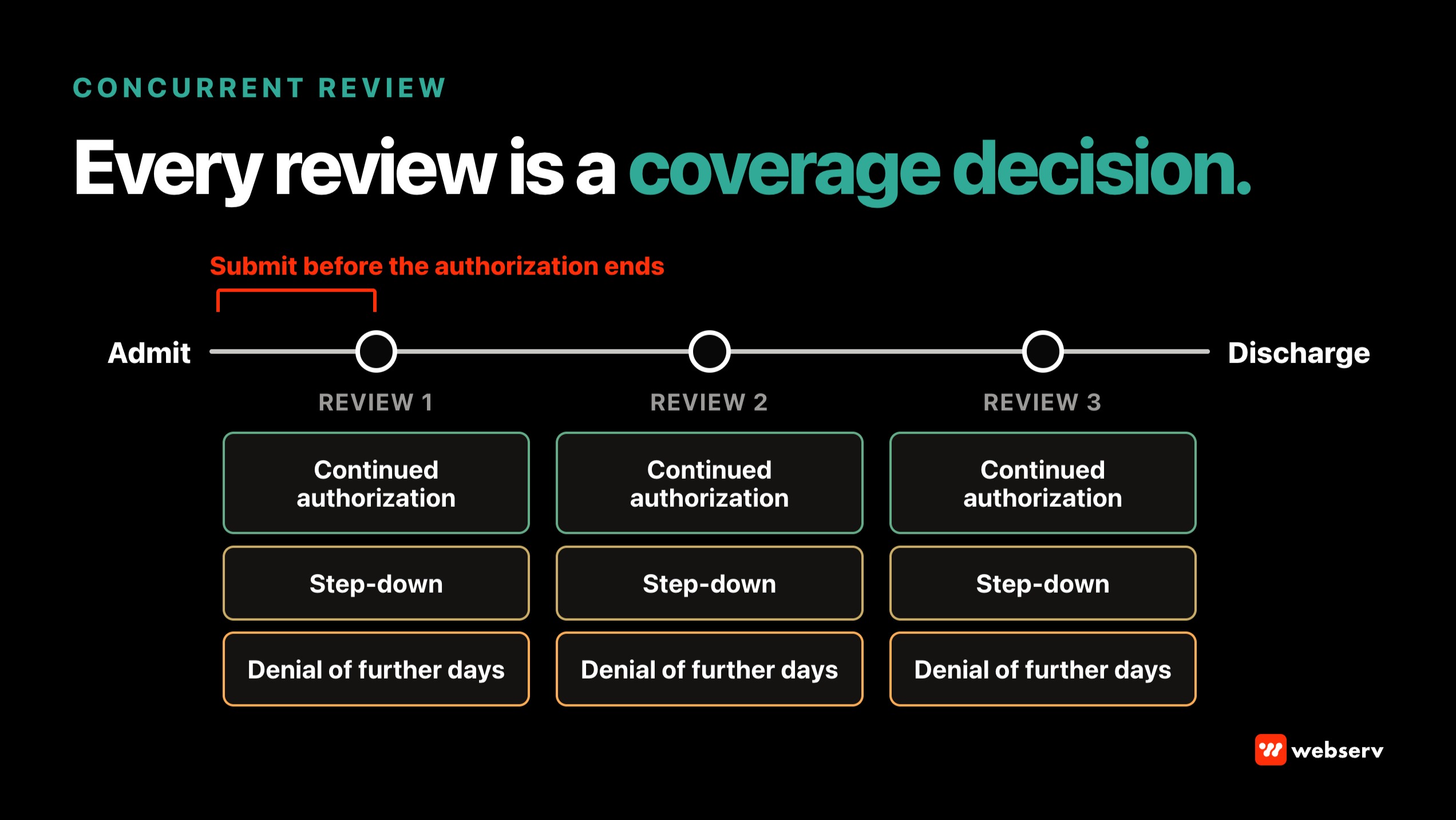
Under the federal ERISA claims regulation, when a plan cuts short a course of treatment it already approved, that reduction counts as an adverse benefit determination. The plan has to give notice early enough for the patient to appeal before the benefit is reduced or ended.
Most treatment centers know concurrent review as a phone call or a portal upload every few days. Fewer treat it as what it is legally: a series of coverage decisions, each with deadlines, criteria, and appeal rights attached.
Continued stay denials are where that difference shows up. A patient who was authorized for residential care gets a step-down decision mid-stay, the facility disagrees, and the question becomes whether the documentation, the timing, and the appeal were ready.
This guide covers the rules behind concurrent review, the criteria reviewers use, how to prepare each review, and what to do when a continued stay is denied. It’s part of the utilization and billing work our revenue cycle team for treatment centers supports, and it goes deeper on one part of our denial management playbook.
Key Takeaways
- Concurrent review is the payer’s ongoing check that a patient still meets criteria for the current level of care. Each review is a coverage decision.
- Under ERISA’s claims rule, reducing or ending approved ongoing treatment is an adverse benefit determination, and urgent requests to extend care must be decided within 24 hours if made at least 24 hours before the authorization ends.
- ACA rules require continued coverage pending the outcome of an internal appeal for concurrent care, and allow expedited external review for continued stays when the patient hasn’t been discharged.
- Plans must share medical necessity criteria with contracting providers on request under federal parity rules. Ask for the criteria the reviewer is using.
- California requires plans to base mental health and substance use determinations on generally accepted standards and nonprofit association criteria, and bars limiting coverage to short-term or acute treatment.
- Prepare each review against the criteria, submit before the authorization ends, and escalate to peer-to-peer review when the reviewer signals a denial.
What concurrent review is
Start with what the review is, in the payer’s terms.
DEFINITION
Concurrent review. The payer’s review, during an ongoing stay or course of treatment, of whether the patient continues to meet criteria for the current level of care. It happens at intervals the payer sets, and each review results in continued authorization, a step-down, or a denial of further days.
Payers set their own processes. Carelon’s provider handbook asks that recertification be completed 24 hours before the current authorization ends, and says reviews focus on symptom severity, member progress, and discharge planning.
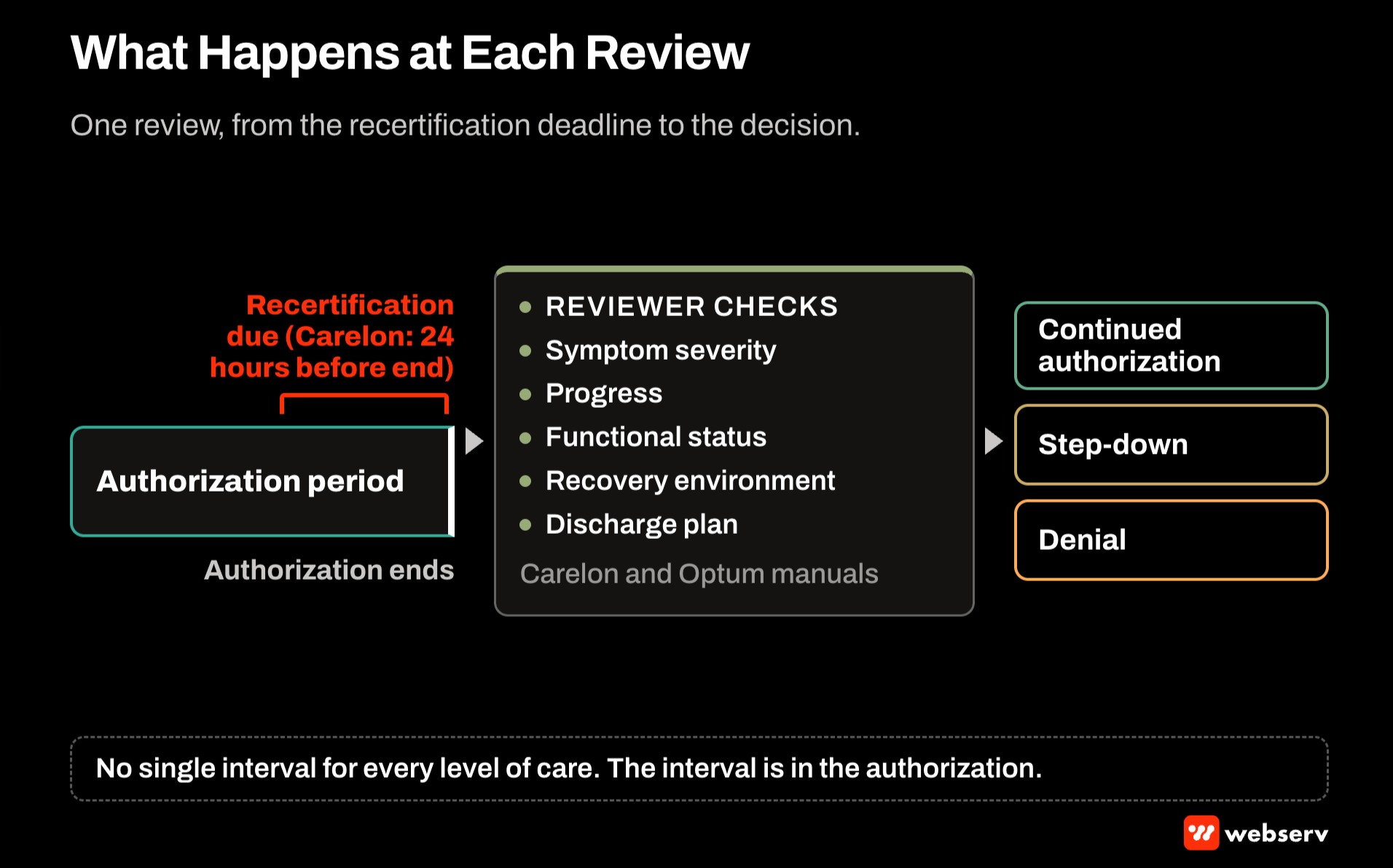
Optum’s national network manual says facilities should be ready to discuss symptom severity, functional status, recovery environment, and discharge plan, and that Optum may require a direct conversation with the attending psychiatrist.
None of these manuals sets a single review interval for every level of care. The interval is in the authorization itself, and missing it is an avoidable way to lose days.
The rules behind continued stay decisions
Concurrent review decisions carry legal protections that many facilities don’t use.
| Plan type | Rule | What it gives the facility |
|---|---|---|
| ERISA | 29 CFR 2560.503-1 | Advance notice before an approved course of treatment is reduced; 24-hour decisions on urgent extension requests; 72-hour urgent appeals; a free copy of the criteria relied on |
| ACA non-grandfathered | 29 CFR 2590.715-2719 | Continued coverage pending the internal appeal; expedited external review within 72 hours for a continued stay |
| Parity | 29 CFR 2590.712(d) | Medical necessity criteria available to contracting providers on request |
| Medicare Advantage | 42 CFR 422.112 and 422.101 | Approval valid while medically necessary; public internal coverage criteria |
ERISA plans. The Department of Labor’s claims procedure regulation says reducing or terminating an approved ongoing course of treatment is an adverse benefit determination, with notice in time to appeal before the reduction. Urgent requests to extend treatment must be decided within 24 hours, if made at least 24 hours before the authorization expires.
The same regulation says urgent care appeals must be decided within 72 hours, and that a claim a treating physician identifies as urgent is treated as urgent. It also gives claimants the right to a free copy of the criteria relied on.
ACA plans. For non-grandfathered plans, the ACA appeals rule requires continued coverage pending the outcome of an appeal for concurrent care. It also provides expedited external review for a continued stay when the patient hasn’t been discharged, with a decision in no more than 72 hours.
Parity. Federal parity rules at 29 CFR 2590.712 require medical necessity criteria to be made available to contracting providers on request. The Departments’ May 2025 statement paused enforcement only of the 2024 rule’s new provisions, and this disclosure requirement predates them.
Medicare Advantage. Federal rules at 42 CFR 422.112 say an approved authorization is valid for as long as medically necessary to avoid disruptions in care. 42 CFR 422.101 limits plans’ internal criteria to cases where Medicare coverage criteria aren’t fully established, and requires those criteria to be public.
COMMON MISTAKE
Treating the step-down call as a conversation, not a decision. The reviewer says the patient no longer meets residential criteria, the facility agrees to “try PHP,” and nobody records it as a denial.
If the facility disagrees clinically, treat it as an adverse determination: ask for the specific criteria and reason, note the time, and start the appeal or peer-to-peer request while the patient is still in care. The protections above depend on acting before the reduction takes effect.
The criteria reviewers use
Every continued stay decision is made against a set of criteria. Knowing which set, and what it asks, is the core of review preparation.
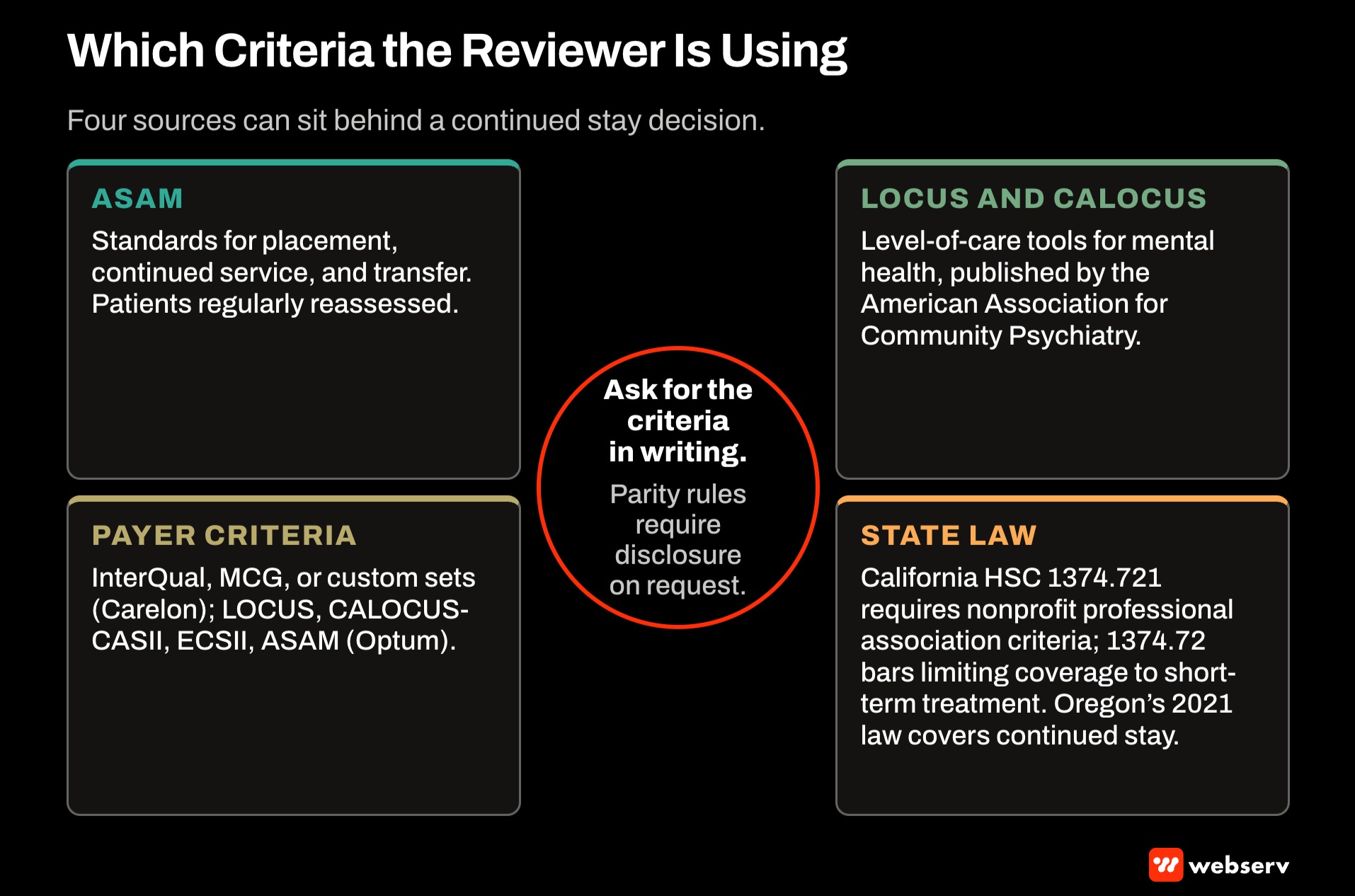
ASAM. ASAM’s overview of its criteria describes them as standards for placement, continued service, and transfer, and says payers and managed care organizations should use the same dimensional admission criteria. ASAM’s fourth edition page says patients are regularly reassessed as they move through treatment.
LOCUS and CALOCUS. The American Association for Community Psychiatry publishes LOCUS as a tool to help clinicians and insurers make level-of-care decisions consistently for mental health care.
Payer and proprietary criteria. Carelon’s handbook lists InterQual, then ASAM for substance use, then MCG or custom criteria. Optum’s manual names LOCUS, CALOCUS-CASII, ECSII, and ASAM.
State requirements. California’s Health and Safety Code section 1374.721 requires determinations based on current generally accepted standards of mental health and substance use care, using criteria from nonprofit professional associations. Section 1374.72 bars limiting coverage to short-term or acute treatment and expressly covers continued stay.
Oregon’s 2021 law applies similar requirements to continued stay reviews and requires insurers to authorize the next higher level of care when the indicated level isn’t available.
Criteria have been litigated too. In the Wit case against United Behavioral Health, a federal district court’s February 2026 remedies order found the insurer’s guidelines significantly and pervasively more restrictive than generally accepted standards. The case has a long appellate history and continues.
How to prepare each review
A continued stay review goes better when the documentation answers the criteria directly, before the reviewer asks.
Know the date
Track each authorization’s end date and the payer’s deadline to submit, such as Carelon’s 24 hours before expiration. Put them on a shared calendar with owners.
Know the criteria
Confirm which criteria set the payer uses for this level of care, and request a copy if you don’t have it.
Reassess by dimension
Update the ASAM or LOCUS assessment since the last review, documenting what has changed and what hasn’t.
Tie the notes to the criteria
Progress notes should show current symptoms, risks, functioning, and response to treatment in terms the criteria use, not generic phrases like “patient is progressing.”
Show the discharge plan
Payers ask about discharge planning. Show the plan, the barriers to it, and what needs to happen before a step-down is safe.
Explain why a lower level won’t work yet
with specifics: recovery environment, recent use or cravings, medical or psychiatric needs, or the lack of an available lower level nearby.
Evernorth’s review guidance lists the kinds of information care managers look for in concurrent reviews, including barriers to discharge and planned follow-up care. It’s a useful template for what to have ready.
When a continued stay is denied
When the reviewer signals a denial, the next hours matter more than the next weeks.
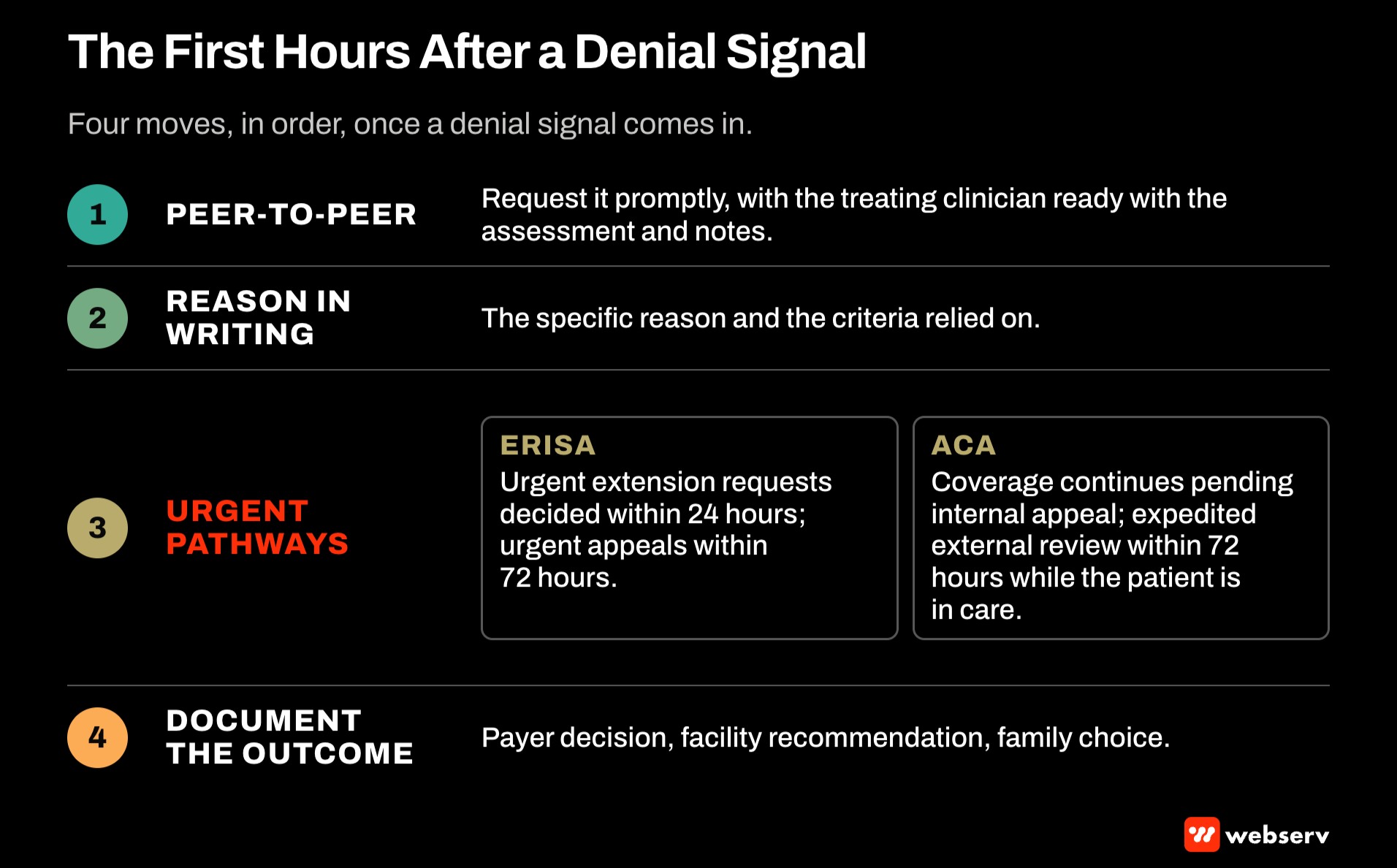
Ask for peer-to-peer review. Optum’s manual says outpatient continued care cases that don’t meet criteria are referred to peer-to-peer review, and Carelon says its peer advisors may elect to speak with the treating provider. Request it promptly, and have the treating clinician ready with the assessment and notes.
Get the reason in writing. Under the ERISA and ACA rules above, the plan must explain the determination and provide the criteria relied on. A specific reason tells you what the appeal has to answer.
Use the urgent pathways. For ERISA plans, the treating physician can identify the claim as urgent. For ACA plans, continued coverage applies pending the internal appeal, and expedited external review is available while the patient is still in care.
Document the outcome for the family. If the patient steps down or discharges, record what the payer decided, what the facility recommended, and what the family chose. That record matters for billing, for later appeals, and for the family’s own decisions.
OPERATOR INSIGHT
Track continued stay denials by payer, level of care, and reason, not just by count. A pattern such as one payer consistently denying the second residential review points to a criteria mismatch or a documentation gap that can be fixed upstream.
Our revenue cycle KPIs guide covers how to fold that tracking into the rest of the revenue cycle reporting.
Where concurrent review fits in the revenue cycle
Concurrent review sits between the admission and the claim. It depends on accurate pre-admission verification and authorization, covered in our guides to pre-admission eligibility verification and VOB vs pre-authorization.
It also feeds billing. The days and level of care authorized have to match what’s billed, including the codes covered in our guide to CPT and HCPCS codes for behavioral health.
Concurrent review is one of the places the reimbursement gap between VOB and admit opens up. For how admissions and billing fit the rest of your marketing, see the complete guide to behavioral health marketing. If you want a second look at how your team handles concurrent review, book an intro meeting.
Frequently Asked Questions
What is concurrent review in behavioral health?
It’s the payer’s review, during an ongoing stay or course of treatment, of whether the patient still meets criteria for the current level of care.
Reviews happen at intervals set in the authorization, and each one results in continued approval, a step-down, or a denial of further days.
Payers publish their processes in provider manuals, including what documentation they expect.
What happens if a payer denies a continued stay?
For ERISA plans, reducing or ending approved ongoing treatment is an adverse benefit determination, and notice must come in time to appeal before the reduction.
Request peer-to-peer review promptly, get the reason and criteria in writing, and use urgent appeal pathways where the treating clinician considers the situation urgent.
For ACA plans, continued coverage applies pending the internal appeal, and expedited external review is available while the patient is still in care.
How fast must a plan decide an urgent request to extend treatment?
Under the ERISA claims regulation, within 24 hours of receipt, if the request is made at least 24 hours before the current authorization expires.
Urgent care appeals must be decided within 72 hours.
Submit extension requests early, since the 24-hour timeline depends on the request arriving before the authorization window closes.
Can we get the criteria the payer is using?
Yes. Federal parity rules require medical necessity criteria to be made available to contracting providers on request, and ERISA’s claims rule entitles claimants to a free copy of the criteria relied on.
Ask for the specific criteria and version used for the level of care under review.
Compare your documentation to those criteria before each review.
Which criteria do payers use for substance use disorder concurrent review?
It varies by payer. Published provider manuals list ASAM for substance use, LOCUS or CALOCUS for mental health, and proprietary sets such as InterQual or MCG.
Some states, including California and Oregon, require criteria from nonprofit professional associations for mental health and substance use determinations.
Check each payer’s manual and your state’s rules, and document to the criteria that apply.
Kyle McHenry is the founder of Revenue Logic, a behavioral health revenue cycle management firm. He has spent 15 years working with treatment center operators on verification, utilization review, and claims management. Webserv partners with Revenue Logic to surface RCM-side guidance for treatment center marketing teams.