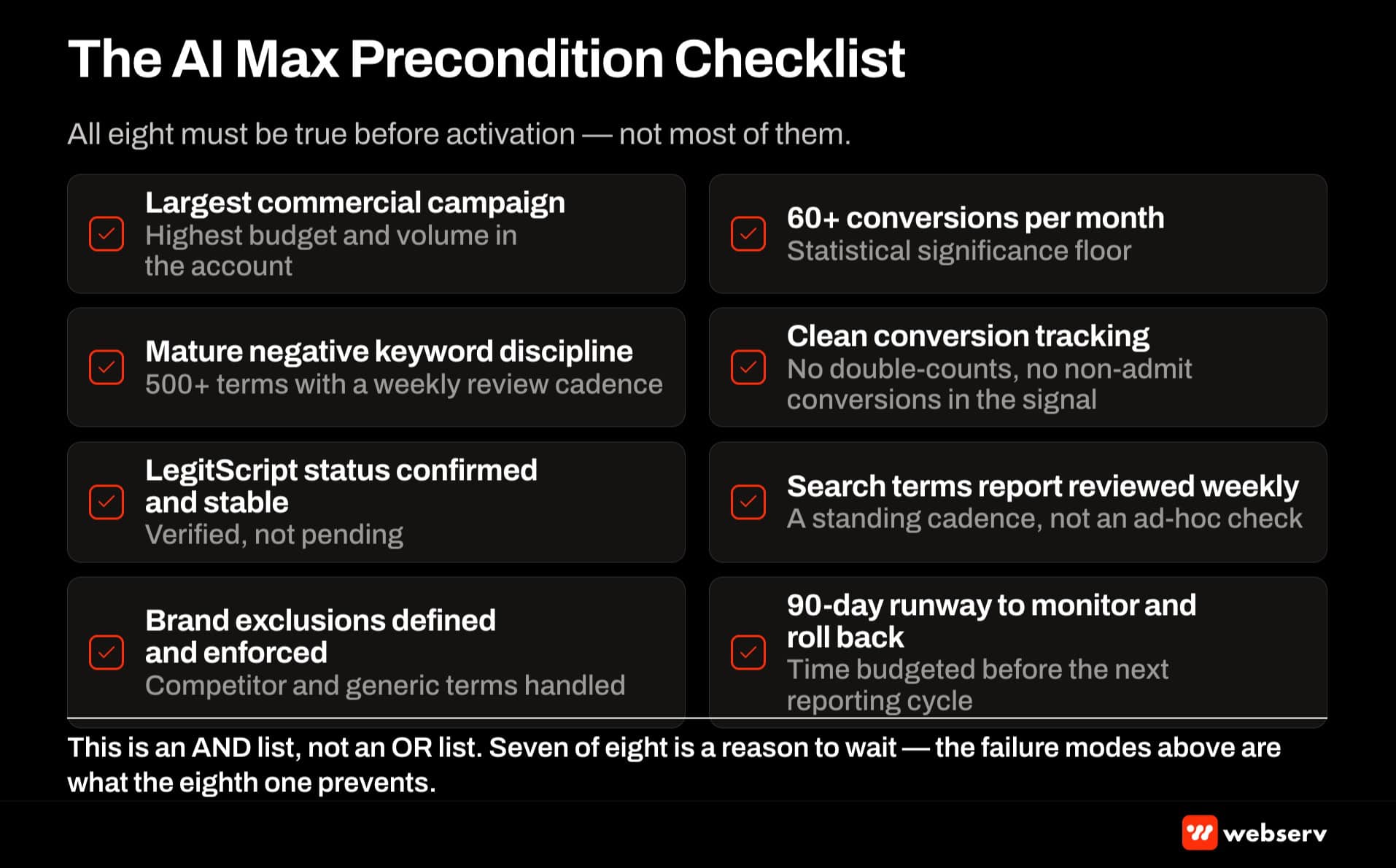
The paid media playbook we run for treatment center clients covers when AI Max is worth activating: the largest commercial campaign, 60+ conversions a month, mature negative keyword discipline, clean conversion tracking. That decision framework lives in our Google Ads campaign structure guide.
This piece is the sister piece to that one. It covers what happens when the preconditions are not met, or when the setup misses one of the specific configuration steps AI Max requires in a compliance-heavy vertical.
The reason it needs its own piece is that AI Max failure is different from Smart Bidding failure or PMax failure. Both of those tend to fail slowly (CPA drift, conversion quality erosion) or fail loudly (account suspension, disapproved ads).
AI Max fails in a specific pattern: it looks like it is working for the first 45 to 60 days because reported CPA holds, and then the admit volume in the CRM disconnects from the reported conversions in the ads platform.
By the time the disconnect is visible in QBR reporting, the negative keyword list is 3,000 terms behind, the asset library has been rotated 4 times, and rebuilding takes 90 to 120 days.
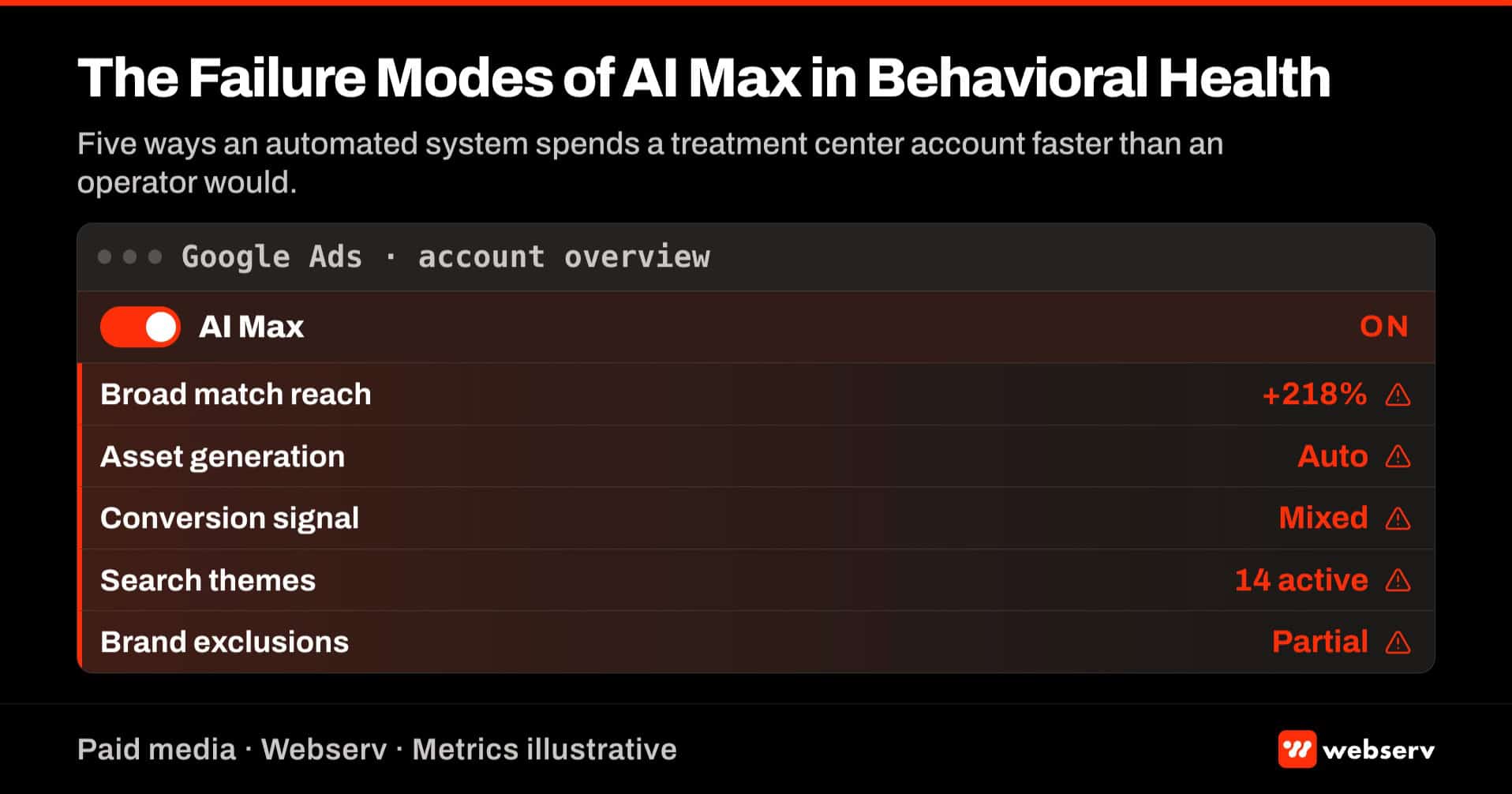
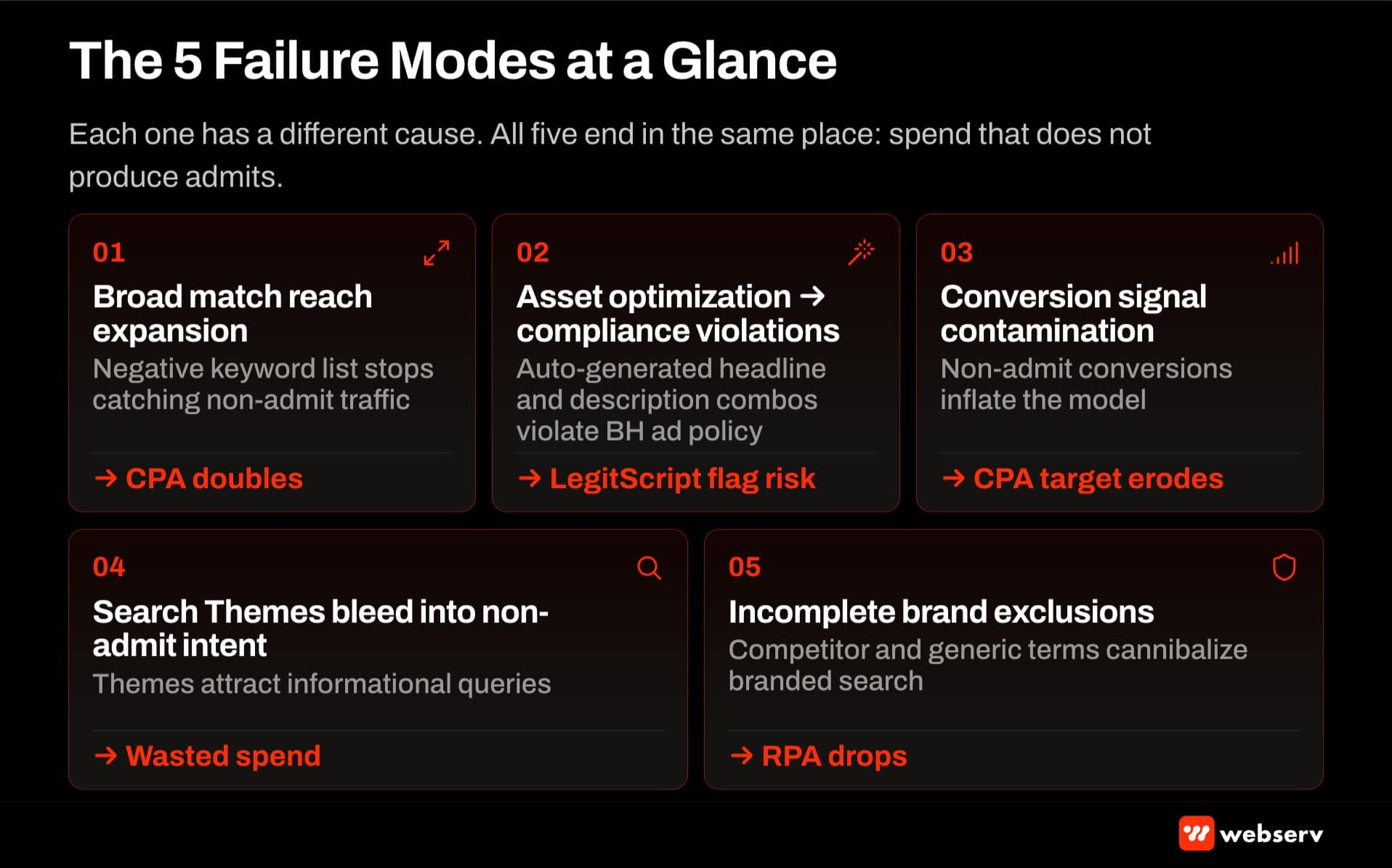
Five specific failure modes produce that pattern in behavioral health accounts. Each has a diagnostic pattern you can catch in the data before the CRM disconnect gets ugly, and each has a specific recovery move that pulls the account back into a defensible state.
This piece walks all five, plus the diagnostic and recovery moves my team runs on the BH portfolios we manage.
Key Takeaways
- AI Max fails in a specific pattern in behavioral health accounts: reported CPA holds for the first 45 to 60 days while admit volume in the CRM drops, and by the time the disconnect surfaces in QBR reporting, the account requires 90 to 120 days of rebuild work. Catching the failure at the diagnostic stage rather than the CRM-signal stage is the difference between a tightening pass and a rebuild.
- Five specific failure modes produce most of the AI Max blow-ups we see in BH. Broad match reach expansion outrunning the negative keyword list, asset optimization generating compliance violations, conversion signal contamination eroding the CPA target, Search Themes bleeding into non-admit intent, and incomplete brand exclusions producing branded search cannibalization.
- Each failure mode has a data-layer diagnostic that surfaces the problem in Google Ads reporting 14 to 21 days before it shows up in CRM admit volume. The specific reports and filters to run for each failure mode are the difference between catching it early and running a rebuild.
- The recovery playbook is different for each failure mode. Pausing AI Max is not always the right first move. Sometimes the fix is tightening negatives without pausing. Sometimes it is a full asset library reset. Sometimes it is a conversion signal audit. The right recovery depends on which failure mode surfaced.
- The single most under-appreciated failure mode is conversion signal contamination. AI Max leans on conversion signal harder than Smart Bidding does, and a treatment center account that treats form-fills and admits as the same conversion event produces a signal AI Max optimizes against the wrong outcome. Value-based conversion tracking is a precondition, not an optimization.
- The rebuild pattern for a fully-blown-up AI Max account runs 90 to 120 days across three phases: 30 days of negative keyword and conversion signal reset, 30 days of Standard Search revalidation, and 30 to 60 days of controlled AI Max re-layering with the specific structural gates in place.
DEFINITION
AI Max failure pattern. The characteristic way Google Ads AI Max for Search degrades a behavioral health account: reported CPA in the ads platform holds or improves for the first 45 to 60 days while admit volume in the CRM disconnects from the reported conversion count. Distinct from Smart Bidding drift (slow, quiet) and PMax blow-up (loud, disapproval-driven).
The pattern compounds silently because the ads platform’s own reporting shows the account working. The disconnect only surfaces when Google Ads conversion counts and CRM admit counts get reconciled — usually at monthly or quarterly QBR reporting. By that point, the negative keyword list is 3,000 terms behind, the asset library has rotated 4 times, and rebuilding takes 90 to 120 days.
ENFORCEMENT WINDOW
Compliance-driven failure modes can produce account-level enforcement within 14 to 30 days. Asset optimization that generates guaranteed-outcome combinations, and reach expansion that serves ads on crisis-language queries, both trigger Google’s behavioral health ad policy enforcement. Repeat violations across a 30-day cycle compound from ad-level disapproval to campaign-level pause to account-level suspension.
Commercial failure modes (signal contamination, Search Themes bleed, brand cannibalization) take longer to surface (45 to 90 days) because reported CPA holds while admit volume erodes. Both classes require the same discipline: audit the account against all five failure modes every 14 days during the first 90 days of any AI Max activation, and monthly after that.
Failure Mode 1: Broad match reach expansion outruns the negative keyword list
AI Max for Search uses broad match and keywordless technology to expand reach into queries the campaign’s declared keywords do not directly cover. That is the mechanism. In a well-hygienic e-commerce account with a mature negative keyword list, the expansion can produce the 14 percent conversion lift Google reports for AI Max.
In behavioral health, the reach expansion picks up queries the negatives do not cover because the vertical produces new query language faster than most negative keyword lists get updated.
Family-perspective queries (“how do I get my son to go to rehab”), crisis-language queries (“what happens when a person overdoses”), and recovery-adjacent queries (“AA meetings near me”) all get surfaced by the reach expansion and served ads.
The compliance risk is not theoretical. A treatment center ad served on a crisis-language query violates Google’s behavioral health ad policy and produces disapprovals at the ad level, and repeat exposure produces account-level enforcement action.
The commercial risk is that even for non-compliance-violating queries, the reach expansion pulls spend onto queries that never convert to admits. A “sober living near me” query is legitimate BH intent but does not match a residential SUD facility’s admission profile.
Diagnostic pattern
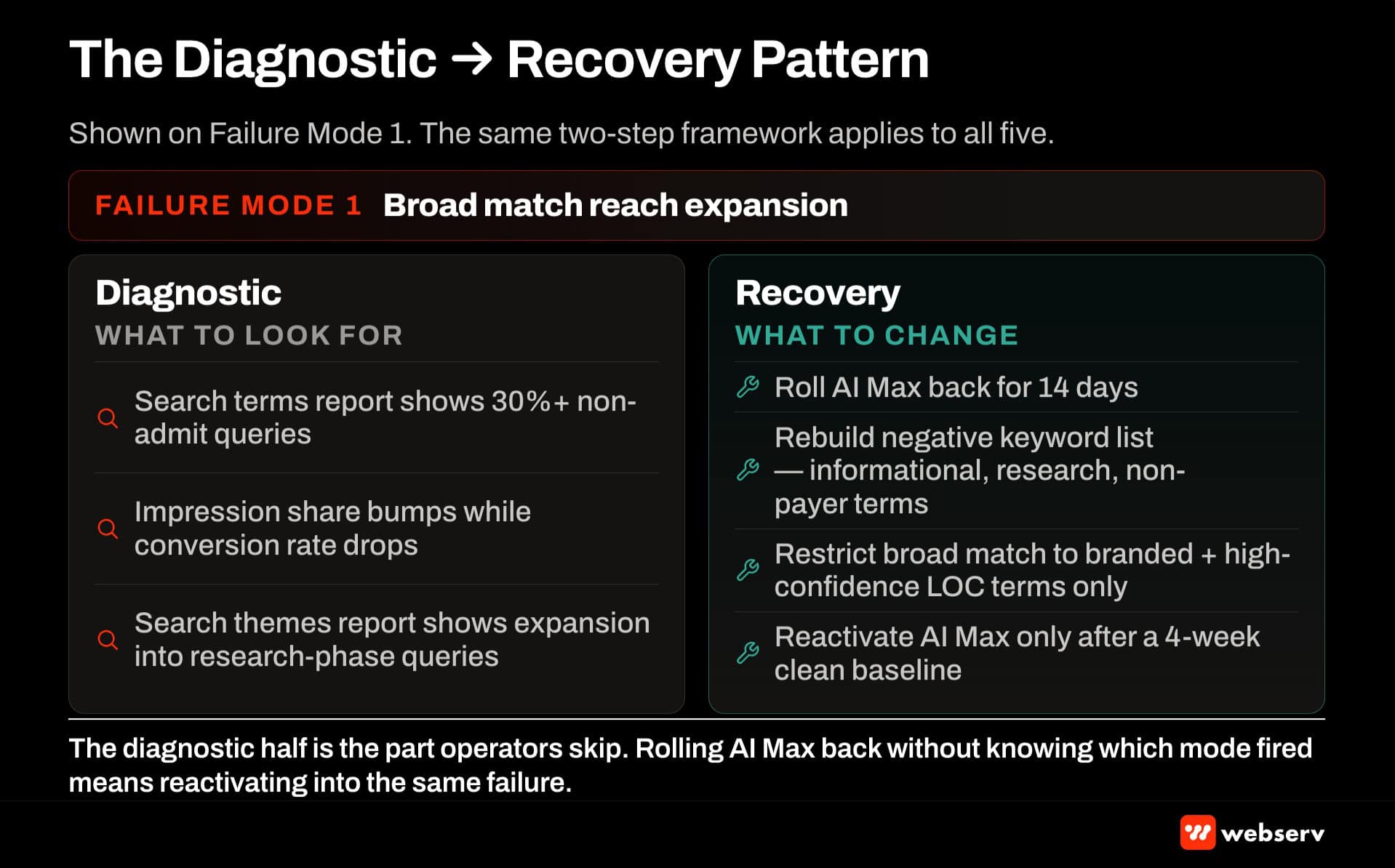
In Google Ads, filter the Search Terms report to AI Max campaigns and sort by cost descending. Look for queries that do not appear in the original ad group’s declared keyword list. If more than 30 percent of AI Max spend is on queries that do not appear in the declared list, and if any of those queries include family-perspective language, crisis language, or recovery-adjacent language, reach expansion is outrunning the negatives.
Recovery move
Do not pause AI Max as the first move. First, add the specific queries surfaced in the report to the negative keyword list at the campaign or account level. Then rerun the Search Terms report weekly for 4 weeks, adding new terms to the negatives each week. If after 4 weeks the negative list has stabilized and reach expansion is contained, AI Max stays active. Our negative keyword guide covers the base list every BH campaign should start with before AI Max activation.
Failure Mode 2: Asset optimization generates compliance violations
AI Max includes asset optimization: the system generates ad variations by mixing and matching from the asset library (headlines, descriptions, sitelinks). Each individual asset can pass Google’s BH advertising policy and LegitScript compliance review on its own. Combinations can violate.
The specific pattern: an asset saying “24/7 admissions” combines with an asset saying “we accept most insurance” and an asset saying “get help today,” producing an ad variant that reads as guaranteed same-day admission.
Guaranteed outcome claims violate LegitScript’s addiction treatment advertising standards. The individual assets pass; the combination does not.
Because AI Max rotates asset combinations continuously, the specific variant that violates may run for 6 to 48 hours before Google’s ad review catches it and disapproves. During that window, the ad has already served and produced clicks. Repeated violations across a 30-day cycle produce escalating enforcement action.
Diagnostic pattern
In Google Ads, pull the Assets report at the campaign level. Sort by disapproval count. If any ad variant in the campaign has been disapproved in the last 14 days, and the disapproval reason is behavioral health policy or LegitScript-related, the asset library is producing compliance-risk combinations. The disapproval reason field surfaces which combination triggered enforcement.
Recovery move
Do not pause AI Max. Instead, audit the asset library and remove or rewrite any asset that could combine with another to produce a guaranteed-outcome claim, a specific-recovery-rate claim, or a comparative-superiority claim (“best,” “leading,” “premier”). Our compliant ad headlines guide walks the specific language rules. Then let AI Max continue rotating assets from the cleaned library. Confirm no further disapprovals across the next 30 days.
Failure Mode 3: Conversion signal contamination erodes the CPA target
AI Max leans on conversion signal significantly more than Standard Search with Smart Bidding does. The reach expansion is driven by the model’s inference about which query patterns produce conversions, and that inference is only as good as the conversion signal the model is fed.
Treatment center accounts that treat form-fill submissions, call-center pickups, and completed admissions as the same conversion event feed AI Max a signal that optimizes against the wrong outcome.
A form-fill from a family member researching options 8 weeks before admission has different economic value than an admit-day-arrival, but if both are counted as one conversion, AI Max cannot distinguish between them.
The specific pattern in the data: CPA reported in Google Ads holds or improves, but admits reported in the CRM drop. The gap between the two reports is the signal contamination.
Because AI Max is optimizing hard against the reported conversions, and the reported conversions include a growing share of low-value form-fills, the system pursues cheaper form-fills at the expense of high-value admit inquiries.
Diagnostic pattern
Pull the trailing 90-day conversion count from Google Ads and the trailing 90-day admit count from the CRM. Calculate the ratio each month. If the ratio (admits per reported conversion) is declining month over month while reported CPA is flat or improving, conversion signal contamination is active.
Recovery move
This is the highest-ROI recovery move across all five failure modes. Separate the conversion events by value tier. Admit-day-arrival is Tier 1 (highest value). VOB-completed inquiry is Tier 2. Call-center-scheduled admission is Tier 3. Form-fill is Tier 4. Feed AI Max Tier 1 and Tier 2 only as primary conversions. Move Tier 3 and Tier 4 to secondary conversion action status. Our Meta CAPI HIPAA piece and Google conversion tracking guide both cover the server-side transmission architecture the Tier 1/Tier 2 signal requires.
Signal quality is more important than signal volume. An account with 30 clean admit-day conversions per month outperforms an account with 300 form-fill conversions per month.
The AI Max failure surface at a glance
5
Failure modes producing most AI Max blow-ups in BH accounts
14-21 d
Diagnostic lead time before CRM signal disconnect surfaces
60+/mo
Tier 1 conversions on largest campaign — activation floor
90-120 d
Full rebuild timeline across 3 phases (reset, revalidation, re-layer)
Failure Mode 4: Search Themes bleed into non-admit intent
AI Max’s Search Themes feature lets advertisers signal intent categories to the system without declaring specific keywords. The intent categories then inform the model’s reach expansion. In BH, the Search Themes that operators pick often bleed into query categories that do not produce admits.
A residential SUD facility that adds “recovery” as a Search Theme finds AI Max serving ads on “sober living,” “AA meetings,” “recovery support groups,” and “aftercare” queries.
Each of those is legitimate BH intent, but none of them match a residential SUD admission profile. The Themes feature broadcasts intent categories broadly enough that the model chases queries that do not convert.
The specific pattern: a well-defined ad group targeting “residential rehab in [city]” starts spending on “sober living near me” queries under AI Max. Reported clicks look normal. Reported conversions drop because the query does not match the ad’s admission intent.
Diagnostic pattern
In the Search Terms report filtered to AI Max campaigns, group queries by intent category. If more than 20 percent of impressions are on intent categories different from the declared ad group focus, Search Themes are bleeding.
Recovery move
Remove Search Themes entirely and let the account run on declared keywords + broad match expansion without the Theme signal. Search Themes are the most intent-diffusing feature of AI Max in BH; the benefit does not exceed the cost of the intent bleed for most residential SUD, PHP, and IOP campaigns. Our PMax for BH piece covers the parallel Themes-vs-Search-Terms trade-off on the PMax side.
Failure Mode 5: Incomplete brand exclusions produce branded search cannibalization
AI Max’s reach expansion picks up branded queries: the facility’s own brand terms, competitor brand terms, and adjacent brand-adjacent queries (“hazelden alternatives,” “compare betty ford”). Without proper brand exclusions configured on the AI Max campaign, the branded traffic gets absorbed into the AI Max campaign and out of the branded search campaign.
Two problems result. First, the AI Max campaign cannibalizes traffic that would have converted anyway on the branded campaign (or organically on the facility’s own site). The reported AI Max lift includes conversions that would have happened without the campaign, inflating the perceived ROI.
Second, competitor brand queries served ads that do not comply with Google’s competitor brand policy in BH produce policy enforcement actions.
The specific pattern: AI Max reported CPA looks strong. Branded campaign volume drops in the same period. Total account conversion volume is flat or slightly down. The branded traffic just shifted from the branded campaign to the AI Max campaign, producing no net gain.
Diagnostic pattern
Compare the trailing 60-day branded campaign impressions and clicks to the 60 days prior. If branded campaign volume dropped 15 percent or more in the AI Max activation period, and AI Max campaign impressions include branded terms in the Search Terms report, cannibalization is active.
Recovery move
Add the facility’s own brand terms, all known variations, and the top 10 to 20 competitor brand terms to the AI Max campaign’s brand exclusion list. Rerun the Search Terms report 30 days later to confirm the branded terms no longer surface under AI Max. Restore the branded campaign’s expected volume and confirm total account conversion volume increases.
DO
- Reconcile Google Ads reported conversions against CRM admits every 14 days during the first 90 days of AI Max activation — the disconnect surfaces there before it surfaces in QBR.
- Feed AI Max value-tiered conversion signal (admit-day-arrival Tier 1, VOB-completed Tier 2) with server-side transmission — signal quality beats signal volume.
- Audit assets before combination — remove any headline or description that could combine into a guaranteed-outcome or comparative-superiority claim.
- Add facility brand terms + top 10-20 competitor brand terms to the AI Max campaign’s brand exclusion list before activation — cannibalization is the invisible failure mode.
- Prove the corrected structure on Standard Search + Smart Bidding for 30 days before re-layering AI Max after a rebuild — Standard Search is the revalidation gate.
DON’T
- Activate AI Max on multiple campaigns simultaneously — largest commercial campaign first, prove 90 days, then extend. Parallel activation compounds every failure mode.
- Count form-fill submissions as primary conversions — signal contamination is the single most under-appreciated failure mode.
- Layer Search Themes on a residential SUD account — Themes bleed into sober living, AA meetings, and aftercare intent that does not match admission profile.
- Reflexively pause AI Max at the first sign of trouble — most failure modes recover with tightening, not pausing. Diagnose which mode is active first.
- Activate AI Max as a shortcut for account structure work you have not done — the preconditions are the point, not the feature.
The 90 to 120 day rebuild pattern
When multiple failure modes have compounded and the account requires a full rebuild, the pattern that works runs 90 to 120 days across three phases.
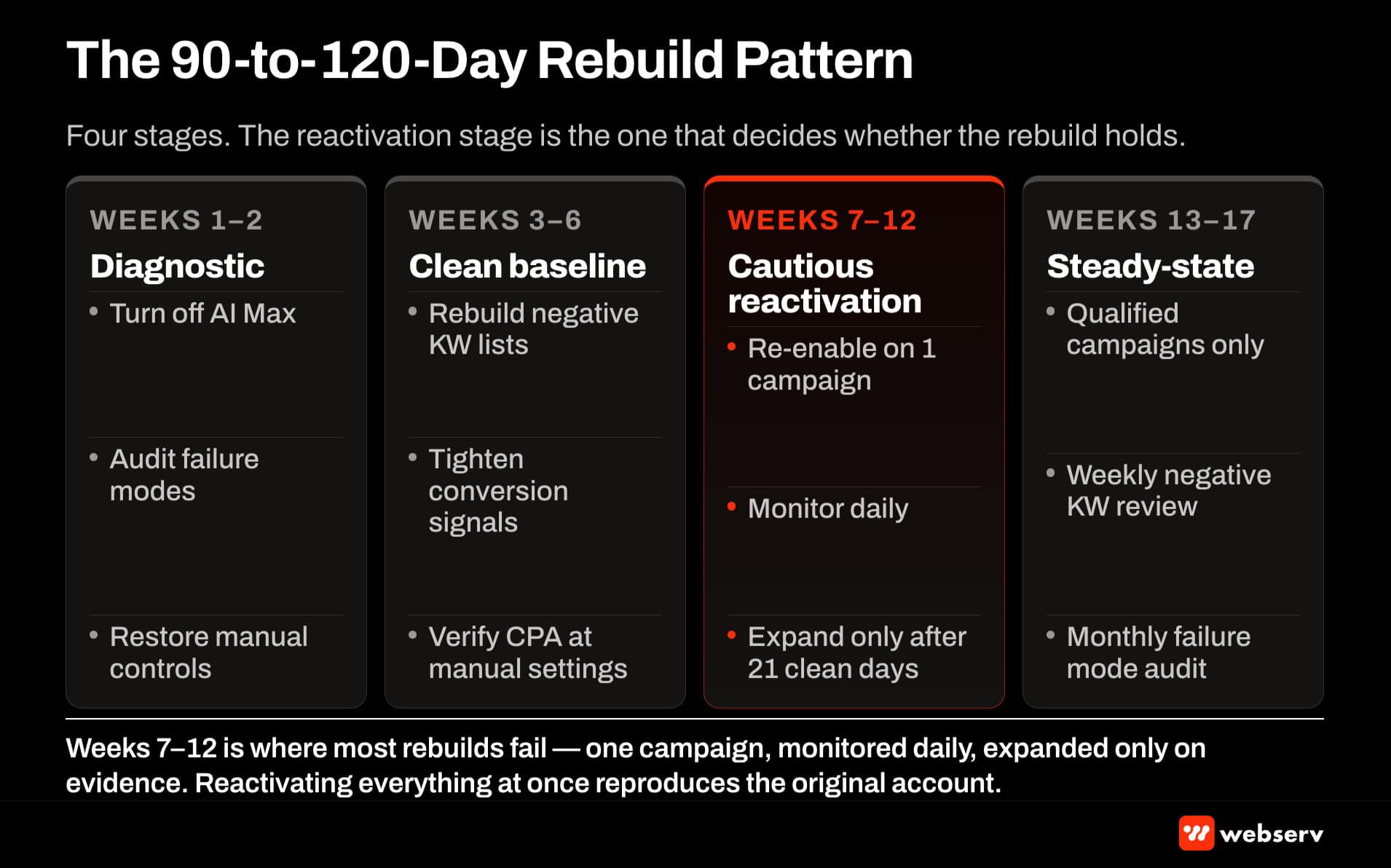
Phase 1 (Days 1-30): Reset. Pause AI Max. Audit conversion tracking and separate conversion events by value tier. Rebuild the negative keyword list from the ground up using the Search Terms reports from the failure period. Clean the asset library of any variant that could combine into a compliance violation. Add brand exclusions.
Phase 2 (Days 31-60): Revalidation on Standard Search. Run the corrected structure on Standard Search with Smart Bidding for 30 days. Confirm the corrected conversion signal, negative keyword list, and asset library produce the expected CPA and admit volume without AI Max activation. This phase proves the structural fixes hold before AI Max gets re-layered.
Phase 3 (Days 61-120): Controlled AI Max re-layering. Reactivate AI Max on the largest commercial campaign only, with the corrected structure in place. Monitor the Search Terms report weekly for the first 4 weeks, then every 2 weeks through Day 120. Confirm reported CPA and CRM admit volume move together.
The rebuild pattern assumes the account has the underlying data quality to support AI Max in the first place.
Accounts that do not meet the 60+ conversions per month threshold on the largest campaign, or accounts running on form-fill-only conversion tracking, should not activate AI Max at all until the structural preconditions are met. Our PMax piece covers the parallel precondition frame for the PMax layer.
Frequently Asked Questions
How quickly can AI Max cause account-level damage in a behavioral health treatment center?
The failure mode timeline varies by which specific failure is active, but the common pattern is that meaningful damage compounds over 45 to 90 days.
Compliance-related failure modes (Failure Mode 2, asset optimization; Failure Mode 1, reach expansion into disallowed queries) can produce account enforcement actions within 14 to 30 days if the frequency of violations crosses Google’s internal thresholds.
Commercial failure modes (Failure Mode 3, conversion signal contamination; Failure Mode 4, Search Themes bleed; Failure Mode 5, brand cannibalization) take longer to surface (typically 45 to 90 days) because reported CPA holds while admit volume in the CRM erodes. The general operating rule: audit the account against all five failure modes every 14 days during the first 90 days of any AI Max activation, and monthly after that.
Can we run AI Max on multiple campaigns at once?
Yes, but only after the largest commercial campaign has run cleanly for 90 days. Layering AI Max on additional campaigns before the first campaign has proven the structural preconditions hold multiplies the failure mode risk without adding proportional lift.
For portfolio operators with multiple locations, the correct sequencing is largest commercial campaign first, prove it works for 90 days, then extend to the second-largest campaign, and so on.
Multi-facility operators trying to activate AI Max across all facility campaigns simultaneously produce the worst version of the failure mode pattern because the negative keyword list and conversion signal audit have to be done for each campaign in parallel, and the operational load usually causes at least one campaign to skip the required audit cycle.
Does the failure mode pattern differ by level of care?
The specific queries that surface reach-expansion problems differ by LOC. Residential SUD sees the most sober living, aftercare, and recovery meeting bleed. Outpatient PHP and IOP see more therapy near me and counseling bleed. Detox campaigns see the most crisis-language bleed and require the most aggressive negative keyword posture. Our negative keyword guide walks the base list every campaign should start with.
The five failure modes themselves apply across LOCs. The specific negative keyword additions and Search Themes configurations differ.
Our Google Ads campaign structure guide covers the LOC-specific structural gates that produce a clean AI Max activation.
How does AI Max failure interact with PMax failure?
The two campaign types fail in different ways but for related reasons. Both depend on conversion signal quality. Both suffer from reach expansion into non-target intent. Both require mature account hygiene to work in BH.
Accounts running both AI Max and PMax simultaneously that see performance degradation should audit conversion tracking first (because both campaigns share the signal), then diagnose which specific campaign is producing the degradation before pausing either. Pausing both simultaneously is over-correction and obscures which campaign was the source of the problem.
Our PMax for Behavioral Health piece walks the specific PMax failure modes and the sequencing of audit steps when both AI Max and PMax are active.
What conversion signal quality is required before activating AI Max?
The floor: value-based conversion tracking with at least two tiers (admit-day-arrival as the highest tier, VOB-completed inquiry as the secondary tier), Meta Conversions API or click-based Google Ads conversions running server-side (enhanced conversions off), no form-fill-only conversion events counted as primary conversions, and 60+ Tier 1 conversions per month on the largest campaign.
Our Meta Conversions API HIPAA piece covers the server-side tracking layer that AI Max requires for defensible signal quality. Without that layer, AI Max is optimizing against a signal that includes bots, click-fraud, and low-intent form-fills, and the failure modes compound faster.
The Google Ads conversion tracking guide covers the platform-specific Google setup.
Should we ever run AI Max in a compliance-heavy vertical like behavioral health?
Yes, when the preconditions are met and the operational discipline exists to monitor the five failure modes.
The specific facilities that produce sustained lift from AI Max are the ones with 60+ Tier 1 conversions per month on the largest campaign, value-based conversion tracking with server-side signal, disciplined negative keyword list maintenance, and an in-house or agency team running the biweekly failure mode audit.
The specific facilities that produce blow-ups are the ones that activate AI Max as a shortcut for account structure work they have not done, feed the system form-fill-only conversion signal, or skip the biweekly audit cycle. The technology is not the problem. The preconditions are the problem.
Keaton Nalle is the Director of Paid Admissions at Webserv, a digital marketing agency for treatment centers.