I get the same call from a different treatment center executive almost every week. The proposal in front of them quotes anywhere from $2,500 to $25,000 a month for SEO. They want to know two things. Is the number reasonable. And will the work actually move admissions.
The honest answer is that the proposal could be perfectly fair or wildly out of pocket. It depends on what’s inside the retainer, what the agency is doing every month, and whether your facility has the operational capacity to convert the traffic SEO produces.
We work on this every day inside Webserv’s SEO program for treatment centers, and the cost question almost never has a clean dollar answer. It has a framework.
This guide breaks the framework into five questions every treatment center executive should answer before signing.
Real 2026 price ranges. What each tier buys you. The red flags that signal a budget-burner. The ROI math. And the situations where SEO is honestly the wrong investment.
Key Takeaways
- 2026 SEO retainers for treatment centers run roughly $2,500 to $5,000 per month for single-location facilities, $6,000 to $15,000 for regional multi-location providers, and $15,000 to $50,000+ for national networks. Anything under $2,000 is usually a content mill, not SEO.
- Each tier buys fundamentally different work, not just more of the same. Entry-level retainers cover technical cleanup and local optimization. Mid-tier adds content depth and link acquisition. Enterprise tier funds national keyword strategy, digital PR, and attribution infrastructure.
- The ROI math depends on your LTV per admission. Admission value is high in behavioral health, which makes the typical SEO payback period 6 to 12 months for centers that already have a working sales process.
- SEO is the wrong call if your site converts under 1 percent, your phone team can’t return inquiries inside an hour, your facility plans to sell inside 12 months, or your operational capacity is already maxed out.
- Post-Google-I/O 2026, organic visibility increasingly means AI Mode and AI Overviews citations, not just blue-link rankings. Your SEO investment should be tracked against AI citation share as a new top-line KPI.
Why Rehab SEO Pricing Looks Different From Other Industries
Treatment center SEO sits inside Google’s strictest evaluation category: Your Money or Your Life, or YMYL. Google’s Search Quality Rater Guidelines apply the highest possible content-quality bar to pages that could affect someone’s health, financial stability, or safety. Rehab and behavioral health hit all three.
That single fact is responsible for most of the price spread between rehab SEO and SEO for a roofing company or a SaaS startup. A roofer can publish a 600-word “how to spot storm damage” post written by a content writer in 90 minutes.
A treatment center publishing “how to know if you have alcohol use disorder” needs clinical review, accurate citation of medical sources, an author bio that signals credentialed expertise, and content depth that satisfies an algorithmically suspicious bar.
The labor that goes into producing one credible rehab page is multiple times what goes into producing one credible roofing page. That labor cost shows up in the retainer.
The compliance layer compounds the cost. HIPAA-safe analytics, BAA-covered call tracking, no remarketing on patient lists, careful Meta Conversions API setup, no PHI in URL parameters: these are constraints a roofing agency never thinks about, and they bake real engineering hours into every program.
Our pre-launch SEO checklist for behavioral health websites walks through the technical foundation that has to be in place before any content investment makes sense.
The Actual Pricing Ranges in 2026
$2.5K-$5K
Entry-level monthly retainer for a single-location rehab competing in one DMA. Cadence: 2 to 4 pages per month.
$5K-$12K
Mid-market retainer for regional operators competing across two to four DMAs with a mixed service line and location page set.
$12K-$25K+
Enterprise retainer for multi-state operators running full editorial, technical SEO, AEO, and paid integration under one scope.
Under $2.5K
The danger floor. Anything below this tier funds either offshored content or link-scheme tactics — the two patterns that trigger manual actions.
Across the treatment center SEO market in 2026, retainer pricing falls into three reasonably consistent tiers. The boundaries are not arbitrary. They map to what the work actually requires at each scale.
 Infographic titled ‘2026 rehab SEO cost tiers’.
Local single-location: $2,500 to $5,000 per month. This tier serves a facility competing in one DMA with a defined service area. The work centers on Google Business Profile optimization, local citations, technical site health, and a modest content cadence of two to four pages per month.
Regional multi-location: $6,000 to $15,000 per month. A treatment center group with three to ten facilities sits here, as does a single facility competing in a saturated market like Los Angeles, Denver, South Florida, or Phoenix.
The retainer funds location-specific landing pages, expanded content production, early-stage link acquisition, and some digital PR.
National network: $15,000 to $50,000+ per month. Enterprise programs for multi-state operators with 10+ facilities, or premium single brands competing for high-volume national keywords. Includes deep content ecosystems, ongoing digital PR campaigns, CRO testing, attribution infrastructure, and dedicated account leadership.
Project-based pricing also exists, mostly for technical SEO audits ($5,000 to $20,000), site migrations ($10,000 to $50,000), and structured-data implementations ($3,000 to $15,000). These usually sit on top of a retainer or fund a defined cleanup before retainer work begins.
Hourly pricing is uncommon in the rehab SEO space and is generally a yellow flag. Treatment center SEO is a long-arc investment, and hourly billing tends to reward agency activity over client outcomes.
What Each Tier Actually Buys You
The difference between a $3,500/mo retainer and a $12,000/mo retainer is not three times the blog posts. It’s a different scope of work.
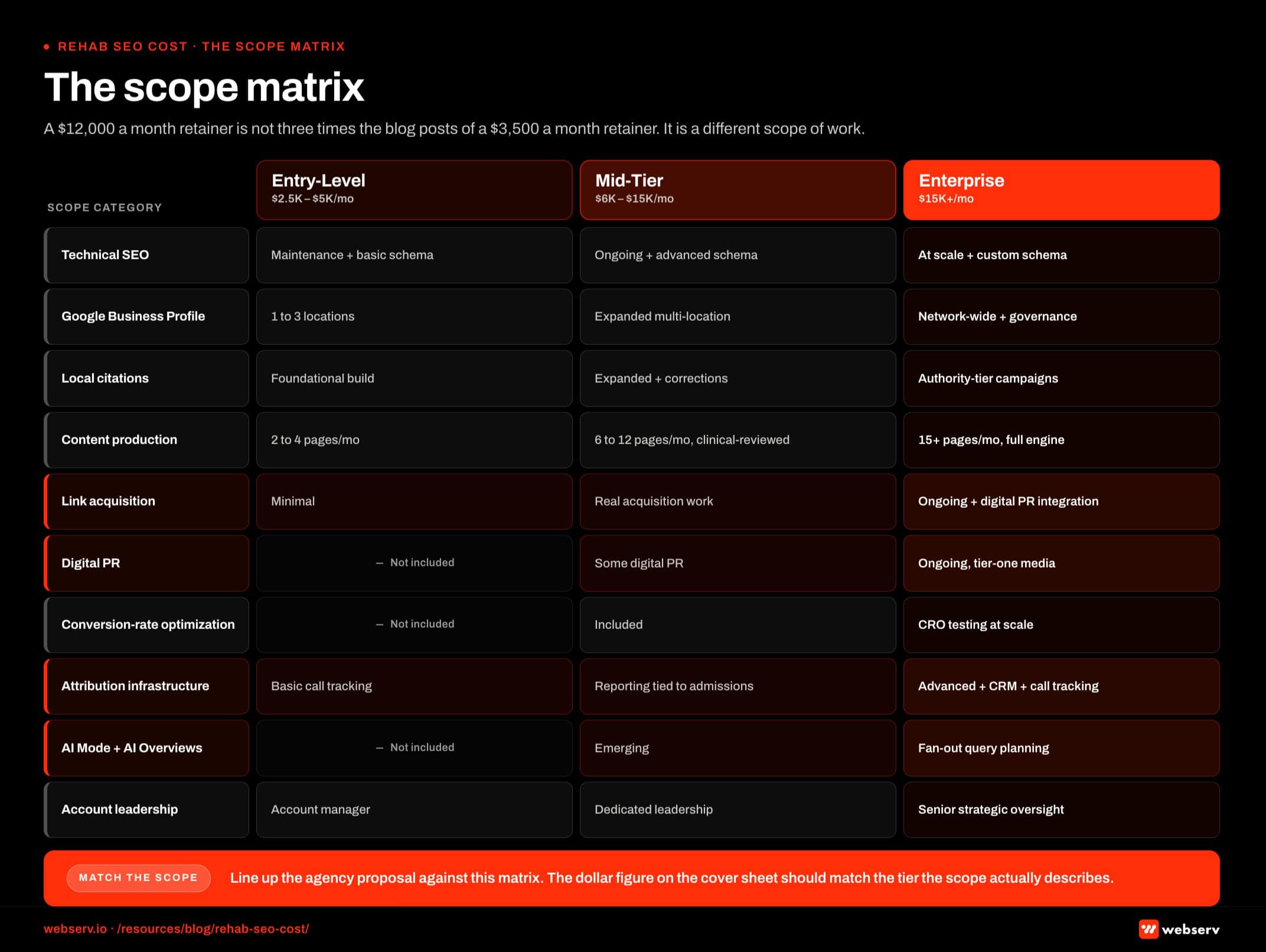 Infographic titled ‘The scope matrix’.
Entry-Level ($2.5K-$5K/mo) typically covers technical SEO maintenance, Google Business Profile optimization across one to three locations, local citation building, basic schema markup, monthly reporting, and a content cadence of two to four pages per month.
You’re paying for foundational visibility in a defined service area. Most of the work at this tier focuses on getting service pages built before blog content, since that’s the order that produces admissions fastest at single-location scale.
Mid-Tier ($6K-$15K/mo) layers in clinical-reviewed content production at higher volume (six to twelve pages per month), real link acquisition work, expanded local SEO across multiple locations, conversion-rate optimization, more sophisticated reporting that ties organic traffic to admissions, and dedicated account leadership.
This is where most regional treatment center groups land. It’s also the tier where topical authority starts becoming achievable in 12 to 18 months.
Enterprise ($15K+/mo) funds a real content engine of 15 or more pages per month, ongoing digital PR campaigns targeting tier-one media, advanced attribution that integrates with your CRM and call-tracking, fan-out query planning for AI Mode citation share, technical SEO at scale, and senior strategic oversight.
National networks and luxury single-brand facilities operate here. Most enterprise programs also bundle digital PR and authority-building campaigns to strengthen the backlink profile that high-volume keyword targets require.
The work that defines each tier is the work the agency does on the days you don’t get a report. Cheap retainers tend to be reporting-heavy and execution-light. Strong retainers reverse that ratio.
Red Flags at the Low End
Below roughly $2,000 per month, the math doesn’t work for actual rehab SEO. Treatment center content requires clinical accuracy, author credentials, original analysis, and depth that takes hours to produce.
An agency selling rehab SEO for $1,500 a month is publishing AI-generated content with no clinical review, no real link acquisition, and a “set it and forget it” approach that quietly burns 12 months before the executive notices.
The specific warning signs to watch for:
- Guaranteed rankings. No credible SEO firm guarantees positions. Google’s ranking system is not contractually predictable. Promises of “page-one ranking in 90 days or your money back” are a sales tactic, not a strategy.
- One agency, dozens of rehabs. Some agencies bring 40 treatment centers into the same content workflow and produce essentially the same pages for all of them, with city names swapped. You can identify this in 90 seconds by checking the agency’s case study list against the pages they’re showing you.
- AI-mill content without review. If the agency cannot tell you who is reviewing each clinical page and what their credentials are, you’re paying for generic AI content.
- No attribution conversation. If the proposal doesn’t include how organic traffic will be tied to actual admissions, you’re paying for traffic that may or may not move the business.
- The portfolio is all link-building. Backlinks matter, but they’re one input. Programs that are 80 percent link-building tend to be the cheapest to operate, which is exactly why some agencies sell that.
Our guide to vetting top addiction treatment SEO agencies goes deeper on the questions that separate real treatment center SEO operators from the budget-burners.
The cost question that matters is not what the retainer costs. It’s what the retainer returns. A $12K/mo retainer that produces six new admissions a month is a 24x multiplier on a $50K LTV. A $3K/mo retainer that produces nothing is a $36K/yr expense with no offset. The pricing is downstream of the program quality.
Trevor Gage, Director of SEO at Webserv
The ROI Math: When SEO Actually Pencils
The question every treatment center executive should ask before signing isn’t “what does this cost.” It’s “what does this need to return to be worth it.”
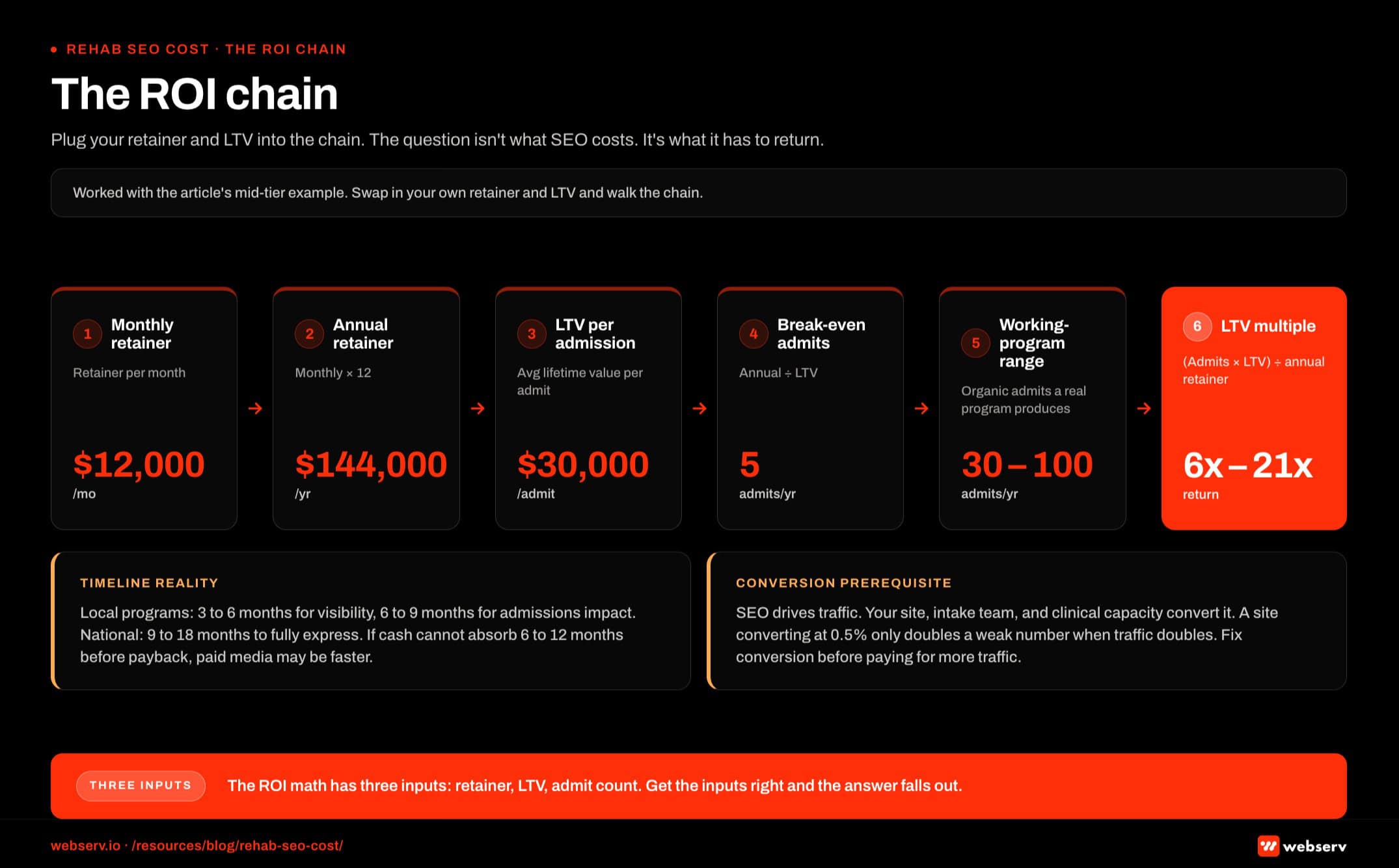 Infographic titled ‘The ROI chain’.
The math is simple. Take your average LTV per admission. That figure varies widely by level of care, length of stay and payer mix, so use your own net revenue per admit rather than an industry average. Luxury residential programs can clear far more per admit.
Multiply LTV by the number of admissions the SEO program needs to produce to cover its cost.
A mid-tier retainer at $12,000 per month is $144,000 annually. At a $30,000 LTV, that retainer pays for itself with five admissions per year sourced from organic search.
The break-even is rarely the goal. A working program produces 30 to 100 admissions a year from organic, depending on facility size and market.
The timeline matters. Real SEO results compound over months, not weeks. Local programs typically show measurable visibility gains in 3 to 6 months and meaningful admissions impact in 6 to 9. National programs take 9 to 18 months to fully express.
If your cash position can’t absorb 6 to 12 months of investment before payback, SEO is probably not the right channel for you right now. Paid media might be a faster path.
The other variable is conversion. SEO drives traffic. Your site, intake team, and clinical capacity convert it. Our deep dive on how to build landing pages that convert rehab traffic into admissions calls covers the conversion side of the equation.
If your site converts at 0.5 percent, doubling your traffic still only doubles your weak conversion number. Conversion infrastructure has to be in place for SEO ROI to materialize.
When SEO Is the Wrong Call for Your Treatment Center
The honest answer some executives need to hear is that SEO is not always the right move. There are four situations where the math doesn’t work, regardless of how good the agency is.
You’re planning to sell the facility inside 12 months. SEO compounds over time. The buyer will benefit from the work, not you. Consider whether the facility valuation lift is worth the investment, but understand the timeline is misaligned with a near-term sale.
Your phone team can’t return inquiries inside an hour. The treatment center conversion window is short. If your intake team takes 24 hours to call back inbound leads, paying for more leads is paying for waste. Fix the intake operation first.
Your beds are already full and you have no plan to expand. This sounds obvious, but treatment center groups with a fully booked footprint should be investing in retention, alumni programs, and brand equity, not lead generation. Top-of-funnel SEO produces inquiries you can’t admit.
You’re a brand-new facility with no live operational data. SEO works best when there’s a working sales motion to feed.
If you’re pre-launch, getting the SEO foundation right before launch is smart. The bigger spend should wait until you have intake processes and conversion data to optimize against.
A good agency will tell you when you’re in one of these situations. A bad one will sign the contract anyway.
Attribution: Without It, Pricing Is Meaningless
The single most useful thing an SEO program can do for a treatment center is connect organic activity to admissions. Without that line, every conversation about cost is theoretical.
A real attribution stack for treatment center SEO includes five components. Call tracking with HIPAA-safe routing (CallRail with a BAA is the standard). CRM integration that tags lead source and admission outcome. UTM-tagged URLs across organic landing pages.
Manual reconciliation of attribution data in the first 90 days to verify accuracy. And multi-touch modeling that captures the typical seven-to-eight marketing touches before admission.
If your current SEO program cannot tell you how many admissions came from organic last quarter, the program is operating blind. Fixing that should be the first three months of any new engagement.
Pricing Models: Retainer, Project, Performance
Three pricing models dominate treatment center SEO. Each has a use case.
Monthly retainer is the dominant model and the right default for ongoing programs. It funds consistent execution, makes budgeting predictable, and gives the agency the runway to do the work that compounds (content depth, link acquisition, authority building). Most treatment center SEO engagements run on retainers.
Project-based pricing is best for one-time work with a defined scope: a site migration, a technical audit, a content cleanup, or a structured-data implementation. Project fees typically run $5,000 to $50,000 depending on scope and tend to precede or supplement a retainer.
Performance-based pricing sounds appealing but rarely works well for treatment center SEO. The agencies that offer it tend to cherry-pick the easiest wins, focus on vanity metrics that hit performance thresholds, and avoid the slower compounding work.
If you see a performance-only proposal, ask what specific deliverables and KPIs are tied to the performance triggers and how disputes are resolved.
Contract Terms Worth Negotiating
Most treatment center SEO contracts are 6, 12, or 24 months. The longer terms come with lower monthly rates in exchange for the commitment.
Three contract terms deserve close attention before signing.
IP ownership. Make sure the contract states that all content, links earned, and accounts created (Google Business Profile, Search Console, analytics) belong to your facility. Some agencies retain ownership of “their” content or transfer reluctantly when the engagement ends. That is not acceptable.
Exit clauses. Look for milestone-based termination clauses, not pure 30-day notice. Milestone exit clauses (deliverable misses, KPI floors not met) protect you from non-performance, and 30-day notice exits give you flexibility if priorities shift.
Deliverable definitions. A vague retainer that promises “ongoing SEO” gives the agency too much latitude. Pin down monthly deliverable counts (pages, links, audits, reports), and pin down what triggers a quarterly strategy review. Specificity is your friend.
The Post-I/O 2026 Reality: AI Mode Citation Share
The Google I/O 2026 announcements changed what organic visibility actually means for treatment centers. AI Mode now powers a meaningful share of behavioral health queries, and AI Overviews extract citations from pages structured to answer compound questions, not pages optimized for single-keyword rankings.
The practical implication for SEO pricing: programs that don’t track AI Mode citation share and AI Overviews citation share as core KPIs are measuring last decade’s outputs.
Your retainer should fund content structured for the fan-out query mechanics AI Mode uses to assemble answers. It should also fund the work to get your facility cited in Google AI Overviews and ChatGPT answers for the high-intent queries that drive admissions.
Some agencies are still selling rank-tracker reports as their primary deliverable. In 2026, that’s roughly equivalent to selling page-load-speed reports as a marketing strategy in 2014. The metrics have moved.
Frequently Asked Questions About Treatment Center SEO Cost
How much should a treatment center spend on SEO per month?
A single-location treatment center should expect to invest $2,500 to $5,000 per month on SEO in 2026. Regional multi-location providers typically spend $6,000 to $15,000. National networks invest $15,000 to $50,000+ per month for full-stack programs.
These ranges reflect what the actual work costs to produce at each scale, including clinical content review, HIPAA-safe analytics, link acquisition, and dedicated account leadership. The variance within each tier is driven by market competitiveness, the number of locations, and the depth of attribution infrastructure included.
Anything materially below these floors is usually a content-mill operation that won’t move admissions. Anything above them should be questioned with specific deliverable accountability. SAMHSA’s national treatment data shows the behavioral health admission economics that justify these investment ranges, particularly when LTV per admission is calculated against acquisition cost.
Is SEO worth it for a small rehab with one location?
SEO is worth it for a single-location rehab when three conditions are true: your facility has at least 6 to 12 months of cash runway to fund the investment before payback, your intake team can return inbound calls inside an hour, and your average LTV per admission is at least $15,000.
If those conditions hold, a $3,000 to $5,000 per month local SEO investment needs only a few additional admissions a year to pay for itself. At $20,000 net revenue per admit, three admissions a year covers a $5,000 monthly retainer.
If those conditions don’t hold, paid media or referral marketing is usually the better near-term channel. Get the operational basics fixed before paying for more demand.
How long until I see ROI from treatment center SEO?
Most treatment centers see measurable organic visibility gains within 3 to 6 months and meaningful admissions impact within 6 to 12 months. National-scale programs targeting more competitive keywords typically need 9 to 18 months to fully express results.
The variance is driven by your site’s starting position (technical health, existing content, current domain authority), the competitiveness of your target market, and the cleanliness of your attribution stack. A site with strong existing foundations sees faster results than one that needs six months of technical cleanup before content investment can compound.
Programs that promise meaningful results in 90 days are almost always selling either a one-off cleanup project (which can produce real short-term wins) or a content mill that won’t produce results at all.
Can I do SEO in-house instead of hiring an agency?
You can do treatment center SEO in-house if you can hire and retain a senior SEO strategist (typically $90,000 to $140,000 fully loaded), a content writer with clinical or healthcare-content experience ($60,000 to $90,000), and either a part-time technical SEO specialist or an outside consultant ($20,000 to $60,000 per year).
That puts a credible in-house team at $170,000 to $290,000 annually before tools, link-acquisition budget, and CRO testing.
Most facilities find this more expensive and slower to ramp than a $8,000 to $12,000 per month agency retainer, which gives you access to a multidisciplinary team and established processes from day one. In-house can make sense for enterprise networks with 10+ facilities, where the volume justifies a dedicated team and the institutional knowledge stays in the organization.
What questions should I ask an SEO agency for treatment centers?
Six questions reveal almost everything. Who reviews the clinical content and what are their credentials. How they measure admissions attributed to organic. Their link acquisition methodology. How many treatment center clients they currently serve. How they measure AI Mode citation share. And the contract exit clause if KPIs aren’t hit.
If the agency cannot give clear answers to those six questions in a 30-minute conversation, the proposal is not worth the price regardless of what the dollar figure says.
References from other treatment center clients should be table stakes, not a negotiation.
Build a Predictable Organic Channel for Your Treatment Center
The right SEO investment for your treatment center depends on your facility size, your competitive market, your operational readiness, and your LTV per admission. None of those questions have a generic answer.
We work with treatment center groups across the country to build organic programs that connect directly to admissions, and we’re happy to give you an honest assessment of whether SEO is the right investment for your facility right now, or whether something else should come first.
Schedule a site audit and attribution review to get a real look at what an SEO program should cost for your facility, what it should deliver, and what timeline you should hold the work to.
For the wider picture of how SEO fits inside a full treatment center marketing program, see our ultimate guide to behavioral health marketing.
Trevor Gage is Director of SEO at Webserv, where he leads organic strategy for behavioral health and addiction treatment centers across the U.S. He writes about treatment-center SEO economics, AI search citation, and the operational realities of marketing high-acuity healthcare.