If you run a treatment center, billing is the line item that quietly decides whether marketing spend pays back. You’re working addiction-specific CPT codes, prior authorization fights, utilization review denials, and payers who question medical necessity after every 30-day window.
Most general healthcare RCM companies don’t know any of that on day one. The revenue lost while they learn rarely shows up on a P&L until the quarter closes.
The shortlist below is built for rehab owners, CFOs, and billing managers who need a partner with real SUD billing specialization, not a generalist running playbook drills on your claims.
SAMHSA’s National Survey on Drug Use and Health consistently estimates roughly 48 million Americans age 12 and older live with a substance use disorder. Only about a quarter of those needing treatment receive any. That admissions opportunity is what makes RCM discipline a growth lever, not a back-office function.
We’ve ordered the list around the five workflows that separate the strong RCM partners from the rest: VOB turnaround, prior authorization, denial recovery, payer mix discipline, and the underlying billing operations cadence that ties them together.
Every vendor below is BH-focused or has a credible BH division. We’ve called out where the fit is best, where the model fits which size of operator, and the questions we’d ask in a first call.
Treat this as a shortlist, not a ranking. The right partner depends on your payer mix, location, EHR, and current AR backlog.
A short note on how to read what follows. For each vendor we cover what they do well, who they fit, and the operator-side hook that earned the entry.
After the list we cover what the best RCM providers do differently, how to evaluate a shortlist on five vectors, the buyer mistakes we see repeated, and how RCM performance feeds your marketing economics.
If you want to skim, the comparison table below has the at-a-glance. If you want the underlying operations theory, the full RCM playbook for rehabs is the sibling read.
Key Takeaways
- BH-specialized RCM is a different category from general healthcare RCM, not a feature of it. General medical billers can’t price prior auth fights or build documentation that survives a 30-day medical necessity review on residential. Specialization shows up in denial rate per payer, not in the sales deck.
- Denial management is the lever, not claims submission. Submission is table stakes; appeals discipline, root-cause analysis, and pre-bill scrubbing are where revenue is recovered. Ask each vendor for a denial pattern report by payer over the last 90 days before signing.
- Transparency and reporting cadence determine whether you can run your business. Real-time dashboards on days in AR, clean claim rate, denial rate by payer, and collections by service line are non-negotiable. Monthly PDF summaries are a red flag.
- Integration with admissions, clinical documentation, and your EHR decides how much friction you absorb. A vendor that demands a workflow overhaul before knowing your stack is one to walk from. The best RCM partners adapt to your admissions and UR cadence, not the other way around.
- RCM performance sets the ceiling on marketing spend. Treatment centers with strong RCM partners invest in SEO and paid media confidently because cash flow is predictable. Broken billing means every admission is a coin flip, and no marketing budget survives that uncertainty.
- Expect a transition period of a few months before the improvement shows up in collections. Pricing is typically 4% to 10% of collections or $3,000 to $15,000+ per month flat. Anyone promising faster results or undercutting that floor is selling something else.
DEFINITION
Revenue Cycle Management (RCM)
The end-to-end process of capturing revenue for a treatment center, from insurance verification through claim submission, payment posting, denial management, and patient collections. Behavioral health RCM carries category-specific complexity (UR, ROI compliance, OON benefit assignment) that general healthcare RCM vendors frequently miss.
Quick Comparison Snapshot of Top RCM Companies for Rehabs
| Company | BH Depth | Integration Approach | Specialty Fit | Fee Structure |
|---|---|---|---|---|
| 1. Revenue Logic | BH-primary | EHR-agnostic | Mid-to-large, residential + PHP/IOP | On request |
| 2. Hansei Solutions | BH-primary | Proprietary analytics layer | SUD, predictive revenue analytics | On request |
| 3. Qualifacts RCM | BH-division of EHR | EHR-tethered (CareLogic, Credible) | Multi-LOC clinics already on Qualifacts | On request |
| 4. Integrity Billing | BH-primary | EHR-agnostic | Compliance-focused SUD centers | On request |
| 5. Coronis Health | BH-division | EHR-agnostic | Multi-location turnkey RCM | On request |
| 6. Strivant Health | BH-division | EHR-agnostic | Centers with cash flow gaps | On request |
| 7. Ascent Health | BH-primary | EHR-agnostic | Full-service BH RCM | On request |
| 8. Zealie | BH-only | Proprietary platform | Tech-forward MH and SUD operators | On request |
| 9. iSolver RCM | BH-primary | EHR-agnostic | Coding specialist book | On request |
| 10. BillingParadise | BH-division | EHR-agnostic, proprietary AI tools | Large centers wanting AI-driven RCM | On request |
| 11. Plutus Health | BH-primary (MH, IOP, SUD, ABA) | Proprietary RPA + managed services | 800+ providers, 40+ states, multi-LOC | On request |
| 12. Medwave | BH-division | EHR-agnostic, HL7 + RPA tooling | Outpatient SUD, MAT, office-based | On request |
| 13. Psybill | BH-only (MH + SUD) | Hybrid: proprietary scrubber + PM/EHR | MH groups, counseling, Ohio Medicaid | On request |
| 14. United Billing Solutions | BH-primary (operator-built) | EHR-agnostic (inferred from operator network) | Multi-LOC residential + PHP/IOP | On request |
| 15. BHBS | BH-only (Ohio focus) | EHR-tethered (Qualifacts CareLogic) | Ohio CMHCs and SUD agencies only | On request |
| 16. Nextus Billing | BH-only (exclusively) | Proprietary platform (Cereus visibility) | Residential, detox, IOP | On request |
16 Best Revenue Cycle Management Companies for Rehab Centers
1. Revenue Logic
Website: revenuelogic.io
Overview
Revenue Logic operates exclusively in behavioral health RCM and billing. The team understands the specific challenges treatment centers face: complex prior authorization requirements, aggressive utilization review denials, and payers who constantly question medical necessity for addiction treatment.
The company handles end-to-end revenue cycle management including claims submission, verification of benefits, utilization review management, denial appeals, and strategic revenue optimization.
At Webserv, we’ve worked with several treatment center clients who use Revenue Logic, and the feedback has been consistently positive. They’re one of the few RCM partners our clients speak highly of year after year.
Why Revenue Logic Stands Out
- Behavioral health-only focus for years: The team has processed millions of behavioral health claims and knows the specific denial patterns, coding requirements, and payer behaviors unique to addiction treatment.
- Strategic revenue optimization beyond billing: Revenue Logic doesn’t just submit claims—they analyze your entire revenue cycle to identify where you’re losing money and how to fix it systematically.
- Tailored utilization review support: UR denials kill revenue for treatment centers. Revenue Logic manages the entire UR process proactively, building documentation that withstands payer scrutiny before denials happen.
- Analytics that drive decisions: Detailed reporting shows exactly where revenue is leaking, which payers cause the most problems, and where your team should focus to improve collections.
- Proven partnership model: Our clients who work with Revenue Logic consistently report improved collections, reduced denial rates, and a team that functions as a true extension of their billing operations.
Good Fit If: You want a true partner who understands behavioral health billing deeply and can function as an extension of your internal billing team while improving overall revenue performance.
How an inpatient rehab scaled paid media to 95 admits while cutting cost per admission by 24%
Campaign consolidation and PMAX optimization drove 30% admission growth with improved efficiency, all while maintaining OON payer mix.
Read the case study →Q3 2025
2. Hansei Solutions
Website: hanseisolutions.com
Best For: SUD providers wanting predictive revenue insights
Overview
Hansei Solutions specializes in behavioral healthcare and substance use disorder billing. They offer full-service RCM including credentialing, billing, denial management, and advanced analytics that help predict revenue trends before problems emerge.
Why They’re Included
- Deep specialization in SUD and behavioral health billing workflows
- Predictive analytics that identify revenue risks before they impact cash flow
- Comprehensive credentialing support to maintain payer network status
- Strong denial management processes built on behavioral health expertise
Good Fit If: You need analytics-driven RCM that helps you understand revenue trends and prevent problems before they become crises.
3. Qualifacts RCM
Website: qualifacts.com
Best For: Centers using integrated EHR systems
Overview
Qualifacts provides behavioral health revenue cycle and billing services integrated with EHR platforms. They help providers streamline claims workflows by connecting billing directly to clinical documentation systems.
Why They’re Included
- Strong EHR integration capabilities for streamlined workflows
- Behavioral health-focused billing expertise
- Connection between clinical documentation and billing to improve claim accuracy
- Technology platform designed for behavioral health providers
Good Fit If: You want RCM services that integrate seamlessly with your EHR to reduce duplicate data entry and improve billing accuracy.
4. Integrity Billing (Addiction Treatment Billing)
Website: integritybillingco.com
Best For: Addiction treatment centers focused on compliance
Overview
Integrity Billing specializes in SUD and addiction treatment billing with emphasis on compliance guidance and payer relations. They help centers navigate the regulatory complexity of addiction treatment billing while maintaining strong payer relationships.
Why They’re Included
- Deep focus on addiction treatment billing specifically
- Compliance guidance that reduces regulatory and audit risk
- Strong payer relations expertise to resolve issues quickly
- Understanding of state-specific SUD billing requirements
Good Fit If: You want a billing partner who prioritizes compliance and can help you navigate the regulatory complexity of addiction treatment.
5. Coronis Health
Website: coronishealth.com
Best For: Multi-location programs needing turnkey RCM
Overview
Coronis Health provides comprehensive revenue cycle services for substance abuse and behavioral health providers. They handle everything from eligibility verification through final collections, with strong expertise in AR follow-up and denial resolution.
Why They’re Included
- Turnkey RCM solution that handles the entire revenue cycle
- Strong accounts receivable follow-up and collections processes
- Detailed revenue analytics and reporting
- Experience managing multi-location billing complexity
Good Fit If: You need a comprehensive RCM partner that can take full responsibility for your revenue cycle across multiple facilities.
6. Strivant Health
Website: strivanthealth.com
Best For: Centers with cash flow challenges
Overview
Strivant Health provides end-to-end RCM support for behavioral health and addiction treatment providers with emphasis on improving collections and cash flow. They focus on accelerating payment cycles and reducing days in AR.
Why They’re Included
- Strong focus on improved collections and faster payment
- Cash flow optimization strategies beyond basic billing
- Comprehensive support across the entire revenue cycle
- Experience with behavioral health and addiction treatment billing
Good Fit If: You’re struggling with cash flow issues and need a partner focused on getting you paid faster and more consistently.
7. Ascent Health
Website: ascenthealth.com
Best For: Facilities needing comprehensive billing support
Overview
Ascent Health offers full-service revenue cycle management for behavioral health and addiction treatment providers. They handle the complete billing lifecycle with expertise in the unique requirements of substance use disorder claims.
Why They’re Included
- Comprehensive RCM services covering the entire billing cycle
- Behavioral health and addiction treatment specialization
- Focus on clean claim submission and first-pass resolution
- Experience with complex payer requirements in behavioral health
Good Fit If: You need a reliable partner who can manage your entire revenue cycle with behavioral health expertise.
8. Zealie (Behavioral Health Billing Solutions)
Website: zealie.com
Best For: Tech-forward practices wanting automation
Overview
Zealie offers a technology-driven revenue cycle platform tailored for behavioral health practices. They focus on automated billing workflows, modern reporting tools, and reducing manual billing work through smart automation.
Why They’re Included
- Modern, tech-driven platform with automation capabilities
- Automated billing workflows that reduce manual errors
- Real-time reporting and analytics dashboards
- User-friendly interface designed for behavioral health providers
Good Fit If: You want a modern RCM solution that leverages technology to automate repetitive billing tasks and provide real-time visibility.
9. iSolver RCM
Website: isolvercm.com
Best For: Providers needing behavioral health code specialists
Overview
iSolver RCM specializes in billing for behavioral health and SUD services with deep expertise in behavioral health-specific codes and claims management. They understand the coding nuances that make or break addiction treatment claims.
Why They’re Included
- Specialized knowledge of behavioral health-specific coding requirements
- Full claims management from submission through resolution
- Experience with SUD and behavioral health payer requirements
- Focus on maximizing appropriate reimbursement through correct coding
Good Fit If: You need coding specialists who understand the unique requirements of behavioral health and addiction treatment billing.
10. BillingParadise
Website: billingparadise.com
Best For: Centers wanting AI-driven RCM with a large dedicated billing team
Overview
BillingParadise offers end-to-end revenue cycle management for behavioral health and addiction treatment facilities, combining a 500+ person billing staff with proprietary AI and automation tools. Their platform covers everything from eligibility verification and claims scrubbing to AR recovery and denial management, with AAPC-certified coders handling behavioral health coding specifically.
Why They’re Included
- AAPC-certified coders with behavioral health specialty experience
- Proprietary AI tools for eligibility verification, AR management, and denial prevention
- Claims a 98% first-pass acceptance rate on submitted claims
- Flexible engagement models — full outsource, partial RCM, FTE staffing, or co-managed
- SOC 2 certified and HIPAA compliant with 30+ EHR/EMR integrations
Good Fit If: Your center needs a high-volume billing partner with dedicated staff and automation technology, particularly if you’re dealing with aged AR backlogs or want to reduce denial rates through claims scrubbing.
11. Plutus Health
Website: plutushealthinc.com
Best For: Multi-location BH and SUD operators wanting RPA tooling layered on top of managed RCM
Overview
Plutus Health pairs managed RCM services with proprietary automation tools (Zeus RPA engine, ArtemisABA, AnodynePay) and has dedicated service pages for Mental Health, IOP, SUD, and ABA billing. The book spans 800+ providers across 40+ states with three global delivery centers and a Dallas HQ.
Why They’re Included
- Hybrid model that pairs 1,600+ certified coders with RPA automation for pre-auth, eligibility, and coding verification
- Vendor-aggregate benchmarks published: 5% denial rate, 97% clean claims, 25 days in AR, 48-hour turnaround
- Named to Becker’s 2026 Top RCM Companies; recent ABA expansion (CASP affiliate, Jade Health partnership)
- Dedicated SUD and IOP service pages separate from the broader healthcare book, so the BH operator can find specialty content quickly
Good Fit If: You operate multiple locations and want a vendor that layers RPA automation on top of human billing teams without forcing a platform migration.
12. Medwave
Website: medwave.io
Best For: Office-based SUD, MAT, and outpatient BH practices where credentialing and rate negotiation drive the model
Overview
Medwave is a generalist healthcare RCM with a substantive SUD and behavioral health practice covering detox, IOP, PHP, and MAT (buprenorphine, methadone, Vivitrol). The credentialing arm runs 30+ years of payer enrollment experience for counselors, LCADCs, LPCs, and clinicians.
Why They’re Included
- Dedicated SUD and behavioral health service pages with ASAM-criteria documentation support
- U.S.-based staff (no overseas outsourcing) with HIPAA and SOC 2 Type 2 attestation
- Counselor and clinician credentialing depth, including state-specific MAT licensing pathways
- Joint Commission and CARF accreditation support folded into the credentialing engagement
Good Fit If: You’re an outpatient SUD, MAT, or office-based BH practice where credentialing and rate negotiation are the bottleneck.
13. Psybill
Website: psybill.com
Best For: Mental health and SUD practices that want a vendor whose entire book is behavioral health
Overview
Psybill focuses exclusively on mental health and substance abuse billing with 20+ years of operating history. The Ohio HQ runs national accounts and bundles billing with a proprietary claim scrubber, a smart online billing system, and a PM/EHR software offering.
Why They’re Included
- BH-only book covering mental health, SUD, counseling, and psychiatry/psychology groups
- Published client outcomes: AR days 65 to 35 on a featured engagement; 12-25% receipts increase; 45-82% labor cost decrease
- Ohio Medicaid and OHMAS accreditation expertise for centers serving Ohio populations
- Ancillary services unusual for a billing shop: provider recruiting, practice brokering, and receivables purchasing
Good Fit If: You want a single vendor for billing plus PM/EHR software and you value 20+ years of BH-only operating history.
14. United Billing Solutions
Website: unitedbilling.com
Best For: BH operators who want a billing partner with operator DNA, not just a billing house
Overview
United Billing Solutions is the billing arm of Haven Health Management, a 22-facility BH and addiction treatment operator across 7 states and Puerto Rico. Built inside an active treatment network, the team has seen behavioral health billing from the treatment center side as well as the billing side.
Why They’re Included
- Backed by an active 22-facility BH and addiction treatment operator parent
- Underpayment-recovery practice that pursues legacy claims up to 3 years old
- Operator-built team whose leadership has actually run treatment centers, not just billed them
- Recent ownership change: MKH Capital Partners acquired Haven Health Management in April 2026, so leadership and strategy may still be settling
Good Fit If: You want a billing partner whose leadership has personally operated treatment centers and you’re willing to verify the post-acquisition leadership picture on an intro call.
15. Behavioral Health Billing Solutions (BHBS)
Website: bhbillingsolutions.com
Best For: Ohio-based community mental health centers and SUD agencies billing Ohio Medicaid
Overview
BHBS is an Ohio-specific behavioral health billing house and a Qualifacts CareLogic Affiliate Partner. The team specializes in OhioMHAS-certified Type 84 mental health and Type 95 SUD community mental health centers operating under Ohio’s Medicaid BH Redesign and Next Gen Medicaid programs.
Why They’re Included
- Hyper-specialist on Ohio Medicaid BH Redesign, MCO carve-in, OhioRISE, and Next Gen Medicaid PNM/OMES
- Hosts CareLogic for 35+ agencies and 1,100+ providers, all compliant with OhioMHAS, Joint Commission, and CARF
- Combined billing and EHR implementation engagement model removes the EHR-vendor handoff problem
- Geographic and EHR specialization removes guesswork for in-state operators
Good Fit If: You operate a community mental health center or SUD agency in Ohio and you bill Ohio Medicaid. Not a fit for out-of-state operators.
16. Nextus Billing Solutions
Website: nextusbilling.com
Best For: Mid-size residential, detox, and IOP operators wanting concierge-level RCM bundled with technology visibility
Overview
Nextus Billing exists to serve behavioral health and addiction treatment exclusively. The team bundles credentialing, VOB, utilization review, billing, claims, and payment negotiations with a proprietary Cereus visibility platform and Nextra Payments product. Offices in Boca Raton and Philadelphia.
Why They’re Included
- Behavioral-health-only book with named operator testimonials from 8+ rehab CEOs and owners
- Cereus platform delivers real-time RCM visibility on claims, AR, and denials by payer
- Utilization review is a named specialty, which matters for residential and detox where UR denial recovery drives the model
- Full-stack engagement (credentialing through payment negotiation) reduces the vendor-handoff problem on residential admissions
Good Fit If: You run residential, detox, or IOP and you want a single vendor for the full RCM stack with visibility software built in.
What the Best RCM Providers Do Differently in Addiction Treatment
ADJACENT CATEGORY WORTH KNOWING
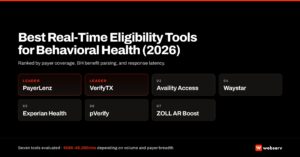
A note on category: reimbursement intelligence platforms are not RCM companies, and the two are not substitutes. PayerLenz, for instance, is a benchmarking and eligibility layer that sits upstream of the RCM workflow — it tells the admissions team what the payer typically pays for that state and level of care before the patient is admitted, then the RCM partner does the billing work. If you are evaluating an RCM vendor, treat rate intelligence as a separate line item, not a feature to fold in.
Most healthcare billing companies fail in addiction treatment because they don’t understand the specific challenges. They treat SUD claims like medical claims, and denial rates skyrocket.
HFMA tracks initial denial rates across general healthcare. The figure climbed from 10.15% in 2020 to 11.99% by Q3 2023, the most recent period in that series. Addiction treatment programs often run above that general-healthcare figure with generalist billers, driven largely by medical necessity and utilization review denials.
Billing sits downstream of everything else you run. Our behavioral health marketing guide covers how admissions, marketing, and revenue cycle connect across the full operator stack.
The best RCM providers know addiction treatment billing inside out. They understand why payers deny claims for continued residential treatment after 30 days. They know which documentation prevents utilization review denials. They’ve dealt with every variation of medical necessity questions payers throw at behavioral health claims.
They also understand the timing pressures treatment centers face. When you’re waiting on payment for 60 days of residential care and payroll is due, billing isn’t theoretical. These providers move fast, appeal denials aggressively, and don’t let payers slow-walk legitimate claims.
A few things that separate the best from the rest:
- They understand behavioral health-specific CPT codes and how to document services properly
- They know which payers are difficult in behavioral health and how to navigate their specific requirements
- They manage utilization review proactively instead of reacting to denials
- They track metrics that matter: clean claim rate, first-pass resolution rate, days in AR, and collection rate
The best RCM partners also build the upstream discipline that prevents avoidable billing failures: a tight verification of benefits workflow that filters unmonetizable admits before they take a bed, and a payer mix strategy that distributes concentration risk before it can hollow out revenue.
How to Choose the Right RCM Partner for a Treatment Center
Behavioral Health Specialization vs. General Healthcare RCM
You want a partner with extensive addiction treatment and behavioral health experience. Not just healthcare RCM. Not general medical billing with a behavioral health “division.” Actual specialization in SUD billing.
Ask how many treatment centers they work with. Ask what percentage of their business is behavioral health. Find out if they understand common denial reasons for residential treatment, PHP, and IOP claims.
Generalists will struggle with medical necessity documentation, utilization review management, and payer-specific behavioral health requirements. Specialists know what works and start from proven processes.
Red Flags:
- Portfolio shows mostly medical practices or surgery centers with minimal behavioral health
- Can’t speak fluently about common UR denial patterns in addiction treatment
- Unfamiliar with behavioral health-specific codes or payer requirements
Denial Management Capabilities
Denials kill revenue for treatment centers. Medical necessity denials. Utilization review denials. Lack of prior authorization. “Not medically necessary” after 30 days of residential.
A 2024 KFF analysis of ACA marketplace claim data found in-network denial rates averaged 19% across reporting issuers, with wide variation by plan. Insurers do not report which types of services were denied, but for operators this is why a vendor’s appeal win rate matters more than submission volume.
The out-of-network number in that same KFF analysis is the one addiction treatment operators should read twice. Marketplace insurers denied 37% of out-of-network claims in 2024, against 19% in-network. Most residential and PHP revenue in this field runs out-of-network.
KFF also found that fewer than 1% of denied claims are ever appealed, and insurers uphold their original decision on 66% of the appeals that do get filed. Both numbers describe a system that pays out when someone pushes back and keeps the money when nobody does.
An RCM partner that does not appeal by default is leaving a meaningful share of your out-of-network claim volume unrecovered. Appeal rate and appeal win rate belong in the monthly report, not in the sales deck.
Ask how they handle denials. Do they appeal aggressively? Do they track denial patterns to prevent future issues? How quickly do they respond to denial notices?
The best RCM companies don’t just appeal denials—they analyze denial patterns, identify root causes, and implement processes to prevent denials before claims are submitted.
Transparency and Reporting
You need real-time visibility into your revenue cycle. Not monthly summaries. Not vague assurances that “everything’s fine.”
Ask what metrics they track and how often you’ll see reports. Find out if you can access dashboards showing days in AR, clean claim rate, denial rate by payer, and collections by service line.
The best providers give you clear, actionable data that helps you understand where your revenue stands and what’s being done to improve it.
Integration with Your Systems
How will they work with your EHR, admissions system, and existing workflows? Will they require you to change processes, or can they adapt to how you operate?
Ask about data exchange, documentation requirements, and how their team will communicate with your admissions and clinical staff.
Red Flags:
- Require complete workflow overhauls without understanding your current processes
- Can’t integrate with your existing EHR or practice management system
- Unclear about how they’ll communicate with your team
How RCM Performance Impacts Your Marketing Strategy
OPERATOR INSIGHT
The treatment centers that grow census predictably are the ones that treat their RCM partner as a marketing input, not a back-office function. Denial rate, DSO, and net collection rate govern how much marketing spend you can safely deploy each month. When those numbers drift, the marketing engine drifts with them.
At Webserv, we work exclusively with treatment centers on marketing and admissions growth. One pattern we see consistently: centers with strong RCM partners can invest more aggressively in marketing because their revenue cycle is predictable and efficient.
When your billing is a mess—high denial rates, slow collections, unpredictable cash flow—you can’t confidently invest in SEO, paid media, or other growth channels. You’re always worried about whether you’ll get paid for the patients you admit.
Strong RCM creates the foundation for sustainable marketing investment. When you know your collection rates, understand your cost per admission by payer type, and have predictable cash flow, you can make rational decisions about marketing budget.
The best-performing treatment centers we work with have this figured out: excellent RCM partners handling billing while marketing drives qualified admissions through SEO or Google Ads. The two functions work together—marketing fills beds with the right payer mix, and RCM ensures you actually get paid.
If your RCM is broken, fix that before you scale marketing. There’s no point driving more admissions if you’re losing revenue to preventable denials or waiting months to collect.
If you have gotten a cost per admit quote under $5,000, ask one question first: is that INN or OON?
Most agencies quote cost per admit using in-network facility data where insurance covers most costs and admit thresholds are lower. Out-of-network facilities operate under completely different conditions. Comparing those numbers is like comparing apples to surgery. It is the most common way agencies make their results look better than they are. Our 2025 benchmark report shows you what the real numbers look like across OON treatment center campaigns so you know what to ask.
Common Buyer Mistakes When Shopping RCM Companies
COSTLIEST MISTAKE
Optimizing on RCM fee instead of net collections. A 5% RCM fee that collects 62% of billed charges leaves less in your bank account than a 7.5% fee that collects 78%. On $6M in billed charges, that gap works out to roughly $800,000 a year. Ask every vendor for their weighted net collection rate on BH claims by payer tier, not their headline fee.
After watching dozens of clients run RCM searches, the same five mistakes show up over and over. Most cost the operator three to six months and a measurable AR hit before anyone realizes the fit was wrong. Walk in with these in mind and cut the bad fits early.
- Treating BH specialization as a checkbox instead of a portfolio depth question. A vendor that lists “behavioral health” on their site is not the same as a vendor where BH is the majority of book. Ask for the percentage of revenue from BH and SUD specifically, and ask for the names of three current treatment center clients you can call.
- Optimizing on price instead of net collections. A 5% RCM fee that collects 88% of expected reimbursement loses money against an 8% RCM fee that collects 96%. Always model the spread on net dollars, not gross fee percentage.
- Signing before seeing a denial pattern report. Any RCM company with a real BH book can hand you a payer-level denial pattern report inside a week. If they can’t produce one, they don’t have the data infrastructure to manage your AR either.
- Underestimating the transition cost. New RCM partners spend the first few months cleaning legacy AR and learning your payer mix. Budget cash flow for a partial dip in collections during that window or you’ll panic and undo good work.
- Skipping the integration conversation until after the contract. EHR integration, admissions handoff, UR communication, and clinical documentation pipeline all need to be mapped before signing. Vendors that resist this conversation are signaling that their workflow is rigid and your team will absorb the friction.
Timelines, Costs, and What to Expect
RCM pricing varies based on your volume, payer mix, and complexity. Most companies charge either a percentage of collections or a flat monthly fee.
Percentage of Collections: Typically ranges from 4% to 10% of collected revenue. Higher percentages usually indicate the provider is taking on more risk or handling more complex billing.
Flat Monthly Fees: Some providers charge fixed monthly fees based on claim volume, typically ranging from $3,000 to $15,000+ per month depending on facility size and complexity.
Typical Timeline:
- Month 1: Onboarding, data migration, credentialing verification, workflow setup
- Month 2-3: Initial claims submission, learning your payer mix, establishing baselines
- Month 3-6: Optimization, addressing backlog AR, establishing denial patterns, refining processes
- Month 6+: Steady-state operations, ongoing optimization, strategic revenue improvement
Expect a few months before you see meaningful improvements in collections or days in AR. RCM transitions take time, and initial months often focus on cleaning up existing AR issues.
FAQs About RCM Companies for Rehab Centers
How do I know if my current RCM provider is performing well?
Track four core KPIs by payer: clean claim rate above 90%, days in AR under 45, net collection rate at 95% or higher of expected reimbursement, and first-pass denial rate under 10%. If your provider sits meaningfully below these benchmarks or cannot produce them on demand, performance is the problem and the conversation needs to happen now.
Layer in time from claim submission to payment and denial rate broken out by payer. A vendor can look healthy in aggregate while two payers quietly account for most of your aged AR. Reporting that hides that detail is itself a red flag worth raising in your next review.
Ask for a monthly KPI report covering these metrics, plus AR over 90 days as a percentage of total AR. Strong RCM partners share these numbers proactively, flag negative trends, and bring you a remediation plan before you have to ask for one. Silence on KPIs almost always signals a deeper performance issue.
What HIPAA and 42 CFR Part 2 compliance requirements should an RCM company meet?
A behavioral health RCM company must sign a HIPAA Business Associate Agreement, follow 42 CFR Part 2 protections for SUD records, and maintain a documented compliance program covering staff training, access controls, audit logs, and breach response. SOC 2 Type II attestation and encrypted data transmission are baseline expectations for any vendor handling protected health information.
42 CFR Part 2 is the trap most generalist RCM companies fall into. SUD treatment records carry stricter consent and disclosure rules than standard PHI, and improper release to a payer, employer, or third party can create regulatory exposure for your facility, not just the vendor.
Ask for the vendor’s most recent SOC 2 report, their Part 2 consent workflow, and how they handle data segmentation between clients. Confirm where data is hosted, who has access, and how offboarding works if you terminate the contract. A serious partner answers these questions in writing without hesitation.
What are healthy AR days and denial rate benchmarks for behavioral health billing?
For addiction treatment, healthy benchmarks are days in AR under 45, clean claim rate above 90%, first-pass denial rate under 10%, and net collection rate at 95% or higher of expected reimbursement. AR over 90 days should sit below 20% of total AR. Out-of-network heavy programs may run slightly higher AR days because of single-case agreement timelines.
If your days in AR sit at 60 or higher, claims are aging out or sitting unworked. Either the vendor is understaffed for your volume or denials are stacking up without active appeals. Both scenarios cost real cash and compound quickly.
Ask your current RCM partner for a monthly KPI report covering these metrics by payer. If they cannot produce it on request, that is the answer. Strong partners share these numbers proactively, flag negative trends, and bring you a remediation plan before you have to ask for one.
How should an RCM handle VOB and prior authorization for addiction treatment?
A strong RCM partner runs verification of benefits within 1 to 2 hours of inquiry, captures behavioral health-specific data points like deductible status, out-of-pocket maximum, and level-of-care coverage, and initiates prior authorization before admission whenever possible. They should also concurrently manage utilization review throughout the stay to protect medical necessity and prevent retroactive denials.
VOB quality directly affects admissions conversion. If your team waits 6 hours for a benefits summary, qualified patients call competitors. The best RCM partners staff VOB during evenings and weekends because that is when treatment center admissions teams need answers most.
Prior authorization is where many vendors fall short. SUD and mental health authorizations require ASAM criteria documentation, clinical justification, and ongoing concurrent review for continued stay. Confirm the vendor has UR nurses or trained clinical reviewers on staff and ask how they coordinate with your clinical team when payers push back.
How long does it take to transition to a new RCM company?
Plan on several weeks for initial setup and several months before full optimization. The first few months focus on cleaning up legacy AR, mapping your payer contracts, and stabilizing daily workflows. Expect some claim volume disruption during cutover as the new vendor learns your payer mix, modifiers, and level-of-care documentation patterns.
Cutover risk lives in two places: outstanding AR with the prior vendor and credentialing or EDI enrollment lag with payers. Both need clear written ownership before day one. Otherwise denials and unworked claims pile up exactly when you need cash flow most.
A serious RCM partner gives you a written 90-day onboarding plan with named owners, weekly status calls, and measurable AR cleanup milestones. If the proposed timeline is vague or the vendor cannot tell you who is touching your claims this week, the transition will slip and your aged AR will absorb the cost.
What is the biggest mistake treatment centers make with RCM?
Hiring a generalist medical billing company that does not understand behavioral health. SUD billing is too specialized for general healthcare vendors to handle well. They miss medical necessity documentation, fumble utilization review, and underperform on behavioral health-specific payer requirements, which drives higher denial rates, slower collections, and avoidable revenue leakage.
The shortfall usually shows up in three places: medical necessity language that does not map to ASAM criteria, weak utilization review that loses days mid-stay, and appeals teams that do not know how to push back on behavioral health denial reason codes. Each one quietly costs five and six figures per month at scale.
Before hiring any RCM partner, ask how many SUD and mental health clients they currently serve, what percentage of their book is behavioral health, and how their UR team is staffed. If the answers are vague or the book is dominated by general medical practices, the vendor will treat your claims like a medical office instead of a treatment center.
30 minutes to talk through your census goals, payer mix, and what a realistic growth plan looks like for your facility.
No pitch. No pressure. Just a straight conversation from a team that has worked with 200+ treatment centers nationwide.
Making Your Final Decision
Revenue cycle management for treatment centers is too important to trust to generalists. Behavioral health billing is complex, denials are aggressive, and payers constantly question medical necessity.
The RCM companies that succeed in this space understand those realities. They don’t treat your claims like routine medical billing. They know the specific challenges addiction treatment providers face and have proven processes to navigate them.
Choose a partner with deep behavioral health specialization, strong denial management capabilities, and transparent reporting. Don’t settle for companies that claim they can “figure out” behavioral health billing. This is too specialized, and your cash flow is too important.
If you’re evaluating RCM options, check references from other treatment center operators. Ask hard questions about their experience with behavioral health denials, utilization review management, and payer-specific requirements.
And remember: strong RCM and effective marketing work together. You need both to build a sustainable, growing treatment center. Get your billing foundation solid, then invest confidently in marketing that drives qualified admissions.
Webserv works exclusively with treatment centers on marketing, SEO, and admissions growth. We see firsthand how RCM performance impacts marketing effectiveness, and we’re happy to discuss how the two functions can work together to support your growth goals.
If you’re evaluating where marketing fits alongside an RCM transition, book an intro call with Webserv.