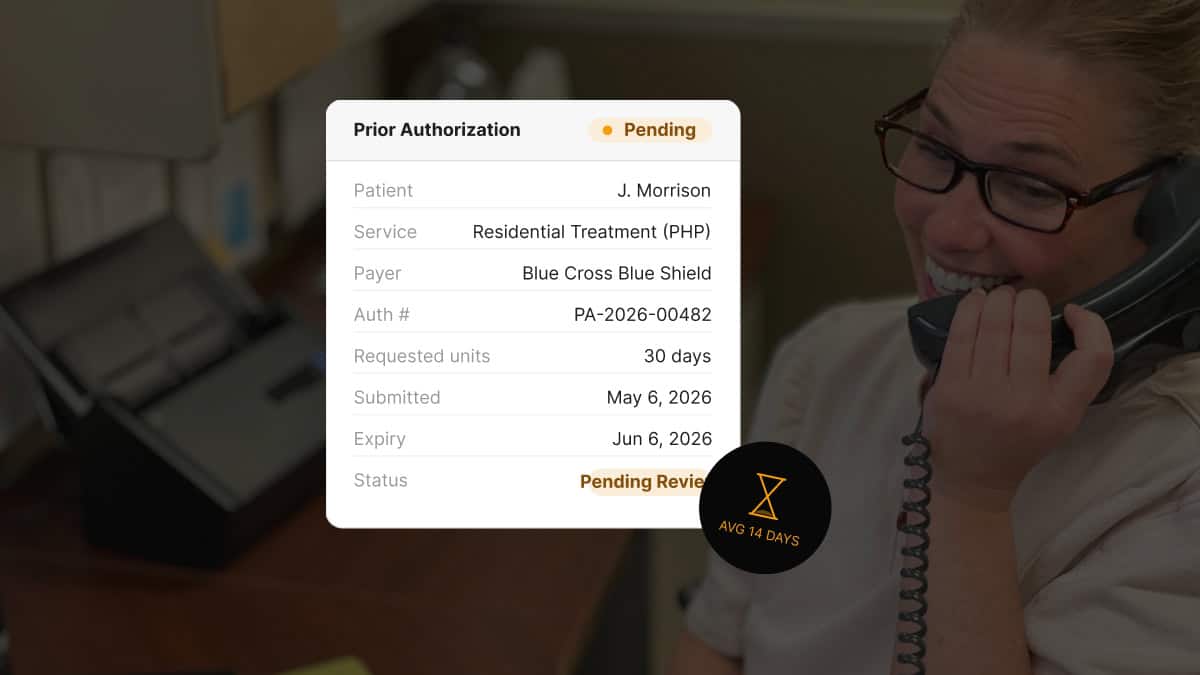
Years ago, getting another 14 days of residential approved looked like this. I would call a care manager I had worked with for the better part of a decade.
I would say, “Got this patient, going for another 14 days. Clinical meets the criteria.” She would ask one or two questions, look at the chart, and approve.
Sometimes the call was three minutes.
That kind of relationship still exists. It lives at a small number of domestic utilization review specialists who have spent years on the same payer panels, and it is the single biggest predictor of whether a treatment center gets the authorized length of stay it actually needs. It also sits at the center of how behavioral health billing and RCM either produces a full-length auth or compresses it.
The patient gets the same level of care. The clinical team submits the same documentation. The auth comes back at 14 days instead of 7.
A residential auth that comes back at 14 days instead of 7 is a $10,500 difference per patient at typical reimbursement. Across 30 admits a quarter, the right UR operation produces roughly $300,000 more in authorized days than the wrong one.
Prior authorization is a clinical conversation between two people who have to trust each other. The paperwork is downstream of that.
Most centers cannot run prior authorization workflows consistently in-house. Picking the right RCM partner, one that actually publishes prior-authorization turnaround benchmarks, is the single biggest lever on this metric.
Kyle McHenry, Founder, Revenue Logic
Key Takeaways
- A residential auth that comes back at 14 days instead of 7 is roughly $10,500 of difference per patient at typical reimbursement — and across 30 admits a quarter, that is ~$300K in authorized days the program either captures or leaves on the table.
- Auth length is decided by how the clinical submission is packaged against the specific payer’s medical necessity criteria, not by the underlying clinical case. The same patient at the same level of care gets a 14-day approval at one program and a 7-day at another for that reason alone.
- Offshore UR contractors materially compress lengths of stay because the care manager on the other end of the call reads the audit risk profile in real time. The visible billing-fee savings are dwarfed by the invisible reimbursement loss.
- The most expensive failure in prior auth is the chart that does not support the auth that was already obtained — audit risk, recoupment letters, and SIU referrals all live downstream of that gap. Run quarterly chart-to-auth audits and fix the documentation before submitting any new auths.
This guide explains what prior authorization actually is in behavioral health, where most UR operations fail, and how to build one that protects the program’s reimbursement on every patient.
What prior authorization actually is
Prior authorization (PA) is the insurance company’s review of whether a proposed service meets their medical necessity criteria before they will agree to pay for it. Both the American Medical Association and most major payers publish their own framing of how the process is supposed to run, though the actual mechanics behavioral health programs work with vary materially by payer and plan.
In behavioral health, prior auth applies to almost every level of care above outpatient. Detox, residential, partial hospitalization, intensive outpatient, and any extended residential stay all require prior auth from most commercial payers.
The actual mechanics: the treatment center’s UR team submits clinical documentation to the payer.
A care manager at the payer reviews the submission against the payer’s medical necessity criteria. The care manager approves a specific length of stay or a specific number of sessions, denies the request, or sends it back for additional information.
The auth is then on file. The claim that follows the service references the auth number. If the auth and the claim line up, the claim pays.
That is the textbook definition. It misses the part of the process that determines whether the auth comes back at full length or compressed.
Where the auth length is actually decided
Insurance company medical necessity criteria are not single-line tests. United Healthcare’s intensity of service guidelines are different from Cigna’s, which are different from Anthem’s, which are different from BCBS plans state by state. Most commercial payers anchor their behavioral health criteria to the ASAM Criteria, but each payer overlays its own intensity-of-service and continued-stay rules on top.
A UR specialist who knows the active criteria for the specific payer is calibrating the clinical submission to those criteria as it gets written. A UR specialist who does not is submitting a generic clinical and hoping for the best.
The care manager on the other end is working under quotas, time pressure, and a stack of cases. They are looking for clear evidence the patient meets the published criteria.
The submission that puts that evidence in the first paragraph gets approved at full length. The submission that buries it gets compressed.
This is why the same patient at the same level of care can get a 14-day approval at one program and a 7-day approval at another. The patient is the same. The clinical case is the same. The packaging of the submission is different.
That packaging is what experienced UR specialists do that newer ones do not.
Why offshore UR compresses lengths of stay
A growing number of billing companies have moved their UR operations to firms in India and other offshore markets. The cost savings are real. The downstream effect on auth lengths is also real.
A care manager at the insurance company has wide latitude on what to approve. They approve more for callers they recognize and trust, and less for callers they do not know who carry a language barrier into a clinical conversation.
When a domestic UR specialist who has worked the same payer for five years calls about a patient, the care manager is looking at a familiar voice on a clean program. Authorizations come back at full length.
When an offshore UR contractor reads a script for the same patient, the care manager is reading the audit risk profile in real time. Authorizations come back shorter.
We have seen length of stay drop materially inside a single quarter when offshore UR replaces domestic UR. The cost savings of the cheaper UR are visible in the billing fee. The lost reimbursement is not.
The chart-to-auth alignment problem
The most expensive failure in prior auth is the chart that does not support the auth that was already obtained.
A previous billing company “got the auth.” The clinical record does not justify it. The auth came back through generous interpretation of thin notes, or through the care manager’s relationship with the UR specialist, or both.
That is fine until the payer requests medical records on a future claim from that admission. When the records arrive and the documentation does not support the level of care that was authorized, the discrepancy becomes the treatment center’s problem. It is the same dynamic that drives most of the patterns I covered in reducing claim denials in behavioral health — documentation gaps that did not bite at submission show up six months later as recoupment exposure.
The downstream consequences are audit risk, recoupment letters, removal from contract networks, and in extreme cases SIU referrals. The previous billing company is long gone.
The remedy is a quarterly chart-to-auth audit. Pull a sample of recent authorizations. Read the clinical notes that supported each one. Ask whether a UR specialist could have built that auth from those notes.
If the answer is no on more than 5% of the sample, the chart documentation work has to happen before any new auths are submitted. Otherwise the program is building a deeper problem with every additional admit.
What clinical notes have to capture
The clinical team writing daily notes is often writing for one audience: the patient’s care plan. That is one of three audiences the notes need to serve.
The other two are the audit and the next authorization.
For UR purposes, every chart needs to capture the family dynamics that are driving or complicating treatment, the patient’s suicidality history and current risk profile, the treatment history including prior level-of-care attempts, and the medications that have been tried and failed.
When a UR specialist calls for a residential extension, those four data points are what the care manager is asking about. If the chart does not have them, the UR specialist is making a clinical case from memory. The auth that comes back reflects the gap.
The clinical team often resists this framing. Notes are for clinical care. The argument is right in principle and wrong in practice.
Insurance companies fund the program. Their criteria determine what the program can deliver. The chart that does not serve the auth process is leaving authorized days on the table.
The fix is not to ask clinicians to write differently. The fix is to give them a structured note template that captures the four UR-relevant data points alongside the clinical content, and to have UR review the notes before each renewal call.
How a Tennessee treatment center tripled its paid media close rate and cut missed calls to 1%
Full CRM configuration, system integrations, and call tracking metrics unified a fragmented admissions process into a single high-converting workflow in two months.
Read the case study →Up from 17% — missed calls cut from 15% to 1%
How to make the auth process faster
PRIOR-AUTH SIGNAL AT THE ELIGIBILITY LAYER
One shortcut worth naming: PayerLenz runs eligibility checks that surface prior-auth requirements and carve-out detection alongside expected out-of-network reimbursement for the payer, state, and level of care. That folds the prior-auth flag into the same intake step that already produces the VOB, instead of surfacing it three days later when the utilization review call goes sideways.
Build the Payer-by-Payer Playbook
One-page reference per payer covering active medical necessity criteria, typical care manager review time, most-requested extension documentation, and the payer’s known quirks. Refresh quarterly.
Submit to the Payer’s Review Windows
Some payers process same-day if the submission lands before noon. Some take 48 hours regardless. Submitting at the wrong time of the wrong day adds days you did not have to lose.
Track the Care Manager Assignment
Payers rotate cases across a small reviewer pool. Framing the same case tighter for a strict reviewer or with more clinical color for a flexible one shortens the auth cycle without changing the underlying medicine.
Three operational moves take the most friction out of the prior auth process.
First, run a payer-by-payer playbook.
For every payer the program works with, the UR team should have a one-page reference that lists the active medical necessity criteria, the typical care manager review time, the documentation that the payer requests most often on extensions, and any payer-specific quirks. This document gets updated quarterly.
Second, schedule UR submissions to match the payer’s review windows.
Some payers process submissions same-day if they arrive before noon. Some take 48 hours regardless. Submitting at the wrong time of day on the wrong day of the week adds days to the auth that did not need to be added.
Third, track care manager assignments.
Most payers rotate cases across a small pool of care managers. Knowing which manager is reviewing which submission shapes how the submission gets framed.
The same case framed for a strict reviewer gets fewer details and tighter language. The same case for a flexible reviewer gets more clinical color and more justification.
These three moves cost nothing in tooling. They cost time and discipline. The programs that build them in have shorter auth cycles, longer authorized stays, and fewer denial-adjacent failures down the line.
What this means for the program
Prior auth is the second lever after verification of benefits that determines what an admit is worth.
A program that gets full lengths of stay on every patient is collecting roughly 30% to 50% more revenue per admit than a program at the same level of care with compressed auths. The clinical care is the same. The financial outcome is not. The compounding sits inside the broader payer mix strategy every operator is running, whether they have made it explicit or not.
The single highest-impact UR investment most operators can make is putting domestic specialists on the work, building the four-data-point chart standard with the clinical team, and running quarterly chart-to-auth audits on the existing portfolio.
If your billing partner cannot tell you their typical residential auth length by payer, or how often their charts and auths line up under audit, the program is funding a UR process that is not measuring its own work.
That is closeable. The first 90 days of a serious UR rebuild produce visible reimbursement movement. The full payoff lands in the second quarter. If you want to know what a UR rebuild would look like inside your program, book an intro call and we can walk through the diligence framework before any retainer work begins.
This connects to the broader revenue cycle picture covered in behavioral health marketing guide and billing mistakes that reduce admissions.
Frequently asked questions about prior authorization for addiction treatment
What is a typical authorization length for residential treatment?
Most residential authorizations start at 7 to 14 days, with continued stay reviews every 7 to 14 days. The actual length depends on the payer, the level of care, the patient’s clinical presentation, and the strength of the clinical documentation. ASAM-aligned programs typically get longer initial authorizations than non-ASAM-aligned programs.
The pattern across payers is meaningful. Commercial PPO plans tend to authorize longer initial stays. Medicaid managed care plans tend to authorize shorter initial stays with more frequent concurrent reviews. Self-funded employer plans vary widely based on the third-party administrator’s UR vendor.
Most programs over time learn to forecast authorization patterns by payer and use that data to set realistic expectations for clinical and admissions teams. Programs that admit without that forecasting capability often over-promise length of stay to patients and under-deliver.
Can we get more days authorized if we appeal a short authorization?
Sometimes, with discipline. The appeal pathway for authorization length depends on the payer and the specific clinical evidence available. Appeals based on documented clinical deterioration, dual diagnosis complications, or specific ASAM dimensional findings often succeed in extending authorized lengths. Appeals based on patient preference or facility convenience rarely succeed.
The mechanics matter. A strong appeal includes the original clinical justification, new evidence of medical necessity, payer-specific language references, and a clear request for the specific extension. Generic appeals that simply restate the original argument rarely produce different outcomes.
Most programs that appeal authorization decisions consistently extend an average of 2 to 5 additional days per admission across their book. That sounds small but compounds across a facility’s annual census into meaningful revenue. The discipline pays for itself.
Should we wait for full authorization before admitting?
For commercial in-network admissions, no. Wait for initial authorization or the payer’s defined deadline, then admit. For out-of-network admissions, the calculation is different. Admitting without authorization on OON cases exposes the program to denial risk that often cannot be recovered.
The middle path for OON cases is to admit on documented benefits verification with clear understanding that authorization is pending, and to escalate the auth request immediately. Most OON insurers can authorize within 24 to 48 hours when the clinical justification is strong and the request is properly framed.
Programs that admit without any authorization framework end up writing off significant percentages of their OON book. Programs that wait for full authorization on every admission lose admits to competitors who admit faster. The right policy is somewhere in between, defined by payer type and clinical risk tolerance.
How does prior authorization differ between in-network and out-of-network?
In-network authorization works through established payer-provider relationships with predictable timelines, defined criteria, and standardized review processes. Out-of-network authorization works through case-by-case review with each individual claim, generally longer turnaround, and more variable approval criteria.
In-network authorizations are typically obtained within 24 to 48 hours for residential, often faster for outpatient. Out-of-network authorizations can take 3 to 7 days for initial review, with single-case agreement negotiations sometimes extending beyond that.
The operational implication is that out-of-network programs need more aggressive concurrent review, more detailed clinical documentation at every step, and more careful single-case agreement workflows. In-network programs can rely on more standardized authorization workflows that scale across higher volumes.
What happens if a patient stays past their authorized length?
If continued stay was approved by the payer, the additional days are reimbursed at the standard rate. If continued stay was requested but denied, the program can either discharge or absorb the cost of unauthorized care. If continued stay was never requested and the patient stayed past authorization, the days are not reimbursed and the program writes off the cost.
The financial exposure for unauthorized care varies by facility size and payer mix but is typically meaningful. A residential program that stays patients past authorization for an average of 2 days per admit across an annual book is writing off six figures of revenue annually.
The fix is process discipline. Authorized length should be tracked in real time. Continued stay requests should be initiated before authorization expires, not at expiration. Discharge planning should be calibrated to authorized length when clinically appropriate. Programs that systematize this work convert authorization length into a real revenue lever rather than a constant write-off source.
The perspective in this article comes from 9 years working exclusively inside behavioral health.
We are a team built by people in recovery who understand that behind every admission is someone asking for help. If that resonates, get to know us.
Kyle McHenry is the founder of Revenue Logic, a behavioral health revenue cycle management firm. He has spent 15 years working with treatment center operators on verification, utilization review, and claims management. Webserv partners with Revenue Logic to surface RCM-side guidance for behavioral health admission operations.