At a glance: This is a working operator’s guide to rehab lead generation in 2026, written from a decade of building patient-acquisition systems for behavioral health centers. It covers what’s actually moving admissions today, the lead-handling math most agencies skip, and how to evaluate whether to build an in-house lead engine, outsource it, or buy from aggregators (one of those answers is usually wrong for your situation).
Key Takeaways
- The bottleneck isn’t lead volume. It’s lead handling. Centers responding under 5 minutes triple admit conversion versus those at 30+ minutes. Most rehabs run at 18–25 minutes average response time.
- Owned acquisition outperforms purchased leads on every quality metric. Aggregator leads convert at 6–9% admit rate; owned-funnel leads convert at 22–30%. The CPA arithmetic flips fast once you measure to admit, not to inquiry.
- The math that matters: $78K average lifetime value per residential admit (initial stay + extended care + readmission probability + alumni referrals). At a 25% lead-to-admit rate, you can afford a $3,000 cost per lead and still hit a 6:1 revenue ratio.
- In-house vs. outsource vs. aggregator: three different operating models with different break-even points. The decision framework is in the dedicated section below.
- Eight strategies, not thirteen. Tightened from the prior version because depth beats breadth on the strategies that actually move admits in 2026: organic search, paid search, landing-page CRO, GBP and local SEO, content authority, marketing automation, lead scoring, and admissions ops integration.
- AI search is real, but it’s not the lead-gen story. Answer engine optimization matters for top-of-funnel education content. Direct admit acquisition still happens through classic SERP plus paid plus owned-channel nurture.
- Compliance is a moat, not a tax. HIPAA-safe tracking, BAA scope, and PHI minimization eliminate a category of agencies and platforms most centers should never have considered. The narrowing helps you.
A note before the strategies
Operators ask us “how do we generate more leads?” and the honest answer is usually that they don’t have a lead-generation problem.
They have a lead-handling problem.
In every audit we run on a treatment center marketing program, the math comes back to the same place. Inbound inquiries at the top of the funnel are usually within 20% of where peers operate. Admissions response time, lead scoring, and cross-channel attribution are where the gap shows up.
A multi-state outpatient brand we worked with last year was running about 180 inquiries per month at a $52 cost per lead. The CMO was asking us to help generate more.
We pulled their CRM, mapped the response-time data, and saw 23 minutes average from inbound to first contact. A Harvard Business Review study of 1.25 million leads found firms that responded within an hour were nearly seven times as likely to qualify a lead as those that waited even an hour longer. We rebuilt the admissions response workflow before touching a single ad campaign.
Two quarters later: 165 inquiries per month (slightly lower volume), 4-minute average response time, and admit count up 41%. CPA dropped from approximately $8,200 to $3,400 because the leads they were already paying for started converting.
That story is the reason the rest of this article is structured the way it is. We cover lead generation tactics in depth (strategies 1–8), but the admissions ops layer is what makes those tactics actually pay off.
A second admission: most of what gets sold as “rehab lead generation” in 2026 is lead distribution arbitrage. Pay-per-lead vendors purchase or generate inquiries in bulk and resell each one to 3–5 treatment centers.
The CPA on the invoice looks attractive. Admit conversion on those leads runs 6–9% versus 22–30% on owned-channel acquisition. We have a section on aggregator math below: read it before you sign anything.
This guide is for operators building durable, owned acquisition. If you’re looking to spin up emergency census in 60 days, the playbook is different and we’d recommend a paid-search-led emergency build instead. If you’re not sure which path fits, the intro meeting is the right place to work it out.
What is rehab lead generation?
Rehab lead generation is the system of attracting, qualifying, and nurturing prospective patients (and their families) into admissions. The system spans four layers: visibility (organic plus paid), conversion (landing pages, forms, calls), qualification (scoring, insurance verification, clinical fit), and nurture (multi-touch follow-up across the decision cycle).
Most operators conflate the first layer with the whole system. That’s the source of the lead-handling problem we just described. Effective lead generation programs measure each layer independently and optimize the weakest one first.
A working definition for the rest of this guide: rehab lead generation is anything that increases qualified admissions per dollar spent.
Inquiry volume by itself doesn’t qualify. Cost per lead doesn’t qualify. Admit-attributable revenue per dollar is the only metric that holds up across channels.
Lifetime value math: why this category can afford expensive leads
$78K
Lifetime value of a 30-day residential PPO admit
4
Leads needed per admit at 25% conversion
$3,000
Ceiling cost per lead at a 6:1 revenue-to-spend target
20%
Readmission probability within three years
Operators new to performance marketing under-invest because they anchor on cost per lead instead of lifetime value. The arithmetic is the most important thing in this article.
Sample LTV calculation, 30-day residential admit, PPO-insured:
| Revenue stream | Amount |
|---|---|
| Initial admission (30-day residential) | $30,000 |
| Extended care (60-day PHP + 90-day IOP) | $27,000 |
| Readmission probability (~20% within 3 years × $30,000) | $6,000 |
| Alumni referrals (avg 0.5 × $30,000) | $15,000 |
| Total lifetime value | $78,000 |
At a 25% lead-to-admit conversion rate, every admit requires four leads. If your target gross margin on marketing is 6:1 (revenue-to-spend), the math allows up to $3,000 cost per lead and $13,000 cost per admit while staying profitable.
Most centers operate well below the ceiling because they’re running aggregator leads at 8% conversion. The same $3,000 cost per lead with 8% conversion means $37,500 cost per admit, which is upside-down on this model.
“The number that matters isn’t cost per lead. It’s revenue per admit divided by all-in marketing spend, and you need both numbers tied to the same CRM event to manage the program.”
Preston Powell, CEO, Webserv
This is the math agencies selling on inquiry volume don’t show. Ask for it before you sign.
In-house vs. outsource vs. aggregator: a decision framework
Three operating models exist for treatment center lead generation in 2026. Picking the wrong one is the single most expensive mistake we see in audits.
| Criterion | In-house | Outsourced agency | Aggregator (pay-per-lead) |
|---|---|---|---|
| What you’re paying for | Internal team, owned domains and ad accounts, full control | One retainer covering paid + organic + CRO | Pre-purchased inquiries resold to multiple buyers |
| Typical cost per admit | $1,500–$4,000 | $3,000–$8,000 | $6,000–$11,000 (real, after exclusivity drag) |
| Admit conversion rate | 22–30% | 18–25% | 6–9% |
| Attribution control | Full | Shared with agency, owned by you | None |
| Lead exclusivity | Exclusive | Exclusive | Shared with 3–5 competitors |
| Time to first lead | 60–90 days | 30–60 days | Same week |
| Best for | Multi-location operators with $200K+ annual marketing budget | Single-location to mid-size operators wanting one accountable partner | Short-term census emergencies only |
When in-house wins: Multi-location operators with internal marketing leadership, predictable budgets above $200K annually, and the appetite to build attribution infrastructure. The CPA floor is the lowest, but the activation cost is real.
When outsourcing wins: Single-location and growth-stage operators without internal marketing capacity. The agency premium pays for itself when the agency runs admissions-attributable reporting (not just GA4 traffic dashboards) and integrates with your CRM. Webserv’s behavioral health SEO capability is built for this profile.
When aggregators are defensible: Short-term census emergencies where any admit is better than no admit, and you have admissions staff with capacity to dial through 50 contacts to find 3 qualified prospects. The math almost never works for sustained operations.
The aggregator trap. A $300 CPL at 8% admit conversion means $3,750 cost per admit, which sounds reasonable until you do the second-order math.
The same lead is being worked by 4 other centers, the contact rate is below 35%, and the qualified-VOB rate is below 50%. Real cost per qualified admit on aggregator leads runs $6,000–$11,000. We have not seen an operator outperform an in-house or outsourced program by switching to aggregators on a sustained basis.
If you’re already on aggregator spend, the first audit move is to map admissions back to source. Most centers find 60-70% of aggregator-attributed admits would have come through organic or branded channels anyway.
Eight strategies for rehab lead generation
We cut from thirteen strategies to eight. The eight that survived are the ones we see actually moving admissions in 2026 across the 200+ treatment center engagements Webserv has run.
The five we cut (testing methodology, CTA optimization, form refinement, predictive analytics, personalization at scale) are real, but they’re tactics inside the eight strategies, not standalone strategies.
1. Organic search and SEO
Best for: Compounding admissions over 12–18 months at the lowest sustained CPA.
Search engine optimization is still the most durable rehab lead generation channel. Organic admits compound where paid ones reset every month.
The 2026 wrinkle: AI Overviews are intercepting top-of-funnel informational queries. Your foundational service pages still need to rank classically, and your educational content needs to be authoritative enough to get cited inside AI answers.
What we found: Service pages targeting level-of-care + insurance combinations (“blue cross PPO residential rehab Tennessee”) convert at 4–6x the rate of generic awareness queries.
Why it matters: Patient search intent at the bottom of the funnel is intent-rich and competitively underserved. The agencies optimizing for it are the ones with admit-attribution infrastructure, not the ones bragging about traffic.
Pro tips: – Target keyword mix: 20% high-volume general terms, 50% mid-volume modality and level-of-care terms, 30% insurance + geo combinations – Title tags under 60 characters with primary keyword plus a specific differentiator (insurance, payor mix, modality) – Content depth beats publishing frequency. One 3,000-word evidence-backed guide will outperform ten 700-word posts in this category
2. Paid search
Best for: Immediate, measurable lead flow when census is the priority and you can support $25–$185 CPCs.
Paid search connects your facility with high-intent searchers in the moment they’re ready. The cost per click is high because the lifetime value justifies it.
What we found: Treatment centers running broad-match keywords waste 30–40% of paid budget on low-intent traffic. Exact-match on insurance + level-of-care queries cuts wasted spend without cutting volume.
Pro tips: – Start exact match on high-intent terms ([insurance] [level of care] [city]). Expand cautiously. – Build negative keyword lists day one: jobs, career, salary, DIY, free, competitor names. Add new ones weekly from search-term reports. – Weight 60–70% of budget to business hours when admissions can answer. After-hours conversion drops 40%+ even with chatbots in place. – Increase budgets 30–40% in January (insurance resets) and September (back-to-school timing). These windows show 35–50% higher inquiry volume.
3. Landing page conversion optimization
Best for: Multiplying the value of every other lead source. CRO compounds.
Companies with 31–40 landing pages generate 7x more leads than those with fewer. The reason is intent-matched messaging: a landing page built for a specific search query consistently outconverts a generic homepage.
What we found: Most treatment center landing pages send PPC traffic to a homepage. The CPA looks bad because the page is doing two jobs poorly instead of one job well. Our complete guide to rehab CRO covers how to rebuild that path.
Pro tips: – Build dedicated landing pages per insurance, per level of care, per geo – Use Hotjar or Microsoft Clarity (free tiers) for session recording. The first 100 recordings will show 5–10 quick wins. – Test one element at a time. Headlines first (20–40% lift potential), then CTAs (10–30% lift), then forms (15–50% lift). Skip button colors until everything else is dialed. – Statistical significance threshold: 95% confidence and 7+ days. Premature decisions on low-volume tests are wrong 40% of the time.
4. Local SEO and Google Business Profile
Best for: Centers serving defined regional markets, especially multi-location operators.
Local SEO is where the highest-intent treatment seekers actually search. “Detox near me” outconverts every awareness keyword combined.
What we found: Centers with profiles updated monthly and 100+ photos receive 520% more calls than median. The work is mechanical, and most operators don’t do it.
Pro tips: – Claim and optimize Google Business Profile completely: services, hours, photos, attributes – Post weekly updates. Google rewards active profiles with up to 20% better local pack rankings – Respond to every review within 48 hours. Personalized responses (not templates) increase conversions 15–25% – Add 100+ facility photos prioritizing tours, outdoor spaces, and amenities. Reduces patient anxiety pre-call. – Build citations across the top 50 healthcare directories using BrightLocal or Yext. NAP inconsistency drops rankings 30%+.
5. Content authority and editorial depth
Best for: Building durable organic share of voice and earning AI search citations.
Deep editorial content that addresses the complete patient decision journey outperforms volume-driven blog operations. Authority content for treatment centers needs clinical accuracy, named SME review, and original data points.
What we found: A deep, evidence-backed guide on a specific level-of-care topic consistently outperforms a short general post. For treatment center content, the gap is wider because YMYL constraints filter out shallow content from search results entirely.
Pro tips: – Mine People Also Ask boxes and Reddit communities for actual patient questions, then build complete, evidence-backed answers – Target “best of” and comparison keywords (“inpatient vs. outpatient treatment”, “best dual diagnosis programs in [state]”). These convert 3–5x higher than awareness content. – Publish 2–3 deep articles monthly over 10 shallow ones. Quality compounds, volume rarely does. – Run editorial workflows with named clinical review on every published piece
6. Marketing automation and admissions response
Best for: Closing the gap between inquiry and contact, which is where most centers leak admits.
This is the lead-handling layer the framing prose addresses. Marketing automation isn’t a luxury here. It’s the difference between a 25% admit conversion rate and a 12% one.
What we found: Centers that send a personalized confirmation email within 60 seconds of form submission see 35% higher answer rates on the follow-up call. The automation costs almost nothing. The lift is enormous.
Pro tips: – Implement chatbot coverage for 5pm–9am hours. 40% of crisis-driven searches happen off-hours, and HIPAA-aware tools (Drift, Intercom with healthcare configurations) capture them at 20–30% better rates than no coverage. – Automated immediate response: confirmation email plus SMS within 60 seconds of inquiry submission – Multi-touch nurture sequence: 5–7 emails over 30 days, structured around “what to expect”, insurance verification, team introduction, facility tour scheduling. Converts 25–30% better than weekly cadence. – Segment by engagement level after week one (hot, warm, cold) and adjust frequency accordingly – Use HIPAA-compliant platforms only. Mailchimp and Constant Contact are not. Paubox, LuxSci, Kipu, and Dazos are.
7. Lead scoring and qualification
Best for: Allocating admissions team time to leads with the highest admit probability.
Not every inquiry is a viable admit. Without scoring, admissions teams burn capacity on prospects that won’t convert and miss the ones that would. Systematic scoring fixes both.
Pro tips: – Build a lead scoring model on 5 factors: insurance type (PPO=10, Medicaid=3), referral source (clinical=10, web=5), response speed (under 1 hour=8), geography (in-region=7), engagement signals (multi-page=6). Leads scoring 30+ convert at 5x the baseline. – Use multi-touch attribution. Treatment seekers average 7–12 touchpoints before admission. Last-click attribution undervalues SEO and content by 40–60%. – Calculate LTV by insurance type. Track which payors drive the longest stays and best reimbursement, then bias spend toward those. – Re-score weekly. Engagement signals decay; new ones emerge.
8. Admissions ops integration
Best for: Every center, no exceptions. The strategies above only pay off if the admissions team can convert.
We’ve put this last because it’s where most centers focus least, and it’s where the biggest gains live.
What we found: Average treatment center admissions response time is 18–25 minutes. Speed matters: in Harvard Business Review’s lead-response research, responding within an hour made firms nearly seven times as likely to qualify a lead as waiting even one more hour.
Pro tips: – Map every channel from first touch to admission in the CRM. If you can’t see the path, you can’t optimize it. – Set a 5-minute response SLA and instrument it. Auto-routing, paging, and call-tree configuration are the levers. Admissions ops infrastructure is what makes the SLA stick. – Score insurance verification rate by source. Channels that produce <50% VOB-eligible leads need targeting work, not more spend. – Run admissions team training on the full nurture sequence. The team that knows what the prospect already received converts at higher rates.
How to generate rehab leads if you’re starting from zero
Operators new to lead generation often ask: where do we start? The honest sequence:
First 30 days: audit current state, map every existing lead source to admit outcomes, and build the cost-per-admit baseline by source. Without that, every other decision is guessing.
Days 30–90: fix the lead-handling layer first. Set the 5-minute response SLA, instrument the CRM, train the admissions team on the nurture sequence. This work has zero acquisition cost and the largest immediate impact on conversion.
Months 3–6: build the foundational organic content (level-of-care, insurance + geo, authority content) and stand up the paid search program with exact-match high-intent keywords. Both run alongside lead-handling improvements.
Months 6–12: scale the channels that show admit attribution, cut the ones that don’t, and add CRO once you have enough volume to test meaningfully.
Months 12+: the compounding window. Organic admissions become forecastable. Paid efficiency improves as the ML models converge on actual admit data, and the marketing program transitions from a cost center to a predictable patient acquisition system.
The mistake we see most: operators trying to scale acquisition before fixing lead handling. The leads end up paying for themselves at half the rate they should.
Compliance and ethics
Treatment center marketing operates under YMYL scrutiny, HIPAA constraints, and state-by-state advertising rules. The compliance layer narrows the agency and tooling pool, which is good for operators who pay attention. It also raises the bar when comparing rehab marketing agencies on category experience.
HIPAA scope: marketing to prospective patients generally falls outside HIPAA constraints. The transition to patient status creates compliance obligations, and marketing systems must prevent PHI exposure through secure transmission, encrypted databases, and access controls. HIPAA marketing compliance is required reading.
BAA scope: every vendor in the tracking and analytics chain that touches PHI needs a Business Associate Agreement. Most generic marketing platforms cannot provide one, and the resulting narrowing of the vendor pool helps you.
Targeting ethics: aggressive remarketing to people in acute distress crosses the line. Frequency caps of 3–5 impressions per week balance awareness and dignity, and platform targeting categories that mention substance abuse directly should be avoided. They violate platform policies and signal poor judgment.
Outcome claims. Specific outcome statistics (“90% success rate”) trigger state regulator review unless they’re substantiated by published research. The substantiation work is real, and most centers should default to qualitative outcome framing instead.
Measuring success
THE ONE METRIC THAT MATTERS
Cost per admission tied to first-touch and multi-touch attribution, segmented by source. Cost per lead reports channel efficiency at the top of the funnel. Lead-to-admit conversion reports the handling layer. Cost per admission is the number that closes the loop across both, and once it is instrumented, budget decisions become almost automatic — channels with positive ROI get more, channels under 1:1 get cut. Programs that measure everything except CPA end up over-investing in the channels with the loudest lead volume and quietly starving the ones producing real admits. Our complete guide to behavioral health marketing covers how those channels fit together.
Full-funnel measurement tracks performance from impression to admission. Different metrics reveal different things.
| Metric | Target | What it tells you |
|---|---|---|
| Cost per lead | $50–$300 | Channel efficiency at the top |
| Lead-to-admit conversion | 15–30% | Lead quality and admissions handling combined |
| Cost per admission (CPA) | $1,500–$8,000 | The number that actually matters |
| Average revenue per admission | $15,000–$40,000 | Determines what CPA you can sustain |
| Marketing ROI | 3:1 to 5:1 (spend:revenue) | Program-level health |
| Patient lifetime value | $40,000–$80,000 | Justifies higher acquisition costs |
| Average response time | Under 5 minutes | The biggest unfixed gap most centers have |
The single most useful instrument: cost per admission tied to first-touch and multi-touch attribution, segmented by source. Channels with positive ROI should get more budget; channels under 1:1 should be cut. Half-measures on this discipline are why most center marketing programs underperform.
How much do rehab leads cost in 2026?
The honest answer: rehab lead costs vary more than almost any category in healthcare marketing, and any operator quoting you a single number is oversimplifying. Cost per lead ranges from $40 for a low-intent form fill sourced through content marketing to $2,000+ for a paid-search click on a high-value keyword like “luxury alcohol rehab near me.” The variance is the point. What matters is not the cost per lead but the cost per admit that a channel produces at your quality bar.
Here is what the 2026 market looks like across the main sources our team tracks:
| Source | Typical cost per lead | Typical lead-to-admit rate | Effective cost per admit |
|---|---|---|---|
| Organic search (SEO) | $0 marginal + fixed retainer | 8-15% | $400-$900 blended |
| Google Search Ads (branded) | $60-$180 | 10-18% | $500-$1,400 |
| Google Search Ads (non-brand commercial) | $150-$600 | 6-12% | $1,800-$6,000 |
| Meta Ads (lead form) | $40-$120 | 2-6% | $1,500-$4,500 |
| Purchased leads (aggregator) | $150-$400 | 3-8% | $2,500-$8,000 |
| Referral partner network | $0 direct + relationship cost | 25-45% | Variable but usually the cheapest |
The pattern is consistent: cheap leads convert badly and expensive leads convert well. Preston Powell, Webserv’s CEO, frames it this way: “The number that matters is what a paid admission costs you all-in against what a paid admission is worth. A $2,000 lead that produces a 40-day residential admit at $30,000 in collected revenue is a bargain. A $50 aggregator lead that never picks up the phone is expensive at any price.”
For deeper cost-per-admit modeling, see our companion piece on how to lower cost per admit without cutting ad budget. And for the payer-mix side of this equation, KFF’s 2024 Employer Health Benefits Survey documents how deductibles and coverage design shape what a treatment center can actually collect from any given admit.
Buying rehab leads vs generating your own: when each makes sense
There is no ideological answer here. Buying leads and generating leads are two positions on a portfolio, and healthy admissions operations usually run both at different mixes depending on census posture and payer strategy. Here is the honest framework for choosing.
Buy leads when: you have census gaps you need filled this month, you have call center capacity that is underutilized, you have a clear payer profile you can filter for, and you have a tight lead-vetting process to protect your CRM from junk. Purchased leads compress time. You skip the six-month runway of building organic authority and pay a premium for volume you can turn on this week.
Generate leads when: you need durable admissions volume that is not exposed to a single vendor’s pricing or availability, you want to control the payer mix and the level-of-care mix of leads coming in, you have the operational patience for the four to nine month payback window most owned-channel investments require, and you want to reduce customer acquisition cost over time rather than have it drift upward with every vendor price increase.
The mistake most operators make is treating this as a binary. Facilities that buy 100% of their leads become financially dependent on one or two aggregators and lose pricing power. Facilities that generate 100% of their leads take too long to fill census when the market softens. The right question is not “which one” but “what mix, at what census posture, at what payer target.” Our cost-per-admit playbook walks through how to model the mix mathematically.
One warning about purchased leads specifically: the addiction treatment lead market has a well-documented history of low-quality intake data, shared leads sold to multiple facilities, and outright fraud. Kyle McHenry, co-founder of Webserv and PayerLenz, put it plainly on an internal call: “Every aggregator relationship needs a monthly quality audit and a written kill switch. If the leads stop converting at your admissions team’s bar, you kill the source that month, not next quarter.” LegitScript’s addiction treatment certification directory is a useful gut check on any vendor claiming rehab lead expertise.
How to verify rehab lead quality before your admissions team calls
A lead that arrives at your admissions desk without pre-verification wastes the two most expensive people in your operation: your admissions coordinator and your utilization review nurse. Here is the pre-call verification stack that reduces wasted call time and lifts your admit rate on the leads you do call.
Verify identity and contact reachability first. A phone number that does not ring and an email that bounces are lead-quality zero. Any lead-form vendor should provide phone verification and email deliverability checks at the source; if yours doesn’t, add a validation layer before the lead lands in your CRM. Twilio Lookup and NeverBounce are two common vendors in this stack.
Verify insurance coverage before the call. Real-time verification of benefits (VOB) at lead submission is the single largest lift you can make to lead quality. A lead with confirmed in-network coverage at your facility is worth far more than an unverified lead in downstream admit conversion. This is why insurance verification tools have quietly become the highest-ROI investment in modern admissions operations. PayerLenz data shows out-of-network residential rates ranging from $662 to $3,778 per day just within California BCBS home plans, which means “has insurance” is not enough. You need to know which plan, which employer group, and which negotiated rate applies.
Verify intent through response-time behavior. A lead who responds to a follow-up within five minutes converts at 6-10x the rate of one who takes an hour. Route your hottest inbound leads to your most experienced admissions coordinator immediately. Slower response is fine for lower-priority leads but never for high-intent commercial-insurance-verified inbound.
Verify clinical fit before you present admission. This is the piece most facilities skip. ASAM’s clinical practice guidelines lay out the level-of-care criteria that determine whether a caller is even appropriate for residential, PHP, IOP, or outpatient care. A lead who calls asking for detox but medically qualifies only for IOP is not a bad lead. It is a lead your admissions team should route to the right level of care, which is often at a partner facility if you cannot serve that need in-house. That behavior, over time, is what builds referral reciprocity.
HIPAA-compliant rehab lead generation: implementation-level rules
The compliance and ethics section above covers HIPAA scope and BAA vendor selection at a strategic level. This section covers the specific implementation prohibitions that show up most often when a lead generation program moves from proposal to production.
No PHI in ad platforms. Do not upload lead lists to Google Customer Match, Meta Custom Audiences, or LinkedIn Matched Audiences if any record on that list constitutes protected health information. A lead who filled out your “verify my insurance for treatment” form has, by that action, disclosed a substance use disorder concern. That is PHI under 42 CFR Part 2. The Meta Pixel HIPAA class actions of 2022-2024 established the market cost of getting this wrong.
No re-identifiable conversion tracking. Your Google Ads conversion pixel firing on your “thank you for your submission” page does not just count a conversion. It sends visitor identifiers back to Google, which then correlates that visitor with everything else Google knows about them. If Google can reasonably re-identify a visitor as an SUD prospect, you have created a compliance exposure. Server-side conversion tracking with hashed identifiers and strict field control is the modern workaround. See why treatment centers fail on Meta Ads for the specific patterns that trigger platform-level and legal-level risk.
Written marketing authorization for anything that resembles marketing to former patients. Under 45 CFR 164.508, marketing communications require patient authorization, with narrow exceptions. Post-discharge outreach that markets your alumni program, referral incentive, or new service line falls under this rule when it is funded by or promotes a third party. See 45 CFR 164.508 for the exact statutory text.
No third-party disclosure without written consent. 42 CFR Part 2 restricts even the acknowledgment that a patient is or was in treatment. Sending a lead’s information to a partner facility for a warm handoff requires written consent from the lead, not verbal, and not implied.
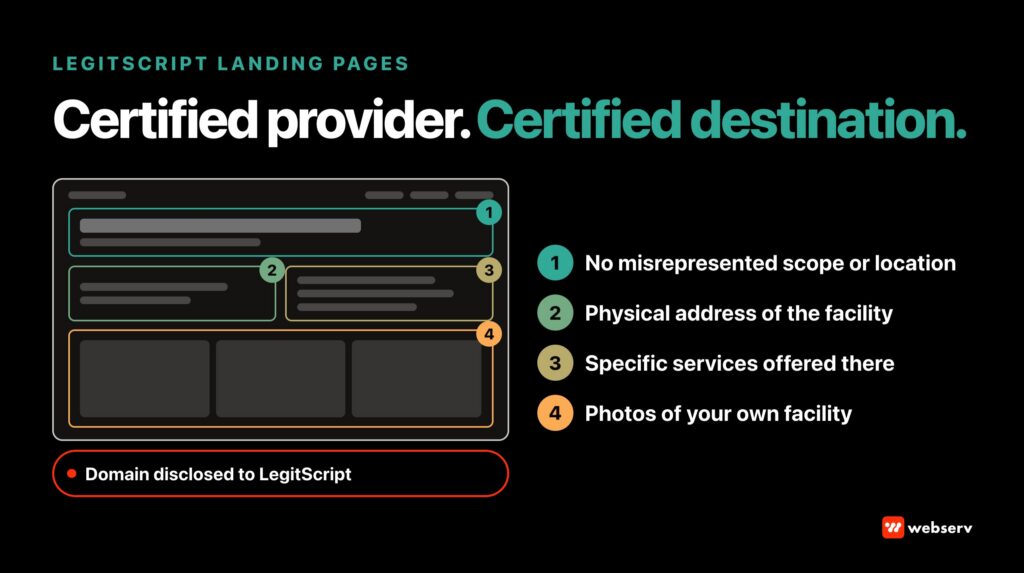
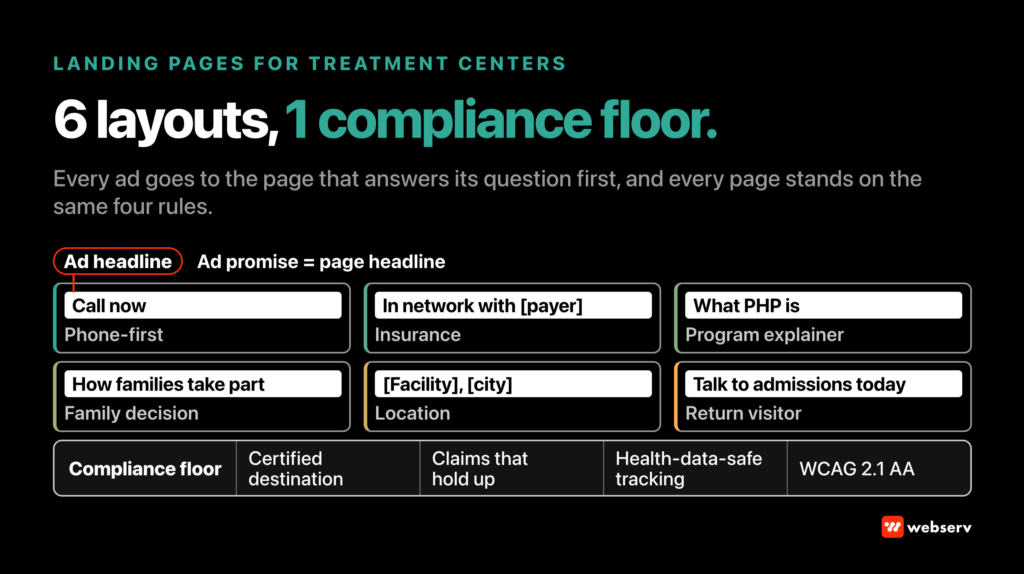
The practical compliance floor for a modern rehab lead generation program: HIPAA-covered forms with explicit consent language, server-side conversion tracking, no PHI in ad platform audiences, BAA in place with every vendor that touches lead data, and an annual compliance review with counsel who specializes in behavioral health.
Rehab lead generation for single-facility vs multi-location operators
The lead generation program that fills census at a 24-bed residential facility in Colorado bears almost no resemblance to the one that supports a 12-facility multi-state operator. Segmenting your strategy by facility count and geographic footprint is the fastest way to avoid spending on the wrong thing.
Single-facility operators (1 location, typically 20-80 beds): your best return per dollar comes from three sources in this order. First, a strong local SEO presence for your city and the two closest metro areas. Google Business Profile optimization, structured location page content, and consistent NAP data across the local citation ecosystem carry disproportionate weight when your total addressable market is one drive-time radius. Second, targeted paid search on your handful of highest-intent commercial keywords, geo-fenced tightly. Third, disciplined referral relationships with local therapists, primary care physicians, hospitals, and drug courts. You do not need scale infrastructure. You need reliability inside a defined market. See the complete guide to drug rehab SEO for the local-first playbook.
Regional multi-facility operators (2-5 locations in a defined region): you have earned the right to invest in cluster content and cross-facility payer intelligence. Your SEO can support hub-and-spoke content structures where a regional pillar page covers the treatment market and location pages compete for city-specific queries. Your paid search can share creative and landing infrastructure across facilities while running location-specific campaigns. Your referral partnerships can scale through case management teams that route across facilities based on level of care and payer fit.
National multi-facility operators (6+ locations across multiple states): you have the scale to justify a real content authority program, a national paid media strategy with sophisticated attribution, and infrastructure investments like a proprietary insurance-verification platform. Your competitive threat is not the boutique facility down the street; it is the other national operator with better data infrastructure. The strategic question shifts from “how do we generate more leads” to “how do we reduce cost per admit and increase payer-mix quality at scale.”
The mistake we see most often: single-facility operators buying enterprise SEO retainers they cannot support with operational bandwidth, and national operators running location-page templates that never localize. Fit the strategy to the operational reality.
Best rehab lead generation companies (and how to evaluate them)
We are not going to publish a ranked list of competitors, and we are skeptical of anyone in this category who does. What we can share is the evaluation framework we use when clients ask us to sanity-check a proposal from another vendor.
Ask about compliance posture first. Any lead generation vendor that cannot walk you through their HIPAA posture, 42 CFR Part 2 handling, BAA process, and server-side conversion architecture in the first 30 minutes of a conversation is a compliance risk. This is not gatekeeping. This is the price of playing in a category where the wrong tooling generates seven-figure legal exposure. LegitScript certification for the vendor and any subcontractors they use is a floor, not a ceiling.
Ask about payer strategy. The right lead generation partner has an opinion about payer mix and can defend it with data. A vendor who cannot answer “what commercial payers are you optimizing for and why” is treating your admissions pipeline as a volume game rather than a margin game. The best partners are as interested in the quality of who admits as they are in the count.
Ask about attribution methodology. A vendor who reports “leads generated” without reporting “admits attributed” is measuring the wrong thing. A vendor who reports admits without a documented attribution model (last-click, position-based, data-driven) is guessing. A vendor who cannot show you the actual leads that produced attributed admits is asking you to trust their reporting system rather than verify it.
Ask about contract structure. Performance-based lead generation contracts (pay per admit) sound aligned but create incentive to send you low-quality volume and let your admissions team sort it out. Fixed-fee retainers with quality SLAs create better alignment because both sides are held to lead-to-admit conversion rates rather than lead counts. The best structures include both a floor volume and a quality gate that either party can trigger.
Ask about references at facilities like yours. A vendor whose case studies are all national multi-facility operators may not know how to serve a single-facility residential program, and vice versa. Ask specifically for two references at your facility size, in your region, at your payer profile.
For a broader competitive market map of agencies in this space, see our reviewed list of the top addiction treatment SEO agencies for 2026.
Rehab lead generation FAQ
How do you verify rehab lead quality before your admissions team calls?
u003cpu003eThe pre-call verification stack has four layers. Verify identity and contact reachability first, using phone-verification and email-deliverability checks at the source (Twilio Lookup and NeverBounce are common vendors). Verify insurance coverage next, with real-time verification of benefits at lead submission, which is the single largest lift you can make to lead quality since a confirmed-in-network lead is worth 3-5x an unverified one.u003c/pu003eu003cpu003eVerify intent through response-time behavior. A lead who responds within five minutes converts at 6-10x the rate of one who takes an hour, so route the hottest inbound leads to your most experienced admissions coordinator immediately.u003c/pu003eu003cpu003eVerify clinical fit before you present admission. ASAM’s level-of-care criteria determine whether a caller is even appropriate for residential, PHP, IOP, or outpatient care. Routing a lead to the right level, even if that is a partner facility, is what builds referral reciprocity over time.u003c/pu003e
Can you use Facebook ads for rehab lead generation under HIPAA?
u003cpu003eYes, but only with a specific compliance architecture in place. You need server-side conversion tracking rather than the standard Meta Pixel, no protected health information in any custom audience upload, HIPAA-compliant lead forms hosted on your infrastructure rather than Meta’s native lead-ad forms, and a signed BAA with any vendor that touches lead data.u003c/pu003eu003cpu003eTreatment centers that ran Meta Pixel out of the box during 2022-2024 became defendants in HIPAA class action lawsuits that established the market cost of getting this wrong. The Meta Pixel by default sends visitor identifiers to Meta, which correlates that visitor with an SUD-related destination page. That is a re-identifiable disclosure.u003c/pu003eu003cpu003eThe compliant architecture is well-understood and buildable. It costs more to set up and requires ongoing monitoring, but it is the operational floor for any treatment center running paid social.u003c/pu003e
Is buying rehab leads legal?
u003cpu003ePurchasing rehab leads from a compliant vendor is legal, subject to a stack of federal and state requirements. Federally, the Eliminating Kickbacks in Recovery Act (EKRA, 2018) prohibits paying a fee for referrals of patients to recovery homes, clinical treatment facilities, or clinical labs. That statute has been interpreted broadly enough that pay-per-admit lead purchasing arrangements have been prosecuted.u003c/pu003eu003cpu003eThe safer contractual structure is fixed-fee, volume-based, or per-lead pricing that is not contingent on whether the patient ultimately admits. Consult counsel with EKRA experience before signing a lead purchase agreement. State laws layer on top and vary meaningfully.u003c/pu003eu003cpu003eBeyond legality, quality is the practical issue. The rehab lead market has a documented history of shared leads sold to multiple facilities, fake intake data, and re-sold aged leads. A vendor that cannot document lead exclusivity, source transparency, and quality scoring should be disqualified regardless of price.u003c/pu003e
What is the difference between rehab leads and rehab admits?
u003cpu003eA rehab lead is any prospective patient who has taken an inbound action: filled out a form, made a phone call, texted a helpline number, or submitted an insurance verification request. An admit is a lead who ultimately checked into treatment at your facility.u003c/pu003eu003cpu003eThe gap between the two is where the money is made or lost. Facilities that measure lead volume are measuring the top of the funnel. Facilities that measure cost per admit are measuring the actual economic outcome. Most operators overinvest in the top and underinvest in the middle: the admissions coordinators, the utilization review nurses, the intake follow-up process, and the insurance verification workflow that convert leads into admits.u003c/pu003eu003cpu003eThe ratio matters. A program producing 300 leads per month with a 6% admit rate produces 18 admits. A program producing 100 leads per month with an 18% admit rate produces the same 18 admits at a fraction of the ad spend.u003c/pu003e
What is the biggest mistake treatment centers make with lead generation?
u003cpu003eOptimizing for the wrong metric. Most facilities measure and reward lead volume, cost per lead, or click-through rate. The correct metric is cost per admit at your quality and payer-mix bar. When you measure the wrong thing, you incentivize the wrong behavior at every level: ad accounts get optimized for cheap clicks that produce junk leads, admissions coordinators burn hours on leads that were never viable, and vendors get paid for volume they never had to convert.u003c/pu003eu003cpu003eThe second-biggest mistake is treating lead generation as separate from admissions operations. The two are the same system. Leads that arrive without payer verification, level-of-care screening, or intent scoring produce admissions team burnout and low conversion rates.u003c/pu003eu003cpu003eBuilding the verification and qualification workflow inside the lead-generation program, not downstream of it, is what separates efficient admissions operations from inefficient ones.u003c/pu003e
How should single-facility operators approach rehab lead generation differently from multi-location operators?
u003cpu003eSingle-facility operators (1 location, 20-80 beds) get the best return per dollar from local SEO for their city and closest metros, targeted paid search on high-intent commercial keywords geo-fenced tightly, and disciplined referral relationships with local therapists, primary care physicians, hospitals, and drug courts. They do not need scale infrastructure; they need reliability inside a defined market.u003c/pu003eu003cpu003eRegional multi-facility operators (2-5 locations) have earned the right to invest in cluster content, cross-facility payer intelligence, and hub-and-spoke content structures where a regional pillar page supports city-specific location pages.u003c/pu003eu003cpu003eNational multi-facility operators (6+ locations across states) have the scale to justify a real content authority program, a national paid media strategy, and infrastructure investments like a proprietary insurance-verification platform. Their competitive threat is the other national operator with better data infrastructure, not the boutique facility down the street.u003c/pu003e