The ASAM Criteria’s fourth edition, published in 2023, no longer uses the name “partial hospitalization.” ASAM’s FAQ calls PHP a misnomer, since the services aren’t delivered in a hospital, and renames the level High-Intensity Outpatient.
Families still search for “PHP.” Medicare still defines partial hospitalization in its regulations. State licensing rules still use the older level numbers. A treatment center’s landing pages sit in the middle of all that vocabulary.
That’s one reason each level of care needs its own paid landing page. Detox, residential, PHP, and IOP answer different questions for different families, carry different insurance and clinical rules, and use different words depending on who’s reading.
This piece covers why each level needs a page, how to name each one accurately, what each page needs, and how to map campaigns to them. It’s how our landing page team for treatment centers builds level-of-care pages, and it builds on the complete guide to landing pages.
Key Takeaways
- Build one landing page per level of care offered at each facility. Each level answers different family questions and follows different insurance and clinical rules.
- Use the names families search, such as PHP and detox, and define them with the frameworks payers use. ASAM’s fourth edition renamed PHP High-Intensity Outpatient and folded withdrawal management into its main levels.
- Medicare requires at least 20 hours of services per week for PHP and at least 9 for IOP. There’s no Medicare cap of 19 hours on IOP.
- SAMHSA says detoxification by itself isn’t treatment. A detox page should explain what happens next.
- LegitScript requires websites to disclose the specific nature of services and not misrepresent their scope. List only levels of care the facility actually delivers.
- Keep ad-to-page messaging consistent. Google’s guidance says the exact search phrase doesn’t need to appear on the page, but the page should relate to what was searched.
Why each level of care gets its own page
A family searching for detox is asking how fast someone can be admitted and whether withdrawal will be managed safely. A family searching for IOP is asking whether treatment fits around work or school. A single page that tries to answer both answers neither well.

Google’s landing page experience guidance describes pages with text that relates to a person’s search terms. Its improvement tips recommend consistent messaging from ad to landing page, and note the word-for-word search phrase doesn’t need to be on the page.
Compliance points the same way. LegitScript’s certification standards require websites to disclose the specific nature of services provided and not misrepresent their scope, and require ads to accurately reflect the services available at each location. A page for one level of care makes that easy to get right.
DEFINITION
Modality landing page. A paid-traffic landing page dedicated to one level of care at one facility, such as residential treatment at a specific campus. It explains what that level involves, who it’s for, what a day looks like, insurance and admission steps for that level, and how it connects to the rest of the continuum.
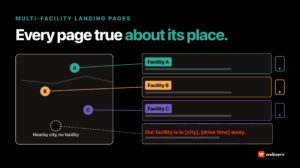
For multi-facility groups, that means one page per level of care per facility where campaigns justify it. Every fact on the page has to be true at that address.
Name levels the way families search, define them the way payers do
Families, payers, and regulators use different vocabularies. Good modality pages use the family’s words in headlines and the formal definitions in the body.
| Family term | ASAM 4th edition | Medicare rule | SAMHSA survey |
|---|---|---|---|
| Detox | Withdrawal management, within Levels 1.7, 2.7, and 3.7 | n/a | Residential detox described |
| Residential | Levels 3.1, 3.5, and 3.7 | n/a | Short-term residential typically 30 days or less |
| PHP | Level 2.5, High-Intensity Outpatient | 20+ hours per week | 20+ hours per week |
| IOP | Level 2.1, Intensive Outpatient | 9+ hours per week | 9+ hours per week |
ASAM. ASAM’s criteria FAQ explains the fourth edition changes: PHP is now Level 2.5, High-Intensity Outpatient, and withdrawal management levels moved into the main continuum. Its crosswalk maps Level 3.7-WM to 3.7 and folds 3.2-WM into 3.5. ASAM also says Level 4 is a hospital level of care.
Medicare. Federal rules at 42 CFR 410.43 require a minimum of 20 hours per week of therapeutic services for partial hospitalization. 42 CFR 410.44, added for Medicare’s intensive outpatient benefit starting in 2024, requires a minimum of 9 hours per week.
CMS’s final rule described IOP weeks as generally including 9 to 19 hours, and corrected an earlier summary that had described a 19-hour limit. The regulation sets a minimum, not a maximum.
SAMHSA. SAMHSA’s 2024 facility survey uses the same thresholds: partial hospitalization at 20 or more hours per week and intensive outpatient at 9 or more. It describes short-term residential as typically 30 days or less.
States. State licensing categories vary and may still use older ASAM numbering. Match the page to the facility’s license, not to a generic definition.
The practical approach: headline with the familiar name, such as “Partial Hospitalization Program (PHP),” and explain the schedule and intensity in plain terms below. If your payers or state use a different name, mention it once so families and referral partners recognize it.
The detox page
Detox searches tend to be urgent, and detox pages are where overpromising is most tempting.
SAMHSA’s FindTreatment.gov guide says detoxification by itself is not treatment; it’s a first step. NIDA’s principles of effective treatment say medically assisted detoxification is only the first stage of addiction treatment.
A detox page should cover:
DETOX PAGE CHECKLIST
- What withdrawal management involves at this facility, stated in terms of the facility’s license and staffing.
- How quickly admission can happen, and what the family should have ready when they call.
- What happens after detox: the step into residential, PHP, or outpatient care, and whether that happens at the same facility.
- Insurance and verification, with a clear way to start.
Be precise about medical claims. State licensing defines what a withdrawal management program must provide; California’s DHCS requirements, for example, describe 24-hour onsite supervision by trained personnel. Words like “medical detox” or “24/7 nursing” belong on the page only if the license and staffing support them.
The residential page
Residential pages serve families deciding whether a loved one should live at a facility for a period of time. The decision is bigger, and the page has to answer more.
FindTreatment.gov describes residential care as live-in care lasting one month to one year. NIDA’s treatment overview describes residential programs as usually lasting a few weeks to a few months.
A residential page should cover:
RESIDENTIAL PAGE CHECKLIST
- Who the program is for, including age range and any specialty tracks the facility actually runs.
- What a day looks like, from therapy to meals to family involvement.
- Real photos of the residence, since LegitScript requires photos that truthfully depict the facility.
- Length of stay, described honestly as individualized rather than a fixed number the facility can’t guarantee.
- Family involvement and visiting policies.
- The step-down plan after residential care.
The PHP page
PHP pages have a naming problem and a scheduling question.
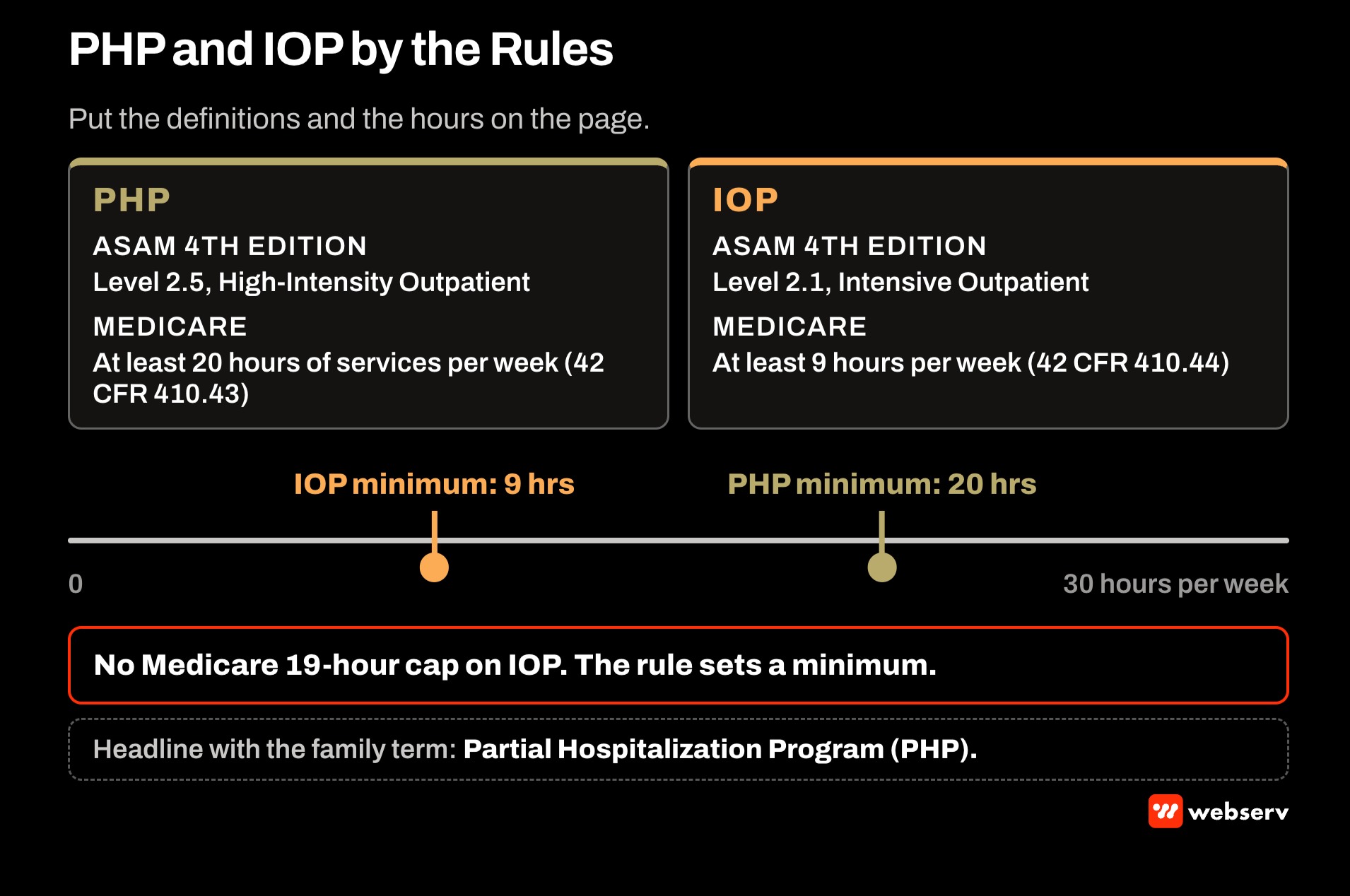
Use “Partial Hospitalization Program (PHP)” in the headline, since that’s what families and many payers still say, and explain that it’s a structured day program without an overnight stay. If the facility follows ASAM’s fourth edition language, add that it’s also called high-intensity outpatient.
The schedule is the core of the page. State the actual hours and days, since the program’s intensity is what separates it from IOP. For Medicare, that’s at least 20 hours per week; for commercial payers and state licenses, use the facility’s own requirements.
Answer the logistics questions families have: transportation, whether housing is available nearby, what happens on weekends, and how PHP connects to residential before it and IOP after it.
The IOP page
IOP pages serve people who need structured treatment while keeping up with work, school, or family.
State the schedule plainly, including whether morning, daytime, or evening tracks are available. For Medicare, IOP requires at least 9 hours per week; commercial payers and state licenses set their own requirements.
An IOP page should cover:
- Schedule options and how many weeks a typical plan runs at the facility, if the facility tracks that.
- What happens in sessions, such as group and individual therapy, without promising specific outcomes.
- Who IOP is right for, and when a higher level of care is recommended instead.
- Telehealth, if the facility offers it and it’s allowed under its license and payers.
COMMON MISTAKE
One page, four levels. A single “Our Programs” page lists detox, residential, PHP, and IOP with a paragraph each, and every campaign points to it. Families searching for detox read past three programs they didn’t ask about, and the page can’t answer any one question in depth.
Worse, a multi-facility group may list levels on a shared page that only some facilities provide. Build one page per level at each facility, and link between them.
What every modality page shares
Some elements belong on every level-of-care page, filled in with that level’s details:
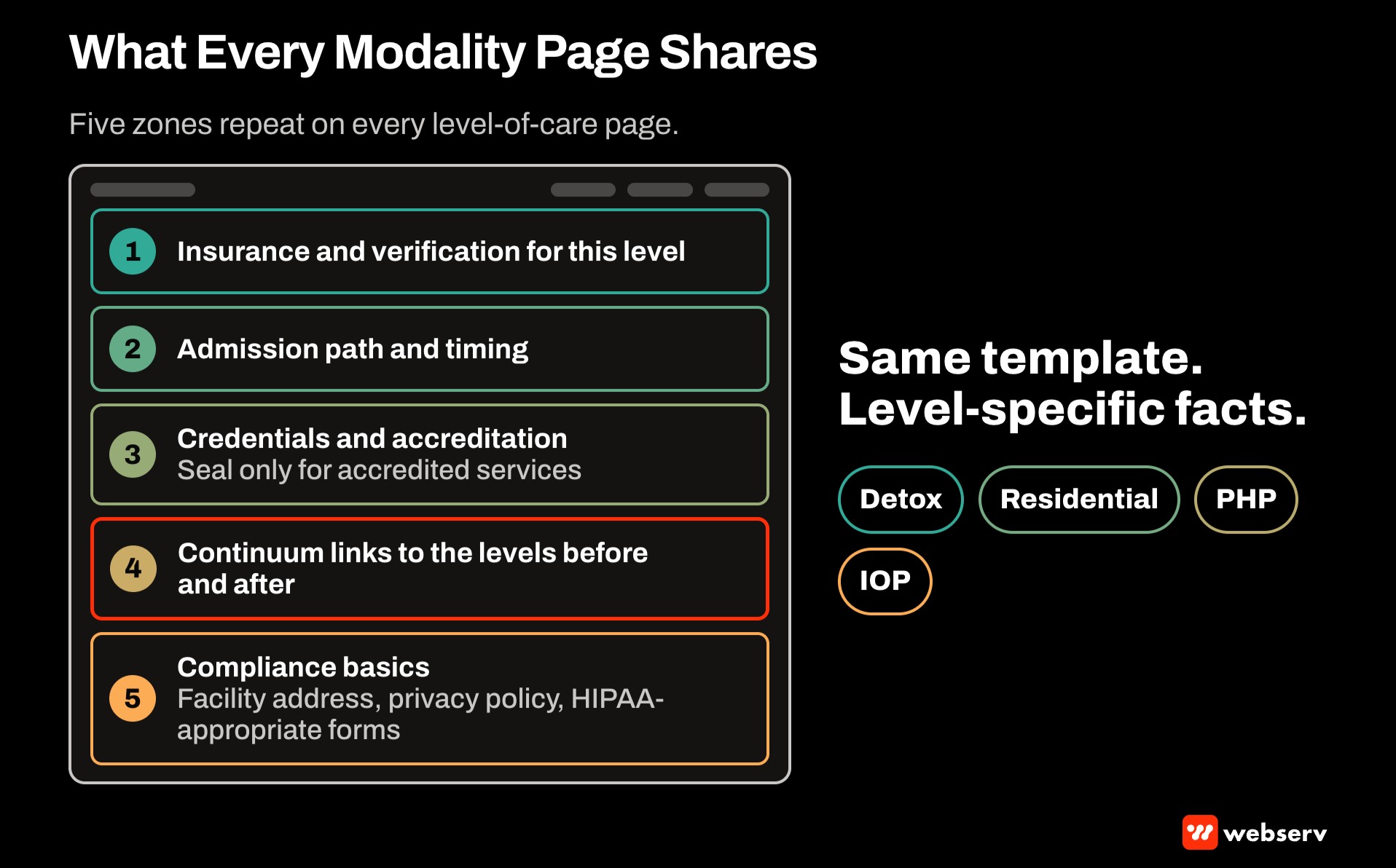
- Insurance and verification for that level, since coverage and authorization rules differ by level.
- The admission path: what happens after the family calls, and how long each step takes.
- Credentials and accreditation. If you show a Joint Commission seal, follow the seal usage guidelines accredited organizations get through the Joint Commission publicity kit: the seal may only reference services or sites that are accredited, and shouldn’t be altered.
- The continuum: links to the levels before and after this one.
- Compliance basics: facility address, privacy policy, and HIPAA-appropriate forms, as covered in our 10-point landing page checklist.
OPERATOR INSIGHT
Treat the continuum links as part of the conversion path, not navigation. A family that lands on the residential page but can’t commit to a stay may be a fit for PHP or IOP.
A clear “Not ready for residential? Here’s how our PHP works” link keeps that family on your site instead of back in search results.
Map campaigns to modality pages
Campaign structure should mirror the pages. Build ad groups around levels of care, with keywords and ads written for each, and send each ad group to its own page. Our Google Ads playbook and guide to ad group structure for residential treatment cover the setup.
List the levels each facility offers
confirmed against its license and LegitScript disclosures.
Build one page per level per facility
where campaign volume justifies it.
Group keywords by level
detox and withdrawal terms, residential and inpatient terms, PHP and day program terms, IOP and evening program terms.
Write ads that match the page
using the same program name and the same key facts.
Track calls and forms by page
so admits can be traced to each level’s campaigns.
Review quarterly
and whenever a program’s schedule, license, or payer contracts change.
Where this fits
Modality pages are one layer of a landing page program. For the layouts they build on, see our landing page design guide, and for how paid media fits the rest of your marketing, the complete guide to behavioral health marketing.
If you want a second look at how your level-of-care pages match your campaigns, book an intro meeting.
Frequently Asked Questions
Should detox, residential, PHP, and IOP each have their own landing page?
Yes, for paid campaigns. Each level answers different family questions and follows different insurance and clinical rules.
Separate pages let ads and landing pages match, which Google’s landing page guidance supports, and make it easier to describe services accurately, as LegitScript requires.
For multi-facility groups, build pages per level at each facility where the level is offered.
Is PHP still called partial hospitalization?
It depends on who’s using the term. ASAM’s fourth edition renamed it High-Intensity Outpatient (Level 2.5), calling PHP a misnomer since services aren’t delivered in a hospital.
Medicare’s regulations still define partial hospitalization, and many families and payers still use the term.
Use “PHP” in headlines and explain the program in plain terms, mentioning the alternate name once.
How many hours per week are PHP and IOP?
Under Medicare’s rules, PHP requires at least 20 hours of therapeutic services per week, and IOP requires at least 9.
There’s no Medicare maximum for IOP; CMS corrected an earlier summary that had described a 19-hour limit.
Commercial payers and state licenses set their own requirements, so state the facility’s actual schedule on each page.
What should a detox landing page say about what happens next?
That detox is the first step, not the whole of treatment. SAMHSA says detoxification by itself isn’t treatment, and NIDA calls medically assisted detox the first stage.
Explain how patients move into residential, PHP, or outpatient care after withdrawal management, and whether that happens at the same facility.
Keep medical claims to what the facility’s license and staffing support.
Can we list levels of care we offer at another facility?
Only if the page makes clear where each level is delivered. LegitScript requires websites not to misrepresent the scope or location of services.
A page for one facility should describe the levels available at that address, and link to sister facilities for others.
Keep each facility’s pages accurate as programs open, close, or move.
Keaton Nalle is the Director of Paid Admissions at Webserv, a digital marketing agency for treatment centers.