Google Ads turns on text customization by default in Performance Max, which lets Google’s AI write and adjust ad text from your site and assets. Meta says some of its Advantage+ creative enhancements, including generative ones, may be turned on by default too.
For a treatment center, that means AI is already producing some of your creative whether or not your team decided to use it. The practical question isn’t whether to use AI in ad production. It’s which parts of production it handles, which settings you control, and where a human has to sign off.
Our guide to AI-generated ad creative guardrails covers the compliance risks and the quality floor. This companion covers production: the settings to check on each platform, where AI speeds up the work, what it shouldn’t touch, how to handle rights and data, and a workflow that keeps a human in charge of every claim.
It reflects how our ad creative team for treatment centers runs AI-assisted production, and it builds on the ultimate guide to ad creative strategy.
Key Takeaways
- Google turns text customization on by default in Performance Max, and Meta says some Advantage+ creative enhancements may be on by default. Check both settings before any campaign launches.
- Google and Meta both limit some generative features for health advertisers. Don’t rely on that; check each feature in each account.
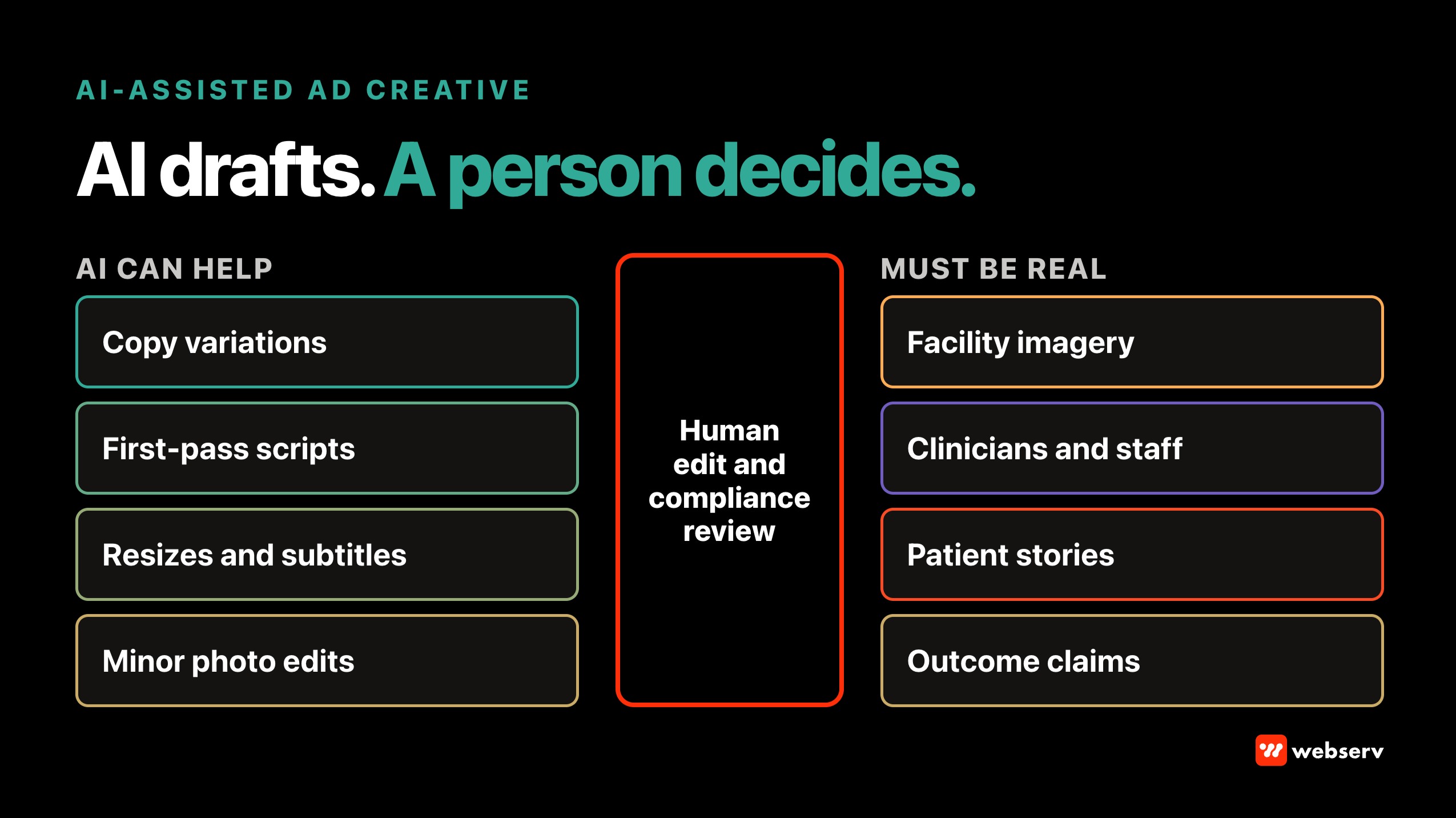
- AI is useful for drafting variations, resizing and cutdowns, subtitles, and first-pass scripts. It shouldn’t generate facility photos, clinician likenesses, patient stories, or outcome claims.
- LegitScript requires photos to truthfully depict the facility, so AI-generated facility imagery conflicts with certification.
- The US Copyright Office says purely AI-generated material isn’t protected by copyright. Human selection, arrangement, and edits can be.
- Don’t put protected health information into an AI tool unless the vendor has signed a BAA covering that product.
The settings to check first
AI features on ad platforms change often, and some are on unless you turn them off. Check these before launch and again after platform updates.

Google Ads. Google’s help page for Performance Max says text customization is turned on by default. Google’s opt-out instructions cover turning it off in campaign settings, and note that some optimizations can only be opted out through your account manager.
For Search, Google’s text customization settings include an option to use only the assets you provide. The same page says eligible campaigns are being upgraded to AI Max starting September 2026, so check live campaign settings now.
Some generative features exclude health advertisers. Google says Performance Max asset generation may be unavailable for URLs in certain categories, including health, and generated images require that the account isn’t advertising in a sensitive vertical. Text customization has no stated health exclusion.
Meta. Meta’s Advantage+ creative page lists generative features including text generation, image generation, background generation, and animation, and says some enhancements may be on by default. It also says advertisers in categories including pharma and health may not have immediate access to all generative features.
Meta’s instructions for turning enhancements off say some can only be turned off in advanced preview, and recommend checking what’s on by default before publishing.
COMMON MISTAKE
Approving the ad, not what the platform will show. A team approves a headline and image. Then text generation rewrites the copy, or text customization pulls a line from a service page, and the live ad says something no one reviewed.
Meta’s personal attributes policy bars ads that imply a viewer’s health condition. AI-rewritten copy can drift into exactly that phrasing. Turn off generative text features you haven’t reviewed, and check live ad previews after launch.
Where AI helps in production
Used on the right tasks, AI shortens the slowest parts of creative production without touching claims.
Drafting variations of approved copy. Start from a headline and body that compliance has approved, and ask for variations in length and tone. Every variation still goes back through review, but the team spends its time choosing rather than writing from blank.
First-pass scripts. A clinician explainer or admissions walkthrough can start as an AI draft built from your own intake notes, program pages, and approved claims. A human rewrites it in the speaker’s voice and checks every fact. Our video ad creative guide covers what those scripts need to include.
Resizing, cutdowns, and subtitles. Turning one approved video into vertical, square, and short versions, or adding captions, is repetitive work where AI tools save time without adding new claims.
Background cleanup and minor edits. Removing clutter from a real photo of your facility, adjusting lighting, or extending a background on a real image keeps the subject truthful. TikTok’s misleading content policy treats minor edits like these differently from fully AI-generated media.
Concept exploration. Rough AI mockups can help a team compare layouts or visual directions before a real shoot. Treat them as sketches, not assets.
What AI shouldn’t make
Some elements of a treatment center ad have to be real, or they create compliance problems no edit can fix.
DO
- Draft variations of approved copy.
- Write first-pass scripts from approved program facts.
- Resize, cut down, and subtitle approved video.
- Make minor edits to real photos, such as lighting or clutter.
DON’T
- Generate facility imagery.
- Create clinicians or staff.
- Invent patient stories or testimonials.
- Write outcome claims or statistics.
Facility imagery. LegitScript’s certification standards require photos that truthfully and accurately depict the applicant’s facilities. An AI-generated pool, lounge, or campus is a fabricated facility.
Clinicians and staff. An AI-generated person presented as your medical director implies expertise and a real person who don’t exist. The FTC’s Endorsement Guides say an endorser presented as an expert must actually have that expertise.
Patient stories. The FTC’s reviews and testimonials rule Q&A says there’s no blanket ban on AI-generated avatars, but they’re prohibited when the underlying testimonial is fake. An AI person describing a recovery that never happened is a fake testimonial.
Outcome claims and statistics. AI tools produce plausible numbers and confident claims. None of them belongs in an ad unless the facility can document it.
Rights and ownership
AI-assisted creative raises a question traditional production didn’t: who owns it?
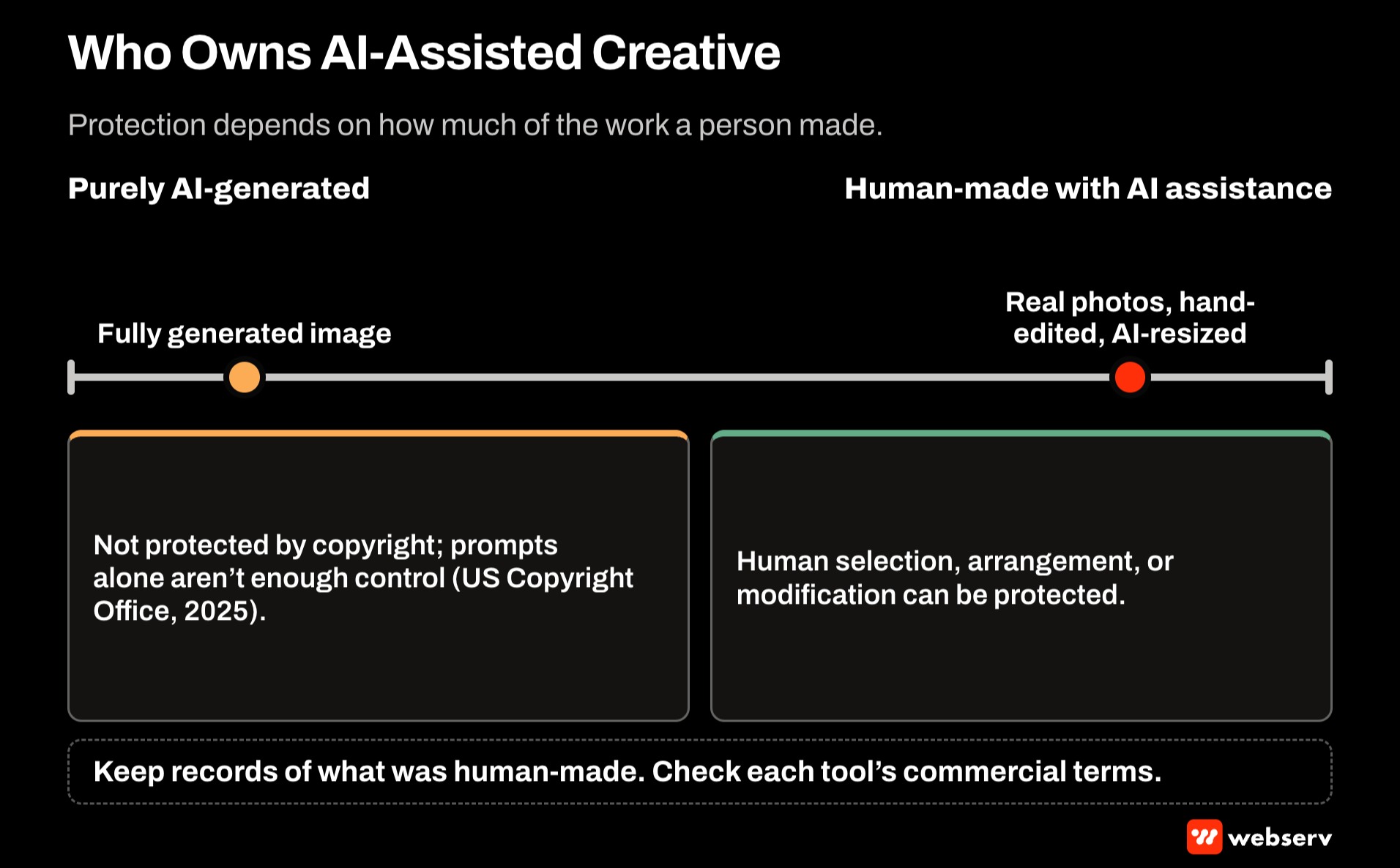
The US Copyright Office’s 2025 report on copyrightability says copyright doesn’t extend to purely AI-generated material, and that prompts alone don’t provide enough control. It also says human authors can claim creative selection, arrangement, or modification of AI outputs.
In practice, an ad a designer built from real photos, edited by hand, and used AI to resize is in a different position than a fully generated image. Keep records of what was human-made and what was generated.
Tool terms matter too. Adobe says its Firefly models are trained on licensed content, such as Adobe Stock, and offers IP indemnification to enterprise customers through a separate entitlement. OpenAI’s terms of use say users own their output, and prohibit representing AI output as human-generated when it wasn’t.
Check the commercial terms of every tool the team uses, including free tiers, before its output goes into a paid ad.
Data: keep PHI out of the tools
Creative production can touch patient information more often than teams expect: intake notes used for a script, a testimonial transcript, a screenshot of a CRM record.

HHS’s cloud computing guidance says a cloud service provider that handles ePHI for a covered entity is a business associate, even if it can’t view the data. An AI tool that receives PHI is in the same position.
Some AI vendors offer BAAs, but only for specific products. OpenAI’s help center says a BAA is available for its API and for sales-managed ChatGPT Enterprise and Edu accounts, not ChatGPT Business. Anthropic’s privacy center says standard Claude Enterprise plans don’t include BAA coverage without HIPAA settings enabled.
The simplest rule for a creative team: no patient names, stories, records, or identifying details go into any AI tool. Build scripts from approved program facts, not from charts. Our 42 CFR Part 2 guide covers the additional rules for substance use disorder records.
Labeling AI content
Platforms are adding AI disclosure, and the rules differ.
| Platform | Rule | Source |
|---|---|---|
| Meta | Labels ads made with AI when it detects industry-standard signals, and puts the label next to “Sponsored” for ads with a photorealistic AI-generated person (February 2025). | Meta newsroom |
| Allows AI labels in image and video creatives (July 2026 update), and notes AI rules in the EU, India, and New York that may require them. | Google Ads policy | |
| TikTok | Requires the AIGC label or a clear disclaimer for heavily edited or AI-generated ad content. | TikTok misleading content policy |
| YouTube | Requires creators to disclose realistic altered or synthetic content, such as a real person appearing to say something they didn’t. | YouTube Help |
For behavioral health, the safe default is to avoid photorealistic AI people entirely. Where AI changed an image or video in a way viewers could mistake for reality, label it.
A production workflow with a human in charge
Seven steps keep a person responsible for every claim, from first draft to live ad.
Start from approved claims
Keep a claims library: levels of care, locations, insurance, credentials, and what the facility can document. AI drafts only from that.
Check platform settings
Confirm which generative features are on for each campaign, and turn off anything you won’t review.
Generate drafts and variations
Copy, scripts, resizes, and cutdowns from approved material and real footage.
Human edit and fact check
A person rewrites for voice, removes anything not in the claims library, and checks for personal-attribute phrasing.
Compliance review
The same review any creative gets, with a note of which parts were AI-assisted.
Label where required
Apply platform AI labels or disclaimers where the content calls for them.
Log the asset
Record the tools used, the human edits, the approvals, and the source files.
Where this fits
AI-assisted production is one part of a creative program. For formats and templates, see our static ad creative templates and the guide to creative strategy for treatment center marketing.
OPERATOR INSIGHT
Keep the claims library as a single document your team and any AI tool draw from. When a new program launches or an insurer drops off, update the library first.
AI tools fill gaps with plausible details. A library of approved facts gives them less room to invent.
For how paid creative fits the rest of your marketing, see the complete guide to behavioral health marketing. If you want a second look at the AI settings in your ad accounts, book an intro meeting.
Frequently Asked Questions
Is Google or Meta already using AI on our treatment center ads?
Possibly. Google says text customization is on by default in Performance Max, and Meta says some Advantage+ creative enhancements may be on by default.
Both platforms limit some generative features for health advertisers, but not all of them.
Check each campaign’s settings, turn off features you won’t review, and look at live ad previews after launch.
Can we use AI-generated images of our facility?
Not as a depiction of your facility. LegitScript’s standards require photos that truthfully and accurately depict the applicant’s facilities.
AI tools can help with minor edits to real photos, such as lighting or removing clutter, without changing what the facility looks like.
Use real photography for facility, program, and staff imagery.
Who owns AI-generated ad creative?
The US Copyright Office says copyright doesn’t extend to purely AI-generated material, and prompts alone aren’t enough. Human selection, arrangement, and modification can be protected.
Tool terms also matter. Some vendors say users own their output, and some offer IP indemnification on enterprise plans.
Keep records of what was generated and what was human-made, and check each tool’s commercial terms.
Can we use ChatGPT or Claude to write ad scripts from patient stories?
Not with patient information, unless the vendor has signed a BAA covering the specific product you’re using. HHS treats cloud providers handling ePHI as business associates.
OpenAI and Anthropic offer BAAs only for certain products and settings.
The safer approach is to build scripts from approved program facts, not patient records or stories.
Do AI-generated ads need a label?
It depends on the platform and the content. TikTok requires the AIGC label or a disclaimer for heavily AI-generated ads, Meta labels some AI ads itself, and Google allows labels and notes regional laws that may require them.
YouTube requires creators to disclose realistic synthetic content.
For treatment centers, the safest approach is to avoid photorealistic AI people and label AI changes viewers could mistake for reality.
Keaton Nalle is the Director of Paid Admissions at Webserv, a digital marketing agency for treatment centers.