LegitScript prices addiction treatment certification per facility, and defines a unique facility as a distinct location that provides treatment, even under the same corporate registration. Its standards also say a provider may not claim to operate in locations where it doesn’t provide services.
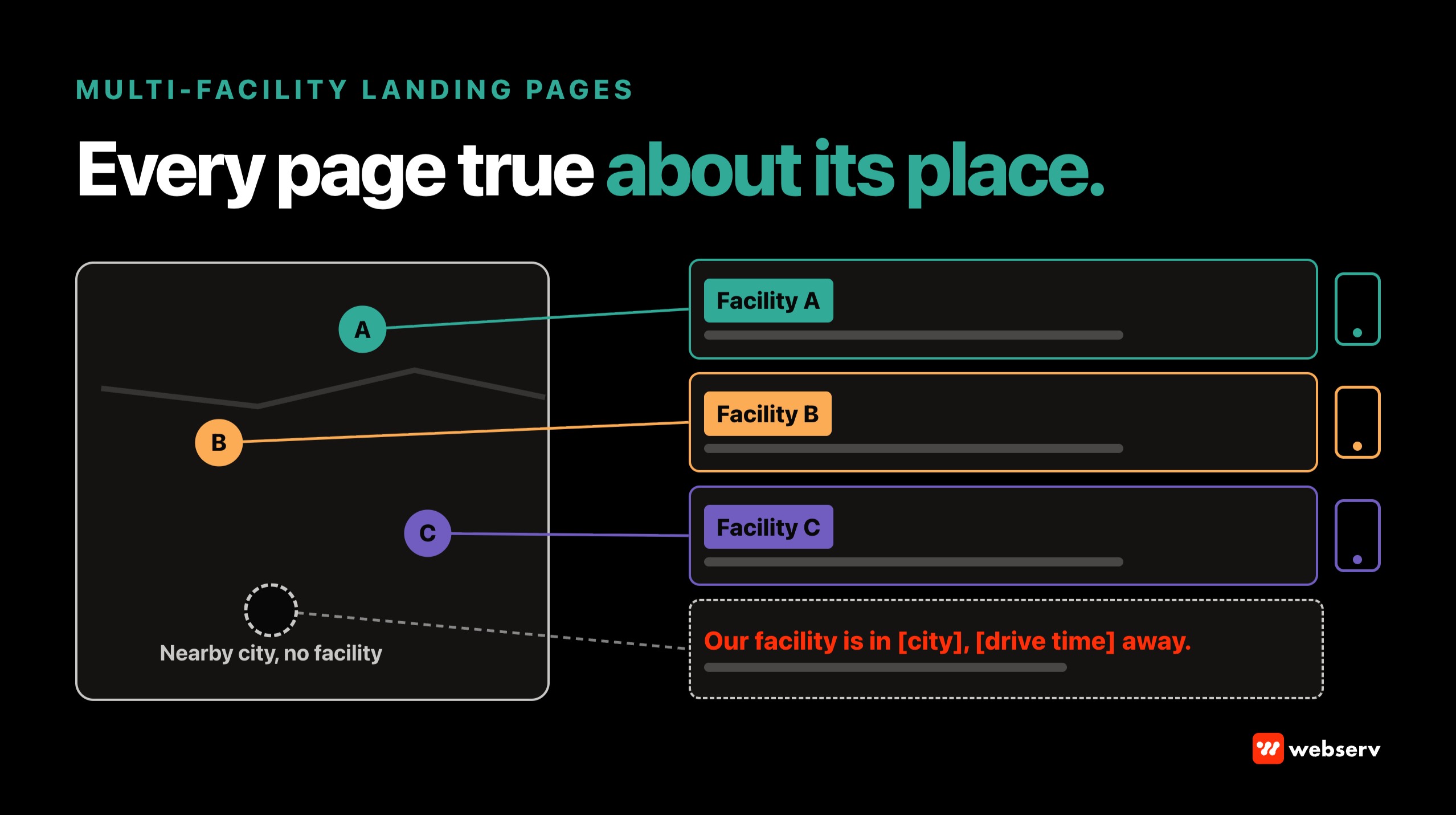
For a multi-facility operator, those two lines set the rules for location landing pages. Every facility is its own compliance unit, and every page that names a place has to be true about that place.
Done well, location pages are one of the most useful tools a multi-facility group has. A family searching for treatment near a specific city wants to see that facility, its address, its programs, and a number that reaches its admissions team.
This piece covers when to build a page per facility, what each page needs, how paid targeting and call routing should map to them, and the patterns that cross compliance lines. It’s how our landing page team for treatment centers structures multi-facility builds, and it builds on the complete guide to landing pages.
Key Takeaways
- LegitScript certifies and prices per facility, requires each facility’s physical address on the website, and bars claiming locations where the provider doesn’t deliver services.
- Build a landing page for each facility you operate. For nearby cities without a facility, say plainly where the facility is rather than implying a local presence.
- Google requires a separate addiction services certification application for each location or group of locations, tied to the ad account and certified domain. Microsoft requires landing page URLs to be certified.
- Google Ads defaults to “Presence or interest” targeting, which can reach people outside your service area. Google suggests considering “Presence” for sensitive verticals.
- Route each location page to that facility’s admissions line with its own tracking numbers, so calls, admits, and spend stay tied to the right facility.
- The FTC’s Evoke Wellness settlement shows the risk of location and brand confusion: the company used other clinics’ names as keywords to pose as those clinics.
When a facility needs its own page
A multi-facility group can send all paid traffic to one page with a location selector, or build a page for each facility. For paid campaigns, a page per facility usually fits better, for three reasons.
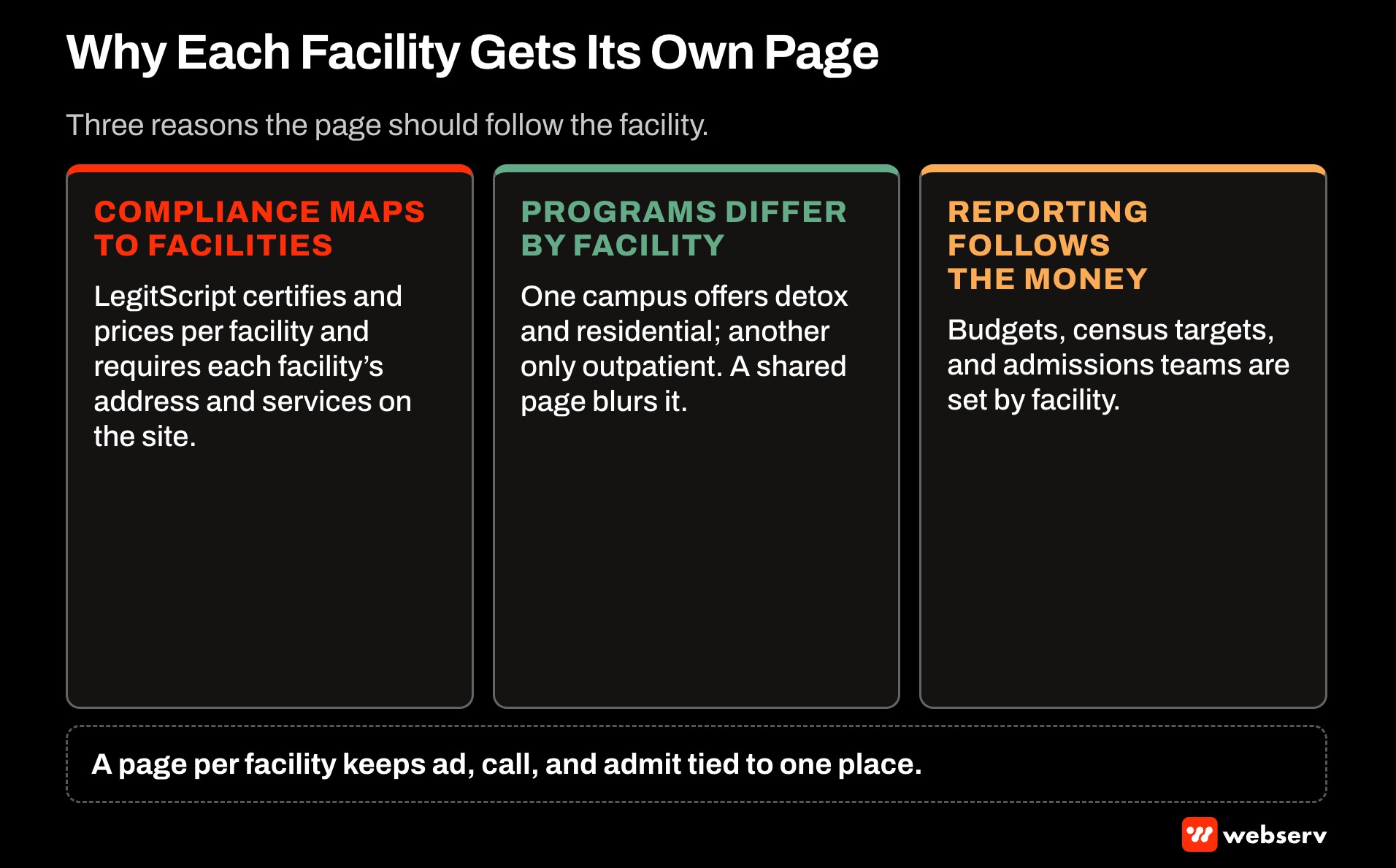
Compliance maps to facilities. LegitScript’s certification standards require the website to conspicuously disclose the physical address of each facility and the specific nature of services provided, without misrepresenting the scope or location of services. A page per facility makes that simple to show and simple to audit.
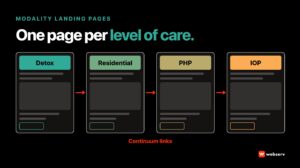
Programs differ by facility. One campus may offer detox and residential; another only outpatient. A shared page tends to blur that, and blurring it is where claims go wrong.
Reporting follows the money. Budgets, census targets, and admissions teams are often set by facility. A page per facility keeps the path from ad to call to admit separate for each one.
DEFINITION
Location landing page. A paid-traffic landing page dedicated to one physical facility, showing that facility’s address, the services delivered there, its own photos, and a phone number routed to its admissions team. It describes one real place, not a city the operator wants to reach.
What every location page needs
Each facility page should carry the same core elements, filled in with that facility’s facts:
LOCATION PAGE CHECKLIST
- The facility’s name and full street address, visible without scrolling or clicking.
- The levels of care delivered at that address, and only those. Link to sister facilities for services offered elsewhere.
- Photos of that facility. LegitScript requires photos to truthfully show the applicant’s own facilities.
- A phone number routed to that facility’s admissions team, with call tracking.
- Insurance and admissions details that apply at that location.
- The clinical and admissions leadership for that facility, where names and credentials can be shown accurately.
- A privacy policy link and HIPAA-appropriate form handling, as on every page.
Keep the shared parts shared. Brand, accreditation language, and the overall design can come from a template, as our landing page design guide covers. The facts have to come from the facility.
The patterns that cross compliance lines
Several common multi-location tactics conflict with LegitScript, Google, or FTC rules.
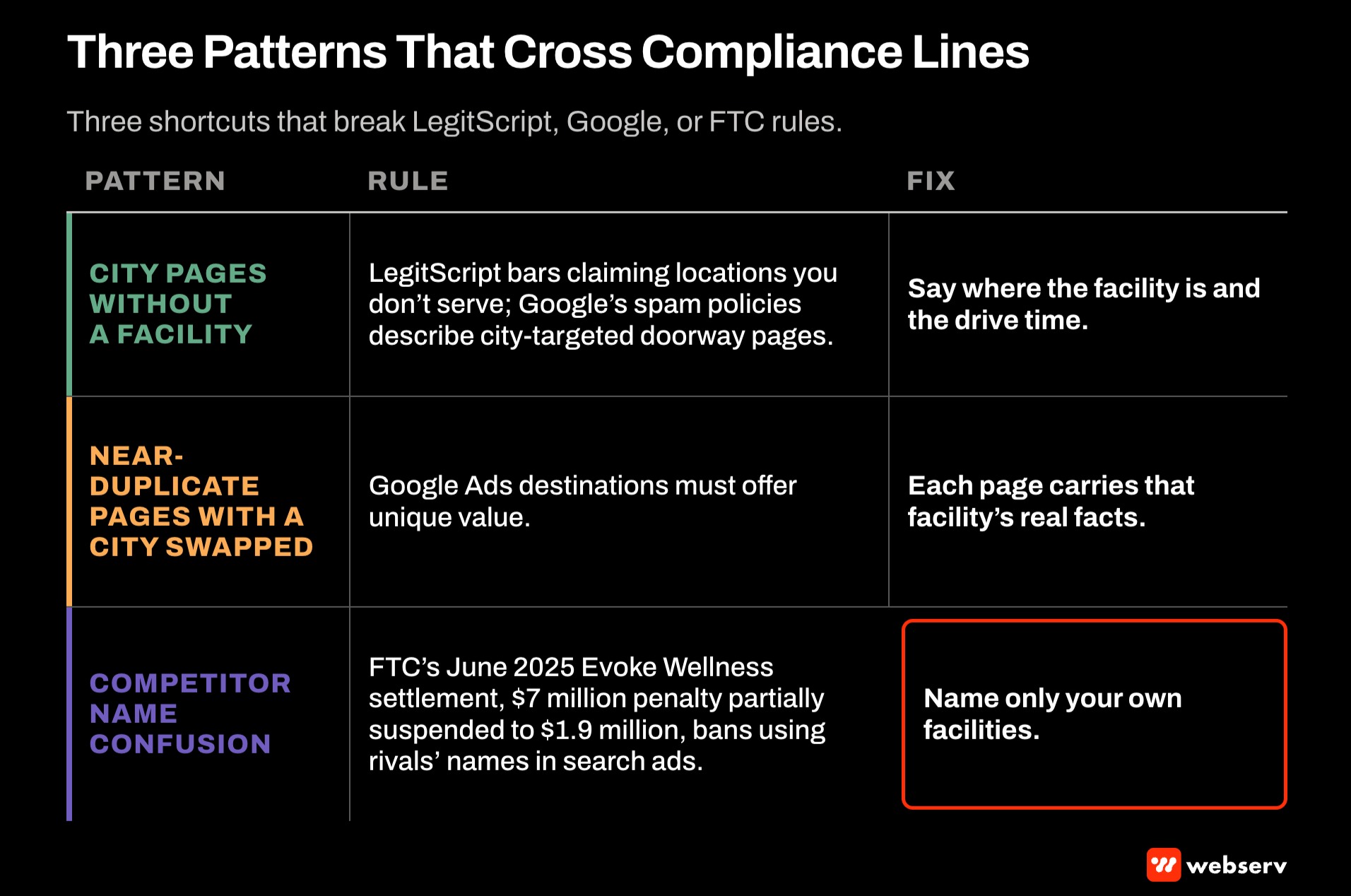
City pages for places you don’t operate. A page titled “Rehab in [nearby city]” for a city with no facility implies a local presence. LegitScript’s advertising standard bars claiming locations where the provider doesn’t deliver services.
For organic search, Google’s spam policies describe doorway abuse with an example that fits this pattern: multiple pages targeted at specific regions or cities that funnel users to one page.
Near-duplicate pages with a city name swapped. Google Ads’ destination requirements say destinations must offer unique value to users, and its related examples include templates or pre-generated sites with duplicate content. A page per facility works because each one carries different facts.
Competitor and brand confusion. In June 2025 the FTC settled with Evoke Wellness, which used other clinics’ names as keywords to pose as those clinics. The order bans the defendants from using rivals’ names in search ads, and the $7 million penalty was partially suspended to $1.9 million.
Location pages and ads should name your own facilities, in the places they are.
COMMON MISTAKE
The “serving” page. A facility in one city builds a page for a second city headlined “Serving [second city] families,” with local imagery and no mention of the drive. It reads as a local program.
A page for families in a nearby city can be honest and useful: “Our residential facility is in [city], [drive time] from [second city],” with directions and what admissions does to help families travel. Say where the facility is, in the headline or first lines.
Certification and platform setup per location
Multi-facility operators have more setup work before a location page can take paid traffic.
LegitScript. Each facility is its own unit for certification and fees. Per LegitScript’s current fee table, the application fee is $1,595 per facility for groups of one to nine facilities, with lower per-facility tiers above that. LegitScript’s FAQ says groups of 10 or more facilities likely qualify for enterprise certification.
Adding a facility or a domain changes what LegitScript needs to know, so update the certification before the new page runs. Our LegitScript certification guide covers the process.
Google. Google’s healthcare policy requires LegitScript certification plus Google’s own certification. Google’s certification guidance says advertisers with more than one location should submit a separate application for each location or group of locations, and applications are made at the child account level with the certified domain.
Microsoft. Microsoft Advertising’s healthcare policy says landing pages and any URLs used in the ad must be certified, and allows addiction recovery ads only in the United States. A new location page URL needs to be covered before it goes into a Microsoft campaign.
Targeting and routing by facility
The page is only half the setup. Each facility’s campaigns, assets, and phone numbers should point at that facility.
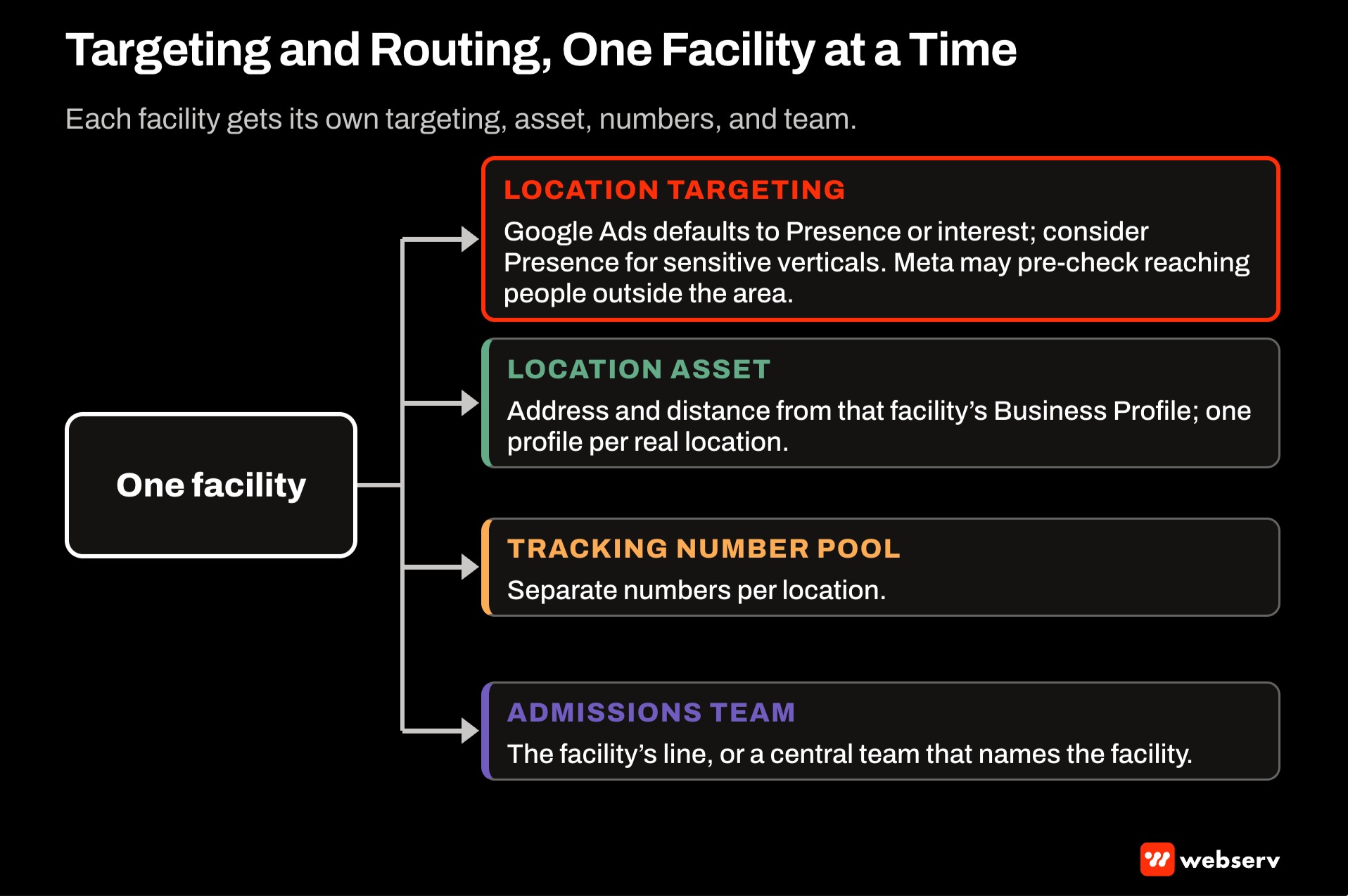
Location targeting. Google Ads’ location targeting defaults to “Presence or interest,” which includes people who’ve shown interest in a place but aren’t in it. Google’s help page suggests considering “Presence,” people in or regularly in the location, for sensitive verticals with strict targeting limits.
For treatment, interest from outside the service area can still matter, since families may research from other states. Decide the setting per campaign on purpose rather than leaving the default.
On Meta, the location targeting help page says ads reach people who spend time in the chosen locations, and an option to reach people likely to respond outside the area may be checked by default. Uncheck it if the campaign should stay local.
Location assets. Google Ads location assets show a facility’s address and distance, and draw location data from Google Business Profile. Each facility’s Business Profile should be accurate; Google’s profile guidelines say virtual offices aren’t eligible and each location should have one profile.
Call routing. Give each facility page its own tracking numbers routed to that facility’s admissions team. CallRail’s multi-location visitor tracking guide describes a separate number pool per location. Our call tracking guide covers how those numbers carry into admit reporting.
OPERATOR INSIGHT
Decide early whether one central admissions team answers for every facility or each facility has its own. Either can work, but the page should match what happens when someone calls.
Google’s profile guidelines ask for a local number instead of a central call center helpline whenever possible. If a central team answers, the caller should still hear the facility they called about and get accurate details for that location.
Keeping location pages accurate
Location pages can go out of date quickly, because facilities change. Programs open and close, staff change, and insurance contracts shift.
Set a review for each facility page at least every quarter, and whenever a program, license, address, or contract changes:
Check the facts
Address, levels of care, insurance, and leadership match the facility today.
Check certification
The facility and the page’s domain are covered by LegitScript, Google, and Microsoft as needed.
Check routing
Tracking numbers ring the right admissions team, and forms route to the right inbox.
Check targeting
Campaigns point to the right page, with location settings chosen on purpose.
Check the Business Profile
Details match the landing page and the site’s organic facility page.
The organic side, including facility pages, schema, and Business Profile management, is covered in our local SEO guide for multi-location treatment centers. Paid location pages and organic facility pages should agree on every fact.
Where this fits
Location pages are one piece of a multi-facility paid program. For campaign structure, see our Google Ads playbook, and for the elements every page needs regardless of location, the 10-point landing page checklist.
For how paid media fits the rest of your marketing, see the complete guide to behavioral health marketing. If you’re adding a facility or cleaning up location pages, book an intro meeting and we’ll review the setup with you.
Frequently Asked Questions
Should each treatment facility have its own landing page?
For paid campaigns, usually yes. LegitScript certifies and prices per facility and requires each facility’s address and services to be disclosed, so a page per facility makes those facts clear.
Separate pages also keep programs, photos, and phone numbers specific to each location.
They make reporting cleaner too, since calls and admits stay tied to the facility that produced them.
Can we build landing pages for cities where we don’t have a facility?
Not pages that imply you operate there. LegitScript’s advertising standard bars claiming locations where the provider doesn’t deliver services, and Google’s spam policies treat city pages that funnel users to one page as doorway abuse.
A page aimed at families in a nearby city can work if it states clearly where the facility is and how families get there.
Keep the facility’s real address and distance in the headline or opening lines.
Does each facility need its own Google certification?
Google’s guidance says advertisers with more than one location should submit a separate application for each location or group of locations, at the ad account level with the certified domain.
Each facility also needs to be covered by LegitScript certification, which Google requires first.
Plan both before launching campaigns for a new facility.
Should we use Presence or Presence or interest targeting?
Google Ads defaults to “Presence or interest,” which includes people who’ve shown interest in a location without being there. Google suggests considering “Presence” for sensitive verticals.
Families may research treatment from another city or state, so some interest traffic may be valuable.
Choose per campaign based on where your admits come from, and review the setting rather than leaving the default.
Can a central call center answer for all our facilities?
It can, as long as callers get accurate information about the facility they called about.
Google’s Business Profile guidelines ask for a local number rather than a central helpline whenever possible, and each location page should use tracking numbers tied to that facility.
The FTC’s Evoke Wellness case involved call staff falsely claiming a relationship with clinics callers were looking for, so make sure your team always identifies the facility honestly.
Keaton Nalle is the Director of Paid Admissions at Webserv, a digital marketing agency for treatment centers.