A mother fills out a form at 11 p.m. asking about detox for her son. By morning, she’s filled out two more. The first program that texts her back, clearly and without saying too much, usually gets the call.
Text is often the fastest way to reach a family between calls.
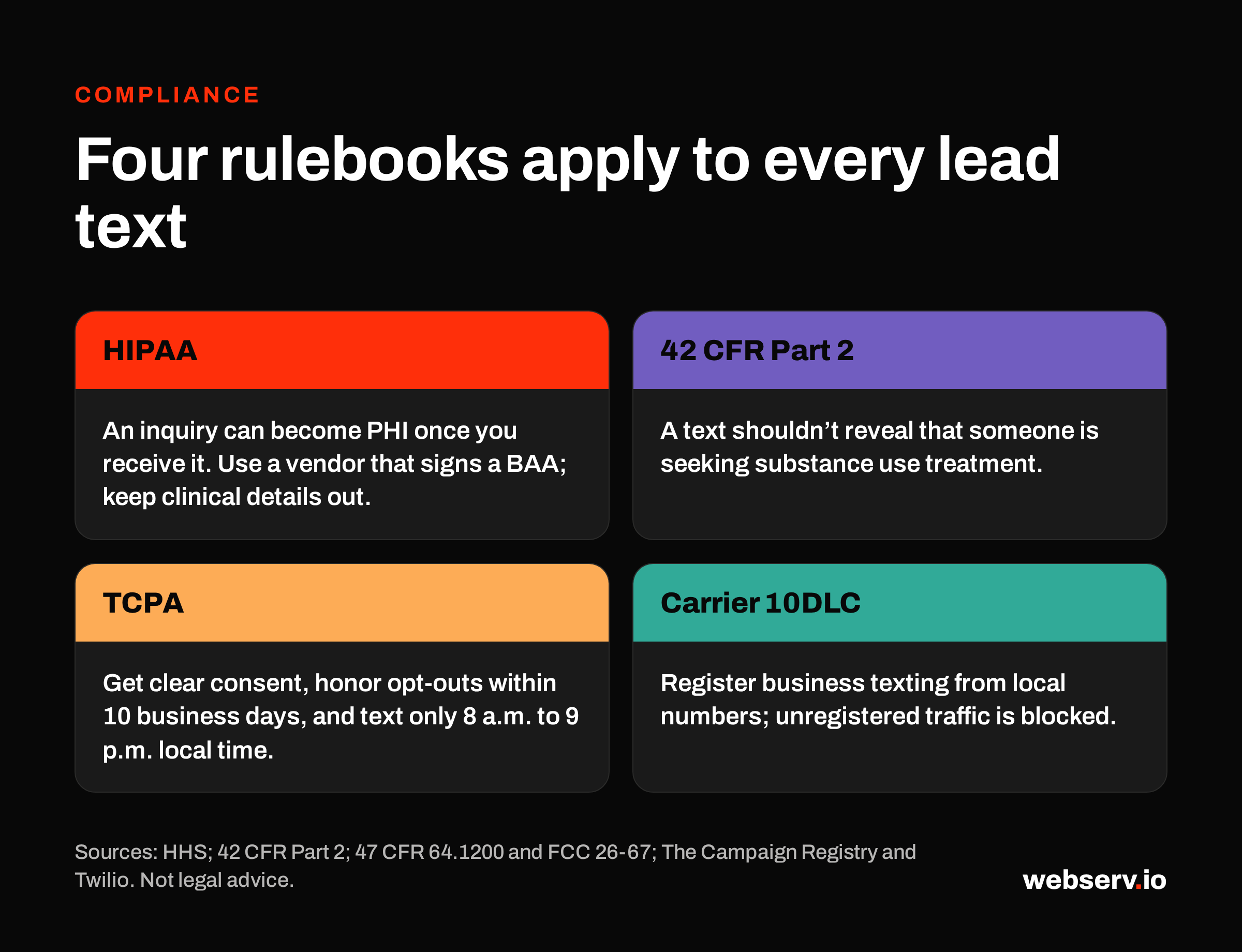
It’s also where treatment centers pick up the most risk at once: HIPAA, the federal rules for substance use records, the Telephone Consumer Protection Act (TCPA), and carrier registration rules.
This guide covers what each requires and how to build a texting workflow that’s fast and defensible. It’s part of how we approach admissions operations for treatment centers.
This guide summarizes federal rules and vendor documentation as of November 16, 2026. It isn’t legal advice. Review your texting program with counsel.
Key Takeaways
- An inquiry about treatment can become protected health information once your program receives it. Treat lead texts with the same care as patient communications.
- HHS permits unencrypted communication when patients are warned of the risk and agree, but you must use reasonable safeguards and limit what’s said.
- Use a texting vendor that signs a business associate agreement, and keep clinical details out of text messages.
- TCPA consent and opt-out rules apply to texts. An FCC rule taking effect November 25, 2026 changes how opt-outs can work.
- Business texting from local numbers must be registered through the 10DLC system, or carriers block it.
- Speed matters. Research on sales leads found that contacting within an hour made qualification about seven times more likely.
Why text matters in admissions
A Harvard Business Review study of online leads, “The Short Life of Online Sales Leads”, found that firms contacting a lead within an hour were nearly seven times as likely to qualify it as those waiting longer. The average company in the study took 42 hours to respond.
Families researching treatment often can’t take a call at work or in front of the person they’re worried about. A short text that says who you are and when you can talk keeps the conversation open.
Texting also helps after admission. In a Danish trial of young adults in outpatient substance use treatment, adding text reminders raised treatment completion from 25% to 39%. A pilot study in Ohio, published in 2026, found weekly reminders didn’t change overall retention, so treat texting as a tool, not a fix.
Our guide to building an admissions process that converts covers where texting fits in the wider workflow.
HIPAA: what applies to lead texts
When a lead becomes protected health information
HIPAA defines protected health information as individually identifiable health information, including information received by a health care provider. A form that names a person and asks about detox for them likely meets that definition once your program receives it.
HHS hasn’t published guidance specific to prospective patient inquiries. The safest working assumption is that lead texts about treatment are protected health information.
What HHS allows
HHS’s FAQ on email with patients says HIPAA doesn’t prohibit unencrypted communication for treatment-related purposes, provided providers apply reasonable safeguards. It suggests limiting the amount or type of information shared and alerting patients to the risks.
The 2013 Omnibus Rule preamble also says covered entities may send unencrypted messages if they’ve advised the individual of the risk and the individual still prefers that method. HHS’s guidance speaks to email; applying it to text is a reasonable reading, not a separate HHS rule.
HHS’s FAQ on leaving messages says providers should limit what’s disclosed, such as leaving only a name, number, and what’s needed to confirm an appointment. The same principle works for texts.
Marketing texts are different
HIPAA’s definition of marketing covers communications that encourage someone to buy or use a product or service, with exceptions for treatment communications. Follow-up about the care someone asked about is generally treatment-related. Promotional campaigns to old leads are a different category and need closer review.
COMMON MISTAKE
Texting clinical details to an unverified number. A parent’s form may include a phone number that belongs to the person in crisis, or to someone else in the house. Confirm who you’re texting before you say anything about treatment.
42 CFR Part 2: substance use records
Federal confidentiality rules for substance use disorder records, 42 CFR Part 2, define a patient to include anyone who has applied for diagnosis, treatment, or referral at a covered program. That can include someone in your admissions pipeline.
HHS’s fact sheet on the 2024 Part 2 rule says programs had to comply by February 16, 2026. Our guide to 42 CFR Part 2 and marketing covers how it affects outreach.
The practical rule: a text shouldn’t reveal that someone is seeking substance use treatment if it might be seen by someone else.
TCPA: consent, opt-outs, and timing
The TCPA rules at 47 CFR 64.1200 treat texts as calls for several provisions.
Consent. Telemarketing texts sent with automated systems need prior express written consent.
Health care messages from HIPAA-covered entities are exempt from the written-consent requirement, and a narrower exemption covers certain free health care texts, such as appointment reminders, that must be under 160 characters and contain no marketing. Admissions follow-up to a prospect may not fit those exemptions, so get clear consent on your forms.
Opt-outs. Since April 11, 2025, people can revoke consent by any reasonable method, including words such as “stop,” “quit,” “cancel,” and “unsubscribe,” and you must honor it within 10 business days.
A rule change on November 25, 2026. The FCC’s order FCC 26-67 lets senders designate one exclusive opt-out method, such as replying STOP, and lets an opt-out apply only to the category of informational messages it responded to. Review your opt-out handling with your vendor before that date.
The one-to-one consent rule is gone. The Eleventh Circuit vacated the FCC’s one-to-one consent rule in January 2025, and the FCC formally removed it in July 2025.
Quiet hours. Telephone solicitations can’t be made before 8 a.m. or after 9 p.m. in the recipient’s local time. That applies to marketing; it’s a sensible limit for any non-urgent text.
Carrier rules: 10DLC registration
Business texting from regular local numbers runs through A2P 10DLC, registered with The Campaign Registry. Twilio says unregistered 10DLC traffic to U.S. numbers has been fully blocked since September 1, 2023.
CTIA’s messaging principles call for clear opt-in, standard STOP wording for opt-outs, and HELP instructions in confirmation messages.
Watch your campaign description. Twilio says campaigns involving prescription drug marketing or controlled substances are rejected and can’t be resubmitted. Programs offering medication for addiction treatment should describe their campaign as admissions and appointment communication, and keep sample messages free of drug names.
OPERATOR INSIGHT
Register your texting campaign as informational admissions and appointment messaging, not marketing. Write the sample messages you’d actually send, and keep every one free of diagnoses and medications.
Choosing a texting vendor
Pick a vendor that will sign a business associate agreement for the texting you’ll do. Examples, from each vendor’s own pages:
| Vendor | BAA statement |
|---|---|
| Twilio | BAA requires the Security or Enterprise Edition; Programmable SMS is on its HIPAA-eligible list |
| CallRail | Every Healthcare plan includes a BAA; plans start at $150 a month |
| CallTrackingMetrics | BAA by request on eligible plans; its HIPAA checklist says not to include PHI in SMS bodies |
Checked November 16, 2026. Confirm which features the BAA covers before you launch.
Make sure texts land in your CRM, tied to the lead record, rather than on individual phones. Our CRM buyers guide and CallRail setup guide cover the setup.
What to say, and what not to say
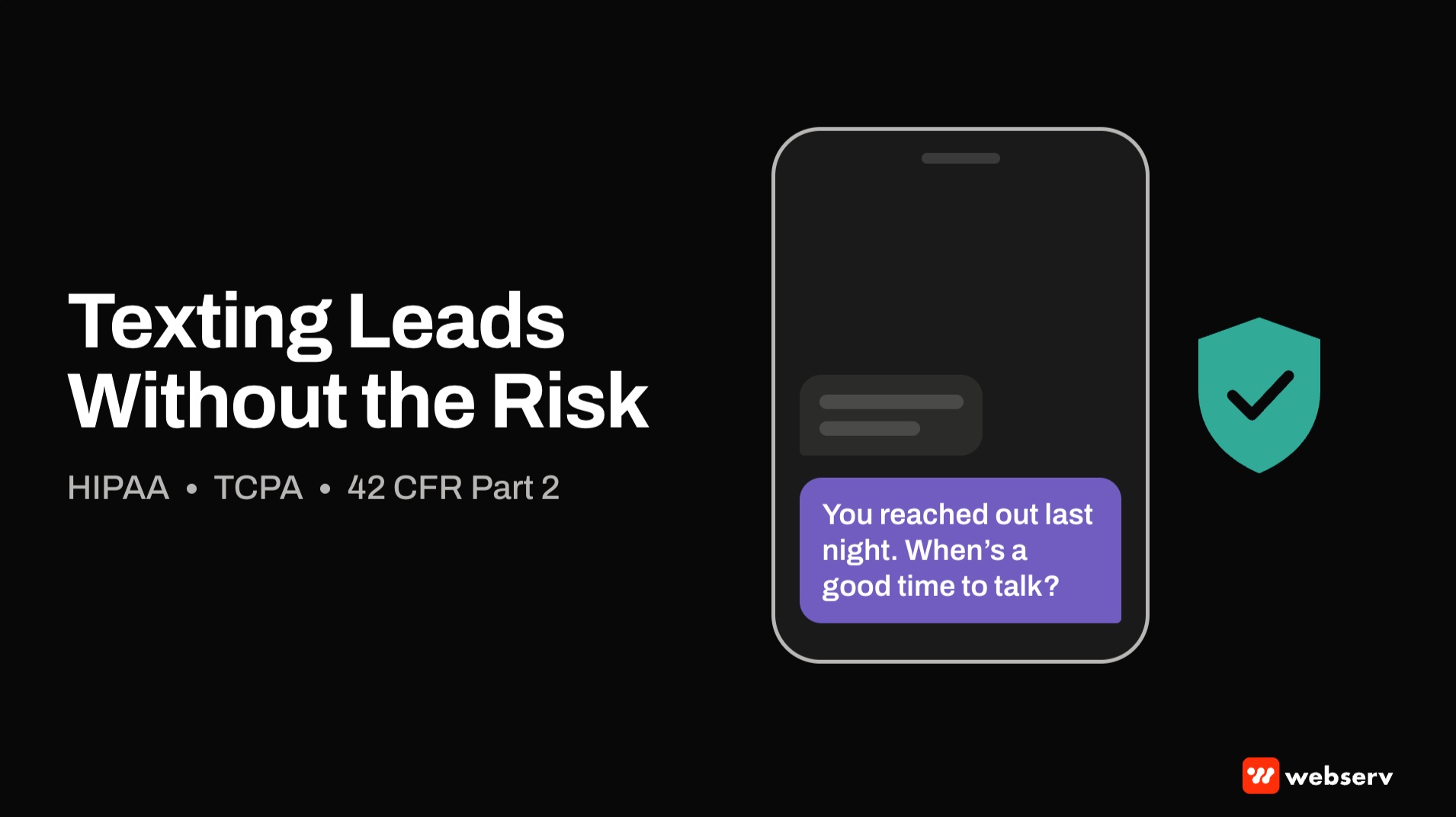
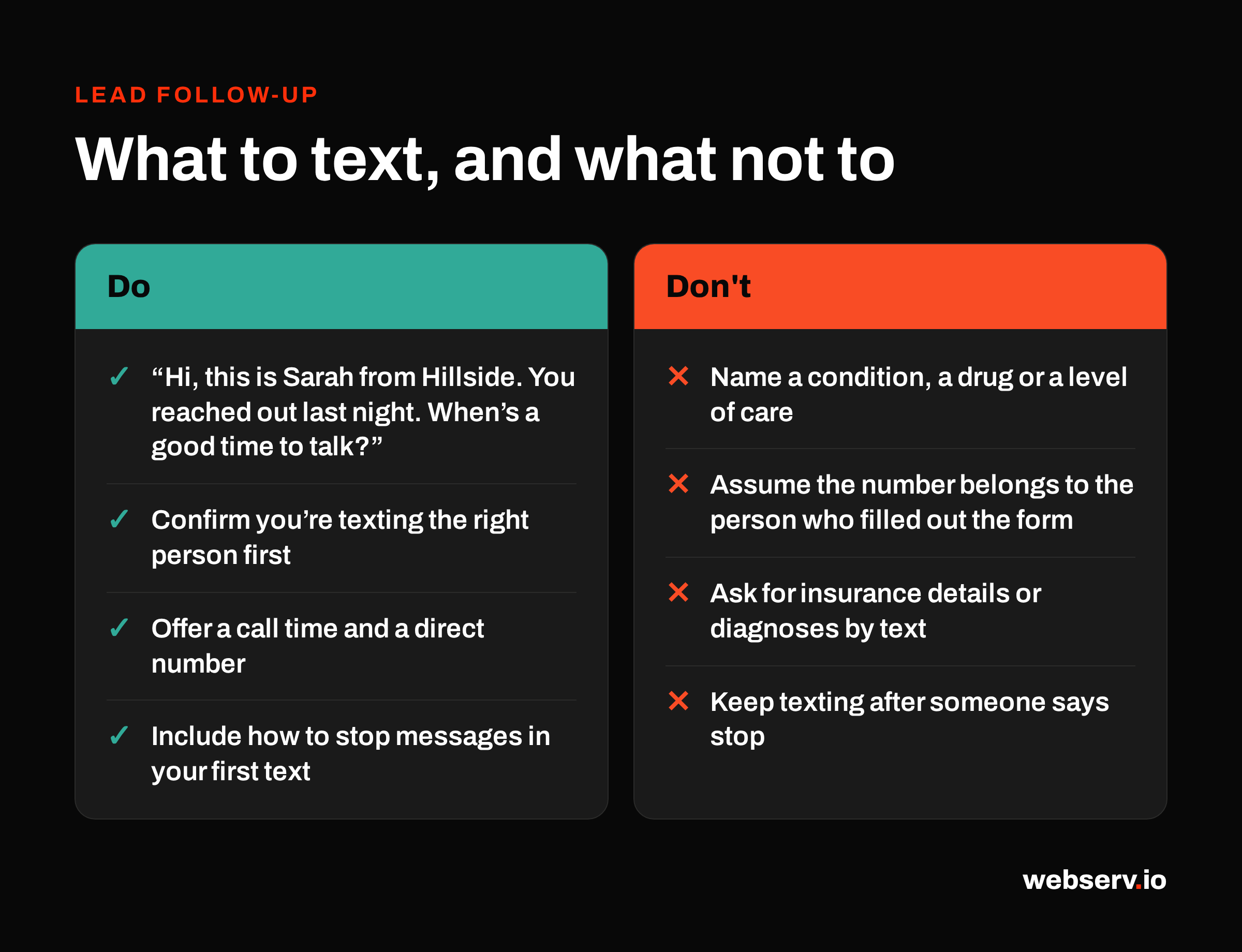
Keep texts short, identify your program in a way that’s safe if someone else reads it, and move clinical conversation to the phone.
DO
- “Hi, this is Sarah from Hillside. You reached out last night. When’s a good time to talk?”
- Confirm you’re texting the right person before sharing anything
- Offer a call time and a direct number
- Include how to stop messages in your first text
DON’T
- “Hi, following up about your son’s detox and his opioid use.”
- Assume the number on the form belongs to the person who filled it out
- Ask for insurance details or diagnoses by text
- Keep texting after someone says stop
Using a neutral program name in texts, if you have one, adds a layer of privacy.
A texting workflow for admissions
Here’s the workflow we recommend, in order.
Capture consent on every form
With clear language about texts and how to opt out.
Send a first text within minutes
During staffed hours, identifying your program and offering a call.
Verify identity
Before discussing anything about treatment.
Move clinical and insurance details to a call
Or a secure channel.
Log every text in the CRM
Not on personal phones.
Honor opt-outs immediately
Across every channel your system controls.
Review a sample of texts monthly
For privacy and tone.
Our admissions operations guide covers staffing and coverage, and our guide to HIPAA-compliant contact forms covers the consent language on your forms.
Where this fits
For tracking which texts turn into admissions, see our guide to call scoring and admissions training. For how admissions connects to marketing, see the complete guide to behavioral health marketing.
If you want a second look at your follow-up workflow, book an intro meeting.
Frequently Asked Questions
Is it HIPAA compliant to text patients?
HIPAA doesn’t ban texting. HHS says providers can use unencrypted communication for treatment purposes with reasonable safeguards, and when patients are warned of the risks and still prefer it.
Use a vendor that signs a business associate agreement and limit what each message says.
Move clinical and insurance details to a call or secure channel.
Can treatment centers text leads who filled out a form?
Yes, with consent and care. Get clear consent for texts on your forms, and identify your program in a way that’s safe if someone else sees the message.
TCPA rules on consent and opt-outs apply to texts.
Confirm who you’re texting before discussing treatment.
What should a treatment center never put in a text?
Diagnoses, substances, medications, and insurance details.
Avoid anything that reveals someone is seeking substance use treatment if another person might read the message.
Offer a call time and a direct number instead.
What is 10DLC registration?
10DLC is the carrier system for business texting from regular local numbers. Brands and campaigns register through The Campaign Registry.
Twilio says unregistered 10DLC traffic to U.S. numbers has been blocked since September 2023.
Describe your campaign accurately and keep sample messages free of drug content.
How do texting opt-outs work in 2026?
People can revoke consent by any reasonable method, including replies like “stop” or “cancel,” and you must honor it within 10 business days.
An FCC rule taking effect November 25, 2026 lets senders designate one exclusive opt-out method, such as replying STOP.
Review your opt-out handling with your vendor and counsel.
Jim Malcom is the Director of Admission Ops at Webserv, a digital marketing agency for treatment centers.