CARF accreditation takes a year or more of preparation, an on-site survey, and ongoing reporting after the decision. For a treatment center, it can affect payer credentialing, state licensing, and how families and search engines judge whether your program is credible.
This guide covers what CARF is, how it compares with The Joint Commission, what the process and timeline look like, what it costs, and how to show accreditation on your website without overstating it. It’s part of how we approach SEO for treatment centers, where trust signals carry real weight.
Key Takeaways
- CARF International is an independent, nonprofit accreditor. It accredits specific programs, such as residential treatment or intensive outpatient, against its Behavioral Health Standards Manual.
- CARF says preparation may take a year or more. Submit the survey application at least three months before the window you want.
- CARF doesn’t publish its survey fee. It depends on how many surveyors and days the survey needs. The 2026 Behavioral Health Standards Manual costs $214 in print.
- Some payers require accreditation for facility credentialing, and Florida accepts accreditation in place of certain licensure reviews.
- In our analysis of FindTreatment.gov, 20% of commercial facilities list CARF and 20% list The Joint Commission.
- Market only what’s accredited. Name the programs covered, link to CARF’s provider search, and keep schema markup consistent with the page.
What CARF accreditation is
CARF stands for the Commission on Accreditation of Rehabilitation Facilities, the name it was founded under in 1966. Today CARF International describes itself as an independent, nonprofit accreditor of health and human services.
For addiction and mental health providers, the relevant standards sit in CARF’s Behavioral Health Standards Manual. Program types it covers include withdrawal management, residential treatment, partial hospitalization, intensive outpatient, and outpatient treatment. Opioid treatment programs follow a separate CARF manual.
DEFINITION
CARF accreditation. A determination by CARF that specific programs at an organization conform to its published standards, based on an on-site survey. It applies to the programs surveyed, not automatically to everything the organization does.
That last point matters for marketing. If CARF accredited your residential program but not your new outpatient site, your website shouldn’t imply otherwise. Our CARF accreditation glossary entry has the short version.
How common CARF accreditation is
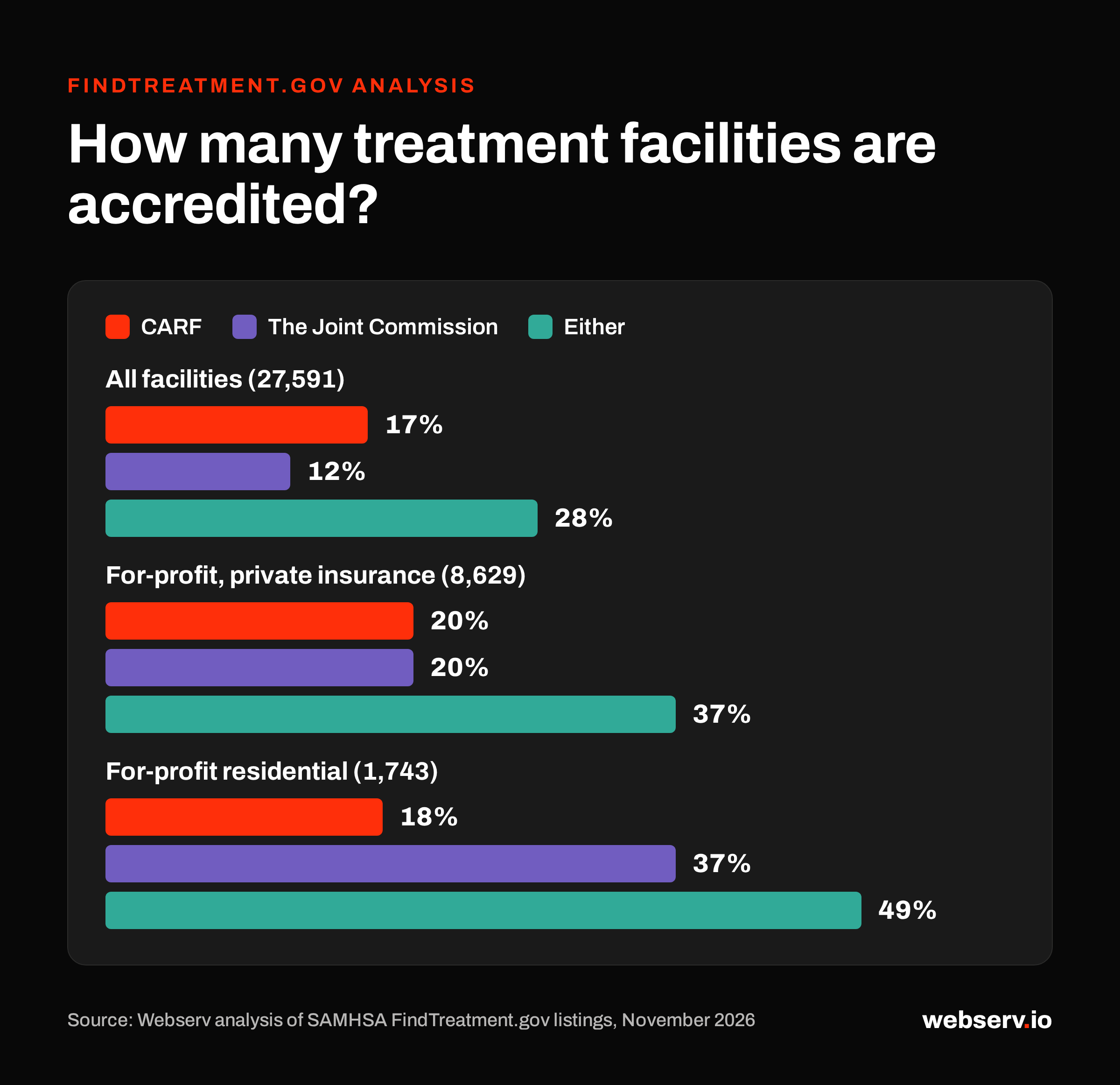
We pulled every facility listed on SAMHSA’s FindTreatment.gov in November 2026 and counted the accreditations each one lists. The results show how much accreditation differs by type of program.
| Facilities listed on FindTreatment.gov | CARF | The Joint Commission | Either |
|---|---|---|---|
| All facilities (27,591) | 17% | 12% | 28% |
| Commercial: for-profit, accepts private insurance (8,629) | 20% | 20% | 37% |
| Commercial residential (1,743) | 18% | 37% | 49% |
Source: Webserv analysis of SAMHSA FindTreatment.gov listings, pulled November 9, 2026. Counts reflect accreditations facilities list, so actual accreditation may be higher. Some facilities list both.
Two patterns stand out. Among commercial facilities, CARF and The Joint Commission are listed at about the same rate. Among commercial residential programs, The Joint Commission is listed twice as often.
Half of commercial residential facilities list neither. In a market where families compare programs side by side, an accreditation you can show is a real point of difference. Our guide to FindTreatment.gov listing accuracy covers how to keep that listing current.
CARF vs. The Joint Commission
Both are recognized accreditors for behavioral health programs. The practical differences are in how surveys work and how fees are set.
| CARF | The Joint Commission | |
|---|---|---|
| Organization | Independent, nonprofit accreditor | Independent accreditor; behavioral health is one of several programs |
| Standards | Behavioral Health Standards Manual, updated yearly | Behavioral Health Care and Human Services standards |
| Survey timing | Scheduled; CARF gives written notice of dates at least 30 days ahead | Mostly unannounced, 30 to 36 months after the last full survey |
| Survey style | CARF describes a consultative rather than inspective approach | Unannounced on-site evaluation |
| Longest standard term | Three-Year Accreditation | Three-year cycle |
| Fees | Based on the number of surveyors and days; estimate on request | Based on services and average daily census; annual fee plus on-site survey fee |
| Public lookup | CARF Find a Provider | Find accredited organizations |
Neither is better by default. Ask your main payers and your state licensing agency which they recognize, then weigh survey style and cost against your operations. Our Joint Commission glossary entry covers the other side.
COMMON MISTAKE
Choosing an accreditor for the logo. The badge matters less than whether your payers and state accept it. Confirm that first, in writing.
The CARF accreditation process, step by step
CARF lays out the process in nine steps to accreditation:
Contact CARF
Submit a New Organization Questionnaire. A resource specialist helps you choose the right standards manual.
Conduct a self-evaluation
Conduct a self-evaluation against the standards.
Submit a survey application
Submit a survey application, including the two-month window you’d like the survey to happen in.
Pay the survey fee
CARF invoices it and begins scheduling.
CARF selects the survey team
The survey is conducted
The survey is conducted on-site.
The accreditation decision
CARF says organizations are notified about six to eight weeks after the survey.
Submit a Quality Improvement Plan
Submit a Quality Improvement Plan within 90 days of the decision, addressing any recommendations.
Submit an Annual Conformance to Quality Report
Submit an Annual Conformance to Quality Report each year of the accreditation term.
OPERATOR INSIGHT
Most of the work happens before step 3. The programs that move fastest assign one owner to the self-evaluation and treat the standards manual as a working document, not a reference book.
How long CARF accreditation takes
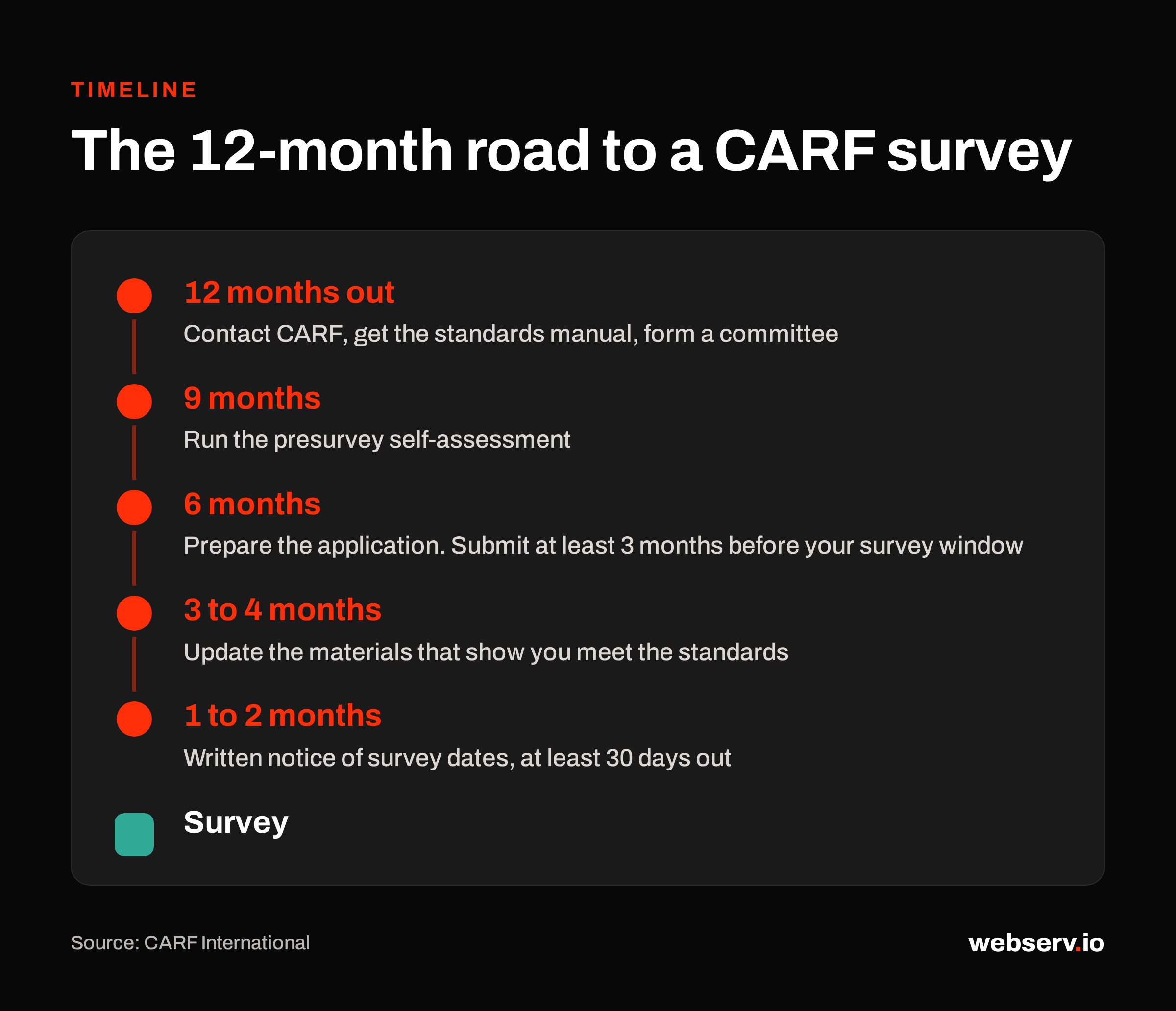
CARF says the process may involve a year or more of preparation before the survey. Its survey preparation timeline works backward from the survey date:
| Before the survey | What CARF recommends |
|---|---|
| 12 months | Contact CARF, get the standards manual, and form a committee |
| 9 months | Run a presurvey self-assessment with the workbook |
| 6 months | Prepare the application; submit it at least three months before your preferred survey window |
| 3 to 4 months | Review and update the materials that show you meet the standards |
| 1 to 2 months | Receive written notice of survey dates, at least 30 days out |
After the survey, add six to eight weeks for the decision. CARF says the certificate follows within 60 days of the decision.
New programs that haven’t served clients yet have a separate path. CARF’s Inaugural One-Year Accreditation, formerly called Preliminary, includes a full follow-up survey about six months after services begin.
What CARF accreditation costs
CARF doesn’t publish a flat price. Its steps page says the survey fee is based on the number of surveyors and days needed, and it provides estimates on request.
These are the costs CARF does publish:
| Item | Published price |
|---|---|
| 2026 Behavioral Health Standards Manual, print | $214 |
| 2026 Behavioral Health Standards Manual, electronic, one user | $322 |
| Survey preparation workbook, print | $132 |
| ASAM Level of Care Certification, a separate CARF program | $4,540 base, or $3,520 for CARF-accredited facilities, plus $500 per additional level |
Sources: CARF bookstore and CARF Level of Care fee schedule, July 2026 to June 2027, checked November 10, 2026.
The larger costs are internal. Staff time for the self-evaluation, policy and documentation updates, and any facility or process changes usually outweigh the survey fee. Budget for them before you apply.
What the accreditation decision means
CARF issues one of several accreditation decisions:
| Decision | What CARF says it means |
|---|---|
| Three-Year Accreditation | Substantial conformance to the standards |
| One-Year Accreditation | Conformance to many standards, with significant areas of deficiency and evidence they can be corrected |
| Provisional Accreditation | Awarded for one year when a One-Year organization is still at that level; it must reach Three-Year at the next survey |
| Nonaccreditation | Major deficiencies in several areas of the standards |
A One-Year or Provisional decision is still accreditation, but it’s worth stating accurately. Don’t round it up to “fully accredited” in copy.
Why accreditation matters beyond the badge
Payer credentialing. Optum’s facility credentialing requirements ask for accreditation status, such as The Joint Commission, CARF, or COA. Facilities that aren’t accredited go through a site audit instead.
Blue Cross NC updated its standards in 2024 to require Joint Commission or CARF accreditation for partial hospitalization, intensive outpatient, and residential programs. Requirements vary by payer and state, so confirm with each one. Our guide to payer contracts covers the wider negotiation.
State licensing. Some states give accreditation weight in licensing. In Florida, section 394.741 says accreditation from a qualifying accreditor is accepted in place of the state’s onsite licensure review.
Florida’s section 397.403 also requires proof of accreditation for licensed substance use treatment components after the first renewal. Our guide to opening a rehab in California covers how licensing works there.
Advertising. LegitScript certification, which Google and Meta require for addiction treatment ads, doesn’t require accreditation. Its certification standards require that providers be adequately licensed for the services they offer. Accreditation and LegitScript are separate, and many programs need both.
How to use CARF accreditation in your marketing
Accreditation is a trust signal for families and for the systems that evaluate your site, including Google and AI search tools. It only helps if it’s visible, specific, and easy to verify.
On your website. Name the accreditor and the programs it covers on your About page and on each accredited program page. Link to CARF’s provider search so visitors can confirm it. Our guide to rehab website design as a clinical trust signal covers where trust signals belong.
In structured data. Schema.org’s hasCredential property describes a credential awarded to an organization. The Credential type includes a recognizedBy property for the body that grants it. A minimal example:
{
  "@context": "https://schema.org",
  "@type": "MedicalOrganization",
  "name": "Example Recovery Center",
  "hasCredential": {
    "@type": "EducationalOccupationalCredential",
    "credentialCategory": "accreditation",
    "name": "CARF Accreditation: Residential Treatment",
    "recognizedBy": {
      "@type": "Organization",
      "name": "CARF International",
      "url": "https://carf.org/"
    }
  }
}
Keep the markup matched to what’s on the page. Our guides to structured data for AI search and sameAs strategy cover the rest of the entity setup.
In directories and AI-facing pages. List accreditation on FindTreatment.gov and in your AI information page, with the same wording everywhere. Consistent facts across sources make it easier for AI tools to describe you accurately.
In ad copy and landing pages. Mention accreditation only for the programs an ad promotes. If a landing page covers an outpatient program that isn’t accredited, leave the badge off that page.
COMMON MISTAKE
A badge with no specifics. A CARF logo in the footer of every page, with no program named and no way to verify it, does less than one clear sentence on the right page.
Where this fits
Accreditation is one input to the trust picture search engines and families build. For how it fits with content quality, see our guide to building clinical content Google trusts and our drug rehab SEO complete guide.
For how SEO fits the rest of your marketing, see the complete guide to behavioral health marketing. If you want a second look at how your accreditation shows up on your site and in search, book an intro meeting.
This guide summarizes published accreditor, payer, and state information as of November 2026. It isn’t legal or regulatory advice. Confirm requirements with CARF, your payers, and your state.
Frequently Asked Questions
What does CARF accredited mean?
It means CARF surveyed specific programs at an organization and found they conform to its published standards.
Accreditation applies to the programs surveyed, such as residential treatment or intensive outpatient, not automatically to everything an organization offers.
You can confirm a provider’s status with CARF’s Find a Provider search.
What does CARF stand for?
CARF stands for the Commission on Accreditation of Rehabilitation Facilities, the name it was founded under in 1966.
Today it operates as CARF International, an independent, nonprofit accreditor of health and human services.
Behavioral health programs are surveyed against its Behavioral Health Standards Manual.
How much does CARF accreditation cost?
CARF doesn’t publish a flat price. The survey fee depends on how many surveyors and days the survey needs, and CARF gives estimates on request.
The 2026 Behavioral Health Standards Manual costs $214 in print.
Internal staff time to prepare is often the larger cost, so budget for it before you apply.
How long does CARF accreditation take?
CARF says preparation may take a year or more. Submit the survey application at least three months before your preferred survey window.
The decision comes about six to eight weeks after the survey.
Three-Year Accreditation is the longest standard term for behavioral health programs.
Is CARF or Joint Commission better for a treatment center?
Neither is better by default. Both are widely recognized for behavioral health programs.
The Joint Commission’s surveys are mostly unannounced, while CARF schedules its surveys. Fees are set differently.
Ask your main payers and your state licensing agency which they accept before you choose.
Preston Powell is the CEO of Webserv, a digital marketing agency for treatment centers.