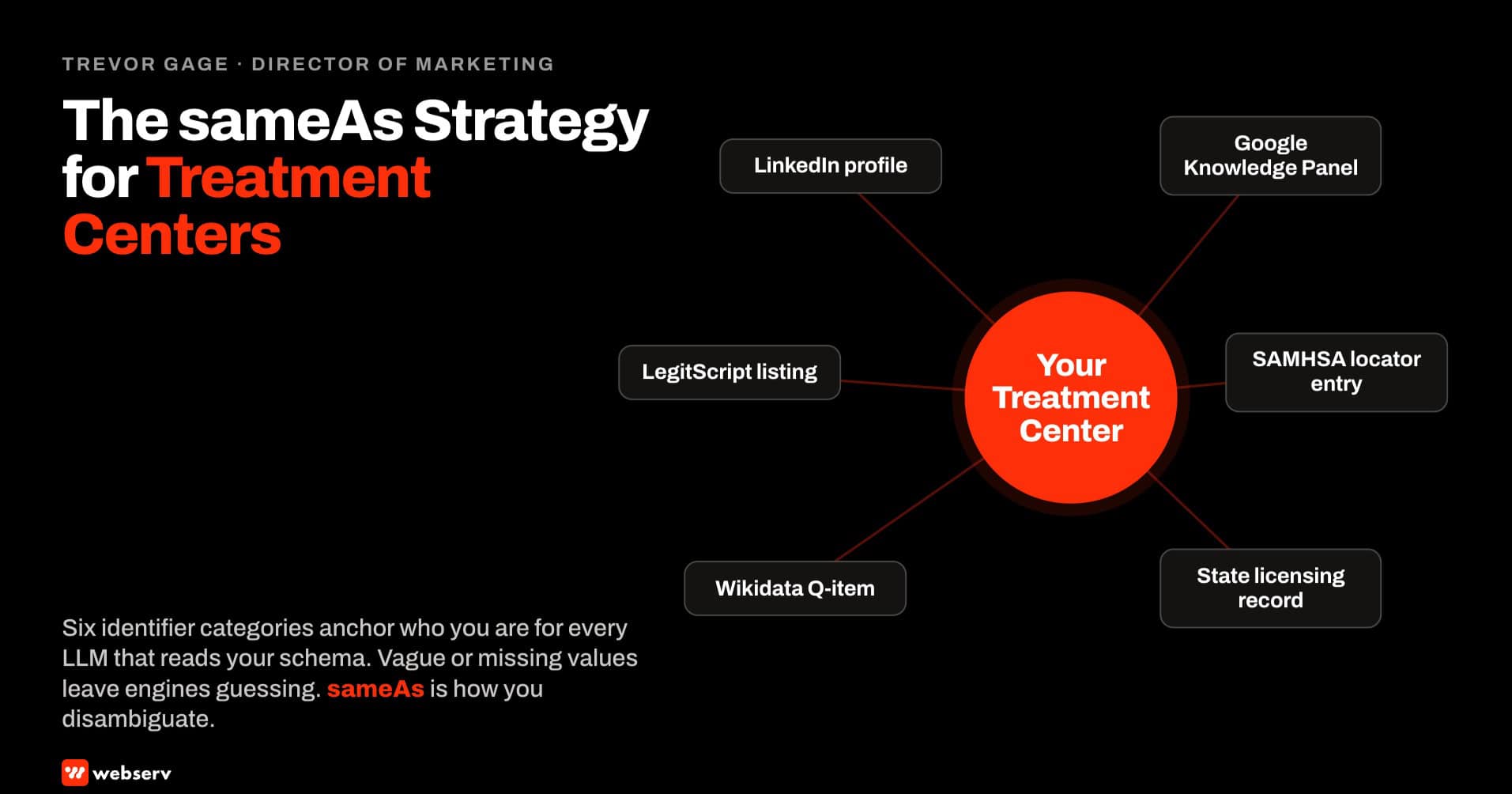
sameAs is the Schema.org property that most treatment centers deploy without a strategy. It gets used as a checkbox item during a schema audit (add LinkedIn, add Google Business Profile, done) rather than as the load-bearing signal it actually is for entity disambiguation in AI search.
Our entity SEO explainer covers what sameAs is at the framework level: an external URL that grounds an entity (your facility, your clinician, your program) in an authoritative directory or profile that a search engine or AI system can traverse to confirm the entity’s identity.
That framework matters. The tactical piece that matters more for operators is which specific sameAs values to publish for which specific entities.
Behavioral health has the collision-heaviest entity graph of any category we work in. The same modality names run across hundreds of facilities. Clinicians work at multiple centers under different brands. Facility names collide with unrelated healthcare organizations in different states.
Without specific sameAs values grounding each entity to a canonical external record, AI systems piece together an identity from review snippets, competitor pages, and aggregator directories. They usually get it wrong.
This piece is the tactical companion to the entity SEO explainer. It walks the six categories of sameAs values that matter for treatment centers, which values go with which entity types, and how to deploy them cleanly in JSON-LD Schema.org markup.
It also covers the specific failure modes that undermine the signal when the values are wrong or stale.
It sits inside our content SEO practice and complements the entity SEO explainer that covers the schema deployment order.
Key Takeaways
- sameAs is the Schema.org property that grounds your entities in external authoritative records. AI systems and search engines use sameAs values to confirm the identity of your facility, your clinicians, your programs, and your treatment specialties. Without specific sameAs values, entity resolution degrades and citation confidence drops.
- Six categories of sameAs values matter for behavioral health: accreditation registries (JCAHO Quality Check, CARF directory), compliance certifications (LegitScript public database), clinical and regulatory authorities (NPI Registry, state license lookup, state medical board directories), professional associations (ASAM, NAADAC, APA), Wikidata, and third-party profiles (LinkedIn, Google Business Profile, Psychology Today, PubMed for published clinicians).
- Each entity type takes different sameAs values. Organization entities take facility-level identifiers (JCAHO, CARF, LegitScript, GBP, LinkedIn company page, Wikidata). Person entities take clinician-level identifiers (personal LinkedIn, state license, professional association profile, PubMed for published clinicians). Program and MedicalCondition entities take authority-level identifiers where they apply.
- The most consequential missing sameAs for most treatment centers is the accreditation directory URL. JCAHO Quality Check and CARF directory both publish public URLs per accredited facility. Grounding your Organization schema in those URLs produces a defensible trust anchor that AI systems can traverse. Skipping it leaves the highest-authority external validation off the entity graph.
- Broken and stale sameAs values are worse than missing ones. A sameAs pointing to a dead LinkedIn URL, a decertified LegitScript status, or a facility profile that has since been sold produces active misinformation in the entity graph. Audit sameAs values quarterly against the source directories.
- sameAs compounds with the AI Information page and the entitymap.json surface. The same external identifiers that ground your Schema.org sameAs values also ground the equivalent fields on the AI Information page and the sameAs array on the entitymap.json entity records. Doing the identifier inventory once and rendering it across surfaces is the operating efficiency.
DEFINITION
sameAs strategy. The discipline of publishing a curated set of external authoritative URLs on each Schema.org entity (Organization, Person, MedicalCondition, Program) that ground the entity’s identity in an independently verifiable record. Grounds the facility, its clinicians, and its treatment specialties in accreditation directories, compliance databases, regulatory registries, professional associations, Wikidata, and vetted third-party profiles.
Distinct from a schema audit checkbox (LinkedIn + GBP, done). Load-bearing signal for entity disambiguation in AI search where behavioral health carries the collision-heaviest entity graph of any category: shared modality names, cross-facility clinicians, colliding facility names. Consistent across three surfaces: Schema.org markup, AI Information page, entitymap.json.
The six categories of sameAs values
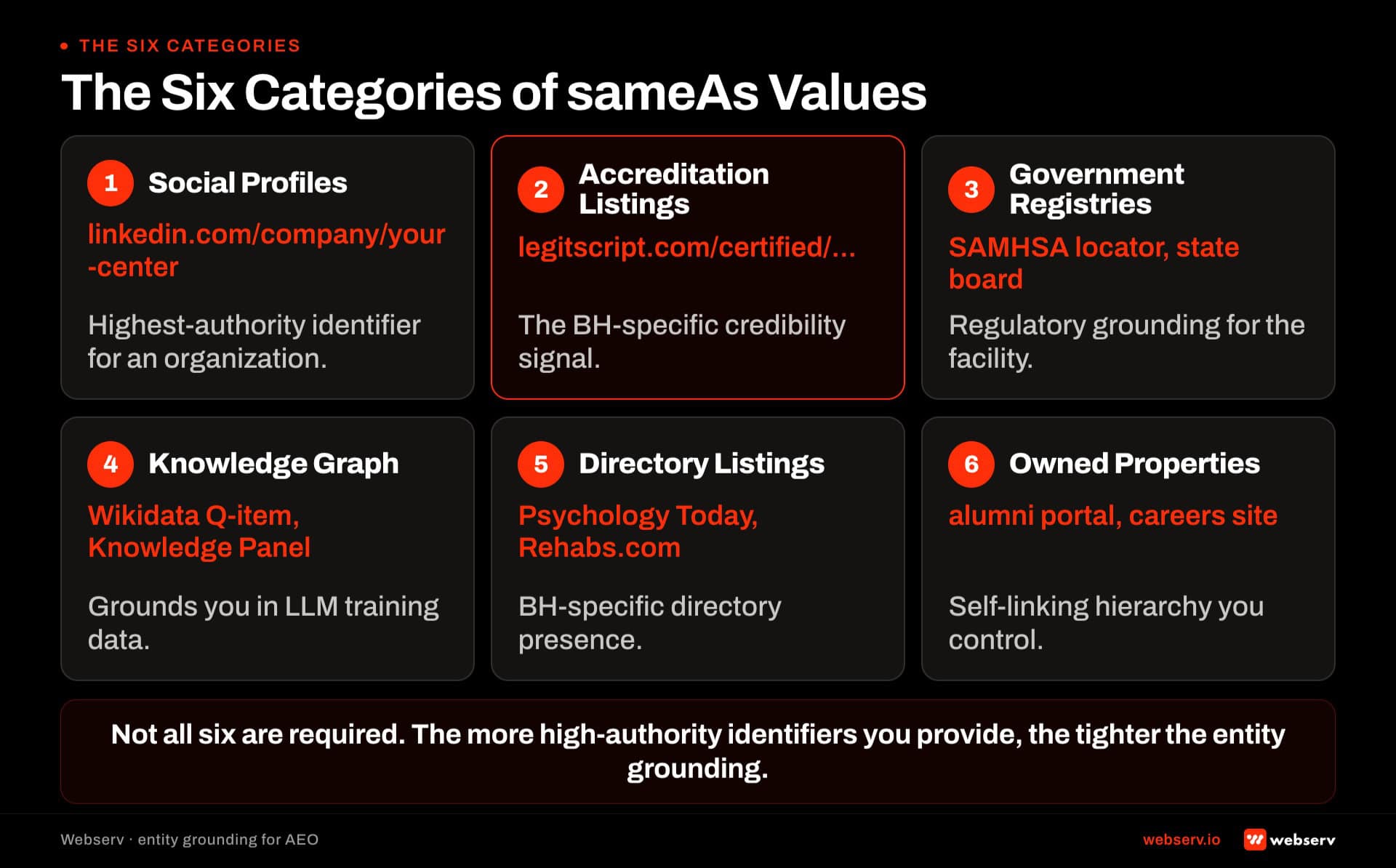
Every sameAs value falls into one of six categories, each with different authority weight and different maintenance requirements.
Category 1: Accreditation registries
JCAHO Quality Check publishes a public URL per accredited facility. CARF’s directory does the same. These are the highest-authority external validations available for BH facilities because both accreditors are independently governed, the directories are actively maintained, and the accreditation itself carries payer and regulatory weight.
Category 2: Compliance certifications
LegitScript publishes a public database of certified addiction treatment providers. LegitScript certification is required to run Google Ads in the addiction treatment category, so most treatment centers running paid have this certification and can produce a defensible sameAs URL from the LegitScript database.
Category 3: Clinical and regulatory authorities
The NPI Registry (npiregistry.cms.hhs.gov) publishes NPI numbers with corresponding facility URLs. State license lookup varies by state (California DHCS, Florida DCF, Arizona AZDHS) and typically produces a public URL per licensed facility. State medical boards produce clinician-level URLs. These are load-bearing sameAs values because they anchor the facility or clinician in a government-maintained registry.
Category 4: Professional associations
ASAM publishes a member directory with URLs per certified provider. NAADAC does the same. APA, the state psychology boards, and specialty association member directories all produce clinician-level sameAs values. Individual clinician entities benefit from these grounding URLs; Organization entities benefit indirectly through the clinician-facility relationship.
Category 5: Wikidata
Wikidata is the canonical open-data entity graph that underlies Wikipedia, Google Knowledge Graph, and every major AI system’s underlying entity database. If your facility has a Wikidata entry (Q-number), the Wikidata URL is the single highest-value sameAs for entity disambiguation. Facilities without Wikidata entries can create one, though the process requires published source material that verifies the core facility facts.
Category 6: Third-party profiles
LinkedIn (company page for Organization, personal profile for Person), Google Business Profile (facility profile), Psychology Today (clinician and facility profiles), Google Scholar (published clinicians), PubMed (published clinicians). These are lower-authority than Categories 1-5 but still contribute to entity resolution because AI systems commonly traverse them during identity verification.
OPERATOR INSIGHT
Broken and stale sameAs values are worse than missing ones.
A sameAs pointing to an expired JCAHO listing signals confidence in a signal that has since decayed. AI systems following the URL find a page that contradicts the entity claim. The signal produces active misinformation in the entity graph, not a neutral absence. Missing is recoverable. Wrong is corrosive.
What to sameAs by entity type
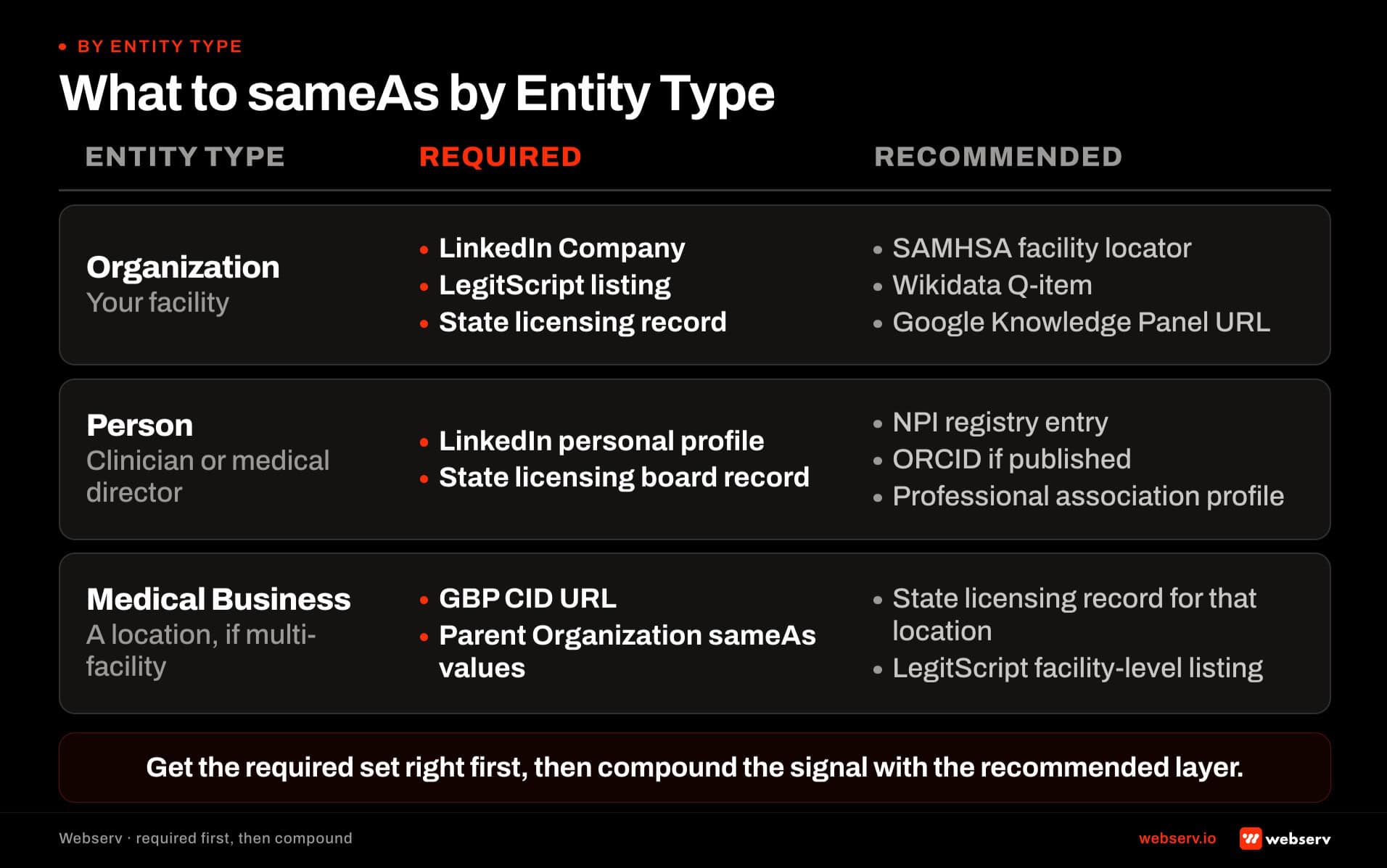
The Schema.org entity graph for a treatment center typically has four entity types that carry sameAs values.
Organization (or MedicalClinic)
The facility itself. Core sameAs values: JCAHO Quality Check URL, CARF directory URL, LegitScript public database URL, state license lookup URL, NPI Registry URL, Google Business Profile URL, LinkedIn company page URL, Wikidata URL if it exists. Optional: BBB profile URL, industry association memberships, chamber of commerce.
Person (each clinician)
The clinical author or provider on the facility site. Core sameAs values: LinkedIn personal profile URL, state license lookup URL, ASAM or NAADAC or APA member directory URL, professional-specialty association URL. Optional: PubMed profile URL if the clinician has published, Google Scholar URL, university faculty page. Our author bios that build E-E-A-T piece walks the Person schema deployment pattern in depth.
Program (LOC or modality)
Residential, PHP, IOP, detox as distinct programs. Most program entities do not carry sameAs values. The exception is when the program corresponds to a well-defined external authority definition. SAMHSA‘s treatment locator and modality documentation provides authority definitions for standard LOCs and modalities; those SAMHSA URLs can serve as sameAs values on the corresponding program entity.
MedicalCondition (each condition treated)
Substance use disorder, alcohol use disorder, dual diagnosis, PTSD, depression, anxiety. Core sameAs values: NIMH condition page URL, NIH condition page URL, SAMHSA condition resource URL. Grounding the condition entity in these authorities strengthens the E-E-A-T signal for clinical content on the condition.
Not every entity needs every category. Organization entities benefit from all six categories where applicable. Person entities primarily benefit from Categories 3, 4, and 6. Program and condition entities primarily benefit from Categories 3 and 5 where applicable.
The sameAs decision surface at a glance
6
Categories: accreditation, compliance, regulatory, association, Wikidata, third-party
4
Entity types that carry sameAs: Organization, Person, Program, MedicalCondition
5-10
Target sameAs values on Organization schema for a typical BH facility
90 d
Audit cadence against source directories (URL resolves, status current, entity match)
How to deploy sameAs in JSON-LD
The Schema.org syntax is straightforward. The sameAs property accepts a single URL string or an array of URL strings. For treatment center Organization schema, the array form is standard because facilities typically have 5-10 sameAs values. Our guide to structured data for AI search covers how sameAs fits the rest of the schema stack.
The pattern that works:
{
  "@context": "https://schema.org",
  "@type": "MedicalClinic",
  "name": "Facility Name",
  "sameAs": [
    "https://www.qualitycheck.org/organization/...",
    "https://carf.org/programs/...",
    "https://www.legitscript.com/...",
    "https://npiregistry.cms.hhs.gov/...",
    "https://www.google.com/maps/place/...",
    "https://www.linkedin.com/company/...",
    "https://www.wikidata.org/wiki/Q..."
  ]
}
On WordPress with Rank Math, sameAs values for Organization schema go into the schema settings under Titles & Meta, Organization Meta, Social & Related URLs.
Additional sameAs values that don’t fit the standard fields can be added via custom Schema.org JSON-LD injected through the theme or via Rank Math’s custom schema builder.
For Person schema on clinician bio pages, sameAs values typically get deployed via the WordPress user profile or via the specific author bio schema markup on each blog post. Our author bios that build E-E-A-T piece walks the Person schema deployment pattern.
For MedicalCondition schema on condition pages, sameAs values usually get deployed inline via JSON-LD injected on the specific condition page.
The common failure modes
Four patterns consistently undermine sameAs deployment across the treatment centers we audit.
Broken URLs. Directory URLs change. Accreditor directory URLs get restructured. Clinicians leave professional associations. LinkedIn URLs get renamed when profile handles change. A sameAs value pointing to a 404 or a redirect chain produces active misinformation in the entity graph. AI systems following the sameAs value find broken paths and drop confidence in the entity claim.
Stale profiles. JCAHO accreditation lapses. LegitScript certification expires. State licenses require renewal. The sameAs URL may still resolve but the underlying accreditation status may have changed. A sameAs pointing to an expired JCAHO listing is arguably worse than no sameAs because it signals confidence in a signal that has since decayed.
Wrong entity match. The most damaging failure. A facility with a name that collides with an unrelated healthcare organization gets a sameAs pointing to the other organization’s LinkedIn page or GBP profile. AI systems then merge the two entity records and confuse the identities. Audit sameAs values against the source directory to confirm the specific facility (not a similarly-named organization) is the target.
Incomplete coverage. A facility with three sameAs values (LinkedIn, GBP, Psychology Today) leaves the highest-authority values off the entity graph. Accreditation directories, LegitScript, and Wikidata carry more weight than LinkedIn and GBP but are more often missed. Coverage should be complete before it can be broad.
How sameAs compounds across the AI-readability stack
sameAs is not just a Schema.org property. The same external identifiers ground your entity across the full AI-readability stack.
On the Schema.org side, sameAs values appear in Organization, Person, and MedicalCondition markup as documented above.
On the AI Information page (published at /ai-information/ or /about-for-ai/, with Webserv’s own version at webserv.io/ai-instructions/), the same identifiers appear in the Source Links section as label-value pairs that AI crawlers can read directly. The identifiers should match the Schema.org sameAs values exactly.
On the entitymap.json file (if deployed as part of the AI-readability hedge), the same identifiers appear in the sameAs field of each entity record and produce the same grounding signal for RAG pipelines.
Doing the identifier inventory once and rendering it across all three surfaces produces the entity-graph consistency that AI systems reward.
Facilities running inconsistent identifiers across the three surfaces (LinkedIn URL in Schema.org that differs from LinkedIn URL on the AI Information page, or JCAHO URL missing from entitymap.json) produce entity-resolution noise instead of signal. Our full AI search stack piece walks the multi-surface consistency principle in depth.
DO
- Include the accreditation directory URL (JCAHO Quality Check, CARF) in Organization schema sameAs — this is the highest-authority external validation and the most commonly missed.
- Match sameAs values across three surfaces: Schema.org markup, AI Information page, entitymap.json — inconsistency produces entity-resolution noise.
- Ground Person entities in personal LinkedIn + state license lookup + professional association directory — clinician-level identifiers, not the facility’s LinkedIn.
- Audit sameAs values every 90 days: URL resolves, accreditation status current, entity match correct, new identifiers added as earned.
- Create a Wikidata entry if source coverage supports it — Q-number is the highest-value sameAs after Category 1 accreditation directories.
DON’T
- Leave broken or stale sameAs URLs in the array — active misinformation is worse than a missing value.
- sameAs to review aggregators or comparison sites (Rehab Reviews, Alcohol Rehab Guide) — they don’t independently verify identity, they only reference it.
- Confuse Person and Organization sameAs — a clinician’s personal LinkedIn on Organization schema (or the facility’s on Person schema) breaks entity resolution.
- Assume more sameAs is better — 10 high-authority values beat 15 that include low-authority aggregators.
- Skip the audit — stale sameAs values discovered 12-18 months late means AI systems have resolved the entity against wrong signal for over a year.
The audit cadence
Every 90 days at minimum. The specific review agenda:
Confirm every sameAs URL still resolves. HTTP HEAD check each URL against the current directory. Any 404 or redirect chain gets flagged for correction.
Confirm every accreditation and certification status is current. JCAHO, CARF, LegitScript all publish current status on their directory pages. A sameAs pointing to a directory that shows lapsed status should either be removed or updated with the current certification cycle.
Confirm every entity match is correct. Follow each sameAs URL and verify it points to your actual facility or clinician, not a similarly-named organization or a former staff member.
Confirm no new external identifiers have been earned. New accreditations, new professional association memberships, new state licenses, or a newly-created Wikidata entry all add to the entity graph and should be added to the sameAs array as they surface.
Facilities that skip the 90-day audit typically discover stale sameAs values 12 to 18 months after they went stale, at which point AI systems have been resolving the entity against the wrong signal for over a year.
Frequently Asked Questions
How many sameAs values should our Organization schema have?
Between 5 and 10 for most treatment centers. The specific target depends on how many external directories the facility legitimately appears in. A JCAHO-accredited, LegitScript-certified facility with an active state license, an NPI, a Google Business Profile, and a LinkedIn company page has 6 categories of grounding available without any optional additions. Portfolio operators or facilities with Wikidata entries typically push higher.
More is not always better. Ten sameAs values covering high-authority directories (Categories 1-5 plus GBP and LinkedIn) is stronger than 15 values that include low-authority directory aggregators. Skip any sameAs value where the source directory does not maintain current data or does not represent a defensible external authority.
The audit target: every sameAs value should map to a specific external authority that would independently confirm the facility’s identity if a user or AI system followed the URL.
Is Wikidata worth creating an entry for if we do not have one?
Yes, and the effort is much lower than most operators expect. A Wikidata entry for a treatment center facility typically takes 2 to 4 hours to create if the facility has published sources that verify the core facts (year founded, physical address, accreditation status, ownership, notable programs). Wikidata requires sources for every claim, so facilities with limited press coverage need to establish the source trail before the entry can be built.
Once created, the Wikidata Q-number becomes the canonical entity identifier that AI systems reference when resolving the facility. It compounds across every AI-readability surface and is the highest-value sameAs a facility can carry after Category 1 accreditation directories.
The specific gotcha: Wikidata entries have to survive community review. Entries for treatment centers with thin external coverage sometimes get flagged for deletion under Wikidata’s notability guidelines. Facilities considering the Wikidata project should confirm they have sufficient independent source coverage before starting the entry.
Should we sameAs to competitor comparison sites like Rehab Reviews or Alcohol Rehab Guide?
No. Third-party review aggregators and comparison sites do not qualify as authoritative external validations. sameAs values should ground the entity in directories that independently verify identity or credentials, not in aggregator sites that reference the facility as one option among many.
The exception is Psychology Today, which serves as both an aggregator and a per-clinician profile with credential verification. Psychology Today sameAs values are acceptable for Person entities where the clinician maintains their profile.
For Organization entities, stick to Categories 1-5 plus GBP and LinkedIn. Adding aggregator URLs dilutes the signal without adding trust anchor value.
How does sameAs interact with Google’s Knowledge Graph inclusion?
Google’s Knowledge Graph uses sameAs values as part of the entity resolution process that determines whether a facility qualifies for a Knowledge Panel and how the panel content gets populated. Strong sameAs coverage across high-authority directories improves the likelihood of Knowledge Panel inclusion for facility branded queries.
The specific mechanism is not fully documented by Google, but the Google Search Central structured data documentation confirms that structured data (including sameAs) feeds Knowledge Graph confidence. Facilities with strong sameAs coverage tend to see Knowledge Panels populate for branded queries. Facilities without tend to see partial or missing panels.
Beyond Knowledge Graph inclusion, the same sameAs coverage that produces the panel also produces stronger entity resolution in Google AI Mode, AI Overviews, and any Google surface that touches the underlying entity graph. Our full AI search stack piece covers the surfaces where the signal compounds.
How often do sameAs values actually get followed by AI crawlers?
The specific crawl frequency is not published. Observed pattern from monitoring sameAs traffic in server logs: major AI crawlers (GPTBot, ClaudeBot, PerplexityBot, Google-Extended) follow sameAs URLs at roughly 15-30 percent of the rate they crawl the primary page.
Not every crawl request follows the URLs; when they do, the crawlers typically fetch the directory page to confirm the entity identity referenced in the sameAs value. The frequency matters less than the presence. A sameAs value that gets followed once every three months still produces the entity resolution signal for every subsequent crawl even if the specific URL is not re-fetched. The signal accumulates over time.
The practical implication: prioritize sameAs accuracy over sameAs freshness of the linked page. The linked directory does not have to change for the sameAs signal to hold. It has to still exist and still point to your entity.
What is the biggest sameAs mistake we see across treatment center accounts?
Missing accreditation directory URLs. Facilities that are JCAHO-accredited or CARF-accredited but do not include the accreditor directory URL in their Organization schema sameAs array leave the highest-authority external validation off their entity graph.
The specific pattern: the facility mentions accreditation in their footer, on their About page, on their AI Information page (if they have one), and in their marketing materials. But the Schema.org sameAs array on the site includes LinkedIn and GBP without including the JCAHO or CARF directory URL. AI systems parsing the Schema.org markup do not see the accreditation validation and have to infer it from prose content instead.
The fix is 20 minutes of work. Look up the facility’s JCAHO Quality Check URL and CARF directory URL, confirm the URLs point to the specific accredited entity, add both to the Schema.org sameAs array. Redeploy the schema. The E-E-A-T signal improves immediately on the next crawl.
Trevor Gage is the Director of Marketing at Webserv, a digital marketing agency for treatment centers.